
You can finish a meeting convinced that you explained yourself clearly, then realize later that you never checked whether the other person understood. You can reread a page until it feels familiar and mistake that familiarity for real understanding. You can feel highly confident about a choice while overlooking evidence that should lower your certainty. These are not just examples of thinking. They involve how you evaluate your own thinking.
Metacognition psychology examines that second layer of mental activity: how people notice what is happening in their minds, judge how well their thinking is working, and decide whether to continue, change direction, seek more information, or stop. It is useful because the quality of a thought process depends partly on whether we can tell when it is working and when it is not.
Quick Answer: Metacognition Is the Mind Checking the Mind

Metacognition is awareness and regulation of your own thinking. It includes noticing what you know, estimating how well you understand something, judging your confidence, spotting errors, and changing your approach when needed. It does not make every judgment accurate, but it gives the mind a way to monitor itself instead of simply producing thoughts and acting on them.
Awareness, monitoring, evaluation, and control in plain English
Imagine you are trying to solve a problem at work. You first understand the problem, remember relevant information, and generate possible solutions. Then another set of questions appears: “Do I actually understand the problem?” “How certain am I?” “Am I repeating an approach that already failed?” “Should I ask someone for more information?” Those questions are metacognitive.
A simple way to see the process is notice, judge, adjust. You notice something about your thinking, judge whether it fits the situation, then adjust if needed. The change may be as small as rereading a sentence or as large as revising an assumption.
Why metacognition is more than simply having thoughts
Ordinary thought can happen with little reflection. You recognize a face, understand a familiar word, follow a practiced route, or answer an easy question without deliberately evaluating each mental step. Metacognition enters when the mind represents something about its own processing, such as “I am not sure,” “this feels familiar,” or “I need to check that.”
What Metacognition Means in Psychology
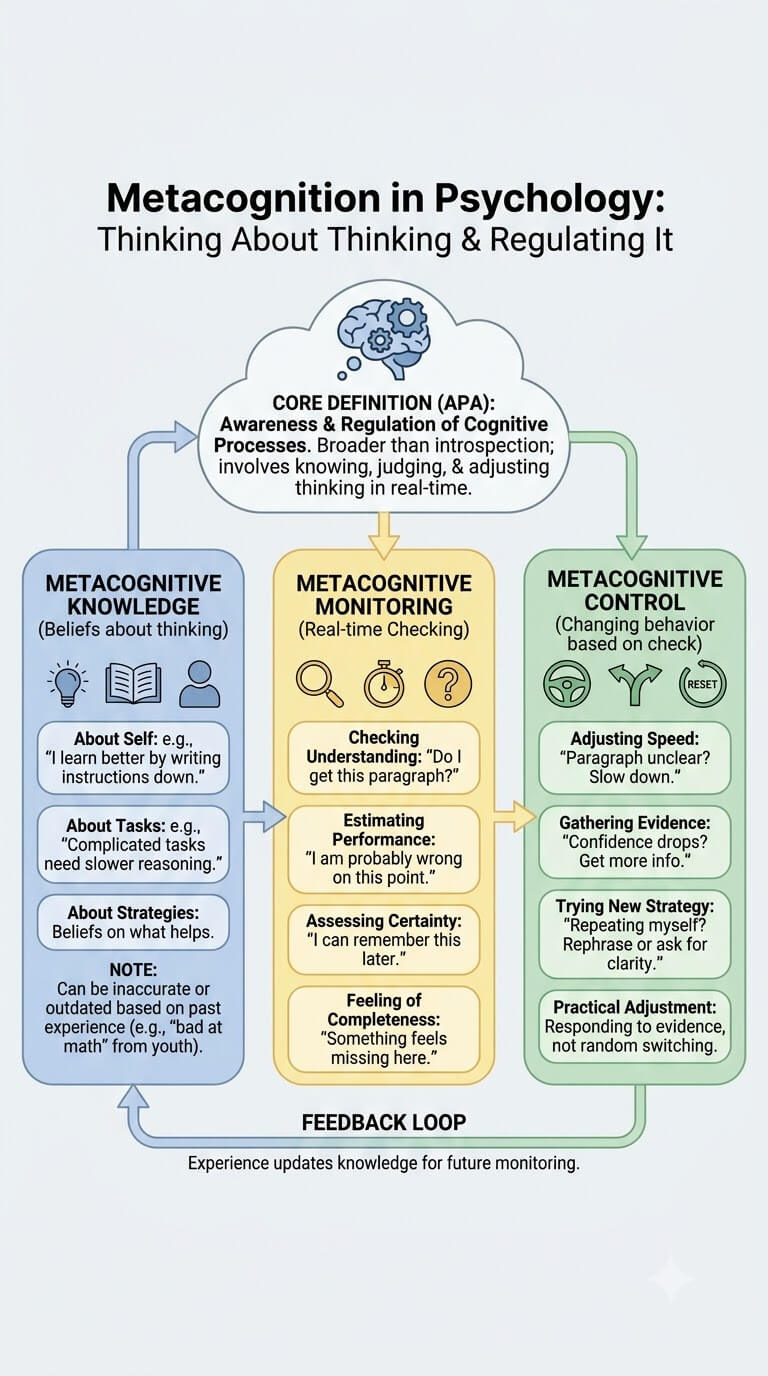
The APA Dictionary of Psychology definition of metacognition centers on awareness of one’s cognitive processes and the ability to think about or regulate them. The idea is broader than introspection. It includes knowledge about how your mind tends to work, real-time judgments about your performance, and choices based on those judgments.
Metacognitive knowledge: what you believe about your own thinking
Metacognitive knowledge is what you believe about yourself as a thinker, about different kinds of tasks, and about strategies that may help. You might know that you remember spoken instructions poorly unless you write them down. You might know that a complicated financial decision deserves slower reasoning than choosing what to eat for lunch.
A broader calibration problem appears when people overestimate what they know beyond one moment of familiarity or one specific task.
That knowledge can help without being perfectly accurate. Beliefs about memory, attention, strengths, and weaknesses come from experience and feedback, but they can become outdated. Someone who struggled with math at thirteen may still assume that numbers are “not for me” despite later evidence of competence.
Metacognitive monitoring: checking understanding, performance, and certainty
Monitoring is the act of estimating what is happening while or after you think. It includes judgments such as “I understand this,” “I am probably wrong,” “I can remember this later,” or “something about my reasoning feels incomplete.” A 2021 open-access review in npj Science of Learning describes metacognition in terms that include both knowledge about cognition and control over cognition, drawing together educational and cognitive neuroscience perspectives.
Metacognitive control: changing what you do based on that check
Control is what happens when a self-evaluation changes behavior. If you notice that a paragraph makes no sense, you slow down. If your confidence in a decision drops, you gather more evidence. If you realize you are repeating the same explanation in an argument, you try a different way of expressing the point or ask what the other person heard.
This makes metacognition practical. Awareness needs feedback, and adjustment works best when it responds to evidence rather than random strategy switching.
The Core Monitoring-and-Control Loop

John Flavell’s foundational work on metacognition and cognitive monitoring helped establish the idea that people have knowledge and experiences concerning their own cognitive activity. For everyday use, that broad idea can be turned into a three-part loop: notice the task and your state, judge the fit between your thinking and the task, then adjust what you do.
Notice the task and your current state
The first step is recognizing what kind of thinking the situation requires. Recalling a fact, learning a concept, interpreting another person, and choosing under uncertainty create different opportunities for error.
Then notice your state. You might be rushing, guessing, relying on memory, or feeling unusually certain. The point is to notice information that matters for the task, not to watch yourself constantly.
Judge how well the current approach is working
Next comes evaluation. Ask what evidence supports your impression. If you believe you understand something, can you explain it without looking at the source? If you think a conversation went badly, what exactly did the other person say or do? If you feel 90 percent certain about a prediction, have similar predictions been accurate before?
This separates a feeling about performance from performance itself. Self-evaluation becomes more useful when impressions meet feedback, observable outcomes, or a concrete test.
Adjust effort, strategy, information-seeking, or stopping
The final step is choosing a response. You may invest more effort, switch methods, ask a clarifying question, check a source, postpone a decision, or decide that the current level of certainty is sufficient. Good regulation does not always mean doing more. Sometimes the best move is to stop checking because the decision is reversible and the available evidence is already adequate.
This gives metacognition a practical rhythm: notice, test, choose. The goal is not perfect certainty. It is better calibration between what the situation demands, what you currently know, and what you do next.
Metacognition vs Cognition: Two Levels of Mental Activity

APA’s overview of cognition describes cognition as involving forms of knowing and awareness such as perceiving, remembering, reasoning, judging, imagining, and problem solving. Metacognition concerns information about those processes and the regulation of them.
First-order thinking versus second-order evaluation
| Situation | Cognition | Metacognition |
|---|---|---|
| Reading | Understanding the sentence | Noticing that you cannot explain what you just read |
| Memory | Trying to recall a name | Judging that the name is likely to come back with one more cue |
| Problem solving | Trying a solution | Recognizing that the approach is producing the same error |
| Conversation | Interpreting another person’s words | Checking whether your interpretation is based on what they said or what you expected |
| Decision | Comparing options | Estimating how confident you should be and whether more information is worth seeking |
The two levels interact but are not interchangeable. Someone can reason skillfully in one domain while still misjudging the limits of their knowledge.
This distinction becomes clearer when you look more closely at the difference between cognition and metacognition, especially the shift from doing a mental task to evaluating how that task is going.
Why cognition can happen without much conscious monitoring
Many mental processes are fast or familiar enough that we do not inspect them closely. You usually do not monitor every word while speaking or every visual assumption while walking through a room.
Metacognitive checks are most valuable at moments where an error would matter, uncertainty is meaningful, feedback is available, or the current approach is failing. That is one reason useful metacognition is selective rather than continuous.
Knowing What You Know and What You Do Not Know
One of the most useful metacognitive skills is detecting the boundary between genuine understanding and a guess, impression, or incomplete grasp.
Metacognitive awareness
Metacognitive awareness is the ability to recognize relevant features of your own thinking. It may sound like “I am relying on an assumption,” “I know the definition but cannot apply it,” or “I keep losing the thread when the explanation gets technical.” This is not the same as being generally self-aware about personality or emotions. The focus is narrower: what is happening in a cognitive process and what that means for the task.
Awareness matters because unnoticed confusion cannot easily guide correction. At the same time, awareness alone does not guarantee accuracy. You may notice uncertainty that is appropriate, or you may worry excessively about a process that is actually functioning well. The next step is to test the impression.
Self-monitoring of understanding, mistakes, and progress
Self-monitoring brings awareness into ongoing performance. A writer notices that an argument has drifted away from the main question. A cook realizes that following the recipe mechanically is not working because the pan is heating faster than expected. A manager notices that a team keeps agreeing in meetings but missing the same handoff afterward.
Planning, Checking, and Adjusting Your Thinking
Monitoring matters most when it changes what you do. Planning and adjustment turn self-observation into a practical response to the task in front of you.
Metacognitive strategies
Metacognitive strategies are deliberate ways of organizing the monitoring-and-control process. Planning may involve identifying what the task requires before starting. Monitoring may involve checking comprehension or error signals while working. Evaluation may involve comparing the outcome with the original goal and deciding what should change next time.
This is broader than study technique. The same structure can appear when preparing for a difficult conversation, troubleshooting a technical problem, or reviewing a decision. The strategy is not valuable because it sounds reflective. It is valuable if it improves the match between your reasoning and the demands of the situation.
Cognitive flexibility when the current strategy stops working
Cognitive flexibility is the ability to shift perspective, rule, or approach when circumstances change. It becomes metacognitively relevant when you first recognize that the current approach is no longer useful. That recognition might be “I am treating this as a memory problem, but it is actually an understanding problem,” or “I am defending my first interpretation even though new information changes the situation.”
Confidence, Certainty, and Miscalibration
People do not experience every belief or answer with the same certainty. Metacognition helps explain how that sense of confidence forms and why it sometimes misses the mark.
Metacognitive confidence
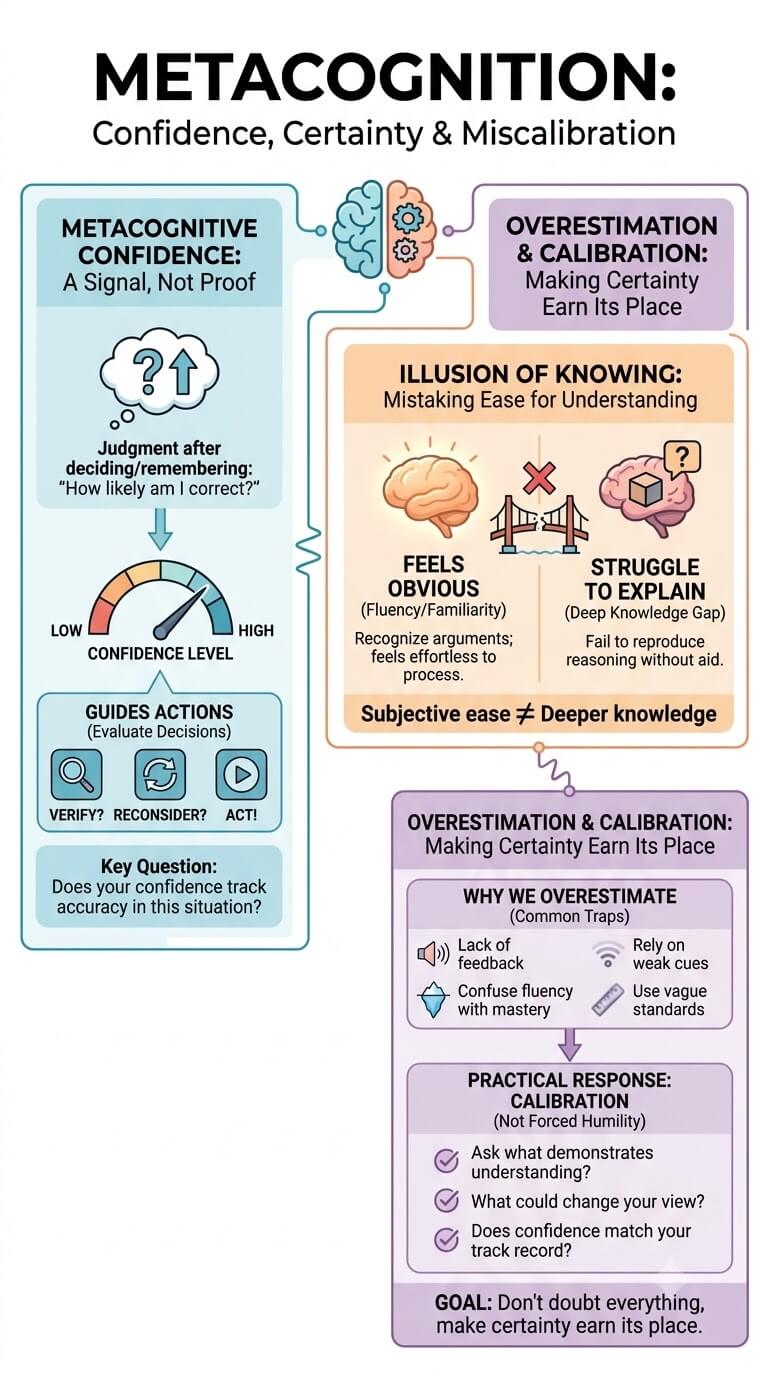
Confidence is one of the clearest everyday forms of metacognitive judgment. After deciding, remembering, or answering, you often have a sense of how likely you are to be correct. Research reviewed by Yeung and Summerfield on confidence and error monitoring in human decision-making describes how confidence judgments and awareness of errors help people evaluate their decisions.
Confidence is useful because it can guide whether to verify, reconsider, or act. But confidence is a signal, not proof. The most useful question is whether your confidence tends to track accuracy in that kind of situation.
Illusion of knowing
An illusion of knowing occurs when subjective familiarity or ease is mistaken for deeper knowledge. You may read an explanation several times and feel that it is obvious, then struggle to explain it without looking. You may recognize a person’s argument and assume you could reproduce the reasoning yourself.
Why people can overestimate what they know
Overestimation does not have one cause. People may lack feedback, rely on weak cues, confuse fluency with mastery, or use standards that are too vague.
A practical response is calibration rather than forced humility. Ask what would demonstrate understanding, what could change your view, and whether confidence matches your track record. The goal is not to doubt everything, but to make certainty earn its place.
Metacognition Across Learning and Memory
Learning and remembering both depend on judgments about what is already secure, what remains uncertain, and where more effort or support may be needed.
Metacognition and learning: judging understanding and choosing what to do next
Learning depends partly on decisions about learning. Do you keep practicing, move on, ask for feedback, revisit a concept, or try to explain it from memory? Metacognition helps generate those decisions by estimating what has been learned and where the gaps remain.
In learning, metacognitive judgments influence whether you keep practicing, test yourself, seek feedback, or decide that your understanding is strong enough to move on.
This is why simply spending more time is not the same as learning effectively. A person who can detect shallow understanding has a better chance of changing the activity before the test, presentation, or real-world task reveals the gap. The central issue here is judgment and regulation, not a list of study hacks.
Metacognition and memory: predicting and evaluating remembering
Memory brings its own self-judgments. You may predict that you will remember an appointment, feel that a forgotten name is close to retrieval, or decide that a memory is vivid enough to trust. Those judgments affect whether you set a reminder, keep searching memory, or rely on recollection.
Memory creates a related challenge because people also judge whether information will remain available later and how much confidence to place in recall.
Metacognition in Decisions Under Uncertainty
Decision-making adds a practical question to self-evaluation: not only “How sure am I?” but also “Is my current level of certainty enough to act?”
Confidence as a signal rather than proof
Everyday decisions rarely come with complete information. You choose a route, hire someone, interpret a message, make a purchase, or decide whether to speak up while uncertainty remains. Metacognition helps by attaching an estimate of reliability to the reasoning.
When to seek more information, reconsider, or act
Good decision monitoring includes a stopping rule. More information has costs: time, attention, money, and sometimes increased confusion. A high-stakes, hard-to-reverse choice may justify more checking than a low-stakes choice that is easy to correct.
Try three questions: How costly would an error be? How reversible is the choice? What new information is realistically available? Those questions turn uncertainty into a practical decision about whether further thinking is worth it.
Under uncertainty, metacognition also helps determine whether the current evidence is strong enough to act or whether another check could meaningfully improve the decision.
Which Metacognition Topic Should You Read Next?
Different metacognitive problems call for different kinds of reflection. The most useful next area depends on where your self-judgment seems to break down.
If your problem is “I do not notice when I am confused”
Look more closely at metacognitive awareness and self-monitoring. The core issue is detecting the gap between apparent progress and actual understanding. Useful checks include explaining an idea without prompts, identifying the exact step where a task becomes unclear, or comparing your prediction with the result.
If your problem is “I feel certain but may be wrong”
Metacognitive confidence and the illusion of knowing are the most relevant areas. They examine how certainty is formed and why it sometimes drifts away from accuracy. Pay attention to the cues behind your confidence: evidence, repeated success, familiarity, speed, status, or simply the feeling that the answer came easily.
If your problem is “I keep using a strategy that is not working”
Metacognitive strategies and cognitive flexibility address the transition from noticing failure to changing approach. The key challenge is often timing. Switch too late and you waste effort. Switch too early and you may abandon a sound approach simply because it feels difficult.
If your problem is “I misjudge what I will remember or learn”
Metacognition in learning and memory focuses on judgments such as “I know this,” “I will remember this,” and “I have practiced enough.” These judgments influence what you review, what you ignore, and whether you create external supports such as notes, reminders, or retrieval practice.
If your problem is “I cannot tell when I have enough information to decide”
Metacognition in decision-making examines how people monitor confidence and uncertainty before committing. The goal is not endless analysis. It is deciding whether the expected value of more information is greater than the cost of continuing to search.
Common Misunderstandings About Metacognition
Thinking about thinking is easy to oversimplify. Several common assumptions make metacognition sound either more powerful or more burdensome than it really is.
Metacognition is not constant self-analysis
Useful metacognition does not require narrating every thought. Continuous self-observation could interfere with fluent performance, especially in familiar tasks. Skilled action often depends on letting practiced processes run while reserving monitoring for moments that matter.
Confidence is not the same as accuracy
Confidence and accuracy are related in many settings, but they are not identical. A person can be correct and unsure, or wrong and confident. Calibration asks how closely confidence tracks actual performance over time.
More monitoring is not always better monitoring
Checking becomes useful when it changes a meaningful decision. Repeatedly revisiting the same conclusion without new evidence may add effort without adding information. A good check has a purpose, a criterion, and a reasonable stopping point.
Metacognition is related to executive control but is not identical to it
Executive control is a broad family of processes involved in directing attention, inhibiting responses, maintaining goals, and shifting behavior. Metacognition overlaps with regulation but emphasizes representations and judgments about one’s own cognitive processes. The concepts are connected, yet neither simply replaces the other.
Using Metacognition Without Turning It Into Overthinking
Reflection is useful when it produces information or guides action. It becomes less helpful when checking continues without a clear question, new evidence, or stopping point.
Check at useful decision points rather than continuously
Choose moments where a check could change what happens next: before committing to a high-stakes answer, after repeated errors, when a task changes, or when confidence is unusually high or low. This keeps reflection functional.
Use observable feedback when possible
Instead of asking only “Do I feel ready?” add a test. Explain the idea aloud, compare a prediction with the result, ask someone to restate what they heard, or review the outcome of a similar past decision. Feedback makes self-evaluation less dependent on mood and familiarity.
Separate reflection from self-criticism
“My approach did not work” contains useful information. “I am terrible at this” turns a specific result into a broad judgment about the self. Metacognition works better when the question stays close to the process: what happened, what evidence do I have, and what should change next?
A short self-check can help:
- What am I trying to accomplish?
- What tells me my current approach is or is not working?
- How confident am I, and what is that confidence based on?
- What is one change that would give me better information?
- When will I stop checking and act?
When Self-Monitoring Becomes Distressing
Most people second-guess themselves sometimes. The concern is not reflection itself, but whether repeated checking becomes difficult to stop or begins interfering with daily life.
Educational reflection versus compulsive checking or severe rumination
Ordinary reflection includes uncertainty, mistakes, and second thoughts. It becomes less useful when checking feels difficult to stop, repeatedly returns to the same question without new information, or consumes enough time and attention to interfere with sleep, work, relationships, or daily functioning.
That distinction cannot be made from a single habit or moment of doubt. Context, frequency, distress, and impact matter. Metacognition is a broad psychological capacity, not a diagnosis, and frequent reflection by itself does not tell you that something is clinically wrong.
When professional support may be appropriate
If repetitive checking, rumination, or fear about your own thoughts becomes severe, persistent, or disruptive, a qualified mental health professional can help assess what is happening in context. Educational reflection tools are not a substitute for individualized care.
If the issue is mild, begin with a simpler boundary: define the question you are trying to answer, decide what evidence would be enough, and give the reflection a stopping point. The purpose is to use thinking to guide action, not to make uncertainty disappear completely.
FAQ About Metacognition Psychology
These questions clarify several boundaries that often cause confusion when people first encounter metacognition.
Is metacognition the same as self-awareness?
No. Self-awareness is broader and can include awareness of emotions, values, behavior, identity, and how you affect other people. Metacognition focuses specifically on knowledge, monitoring, and regulation of cognitive processes. The two can overlap when, for example, you notice that a strong emotion is affecting how you interpret evidence.
Can metacognitive accuracy improve?
It can improve in some contexts when people compare predictions with outcomes and receive useful feedback. Improvement is often task-specific, so better calibration in one area does not guarantee equally accurate self-judgment everywhere.
Does being intelligent guarantee good metacognition?
No. Reasoning ability and self-evaluation are related but distinct. A person may solve difficult problems well yet still misjudge when they are likely to be wrong, or may be highly capable while underestimating performance.
Can metacognition be inaccurate?
Yes. People can misjudge what they know, how well they understand, how reliable a memory is, or how confident they should be. That is why calibration matters. External feedback, retrieval, explanation, prediction tracking, and outcome review can reveal gaps between subjective certainty and actual performance.
Is metacognition always conscious?
Not necessarily in a fully deliberate, verbal sense. Some self-evaluative signals, such as a vague feeling that an answer is wrong or that a memory is close to retrieval, can arise quickly. Deliberate metacognition becomes clearer when you turn that signal into an explicit judgment and decide what to do with it.
Key Takeaways
- Metacognition is the mind’s ability to represent, monitor, and regulate aspects of its own thinking.
- A useful everyday model is notice, test, choose: notice your mental state, test your impression against evidence, then choose whether to continue or adjust.
- Confidence, familiarity, and the feeling of understanding are informative cues, but none of them guarantees accuracy.
- Learning, memory, problem solving, conversations, and decisions all create different metacognitive judgments.
- Good monitoring is selective. It helps most when a check can change a meaningful decision, reveal an error, or guide a better strategy.
- If self-checking becomes repetitive, difficult to stop, or disruptive to daily life, individualized professional support may be more useful than adding more reflection.
A practical next step is to choose one recurring situation where your confidence and your results do not always match. For a week, write down what you predict, how certain you feel, and what actually happens. That small record gives you something metacognition needs in order to improve: feedback about your own judgments.

Michael Reed is the Founder and Lead Writer at Psychology Exposed. He writes about human behavior, relationships, emotional patterns, self-awareness, and practical psychology topics using research-informed, easy-to-understand content.
Read More About Michael Reed: https://psychologyexposed.com/michael-reed/