
Aging is often described as if the mind follows one simple direction: memory gets worse, social life shrinks, personality freezes, and independence disappears. Real psychological aging is far more varied. Some mental operations become slower, while knowledge and expertise may remain strong. Social circles may become smaller because people invest more selectively, not because they have failed socially. Emotional priorities can shift even while grief, illness, and stress remain real.
The psychology of aging studies this mixture of change, continuity, loss, adaptation, and compensation in later adulthood. It asks how cognition, memory, emotion, identity, relationships, goals, and everyday functioning change with age. It also helps separate common gradual variation from sudden or severe changes that deserve medical or mental health evaluation.
Quick Answer
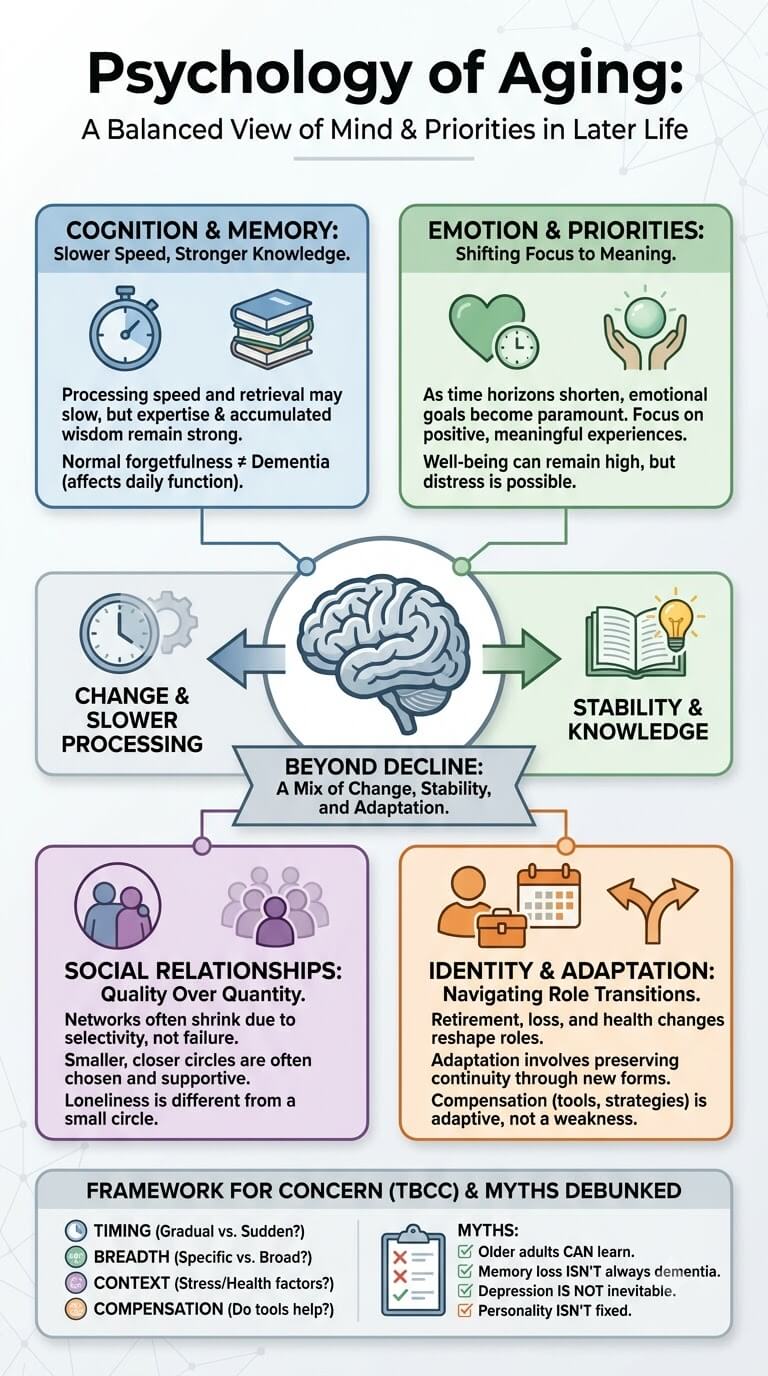
Psychological aging includes gains, losses, stability, and adaptation
Later adulthood is not a single decline curve. Different abilities and priorities follow different patterns. Some speeded cognitive operations can become less efficient, while vocabulary, accumulated knowledge, practiced skills, emotional perspective, and expertise may remain useful for many years. The National Institute on Aging overview of how aging affects thinking describes both age-related changes and areas that can remain relatively stable.
Normal aging is not the same as dementia or inevitable emotional decline
Occasional forgetfulness, slower retrieval, or needing more time with unfamiliar information can occur in normal aging. Dementia involves more substantial cognitive impairment that interferes with everyday life and has causes that require professional assessment. Emotional well-being also does not automatically worsen with age. Research on emotional aging shows considerable variation, including evidence that many older adults report strong emotional well-being.
What the Psychology of Aging Studies
Cognition and memory
Psychologists study how attention, memory, reasoning, processing speed, language, and problem-solving change in later life. The goal is not simply to measure what gets worse. Researchers also examine preserved abilities, expertise, strategy use, and ways people compensate when a task becomes more demanding.
Later adulthood is one part of the broader process of development across the lifespan rather than a separate process defined only by decline.
A person who needs more time to recall a name may still recognize the person, remember the relationship, and use context to retrieve the information later. That pattern is psychologically different from forgetting who the person is or losing the ability to manage familiar daily tasks.
Emotion and regulation
Later adulthood can bring changes in what people choose to attend to, which conflicts feel worth pursuing, and which relationships receive emotional energy. Emotion regulation may also become more selective, with people relying on experience to avoid unnecessary conflict or prioritize situations that feel meaningful.
These patterns should not be romanticized. Older adults can experience depression, anxiety, grief, trauma, loneliness, and intense stress. Age does not protect someone from psychological pain.
Identity, purpose, and adaptation
Retirement, caregiving, bereavement, health changes, relocation, financial changes, or loss of a long-held role can reshape identity. Someone who spent decades describing themselves through a profession may need a new answer to “What matters now?” after leaving work.
Adaptation often involves preserving continuity while changing the form of a valued role. A retired teacher may continue mentoring. A person with reduced mobility may preserve social connection through different routines. Development can mean changing the strategy while keeping the underlying value.
Social relationships and changing priorities
Psychologists also study how social networks, family roles, friendship, intimacy, loneliness, caregiving, and social selectivity change with age. A smaller network is not automatically a poorer network. The quality and meaning of contact often matter more than the raw number of people involved.
Cognitive Aging Is Not One Single Process
Processing speed and effortful mental operations can change
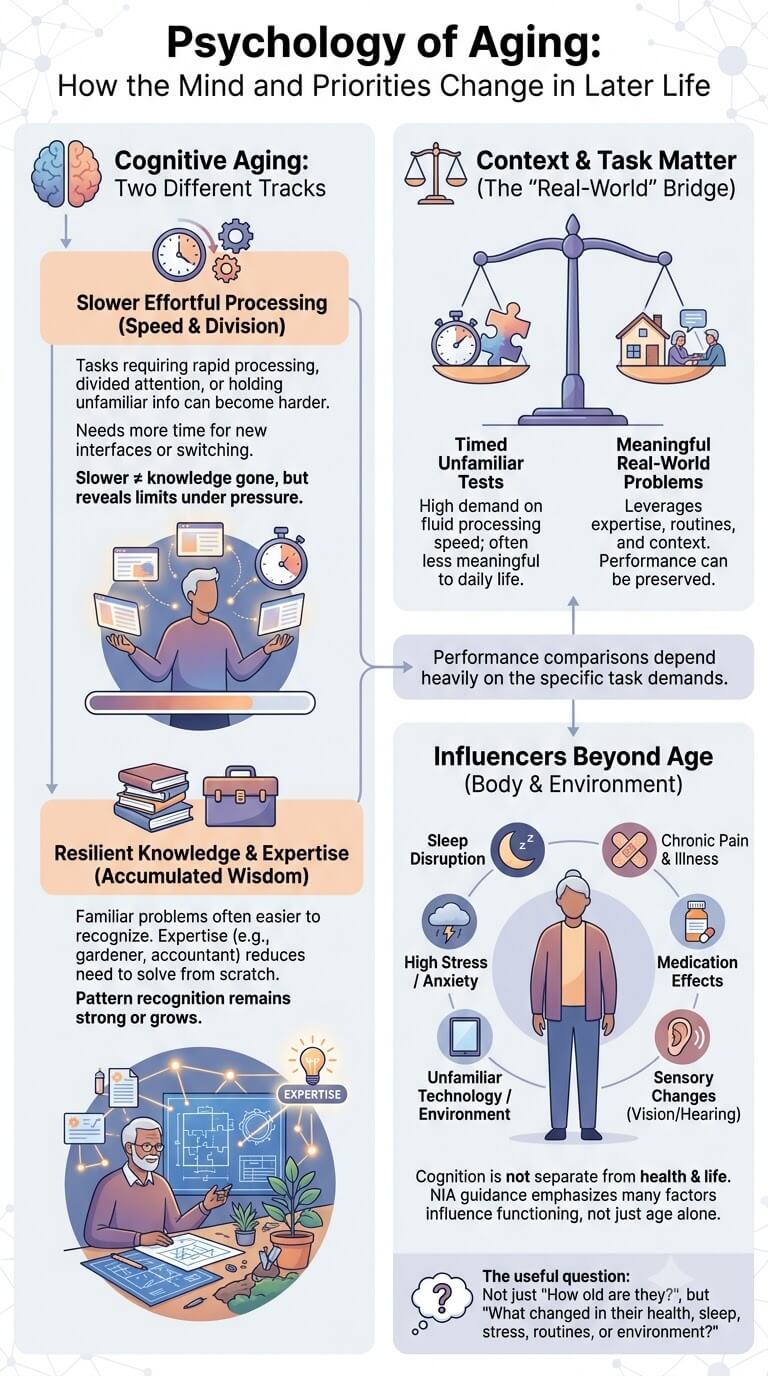
Some tasks become harder because they require rapid processing, divided attention, or holding several unfamiliar pieces of information active at once. Older adults may need more time to learn a new interface, switch quickly between tasks, or retrieve a detail under time pressure.
To understand these changes within the broader development of reasoning, control, strategy, and mental performance, see cognitive development.
Slower performance does not necessarily mean the underlying knowledge is gone. Time pressure can reveal changes that are much less noticeable in ordinary life, where people can use notes, routines, context, or extra time.
Knowledge and expertise may remain strong or grow
Accumulated knowledge can make familiar problems easier to recognize. An experienced gardener, accountant, nurse, carpenter, teacher, or business owner may notice patterns that a younger novice misses. Expertise reduces the need to solve every problem from first principles.
This is one reason age comparisons depend heavily on the task. A timed unfamiliar test and a meaningful real-world problem may place very different demands on the mind.
Strategy, health, stress, sleep, and context affect performance
Cognition does not operate separately from the body or environment. Sleep disruption, pain, hearing or vision changes, medication effects, depression, anxiety, illness, unfamiliar technology, and high stress can all affect cognitive performance. The NIA guidance on cognitive health in older adults emphasizes that cognitive functioning is influenced by many health and lifestyle factors rather than age alone.
When someone appears more forgetful or confused, the useful question is not only “How old are they?” It is also “What changed in the person’s health, sleep, stress, medication, senses, routines, or environment?”
Memory Changes in Later Adulthood
Normal everyday lapses versus persistent functional problems
Forgetting where you placed your glasses, taking longer to recall a name, or occasionally missing an appointment can happen at many ages and may become more common later in life. The National Institute on Aging guide to forgetfulness and aging distinguishes mild age-related forgetfulness from more serious memory problems that interfere with everyday functioning.
The pattern matters. A single lapse is weak evidence. Repeatedly getting lost in familiar places, being unable to manage previously routine finances, rapid worsening, or major changes in everyday independence raise a different level of concern.
Why retrieval can feel slower even when knowledge remains available
Sometimes the information is still stored but less quickly accessible. A name may arrive ten minutes after the conversation. A word may feel “on the tip of the tongue.” Extra cues or context can help retrieval.
This is different from losing the underlying concept. If someone cannot retrieve a person’s name immediately but knows who they are, how they met, and what they discussed last week, much of the relevant knowledge remains available.
Memory Psychology is the deeper home for memory systems
Later-life memory includes working memory, autobiographical memory, semantic knowledge, prospective memory, retrieval, and many other processes. Each can follow a different pattern. A broad aging article can explain the context, but a dedicated memory lens is better for understanding how encoding, storage, retrieval, and memory bias work across ages.
Emotional Life in Later Adulthood
Emotional goals and priorities can shift
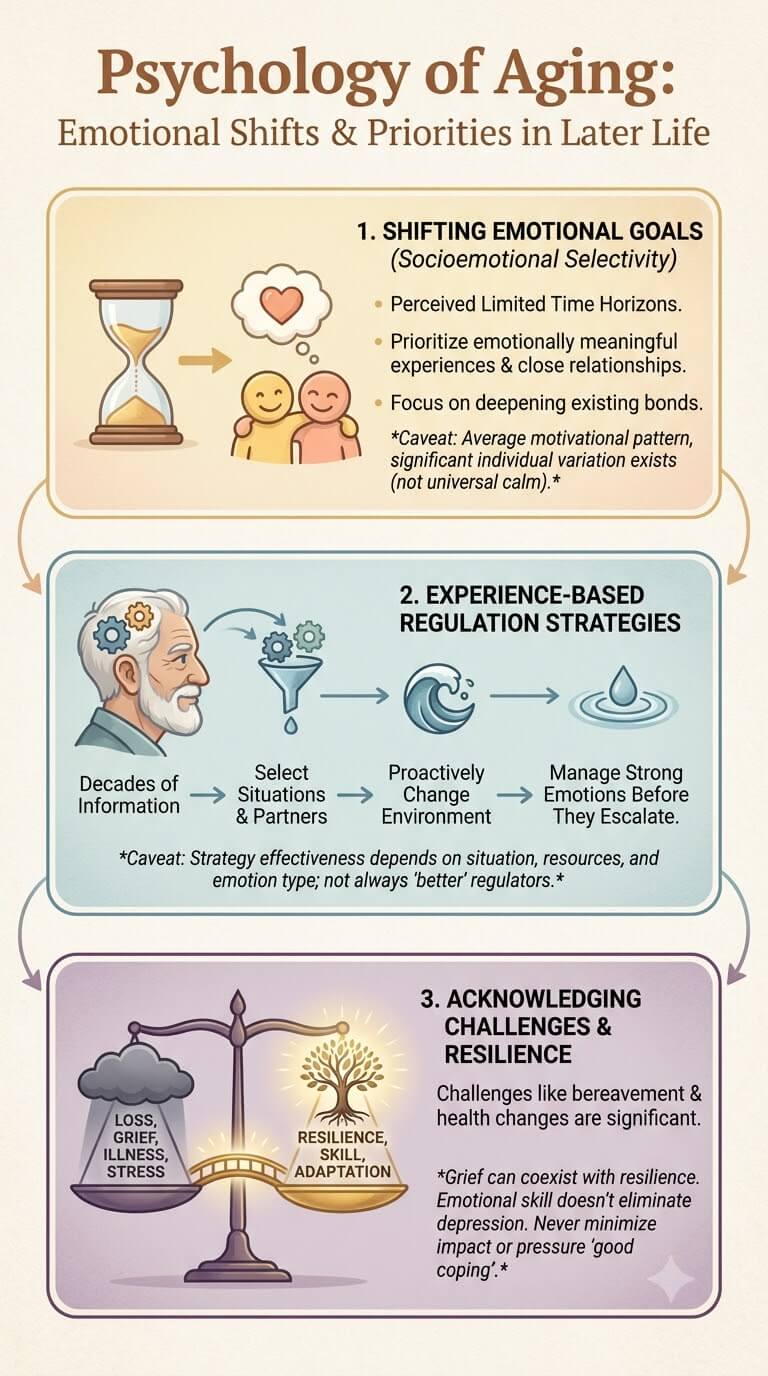
As people become more aware that time is limited, they may place greater value on emotionally meaningful experiences and relationships. Socioemotional selectivity theory proposes that perceived time horizons influence which goals people prioritize. A review of socioemotional selectivity theory and perceived time discusses how emotional meaning can become more important as time horizons change.
Later-life emotion is also part of the longer process through which people build and adapt emotional skills across development.
This does not mean every older adult becomes calm, positive, or relationship-focused. It describes an average motivational pattern with substantial individual variation.
Experience can support more selective regulation strategies
Older adults have decades of information about which situations are worth entering, which conflicts tend to escalate, which people are supportive, and which strategies work for them. That experience can support regulation by changing the environment before strong emotion becomes difficult to manage.
A review of emotion regulation in older adulthood cautions against the simple claim that older adults are always better emotion regulators. Strategy use and effectiveness depend on the situation, available resources, and type of emotion.
Loss, grief, illness, and stress still matter and should not be minimized
Later life can include bereavement, health changes, caregiving strain, reduced mobility, financial stress, discrimination, or loss of familiar roles. Positive emotional-aging findings should never be used to tell someone they “should” be coping well because they are older.
Grief can coexist with resilience. Emotional skill can coexist with depression. Adaptation does not require pretending a loss is small.
Social Priorities and Relationships
Smaller networks do not automatically mean social failure
Social networks often become smaller across adulthood. Some reductions reflect loss or barriers, but others reflect selectivity. Research on socioemotional selectivity suggests that a smaller network can contain a higher proportion of emotionally meaningful relationships.
Changing social networks and priorities are easier to interpret within the broader process of social development.
The number of contacts is therefore a poor standalone measure of social health. Someone with three close, reliable relationships may feel better connected than someone with twenty superficial contacts.
Selectivity, closeness, and meaningful contact
Older adults may become less interested in maintaining relationships that feel chronically unrewarding or conflict-heavy. They may invest more in family, long-term friends, neighbors, community groups, faith communities, volunteering, or chosen relationships that carry history and meaning.
Selectivity is not the same as withdrawal. The key difference is whether the smaller social world feels chosen and supportive or unwanted and isolating.
Loneliness is different from choosing a smaller circle
Loneliness refers to a painful gap between desired and actual connection, while social isolation concerns limited social contact or support. A person can live alone without feeling lonely, or feel lonely while surrounded by people. The National Institute on Aging information on loneliness and social isolation explains that older adults can face increased risks because of health changes, mobility limitations, sensory loss, or loss of family and friends.
Support should therefore respond to the person’s experience rather than assuming every older adult needs a larger social calendar.
Identity, Roles, and Adaptation to Change
Retirement, caregiving, bereavement, health, and role transitions
Roles organize daily life. They provide routines, social contact, competence, status, responsibility, and meaning. When a role ends or changes, several psychological functions can change at once.
Retirement, caregiving, loss, health changes, and new roles can also reopen questions explored more deeply in identity development.
Retirement may feel freeing to one person and disorienting to another. Caregiving can deepen purpose while reducing autonomy. Bereavement can alter not only companionship but also identity, routines, finances, and future expectations.
Preserving continuity while roles change
Adaptation becomes easier when people identify what the old role represented. Was work important because of mastery, social contact, structure, service, recognition, or income? The replacement does not need to look identical if it preserves the function that mattered.
A retired manager who valued mentoring may find continuity through volunteering. A person who can no longer travel independently may preserve curiosity through local learning or virtual communities. Continuity is psychological, not merely behavioral.
Compensation: changing the strategy when the old method is less effective
Compensation means using another route to preserve functioning or a valued goal. Examples include calendars, medication organizers, written instructions, hearing aids, better lighting, simplified routines, transportation support, or moving frequently used items to easier locations.
Research on research on compensation strategies in older adults describes how people use behavioral and environmental supports to maintain daily functioning. Using tools is not a sign that development has failed. Often it is evidence of adaptive problem-solving.
Psychology of Aging vs Adult Development

Adult development covers the broader adult lifespan
Adult development examines change from early adulthood through later life. It includes changing goals, identity, work, relationships, expertise, caregiving, personality, and adaptation across several decades.
Aging focuses on later-life changes, adaptation, and age-related context
The psychology of aging narrows the lens to later adulthood, where cognitive change, health context, retirement, bereavement, social selectivity, compensation, and changing time perspective may become more relevant.
For a broader explanation of how later adulthood fits within flexible lifespan periods, see stages of development.
The boundary is gradual rather than a single birthday
There is no psychological switch that activates at sixty-five. Retirement age, health, work, family roles, culture, and individual functioning vary widely. The useful boundary is the developmental context, not an exact number.
Common Myths About Aging Psychology
Older adults cannot learn new things
Older adults can learn new skills and information. Learning may require more repetition, time, or structured support in some tasks, especially when information is unfamiliar or rapidly presented. That is different from being unable to learn.
Experience can also make learning more efficient when new information connects to existing knowledge.
Memory loss is always dementia
Normal aging can involve mild forgetfulness and slower retrieval. Dementia is not a normal or inevitable consequence of aging. What matters is the degree, progression, breadth of change, and impact on daily functioning.
People inevitably become lonely or depressed
Later life can include risk factors for loneliness and depression, but neither is an inevitable part of aging. Social meaning, health, mobility, loss, resources, and individual circumstances all matter. Some older adults report strong emotional well-being and meaningful relationships.
Personality becomes completely fixed
Personality has meaningful stability, but adults can continue changing habits, goals, relationships, coping strategies, and even aspects of trait expression. Later-life adaptation often requires flexibility rather than psychological rigidity.
A Practical Framework for Understanding a Change

When a later-life change raises concern, use four questions: Timing, Breadth, Context, Compensation. This framework cannot diagnose a condition, but it helps separate ordinary variation from patterns that deserve closer evaluation.
Timing: Is the change gradual or sudden?
Gradual changes over years often raise different questions from confusion or functional decline that appears over hours, days, or weeks. Sudden change can reflect medical problems, medication effects, infection, injury, or other urgent causes and should not be dismissed as “just aging.”
Breadth: Is it specific to one task or broad across daily life?
Difficulty learning one new phone application is different from becoming unable to manage multiple previously familiar activities. A narrow problem may reflect task design, unfamiliarity, sensory demands, or limited practice. Broad decline carries more concern.
Context: What role do sleep, stress, health, medication, and environment play?
Look for recent changes in sleep, pain, mood, hearing, vision, medication, alcohol use, illness, bereavement, isolation, or environmental complexity. These factors can affect attention and memory without telling you the underlying cause.
Compensation: Is external support helping?
Notice whether a calendar, written instructions, better lighting, quieter environment, extra time, or routine restores good functioning. Effective compensation suggests that the person can still use strategies to manage the task, although it does not rule out a health concern if other warning signs are present.
| Question | Less concerning pattern | More concerning pattern |
|---|---|---|
| Timing | Slow, mild change over years | Sudden confusion or rapid worsening |
| Breadth | Difficulty with one unfamiliar task | Multiple previously familiar daily tasks become difficult |
| Context | Performance worsens mainly when tired, stressed, or rushed | Change persists broadly regardless of context |
| Compensation | Simple tools restore effective functioning | Tools no longer support basic safety or independence |
Supporting Psychological Adaptation Without Infantilizing
Preserve autonomy and choice
Offering support should not automatically mean taking control. Older adults differ widely in ability, preference, and risk. Ask what help is wanted, explain concerns clearly, and preserve decision-making wherever possible.
Speaking about an older adult as if they are absent, simplifying every choice without need, or assuming incompetence based on age can reduce dignity and autonomy.
Use tools and environments that reduce unnecessary cognitive load
Good design benefits everyone. Clear labels, predictable locations, written instructions, medication systems, calendars, adequate lighting, hearing support, and fewer unnecessary steps can make daily tasks easier without lowering meaningful independence.
Support meaningful connection without assuming more contact is always better
Ask what kind of connection the person values. One older adult may want frequent group activity. Another may prefer a few close relationships and regular quiet time. Support should target unwanted isolation or loneliness, not force a socially “busy” lifestyle as proof of healthy aging.
How Aging Connects With Other Areas of Psychology
When the question is primarily cognitive or memory-based
If the main issue is how memories are encoded, retrieved, distorted, or supported by working memory, a memory-specific lens is more precise. Cognitive development can also help explain how reasoning and mental control change across the lifespan.
When the question is about roles, relationships, or adaptation
Adult development is the broader home for changes in work, caregiving, identity, relationships, and goals across adulthood. Emotional development helps explain changes in emotional understanding and regulation, while social development provides a deeper lens on social roles, belonging, and relationship priorities.
When Changes Need Professional Evaluation
Sudden confusion, rapid decline, safety problems, or major functional changes
Sudden confusion, rapid cognitive worsening, repeated falls linked to confusion, getting lost in familiar places, inability to manage medication or finances, or major new safety problems require medical attention rather than an aging explanation. The cause may be treatable, urgent, or unrelated to a neurodegenerative condition.
Persistent depression, severe anxiety, self-neglect, abuse, financial exploitation, or imposed isolation
Depression and severe anxiety are not inevitable parts of aging. Persistent distress, self-neglect, suicidal thoughts, abuse, neglect, financial exploitation, coercive control, or deliberate isolation by another person deserves qualified support.
Older adults can be especially vulnerable when they depend on someone for housing, transportation, money, medication, or personal care. Safety and dignity should take priority over preserving appearances or avoiding conflict.
FAQ About the Psychology of Aging
What psychological changes are normal with aging?
Normal aging can include slower processing, more effortful retrieval, changes in attention under complex conditions, shifting emotional priorities, and greater selectivity in social relationships. Knowledge, expertise, personality continuity, and many everyday skills can remain strong. There is large individual variation, so age alone does not predict a person’s functioning.
Is forgetfulness always a sign of dementia?
No. Mild forgetfulness and slower retrieval can occur with normal aging. Concern increases when memory problems become persistent, worsen rapidly, affect several areas of daily life, create safety problems, or reduce independence. A qualified medical assessment is needed to determine the cause.
Can emotional well-being improve with age?
For many people, emotional priorities and regulation strategies change in ways that support well-being, and research often finds relatively positive emotional experience in older adulthood. This is an average pattern, not a guarantee. Grief, depression, anxiety, trauma, illness, and social adversity remain important at every age.
Why do social circles sometimes become smaller in later life?
Networks can shrink because of retirement, relocation, health, mobility changes, or loss. They can also become smaller because people invest more selectively in emotionally meaningful relationships. A smaller network is not the same as loneliness. The important question is whether the level of connection matches what the person wants and needs.
Can older adults still learn and change?
Yes. Older adults can learn new information, develop skills, change routines, form relationships, revise goals, and adapt to new roles. Some forms of learning may take more time or benefit from repetition and external support, but psychological development does not stop simply because a person reaches later adulthood.
Key Takeaways
- Psychological aging includes change, stability, loss, growth, and adaptation rather than one uniform decline.
- Cognitive aging is multidimensional. Slower speed or retrieval can coexist with strong knowledge, expertise, and effective strategy use.
- Memory lapses are not automatically dementia. Timing, breadth, functional impact, and progression matter.
- Older adults may become more selective about emotional and social priorities, and a smaller social network does not automatically mean loneliness.
- Compensation through tools, routines, environmental changes, and support can preserve autonomy and functioning.
- Sudden confusion, rapid decline, severe distress, major functional change, abuse, exploitation, or imposed isolation deserves qualified attention.
If a later-life change concerns you, avoid starting with the label “old age.” Start with the pattern. Ask when the change began, how broad it is, what context makes it better or worse, and whether practical supports restore functioning. That approach respects both the reality of aging and the individuality of the person experiencing it.
Educational note: Psychology Exposed provides general, research-aware education about later-life psychological development. It cannot diagnose dementia, depression, anxiety, or other medical or mental health conditions and does not replace individualized professional evaluation.
About the author: Michael Reed is the Founder & Lead Writer at Psychology Exposed. He explains human behavior, emotional patterns, relationships, self-awareness, and everyday psychology in clear, practical language for general readers.

Michael Reed is the Founder and Lead Writer at Psychology Exposed. He writes about human behavior, relationships, emotional patterns, self-awareness, and practical psychology topics using research-informed, easy-to-understand content.
Read More About Michael Reed: https://psychologyexposed.com/michael-reed/