

Developmental stage charts are appealing because they turn a complicated lifespan into a sequence that looks easy to follow. Childhood comes first, adolescence follows, adulthood arrives, and later life seems to complete the picture. The problem begins when the chart is treated like a timetable that every person is supposed to match.
Psychological development is more variable than that. People can show rapid change in one area, gradual change in another, and long stretches of relative stability in a third. A stage model can still be useful, but only when it helps organize questions rather than judge a person by a birthday. The most useful question is usually not, “What stage should this person be in?” It is, “What kind of change are we trying to understand, and what does age actually tell us about it?”
Quick Answer

Stages of development in psychology are broad ways of organizing change across the lifespan. They help describe common periods such as childhood, adolescence, adulthood, and later life, but they are not exact psychological deadlines. Some changes appear stage-like, while others unfold gradually. Age provides context, but development also depends on experience, relationships, culture, opportunity, health, and the specific ability being considered.
Stages are organizing models, not exact psychological deadlines
A developmental stage is best understood as a model for grouping changes that often become especially relevant during a period of life. The wider field of developmental psychology studies change from conception through old age, including the many biological, psychological, social, cultural, and environmental influences that shape development.
That broad definition matters because no single stage label can describe everything happening inside a person. “Adolescence,” for example, can tell you that autonomy, identity, peer relationships, and changing responsibilities are often important. It cannot tell you exactly how reflective, emotionally regulated, socially confident, or independent one particular teenager will be.
Development can be both gradual and stage-like
Some changes look gradual when measured closely. Vocabulary may expand over years. Social judgment can become more nuanced through repeated experiences. A person may slowly become better at planning, regulating emotion, or balancing competing roles.
Other changes can feel more stage-like because a new demand reorganizes daily life. Starting school, entering adolescence, leaving home, becoming a caregiver, retiring, or adapting to physical changes can create a noticeable shift in what a person must manage. The transition may be real even when the underlying psychological capacities developed gradually.
What a Developmental Stage Means in Psychology
Stage language is useful only if we are clear about what is being grouped together. Three ideas are often mixed up: an age period, a developmental task, and a psychological capacity.
These age periods make the most sense when viewed within the broader process of development across the lifespan rather than as isolated checkpoints.
Age period, developmental task, and psychological capacity are different ideas
An age period is a broad stretch of the lifespan, such as early childhood or later adulthood. A developmental task is a challenge that often becomes important during that period, such as learning to function more independently or adapting to changing roles. A psychological capacity is an ability, such as perspective-taking, planning, emotional regulation, or memory.
| Idea | What it describes | Example |
|---|---|---|
| Age period | Where someone broadly sits in the lifespan | Adolescence |
| Developmental task | A challenge or transition that often becomes important | Negotiating more autonomy |
| Psychological capacity | An ability used to handle tasks and situations | Considering long-term consequences |
These categories overlap, but they should not be treated as interchangeable. A person can enter a new age period before fully developing a capacity needed for one of its common tasks. Someone can also build a capacity earlier because their environment gives them more opportunity to practice it.
Why researchers use stages despite individual variation
Human development is too complex to understand as a single stream of unrelated events. Stages provide structure. They allow researchers and readers to ask what tends to become more likely, more demanding, or more socially important during a certain part of life.
The value is probabilistic, not absolute. A stage can highlight a pattern worth examining without claiming that everyone reaches the same point at the same age. Good stage thinking helps you notice common developmental pressures while leaving room for different routes through them.
A Practical Lifespan Map
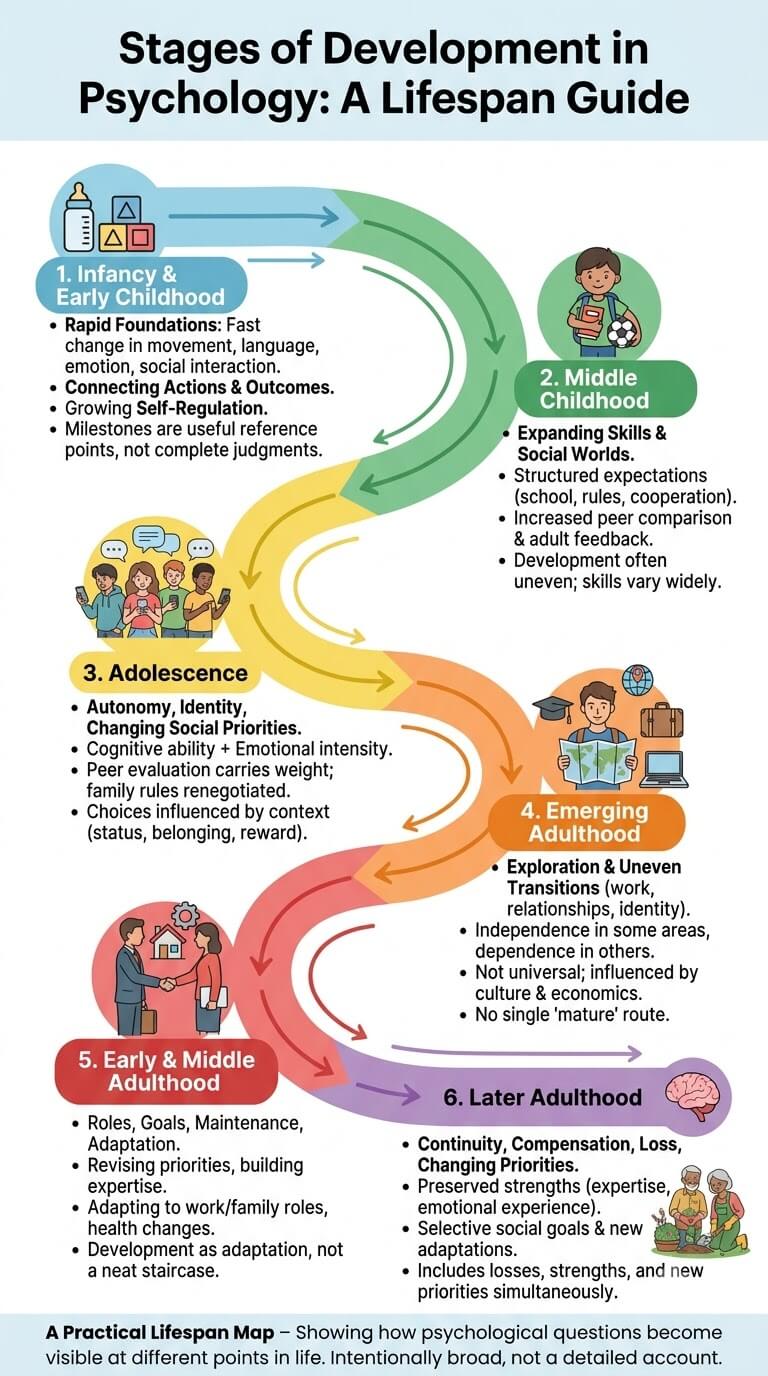
The following map is intentionally broad. It does not replace a detailed account of any age period. Its purpose is to show why different psychological questions become more visible at different points in life.
Infancy and early childhood: rapid foundations
Early life involves unusually fast change in movement, language, attention, memory, emotion, and social interaction. Children increasingly connect actions with outcomes, understand words and symbols, participate in shared routines, and rely on other people while gradually gaining more self-regulation.
Milestones can help describe common skills, but they should not be confused with a full stage theory. The CDC developmental milestone guidance describes milestones as things most children can do by certain ages. That makes them useful reference points, not complete judgments about a child’s psychological development.
Middle childhood: expanding skills and social worlds
School-age children often face more structured expectations for attention, learning, rule-following, cooperation, friendship, and independent problem-solving. Their world expands beyond the immediate family, so comparison with peers and feedback from teachers or other adults can become more influential.
Development during this period is often uneven. A child may read far above grade level while still needing help with frustration. Another may be socially confident but slower to organize multi-step tasks. A stage label should make these differences easier to interpret, not erase them.
The broad childhood period contains several interacting psychological changes, explored together in our guide to child development.
Adolescence: autonomy, identity, and changing social priorities
Adolescence brings new combinations of cognitive ability, emotional intensity, social awareness, identity exploration, and pressure to make increasingly independent choices. Peer evaluation can carry more weight, while family rules may be renegotiated as the young person seeks greater autonomy.
Adolescence deserves its own context because autonomy, peers, identity, and decision-making all change together during adolescent development.
This period is often oversimplified as a stage of irrationality. A better view is that growing capacities are being used in situations with changing rewards, responsibilities, and social stakes. A teenager may reason carefully in a calm setting and make a different choice when status, belonging, embarrassment, or immediate reward becomes central.
Emerging adulthood: exploration and uneven role transitions
For some people, the transition out of adolescence includes a period of exploration in work, relationships, identity, education, and living arrangements. Independence may grow in one area while remaining limited in another. Someone may make their own daily decisions but still depend on family financially, or hold a full-time job while feeling uncertain about long-term direction.
This pattern is not universal. Economic conditions, family structures, culture, educational systems, and social expectations strongly influence whether such a period is recognizable at all. Stage language should never imply that a particular route into adulthood is the only mature one.
Early and middle adulthood: roles, goals, maintenance, and adaptation
Adult development often receives less attention because the changes may not look as dramatic as childhood milestones. Yet adults continue to revise priorities, build expertise, adapt to work and family roles, maintain relationships, respond to health changes, and rethink commitments.
A person in midlife may not be entering a new “level” of psychology. They may instead be solving a new combination of problems with accumulated skills, habits, values, and constraints. This is one reason adult development often looks more like adaptation than a neat staircase.
Later adulthood: continuity, compensation, loss, and changing priorities
Later life includes both change and continuity. Some cognitive processes may become less efficient, while knowledge, expertise, emotional experience, and practiced strategies can remain strong. Social goals may become more selective, and changing health or roles can require new forms of adaptation.
The National Institute on Aging’s information on brain health notes that aging brings natural brain changes that can affect memory, learning, and other cognitive functions. This is another reason a stage should not be reduced to one direction of change. Later adulthood can include losses, preserved strengths, compensation, and new priorities at the same time.
Stage Models vs Continuous Development

One of the oldest tensions in developmental thinking is whether change happens in distinct steps or as a more continuous process. Everyday life gives reasons to take both possibilities seriously.
What stage models capture well
Stage models are helpful when several changes gather around a transition and reorganize what matters. Entering school, adolescence, parenthood, or retirement can alter routines, expectations, relationships, and decisions at once. Even if underlying abilities changed gradually, the new context can produce a recognizable before-and-after experience.
Stages also help organize communication. Saying “adolescence” quickly points to a set of likely developmental questions that would be awkward to list every time. The label becomes useful shorthand as long as shorthand is not mistaken for a complete explanation.
What gradual-change models capture well
Continuous models fit abilities that improve through repeated practice, accumulated knowledge, or slowly changing regulation. Language, expertise, social judgment, and many forms of self-control often develop through many small adjustments rather than one sudden shift.
Gradual models also fit the reality that two people can reach similar outcomes by different routes. One person may gain independence through early work experience, another through education, another through caregiving responsibilities. The psychological skill can develop without a single universal transition point.
Why both perspectives can be useful at once
A useful way to reconcile the two views is to separate the underlying change from the life demand that reveals it. A capacity may grow continuously, while a new situation makes that capacity suddenly more important. Planning may improve gradually, for example, but moving away from home can expose whether someone can use planning across money, meals, time, appointments, and work.
Lifespan research often emphasizes that development includes gains, losses, stability, and adaptation rather than one universal direction. A peer-reviewed open-access discussion of adaptation across the lifespan highlights why age-specific snapshots alone cannot capture the full developmental process. Thinking in both periods and processes gives a more realistic picture.
Different Domains Do Not Move in Lockstep
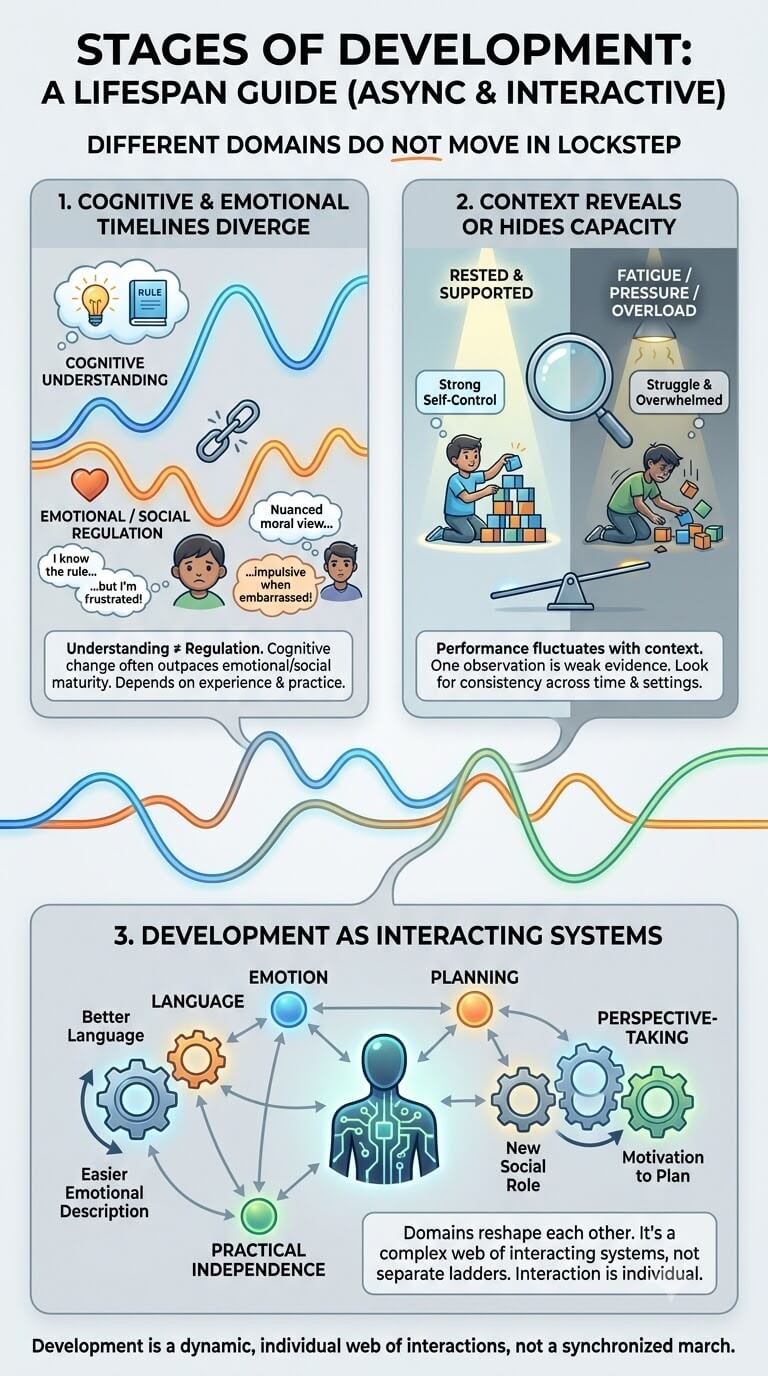
A major reason stage charts are easy to overread is that they make development look synchronized. Real people are less tidy. Cognitive, emotional, social, and practical capacities can develop on different timelines.
Cognitive change can outpace emotional or social change
A child may understand a rule but still struggle to follow it when frustrated. A teenager may explain a moral dilemma with impressive nuance yet react impulsively when embarrassed in front of friends. An adult may be highly skilled at work but inexperienced in handling conflict within a new caregiving role.
These examples do not mean one domain is “behind” in a simple sense. Different capacities depend on different experiences, pressures, and opportunities to practice. Intellectual understanding is not identical to emotional regulation, and social confidence is not identical to practical independence.
Context can reveal or hide a capacity
Performance changes with context. A person may show strong self-control when rested and supported, then struggle under fatigue, fear, overload, or social pressure. A child may speak freely at home but become quiet in an unfamiliar group. An older adult may remember well in a calm environment but struggle when rushed through several instructions at once.
That is why one observed behavior is weak evidence for assigning a developmental level. The better question is whether the capacity appears across time, settings, and levels of demand.
Development in one domain can reshape another
Domains also interact. Better language can make emotional experiences easier to describe. Stronger perspective-taking can change friendships. Greater practical independence can reshape identity. A new social role can create motivation to develop planning or communication skills that were previously less important.
Development therefore looks less like separate ladders and more like interacting systems. A stage label can tell you which systems may be under new pressure, but it cannot tell you how the interaction will unfold for one person.
How to Read a Developmental Stage Chart Without Overinterpreting It
A chart is most useful when it prompts better observation. Use it as a map for questions, not as a scorecard.
Treat age ranges as context, not verdicts
Age ranges summarize patterns across groups. They do not prove what one person should be able to do on a particular birthday. Even formal age categories differ across theories because different researchers are trying to explain different kinds of change.
If a chart says that a capacity commonly becomes more visible during a period, read that as “this is often worth noticing here,” not “everyone must show this now.”
Look for patterns across time instead of one isolated behavior
Suppose a normally independent twelve-year-old asks a parent to handle something they usually manage alone after a stressful day. That one moment does not prove regression. If the same difficulty appears repeatedly across weeks, settings, and tasks, it provides more useful developmental information.
The same rule applies in adulthood. One forgotten appointment, one emotional argument, or one hesitant decision does not establish a stage-related decline. Patterns are more informative than isolated moments.
Separate expected variation from meaningful concern
Variation is expected. Meaningful concern is more likely when a difficulty is persistent, appears across settings, interferes substantially with everyday functioning, or involves loss of abilities that were previously established.
| Observation | A cautious interpretation | What to notice next |
|---|---|---|
| A skill appears later than a chart suggests | There may be normal variation, different opportunity to practice, or a concern worth checking | Look at progress over time and functioning across settings |
| A person performs differently under stress | Context may be reducing access to an existing skill | Compare calm and high-demand situations |
| A previously reliable skill disappears | This deserves more attention than simple timing variation | Note onset, breadth, functional impact, and seek qualified evaluation when appropriate |
Stage Models and the Most Common Misunderstandings
Many mistakes come from turning a descriptive model into a hierarchy. Development is not a competition to reach a final state as early as possible.
Later is not automatically worse
A person may take longer to become confident in a role because they had fewer chances to practice it, because the role carries different cultural expectations, or because other responsibilities took priority. Timing by itself says little about character, effort, or long-term potential.
It is more useful to ask whether growth is occurring and whether the current level of functioning matches the demands that matter in the person’s real environment.
Earlier is not automatically better
Showing a skill early can be positive, but earlier timing does not guarantee maturity across other areas. A child who reads early is not necessarily ahead socially. A teenager who takes on adult responsibilities early may have strong practical skills while still needing age-appropriate support.
“Advanced” in one domain should not become a reason to expect adult-level regulation, judgment, or independence everywhere else.
Regression under stress does not erase prior development
People sometimes use simpler coping strategies when demands exceed their current resources. A child may become clingier during a major transition. An adult may seek more reassurance after a frightening health event. Temporary dependence or emotional reactivity does not automatically mean development has reversed.
The important distinction is between a context-linked change that improves as pressure decreases and a broader loss of abilities or functioning that persists.
Culture changes the timing and meaning of many transitions
Ideas such as independence, adulthood, family obligation, emotional expression, and appropriate social behavior are partly shaped by culture. The APA Dictionary’s sociocultural perspective emphasizes the role of social interaction and cultural context in development.
A person who remains closely involved with family in adulthood may be functioning exactly as expected within their social world. A stage model becomes misleading when it turns one culture’s preferred timeline into a universal psychological standard.
When the Better Question Is About a Specific Process
Sometimes an age-stage question is too broad to be useful. If you know what ability or difficulty you are trying to understand, a process-focused view usually gives a clearer answer.
If the concern is how people become better able to understand, express, and regulate feelings, the more useful focus is emotional development.
Choose cognitive development for reasoning and problem-solving
If the real question is how someone thinks through problems, shifts strategies, uses working memory, or handles abstract ideas, age is background information. The main issue is cognitive development. This helps separate “What age period are they in?” from “What kind of thinking does this task require?”
Choose emotional or social development for regulation and connection
If the concern involves recognizing feelings, managing strong emotion, understanding another person’s perspective, cooperating, or building friendships, the more useful lens may be emotional or social development. A single stage label can hide the exact capacity that needs attention.
Choose an age-period article for childhood, adolescence, adulthood, or aging
If several processes are changing together and the age context itself is central, then an age-period view makes sense. Childhood, adolescence, emerging adulthood, broader adulthood, and later life each bring distinctive combinations of demands. The key is to use the period as context rather than a verdict on maturity.
A First-Step Framework for a Developmental Question

When a stage chart leaves you with more confusion than clarity, use three lenses: period, domain, and pattern. This keeps age in the picture without letting age do all the explanatory work.
Identify the age period
First, identify the broad life period and the demands that commonly come with it. A school-age child may be expected to manage classroom routines. An adolescent may be negotiating autonomy. A new adult may be handling more independent decisions. An older adult may be adapting to changes in health, work, or social roles.
This step provides context. It does not decide whether the behavior is expected or concerning.
Identify the psychological domain
Next, name the capacity involved. Is the issue reasoning, attention, memory, emotional regulation, perspective-taking, identity, social understanding, or practical independence? A clear domain prevents vague statements such as “not mature for their age,” which often combine several very different abilities.
For example, someone might understand consequences clearly but struggle with emotional regulation under conflict. Another person might regulate emotion well but lack experience with financial planning. Those are different developmental questions.
Identify whether the concern is change, delay, context, or loss of function
Finally, classify the pattern. Is a new capacity gradually emerging? Does a skill appear later than expected? Does the person have the skill but lose access to it in certain contexts? Or has a previously established ability declined or disappeared?
| Pattern | Core question | Example |
|---|---|---|
| Change | What new ability is emerging? | A child begins considering two viewpoints in a disagreement. |
| Timing difference | Is progress occurring on a different timetable? | A skill appears later than a broad reference range. |
| Context effect | Is the ability present but harder to use under certain demands? | An adolescent plans well alone but acts impulsively under intense peer pressure. |
| Loss of function | Has an established ability meaningfully declined? | An adult suddenly struggles with everyday tasks they previously managed reliably. |
This three-part check is more informative than assigning someone to a higher or lower stage. It turns a label into a concrete question that can guide observation and, when necessary, a conversation with a qualified professional.
When Developmental Timing Raises a Real Concern
Stage and milestone information should not be used to diagnose someone. It can, however, help identify when a pattern deserves closer attention.
Persistent difficulty across settings versus normal unevenness
Many abilities appear unevenly at first. A new skill may work in a familiar setting before it generalizes elsewhere. Concern becomes more meaningful when a difficulty persists over time, appears in multiple environments, and significantly interferes with learning, relationships, communication, independence, or everyday functioning.
For children, developmental screening and professional evaluation are more appropriate than trying to make a diagnosis from an online chart. For adults, the same principle applies: a broad age expectation is not a substitute for assessment of the actual change and its impact.
Sudden loss of skills or major interference with daily life
Loss of a previously established ability deserves different attention from simply developing a skill later than average. Sudden confusion, major changes in memory, loss of language or motor abilities, or a rapid decline in everyday functioning should not be dismissed as “just a stage.” Depending on the situation and age, prompt medical or developmental evaluation may be appropriate.
If you are worried about a child, an older adult, or yourself, write down what changed, when it began, where it happens, and how it affects daily life. Specific observations are more useful to a qualified professional than a stage label alone.
FAQ About Stages of Development in Psychology
How many stages of psychological development are there?
There is no single universally accepted number. Different theories divide the lifespan according to different questions, such as cognitive development, psychosocial challenges, moral reasoning, or broad age periods. A useful model should be judged by what it helps explain, not by whether it provides the one “correct” list of stages.
Are developmental stages the same as milestones?
No. A stage is a broader theoretical or descriptive period in development. A milestone is a specific skill or behavior that commonly appears by a certain age, especially in early childhood. Milestones can help with developmental monitoring, but they do not tell you the person’s complete psychological stage.
Can people skip a developmental stage?
The answer depends on the theory. Some classical stage theories propose an ordered sequence, while broader lifespan models allow more variation in timing, pathways, and developmental tasks. In everyday use, it is safer to avoid assuming that a person has literally “skipped” a stage based on one behavior. Look at the specific capacity, context, and pattern of change instead.
Do adults have developmental stages too?
Yes, many approaches to lifespan psychology describe meaningful development in adulthood and later life. Adults continue to adapt to new roles, goals, relationships, health conditions, responsibilities, and losses. What changes is that adult development is often less synchronized by age than early childhood development, so stage boundaries become especially approximate.
Why do different theories use different age ranges?
They are often measuring different things. A theory about reasoning may use one set of transitions, while a theory about identity or social roles uses another. Historical period and culture also influence when education, work, partnership, independence, and other major transitions tend to occur. Different age ranges do not necessarily mean one theory is wrong; they may reflect different questions.
Key Takeaways
- Developmental stages are useful maps for common periods and transitions, not exact deadlines for individual maturity.
- Age period, developmental task, and psychological capacity are related but different concepts.
- Some changes unfold gradually while life transitions can make those changes appear more stage-like.
- Cognitive, emotional, social, and practical development often move at different rates, so one ability should not be used to rank the whole person.
- Use the period-domain-pattern framework to distinguish ordinary variation from a context effect, timing difference, or possible loss of function.
- Persistent cross-setting difficulty, major functional interference, or sudden loss of established skills deserves qualified evaluation rather than interpretation from a stage chart alone.
If a stage chart makes you feel that someone is simply “ahead” or “behind,” narrow the question before drawing a conclusion. Name the life period, identify the exact psychological capacity, and look at the pattern across time and settings. That approach usually produces a more accurate and more humane understanding of development.

Michael Reed is the Founder and Lead Writer at Psychology Exposed. He writes about human behavior, relationships, emotional patterns, self-awareness, and practical psychology topics using research-informed, easy-to-understand content.
Read More About Michael Reed: https://psychologyexposed.com/michael-reed/