

A four-year-old may know the rule “use your words” and still push another child when a toy is taken. A seven-year-old may explain exactly what homework needs to be done, then lose track after the second step. A nine-year-old may show impressive empathy toward a friend but become rigid and unfair during a competitive game. These moments can look inconsistent if childhood development is treated as a simple ladder.
Child development psychology gives a better frame. During childhood, thinking, emotion, self-control, language, social understanding, and learning develop together, but not at the same speed. A child can be advanced in one area and still need substantial support in another. This article explains those interacting changes without turning normal variation into diagnosis or offering one-size-fits-all parenting rules.
Quick Answer

Childhood development is multi-domain and highly uneven
Psychological development in childhood includes changes in thinking, attention, memory, language, emotional understanding, self-regulation, social awareness, relationships, and behavior. The American Psychological Association’s overview of developmental psychology describes development as involving cognitive, social, intellectual, perceptual, personality, and emotional change across life. In childhood, several of these areas are changing rapidly at the same time.
Milestones are guideposts, not a complete psychological profile
Developmental milestones can help adults notice broad patterns in what many children are able to do by certain ages. The CDC developmental milestones cover how children play, learn, speak, act, and move. A milestone list is useful for observation, but it cannot explain a whole child, identify the cause of a difficulty, or replace qualified evaluation when there is a persistent concern.
What Child Development Psychology Looks At
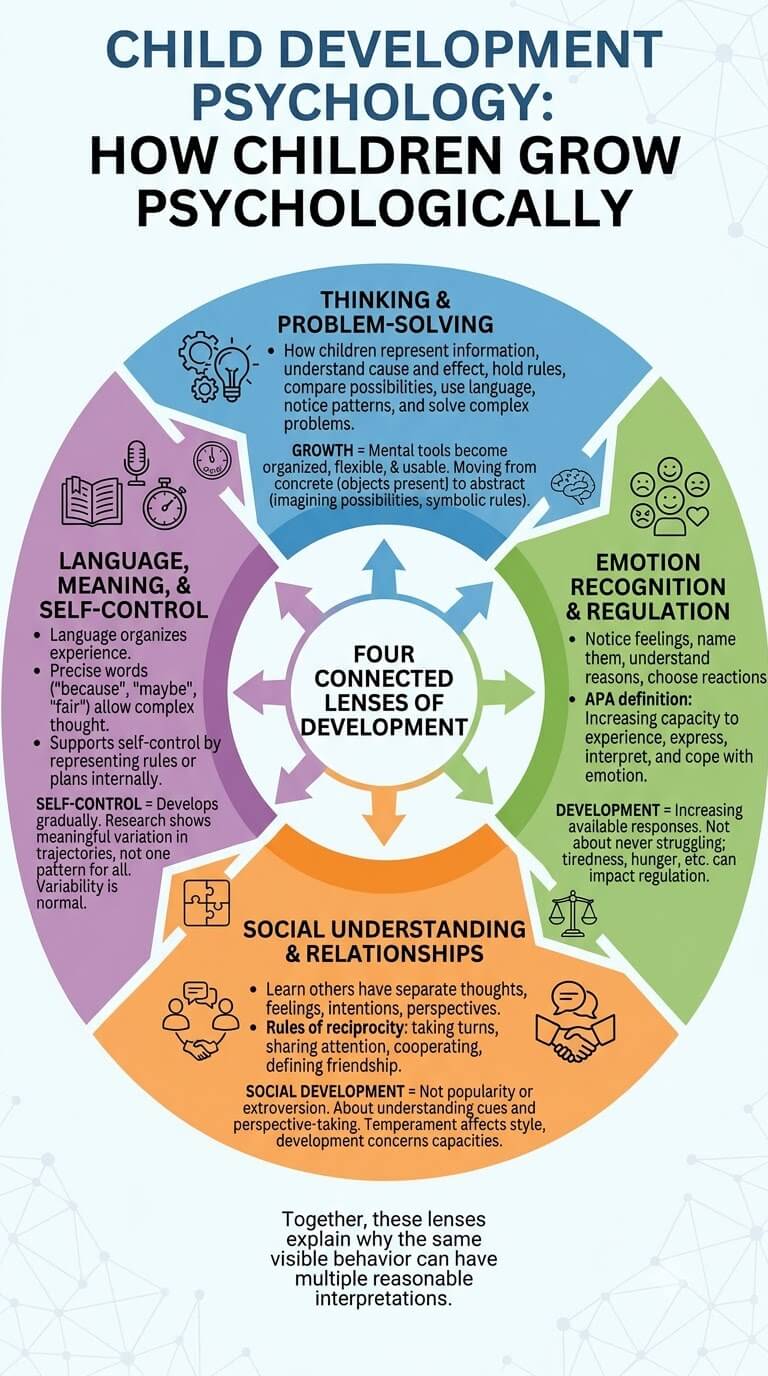
A useful way to understand childhood development is to look through four connected lenses: Thinking, Regulation, Relationships, and Learning. Each lens answers a different question. Together, they help explain why the same visible behavior can have more than one reasonable interpretation.
Thinking and problem-solving
This includes how children represent information, understand cause and effect, hold rules in mind, compare possibilities, use language, notice patterns, and solve increasingly complex problems. Growth in thinking does not mean that a child simply becomes “smarter” every year. It means that mental tools become more organized, flexible, and usable across a wider range of situations.
For example, a younger child may solve a problem best when objects are physically present. With experience and cognitive growth, the child becomes more able to imagine possibilities, follow symbolic rules, and reason about things that are not immediately visible.
Emotion recognition and regulation
Children gradually become better able to notice feelings, name them, understand why they happen, and choose what to do with them. The APA Dictionary description of emotional development emphasizes increasing capacity to experience, express, interpret, and cope with emotion.
That process is not the same as learning never to cry, get angry, or become frustrated. A child can understand an emotion well and still struggle to regulate it when tired, embarrassed, hungry, overstimulated, or disappointed. Development is partly about increasing the number of available responses.
Social understanding and relationships
Children learn that other people have separate thoughts, feelings, intentions, preferences, and perspectives. They also learn rules of reciprocity: taking turns, sharing attention, repairing small conflicts, cooperating toward a common goal, and deciding what friendship means.
Social development is not measured by popularity or extroversion. A quiet child may understand social cues very well. A highly outgoing child may still struggle with turn-taking or perspective-taking. Temperament affects style, while development concerns the underlying capacities being used.
Language, meaning, and self-control
Language gives children tools for organizing experience. Words such as “before,” “because,” “maybe,” “fair,” “promise,” and “disappointed” allow increasingly precise thought. Language also supports self-control because a child can begin to represent a rule or plan internally instead of relying entirely on an adult’s immediate reminder.
Self-control develops gradually. Longitudinal research on behavioral self-regulation across early childhood found meaningful variation in developmental trajectories rather than one identical pattern for every child. That variability is important when interpreting everyday behavior.
Why Childhood Is a Period of Rapid Psychological Change
New capacities build on earlier foundations
Development is cumulative. A child who can hold a simple rule in mind is better positioned to follow a two-step plan. A child who can label frustration has a better chance of explaining a problem before acting on it. A child who understands that another person can feel differently is better able to negotiate rather than assume everyone sees the situation the same way.
These foundations interact. More language can improve emotional explanation. Better working memory can help a child follow social rules during a game. More experience with peers can create opportunities to practice perspective-taking and repair.
Learning changes what children notice and expect
Children do not passively wait for abilities to appear. Experience changes what they know, what they predict, and which strategies they can use. A child who has repeatedly played board games may become skilled at taking turns and tracking rules in that context. The same child may still struggle with waiting in a less structured situation.
This is one reason development can look uneven across settings. A well-practiced environment provides cues and routines. A new environment asks the child to transfer what they know without as much support.
Relationships provide repeated feedback about emotion and behavior
Adults, siblings, peers, teachers, and other caregivers respond to children’s behavior every day. Those responses teach what emotions mean, which behaviors are acceptable, how conflict is handled, and whether asking for help is useful.
This does not mean one interaction determines development. Repeated experiences matter more than isolated moments. Children also bring their own temperament, skills, expectations, and sensitivities into those interactions, so development is an ongoing exchange between the child and the environment.
Cognitive Development in Childhood
From action and concrete experience toward more flexible mental representation
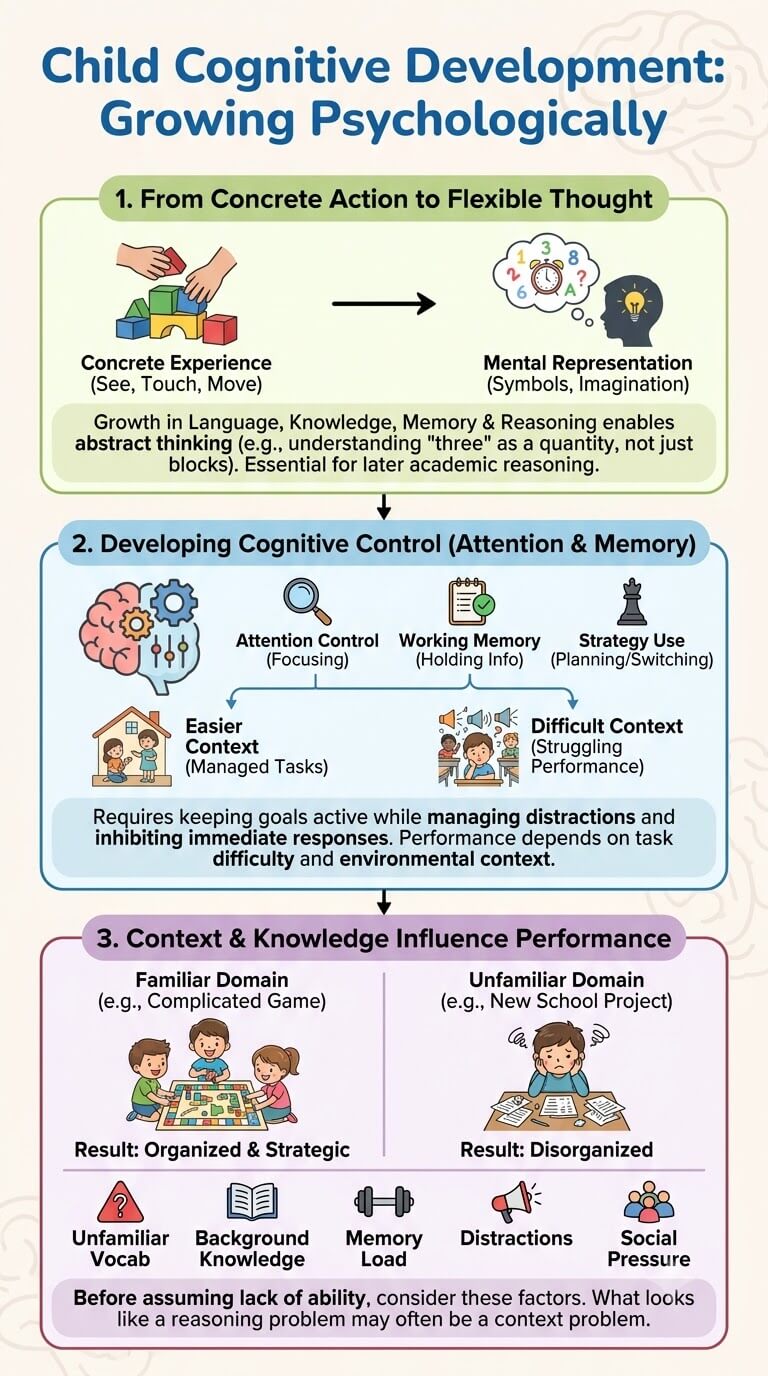
Young children often understand ideas more easily when they can see, touch, move, or act on something. Concrete experience gives the mind fewer invisible relationships to manage. As language, knowledge, memory, and reasoning grow, children become increasingly able to use symbols, imagine alternatives, and think about events that are not happening right now.
A child may first understand “three” by counting three blocks. Later, the child can understand that three is a quantity that applies to blocks, sounds, days, or imaginary objects. The move from specific experience toward more flexible representation makes later academic and everyday reasoning possible.
Growing attention control, working memory, and strategy use
Many childhood tasks require more than understanding. They require keeping a goal active while doing something else. A child may know the classroom rule but forget it while talking excitedly with a friend. Another may understand a math procedure but lose the first result while completing the second step.
As cognitive control develops, children become better at holding relevant information in mind, inhibiting an immediate response, and switching strategies. Performance still depends on task difficulty and context. A child who manages three instructions at home may struggle with the same number of steps in a noisy classroom.
Why knowledge and context change performance
Children often think more strategically in familiar domains. A child who seems poor at planning may organize a complicated game with friends because the rules, goals, and possibilities are well known. The same child may become disorganized during an unfamiliar school project.
Before concluding that a child lacks a cognitive ability, ask how much the task depends on unfamiliar vocabulary, background knowledge, memory load, distractions, or social pressure. What looks like a reasoning problem may partly be a context problem.
Emotional Development in Childhood
Naming feelings and linking them to causes
Early emotional language is often broad: happy, sad, mad, scared. Over time, children can learn distinctions such as disappointed, embarrassed, jealous, worried, lonely, proud, frustrated, and relieved. More precise language can make emotional experiences easier to explain and compare.
Linking feelings to causes is another developmental step. “I am angry” becomes “I am angry because I thought it was my turn.” That explanation creates room for problem-solving that pure emotional intensity does not.
Co-regulation and the gradual growth of self-regulation
Children do not begin with adult-level regulation and then simply choose whether to use it. Early regulation often depends heavily on other people and on the environment. A calm adult, predictable routine, reduced stimulation, or clear structure can make regulation more possible.
With repeated experience, children gradually take over more of that work. They may use words, seek space, ask for help, delay a response, remind themselves of a rule, or choose another activity. The transfer from external support toward more independent regulation is gradual rather than all-or-nothing.
Understanding mixed feelings and social display rules
Children also become better able to understand that one event can create more than one feeling. A move to a new city can feel exciting and sad. Winning a competition can create pride and concern for a disappointed friend. A child can love someone and still feel angry with them.
They also learn that emotions and expressions are related but not identical. People sometimes hide disappointment to be polite, soften anger to avoid hurting someone, or smile while nervous. Understanding this makes social situations less literal and more psychologically complex.
Social Development in Childhood
Shared attention, cooperation, and perspective-taking
Social understanding requires coordinating attention with other people. Children learn to notice what another person is looking at, what information the other person has, and how a shared goal can be achieved. Over time, they become better able to represent viewpoints that differ from their own.
Perspective-taking does not guarantee kind behavior. A child may understand that a sibling is upset and still choose not to share. Social knowledge and social motivation are related but separate. Knowing what another person feels is not the same as always prioritizing it.
Friendship, fairness, rules, and conflict
Friendships become more complex as children develop. Shared activity is important, but trust, loyalty, mutual support, fairness, and disclosure can become more meaningful with age. Conflict also becomes a developmental arena because children have to negotiate competing goals.
Fairness often becomes more nuanced too. Younger children may focus on equal shares. Older children may increasingly understand that context matters, such as effort, need, prior agreements, or responsibility. They still may reject an outcome strongly when it disadvantages them personally.
The expanding role of peers and group belonging
As children spend more time with peers, group norms become a stronger source of feedback. Children learn which behaviors are admired, ignored, teased, copied, or rejected. This can support cooperation and shared identity, but it can also create pressure to conform.
Peer influence is not automatically harmful. Peers can model kindness, persistence, humor, problem-solving, curiosity, and rule-following as well as risk. The important question is what the group rewards and what the child learns from belonging to it.
Learning, Play, and Everyday Experience
Observation and imitation
Children learn a great deal by watching. They notice how adults handle mistakes, how siblings respond to frustration, how peers join a game, and how people use tools. Observation gives children a model before they have to produce the behavior independently.
Imitation is not simple copying. Children gradually learn which parts of an action matter and when a behavior should transfer to a new context. A phrase that works during a classroom discussion may need to be adapted during conflict with a sibling.
Practice, feedback, and skill-building
Practice strengthens skills when it provides information about what works. Repetition alone is not always enough. Feedback helps a child compare an attempt with the goal, while manageable challenge creates opportunities to adjust.
Children also benefit from tasks that are neither effortless nor impossibly difficult. Too little challenge produces little need for adaptation. Too much challenge can overwhelm the very attention and regulation needed to learn.
Why play can combine cognitive, emotional, and social learning
Play is distinctive because it can combine imagination, rules, negotiation, movement, emotion, language, and problem-solving in the same activity. A review of play and children’s development describes links between play and cognitive, emotional, linguistic, motor, and psychosocial skills.
Consider a pretend restaurant. Children have to agree on roles, remember the scenario, use symbolic objects, negotiate disagreements, wait for turns, and adapt when someone changes the story. The activity is enjoyable, but it also creates repeated developmental demands.
Child Development vs Parenting Advice
Developmental psychology describes patterns of change
Developmental psychology asks questions such as: what abilities tend to become more complex, what mechanisms may support that change, how much variation exists, and how do context and experience influence performance? It does not prescribe one correct response for every family.
A developmental explanation may help an adult understand why a task is difficult without automatically deciding how the adult should respond. Description and intervention are separate questions.
Parenting choices depend on the child, context, culture, and safety
A strategy that fits one child may not fit another. Age, temperament, language, family structure, disability, culture, environment, stress, and safety all matter. Even the same child may need different amounts of structure in different situations.
General psychological information is most useful when it reduces unrealistic expectations and sharpens observation. It should not be used to declare that one parenting style is universally correct or that every behavior has a simple cause.
Why a general article cannot evaluate an individual child
Individual assessment requires more than a list of behaviors. A professional may consider developmental history, health, language, hearing, school demands, family context, sleep, stress, functioning across settings, and many other factors.
That is why an article can explain possibilities but cannot tell you why a particular child is struggling. The same visible behavior can arise from very different circumstances.
What Developmental Milestones Can and Cannot Tell You

Milestones as population-based reference points
Milestones summarize skills that many children demonstrate by certain ages. They are useful because they give adults concrete behaviors to notice rather than vague impressions such as “something feels off.” They also support earlier conversations with professionals when concerns persist.
For a broader explanation of age periods, milestones, and why development does not follow one rigid schedule, see our guide to stages of development.
A milestone is not a score of character, intelligence, or future potential. Reaching one skill earlier does not mean a child will be advanced in every domain, and reaching another later does not reveal the reason.
Uneven development across different domains
A child may have advanced vocabulary and still need substantial help with frustration. Another may be socially confident but slower to manage multi-step instructions. A third may solve visual puzzles well while struggling to explain reasoning in words.
Unevenness is expected because different tasks depend on different combinations of knowledge, language, attention, regulation, motor skill, and experience. The meaningful question is the pattern, not whether every ability sits at the same level.
Looking for patterns across time and settings
One hard day is weak evidence. Repeated difficulty across time and in several settings tells you more. A child who struggles only when exhausted after school presents a different pattern from a child who consistently loses previously mastered skills or cannot participate in ordinary activities across home and school.
When concern persists, documenting concrete examples can be more useful than choosing a label. Note what the child was asked to do, what support was available, what happened, and whether the difficulty appears elsewhere.
Common Misreadings of Child Behavior
Limited skill can look like unwillingness
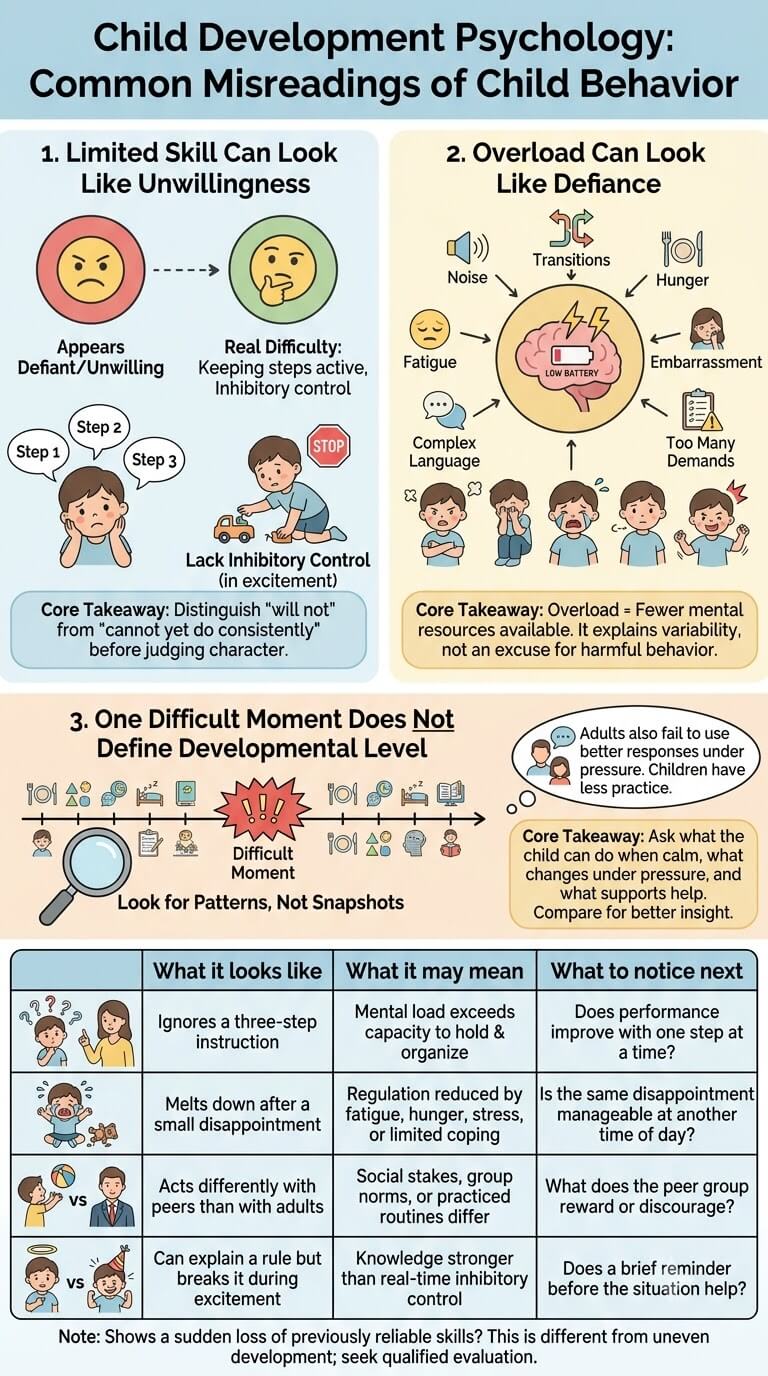
A child who does not complete a multi-step instruction may appear defiant when the real difficulty is keeping all the steps active. A child who grabs may know the rule about asking but lack the inhibitory control to use it reliably in a highly exciting moment.
This does not mean limits or expectations are unnecessary. It means an adult’s interpretation should distinguish “will not” from “cannot yet do consistently” before drawing conclusions about character or motive.
Overload can look like defiance
Noise, transitions, hunger, fatigue, embarrassment, complex language, or too many simultaneous demands can reduce a child’s available regulation. Under overload, a child may argue, freeze, cry, avoid, or act impulsively.
Overload is not an excuse for harmful behavior. It is information about when the child has fewer mental resources available. That information can help explain why the same expectation is manageable in one setting and difficult in another.
One difficult moment does not define a developmental level
Development should be inferred from patterns, not snapshots. Adults also have moments when they know a better response but fail to use it. Children have fewer years of practice and often less control over their environments, so performance may be especially variable.
Ask what the child can do when calm, what changes under pressure, and what kinds of support improve performance. Those comparisons are more informative than a single success or failure.
| What it looks like | What it may mean | What to notice next |
|---|---|---|
| “Ignores” a three-step instruction | The mental load may exceed what can be held and organized | Does performance improve with one step at a time? |
| Melts down after a small disappointment | Regulation may be reduced by fatigue, hunger, stress, or limited coping options | Is the same disappointment manageable at another time of day? |
| Acts differently with peers than with adults | Social stakes, group norms, or practiced routines may differ | What does the peer group reward or discourage? |
| Can explain a rule but breaks it during excitement | Knowledge may be stronger than real-time inhibitory control | Does a brief reminder before the situation help? |
| Shows a sudden loss of previously reliable skills | This is different from ordinary uneven development | Seek qualified developmental or medical evaluation |
Which Developmental Question Are You Actually Asking?
When the question is mainly about reasoning and problem-solving
If you are trying to understand how children hold information in mind, shift strategies, inhibit an immediate response, or move toward more abstract reasoning, cognitive development is the more precise lens. That perspective can clarify why a child understands a concept but struggles to use it under mental load.
When the question is mainly about emotion
If the concern centers on naming feelings, understanding causes, coping with strong emotion, or gradually moving from co-regulation toward greater self-regulation, emotional development deserves closer attention. The focus is capacity-building, not simply “good” versus “bad” behavior.
When the question is mainly about peers and relationships
Questions about cooperation, perspective-taking, friendship, belonging, reciprocity, and group norms fit social development. Attachment is a neighboring topic, but attachment specifically concerns expectations and patterns around closeness, security, and important relationships rather than all social growth.
When the question is mainly about acquiring a skill
If the main issue is practice, feedback, observation, transfer, or how experience creates a lasting change in knowledge or performance, learning psychology is a better fit. Development affects how children learn, while learning supplies experiences that can shape development.
As childhood gives way to the teen years, new autonomy, peer, identity, and decision demands become central to adolescent development.
When a Child Development Concern Needs Qualified Evaluation
Loss of previously acquired skills
A noticeable loss of abilities that a child previously used reliably deserves attention. Examples might involve language, movement, social engagement, self-care, or other everyday skills. Loss is different from occasional inconsistency, tiredness, or refusing to perform a skill in one situation.
A pediatric or developmental professional can consider medical, neurological, sensory, environmental, and psychological possibilities rather than assuming a cause from the behavior alone.
Persistent concerns across settings or major interference with daily functioning
It is worth discussing persistent concerns when a difficulty appears across settings, lasts over time, and substantially interferes with communication, learning, relationships, safety, or everyday participation. Early discussion does not mean assuming a diagnosis. It means gathering better information while support options are still open.
Safety, neglect, abuse, or severe distress
If a child is experiencing violence, threats, sexual harm, severe humiliation, neglect, coercion, or another unsafe situation, developmental explanations should not be used to minimize the problem. Safety takes priority over trying to teach better coping or communication.
Likewise, severe emotional distress, self-harm behavior, or statements suggesting immediate danger require prompt qualified help. General educational information is not an adequate response to an urgent safety concern.
FAQ About Child Development Psychology
What are the main areas of psychological development in childhood?
Common areas include cognitive development, language, emotional understanding and regulation, social understanding, relationships, attention, memory, self-control, and learning. These domains interact rather than developing separately. A change in language, for example, can make it easier for a child to explain emotions and participate in more complex social negotiation.
Are developmental milestones strict deadlines?
No. Milestones are reference points for skills many children demonstrate by particular ages, not exact deadlines that every child follows identically. They are useful for observing patterns and raising questions. Persistent concern, significant functional difficulty, or loss of previously acquired skills deserves professional discussion rather than interpretation from a checklist alone.
Why can a child seem advanced in one area and behind in another?
Different abilities depend on different combinations of experience, language, attention, regulation, knowledge, motor skill, and opportunity. A child can therefore be highly capable in one area while developing more slowly in another. Uneven development is not unusual, although large or persistent differences may warrant closer evaluation depending on their impact.
How do relationships influence child development?
Relationships provide repeated experiences of language, emotion, cooperation, limits, comfort, conflict, and repair. Children learn not only from what adults tell them but from what people repeatedly do. Peers also become important sources of feedback and practice as childhood progresses. No single interaction determines development, but recurring relational patterns create learning opportunities.
Is difficult behavior always a sign of a developmental problem?
No. Difficult behavior may reflect frustration, fatigue, hunger, unfamiliar demands, strong emotion, social pressure, limited practice, or ordinary testing of boundaries. What matters is the pattern across time and settings, the child’s level of functioning, and whether skills are growing. A professional evaluation is more appropriate when difficulties are persistent, severe, worsening, or associated with loss of skills.
Key Takeaways
- Child development is not one ladder. Thinking, emotion, self-control, language, relationships, and learning can progress at different rates.
- A child’s visible behavior does not reveal its cause by itself. Capacity, context, mental load, emotion, and prior experience all affect performance.
- Milestones are useful observation tools, but they do not measure character, intelligence, or future potential and should not be treated as strict deadlines.
- Play, relationships, observation, practice, and feedback create everyday opportunities for cognitive, emotional, and social development to interact.
- Developmental psychology explains patterns of change; it does not provide a universal parenting formula or diagnose an individual child.
- Persistent cross-setting difficulties, major functional interference, loss of previously acquired skills, severe distress, or safety concerns deserve qualified attention.
When a child’s behavior is confusing, the most useful next step is often to make the question smaller. Ask what the child is being asked to think, remember, regulate, understand socially, or learn. Then compare what happens across contexts. A precise developmental question gives you more useful information than a global judgment such as “immature,” “lazy,” “advanced,” or “difficult.”
Educational note: Psychology Exposed provides general information about psychological development. It cannot evaluate an individual child’s development or replace pediatric, developmental, educational, or mental health assessment.
About the author: Michael Reed is the Founder & Lead Writer at Psychology Exposed. He explains human behavior, emotional patterns, relationships, self-awareness, and everyday psychology in clear, research-aware language for general readers.

Michael Reed is the Founder and Lead Writer at Psychology Exposed. He writes about human behavior, relationships, emotional patterns, self-awareness, and practical psychology topics using research-informed, easy-to-understand content.
Read More About Michael Reed: https://psychologyexposed.com/michael-reed/