
A child who waits for a turn, a teenager who notices that a joke lands differently with different groups, and an adult who adjusts to the expectations of a new workplace are all doing more than “being social.” They are reading people, tracking rules, interpreting intentions, balancing their own goals with someone else’s, and deciding what a relationship requires.
Social development psychology looks at how those capacities change over time. It includes perspective-taking, cooperation, reciprocity, friendship, conflict, belonging, and the ability to understand increasingly complex social situations. It does not mean becoming more outgoing, making more friends, or learning one ideal style of eye contact or conversation. Social behavior depends heavily on context, culture, temperament, power, familiarity, and the particular relationship involved.
The same visible behavior can mean different things at different ages and in different settings. A quiet child may be observing before joining, while an adult with a smaller social circle may be becoming more selective. The useful question is not simply, “How social is this person?” but “What does this situation and relationship require?”
Quick Answer
Social development is the growth of social understanding and relationship capacity
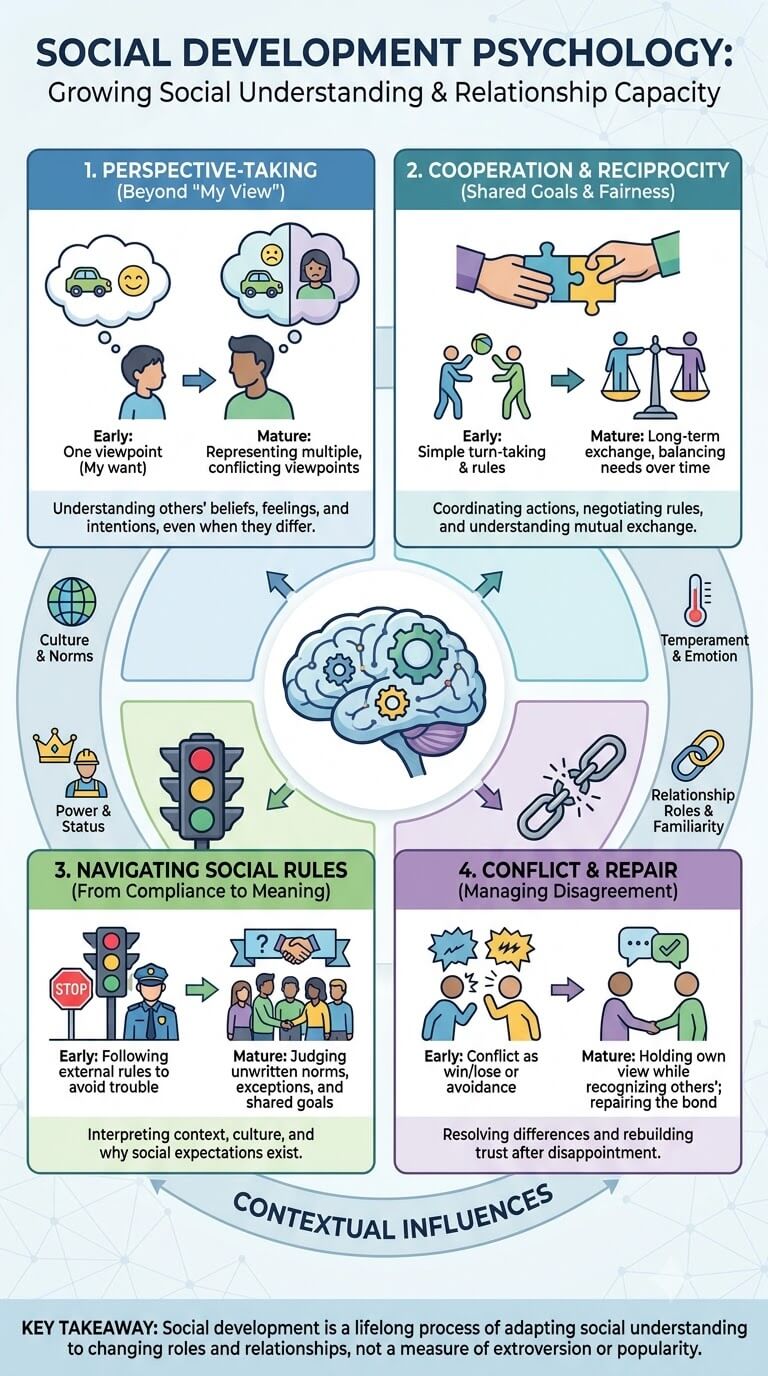
Social development involves changes in how people understand others, cooperate, follow and negotiate social rules, form relationships, manage conflict, and take another person’s perspective. The APA Dictionary of Psychology description of psychosocial development includes changes in social cognition, perspective-taking, prosocial behavior, and understanding that other people act from their own knowledge and desires.
It is not the same as extroversion or popularity
An introverted person can have sophisticated social understanding, strong friendships, excellent perspective-taking, and thoughtful conflict skills. A highly outgoing person can still misread boundaries or group dynamics. Popularity is also shaped by status, opportunity, appearance, group norms, and local culture. Social development is better understood as a growing set of capacities for navigating relationships than as a score for how much someone likes being around people.
What Social Development Includes
Reading social cues and intentions
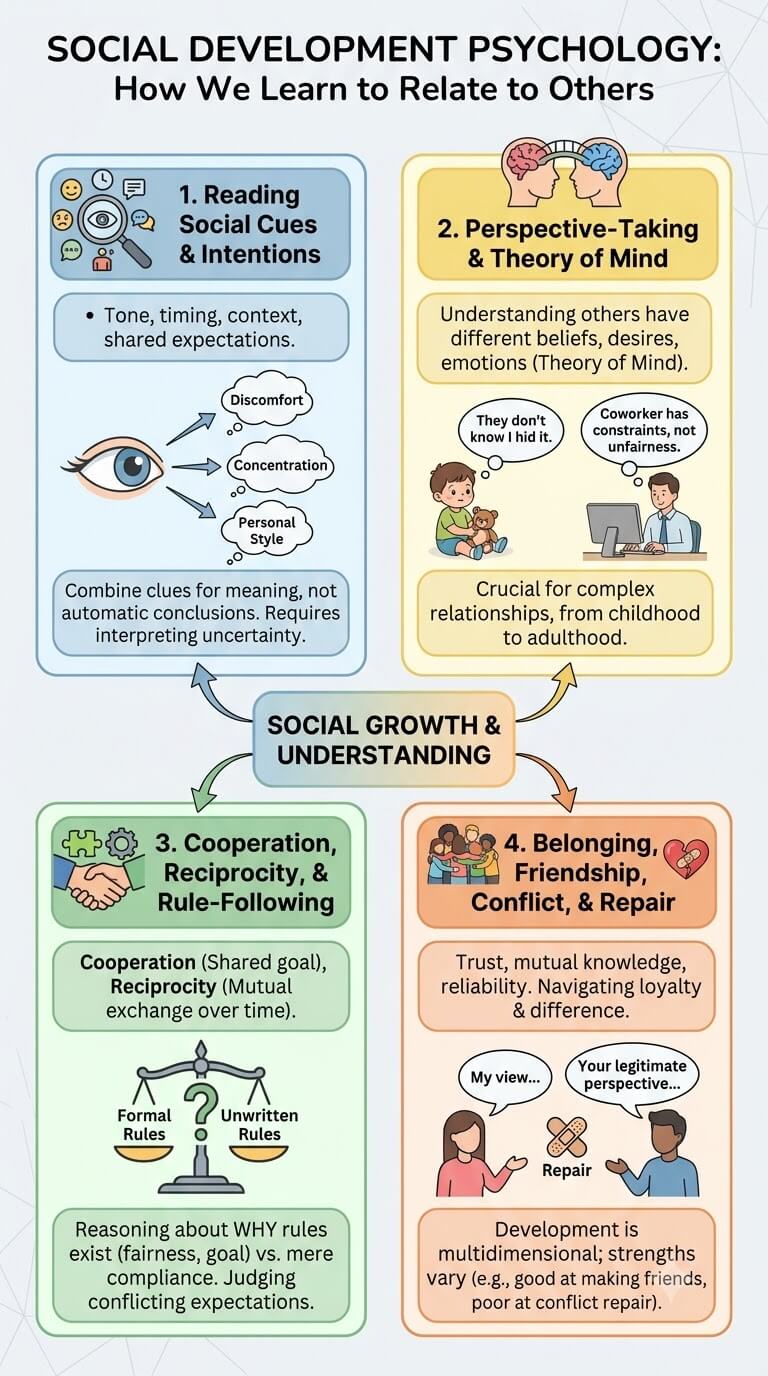
Social situations contain information that is rarely stated completely. Tone, timing, facial expression, context, previous interactions, roles, and shared expectations all contribute to meaning. Learning to use these cues is part of development, but no single cue is perfectly reliable. Looking away can signal discomfort, concentration, respect, distraction, or simply a personal communication style.
These changes in relationships and social understanding belong to the wider process of development across the lifespan.
As social understanding grows, people become better able to combine clues rather than treating one behavior as proof. “She did not answer immediately” becomes one piece of information, not an automatic conclusion that she is angry. This shift matters because social life requires uncertainty. We often have to make reasonable interpretations without pretending we can read another person’s mind.
Perspective-taking and understanding other minds
Perspective-taking means representing what another person may know, believe, want, feel, or see from their position. The APA Dictionary explanation of theory of mind describes the understanding that other people can have intentions, beliefs, perceptions, desires, and emotions different from one’s own.
That ability becomes increasingly useful as relationships become more complex. A child learns that a classmate may not know what happened earlier. A teenager begins to track how the same comment may be interpreted differently by a friend, teacher, or online audience. An adult may need to understand a coworker’s constraints without assuming those constraints make every decision fair.
Cooperation, reciprocity, and rule-following
Cooperation requires coordinating actions toward a shared outcome. Reciprocity adds a sense of exchange over time: I take your needs seriously, and I expect you to take mine seriously too. Rule-following starts simply in many childhood settings, but later social life requires people to judge which rules are formal, which are unwritten, when exceptions are reasonable, and what happens when two expectations conflict.
This is why social maturity cannot be reduced to compliance. A person may follow a rule because of fear, habit, fairness, loyalty, respect for a role, or understanding of a shared goal. Development often increases the ability to reason about why a social expectation exists, not merely whether it exists.
Belonging, friendship, conflict, and repair
Relationships eventually ask for more than pleasant interaction. Friendship involves trust, mutual knowledge, reliability, and some ability to repair disappointment. Group belonging brings questions about loyalty and difference. Conflict requires a person to hold their own viewpoint while recognizing that the other person may have a legitimate perspective too.
These capacities develop unevenly. Someone may be skilled at making new friends but poor at repairing conflict. Another person may be deeply loyal in close relationships but uncomfortable entering unfamiliar groups. Social development is multidimensional, so one strength does not guarantee every other social skill.
How Social Worlds Expand Across Development
Early relationships are the first social learning environment
Early social development begins in repeated interactions with caregivers and other familiar people. Infants and young children learn that expressions, sounds, gestures, and actions affect what happens next. They gradually participate in shared routines, take turns in simple interactions, notice other people’s reactions, and build expectations about familiar social situations.
The CDC’s current developmental milestone guidance includes social and emotional behaviors alongside language, learning, and movement. These milestones are useful reference points, not a complete judgment of a child’s social development. Children can be uneven across domains, and concerns are better understood as patterns across time and settings than as one isolated behavior.
Many foundations of cooperation, friendship, fairness, and perspective-taking become visible during child development.
Peers introduce comparison, negotiation, and group norms
Peers create a different social environment from adult-child relationships. People of similar age or status often have less built-in authority over one another, so cooperation depends more on negotiation. A child who wants to stay in a game has to consider fairness, turn-taking, shared rules, and whether other children still want to participate.
As peer groups become more important, social comparison grows. People learn what gains approval, which differences are accepted, and how reputation travels. This can support belonging and learning or create pressure to conform. Development does not make people immune to peers, but it can improve awareness of group influence.
Adult roles add intimacy, responsibility, work, and caregiving
Adult social life often becomes more role-dense. The same person may be a partner, friend, coworker, manager, sibling, parent, caregiver, neighbor, and community member. Each role has different expectations about privacy, responsibility, reciprocity, authority, and emotional closeness.
Adult social change may be less visible than childhood change, but people still learn to negotiate boundaries, share responsibility, handle changing power, maintain relationships, and adapt when work, family, health, or location reshapes their social world.
The Development of Perspective-Taking
Moving from one viewpoint toward multiple viewpoints
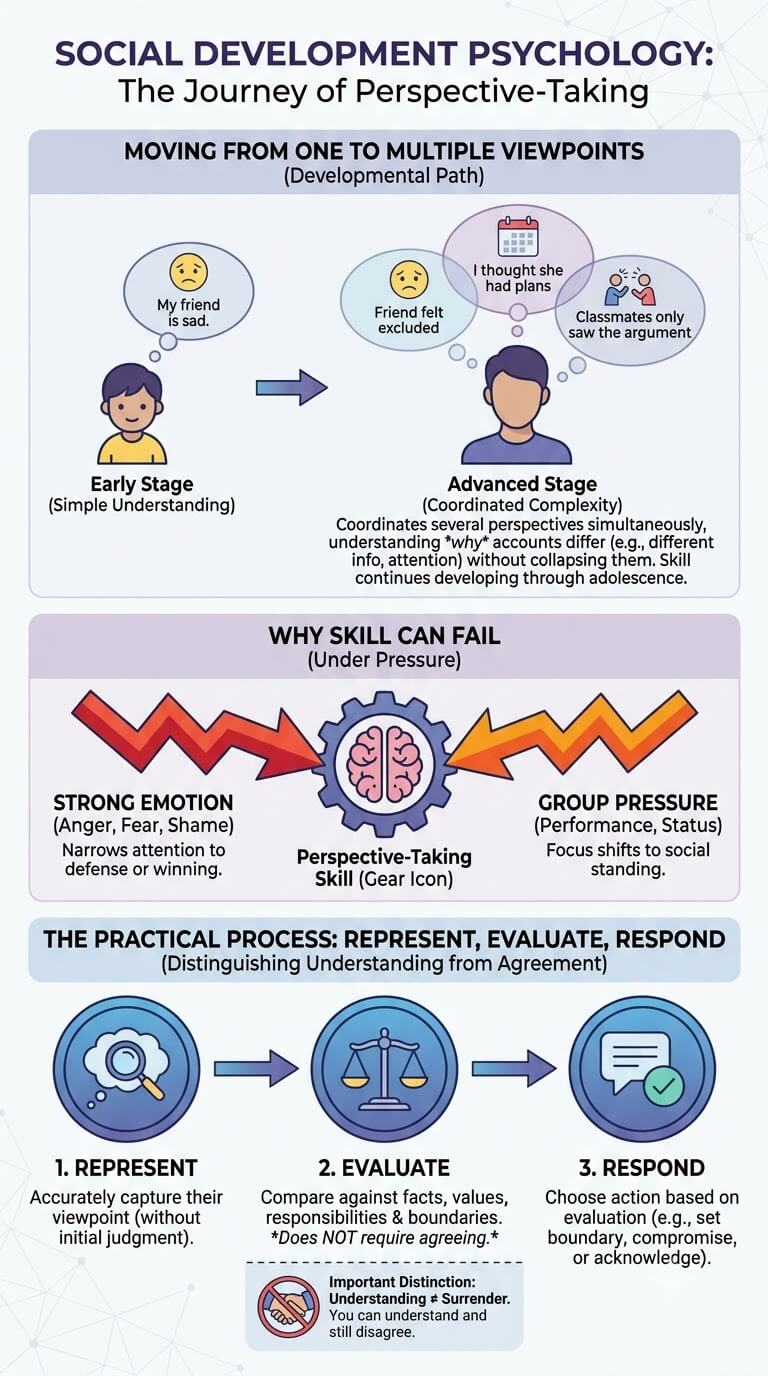
Young children can understand many aspects of other people’s experience, but coordinating several perspectives at once becomes increasingly sophisticated. It is one thing to know, “My friend is sad.” It is more complex to understand, “My friend is sad because she thought I excluded her, while I thought she already had plans, and our classmates only saw the final argument.”
More advanced perspective-taking allows a person to represent several viewpoints without collapsing them into one. This is especially important in conflict because people often have different information. Two accounts can disagree without one person necessarily lying. The mismatch may come from attention, memory, assumptions, role expectations, or what each person could see at the time.
Why perspective-taking can fail under emotion or group pressure
Having a social skill does not mean using it equally well in every moment. Strong anger, embarrassment, competition, fear of rejection, or pressure to perform for a group can narrow attention. The person may become more focused on defending status, avoiding shame, or winning than on representing another viewpoint accurately.
Research on social perspective-taking from adolescence into adulthood suggests that the ability to use another person’s perspective to guide decisions continues developing through adolescence. The practical point is not that teenagers lack empathy. It is that using social understanding in real decisions continues to become more coordinated with age and experience.
Understanding a perspective does not require agreeing with it
Perspective-taking is sometimes confused with surrender. They are different. You can understand why a friend felt ignored and still believe you acted reasonably. You can recognize why a manager wants a deadline met and still say the workload is unrealistic. You can understand a family tradition without choosing to follow it.
A useful distinction is represent, evaluate, respond. First represent the other viewpoint as accurately as you can. Then evaluate it against facts, responsibilities, values, and boundaries. Finally choose your response. Skipping the first step creates misunderstanding; skipping the second can turn understanding into automatic compliance.
Reading and responding to other people also depends partly on growing emotional understanding, which is examined more closely in emotional development.
Cooperation, Fairness, and Reciprocity
Learning turn-taking and shared rules
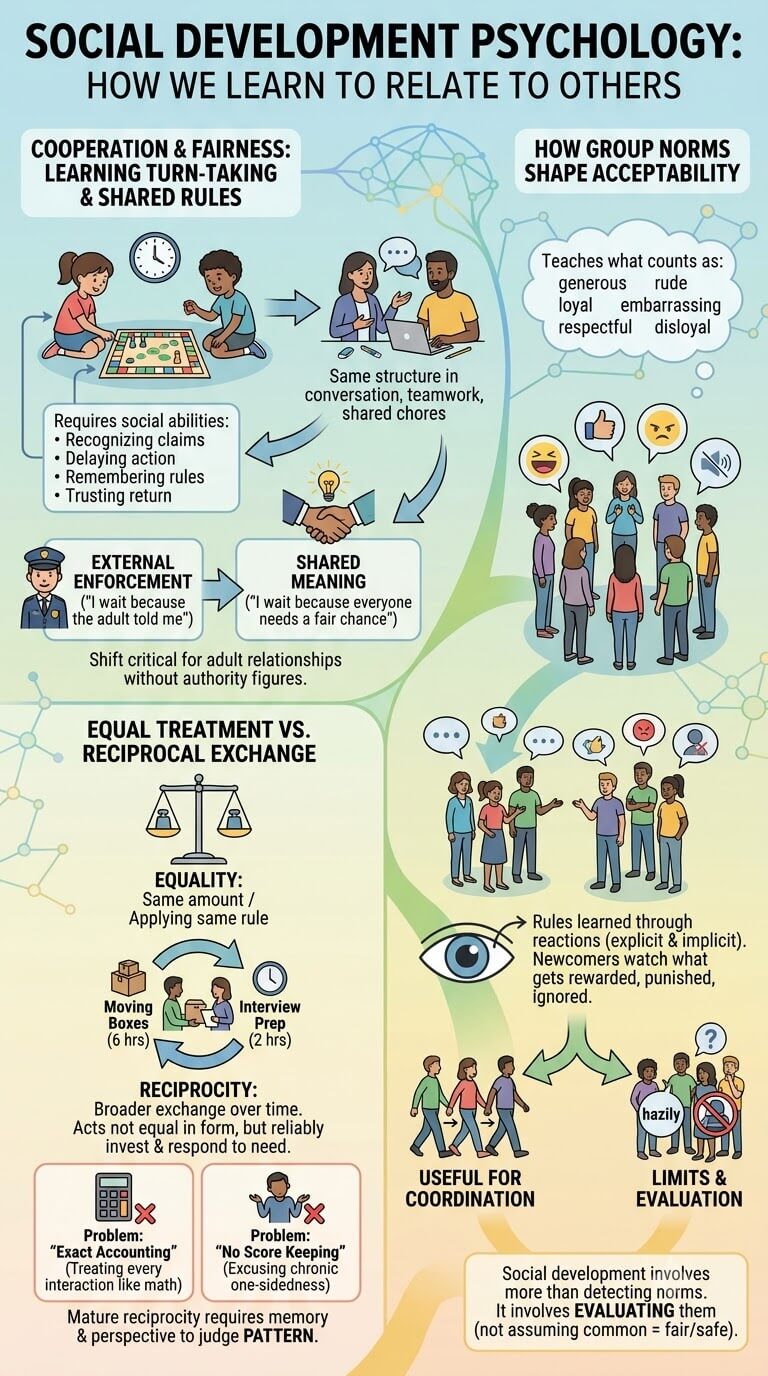
Turn-taking looks simple, but it requires several social abilities: recognizing another person’s claim to participation, delaying one’s own action, remembering the shared rule, and trusting that one’s own turn will return. Games make these requirements visible, but the same structure appears in conversation, teamwork, shared chores, and decision-making.
As people develop, rules can become less external. Instead of “I wait because the adult told me to,” the reason can become “I wait because everyone needs a fair chance to participate.” That shift from external enforcement toward shared meaning is important in adult relationships, where many expectations are not monitored by an authority figure.
Equal treatment is not always the same as reciprocal exchange
Equality means giving people the same amount or applying the same rule. Reciprocity concerns the broader exchange between people over time. A friend may help you move apartments for six hours, while you later help them prepare for an interview for two. The acts are not equal in form, but the relationship can still feel reciprocal if both people reliably invest and respond to need.
Problems appear when one person treats every interaction like exact accounting or, at the other extreme, when “we do not keep score” becomes a way to excuse chronic one-sidedness. Mature reciprocity requires enough memory and perspective to judge the pattern, not only the last exchange.
How group norms shape what feels socially acceptable
Groups teach members what counts as generous, rude, loyal, embarrassing, respectful, or disloyal. These rules can be explicit, but many are learned through reactions. A newcomer watches what gets laughed at, ignored, rewarded, criticized, or quietly avoided.
Norm sensitivity is useful because it helps people coordinate. It also has limits. A group can normalize exclusion, cruelty, hazing, or dishonesty. Social development therefore involves more than detecting norms. It also involves evaluating them rather than assuming that common behavior is automatically fair or safe.
Friendship and Peer Development
From shared activity toward trust, disclosure, and mutual support
Early friendships often grow around proximity and shared play. With development, friendship can become more psychologically complex. Reliability, loyalty, private disclosure, emotional support, shared values, and respect for personal boundaries become more important.
A developmental review of close relationships across childhood and adolescence describes changes in how relationships are organized as young people move among family, peer, friendship, and eventually romantic contexts. The exact timing varies, but the broad point is that different relationships ask for different forms of coordination and intimacy.
Relationships do more than provide companionship; they also give feedback that can influence how identity develops.
Why peer feedback becomes especially powerful in adolescence
Adolescence brings greater independence from adults at the same time that peer groups provide information about identity, belonging, status, attractiveness, competence, and acceptable behavior. Feedback from peers can therefore carry unusual weight. A comment that an adult dismisses as “just what kids say” may matter because it affects where a teenager believes they stand socially.
Peer belonging and group influence become particularly important within the wider context of adolescent development.
Peer influence is not automatically negative. Friends can reinforce studying, exercise, kindness, creativity, courage, or responsible behavior just as they can reinforce risk. The important developmental question is what the group rewards and how much freedom the individual feels to disagree without losing belonging.
Social comparison and belonging without reducing adolescence to peer pressure
Comparison helps people locate themselves in a social world. “Am I good at this?” often becomes “How do I compare with others who are doing it?” That can motivate learning, but constant comparison can also distort self-evaluation when the reference group is unusually selective or when online visibility makes exceptional lives look ordinary.
Belonging complicates the picture because people rarely make social choices as isolated individuals. A teenager may know that a joke is mean and still laugh because silence feels socially costly. An adult may stay quiet in a meeting for similar reasons. Development increases the possibility of independent judgment, but group pressure remains a human influence across the lifespan.
Social Development vs Attachment vs Communication Skills
These topics overlap, but they answer different questions. Keeping the distinction clear prevents one concept from being used to explain every relationship difficulty.
| Topic | Main question | Example |
|---|---|---|
| Social development | How do social understanding and relationship capacities change over time? | A child becomes better able to coordinate two viewpoints during a disagreement. |
| Attachment | How are closeness, security, separation, and support experienced in important relationships? | An adult notices that uncertainty about a partner’s availability strongly affects how they respond. |
| Communication skills | How effectively do people send, receive, clarify, and repair meaning? | Two coworkers learn to ask clarifying questions before acting on an ambiguous request. |
Development describes change in social capacities over time
The developmental lens asks how a capacity emerged, became more complex, and changes with new social demands. It might examine how a child moves from simple turn-taking to negotiating fairness, or how an adult adapts from friendship-based reciprocity to the very different responsibilities of caregiving.
Attachment describes patterns around closeness and security
Attachment is more specific. It concerns expectations and behavior related to connection, security, support, and separation in close relationships. Attachment experiences can influence social development, but they do not explain every social preference or difficulty. Being reserved in groups, for example, is not enough to identify an attachment pattern.
Communication focuses on sending, receiving, and repairing meaning
Communication skills are the mechanics and habits people use in interaction: listening, clarifying, expressing needs, noticing misunderstanding, and repairing after a message goes wrong. Social development helps explain how the capacity to understand these interactions changes. Communication guidance focuses more directly on what people do within a conversation.
Why Social Skills Can Look Uneven
Familiar versus unfamiliar settings
A person may be expressive and flexible with close friends but quiet in a new group. Familiar settings reduce uncertainty because the person already knows the rules, humor, hierarchy, and likely reactions. Unfamiliar settings require more active monitoring, which can make someone appear less socially skilled than they are.
This is especially important when judging children. A child who speaks freely at home but watches silently for the first part of a birthday party may be gathering information. The behavior alone does not tell you whether the child lacks social understanding.
Power, status, anxiety, and group belonging
Social behavior changes when the cost of making a mistake changes. It is easier to disagree with a close friend than with a supervisor who controls your schedule. It is easier to enter a group when you already know one member. Anxiety can also consume attention that would otherwise be used for conversation, memory, and flexible responding.
Power matters because not every interaction is between equals. A person who stays quiet in a threatening or humiliating environment may be making a safety calculation, not showing a social-skills deficit. Advice that assumes everyone can simply “speak up” ignores the consequences that may follow in some families, workplaces, schools, or relationships.
Cultural rules for eye contact, directness, independence, and respect
Social competence has no single universal appearance. Cultures and communities differ in eye contact, silence, emotional expressiveness, direct disagreement, physical distance, independence, and family obligation. Individuals within the same culture also vary.
A narrow standard such as “good social skills require steady eye contact” can mistake one cultural style for a universal rule. A better question is whether a person can navigate relevant expectations while preserving appropriate boundaries and choice.
Social Development in Adulthood
Intimacy, work roles, caregiving, and changing networks
Adult social development often happens through role transitions. A first management job requires learning how authority changes a conversation. Long-term partnership requires negotiating interdependence. Parenting or caregiving can reorder time, friendships, and family responsibilities. Moving cities may require rebuilding a social network from the beginning.
These experiences create new social problems to solve. Skills learned in friendship do not automatically transfer perfectly to leadership, caregiving, or partnership. Adults continue adapting because the relationships themselves keep changing.
After adolescence, friendships and intimate relationships often become less structured by school and more deliberate during emerging adulthood.
Selectivity and changing social priorities later in life
A smaller network in later adulthood should not automatically be read as social decline. Research reviewed in work on social relationships across adulthood has found age-related changes in network size alongside evidence that interactions with remaining network members can be experienced as more satisfying.
Social roles continue changing through work, partnership, caregiving, and other responsibilities as part of adult development.
This illustrates an important lifespan principle: more is not always better. People may become more selective about where they invest time and emotional energy. At the same time, unwanted isolation and loneliness are different from chosen selectivity. The meaning of a small network depends on whether it fits the person’s preferences and provides enough connection and support.
A Social Development Reflection Framework
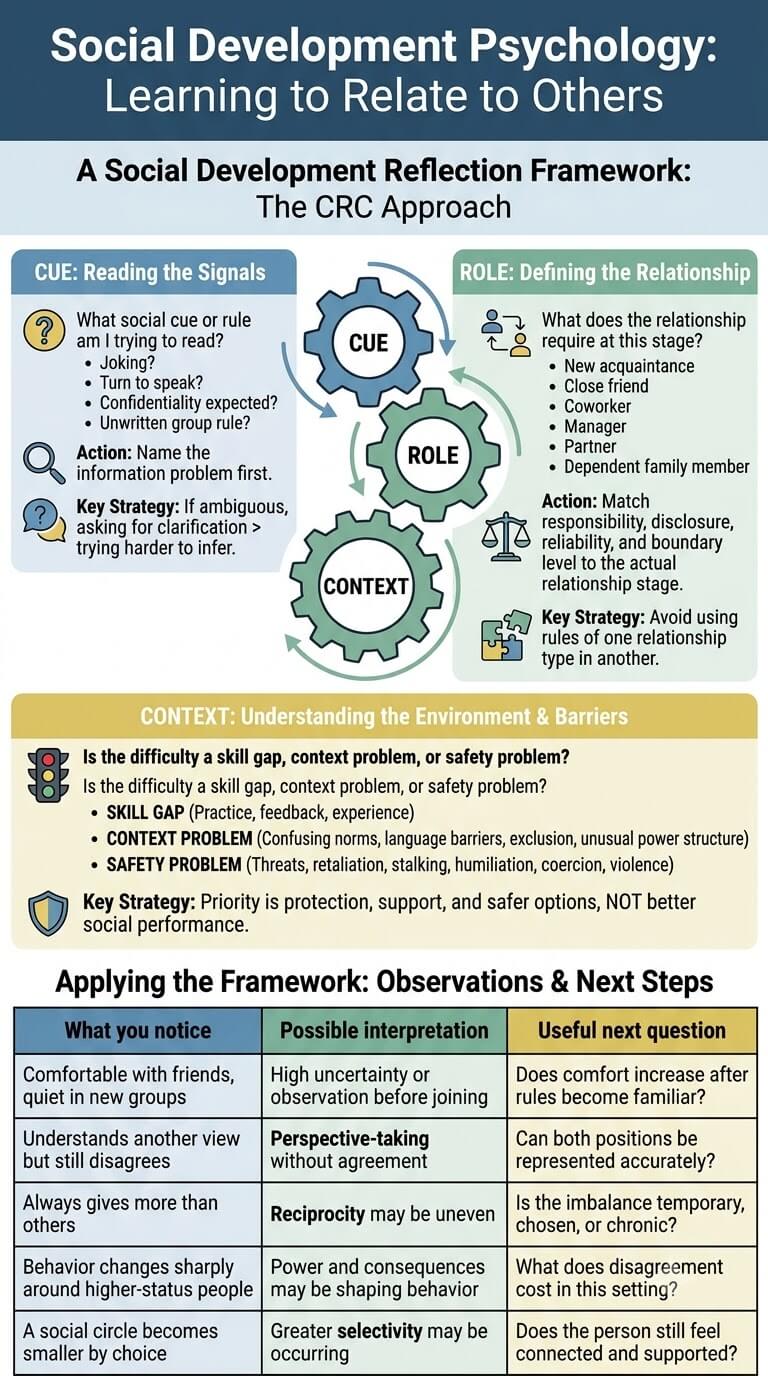
When a social situation is confusing, use the Cue, Role, Context framework. It prevents a vague judgment such as “I am bad with people” from swallowing several different problems.
What social cue or rule am I trying to read?
Name the information problem first. Are you unsure whether someone is joking, whether it is your turn to speak, whether a friend expects confidentiality, or whether a group has an unwritten rule? If the cue is ambiguous, asking for clarification may be more useful than trying harder to infer it.
What does the relationship require at this stage?
A new acquaintance, close friend, coworker, manager, partner, and dependent family member do not require the same kind of reciprocity. Ask what responsibility, disclosure, reliability, and boundary level fits the relationship as it actually exists. Many social mistakes come from using the rules of one relationship in another.
Is the difficulty a skill gap, context problem, or safety problem?
A skill gap may improve with practice, clearer feedback, or more experience. A context problem may mean the environment has confusing norms, language barriers, exclusion, or an unusual power structure. A safety problem is different again. If speaking honestly brings threats, retaliation, stalking, humiliation, coercion, or violence, the priority is not better social performance. It is protection, support, and safer options.
| What you notice | Possible interpretation | Useful next question |
|---|---|---|
| Comfortable with friends, quiet in new groups | High uncertainty or observation before joining | Does comfort increase after the rules become familiar? |
| Understands another view but still disagrees | Perspective-taking without agreement | Can both positions be represented accurately? |
| Always gives more than others | Reciprocity may be uneven | Is the imbalance temporary, chosen, or chronic? |
| Behavior changes sharply around higher-status people | Power and consequences may be shaping behavior | What does disagreement cost in this setting? |
| A social circle becomes smaller by choice | Greater selectivity may be occurring | Does the person still feel connected and supported? |
What to Explore Next
Emotional Development for regulation in social situations
If the main difficulty appears when feelings become intense, emotional development is the more useful next lens. A person can understand a social rule and still lose access to flexible responding when angry, ashamed, excited, or afraid. Emotional awareness and regulation support social skill, but they are not the same thing.
Identity Development for belonging and self-definition
Belonging raises identity questions: Which groups feel like “us”? Which expectations feel chosen? Which parts of the self change across settings? Identity development looks more closely at exploration, commitment, roles, values, and the tension between fitting in and maintaining a coherent sense of self.
Attachment Styles or Communication Psychology for relationship-specific patterns
If the concern centers on closeness, reassurance, separation, or expectations of support, attachment is more precise. If the problem is how meaning gets lost in conversation, how to listen, or how to repair misunderstanding, communication psychology is the better fit. Social development provides the developmental background without replacing either of those questions.
When Social Difficulties Need More Than General Guidance
Persistent isolation or impairment across settings
Some social difficulties are temporary, context-specific, or part of normal variation. More support may be useful when the difficulty is persistent across settings, causes severe distress, or substantially interferes with school, work, daily responsibilities, or relationships. A qualified professional can consider language, hearing, development, anxiety, mood, neurodevelopmental differences, environment, and other factors without assuming one cause from a short checklist.
Bullying, coercion, threats, humiliation, or unsafe social environments
Social advice has limits when the environment is unsafe. If someone is being threatened, stalked, humiliated, coerced, physically harmed, or punished for setting ordinary boundaries, the issue is not simply a failure to communicate well. Do not use perspective-taking to excuse harmful behavior or pressure the targeted person to empathize their way out of danger. Safety planning and support from appropriate trusted people or services may be more important than direct confrontation.
FAQ About Social Development Psychology
Is social development the same as social skills?
No. Social skills are specific abilities or behaviors used in interaction, such as taking turns, listening, entering a group, negotiating, or repairing a misunderstanding. Social development is the broader process through which social understanding, relationship expectations, perspective-taking, and these specific skills change over time.
Do friendships change developmentally with age?
They often do. Shared play and proximity can be especially important early on, while trust, mutual disclosure, loyalty, emotional support, and respect for boundaries may become increasingly important as relationships grow more complex. There is no single timeline, and culture, opportunity, personality, and life circumstances all affect what friendship looks like.
Why are peers so influential during adolescence?
Peers provide belonging, comparison, status information, feedback about identity, and opportunities for greater independence from adults. Their influence can encourage both helpful and risky behavior. Adolescents are not passive recipients of peer pressure, but peer presence can change the social meaning and perceived reward of a choice.
Can social development continue in adulthood?
Yes. Adults enter new roles, relationships, workplaces, communities, and caregiving responsibilities that require different forms of negotiation, reciprocity, authority, and intimacy. Social networks and priorities can also change over time. Development continues because social demands continue changing.
Does being introverted mean weaker social development?
No. Introversion concerns preferences and patterns of stimulation or social engagement, not a lack of social understanding. An introverted person may prefer fewer interactions while showing strong empathy, perspective-taking, reciprocity, conflict skills, and close relationships. Frequency of socializing should not be treated as a simple measure of social competence.
Key Takeaways
- Social development is the growth of social understanding and relationship capacity, not a movement toward greater extroversion or popularity.
- Perspective-taking becomes more complex as people learn to represent several viewpoints, but understanding another viewpoint does not require agreeing with it.
- Cooperation and reciprocity develop from simple turn-taking into more flexible judgments about fairness, responsibility, and exchange across time.
- Peers matter because they provide belonging, comparison, feedback, and group norms. Their influence can support prosocial behavior as well as risky choices.
- Social behavior is strongly shaped by familiarity, power, culture, anxiety, role expectations, and safety, so one behavior rarely proves a global social deficit.
- Adulthood brings continued social development through intimacy, work, caregiving, changing networks, and more selective use of social time.
If you want to understand a difficult social moment more clearly, avoid beginning with a global label such as “awkward,” “immature,” or “bad with people.” Identify the cue that was hard to read, the role or relationship involved, and the context shaping the interaction. That usually reveals a more specific question, and specific questions are much easier to learn from.
Educational note: Psychology Exposed offers general, research-aware information about human behavior and development. A web article cannot assess an individual’s developmental, neurological, or mental health needs. Persistent impairment, severe distress, or sudden changes deserve individualized evaluation.
About the author: Michael Reed, Founder & Lead Writer at Psychology Exposed, explains human behavior, relationships, emotional patterns, self-awareness, and everyday decisions in clear language for general readers.

Michael Reed is the Founder and Lead Writer at Psychology Exposed. He writes about human behavior, relationships, emotional patterns, self-awareness, and practical psychology topics using research-informed, easy-to-understand content.
Read More About Michael Reed: https://psychologyexposed.com/michael-reed/