

Being emotionally developed does not mean staying calm all the time. A child who can say “I am disappointed” instead of only crying, a teenager who notices that embarrassment is turning into anger, and an adult who can feel hurt without treating that feeling as proof of another person’s intention are showing different parts of emotional development.
These abilities are built over time. People gradually become better able to notice emotional signals, put feelings into words, understand why an emotion appeared, recognize mixed emotions, interpret other people’s reactions, and choose what to do next. The process is rarely smooth. Someone may be thoughtful about feelings at work and reactive with family, or highly self-aware when calm and far less flexible when overwhelmed.
Emotional development psychology looks at how these capacities grow and reorganize across life. It is different from asking how to stop a strong feeling in the moment, and it is not a way to rank people as emotionally “mature” or “immature” from one reaction.
Quick Answer
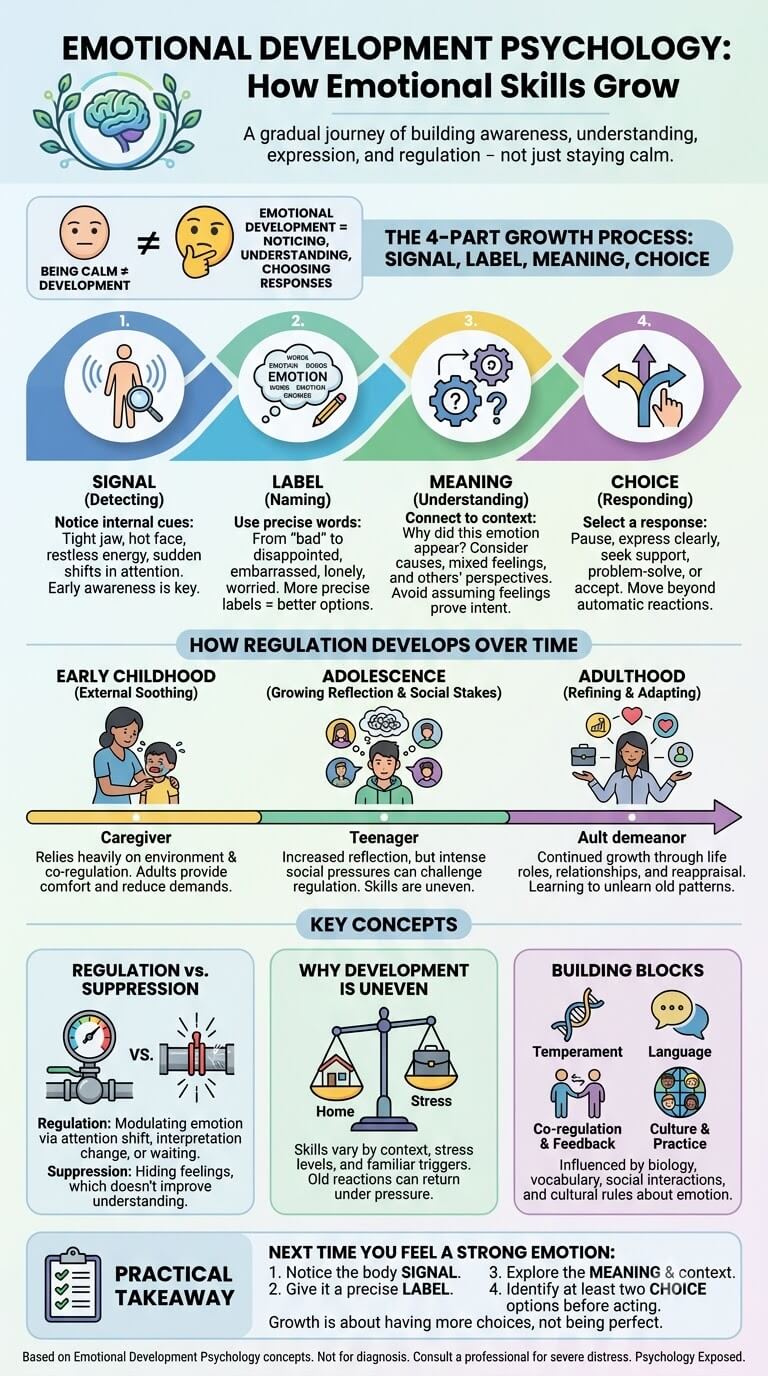
Emotional development includes awareness, understanding, expression, and regulation
Emotional development is the gradual growth of several connected abilities: noticing feelings, naming them accurately, understanding their causes and meanings, reading emotional information in other people, expressing emotion in socially workable ways, and regulating responses when needed. These skills develop through maturation, language, relationships, repeated experience, and the cultural rules a person learns around emotion.
Regulation is not the same as suppressing emotion
The APA Dictionary of Psychology definition of emotion regulation describes regulation as the ability to modulate emotion. That is broader than hiding what you feel. Regulation may involve shifting attention, changing how a situation is interpreted, waiting before acting, expressing a feeling more clearly, or choosing an environment that makes the emotion easier to manage. Suppression is only one possible response, and it does not automatically increase emotional understanding.
What Emotional Development Means
A useful way to think about emotional development is as a four-part process: Signal, Label, Meaning, Choice. First, the person detects an emotional signal. Next, they give it a workable label. Then they connect the feeling with context and meaning. Finally, they gain more options for how to respond. Development does not make these steps perfect. It makes them more available and more flexible.
Emotional skills are one part of the wider process of development across the lifespan.
Detecting internal emotional signals
Emotion often appears in the body before it appears as a clear sentence in the mind. A tight jaw, hot face, restless energy, heavy chest, urge to withdraw, or sudden change in attention may be part of an emotional response. Young children often experience these states before they can explain them. Adults can also miss early signals, especially when they are busy or accustomed to ignoring emotion.
Recognizing the signal creates a small but important advantage. “Something is happening in me” is more useful than discovering the feeling only after shouting, shutting down, or sending a message you regret. Emotional awareness begins with detection, not with perfect interpretation.
Learning emotion words and categories
Words give structure to emotional experience. “Bad” can become disappointed, embarrassed, lonely, irritated, jealous, worried, or ashamed. The more precise label does not make the feeling disappear, but it changes what can happen next. Disappointment may call for adjusting an expectation. Embarrassment may need perspective. Anger may point to an obstacle, perceived unfairness, or a crossed boundary.
Labels also help people communicate. “I feel off” gives another person little information. “I feel left out because plans were made without me” identifies both the emotion and its context. This is one reason language and emotional development are closely connected.
Understanding causes, mixed feelings, and other people’s emotions
As emotional understanding becomes more complex, people become more able to recognize that one event can produce several feelings at once. Starting a new job can bring excitement, fear, pride, and grief about leaving the old one. A teenager can love a friend and still resent being excluded. An adult can understand a parent’s good intention while still feeling hurt by the impact.
Emotional development also expands perspective-taking. A person learns that someone else can feel differently about the same event, and that another person’s expression may not perfectly reveal what they feel. This reduces the temptation to assume that one’s own emotional reading is the only possible interpretation.
Choosing how to express or regulate a feeling
The later part of the process is not “get rid of the emotion.” It is deciding what response fits the situation. Crying may be appropriate. So may asking for space, seeking comfort, setting a boundary, waiting before replying, taking action on a real problem, or simply allowing a feeling to pass without turning it into behavior.
Greater emotional development increases response options. When only one response feels available, the emotion tends to drive behavior directly. When several options are accessible, the person has more room to choose.
| Developmental step | Basic form | More complex form |
|---|---|---|
| Signal | Feels activated or uncomfortable | Notices early body and attention changes |
| Label | “I feel bad” | Distinguishes disappointment, fear, shame, anger, or loneliness |
| Meaning | “This feeling means something is wrong” | Considers context, interpretation, history, and alternative explanations |
| Choice | Acts on the first impulse | Selects among expression, pause, problem-solving, support, or acceptance |
The Building Blocks of Emotional Development
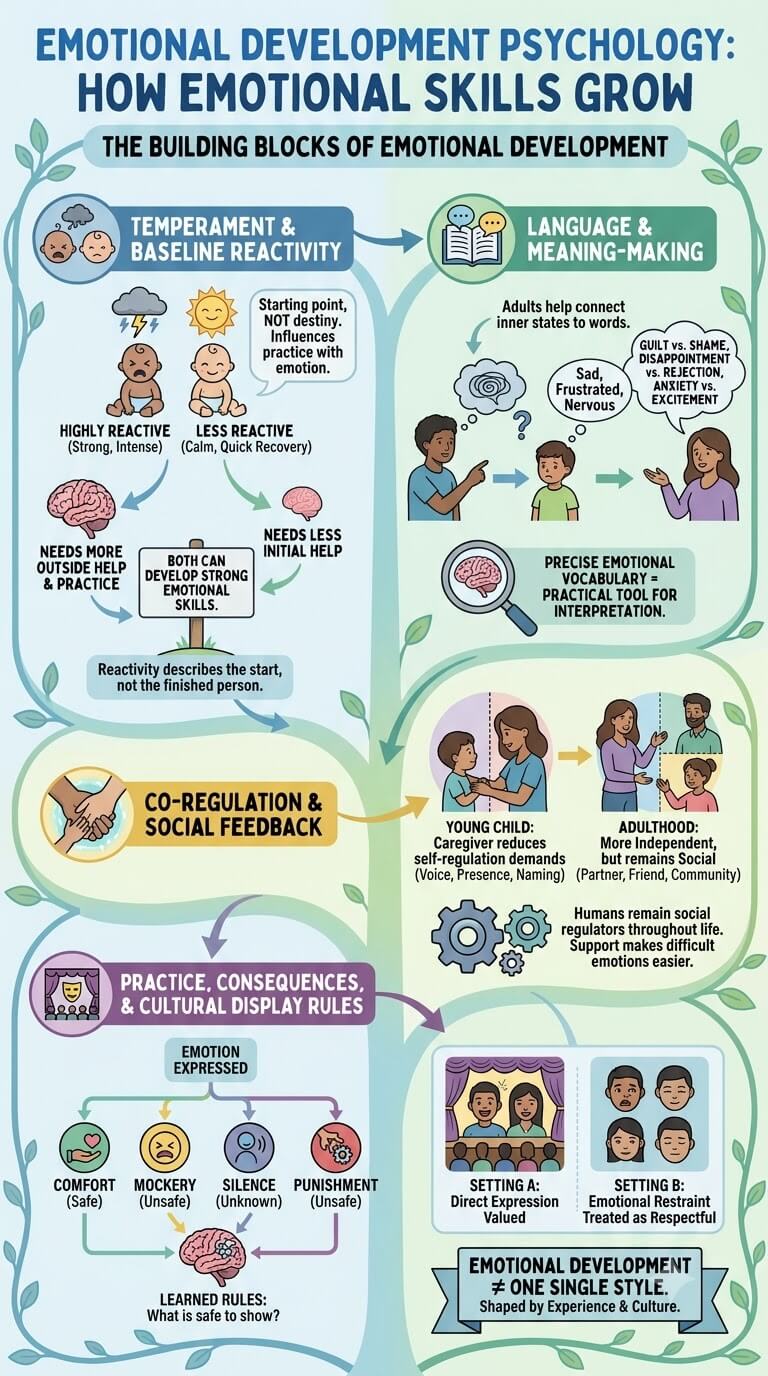
Temperament and baseline reactivity
People do not begin from identical emotional starting points. Some infants and children react strongly to novelty, frustration, noise, separation, or change. Others are less reactive or recover more quickly. Temperament can influence how often a child gets practice with intense emotion and how much outside help they need before self-regulation is possible.
The foundations of labeling feelings, co-regulation, and gradually increasing self-regulation are especially visible in child development.
Temperament is not destiny. A highly reactive child can develop strong emotional skills, and a calm child can still struggle to understand or communicate feelings. Reactivity describes part of the starting pattern, not the finished person.
Language and meaning-making
Language makes emotion easier to organize. Adults help children connect inner states with words by naming what may be happening: “You wanted another turn and it ended,” or “You look nervous because this place is new.” Over time, the child begins doing more of that meaning-making internally.
Adults continue to benefit from emotional language. A person who learns to distinguish guilt from shame, disappointment from rejection, or anxiety from excitement has more precise information for deciding what to do. Emotional vocabulary is not a performance of sophistication. It is a practical tool for interpretation.
Co-regulation and social feedback
Before people can consistently regulate emotion alone, they often regulate with other people. A caregiver’s voice, proximity, predictable response, or help naming a feeling can reduce the demands on a young child’s still-developing self-regulation. Researchers studying emotion regulation development in early childhood have examined how self-regulatory processes become more effective across these early years.
Co-regulation does not disappear in adulthood. A calm friend, supportive partner, clear manager, or familiar community can make difficult emotion easier to manage. Adult self-regulation usually involves more independent capacity, but humans remain social regulators throughout life.
Practice, consequences, and cultural display rules
People learn what happens when emotion is expressed. If sadness is met with comfort, mockery, silence, problem-solving, or punishment, those responses become information about what is safe to show. If anger is accepted in one family but sadness is discouraged, children may learn to translate vulnerable feelings into irritation. Other families may discourage anger while allowing worry or guilt.
Culture also shapes how emotion should be displayed, to whom, and under what circumstances. Direct expression may be valued in one setting while emotional restraint is treated as respectful in another. Emotional development therefore cannot be measured by a single cultural style such as “always say exactly how you feel.”
How Emotional Regulation Develops

From external soothing toward greater self-regulation
Early regulation depends heavily on the environment. A baby cannot step away, reframe a disappointment, or remind themselves that a caregiver will return. Adults change the environment, provide soothing, and reduce demands. As language, attention, memory, and executive control develop, children gain more ways to participate in regulating themselves.
The shift is gradual. A preschooler may need a reminder to take space. A school-age child may recognize that they need a break but still need help using it. An adolescent may regulate effectively in many settings and struggle when social rejection or public embarrassment raises the stakes.
Using attention, interpretation, and action to change an emotional response
Emotion regulation can happen at several points. Attention can be moved away from an unhelpful cue. A situation can be interpreted differently. The person can change the situation itself, choose a response, or recover after the first response has already happened.
For example, imagine waiting for a friend who is late. One person repeatedly checks the door and builds the story “They do not respect me.” Another considers traffic, sends a neutral message, and decides what waiting limit is acceptable. The second person is not necessarily less annoyed. They are using more than one regulation tool before deciding what the lateness means.
Why strong emotion can temporarily reduce access to learned skills
A person can possess an emotional skill without being able to use it equally well in every state. Strong emotion narrows attention, increases urgency, and makes habitual responses more likely. This is why someone may give thoughtful advice to a friend but struggle to use the same perspective during their own conflict.
This difference matters when judging emotional development. A bad moment does not prove the skill is absent. At the same time, repeated harmful behavior should not be excused simply because someone was upset. The useful question is whether the person can recover, reflect, take responsibility, and build better access to the skill next time.
Emotional Understanding Becomes More Complex Over Time
Moving beyond simple good-versus-bad feeling labels
Young children often organize experience into broad positive and negative categories. With language and experience, emotional categories become more detailed. This helps people distinguish what kind of problem they are facing. Fear may call for safety information. Guilt may call for repair. Grief may require time and support rather than a solution.
Emotional experiences can also become part of how people interpret who they are, connecting this process with identity development.
Adults can still collapse feelings into broad labels when overwhelmed. “I am stressed” may contain worry, resentment, overload, disappointment, and uncertainty. Separating them often reveals that different parts need different responses.
Recognizing mixed and conflicting emotions
Complex emotional understanding includes accepting that opposite feelings can coexist. You can be relieved that a relationship ended and still miss the person. You can feel proud of moving away and sad about leaving family. You can understand why someone made a choice and remain angry about its effect.
This capacity reduces pressure to force experience into one verdict. Mixed emotion is not necessarily confusion. Sometimes it is a more accurate representation of a complicated situation.
Separating intention, impact, and emotional meaning
A later emotional skill is keeping several truths in view. Someone may not have intended to embarrass you, yet the comment may still have landed painfully. Your hurt is real, but it does not by itself prove malicious intent. Their good intention matters, but it does not erase impact.
This distinction supports more accurate conversations. Instead of “You wanted to humiliate me,” the person can say, “I felt embarrassed when that was said in front of everyone. What did you mean by it?” Emotional information becomes part of the evidence rather than the whole verdict.
Emotional Development vs Emotional Control
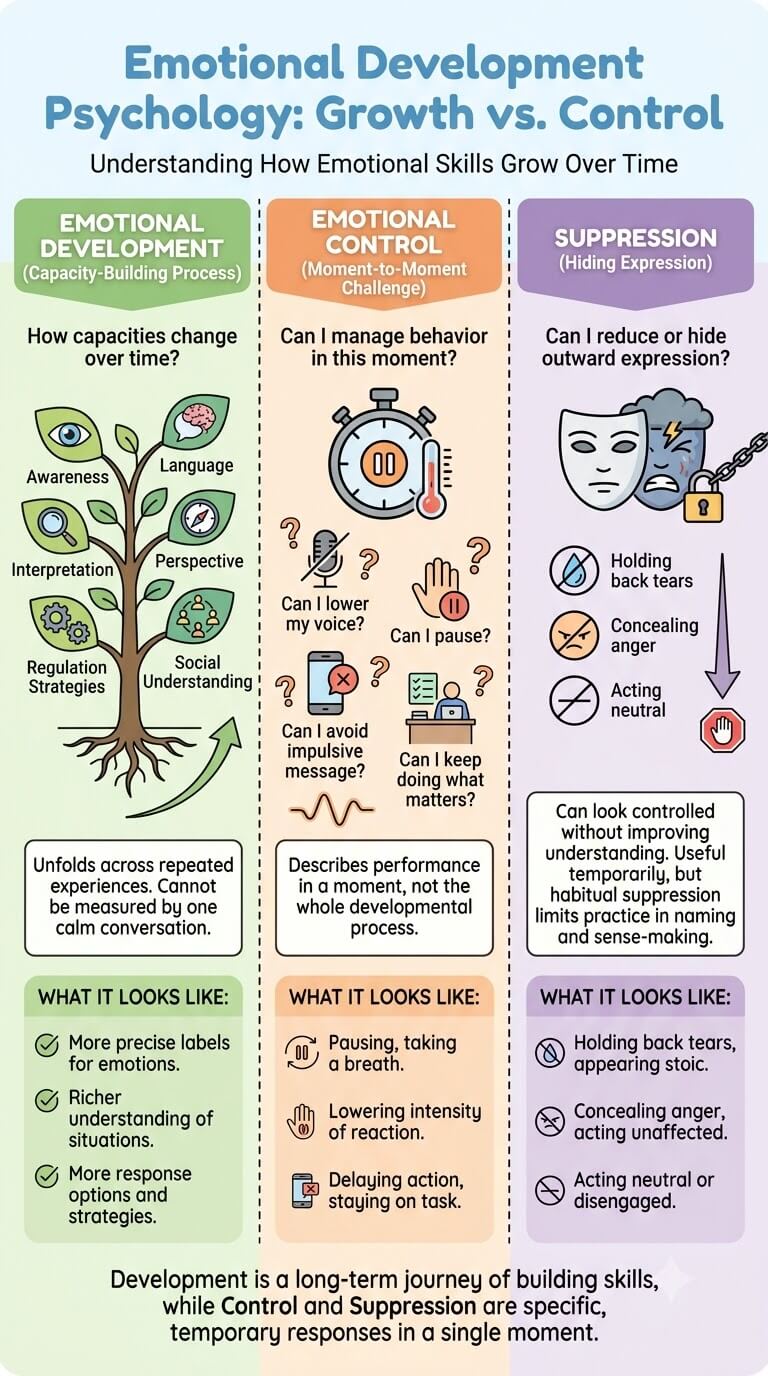
Development is a capacity-building process
Emotional development unfolds across repeated experiences. It includes building awareness, language, interpretation, perspective, regulation strategies, and social understanding. It cannot be measured by whether a person stayed calm in one conversation.
Emotional control is a moment-to-moment regulation challenge
Emotional control usually refers to what happens during a particular state: Can I pause? Can I lower my voice? Can I avoid sending the impulsive message? Can I keep doing what matters while the feeling is present? These are useful questions, but they describe performance in a moment, not the whole developmental process.
Suppression can look controlled without improving understanding
A person may appear composed because they hide every visible sign of emotion. That can be useful temporarily in some situations, such as completing an urgent task before processing a personal problem. But habitual suppression can leave the person with little practice naming, communicating, or making sense of emotion.
| Concept | Main question | What it can look like |
|---|---|---|
| Emotional development | How are emotional capacities changing over time? | More precise labels, richer understanding, more response options |
| Emotional control | Can I manage my behavior in this moment? | Pausing, lowering intensity, delaying action, staying on task |
| Suppression | Can I reduce or hide outward expression? | Holding back tears, concealing anger, acting neutral |
Why Emotional Development Is Uneven
Skills can differ across home, school, work, and relationships
Emotional skill is partly context-sensitive. A child may handle frustration well at school where routines are predictable and fall apart at home after holding themselves together all day. An adult may remain calm with customers but react strongly to criticism from a partner because the relationship carries more personal meaning.
Unevenness does not automatically mean someone is pretending. Different settings activate different histories, expectations, consequences, and emotional stakes.
Stress can narrow regulation options
When stress accumulates, the gap between feeling and reaction often gets smaller. Sleep loss, caregiving pressure, financial strain, conflict, or uncertainty can leave fewer mental resources for reflection. A skill that is easy on a good day may become harder to access when several demands arrive at once.
This does not make harmful actions acceptable. It does suggest that improving emotional functioning sometimes requires changing the load around the emotion as well as practicing the regulation skill itself.
A familiar trigger can reactivate older coping patterns
People often develop newer skills on top of older habits. A familiar cue such as being ignored, criticized, excluded, or rushed can make an older response feel suddenly automatic. The person may become defensive, withdraw, appease, or escalate before the more reflective response comes online.
The developmental question is not “Why am I back at zero?” It is “How quickly can I recognize what happened, recover access to other options, and respond differently after I notice?” Old reactions can remain available even when newer capacities are real.
Emotional Development in Adolescence and Adulthood
Stronger reflection with changing social stakes in adolescence
Adolescence brings more sophisticated reflection about emotion, identity, relationships, and other people’s perspectives. At the same time, peer evaluation, belonging, autonomy, romantic interest, status, and embarrassment can make certain emotional situations especially intense.
These emotional capacities are tested under new social and autonomy demands during adolescent development.
A review of positive and negative emotion regulation in adolescence describes adolescence as a period of substantial development in emotion-regulation skills. This combination helps explain why a teenager can discuss feelings thoughtfully in one moment and struggle to regulate in a socially charged one.
Adult growth through roles, relationships, and repeated reappraisal
Emotional development does not end when formal schooling ends. Work, partnership, parenting, friendship, caregiving, loss, failure, responsibility, and repeated conflict all create opportunities to refine emotional understanding. Adults may become better at recognizing which situations are worth engaging, which interpretations are unreliable, and which response strategies actually help.
Growth can also involve unlearning. Someone raised to treat anger as unacceptable may learn to recognize anger as information without becoming aggressive. Someone who learned to hide sadness may discover that selective disclosure creates connection rather than weakness.
Later adulthood and changing emotional priorities
Later adulthood is not simply a period of reduced emotional capacity. Goals and regulation strategies may change as people become more selective about time, relationships, and emotionally meaningful experiences. Research on age and emotion regulation in daily life has examined how the frequency and use of regulation strategies differ across adulthood.
Emotional growth also continues as adults adapt to changing goals, relationships, responsibilities, and roles through adult development.
These are average developmental patterns, not rules for every person. Health, grief, cognitive changes, social support, culture, and life circumstances can strongly influence emotional experience at any age.
Later adulthood adds another context for emotional adaptation, explored more specifically in the psychology of aging.
A Practical Emotional Development Self-Check
Emotional development is easier to assess by looking at a sequence than by asking whether you are “good with emotions.” Use the four-part model on one recent situation.
Can I identify what I feel?
Begin with the signal and label. What happened in your body? What emotion word fits best? If you have only “fine,” “bad,” or “stressed,” try one level more precise. The aim is not to find a perfect label. It is to create enough specificity to choose a better response.
Can I explain what triggered it without treating the feeling as proof?
Move to meaning. What event preceded the emotion? What did you assume it meant? Which part is observable fact, and which part is interpretation? “They looked at their phone while I was talking” is an observation. “They do not care about me” is one possible meaning. The feeling may be valid even when the interpretation still needs checking.
Can I choose among several responses rather than one automatic response?
Now look for options. Could you ask a question, take ten minutes, write down what you want to say, solve the practical problem, seek comfort, set a limit, or decide that the feeling does not require action? Having choices is one of the clearest signs that emotional regulation is becoming more flexible.
First Steps for Building Emotional Skills

Increase emotional precision before trying to control intensity
When emotion is manageable enough to reflect, identify it more precisely. “I am angry” may become “I feel dismissed and embarrassed.” “I am anxious” may become “I am uncertain about what will happen and I keep imagining the worst outcome.” Precision often reveals a more specific need or question.
Practice a pause that creates more than one response option
A useful pause is not avoidance. It creates room for choice. That pause might be one slow breath before replying, a short walk, writing a draft without sending it, or saying, “I want to answer this well. Give me a few minutes.” The measure of the pause is whether you return with more options, not whether you become completely calm.
Review patterns after the emotion has passed
Reflection is easier after intensity drops. Ask what you noticed early, what story you told yourself, what you did, what helped, and what you would prefer next time. This turns one emotional episode into learning instead of only regret.
Keep the review specific. “I am terrible at emotions” offers no direction. “When I feel publicly corrected, I move from embarrassment to sarcasm very quickly” identifies a sequence that can actually be practiced.
How Emotional Skills Interact With Triggers and Relationships
When the question is about emotions generally
If you want to understand what emotions are, why humans have them, or how different emotions influence behavior, the broader psychology of emotion is the better starting point. Emotional development asks a narrower question: how does a person’s ability to understand and work with those emotions change over time?
When the question is about a recurring trigger or relationship pattern
If one specific cue repeatedly creates a strong reaction, the useful question may shift toward emotional triggers. If the difficulty mainly appears in conversations with another person, listening, trust, attachment expectations, or social development may be more relevant. Emotional development still matters, but it is only one part of the situation.
When Emotional Difficulties Need More Support
Severe distress, persistent impairment, aggression, or self-harm risk
Strong emotion is part of ordinary life, but severe or persistent distress deserves more than a self-help framework when it substantially disrupts sleep, work, school, relationships, eating, daily functioning, or safety. Repeated aggression, feeling unable to control dangerous impulses, or thoughts of self-harm also call for qualified support rather than simply trying harder to regulate alone.
Emotional difficulty can have many possible contributors, including mental health conditions, physical health issues, medication effects, chronic stress, grief, or major life changes. A qualified clinician can assess the whole picture instead of assuming the problem is a lack of emotional maturity.
Fear, threats, humiliation, coercion, or unsafe environments
Regulation advice should not be used to make someone tolerate an unsafe situation more quietly. If fear, threats, stalking, coercion, humiliation, violence, or retaliation are present, safety takes priority over having a calmer conversation. The person affected may need individualized professional or safety support rather than communication practice with the person causing harm.
FAQ About Emotional Development Psychology
At what age is emotional regulation fully developed?
There is no single age when emotional regulation becomes complete. Important abilities develop throughout childhood and adolescence, but adults continue refining strategies through experience, relationships, changing roles, and new demands. Regulation also remains context-sensitive, so a person may handle one kind of emotion well and struggle with another at the same age.
Is emotional maturity the same as being calm?
No. Calmness can reflect regulation, temperament, suppression, low emotional intensity, or simply the situation. Emotional development includes understanding and expressing emotion as well as managing behavior. Someone can cry while responding thoughtfully, or appear calm while avoiding every difficult feeling.
Can adults improve emotional skills?
Yes. Adults can expand emotional vocabulary, notice body signals earlier, practice different regulation strategies, revise interpretations, communicate feelings more accurately, and learn from repeated emotional situations. Development in adulthood may be less visible than in childhood, but psychological change does not stop at a fixed age.
Why do old emotional reactions return under stress?
Stress can reduce access to slower, more reflective responses and make familiar habits easier to trigger. An older coping response may therefore appear even when newer skills are genuine. What matters is whether the person can notice the sequence sooner, recover, repair harm when needed, and strengthen alternative responses over time.
Does emotional development look the same across cultures?
No. The basic capacity to experience and regulate emotion is human, but cultures differ in which emotions are encouraged, how directly they are expressed, when restraint is valued, and what emotional behavior communicates respect or closeness. A culturally unfamiliar style should not automatically be treated as less developed.
Key Takeaways
- Emotional development includes noticing emotional signals, labeling feelings, understanding their meaning, reading other people’s emotions, and gaining more choices for expression and regulation.
- Regulation is broader than suppression. A regulated response may involve attention, interpretation, problem-solving, expression, support, or a deliberate pause.
- Temperament, language, co-regulation, social feedback, practice, and culture all influence how emotional skills develop.
- Emotional skills can look uneven because stress, relationship stakes, familiar triggers, and different environments change how easy a skill is to access.
- Adolescence and adulthood both include continued emotional development. No single birthday marks the end of emotional growth.
- Severe distress, self-harm risk, aggression, major impairment, or unsafe dynamics require more than general emotional-skills advice.
For a practical next step, choose one recent emotional moment and trace only four things: the first signal you noticed, the most accurate label you can give the feeling, the meaning you attached to the event, and the response options you had. You do not need to judge the reaction as mature or immature. You are looking for the point where one more option could become available next time.
Educational note: Psychology Exposed provides general, research-aware information about psychology and human behavior. It does not diagnose emotional or mental health conditions and is not a substitute for individualized professional care.
About the author: Michael Reed, Founder & Lead Writer at Psychology Exposed, focuses on making research-aware psychology understandable in everyday life, including emotions, behavior, relationships, and self-awareness.

Michael Reed is the Founder and Lead Writer at Psychology Exposed. He writes about human behavior, relationships, emotional patterns, self-awareness, and practical psychology topics using research-informed, easy-to-understand content.
Read More About Michael Reed: https://psychologyexposed.com/michael-reed/