
A teenager can debate a complicated social issue with impressive logic, plan months ahead for an exam, and still make a surprisingly impulsive choice when friends are watching. That contrast is often treated as proof that teenagers are irrational. It is more accurate to see adolescence as a period in which growing cognitive ability meets rapidly changing social, emotional, motivational, and autonomy demands.
Adolescent development psychology looks at that whole transition. It asks how reasoning, identity, relationships, emotion, independence, and decision-making change together. The goal is not to excuse harmful behavior or reduce every difficulty to “the teen brain.” It is to understand why the same teenager can show strong judgment in one context and much weaker judgment in another.
Quick Answer

Adolescence combines growing capacity with changing social and emotional stakes
During adolescence, people become better able to think abstractly, consider future possibilities, question inherited rules, define themselves, and make more independent choices. At the same time, belonging, peer evaluation, novelty, reward, embarrassment, status, and autonomy can become especially important. Development therefore involves both increasing capacity and changing conditions under which that capacity is used.
Teen behavior cannot be explained by an unfinished brain alone
The National Institute of Mental Health overview of the teen brain describes adolescence as an important period of brain fine-tuning, learning, adaptation, and social development. That information is useful, but brain maturation is only part of the picture. Experience, family relationships, peers, culture, opportunities, sleep, stress, and the meaning of a situation also shape behavior.
What Changes Psychologically During Adolescence
Greater abstract and future-oriented thinking
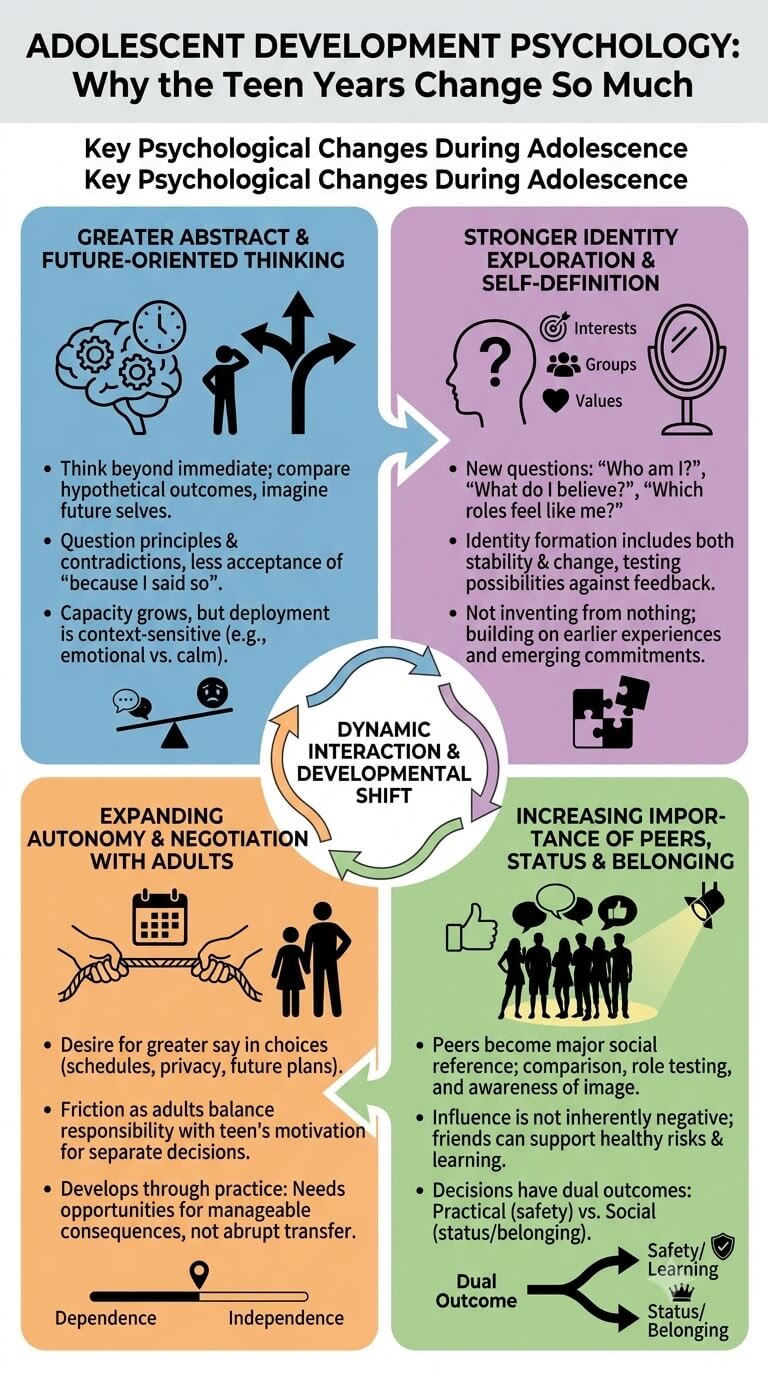
Adolescents become increasingly able to think beyond what is immediately visible. They can compare hypothetical outcomes, reason about principles, question contradictions, imagine future selves, and consider what another person might believe about them. This makes conversations more complex because teenagers are less likely to accept “because I said so” as a complete explanation.
Adolescence is one major transition within the broader pattern of development across the lifespan.
Greater abstract thinking does not mean every decision becomes consistently farsighted. A person may understand long-term consequences in a calm discussion and still give more weight to an immediate reward in a highly emotional or socially charged moment. Capacity is growing, but deployment remains sensitive to context.
The reasoning and control capacities involved in these decisions are examined more closely in our guide to cognitive development.
Stronger identity exploration and self-definition
Adolescence creates new opportunities to ask, “What do I believe?”, “What kind of person do I want to be?”, and “Which groups or roles feel like me?” Interests, appearance, friendships, values, future plans, culture, and social categories may all become more personally meaningful.
A review of identity development during adolescence emphasizes that identity formation includes both stability and change. Teenagers do not simply invent a new self from nothing. They test possibilities against earlier experiences, social feedback, values, and emerging commitments.
Expanding autonomy and negotiation with adults
Adolescents usually want greater say over schedules, friendships, privacy, appearance, school choices, technology, money, and future plans. That shift can create friction because adults may still be responsible for safety, family rules, education, or legal decisions while the teenager is increasingly motivated to act as a separate decision-maker.
Autonomy develops through practice. If every meaningful choice is made for a teenager, there are fewer opportunities to learn from manageable consequences. If responsibility is handed over without support, the demand may exceed the teen’s current experience. Development often involves a changing balance rather than an abrupt transfer from dependence to complete independence.
Increasing importance of peers, status, and belonging
Peers become a major social reference point. Teenagers compare themselves with others, learn group norms, test social roles, and become more aware of how they are seen. This can increase pressure, but peer influence is not inherently negative. Friends can support studying, sports, creativity, volunteering, honesty, and healthy risk-taking such as joining a new group or trying an unfamiliar skill.
Belonging matters because a choice can have two outcomes at once: a practical outcome and a social outcome. Refusing a risky idea may protect safety while threatening status. Speaking in class may support learning while increasing fear of embarrassment. The social meaning changes the decision.
Why Context Matters So Much in Adolescent Decision-Making
Calm reasoning versus emotionally or socially charged situations
A teenager answering a hypothetical question alone in a quiet room is solving a different psychological problem from a teenager making the same choice while angry, excited, embarrassed, attracted to someone, or being watched by friends. The facts may be identical, but the emotional and social stakes are not.
Research reviewed in work on the neuroscience of adolescent decision-making highlights the importance of context, particularly situations involving peers and reward. This helps explain why strong reasoning ability does not guarantee identical choices across settings.
Immediate rewards, social observation, and perceived consequences
Immediate rewards often feel vivid. Future consequences are more abstract. Add an audience, and the reward may include laughter, approval, belonging, attention, or status. A choice that looks irrational from the outside can therefore make more sense when the teenager’s perceived payoff is understood.
This does not mean the choice is wise. It means the decision is being evaluated using more than physical risk or long-term consequences. The teenager may also be considering “Will I look afraid?”, “Will they stop inviting me?”, or “Will this prove I belong?” Those social outcomes can carry real psychological weight.
Experience and opportunity to practice self-directed choices
Decision-making improves partly through experience. Choosing a course, managing a budget, resolving a friendship problem, planning transportation, or dealing with a missed deadline teaches information that cannot be fully learned through lectures.
Practice also makes consequences more concrete. A teen who has had to rearrange plans after overspending may understand budgeting differently than one who has only heard that spending too much is bad. Development therefore depends on opportunities to make decisions at a level where mistakes are informative rather than catastrophic.
The Development of Autonomy

Moving from external rules toward internal reasons
Children often follow rules because an adult is present, because punishment is expected, or because the rule is familiar. Adolescents increasingly ask whether the rule makes sense and whether they personally endorse the reason behind it.
This transition can sound argumentative. “Why?” may be a challenge, but it can also reflect a developmental shift toward internal justification. A rule that can be explained in terms of safety, fairness, responsibility, or shared household needs gives the teenager something to evaluate rather than merely obey.
Why autonomy includes responsibility, not just freedom
Autonomy means having meaningful control over choices while understanding that choices affect other people and future options. Staying out later, for example, also involves transportation, communication, sleep, school responsibilities, and agreements with the people who share responsibility for safety.
Research on adolescent autonomy with parents and peers illustrates that autonomy develops within relationships rather than simply by rejecting them. A teenager can become more self-directed while remaining connected to family and other important people.
Conflict as renegotiation rather than automatic dysfunction
Some conflict during adolescence reflects changing boundaries. A teenager wants more privacy; a parent still expects information. The teen wants control over clothing or friendships; the adult worries about safety or values. Both may be reacting to a relationship whose rules are changing.
Conflict is not automatically healthy either. Constant humiliation, threats, intimidation, severe control, or violence should not be reframed as normal developmental friction. The useful distinction is between negotiation over changing autonomy and behavior that creates fear or danger.
Identity and Self-Definition During Adolescence
Trying roles, values, groups, and future selves
Adolescents often experiment. They may change styles, interests, friendship groups, goals, or opinions. From an adult perspective, this can look inconsistent. From a developmental perspective, some inconsistency is expected when a person is comparing possibilities.
Exploration becomes more productive when experience generates information. Joining a club, taking a class, volunteering, working part-time, or spending time with different groups can reveal more than endless thinking about who one “should” become.
The exploration of roles, beliefs, values, and future selves is examined more deeply in our guide to identity development.
Feedback from peers and family as identity information
Other people act like mirrors. A teen may learn that friends see them as funny, dependable, awkward, athletic, artistic, brave, quiet, or ambitious. Family feedback may reinforce other roles such as “the responsible one” or “the difficult one.” These labels can influence self-understanding even when they are incomplete.
Adolescent development involves deciding which feedback to accept, modify, or reject. A teenager does not need to become independent from all influence. The more realistic goal is learning which influences fit chosen values and which merely protect approval.
Why uncertainty can be developmentally normal
A teenager who changes career ideas three times is not necessarily confused in a clinically meaningful sense. They may be discovering what different roles involve. A person who questions a belief may be testing whether it still fits rather than losing all stability.
Concern becomes more important when identity uncertainty is accompanied by severe distress, frightening disconnection, major loss of functioning, or self-harm thoughts. Ordinary exploration and severe psychological instability should not be treated as the same thing.
Peer Influence Without the Stereotype
Peers can increase risk, support, learning, and prosocial behavior
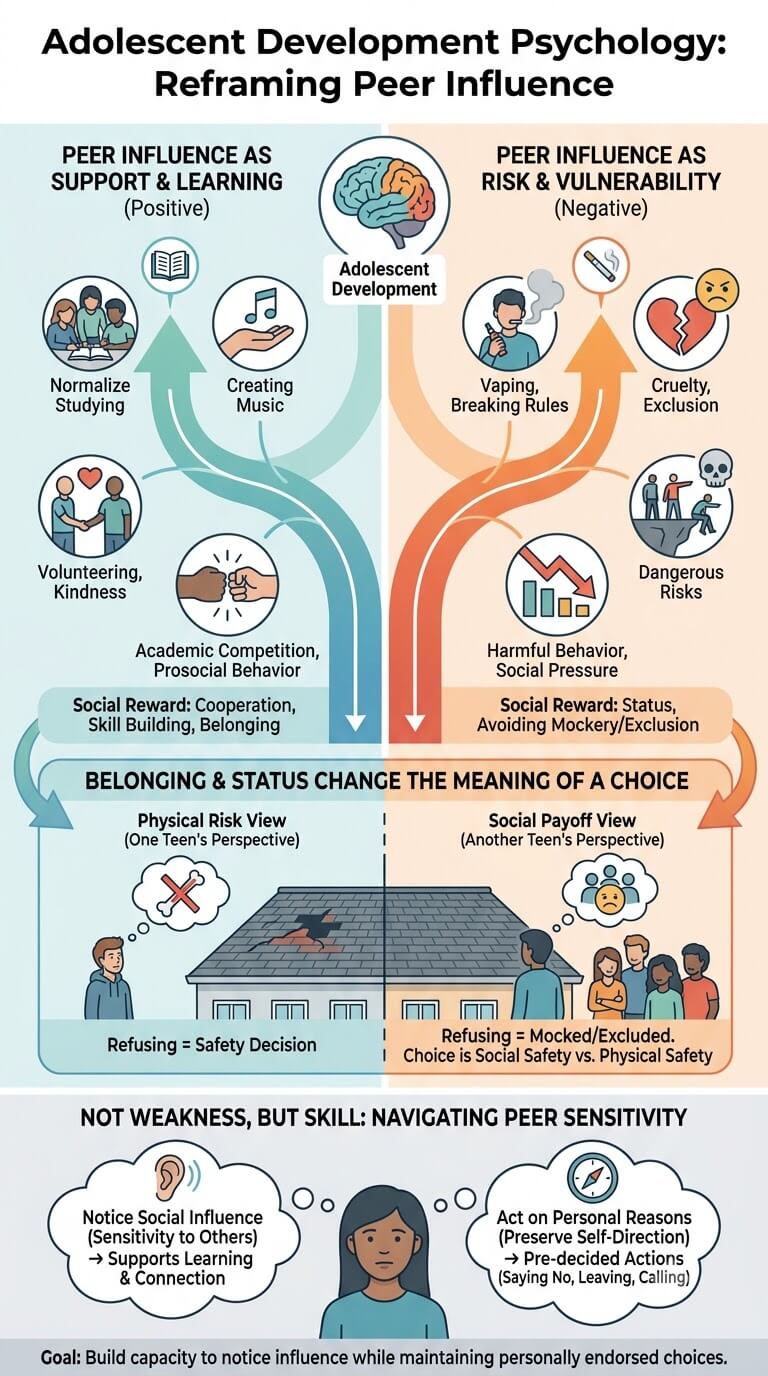
“Peer pressure” is often used as if peers only push teenagers toward harmful behavior. In reality, peers teach and reinforce many kinds of behavior. A friend group may normalize studying, exercising, creating music, volunteering, breaking rules, vaping, kindness, cruelty, or academic competition.
A review of peer influences on adolescent decision-making describes how the presence and behavior of peers can affect adolescent choices. The direction of influence depends on what the group values and what social reward the teenager expects.
Belonging and status change the meaning of a choice
Imagine two teenagers deciding whether to climb onto a dangerous roof. For one, it is mainly a physical-risk decision. For the other, refusing may also mean being mocked or excluded by a new friend group. The second teen is not facing the same perceived choice.
Understanding the social payoff helps adults and teens think more clearly about prevention. Saying “just make the right decision” ignores the cost the teenager believes they may pay. A better preparation is deciding in advance what to say, who to call, or how to leave when social pressure is likely.
Peer influence also makes more sense within the wider development of perspective-taking, belonging, and relationships covered in social development.
Why peer sensitivity is not the same as weakness
Humans are social, and adolescence is a period when peer relationships become especially significant. Sensitivity to other people’s reactions can support learning, cooperation, friendship, and belonging. It can also create vulnerability to exclusion and social pressure.
The skill is not becoming unaffected by peers. It is becoming better able to notice social influence while preserving the ability to act on personally endorsed reasons when the group pulls in another direction.
Emotional Development in Adolescence
More complex emotional understanding
Adolescents become increasingly able to recognize mixed emotions, think about why feelings change, understand how social situations shape emotion, and reflect on how they are perceived. A teen can be proud of an achievement and embarrassed by attention at the same time.
More complex emotional understanding does not guarantee calm behavior. Knowing that jealousy, disappointment, or shame is present is different from regulating it effectively during a fast-moving conflict.
Regulation under changing stress and social evaluation
Adolescent stress often includes evaluation: grades, appearance, friendships, dating, popularity, family expectations, future plans, and social media visibility. These concerns are not trivial simply because an adult has already survived similar experiences. To the teenager, the outcome may affect belonging or identity in a very immediate way.
Regulation improves through experience and strategies such as pausing, seeking support, changing attention, reinterpreting a situation, or postponing action. Sleep also matters. NIMH notes that many teenagers do not get enough sleep and that insufficient sleep can make attention and impulse control more difficult.
Why strong emotion does not equal poor emotional development
A teenager can have sophisticated emotional insight and still feel intensely. Emotional development is not a movement toward having weaker feelings. It involves becoming more able to identify, interpret, express, and manage feelings without allowing every immediate impulse to determine behavior.
Intensity becomes more concerning when distress is persistent, severely impairs daily functioning, or is accompanied by self-harm, suicidal thinking, dangerous substance use, or other serious risk. Strong ordinary emotion and severe mental health distress need different responses.
Adolescent Development vs Emerging Adulthood
Dependence, schooling, and family context remain more central in adolescence
Most adolescents still live within structures created largely by adults. School schedules, household rules, transportation, finances, and legal responsibility limit how independently choices can be carried out. Adolescents may want autonomy before they have full control over the practical conditions of life.
For a wider view of where adolescence fits among other age periods without treating those boundaries as rigid, see stages of development.
Emerging adulthood often adds greater role exploration and practical independence
For many people, the period after adolescence involves more direct choices about work, education, relationships, living arrangements, and money. Identity exploration may continue, but the decisions increasingly have practical adult consequences.
That does not mean everyone experiences a distinct “emerging adulthood” period. Culture, finances, family expectations, education, work opportunities, and social roles affect when and how adult independence develops.
The transition is gradual and culturally variable
There is no single psychological birthday when adolescence switches off. A nineteen-year-old may have adult responsibilities in one area and substantial dependence in another. A sixteen-year-old may handle family responsibilities that require unusual maturity while still having limited legal or financial autonomy.
Developmental categories are most useful as maps, not verdicts. They describe common patterns while leaving room for culture and individual circumstances.
Common Myths About Adolescent Psychology
Teens cannot think logically
Adolescents can reason logically and increasingly handle abstraction, hypothetical thinking, and future planning. The more accurate issue is that performance changes with context. Social evaluation, emotion, reward, stress, and experience can change which reasoning tools are used in the moment.
All risk-taking comes from hormones
Hormonal and biological changes are part of adolescence, but risk behavior also depends on peers, rewards, opportunity, personality, learning history, family context, culture, stress, and the specific situation. A single biological explanation misses too much.
Conflict with adults is always a sign of bad relationships
Some disagreement reflects renegotiation of autonomy and boundaries. A teenager asks for more privacy or choice; an adult tries to maintain safety and responsibility. The quality of the conflict matters more than the mere presence of disagreement.
Respectful disagreement is different from chronic contempt, threats, coercion, humiliation, or violence. Those behaviors should not be normalized as ordinary teen-parent conflict.
Peer influence is always harmful
Peers can encourage risk, but they also reinforce effort, generosity, courage, creativity, learning, and responsible choices. The better question is not whether peers have influence. It is what kind of behavior the group rewards and how much freedom a teenager feels to disagree.
A Better Framework for Understanding a Teen Behavior
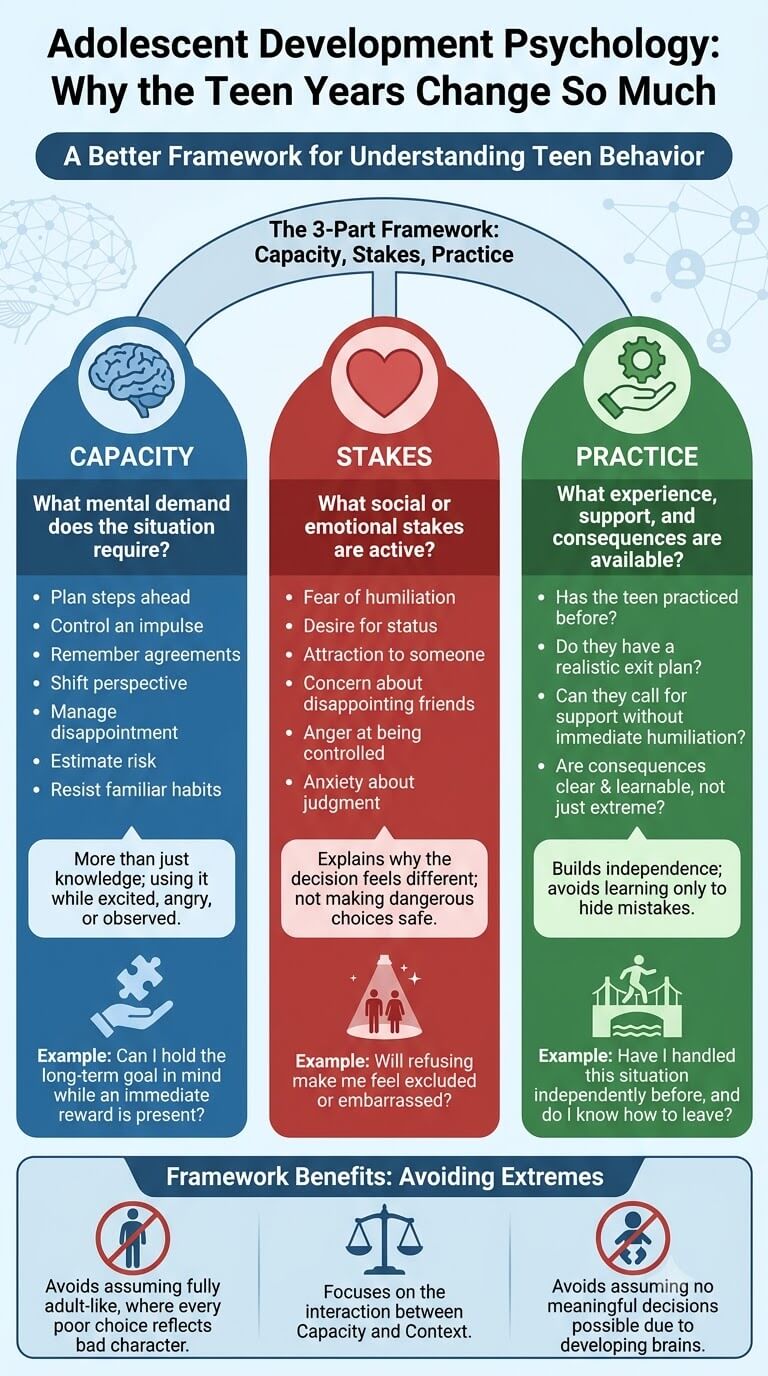
When a teen’s choice seems confusing, use a three-part check: Capacity, Stakes, Practice. This separates what the teenager is able to understand from what the moment means socially or emotionally and how much experience they have using that ability independently.
What capacity does the situation require?
Does the teen need to plan several steps ahead, control an impulse, remember an agreement, shift perspective, manage disappointment, estimate risk, or resist a familiar habit? Define the actual mental demand before deciding that the problem is immaturity.
For example, “You should have known better” may refer to knowledge. The teen may indeed know the rule. The more precise question is whether they successfully used that knowledge while excited, embarrassed, angry, or under peer observation.
What social or emotional stakes are active?
Ask what the teenager believes is at risk besides the obvious outcome. Is there fear of humiliation? Desire for status? Attraction to someone? Concern about disappointing friends? Anger about feeling controlled? Anxiety about being judged?
These stakes do not make a dangerous choice safe, but they help explain why the decision feels different from an adult’s outside view. Understanding the perceived payoff makes it easier to prepare for the real pressure point.
What experience, support, and consequences are available?
Has the teenager practiced this kind of choice before? Do they have a realistic exit plan? Can they call someone without expecting immediate humiliation? Are consequences clear enough to learn from, or so extreme that the teen mainly learns to hide mistakes?
| Question | What it reveals | Example |
|---|---|---|
| Capacity | The thinking or regulation skill required | Can I hold the long-term goal in mind while an immediate reward is present? |
| Stakes | The social and emotional meaning of the moment | Will refusing make me feel excluded or embarrassed? |
| Practice | How much experience and support exist | Have I handled this situation independently before, and do I know how to leave? |
This framework avoids two extremes. One extreme assumes the teenager is fully adult-like and therefore every poor choice reflects bad character. The other assumes teenagers cannot make meaningful decisions because their brains are still developing. Both miss the interaction between capacity and context.
What to Explore Next
Identity Development for exploration and commitment
If the central question is how a teenager is testing roles, values, beliefs, groups, or future directions, identity development is the more precise lens. That topic goes deeper into exploration, commitment, revision, and continuity of the self.
Cognitive Development for reasoning and control
If the question is mainly about working memory, inhibition, flexible thinking, abstract reasoning, or problem-solving, cognitive development provides a closer look at how those capacities change over time.
Social Development for peers and perspective-taking
If the issue centers on friendship, reciprocity, cooperation, perspective-taking, belonging, or group norms, social development helps separate age-related social learning from personality or popularity.
Emerging Adulthood for the next transition
If the main concern is what happens after adolescence as practical independence, work, relationships, and adult roles become more self-directed, emerging adulthood is the better frame. It continues some of the same developmental questions under different life conditions.
When Adolescent Distress or Risk Needs Support
Persistent severe distress, self-harm, substance risk, or major functional decline
Developmental change does not explain away serious mental health concerns. Persistent hopelessness, severe anxiety, self-harm, suicidal thoughts, dangerous substance use, major withdrawal, or a sharp decline in school, sleep, eating, relationships, or daily functioning deserves qualified attention.
Do not rely on “teenagers are moody” as an explanation when the severity, duration, or risk is high. A pediatric, medical, school mental health, or licensed mental health professional can evaluate the larger picture.
Abuse, coercion, bullying, threats, exploitation, or unsafe relationships
Adolescents can face harm from adults, peers, romantic partners, online contacts, employers, or groups. Fear, threats, sexual coercion, stalking, financial exploitation, severe bullying, blackmail, violence, or retaliation are safety issues, not simply developmental conflict.
In unsafe situations, prioritize protection and trusted support over trying to improve communication with the person causing harm. If there is immediate danger, use local emergency or specialized safety resources appropriate to the situation.
FAQ About Adolescent Development Psychology
Why do teenagers act differently around peers?
Peers can change the emotional and social meaning of a choice. A decision may suddenly involve belonging, status, embarrassment, approval, or fear of exclusion in addition to the practical outcome. Research on adolescent decision-making shows that peer presence and peer behavior can influence choices, although the size and direction of that influence vary across people and situations.
Does adolescent brain development mean teens cannot make good decisions?
No. Adolescents can reason, plan, learn, and make responsible choices. Brain development continues during adolescence, but behavior also depends on experience, social context, stress, reward, sleep, and opportunity to practice decision-making. “Still developing” should not be translated into “incapable of good judgment.”
Is conflict with parents normal during adolescence?
Some increase in disagreement can occur as autonomy and family boundaries are renegotiated. That does not mean constant hostility is inevitable or desirable. Respectful negotiation is different from intimidation, humiliation, threats, severe control, or violence, which should not be normalized as a routine developmental stage.
When does adolescence end psychologically?
There is no single psychological cutoff. Biological development, legal adulthood, financial independence, education, cultural expectations, and adult roles do not all change on the same date. Adolescence gradually gives way to adult patterns, and the timing varies across individuals and societies.
Why does identity change so much in the teen years?
Adolescents gain more abstract thinking, social comparison, autonomy, exposure to different groups, and opportunities to imagine future roles. Those changes create more material for identity exploration. Some aspects of identity become more stable, while others remain open to revision as experience grows.
Key Takeaways
- Adolescence involves growing reasoning, autonomy, identity, emotional understanding, and social awareness, not a simple period of irrationality.
- Teen decisions often vary across contexts because peer observation, reward, embarrassment, belonging, stress, and immediate emotion can change what feels important.
- Autonomy develops through supported practice and responsibility, not by choosing between total control and total independence.
- Peer influence can promote both risky and positive behavior. The important question is what the group rewards and how much freedom the teen feels to disagree.
- Identity exploration and strong emotions can be part of normal development, but severe distress, self-harm, dangerous substance use, or major functional decline deserves qualified support.
- A useful way to understand confusing teen behavior is to separate Capacity, Stakes, and Practice before making a global judgment about maturity or character.
When a teenager’s behavior surprises you, choose one recent situation and run it through the Capacity, Stakes, Practice framework. Identify the mental skill required, the social or emotional meaning of the moment, and how much real experience the teenager has handling that demand independently. That gives you a more useful starting point than “teens are just impulsive” or “they should know better.”
Educational note: Psychology Exposed provides general, research-aware information about adolescent development. It cannot evaluate an individual teenager or replace medical, developmental, mental health, or safety assessment.
About the author: Michael Reed is the Founder & Lead Writer at Psychology Exposed. He explains human behavior, relationships, emotional patterns, self-awareness, and everyday psychology in clear, practical language for general readers.

Michael Reed is the Founder and Lead Writer at Psychology Exposed. He writes about human behavior, relationships, emotional patterns, self-awareness, and practical psychology topics using research-informed, easy-to-understand content.
Read More About Michael Reed: https://psychologyexposed.com/michael-reed/