

Most people do not build an identity once and then carry the same finished version for life. A teenager may be certain about a future career and rethink it after real experience. A young adult may discover that values inherited from family do not fit every part of adult life. A parent, manager, caregiver, retiree, or newly single adult may have to answer an old question in a new context: who am I now?
Identity development psychology looks at that process of continuity and change. It focuses on how people explore possibilities, make commitments, test them in real life, and revise them when experience no longer fits. This is different from simply listing personality traits or asking whether you are having an identity crisis. Uncertainty can be uncomfortable, but uncertainty by itself is not evidence that something is psychologically wrong.
Quick Answer
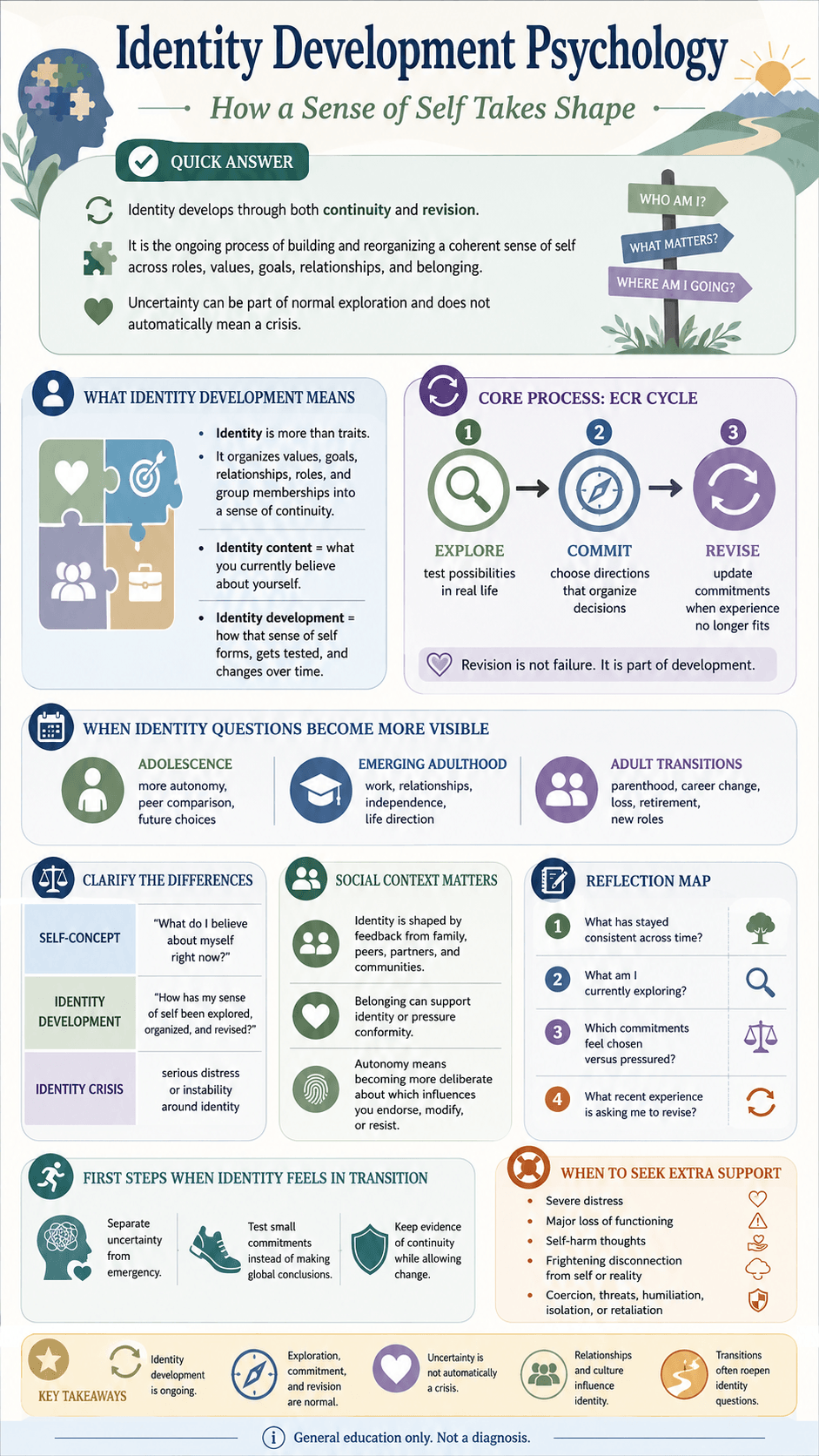
Identity develops through both continuity and revision
Identity development is the ongoing process of building and reorganizing a coherent sense of who you are across roles, values, goals, relationships, and group memberships. Research on identity development often emphasizes processes of exploration and commitment rather than one final state that everyone reaches. A review in PubMed Central on identity development in adolescence describes these processes as dynamic and connected across time.
Uncertainty can be part of exploration without being a crisis
Not knowing exactly what you want can mean several different things. You may be considering real alternatives, testing a new role, adjusting to a transition, or discovering that an old commitment no longer fits. A crisis involves more than ordinary questioning. It usually includes a level of distress, instability, or loss of functioning that makes the uncertainty harder to manage.
What Identity Development Means
Identity as an organized sense of who I am
Identity is broader than a list of adjectives. “I am quiet,” “I am ambitious,” or “I am creative” may describe parts of a self-concept, but identity also organizes how those qualities fit with your values, relationships, history, goals, social roles, and expectations about the future.
Identity is one changing capacity within the broader pattern of development across the lifespan.
That organization gives continuity. You may behave differently at work, with family, and with close friends while still experiencing yourself as the same person. Development becomes visible when those parts no longer fit together as easily, or when a new experience asks you to make room for a different version of yourself.
Roles, values, goals, relationships, and group memberships
Identity is built from multiple domains. Work may answer “what do I contribute?” Relationships may answer “who am I with other people?” Values help answer “what matters enough to guide my choices?” Cultural, community, religious, professional, family, and social identities can also influence how a person understands belonging and responsibility.
No single domain has to dominate. A person may care deeply about work without making work the center of identity. Another may organize life around family, creativity, service, faith, independence, or community. The developmental task is not to choose the one correct domain. It is to build enough coherence that important parts of life can coexist without constant contradiction.
The difference between identity content and identity development
Identity content is what you currently believe belongs to your sense of self. Identity development is how those beliefs were formed, tested, strengthened, questioned, or revised. The difference is similar to the difference between a photograph and a film. One captures what is present now. The other shows how the picture changes over time.
This distinction matters because two people can describe themselves in similar ways while arriving there through very different processes. One person may have explored several paths and made a considered commitment. Another may have accepted the same path mainly because it was expected. The current answer looks similar, but the developmental route is different.
The Core Process: Exploration, Commitment, and Revision

A practical way to understand identity development is the ECR cycle: Explore, Commit, Revise. The cycle does not always move neatly forward. People may revisit an earlier question after a new relationship, loss, job change, migration, parenthood, illness, success, failure, or change in values.
Exploring possibilities rather than choosing immediately
Exploration means considering alternatives seriously enough to learn from them. That may involve trying a course, talking with people in a profession, spending time with a new community, reconsidering a belief, or noticing how you feel in a role you once assumed you wanted.
Exploration is more useful when it produces information. Endless comparison without action can create the feeling of movement while leaving every option hypothetical. A person choosing between careers may learn more from one short project or informational interview than from another month of imagining every possible future.
Making commitments that organize choices
A commitment gives structure. It may be a career direction, relationship, value, community, long-term goal, or way of living that becomes meaningful enough to guide decisions. Commitment reduces the need to reopen every question every day.
Commitment does not require absolute certainty. In real life, many good commitments are made with incomplete information. The useful question is often not “Can I guarantee this will be right forever?” but “Do I have enough evidence and alignment to live this choice seriously for now?”
Revising commitments when experience no longer fits
Revision is not automatically failure. Sometimes a commitment was appropriate for one period and becomes less suitable after new responsibilities, knowledge, relationships, or priorities emerge. The developmental challenge is to update without assuming that everything that came before was wasted.
For example, a teacher who moves into instructional design may still carry forward an identity organized around helping people learn. The role changes, but an important thread remains. Revision often works best when people ask what should be preserved, what should be released, and what needs to be added.
| Identity process | Useful question | What it can look like |
|---|---|---|
| Explore | What possibilities deserve real-world testing? | Trying roles, gathering information, comparing values, meeting different people |
| Commit | What matters enough to organize my next choices? | Choosing a direction, relationship, principle, community, or goal |
| Revise | What no longer fits, and what still belongs? | Updating a role or belief while preserving meaningful continuity |
Why Identity Becomes Especially Visible During Transitions
Adolescence and expanding autonomy
Adolescence often makes identity questions more visible because young people gain new cognitive, social, and practical opportunities. They encounter more peer groups, ideas, expectations, future choices, and chances to compare themselves with others. The American Psychological Association’s overview of adolescent development describes forming a realistic and coherent sense of identity as an important part of adolescent emotional development.
Identity questions often become more visible as autonomy and peer comparison expand during adolescent development.
That does not mean identity begins in adolescence. Children already build self-understanding from abilities, relationships, feedback, culture, and belonging. Adolescence simply adds greater abstraction and autonomy, which make questions about values, future roles, and social identity more explicit.
The foundations of self-understanding begin well before adolescence and develop alongside other aspects of child development.
Emerging adulthood and new possibilities
For many people, the years after adolescence bring a wider range of choices about work, education, relationships, living arrangements, community, and independence. That can increase exploration because decisions once shaped mainly by family or school structures become more self-directed.
Questions about work, relationships, independence, and possible future selves often continue into emerging adulthood.
Longitudinal research on identity statuses across adolescence and emerging adulthood illustrates that patterns of exploration and commitment can change over time rather than locking into one permanent category. This is one reason a young adult can feel settled in one domain, uncertain in another, and still be developing normally.
Adult transitions that reopen identity questions
Identity development does not end when a person gets a job, chooses a partner, or reaches a particular birthday. New roles can reactivate questions that felt settled. Parenthood may change priorities. A promotion can expose a gap between professional success and personal values. Retirement may remove a role that once supplied structure and status.
Identity can also be reorganized by caregiving, career changes, loss, new relationships, and other forms of adult development.
Educational lifespan-development material from OpenStax on identity in middle adulthood notes that identity continues to evolve as adults adapt to changing goals and experiences. Development in adulthood is often less dramatic than in adolescence, but it can still be psychologically meaningful.
Identity Development vs Self-Concept vs Identity Crisis

Self-concept describes what you currently believe about yourself
Self-concept includes beliefs such as “I am dependable,” “I am not athletic,” “I am a good listener,” or “I am someone who needs independence.” These beliefs can be accurate, distorted, broad, narrow, stable, or situation-specific.
Identity uses some of that material but connects it to larger questions of continuity, belonging, commitment, and direction. You can update a self-concept without reorganizing your whole identity. Realizing “I am better at public speaking than I thought” may change one self-belief without changing who you believe yourself to be overall.
Identity development describes how the larger self-structure changes over time
Development asks how different pieces become coordinated. A person may gradually integrate “I value security,” “I want creative work,” and “I need time for family” into a career identity that looks different from what they imagined at eighteen.
The developmental focus is process. Which alternatives were considered? Which commitments were inherited, chosen, or revised? What experiences changed the person’s interpretation? What stayed stable enough to create continuity?
Identity crisis describes distress or instability around identity, not the entire developmental process
People sometimes use “identity crisis” to describe any period of doubt. That can make normal reconsideration sound pathological. A difficult transition may involve confusion without becoming a severe psychological crisis.
The distinction becomes more important when uncertainty is accompanied by persistent distress, inability to function, frightening changes in the sense of self, or other symptoms that feel unmanageable. In those cases, the issue deserves individualized attention rather than a broad label from an educational article.
| Concept | Main question | Example |
|---|---|---|
| Self-concept | What do I currently believe about myself? | “I see myself as independent and analytical.” |
| Identity development | How has my larger sense of self been explored, organized, and revised? | Reconsidering what independence means after entering a committed relationship |
| Identity crisis | Is identity uncertainty creating serious distress or instability? | Feeling unable to maintain a workable sense of direction or continuity |
Relationships and Social Context Shape Identity
Feedback from family, peers, partners, and communities
Identity is personal, but it is not created in isolation. Other people reflect versions of us back to ourselves. A family may repeatedly describe one child as “the responsible one.” Friends may reinforce a sense of being funny, brave, quiet, fashionable, academic, rebellious, caring, or ambitious. Workplaces and communities add further expectations.
Feedback matters because repeated social responses become evidence. The challenge is that social evidence is not always neutral. A role can be reinforced because it serves the group, not because it fits the person. Someone praised for always being available may eventually realize that “helpful” has become mixed with difficulty saying no.
Belonging can support identity or pressure conformity
Groups can give language, history, support, opportunity, and a sense of being understood. They can also create pressure to perform a version of the self that protects belonging. The same person may therefore feel more authentic in one community and more constrained in another.
A useful test is whether belonging leaves room for reasonable difference. Supportive belonging does not require identical opinions, interests, roles, or life choices. If disagreement leads to humiliation, threats, isolation, or retaliation, the issue is no longer simply about identity exploration. Safety and coercion need to be considered separately.
Why identity is personal without being socially isolated
The idea of “finding yourself” can sound as if the true self exists independently of relationships and culture. Human identity is more relational than that. Language, opportunities, social categories, family stories, institutions, and historical context all shape which possibilities are visible and meaningful.
Because identity forms partly through feedback, belonging, and social roles, it is closely connected with social development.
This does not mean society determines every choice. It means identity develops through an ongoing negotiation between personal experience and social context. Autonomy is not the absence of influence. It is greater awareness of which influences you want to endorse, modify, or resist.
Values, Goals, and Roles Do Not Always Change Together

A new role can precede a new sense of self
Sometimes behavior changes before identity catches up. A first-time manager may perform leadership tasks for months while still thinking, “I am just the person who used to do the technical work.” A new parent may meet caregiving responsibilities while taking longer to feel that parenthood belongs inside their sense of self.
This lag is not necessarily a problem. Roles provide experiences, and experiences supply evidence. Identity may gradually reorganize as the person learns what the role requires and which parts fit.
Values may stay stable while goals change
A person can abandon a goal without abandoning the value behind it. Someone who leaves medicine after years of training may still value service, mastery, or helping others. Those values can be expressed through another profession.
This distinction reduces all-or-nothing thinking. “I changed my goal” does not have to become “I never knew who I was.” Sometimes the deeper identity thread is more stable than the particular plan that once expressed it.
Conflicting roles can create temporary identity tension
Roles make competing demands. A person may value being a present parent and an ambitious professional. They may care about family expectations while also wanting more independence. They may feel loyal to a community while disagreeing with some of its norms.
Identity tension often becomes easier to understand when the conflict is stated precisely. Instead of “I do not know who I am,” the real question may be “I do not yet know how to combine two roles that matter to me.” That is a more specific developmental problem and usually allows more specific experiments.
What Healthy Identity Development Does Not Require
Perfect certainty
A workable identity does not require a permanent answer to every major life question. Some commitments can be strong while others remain open. You can know how you want to treat people while being uncertain about where you want to live. You can feel clear about a relationship while reconsidering work.
Certainty also changes with new evidence. Treating every doubt as proof that a commitment is wrong can make identity fragile. The stronger skill is often tolerating enough uncertainty to gather useful information.
One permanent career or life plan
A coherent identity is not the same as following one plan without revision. Careers change, relationships change, abilities change, and opportunities change. A stable sense of self can include the capacity to adapt.
The question is whether revisions are connected to experience and values rather than whether the original plan survived untouched. Continuity can live in principles, interests, relationships, or ways of contributing even when the external path changes.
Total independence from other people’s influence
No one develops without influence. Family, peers, culture, mentors, communities, media, and institutions shape what people see as possible and desirable. The goal is not to remove all influence but to become more deliberate about it.
A useful sign of ownership is being able to explain why a commitment matters to you beyond “this is what people expect.” Another is being able to reconsider a commitment without feeling that disagreement automatically means betrayal.
An Identity Development Reflection Map
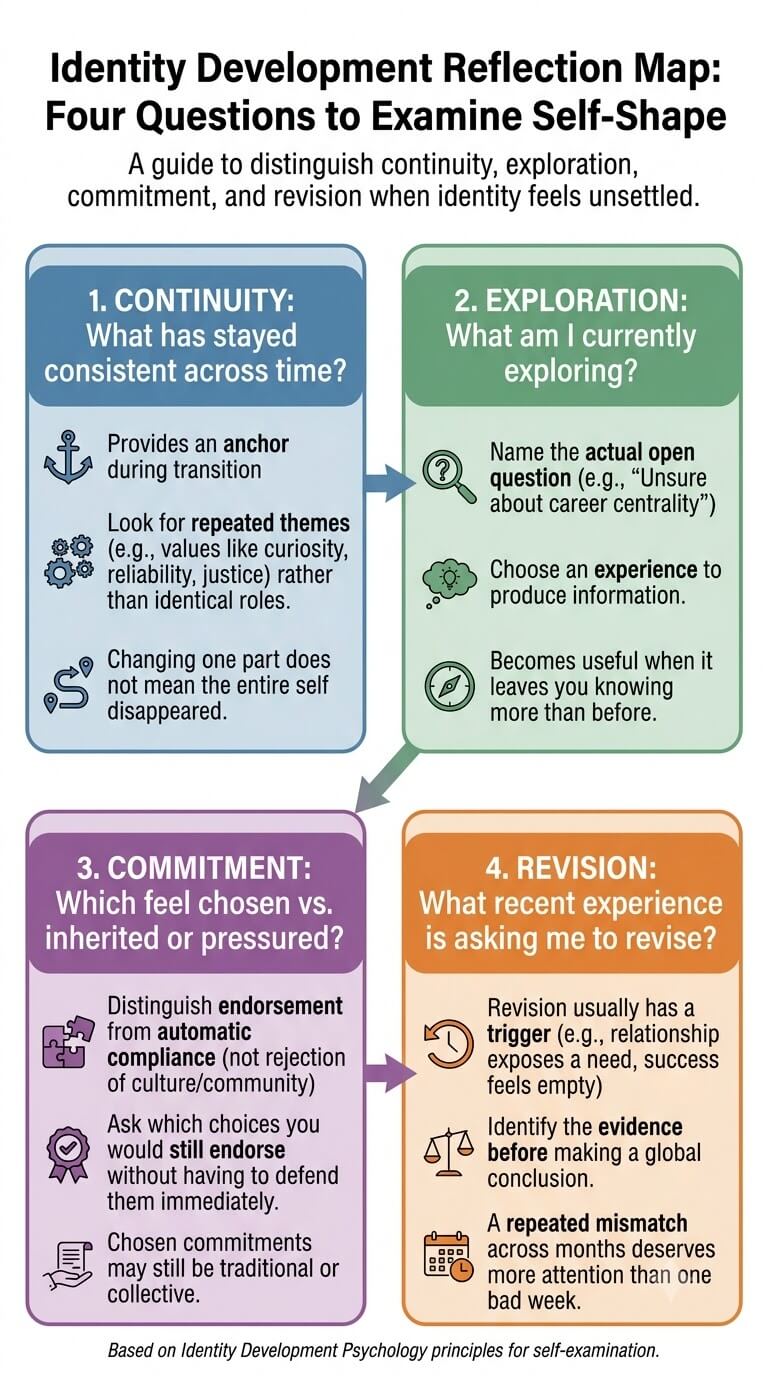
When identity feels unsettled, four questions can turn a vague feeling into something easier to examine. They are not a diagnostic test. They are a way to distinguish continuity, exploration, commitment, and revision.
What has stayed consistent across time?
Look for repeated themes rather than identical roles. Perhaps you have repeatedly valued curiosity, independence, reliability, creativity, belonging, justice, achievement, or care. You may have expressed the same theme through very different jobs and relationships.
Continuity provides an anchor during transition. It reminds you that changing one part of life does not mean the entire self has disappeared.
What am I currently exploring?
Name the actual open question. “My identity is confusing” is hard to work with. “I am unsure whether I want my career to remain central to my identity” is clearer. So is “I am reconsidering what closeness should look like in adult friendships.”
Once the question is specific, choose an experience that could produce information. Exploration becomes useful when it leaves you knowing more than before.
Which commitments feel chosen versus inherited or pressured?
Some inherited commitments fit beautifully. Others continue mostly because changing them would disappoint someone or disrupt belonging. Ask which choices you would still endorse if you could examine them without having to defend them immediately.
This is not an invitation to reject family, culture, or community. It is a way to distinguish endorsement from automatic compliance. A chosen commitment may still be traditional, collective, or deeply connected to other people.
What recent experience is asking me to revise?
Revision usually has a trigger. Maybe a role feels different in practice than it did in imagination. Maybe a relationship exposes a need you previously ignored. Maybe success fails to feel as meaningful as expected. Maybe a value becomes clearer after seeing its opposite.
Identify the evidence before making a global conclusion. One bad week may not justify rebuilding your life. A repeated mismatch across months deserves more attention.
First Steps When Your Identity Feels in Transition
Separate uncertainty from emergency
Ask whether you are uncomfortable or unable to function. Ordinary uncertainty may still bring sadness, anxiety, embarrassment, or regret, but you can usually keep carrying out basic responsibilities while exploring. Severe distress, rapid changes in functioning, frightening disconnection from yourself, or immediate safety concerns call for more support.
Test small commitments before making global conclusions
You do not have to solve identity questions entirely in your head. If you are reconsidering work, volunteer on a project, shadow someone, take a course, or change one responsibility. If you are reconsidering community, attend a new group before deciding where you belong permanently.
Small commitments create feedback with lower stakes. They also reduce the pressure to discover a perfectly certain future self before taking the next step.
Keep evidence of continuity while allowing change
Write down what you want to preserve from the previous version of your life. Skills, values, relationships, lessons, interests, and ways of treating people can move forward even when a role ends.
This prevents revision from becoming unnecessary self-erasure. A mature identity is often less like replacing one person with another and more like editing a story while keeping important chapters in view.
When Another Psychology Lens Fits Better
When the question is about current self-understanding
If your main question is “What do I believe about myself right now?” self-concept is the more precise lens. If you are asking whether a trait such as conscientiousness or extraversion is stable, personality psychology is more relevant. If the question is why a belief feels tied to who you are, beliefs and identity may be the better focus.
Identity development becomes most useful when the question includes time: how did this part of me form, why is it changing now, what am I exploring, and which commitments still fit?
When the question is about a developmental transition
Age and life context can change the meaning of identity exploration. Adolescence brings increasing autonomy and peer comparison. Emerging adulthood may bring education, work, relationship, and independence choices. Later adult transitions can involve caregiving, career shifts, loss, retirement, or changing social roles.
The identity process is only one part of those periods. Looking at the wider developmental context can explain why several psychological demands are arriving at once.
When Identity Distress Needs Professional Support
Severe distress, loss of functioning, or persistent disconnection
Identity questioning does not need to be treated as illness. Still, professional support may be useful when uncertainty is accompanied by severe or persistent distress, inability to manage daily responsibilities, major sleep or appetite disruption, self-harm thoughts, or experiences of disconnection from yourself or reality that are frightening or difficult to manage.
Those experiences have many possible explanations and should not be self-diagnosed from an article. A qualified mental health or medical professional can consider the wider picture and help determine what kind of support is appropriate.
Coercion, threats, humiliation, or control around identity and belonging
Some identity conflicts are not simply internal. A person may face threats, punishment, financial control, humiliation, isolation, stalking, or retaliation for expressing a belief, relationship, role, or part of themselves. In that situation, communication tips and self-reflection may not address the real problem.
Prioritize safety. Consider trusted support, specialized services, or local emergency help when needed. You do not have to prove that a situation fits a particular label before taking fear, threats, or retaliation seriously.
FAQ About Identity Development Psychology
Is identity development only an adolescent process?
No. Adolescence is an especially visible period for identity development because autonomy, abstract thinking, peers, and future choices expand. Identity continues to change in emerging adulthood and later adulthood as people enter, leave, and reinterpret important roles. The pace and subject of change may shift, but development does not stop after the teen years.
What is the difference between identity development and identity crisis?
Identity development is the broader process of exploring, committing, and revising a sense of self. An identity crisis refers to a more disruptive period of uncertainty or instability. Exploration can be uncomfortable without becoming a crisis, and not every change in career, relationship, belief, or role means a person’s identity is collapsing.
Can a stable identity still change?
Yes. Stability does not require rigidity. A stable identity can include durable values and relationships while allowing goals, roles, beliefs, or priorities to change. In fact, the ability to revise when new experience matters can help preserve coherence rather than weaken it.
How do relationships influence identity without determining it?
Relationships provide feedback, expectations, opportunities, belonging, and comparison. Those influences help shape what people notice about themselves and which identities feel possible. Influence is not the same as determination. People can evaluate feedback, reject some expectations, strengthen others, and make commitments that differ from what important people prefer.
Why do major life transitions change how I see myself?
Transitions change the roles, demands, relationships, and evidence available to you. A job loss may remove a role that once supplied confidence. Parenthood may introduce responsibilities that alter priorities. Moving to a new culture may make previously invisible parts of identity more noticeable. The transition changes the context in which the self is understood.
Key Takeaways
- Identity development is an ongoing process of organizing roles, values, goals, relationships, and belonging into a workable sense of self.
- Exploration, commitment, and revision are more useful ways to understand identity change than expecting one permanent answer to “Who am I?”
- Self-concept describes current beliefs about yourself, while identity development focuses on how the larger structure of the self changes across time.
- Uncertainty does not automatically mean an identity crisis. Transitions often reopen questions that were previously settled.
- Relationships and culture influence identity, but greater autonomy includes deciding which influences you want to endorse rather than eliminating influence entirely.
- When identity distress includes major functional decline, self-harm thoughts, frightening disconnection, coercion, threats, or retaliation, individualized professional or safety support is more appropriate than self-analysis alone.
If your sense of self feels unsettled, choose one identity question instead of trying to answer your entire life at once. Identify what has stayed consistent, what you are actually exploring, which commitment is under pressure, and what small real-world experience could give you better information. A clearer next experiment is often more useful than demanding immediate certainty.
Educational note: Psychology Exposed offers general psychology education for self-understanding. It cannot determine why a particular person is experiencing identity distress or replace individualized mental health, medical, or safety support.
About the author: Michael Reed, Founder & Lead Writer at Psychology Exposed, explains human behavior, emotional patterns, relationships, and self-awareness in practical, research-aware language for general readers.

Michael Reed is the Founder and Lead Writer at Psychology Exposed. He writes about human behavior, relationships, emotional patterns, self-awareness, and practical psychology topics using research-informed, easy-to-understand content.
Read More About Michael Reed: https://psychologyexposed.com/michael-reed/