

A five-year-old, a fifteen-year-old, a thirty-five-year-old, and a seventy-five-year-old may face completely different problems, yet the psychology behind their choices is not simply a matter of age. Across life, people gain new capacities, revise old expectations, adapt to changing roles, and sometimes keep familiar patterns even when their circumstances change.
Developmental psychology looks at those patterns of change and continuity. It asks how thinking, emotion, identity, relationships, learning, and behavior develop from early life through later adulthood. The point is not to rank people by a perfect timeline or to explain every difficulty as a developmental problem. A lifespan view is more useful when it helps you ask a better question: what is changing, what is staying relatively stable, and what context is shaping both?
Quick Answer

Developmental psychology is the study of psychological and behavioral change across life. It includes childhood, adolescence, adulthood, and aging, and it examines both growth and stability. Development is influenced by biological maturation, experience, relationships, culture, opportunities, stress, and personal choices, so two people of the same age can follow noticeably different paths.
Development is change plus continuity across time
Development does not mean that everything about a person keeps changing. Some tendencies may remain fairly stable while other abilities, goals, roles, or coping strategies shift. The APA Dictionary of Psychology describes the field as extending beyond childhood to adult development and aging, which is why a lifespan perspective matters.
Different capacities can change at different rates
A person can be advanced in one area and still be developing in another. A teenager may reason impressively about an academic problem but struggle to pause when friends are watching. An adult may have strong work skills yet feel uncertain in a new caregiving role. Development is often uneven because different situations call on different combinations of knowledge, emotion regulation, social understanding, and experience.
What Developmental Psychology Studies
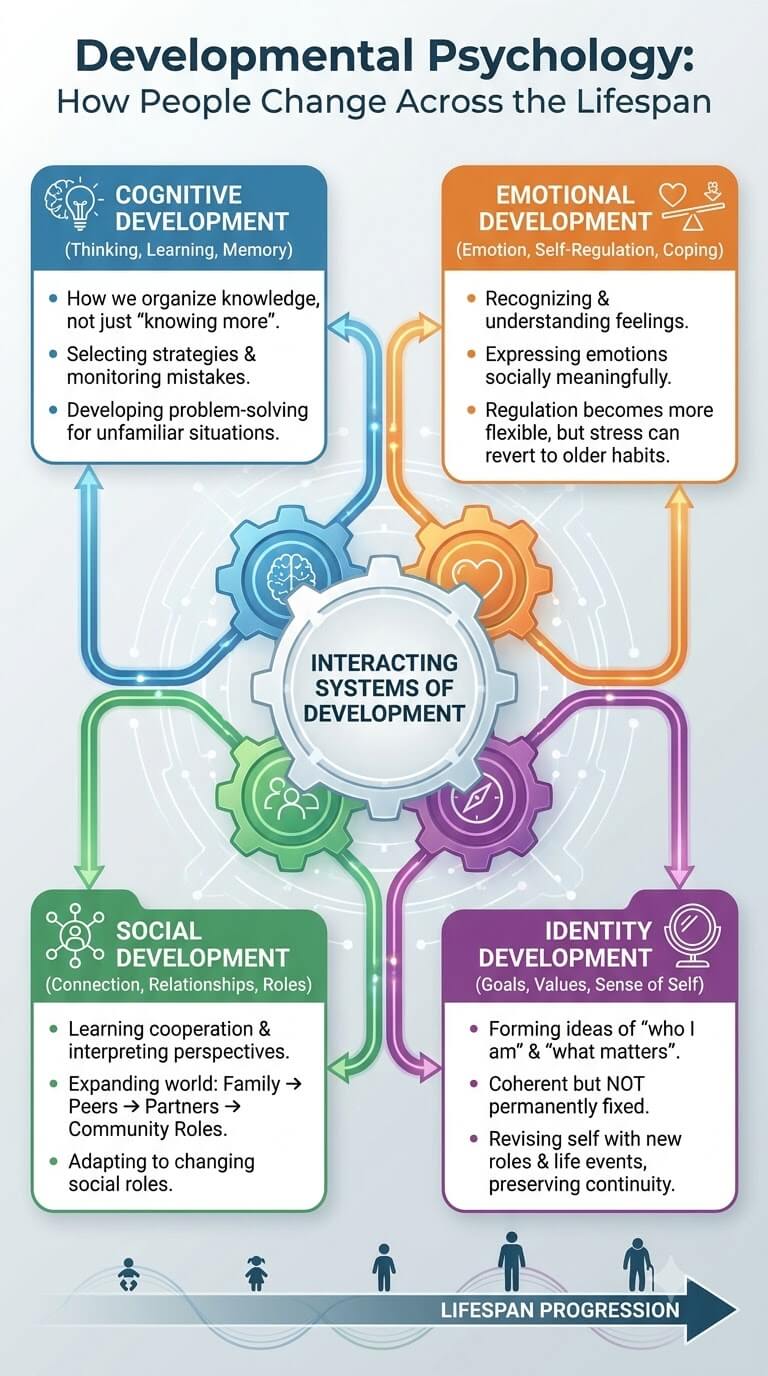
The field is broad because human change is broad. Instead of treating development as one ladder, it is more accurate to picture several interacting systems that influence one another over time.
Thinking, learning, memory, and problem-solving
People gradually change in how they represent information, focus attention, remember what matters, compare possibilities, and solve unfamiliar problems. Developmental questions in this area are not only about knowing more. They also concern how people organize knowledge, choose strategies, monitor mistakes, and use experience.
Emotion, self-regulation, and coping
Emotional development includes recognizing feelings, understanding what may have caused them, expressing them in socially meaningful ways, and choosing how to respond. Regulation usually becomes more flexible with practice, but strong stress can make an otherwise capable person rely on older or simpler coping habits.
Social connection, relationships, and roles
Social development includes learning how to cooperate, interpret other people’s perspectives, handle rules, build friendships, negotiate closeness, and adapt to changing roles. The social world expands dramatically from family relationships in childhood to peers, partners, workplaces, caregiving, and community roles later in life.
Identity, goals, values, and sense of self
People also develop ideas about who they are, what matters to them, which groups they belong to, and what kind of future they want. Identity can become more coherent without becoming permanently fixed. New roles, relationships, losses, achievements, and cultural expectations can all lead people to revise parts of the self while preserving a sense of continuity.
Why Developmental Psychology Matters in Everyday Life
A developmental perspective becomes practical when it helps explain everyday differences without turning age into a shortcut for judging ability or maturity.
Why age alone never explains a person
Age gives useful context, but it does not tell you exactly what someone can understand, feel, or do. Two children in the same grade can differ in language, self-control, confidence, and social experience. Two adults of the same age can have very different responsibilities, health conditions, cultures, resources, and histories. A lifespan approach uses age as one piece of information rather than a complete explanation.
Why development is shaped by biology, experience, culture, and context
Development happens through ongoing interaction. Maturation changes what becomes possible, while learning and relationships shape how abilities are practiced. Culture influences what independence, adulthood, family responsibility, emotional expression, and aging are expected to look like. Opportunity matters too. A skill that is rarely needed or supported may develop differently from one that is practiced every day.
A Lifespan Framework for Psychological Change
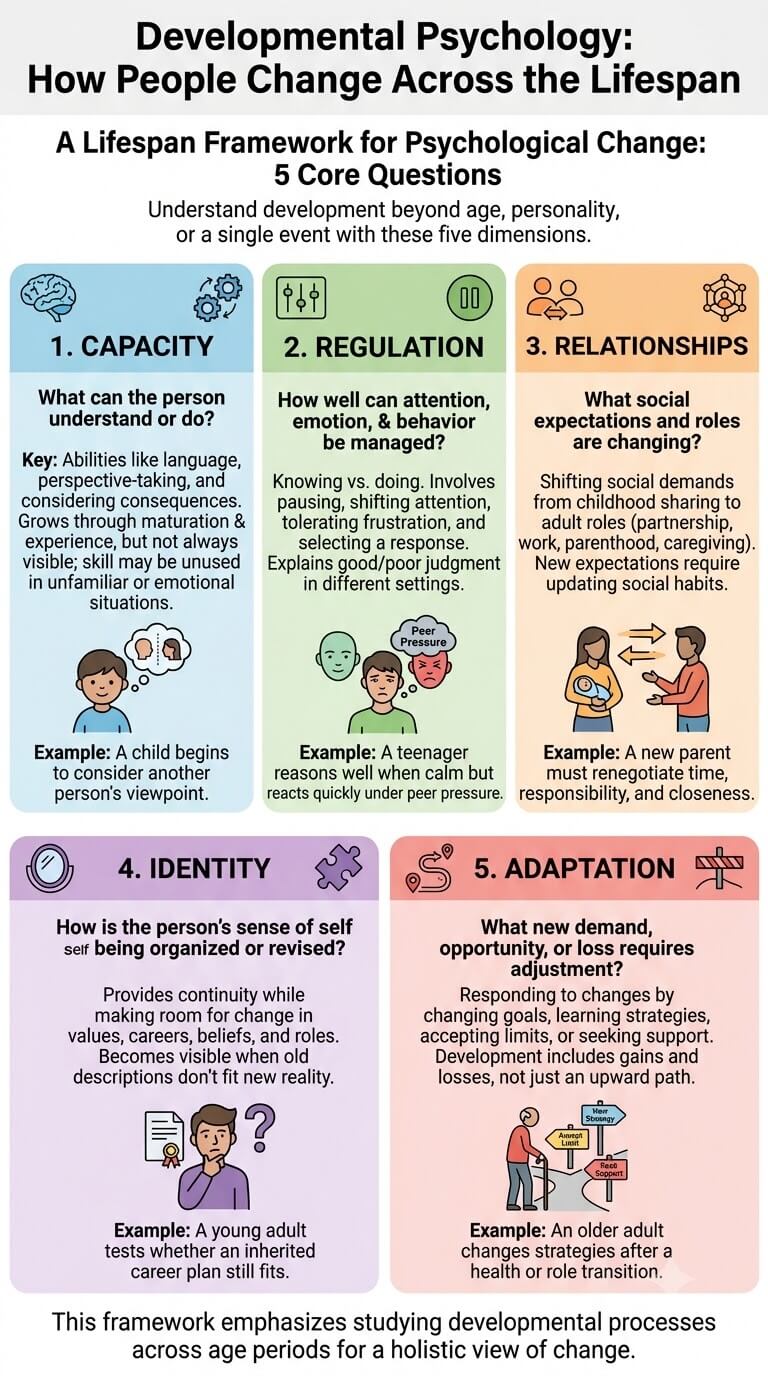
A practical way to understand development is to look at five questions. They keep you from reducing a person’s behavior to age, personality, or one dramatic experience.
| Dimension | Core question | Everyday example |
|---|---|---|
| Capacity | What can the person understand or do? | A child begins to consider another person’s viewpoint. |
| Regulation | How well can attention, emotion, and behavior be managed in this situation? | A teenager reasons well when calm but reacts quickly under peer pressure. |
| Relationships | What social expectations and roles are changing? | A new parent must renegotiate time, responsibility, and closeness. |
| Identity | How is the person’s sense of self being organized or revised? | A young adult tests whether an inherited career plan still fits. |
| Adaptation | What new demand, opportunity, or loss requires adjustment? | An older adult changes strategies after a health or role transition. |
Capacity: what a person can understand or do
Capacity refers to the abilities available to someone, such as remembering instructions, using language, considering future consequences, or understanding another perspective. Capacity grows through maturation and experience, but it is not always visible in every situation. Someone may possess a skill yet fail to use it when the task is unfamiliar or emotionally intense.
Regulation: how a person manages attention, emotion, and behavior
Knowing what to do and doing it are different developmental challenges. Regulation involves pausing, shifting attention, tolerating frustration, remembering a goal, and selecting a response. This helps explain why people can show good judgment in one setting and poor judgment in another without assuming their underlying capacity disappeared.
Relationships: how social expectations and roles change
Development continually changes what relationships ask of us. Children learn sharing and cooperation. Adolescents negotiate autonomy and belonging. Adults may move through partnership, work, caregiving, parenthood, friendship changes, and later-life role transitions. Each shift brings new expectations, so familiar social habits sometimes need to be updated.
Identity: how the self is organized and revised
Identity gives continuity to experience, but it also has to make room for change. A person may keep core values while changing careers, relationships, beliefs, or social roles. Developmental change often becomes visible when an old self-description no longer fits a new reality.
Adaptation: how people respond to new demands and losses
Adaptation is not simply bouncing back. It can involve changing a goal, learning a new strategy, accepting a limit, seeking support, or investing more in what remains meaningful. Lifespan research often emphasizes that development includes gains and losses rather than a simple upward path. A recent open-access review on adaptation across the lifespan highlights the value of studying developmental processes across age periods instead of treating each period in isolation.
Stages of Development in Psychology
Stages offer one way to organize a long lifespan, but they are most useful when treated as flexible models rather than fixed deadlines.
For a closer look at how age periods can organize development without turning them into rigid deadlines, see our guide to stages of development in psychology.
What stages can clarify and what they can oversimplify
Stage models give people a map. They can highlight recurring tasks or transitions, such as early language growth, adolescent autonomy, or later-life adaptation. The risk is treating the map as a stopwatch. Real development is often gradual, uneven, and influenced by context, so a stage should not become a verdict about whether someone is psychologically on schedule.
Stages are organizing models rather than rigid deadlines
Different theories divide the lifespan in different ways because they focus on different questions. One model may emphasize cognitive change, another identity or social roles. The useful question is not, “Which single stage chart is correct?” but, “What kind of change is this model trying to explain?” That approach keeps stages informative without forcing every life into the same sequence or timing.
Cognitive Development Psychology
Changes in thinking involve more than accumulating facts. They also involve the strategies and mental tools people use to understand new problems.
How reasoning and problem-solving change with experience and maturation
Cognitive development examines changes in thinking. Over time, people become able to represent more complex information, use better strategies, compare perspectives, and draw on larger bodies of knowledge. Development also affects attention control and the ability to hold a goal in mind while resisting distractions.
Cognition is broader than learning or memory alone
Learning concerns changes that come through experience, while memory concerns storing and retrieving information. Cognitive development asks a wider question: how does the system used for thinking itself become more capable, strategic, flexible, or specialized? This distinction matters because a person can know a great deal yet still find a new reasoning task difficult, or forget details while using strong judgment based on experience.
Emotional Development Psychology
Emotional growth includes learning what feelings mean, how they interact, and how to respond without assuming that calmness is the only sign of maturity.
From recognizing feelings to increasingly complex regulation
Emotional development begins with more than learning emotion words. People gradually become better able to connect feelings with causes, notice mixed emotions, anticipate emotional consequences, and choose among several ways to respond. Relationships matter because early regulation often happens with help before it becomes more self-directed.
Emotional capacities continue developing beyond childhood
Adults still encounter situations that demand new emotional skills. A person who regulates well at work may struggle with grief, caregiving, intimacy, or a major identity transition. Later development can involve becoming more selective about emotional goals and more skilled at choosing which situations deserve attention, while still remaining vulnerable to stress and loss.
Social Development Psychology
Human beings learn social life gradually, from basic reciprocity to complex expectations about friendship, intimacy, cooperation, status, and responsibility.
How connection, cooperation, social understanding, and roles develop
Social development involves learning what other people may know, want, expect, and feel. It includes perspective-taking, reciprocity, cooperation, friendship, conflict, group belonging, and role expectations. These skills are shaped by repeated social experience, not simply by whether someone is outgoing.
Social development is different from general relationship advice
A developmental lens asks how social capacities change over time. It might examine why peer approval becomes especially meaningful in adolescence or why adults become more selective about certain relationships. It does not assume that every relationship difficulty reflects an immature skill. Power, culture, stress, incompatible expectations, and unsafe dynamics can also shape what happens between people.
Identity Development Psychology
A sense of self develops through both stability and revision as people test roles, commitments, values, relationships, and possible futures.
How continuity and revision coexist in the sense of self
Identity development concerns how people organize roles, values, goals, group memberships, and life stories into a workable sense of self. Development requires both continuity and revision. Too much rigidity can make adaptation difficult, while constant reinvention can make commitments hard to sustain.
Identity development is not the same as an identity crisis
Questioning a role, belief, or future plan can be part of ordinary development. An identity crisis implies a more intense period of instability or distress, whereas identity development describes the broader process of exploring possibilities, making commitments, and revising them when life provides new information. That process can continue well into adulthood.
Child Development Psychology
Childhood brings several forms of change at once, which is why one behavior rarely tells the whole story about a child’s development.
Why childhood combines rapid cognitive, emotional, and social change
Childhood is a period when many capacities are developing at once. Language expands what children can represent and communicate. Growing attention and memory support learning. Social experience introduces rules, fairness, cooperation, and perspective-taking. Emotional regulation gradually becomes less dependent on immediate adult help, although children still vary greatly in pace and context.
For a closer look at how thinking, emotion, social understanding, and self-control interact during childhood, see psychological development in childhood.
Milestones are useful guideposts, not complete psychological profiles
The CDC’s developmental milestone guidance tracks areas such as playing, learning, speaking, acting, and moving, and it also notes that milestone resources are not substitutes for validated screening. That distinction is important. A checklist can flag a question, but it cannot explain a child’s whole developmental pattern or diagnose a condition.
Adolescent Development Psychology
Adolescence is easier to understand when growing competence is considered alongside new social pressures, greater autonomy, and changing emotional stakes.
Autonomy, peers, identity, emotion, and changing decision contexts
Adolescence combines growing reasoning ability with a rapidly changing social world. Young people gain more independence, become more sensitive to belonging and status, explore identity, and face decisions with greater real-world consequences. Their choices may look very different depending on whether they are calm, emotionally activated, alone, or being observed by peers.
Adolescence makes more sense without stereotypes
Calling teenagers irrational misses the point. Many adolescents can reason thoughtfully, plan ahead, and understand consequences. The developmental question is how those abilities are used under real conditions, including social rewards, novelty, stress, family expectations, and limited experience. A balanced view recognizes both growing competence and continued need for practice.
The teen years bring a distinctive mix of growing autonomy, identity exploration, peer influence, and changing decision contexts, which we examine further in adolescent development.
Emerging Adulthood Psychology
For many people, the transition out of adolescence includes exploration before adult roles become more stable, although this pattern varies widely.
Exploration, independence, uncertainty, and uneven transitions
For some people, the years after adolescence involve extended exploration of work, relationships, values, education, and independent living. Commitments may be less settled, and practical independence can develop unevenly across finances, housing, decision-making, and emotional responsibility. Uncertainty during this period does not automatically mean someone is failing to mature.
The transition is real for many people, but it is not universal
Culture and economics strongly shape the route into adult roles. Some people take on major work or family responsibilities early, while others have longer periods of education or exploration. A useful developmental view therefore treats emerging adulthood as a possible pattern rather than a required stage with one correct age range.
Adult Development Psychology
Psychological development continues after youth, often through less visible changes in priorities, roles, strategies, relationships, and definitions of success.
Why adulthood is continued development rather than a finished state
Adults continue to change as responsibilities, relationships, health, knowledge, and goals shift. A new career may demand a different identity. Long-term partnership can require new forms of negotiation. Caregiving can change priorities. Experience can improve judgment in familiar domains even while other abilities change more gradually.
Psychological growth does not stop after youth, and our guide to adult development looks more closely at changing goals, roles, relationships, and ways of adapting.
Adult development includes stability, selection, and adaptation
Maturity does not mean becoming psychologically finished. Adults often become more selective about where they invest time and effort. Some commitments become stronger, while others are revised. Development may look less dramatic than in childhood because it is frequently expressed through changing roles, strategies, and priorities rather than obvious new milestones.
Psychology of Aging
Later adulthood is not one uniform decline. It includes preserved abilities, changing priorities, adaptation, compensation, and meaningful individual differences.
Change, stability, compensation, and shifting priorities in later adulthood
Later adulthood includes both change and continuity. Some aspects of processing may become slower, while knowledge and expertise can remain strong. People may also change how they allocate attention, maintain relationships, and compensate for new limitations. The National Institute on Aging’s overview of age-related thinking changes notes that aging can include positive cognitive differences as well as challenges.
For later adulthood specifically, see our guide to the psychology of aging, including cognitive, emotional, social, and identity changes.
Normal variation should not be treated as inevitable decline
Occasional forgetfulness, slower retrieval, or a smaller social circle does not by itself tell you that something is seriously wrong. At the same time, sudden confusion, rapid loss of ability, or major interference with daily functioning deserves attention. Developmental thinking works best when it recognizes normal variation without dismissing meaningful change.
Which Developmental Topic Should You Explore Next?
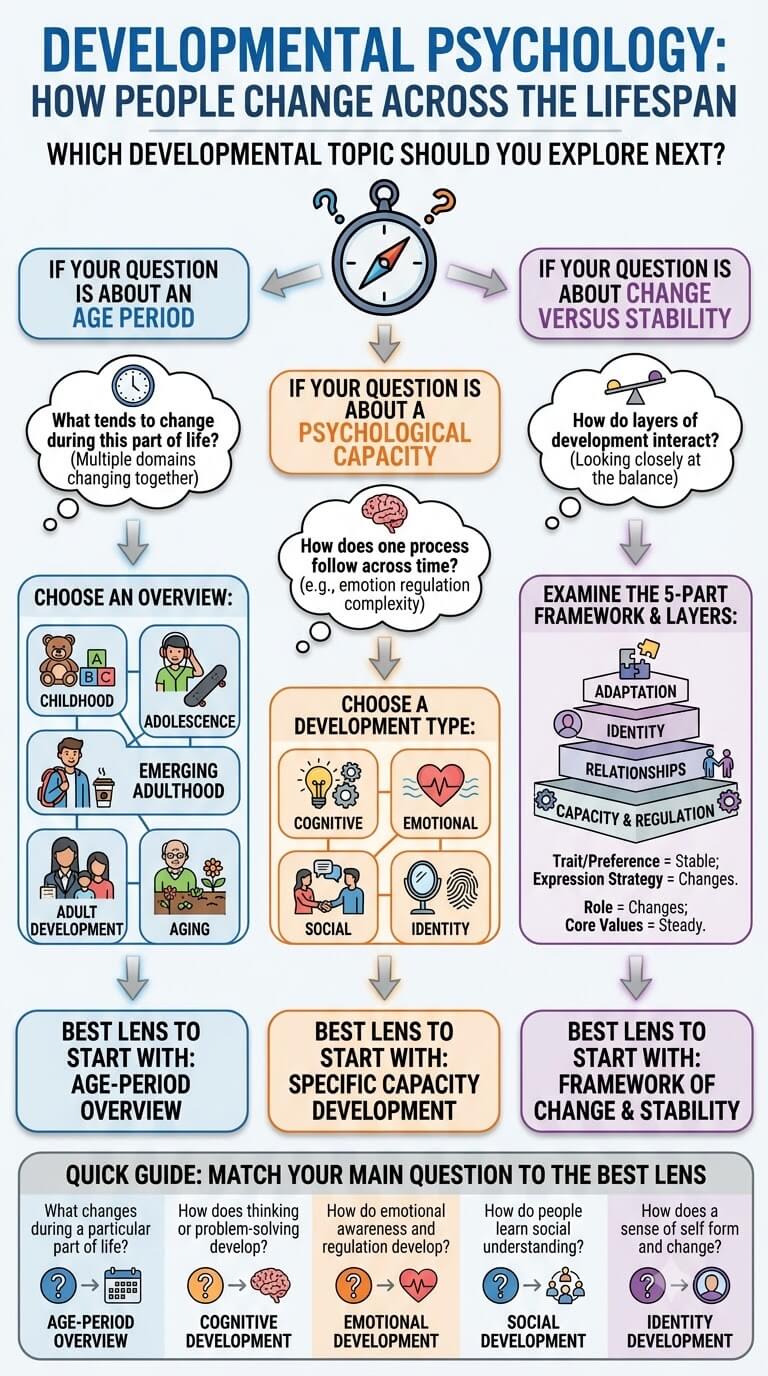
If a broad lifespan explanation has raised a more specific question, the fastest next step is to identify whether you are mainly asking about an age period, a psychological capacity, or the balance between change and stability.
If your question is about an age period
Choose childhood, adolescence, emerging adulthood, adult development, or aging when the main question is, “What tends to change during this part of life?” This is useful when several domains, such as identity, relationships, emotion, and thinking, are changing together.
If your question is about a psychological capacity
Choose cognitive, emotional, social, or identity development when the question follows one process across time. For example, “How does emotion regulation become more complex?” is different from “What psychological changes are common during adolescence?”
If your question is about change versus stability
Look closely at the five-part framework: capacity, regulation, relationships, identity, and adaptation. A trait or preference may be fairly stable while the strategy used to express it changes. A role may change while core values remain steady. Separating these layers often makes development easier to understand.
| Your main question | Best lens to start with |
|---|---|
| What changes during a particular part of life? | An age-period overview |
| How does thinking or problem-solving develop? | Cognitive development |
| How do emotional awareness and regulation develop? | Emotional development |
| How do people learn social understanding and relationship roles? | Social development |
| How does a sense of self form and change? | Identity development |
Common Misunderstandings About Human Development
Several popular assumptions make development look more rigid and predictable than it really is. Correcting them leads to a more useful lifespan view.
Development is not a race against a universal timetable
Timelines can be useful, especially when they identify abilities that usually emerge within broad periods. They become harmful when every difference is treated as failure. People develop within families, cultures, bodies, opportunities, and environments that vary widely. Comparing one person with an idealized schedule can hide the more useful question of how they are functioning over time.
Earlier experience matters without making later change impossible
Early relationships and learning can shape expectations and habits, but influence is not destiny. Later relationships, education, practice, environments, and deliberate choices can also change developmental pathways. Plasticity has limits, and change may become harder in some areas, yet a lifespan perspective does not assume that meaningful development ends after childhood.
Change is not always improvement and stability is not always stagnation
Development includes gains, losses, tradeoffs, and maintenance. Becoming more selective about goals may look like doing less, but it can reflect better allocation of limited time. Holding a stable value through a difficult transition may represent strength rather than lack of growth. The direction of change has to be understood in context.
Culture and context affect what development looks like
Independence, emotional expression, family obligation, career timing, partnership, and aging carry different meanings across cultures. A behavior that signals maturity in one setting may not carry the same meaning in another. Developmental explanations are strongest when they describe psychological processes without treating one cultural pathway as the universal standard.
How Development Connects With Other Areas of Psychology
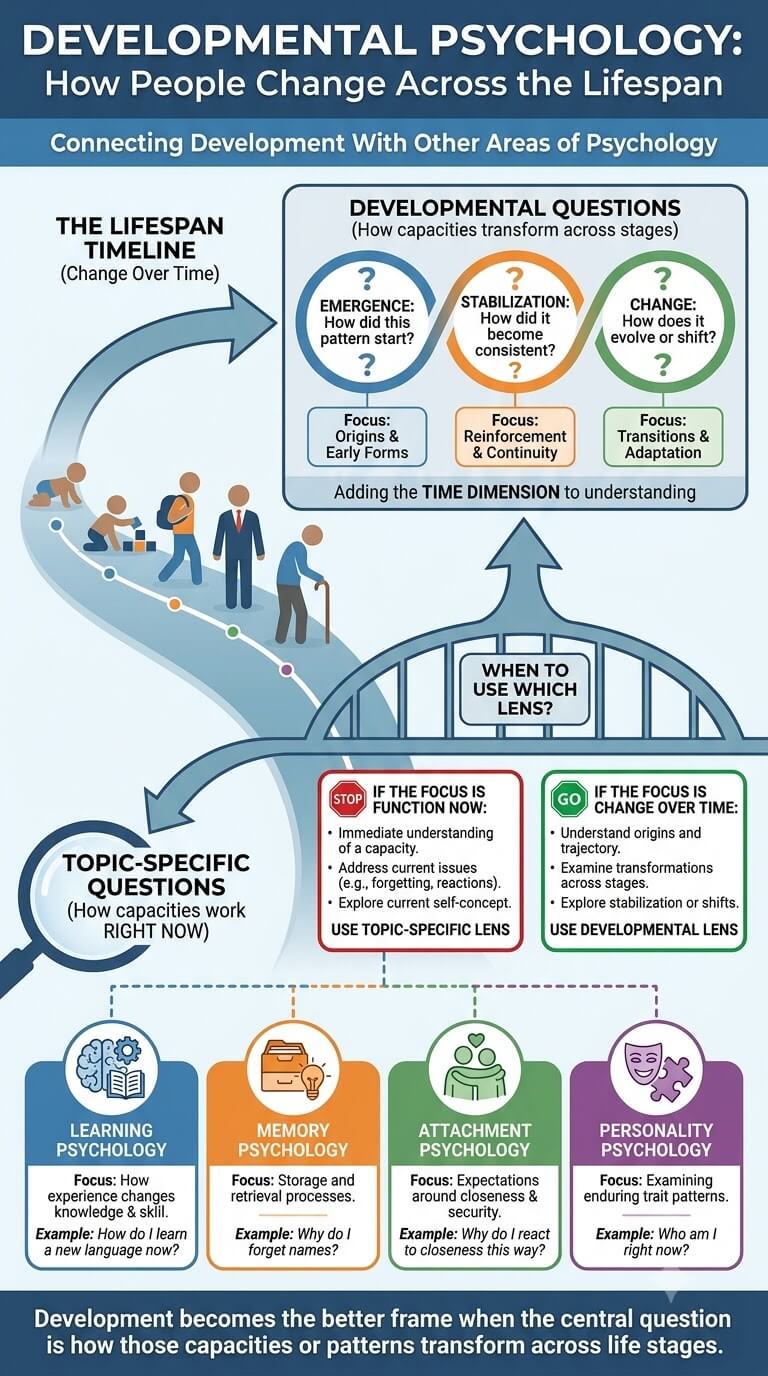
The same behavior can be examined from several psychological angles. The most useful angle depends on whether your main question is about function now or change over time.
Developmental questions differ from topic-specific psychology questions
A lifespan question asks how a capacity or pattern changes over time. Other psychological questions may focus on how the capacity works right now. Learning psychology can explain how experience changes knowledge or skill. Memory psychology can explain storage and retrieval. Attachment can explain expectations around closeness and security. Personality psychology can examine trait patterns. Developmental psychology adds the time dimension: how did this pattern emerge, stabilize, or change?
When another lens is the better next step
If your main concern is why you keep forgetting information, memory is likely the sharper lens. If you want to understand a recurring reaction to closeness, attachment may be more useful. If you are exploring who you are right now, self-awareness or self-concept may be more direct. Development becomes the better frame when the central question is how those capacities or patterns transform across life stages.
When Developmental Concerns Need More Than General Information
A broad lifespan framework has limits. Some changes are significant enough that observation and self-education should give way to qualified assessment or safety support.
Sudden loss of functioning or severe distress
Gradual variation is common, but sudden loss of previously available abilities deserves a different response. A child who loses acquired skills, an adult with rapid cognitive change, or anyone whose distress is severely interfering with daily life may need qualified assessment rather than general educational guidance. The goal is not to label the person from a checklist, but to take meaningful change seriously.
Safety, neglect, coercion, or major developmental concerns
Developmental explanations should never be used to excuse mistreatment. Fear, coercion, threats, humiliation, neglect, exploitation, or unsafe living conditions call for attention to safety and appropriate support. Likewise, persistent concerns about a child’s development across settings are worth discussing with a qualified health or developmental professional rather than relying on age comparisons alone.
FAQ About Developmental Psychology
These questions address common points of confusion about lifespan change, stage models, adult development, early experience, and cultural variation.
Is developmental psychology only about children?
No. Modern developmental psychology covers change across the lifespan, including adolescence, adulthood, and aging. Childhood remains important because many abilities develop rapidly there, but adult roles, identity, cognition, relationships, and adaptation also continue to change.
Do all people pass through the same psychological stages?
Not in a perfectly uniform way. Stage models can describe common patterns or developmental tasks, but timing and expression vary with culture, experience, opportunity, health, and individual differences. Different theories also divide development differently because they focus on different psychological processes.
Can adults still change psychologically?
Yes. Adults can learn, revise habits, change goals, develop new relationship skills, adapt identity, and respond differently to new roles. Some characteristics are relatively stable, and not every change is easy, but adulthood is not a psychological endpoint.
How much of development comes from early experience?
Early experience can have lasting influence because it helps shape knowledge, expectations, habits, and relationships. It is still only part of the story. Later experiences, environments, relationships, health, culture, and personal choices can reinforce, redirect, or partly compensate for earlier patterns.
Is normal development the same in every culture?
No. Some broad human capacities are widely shared, but cultures differ in what they expect from children and adults, when responsibilities are introduced, how emotion is expressed, and what independence or maturity means. Development should be understood within the person’s cultural and social context.
Key Takeaways
- Developmental psychology studies both change and continuity from early life through later adulthood.
- Age provides context, but it does not explain a person’s abilities, behavior, or maturity by itself.
- Capacity, regulation, relationships, identity, and adaptation offer a practical way to understand change across life.
- Cognitive, emotional, social, and identity development can move at different rates and look different across settings.
- Stage models are useful maps, but they should not be treated as rigid deadlines for every person.
- A specific next step is to identify whether your question is mainly about an age period, a psychological capacity, or a meaningful change in functioning.
Educational note: Michael Reed, Founder & Lead Writer at Psychology Exposed, writes about psychology and human behavior in plain, research-aware language. This information is educational and is not a substitute for individualized medical, psychological, or developmental assessment.

Michael Reed is the Founder and Lead Writer at Psychology Exposed. He writes about human behavior, relationships, emotional patterns, self-awareness, and practical psychology topics using research-informed, easy-to-understand content.
Read More About Michael Reed: https://psychologyexposed.com/michael-reed/