
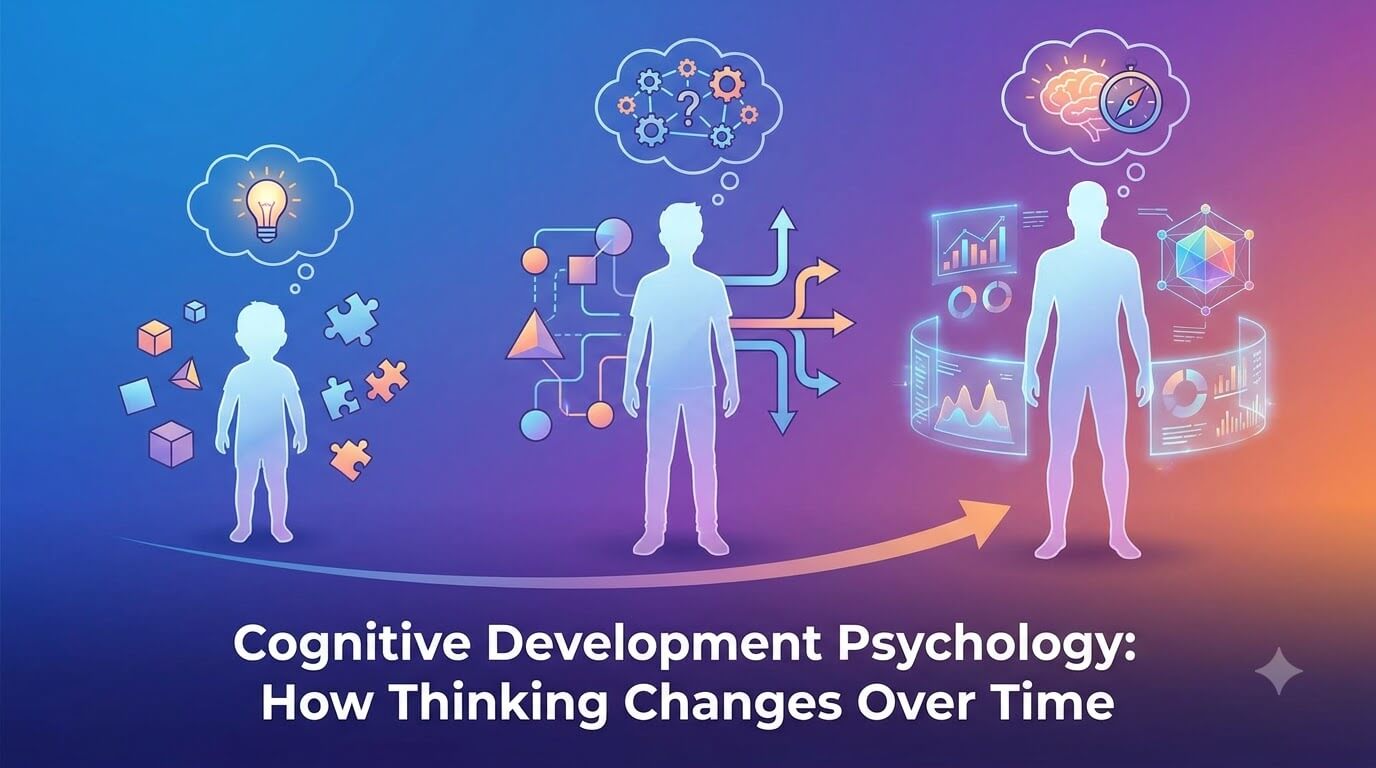
A child who solves a puzzle by moving pieces until something fits, a teenager who compares several possible outcomes before choosing, and an experienced adult who recognizes a familiar problem almost immediately are all thinking. What changes is not simply how many facts they know. The way they represent a problem, hold information in mind, ignore distractions, choose a strategy, and notice mistakes can change across development.
Cognitive development psychology examines those changes in thinking. It helps explain why reasoning may look strong in one setting and surprisingly weak in another, why experience can make an adult faster at a familiar problem even when some basic processing becomes slower, and why knowing a rule is not the same as being able to use it under pressure. It is not a test of whether someone is “smart enough,” and it is not a way to diagnose a child or adult from a few everyday mistakes.
Quick Answer
Cognitive development is more than knowing more facts
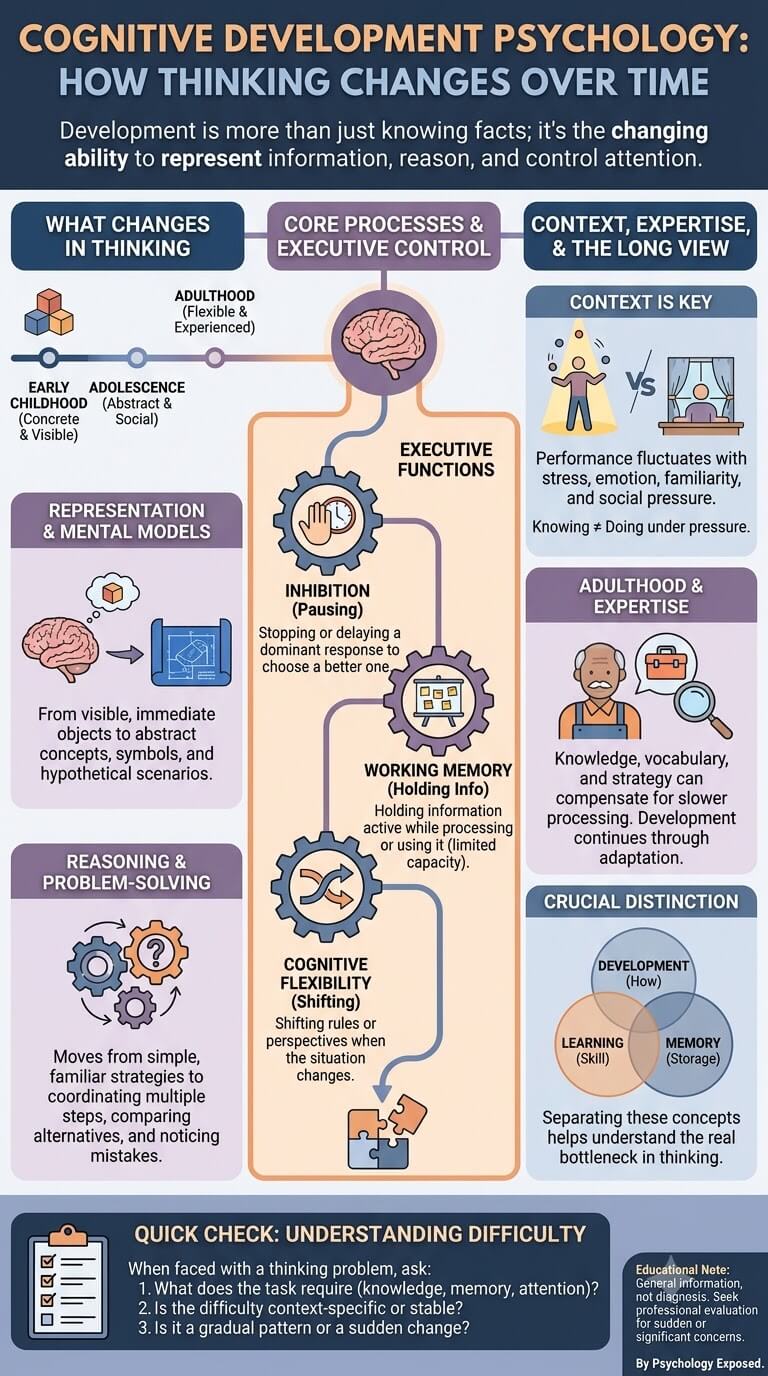
Cognitive development is the changing ability to represent information, reason, solve problems, control attention, shift perspective, and use mental strategies over time. The APA Dictionary of Psychology definition of cognitive development includes growth in processes such as perceiving, remembering, concept formation, problem-solving, imagination, and reasoning. Development therefore involves how a person thinks, not only what they know.
Capacity, strategy, experience, and context all matter
A useful way to understand cognitive performance is to separate four influences: what a person can currently do, what strategy they choose, what experience they can draw on, and what the situation demands. A person may have the capacity for a task but use an inefficient strategy. They may also perform below their usual level when tired, rushed, emotionally activated, or unfamiliar with the problem.
What Cognitive Development Means
Representing information and building mental models
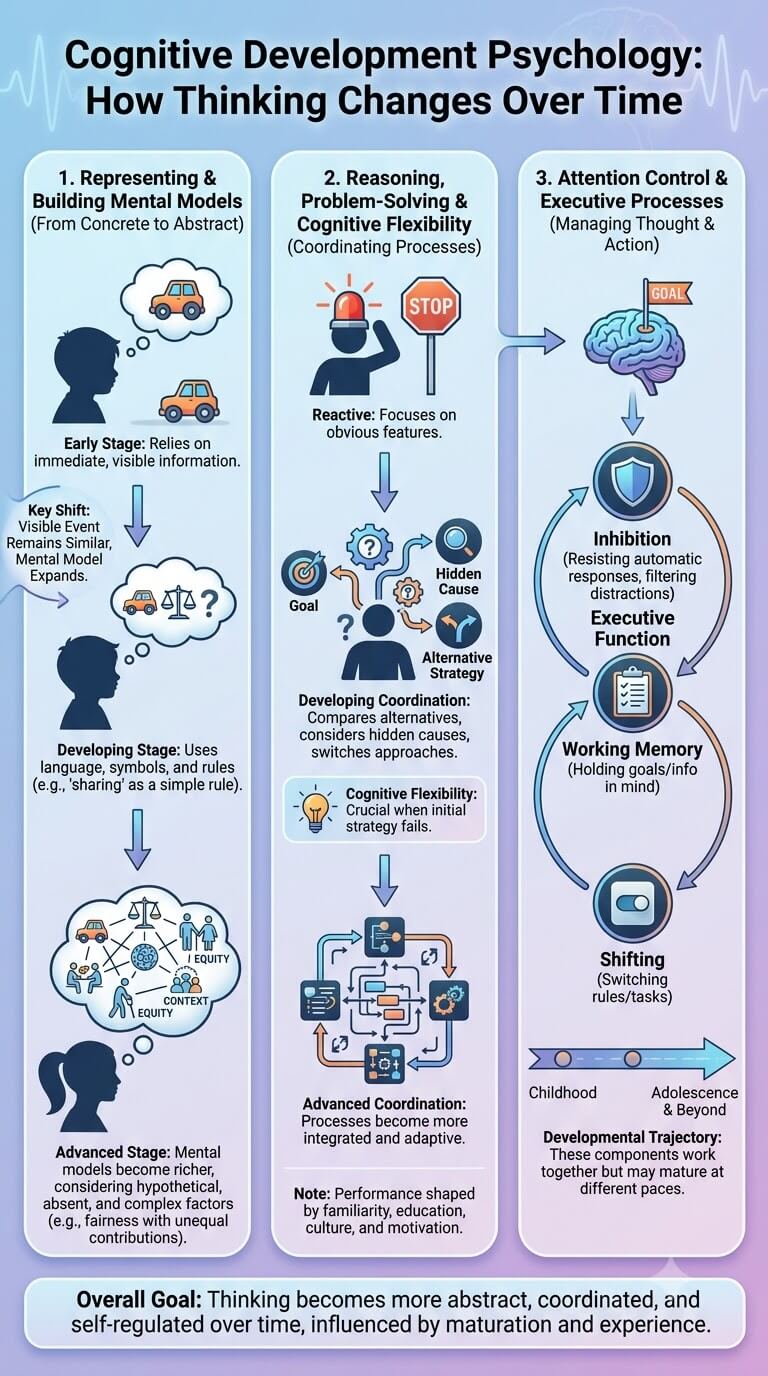
Thinking begins with how a person represents a situation in the mind. A young child may rely heavily on what is visible right now. With development, language, symbols, categories, prior knowledge, and imagined possibilities make it easier to think about things that are absent, hypothetical, or complicated.
For example, “sharing” may first mean handing over a toy because an adult says to. Later, a child can represent fairness as a rule. Still later, a teenager or adult can recognize that equal shares are not always fair if people contributed differently or have different needs. The visible event stays similar, but the mental model becomes richer.
Reasoning, problem-solving, and cognitive flexibility
Reasoning involves drawing conclusions from information. Problem-solving adds a goal: something must be understood, changed, reached, or repaired. Cognitive flexibility helps when the first interpretation or strategy no longer works.
Cognitive change is one part of the broader pattern of psychological development across the lifespan.
Development can make these processes more coordinated. Instead of reacting to the most obvious feature, a person becomes more able to compare alternatives, consider hidden causes, and switch approaches. That does not mean older always means better. Familiarity, education, culture, motivation, and the exact task can strongly shape what a person is able to show.
Attention control and executive processes
Some thinking problems are not caused by lack of knowledge. They happen because the person must hold a goal in mind while resisting an automatic response, filtering distractions, or switching rules. These abilities are often discussed under executive function.
A developmental review in PubMed Central on executive function across childhood and adolescence describes inhibition, working memory, and shifting as important components whose organization and performance change with development. These skills work together, but they do not necessarily mature at exactly the same pace.
From Concrete Experience to More Flexible Reasoning
Why young minds rely heavily on visible and immediate information
Concrete information reduces the amount of mental work required. If the objects are in front of you, you do not have to imagine them. If the rule is demonstrated, you do not have to infer it. This is one reason children often perform better when a problem is tied to familiar objects, actions, or stories.
Age can provide useful context, but our guide to stages of development explains why cognitive change should not be treated as a rigid age-by-age ladder.
That reliance should not be mistaken for an absence of thought. Children often reason effectively within the knowledge and representations available to them. The challenge grows when a task requires holding several invisible relationships in mind at once or ignoring a feature that looks important but is not.
How language, symbols, and prior knowledge expand what can be represented
Language gives people ways to label distinctions that would otherwise be difficult to hold steady. Words such as “before,” “unless,” “fair,” “probability,” and “evidence” make certain relationships easier to discuss and compare. Schooling and everyday experience also provide concepts that become tools for later thinking.
These cognitive changes interact with emotion, language, play, and relationships during psychological development in childhood.
Prior knowledge can reduce cognitive load. An experienced cook does not have to rediscover what browning means each time food hits a pan. A skilled driver recognizes patterns in traffic that a beginner must consciously analyze. Development therefore includes the accumulation of useful mental structures, not only changes in raw processing capacity.
Why abstract reasoning is context-dependent even in adults
Adults are capable of abstract reasoning, but people do not use their highest level of reasoning in every situation. A familiar example can make a difficult principle easy to see, while an unfamiliar format can make the same principle feel confusing. Emotion, time pressure, incentives, and social consequences can also change which mental resources are available.
This matters because a poor answer to one abstract problem does not reveal a complete developmental level. The better question is whether the difficulty reflects missing knowledge, an overloaded mental workspace, an ineffective strategy, or a task that makes the relevant structure hard to see.
How Problem-Solving Develops
Problem-solving becomes more effective when several processes begin to work together. A simple four-part model is useful: Frame, Filter, Try, Check. First define the real problem, then filter out irrelevant information, try a strategy, and check whether the result actually moves toward the goal. Development often improves not just the strategy itself, but the coordination among these steps.
Recognizing the goal and relevant information
A problem can be hard because the goal is unclear. Imagine a child asked to “clean the room.” The instruction contains several possible goals: put toys away, make the bed, organize books, or make the room look acceptable to an adult. Breaking the task into a visible end state reduces ambiguity.
Adults face the same problem in more complex form. “Fix my career” is too broad to solve directly. “Find out whether this role is a poor fit because of the work itself or because of the current manager” is a more workable representation. Better problem-solving often begins with a better description of the problem.
Choosing strategies instead of reacting to surface features
Novices often respond to what a problem looks like on the surface. With experience, people become better able to notice underlying structure. Two math problems may look different but require the same operation. Two workplace conflicts may involve different people but share the same bottleneck: unclear responsibility.
A review of the development of flexible problem-solving discusses how increasing executive abilities can support the capacity to move beyond a familiar response and select among alternative strategies. Flexibility is especially useful when a once-successful method stops fitting the problem.
Monitoring errors and revising a plan
Effective thinkers do not only generate an answer. They compare the answer with the goal. This monitoring process catches mistakes such as “I solved the calculation but answered the wrong question” or “I won the argument but made the relationship problem worse.”
Development often brings a greater ability to notice mismatch and adjust. Yet this ability is also vulnerable to confidence, fatigue, stress, and time pressure. A person can be highly skilled at reviewing work when calm and still skip that step when rushing. Competence and real-time performance are related, but they are not identical.
| Problem-solving step | Less developed or overloaded response | More strategic response |
|---|---|---|
| Frame | Acts on the first visible problem | Clarifies the actual goal and constraints |
| Filter | Treats every detail as equally important | Separates useful information from distraction |
| Try | Repeats the first familiar method | Selects or tests an approach that fits the structure |
| Check | Stops after producing an answer | Compares the result with the goal and revises if needed |
Executive Control Across Development
Inhibition: pausing a dominant response
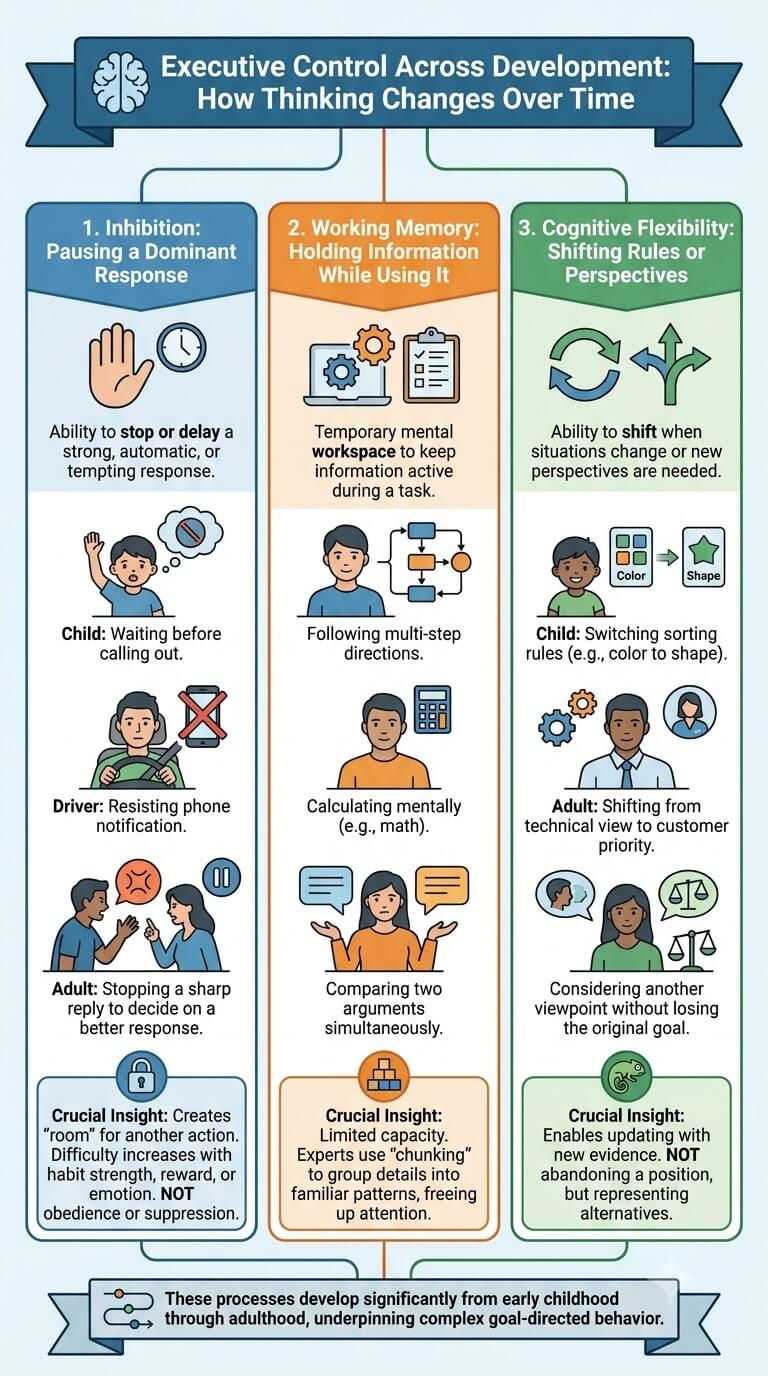
Inhibition is the ability to stop or delay a response that is strong, automatic, or tempting when another response better serves the goal. A child may need to wait before calling out an answer. A driver may need to resist checking a phone notification. An adult in conflict may need to stop a sharp reply long enough to decide whether it will help.
Inhibition is not the same as obedience or emotional suppression. It is a control process that creates room for another action. The required amount of control depends on the situation. The stronger the habit, reward, emotion, or distraction, the harder the pause can become.
Working memory: holding information while using it
Working memory is the temporary mental workspace used when information must stay active while something is done with it. Following multi-step directions, calculating in your head, comparing two arguments, and remembering the beginning of a sentence while interpreting the end all place demands on this workspace.
Because working memory is limited, more developed thinking does not mean unlimited mental capacity. Experts often appear to hold more because their knowledge lets them group details into meaningful chunks. A beginner sees separate pieces. An experienced person sees a familiar pattern and can devote more attention to what is unusual.
Cognitive flexibility: shifting rules or perspectives
Flexibility becomes important when a situation changes or when two perspectives must be compared. A child sorting cards by color may struggle when the rule suddenly changes to shape. An adult may understand a project from a technical viewpoint but need to shift to the customer’s priorities before choosing a solution.
Flexibility does not mean abandoning a position whenever someone disagrees. It means being able to represent another rule, interpretation, or strategy without losing track of the original goal. That capacity makes it easier to update when new evidence genuinely matters.
Cognitive Development vs Learning vs Memory
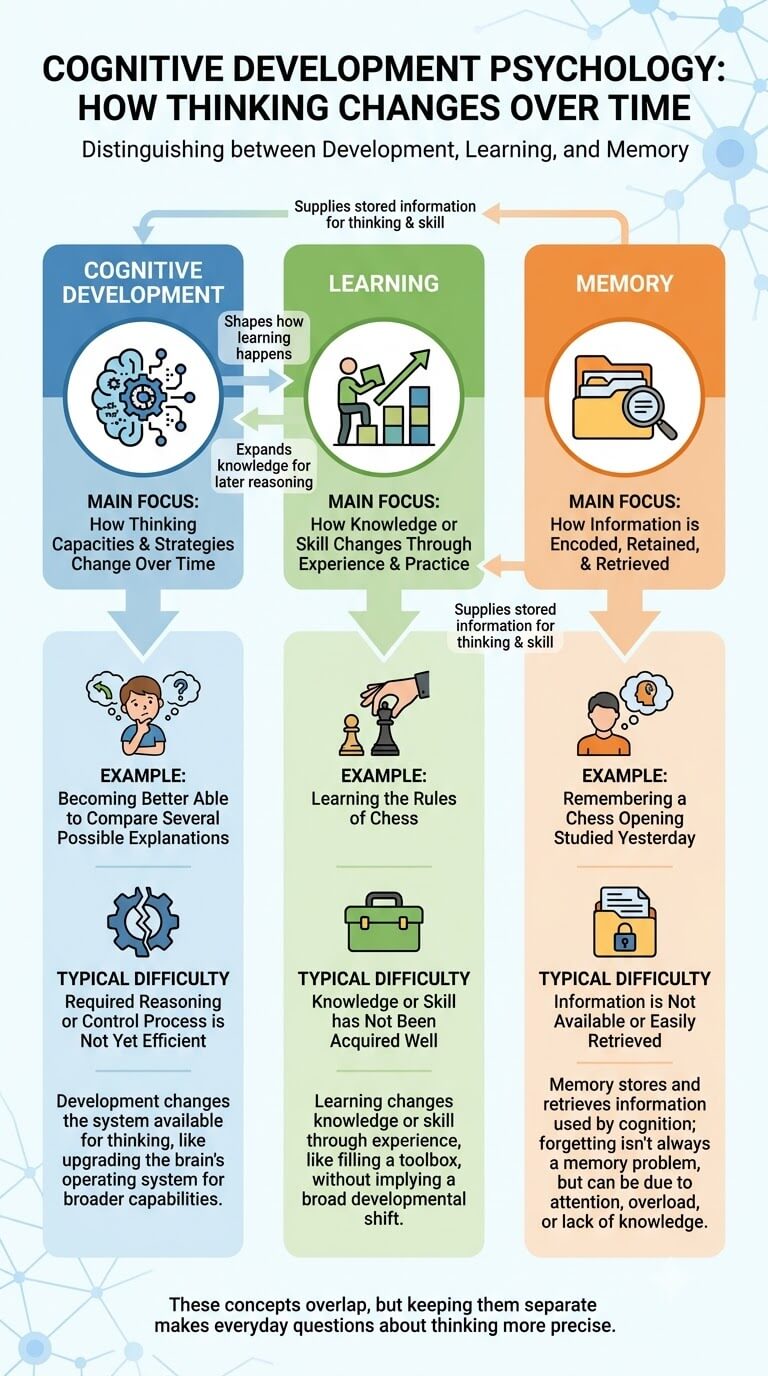
These concepts overlap so strongly that they are easy to collapse into one idea. Keeping them separate makes everyday questions more precise.
| Question | Cognitive development | Learning | Memory |
|---|---|---|---|
| Main focus | How thinking capacities and strategies change over time | How knowledge or skill changes through experience and practice | How information is encoded, retained, and retrieved |
| Example | Becoming better able to compare several possible explanations | Learning the rules of chess | Remembering a chess opening studied yesterday |
| Typical difficulty | The required reasoning or control process is not yet efficient | The knowledge or skill has not been acquired well | The information is not available or easily retrieved |
Development changes the system available for thinking
Cognitive development concerns the changing organization and efficiency of processes used to think. A child who becomes better able to hold two rules in mind has gained a capability that can support many different tasks. The change is broader than learning one specific lesson.
Learning changes knowledge or skill through experience
Learning happens when experience produces a relatively lasting change in knowledge or performance. Practice can make a task easier without implying a broad developmental shift. An adult can learn a new software program, a teenager can learn guitar chords, and a child can learn multiplication facts at very different developmental points.
Development shapes how learning happens, while learning itself can expand the knowledge base that later reasoning uses. They influence one another without being interchangeable.
Memory stores and retrieves information used by cognition
Reasoning requires information, and memory supplies much of it. If you cannot recall an important fact, your reasoning may fail even though the reasoning process itself is intact. Conversely, you can remember many facts yet struggle to compare them, prioritize them, or use them flexibly.
This distinction is useful before assuming that every forgotten instruction is a memory problem or every poor solution is a reasoning problem. Sometimes the real bottleneck is attention, overload, unclear instructions, or lack of relevant knowledge.
Why Cognitive Performance Can Look Uneven
Familiar knowledge can support sophisticated reasoning
People often reason better in domains they understand. A teenager who seems disorganized in a new chemistry unit may plan an elaborate multiplayer game strategy with impressive anticipation. A mechanic may diagnose an engine problem faster than someone with stronger general test scores because years of experience make relevant patterns visible.
Knowledge changes the task itself. It helps a person notice what matters, ignore what does not, and retrieve useful strategies. This is one reason a single performance should not be treated as a pure measure of overall cognitive development.
Stress, distraction, sleep, and emotion can reduce available control
Executive control is effortful. When attention is split, sleep is poor, or emotion is intense, there may be less capacity available for holding goals in mind and inhibiting immediate reactions. A person who normally follows a plan well may become impulsive during a heated argument or forget steps while rushing to meet a deadline.
Context does not erase responsibility, but it changes what performance tells us. “You knew better” may be true at the level of knowledge while missing the question of whether the person successfully accessed and used that knowledge in the moment.
A person can understand a rule and still fail to use it in the moment
This gap appears across the lifespan. A child can repeat a classroom rule and still break it during an exciting game. A teenager can describe the risks of speeding and still drive differently with friends in the car. An adult can know a budgeting rule and ignore it during an emotionally charged purchase.
The useful distinction is between knowing and deploying. Development involves improving both, but deployment remains sensitive to incentives, habits, emotion, and social context even in adulthood.
Adolescence and the Changing Decision Context
Growing reasoning ability alongside strong social and reward contexts
Adolescence is not a period in which reasoning is simply absent. Many reasoning abilities become increasingly sophisticated. At the same time, decisions may occur in situations involving social evaluation, novelty, strong rewards, embarrassment, belonging, or immediate emotion.
The gap between what a person can reason through calmly and what happens under strong social or emotional pressure becomes especially relevant during adolescent development.
Research summarized in a review of “hot” and “cool” executive functions in adolescence highlights an important distinction between cognitive control in relatively neutral tasks and control when motivational or emotional stakes are involved. This helps explain why performance can look adult-like in one setting and less controlled in another.
Why adult-like reasoning does not guarantee adult-like choices in every situation
A choice is produced by more than reasoning skill. It also reflects what feels rewarding, what information is noticed, what consequences seem immediate, how much experience a person has in that setting, and whether peers are present. Two people can understand the same probabilities and still choose differently because they weight the outcomes differently.
This is also true for adults. Expertise in reasoning does not remove bias, social pressure, or emotion. Development may expand the set of tools available, but wise use of those tools still depends on the situation and on practiced habits of reflection.
Cognitive Development in Adulthood
Expertise and knowledge can offset some processing changes
Adult cognition is not a simple story of reaching a peak and then declining. Different abilities follow different patterns. Knowledge, vocabulary, professional expertise, and familiar strategies can remain strong or improve even while some speeded or effortful processes become less efficient with age.
This is why an experienced nurse may recognize a familiar clinical pattern quickly, or an older accountant may solve a practical problem efficiently despite taking longer on an unfamiliar timed test. Experience can change the route to an answer.
Strategy use, goals, and context continue to matter
Adults continue to refine how they allocate attention and effort. Someone may become more selective about which problems deserve deep analysis, rely more on external tools for routine memory demands, or use established routines to reduce unnecessary decisions. These are not necessarily signs of reduced ability. Often they are efficient adaptations.
Cognitive development in adulthood therefore includes strategy selection and compensation. People do not merely gain or lose capacity. They also change how they use the abilities, knowledge, and tools available to them.
Normal change is not the same as sudden cognitive decline
Later adulthood brings average changes in some aspects of memory, learning, and processing, but there is substantial variation among individuals. The National Institute on Aging overview of brain health emphasizes that aging affects cognitive functions in complex ways and that health, lifestyle, and other factors matter.
For a closer look at cognitive stability, compensation, and age-related change in later life, see the psychology of aging.
A gradual need for more time on an unfamiliar task is different from sudden confusion, rapid deterioration, getting lost in familiar places, or a major new difficulty managing everyday responsibilities. Sudden or substantial change deserves qualified medical evaluation rather than being dismissed as “just aging.”
A Self-Check for Understanding a Cognitive Development Question
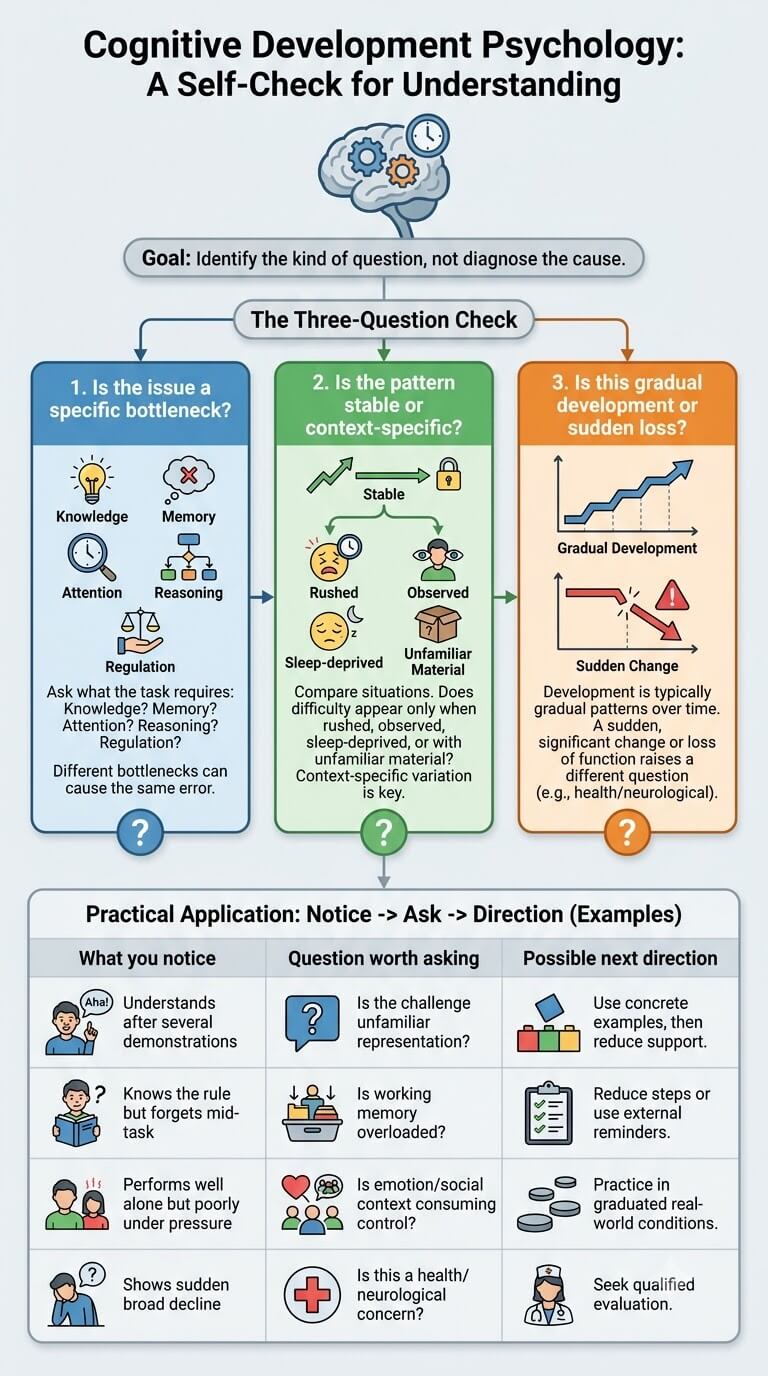
Before explaining a difficulty as age, intelligence, or lack of effort, use a three-question check. The point is not to diagnose the cause. It is to identify which kind of question you are actually asking.
Is the issue knowledge, memory, attention, reasoning, or regulation?
Ask what the task requires. If a student cannot solve an equation, do they know the relevant rule? Can they remember it? Can they focus long enough to apply it? Do they understand why the rule works? Can they resist a familiar but wrong shortcut? Different bottlenecks can produce the same visible error.
Is the pattern stable across settings or context-specific?
Compare situations. Does the difficulty appear only when the person is rushed, socially observed, sleep-deprived, or dealing with unfamiliar material? Do they perform much better with a visual example than with verbal instructions? Context-specific variation often provides more useful information than a broad label such as “bad at reasoning.”
Is this gradual development or a sudden loss of function?
Development usually involves patterns across time. A sudden change raises a different question. If a child loses skills they previously used reliably, or if an adult develops abrupt confusion or major new cognitive difficulty, general developmental explanations are not enough. The timing and severity of the change matter.
| What you notice | Question worth asking | Possible next direction |
|---|---|---|
| Understands after several demonstrations | Is the challenge unfamiliar representation rather than reasoning itself? | Use concrete examples, then gradually reduce support |
| Knows the rule but forgets mid-task | Is working memory overloaded? | Reduce simultaneous steps or use external reminders |
| Performs well alone but poorly under pressure | Is emotion, distraction, or social context consuming control? | Practice in graduated real-world conditions |
| Repeats a failed strategy | Is monitoring or flexibility the bottleneck? | Pause to compare the result with the goal and generate another method |
| Shows sudden broad decline | Is this a health or neurological concern rather than normal development? | Seek qualified evaluation |
What to Explore Next
Learning Psychology for skill acquisition
If the main question is how practice, feedback, observation, or experience changes a specific skill, learning is the more precise lens. Cognitive development helps explain the thinking resources available for learning, but it does not replace an explanation of how a skill is acquired.
Working Memory Psychology for mental workspace and overload
If the difficulty appears when several pieces of information must be held and manipulated at once, working memory deserves closer attention. This can clarify why reducing steps, writing information down, or grouping details into meaningful chunks may improve performance without changing the person’s underlying knowledge.
Adolescent Development or Psychology of Aging for age-specific context
Sometimes the age period matters more than the cognitive process alone. Adolescence adds changing social, motivational, and autonomy demands. Later adulthood adds questions about compensation, health, memory, and changing cognitive priorities. A lifespan perspective helps avoid assuming that the same behavior means the same thing at every age.
When Cognitive Changes Need Professional Evaluation
Sudden decline, safety issues, or major daily impairment
Sudden confusion, rapid deterioration, getting lost in familiar settings, major new difficulty managing medication or money, or cognitive changes that create immediate safety risks should not be explained away as ordinary development or aging. Medical conditions, medications, sleep problems, neurological issues, substance effects, and other factors may need to be considered by a qualified professional.
Concerns about a child’s development across multiple settings
One difficult task rarely tells you enough. A more meaningful concern may be a persistent pattern across home, school, and other settings, especially if it interferes substantially with learning, communication, safety, or everyday functioning. A pediatric or developmental evaluation can look at the whole pattern rather than turning a single mistake into a diagnosis.
FAQ About Cognitive Development Psychology
Is cognitive development the same as intelligence?
No. Intelligence measures typically summarize performance across selected cognitive tasks, while cognitive development asks how thinking processes and strategies change over time. Reasoning, attention control, working memory, language, knowledge, and problem-solving interact, but no single score captures every part of cognitive development.
Does cognitive development stop in adulthood?
No. Some basic abilities change more slowly after youth, but adults continue to build knowledge, expertise, strategies, and ways of allocating attention. Adult development also includes adaptation to new roles and constraints. Different cognitive abilities follow different trajectories, so there is no single age when “thinking development” simply ends.
Why can someone reason well but make a poor decision?
Reasoning ability is only one ingredient in a decision. Emotion, immediate reward, social pressure, habits, incomplete information, fatigue, and competing goals can all affect whether reasoning is used effectively. A person may understand the logic of a better choice and still fail to apply it in a high-pressure moment.
Is working memory part of cognitive development?
Yes. Working memory is one of the processes that supports complex thinking, and its effective use changes through development. It helps a person keep goals, rules, and intermediate information active while solving a problem. It is closely related to executive control, but it is not the whole of cognitive development.
Can experience compensate for slower processing?
Often, experience can reduce how much processing is needed for familiar tasks. Knowledge helps people recognize patterns, ignore irrelevant details, and choose efficient strategies. Compensation is not unlimited, and unfamiliar or highly speeded tasks may still reveal age-related differences, but practical performance depends on much more than raw speed.
Key Takeaways
- Cognitive development involves changes in how people represent information, reason, solve problems, control attention, and adapt strategies, not simply an increase in stored facts.
- The same person can perform very differently across tasks because knowledge, familiarity, stress, emotion, time pressure, and social context affect the mental resources available.
- Executive processes such as inhibition, working memory, and cognitive flexibility help connect goals with action, and these processes continue to develop and reorganize over time.
- Learning, memory, and cognitive development overlap but answer different questions. Separating them helps identify the real bottleneck behind a difficulty.
- Adulthood includes continued cognitive adaptation through expertise, strategy use, and compensation. Later-life change is not a single uniform decline.
- If cognitive functioning changes suddenly, broadly, or enough to create safety or daily-living problems, a qualified evaluation is more appropriate than a general developmental explanation.
A useful next step is to take one real example of a thinking difficulty and identify the bottleneck before labeling the person. Ask what the task requires, what they already know, what must be held in mind, what distraction or emotion is present, and whether the problem is stable across settings. That narrower question is usually more informative than asking whether someone is simply “mature,” “smart,” or “bad at thinking.”
Educational note: Psychology Exposed provides general, research-aware education about behavior and development. This information is not a diagnosis or a substitute for individualized medical, developmental, or mental health assessment.
About the author: Michael Reed is the Founder & Lead Writer at Psychology Exposed. He writes about human behavior, relationships, emotional patterns, self-awareness, and everyday decisions in clear, research-aware language for general readers.

Michael Reed is the Founder and Lead Writer at Psychology Exposed. He writes about human behavior, relationships, emotional patterns, self-awareness, and practical psychology topics using research-informed, easy-to-understand content.
Read More About Michael Reed: https://psychologyexposed.com/michael-reed/