

Adulthood is often described as if development ends once someone finishes school, starts working, or becomes independent. Real adult life looks very different. A person may become more confident at work in their thirties, rethink success in their forties, take on caregiving in their fifties, build new expertise in their sixties, or reorganize relationships after retirement. The changes are usually less visible than childhood milestones, but they are still psychological development.
Adult development psychology looks at how people continue to change after youth through goals, roles, relationships, identity, cognition, motivation, experience, and adaptation. It does not assume that every adult follows the same sequence. Parenthood, marriage, career advancement, home ownership, or retirement may be important for some people and irrelevant or unavailable to others. The more useful question is how adults adjust to changing opportunities, constraints, commitments, and priorities across time.
Quick Answer
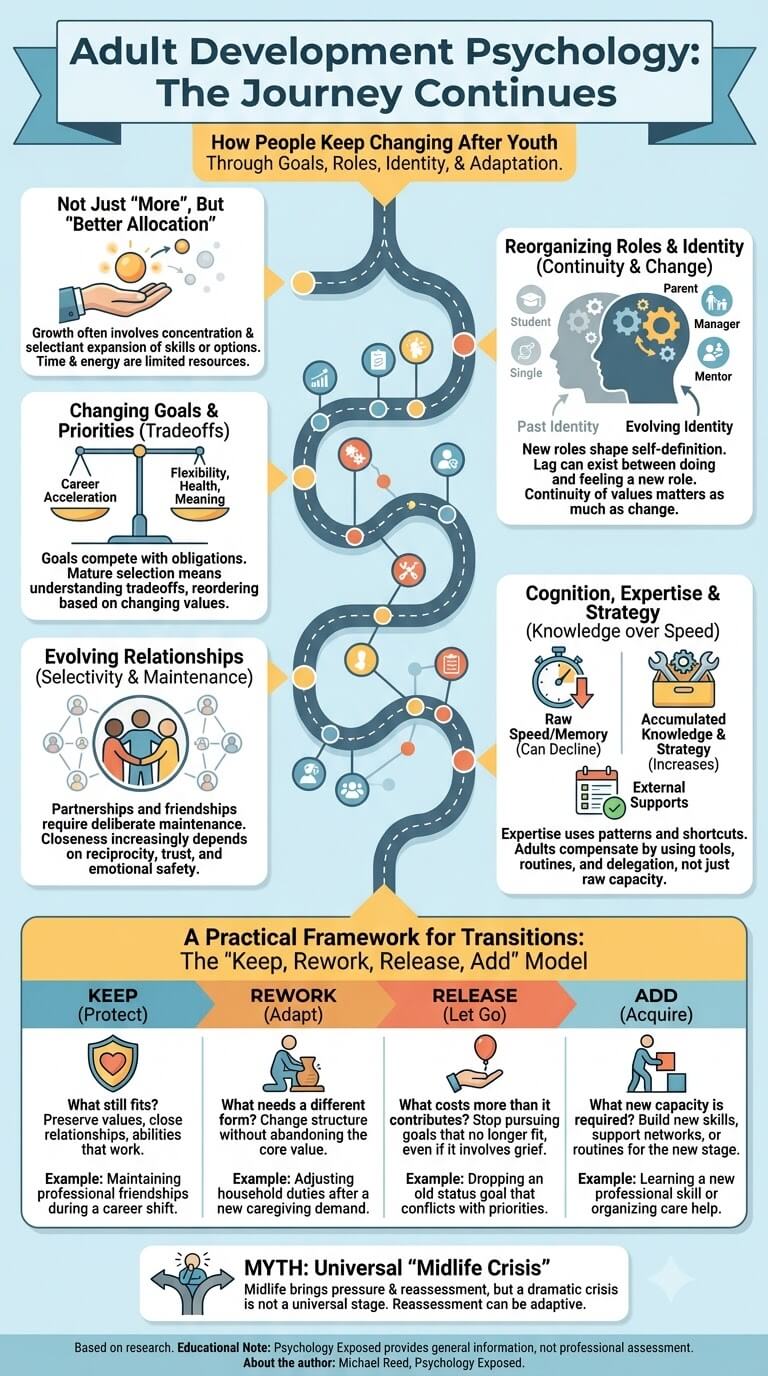
Adult development continues long after formal education ends
Adults continue developing because their environments, responsibilities, bodies, relationships, knowledge, and goals keep changing. Research on lifespan motivation emphasizes that people actively shape development by choosing goals, investing effort, adjusting strategies, and sometimes disengaging from goals that are no longer attainable. A widely cited lifespan theory of developmental motivation describes goals as central organizing units in how people influence their own life course.
Change in adulthood is a mix of stability, growth, tradeoffs, and adaptation
Adult development is not a straight path toward becoming “better” at everything. Some abilities become more efficient through knowledge and expertise. Some goals become more selective. Social roles can deepen or disappear. Personality shows both stability and change. Later-life cognition also includes a mixture of preserved abilities, accumulated knowledge, and age-related changes rather than one uniform decline.
What Adult Development Psychology Studies
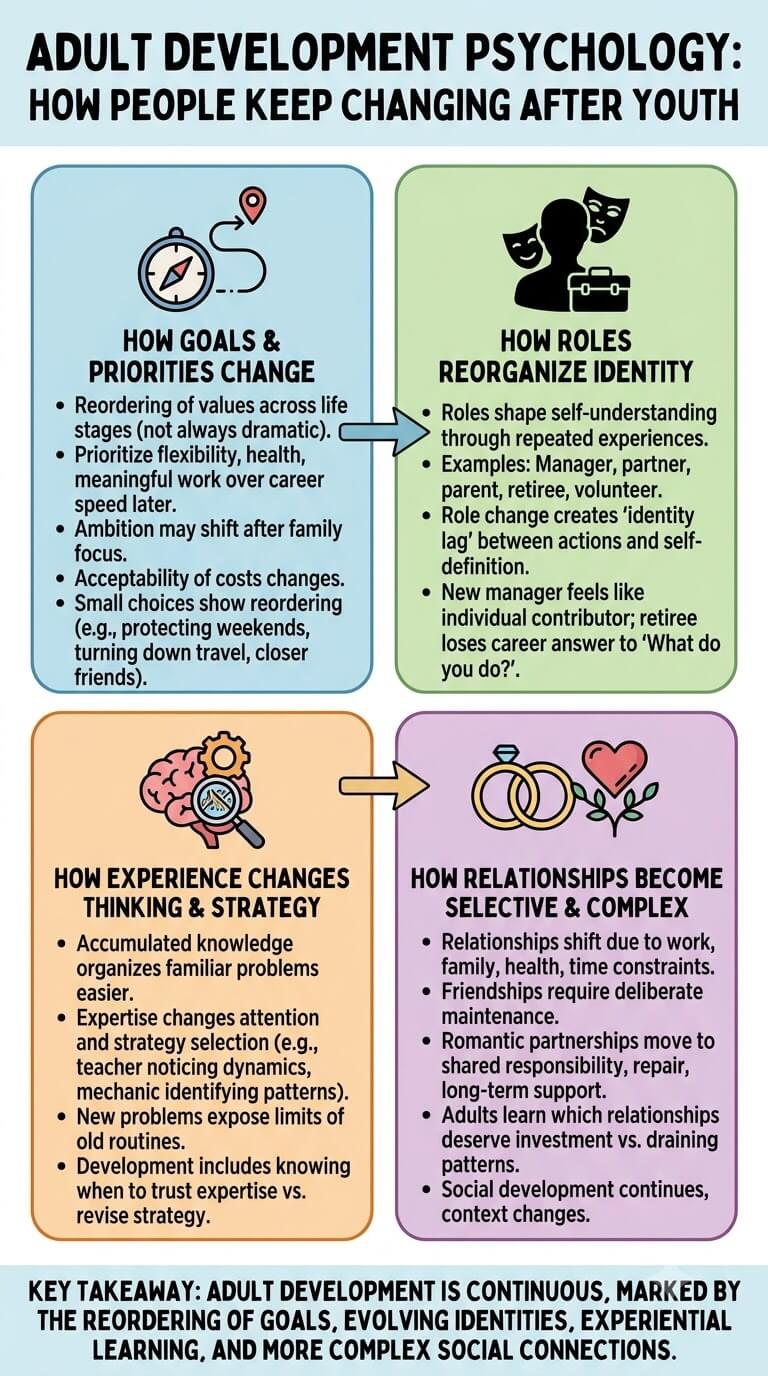
How goals and priorities change
Adults rarely value every goal equally across life. A person who once prioritized career acceleration may later care more about flexibility, caregiving, health, community, or meaningful work. Another may become more ambitious after years focused on family. Development includes changes in which goals deserve time and which costs feel acceptable.
These adult changes belong to the larger process of development across the lifespan.
This reordering is not always dramatic. It may show up in smaller choices, such as turning down a promotion that requires constant travel, protecting weekends, choosing closer friendships over a larger social network, or returning to education for a new direction.
How roles reorganize identity
Roles provide repeated experiences that shape how adults understand themselves. Becoming a manager, partner, parent, caregiver, mentor, business owner, student, volunteer, or retiree can alter daily behavior and self-definition.
Role change can create a lag between what someone does and who they feel they are. A new manager may perform the job while still identifying mainly as an individual contributor. A person leaving a long career may lose a familiar answer to “What do you do?” before a new identity becomes clear.
How experience changes thinking and strategy
Adults accumulate knowledge that makes many familiar problems easier to organize. An experienced teacher can notice classroom dynamics that overwhelm a beginner. A mechanic can identify patterns that look like unrelated details to a novice. Expertise changes what gets attention and which strategies come to mind first.
At the same time, new problems can expose the limits of old routines. Adult development includes learning when expertise should be trusted and when a familiar strategy needs revision.
How relationships become more selective and complex
Adult relationships change as work, family, location, health, caregiving, and time constraints shift. Friendship may require more deliberate maintenance. Romantic relationships may move from attraction and compatibility into questions of shared responsibility, repair, money, family, and long-term support.
Adults also learn which relationships deserve more investment and which patterns repeatedly drain trust or energy. Social development does not end after adolescence. The context simply changes.
Why Adult Development Is Easy to Miss
There are fewer obvious milestones
Childhood development is easy to observe because many changes are rapid and visible. Adults rarely celebrate the first time someone negotiates a difficult boundary calmly, revises a career identity, becomes better at managing uncertainty, or learns to use experience more strategically.
Because adult change is less dramatic, people often confuse stability with absence of development. A person may appear externally similar while making important internal changes in goals, priorities, confidence, or coping.
Change often happens inside existing roles
Development does not always require a new job, relationship, city, or life stage. A person can remain in the same profession while becoming more selective, mentoring others, handling conflict differently, or redefining success.
The role stays the same, but the way the person inhabits it changes. This is one reason age alone tells us little about psychological development.
Adult growth often looks like better allocation, not constant expansion
Young people are often encouraged to add skills, options, activities, and relationships. Adult development increasingly includes choosing what not to pursue. Time and energy are limited, so growth may involve concentration rather than expansion.
An adult who stops chasing every opportunity is not necessarily becoming less ambitious. They may be allocating resources more intentionally toward goals that matter more.
Timing is not the same as maturity
Adults reach roles at very different times. One person becomes a parent at twenty-two, another at forty, and another never becomes a parent. Someone may change careers at thirty-five, return to school at fifty, or become financially independent later because of disability, caregiving, migration, or economic conditions. None of these timelines provides a complete measure of psychological maturity.
A more useful developmental question is how a person responds to the demands they actually face. Do they learn from experience, take increasing ownership of choices, revise plans when evidence changes, and build workable relationships between goals and constraints? Adult development is better understood through adaptation than through a checklist of when socially visible milestones occur.
Goals and Motivation Across Adulthood

Goals become more constrained by real-world tradeoffs
Adult goals compete with obligations. A promotion may increase income but reduce time with family. Returning to school may create a better future but require debt or schedule changes. Relocating may improve work opportunities while weakening social support.
Adapting to adult roles also relies on emotional understanding and regulation that continue evolving through emotional development.
Development involves learning to evaluate the entire package rather than the attractive part alone. Mature goal selection is often less about wanting more and more about understanding tradeoffs.
Control means knowing when to persist and when to adjust
Persistence is useful when effort can still change the outcome. It becomes costly when a goal is no longer realistic or when the price has become incompatible with other priorities. Lifespan motivation research distinguishes efforts to change the environment from efforts to adapt goals and expectations when circumstances limit control.
For example, an athlete recovering from a permanent injury may not be able to restore the exact previous career path. Development may involve preserving valued elements such as competition, mastery, or coaching while revising the original goal.
Progress can become more important than novelty
Early adulthood often contains many firsts. Later adult motivation may depend less on novelty and more on depth, competence, contribution, or meaning. Someone may prefer getting better at a craft over constantly switching to new interests.
This does not mean adults stop seeking novelty. It means novelty is one possible reward among many, not the default marker of growth.
Identity Development Does Not Stop in Adulthood
New roles can expand the sense of self
Adult identity develops when new roles create evidence about abilities, values, and priorities. A person may discover patience through caregiving, leadership through a difficult project, independence after divorce, or creativity after returning to a neglected interest.
Changes in roles can also reorganize the sense of self, making identity development an important neighboring process.
Research on social roles and identity development in adulthood treats adult identity as something that continues to evolve rather than a structure completed at the end of adolescence.
Transitions can make a stable identity feel temporarily uncertain
Job loss, migration, parenthood, separation, illness, caregiving, or retirement can remove familiar routines and feedback. When a major role changes, the person may temporarily feel less certain about who they are.
That uncertainty does not automatically mean an identity crisis. It may reflect a period of reorganization in which old roles no longer provide the same structure and new ones have not yet become familiar.
Continuity matters as much as change
Adults do not need to reinvent themselves with every transition. Development often works by carrying forward stable values or abilities while changing how they are expressed. A journalist who becomes a teacher may preserve curiosity and communication while changing the role through which those qualities are used.
Continuity makes change psychologically manageable. It allows a person to say, “Some important parts of me are still here, even though this role is different.”
Relationships and Social Roles Change Across Adulthood
Friendships become more intentional
Adult friendship often has less automatic contact than school-based friendship. Work schedules, relocation, caregiving, and family responsibilities can reduce spontaneous time together. Closeness increasingly depends on deliberate maintenance.
This can make a smaller social network feel more meaningful than a large one. Adults may invest more heavily in relationships that offer reciprocity, history, trust, or emotional safety.
Friendship, partnership, caregiving, and changing social roles are also part of the continuing process of social development.
Partnerships change as responsibilities accumulate
A long-term relationship is not psychologically identical at year two and year twenty. Work demands, money, caregiving, health, children, relocation, and changing goals can alter what the relationship requires.
Development in partnership often means renegotiating roles rather than assuming the original arrangement should remain unchanged. A division of labor that worked before children, illness, or a career change may no longer be workable later.
Caregiving can reorganize time, identity, and priorities
Many adults care for children, partners, parents, relatives, or friends. Caregiving can bring meaning and closeness, but it can also compress time, reduce autonomy, and create competing responsibilities.
Development here may involve learning to coordinate care with limits, ask for help, protect essential needs, and accept that not every role can receive maximum effort at the same time.
Cognition, Expertise, and Strategy in Adulthood
Knowledge can make familiar problems easier
Accumulated knowledge changes how adults solve problems. Experts recognize meaningful patterns, use better shortcuts, and know which information is irrelevant. This can make experienced adults highly efficient in familiar domains even when a novice is faster on a simple timed task.
Changes in expertise, strategy, reasoning, and cognitive control can be understood more specifically through cognitive development.
Different cognitive abilities follow different trajectories
Adult cognition should not be reduced to a single curve. Processing speed, memory, vocabulary, expertise, reasoning, and attention do not change in identical ways. Later adulthood can involve increased difficulty with some speeded or memory-heavy tasks while knowledge and practiced skills remain strong.
The National Institute on Aging overview of cognitive health emphasizes that cognitive functioning in later adulthood is influenced by many factors, including health conditions, medications, sleep, sensory changes, and lifestyle. Normal aging is not the same as sudden or severe cognitive decline.
Adults often compensate instead of relying on raw capacity alone
Effective adults use tools. Calendars, written systems, routines, checklists, delegation, templates, and environmental design reduce unnecessary cognitive load. Using support is not evidence of failed development. It can be a sophisticated adaptation.
A highly experienced professional may intentionally externalize routine details so mental energy can be used for judgment. Development sometimes looks like becoming better at deciding what the mind should not have to remember.
Adult Development vs Personality Change

| Question | Adult development | Personality change |
|---|---|---|
| Main focus | How goals, roles, relationships, cognition, identity, and adaptation change across adult life | How relatively enduring trait patterns change or remain stable over time |
| Example | A person becomes more selective about work and invests more in caregiving | A person becomes more conscientious or less emotionally reactive over several years |
| What it does not require | A major shift in personality traits | A change in every adult role or life goal |
Personality is one part of adult development
Adults can develop substantially without becoming different people at the trait level. Someone may keep a generally introverted personality while becoming more skilled at leadership. Another may remain highly conscientious but change what they believe deserves that effort.
Personality itself shows both stability and change
The old idea that personality becomes completely fixed by age thirty is too simple. A review of personality trait change in adulthood summarizes evidence that traits continue to show change through adult life, even while people retain meaningful individual consistency.
This combination matters. Stability allows identity and relationships to feel continuous. Change allows adaptation to roles, experiences, habits, and environments.
Adult Development Is Not the Same as a Midlife Crisis
Midlife often contains pressure without becoming a crisis
Middle adulthood can bring several demands at once: career responsibility, caregiving, financial pressure, health changes, relationship maintenance, and awareness of time. These pressures can prompt reflection about priorities and unrealized goals.
That reflection is not automatically a crisis. A review of midlife opportunities and challenges notes that the idea of a universal midlife crisis is not supported by evidence. Many adults experience midlife as demanding without undergoing a dramatic breakdown or reinvention.
Reassessment can be adaptive
Questioning a career, relationship pattern, or goal can be useful when circumstances have changed. The important distinction is whether reflection produces clearer priorities and realistic action or becomes persistent distress without movement.
Major distress deserves its own explanation
Depression, anxiety, grief, trauma responses, substance problems, relationship abuse, or serious health concerns should not be flattened into “midlife crisis.” An age label may hide the actual problem that needs attention.
A Practical Framework for Adult Transitions
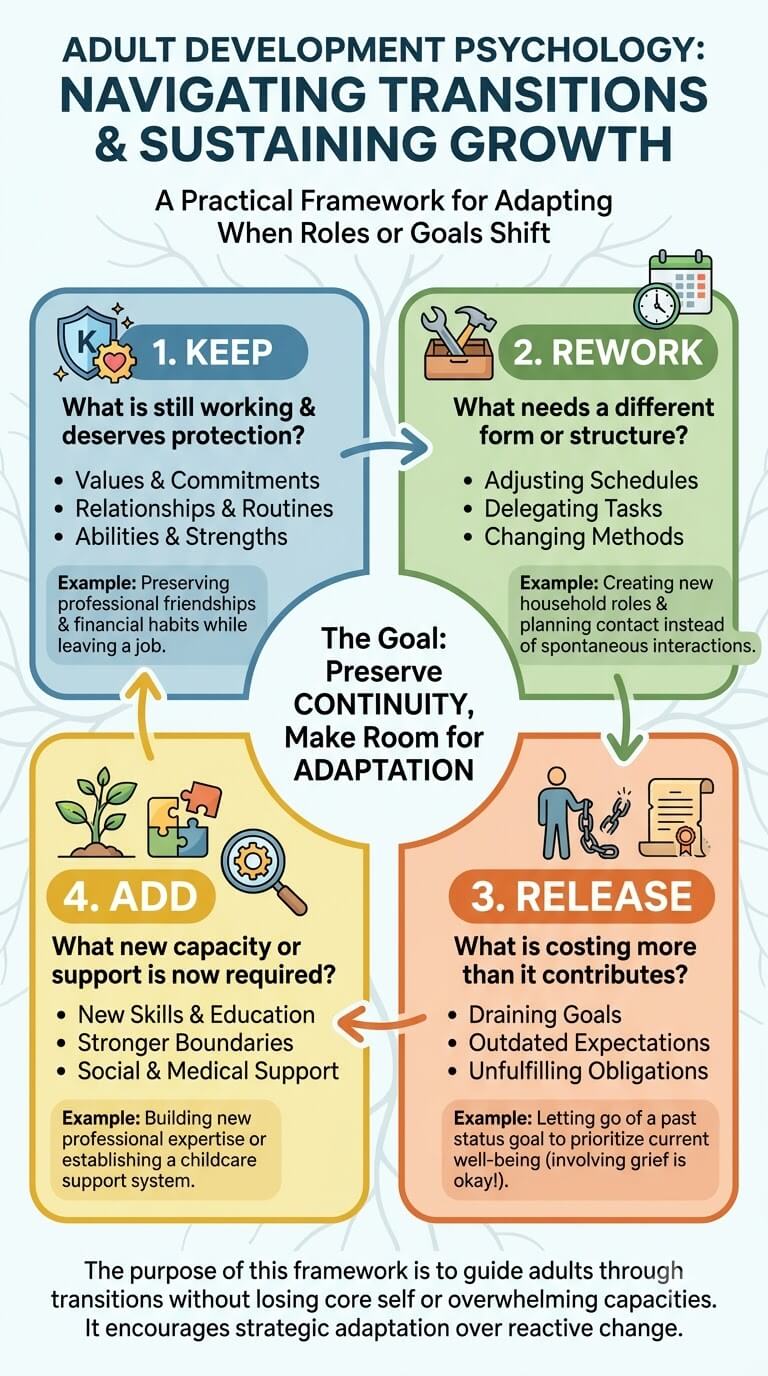
When an adult role or goal no longer fits, use four questions: Keep, Rework, Release, Add. The purpose is to preserve continuity while making enough room for adaptation.
Keep: What is still working?
Identify the values, relationships, abilities, routines, or commitments that still deserve protection. During transition, people sometimes assume everything must change because one important part feels wrong.
A person leaving a career may want to keep professional friendships, financial habits, mentoring, or a sense of contribution even if the job itself needs to change.
Rework: What needs a different form?
Some parts of life still matter but cannot continue in the same way. A caregiver may need a new schedule. A manager may need to delegate. A friendship may need planned contact instead of spontaneous contact.
Reworking is adaptation without abandonment. The underlying value remains, but the method changes.
Release: What is costing more than it contributes?
Adults accumulate obligations, identities, routines, and expectations. Not all of them deserve permanent maintenance. A goal may have been meaningful ten years ago and still be draining resources even though it no longer fits.
Release can involve grief. Letting go of an old plan may mean accepting that a possible future will not happen. That emotional cost does not prove the decision is wrong.
Add: What new capacity or support is now required?
A changed life often requires something that was not previously necessary. That might be a new skill, stronger boundary, social network, financial system, medical support, childcare arrangement, education, or way of organizing time.
Adding strategically is different from responding to uncertainty by doing more of everything. The question is what the new situation specifically requires.
| Step | Question | Example |
|---|---|---|
| Keep | What still fits and deserves protection? | Preserve close friendships during a career transition |
| Rework | What matters but needs a different structure? | Change household responsibilities after a new caregiving demand |
| Release | What no longer justifies its cost? | Stop pursuing a status goal that conflicts with current priorities |
| Add | What new skill, support, or routine does this stage require? | Build a new professional skill or caregiving support system |
What to Explore Next
Emerging Adulthood for the transition into adult roles
If the main question is about the years when identity, work, relationships, housing, and independence are still being tested, emerging adulthood is the more precise lens. Adult development is broader and includes change after roles have become more established.
Identity Development for changes in the sense of self
If a transition mainly raises questions such as “Who am I without this job?” or “Which values still feel like mine?”, identity development provides a closer look at exploration, commitment, and revision.
Motivation Psychology for changing goals and effort
If the issue is why effort starts, fades, or becomes difficult even when the life direction is clear, motivation psychology can separate goal structure, reward, autonomy, progress, and fear of failure from a broader developmental transition.
Psychology of Aging for later-life changes
If the central concern involves later-adult cognition, memory, social priorities, retirement, loss, or adaptation to age-related change, the psychology of aging offers more specific context than a general adult-development overview.
When Adult Change Needs More Than Self-Reflection
Persistent severe distress or major functional decline
Life transitions can create uncertainty, grief, frustration, or anxiety without indicating a mental disorder. Professional support becomes more important when distress is severe or persistent, or when there is a major decline in sleep, eating, work, self-care, concentration, relationships, or everyday functioning.
Sudden confusion, major cognitive change, or rapid loss of abilities also deserves medical evaluation rather than being explained as ordinary adult development or aging.
Unsafe relationships or coercive control
Threats, violence, stalking, financial control, severe humiliation, isolation, or retaliation are not ordinary developmental challenges. If an adult transition is occurring inside an unsafe relationship, safety planning and specialized support take priority over communication exercises or self-improvement strategies.
FAQ About Adult Development Psychology
Does psychological development stop after age 25?
No. Some aspects of brain and cognitive maturation continue into young adulthood, but psychological development is much broader than brain maturation. Adults continue changing through roles, goals, relationships, identity, learning, expertise, health, and adaptation throughout life.
Can adults change their personality?
Yes, personality traits show both stability and change across adulthood. People usually remain recognizable over time, but average trait levels and individual patterns can shift. Adult development is broader than personality change, so meaningful growth can also happen even when basic trait patterns remain relatively stable.
Is a midlife crisis a normal stage everyone goes through?
No. Midlife can bring pressure, reassessment, and competing responsibilities, but a dramatic crisis is not a universal developmental event. Some adults experience severe distress in midlife, while many do not. The cause of distress should be understood specifically rather than assumed from age alone.
Why do adult priorities change over time?
Priorities change because time, opportunity, responsibilities, health, relationships, experience, and expectations change. A goal that was worthwhile under one set of conditions may become less important when its costs rise or another value becomes more central.
Is becoming more selective a sign of decline?
Not necessarily. Selectivity can be an adaptive response to limited time and competing goals. Adults may invest more deeply in fewer relationships, focus on the work where their expertise matters most, or stop pursuing options that no longer fit. The key question is whether selectivity supports functioning and personally meaningful priorities.
Key Takeaways
- Adult development continues through changing goals, roles, relationships, identity, cognition, expertise, and adaptation.
- Growth in adulthood often looks like better allocation of time and effort rather than constant expansion of options.
- Identity and personality both show continuity and change, but adult development is broader than either one.
- Midlife reflection is common, but a dramatic midlife crisis is not a universal psychological stage.
- Adults often maintain performance by combining knowledge, expertise, strategy, and external supports rather than relying on raw mental speed alone.
- The Keep, Rework, Release, Add framework can help organize a transition without assuming that an entire life needs to be reinvented.
If an adult transition feels confusing, choose one role, goal, or relationship that has changed and ask four questions: what still fits, what needs a different form, what no longer deserves the cost, and what new support or skill is required. Development in adulthood is often less about becoming a completely different person and more about adapting a continuous self to changing conditions.
Educational note: Psychology Exposed provides general, research-aware information about adult psychological development. It cannot evaluate an individual’s mental health, cognitive change, relationship safety, or medical concerns and does not replace qualified professional assessment.
About the author: Michael Reed is Founder & Lead Writer at Psychology Exposed, where he turns research on human development, behavior, and everyday decision-making into clear explanations for non-specialist readers.

Michael Reed is the Founder and Lead Writer at Psychology Exposed. He writes about human behavior, relationships, emotional patterns, self-awareness, and practical psychology topics using research-informed, easy-to-understand content.
Read More About Michael Reed: https://psychologyexposed.com/michael-reed/