

You can be old enough to make major life decisions and still feel as if your adult life is not fully settled. One person is finishing school and moving back home. Another has a full-time job but no clear career direction. Someone else is financially independent yet uncertain about relationships, identity, or where to build a life. These experiences are often grouped under the idea of emerging adulthood.
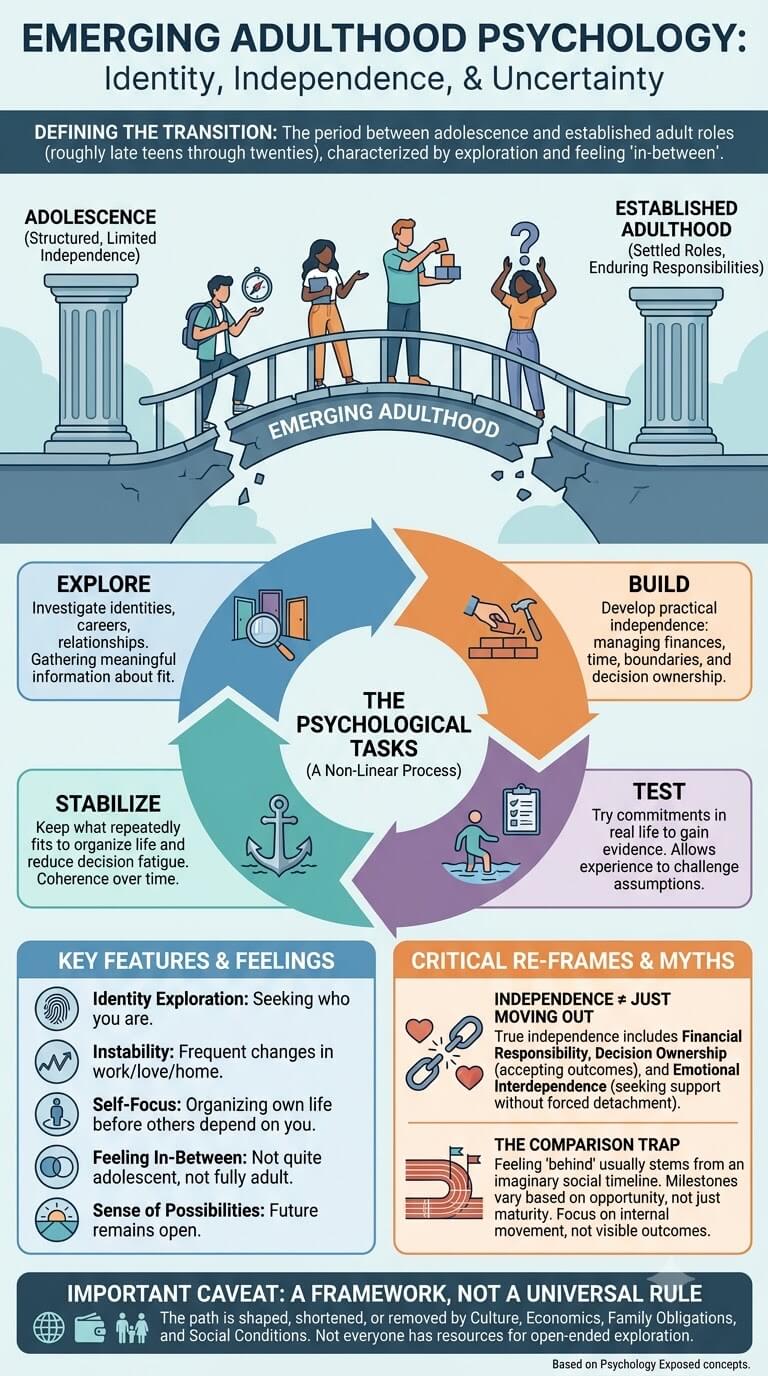
Emerging adulthood psychology examines a transition between adolescence and more established adult roles. It is useful because it captures a period when identity, work, relationships, independence, and future direction may all be changing at once. It is not a universal stage that everyone experiences in the same way. Culture, finances, education, family expectations, work opportunities, caregiving responsibilities, and social conditions can shorten, reshape, or remove many of the experiences commonly associated with it.
Quick Answer
Emerging adulthood describes a transition, not a fixed personality type
The APA Dictionary of Psychology defines emerging adulthood as a period spanning the late teens through the twenties that is theoretically distinct from adolescence and established young adulthood. The idea is commonly used to describe a time of increased exploration in identity, relationships, work, and life direction, often alongside a feeling of being partly adult but not fully settled.
The framework is useful, but it is not universal
Not everyone has years available for open-ended exploration. Some people enter full-time work, marriage, parenthood, military service, caregiving, migration, or financial responsibility early. Others remain dependent for longer because of housing costs, education, disability, labor markets, or family structures. Research comparing transitions across societies shows that the path into adulthood varies with social and demographic conditions, so the framework should be treated as a map rather than a rule.
What Emerging Adulthood Means
A period between adolescence and more settled adult roles
Adolescence is often structured by school, family rules, and limited legal independence. Established adulthood usually brings more enduring responsibilities, although the exact form differs from person to person. Emerging adulthood sits between those conditions for many people.
This transition is one part of the broader pattern of psychological development across the lifespan.
Someone in this period may have adult rights and obligations but still be exploring long-term work, partnership, location, beliefs, or lifestyle. They may support themselves financially in one year and need family help the next. That inconsistency is one reason the period can feel psychologically unusual.
Why the boundaries are flexible
There is no single birthday when emerging adulthood begins or ends psychologically. Legal adulthood, financial independence, emotional maturity, stable work, partnership, and parenthood rarely happen at the same moment. One person may feel adult at nineteen because they manage a household. Another may feel “in between” at twenty-seven despite a stable job.
Age ranges used in research are helpful for studying groups, but an individual’s experience depends on roles and context. Treating twenty-five as a psychological deadline would miss the point of the concept.
Five commonly discussed features, with important limits
Emerging adulthood is often described through five themes: identity exploration, instability, self-focus, feeling in-between, and a sense of possibilities. A recent review of the defining features of emerging adulthood across contexts highlights both the usefulness of these themes and the difficulty of treating them as invariant characteristics.
For example, “self-focus” does not mean selfishness. It refers to having more responsibility for organizing one’s own life before obligations to a spouse, children, or long-term role become dominant. Even that experience varies. A young adult caring for siblings or contributing heavily to family finances may have little room for self-focused exploration.
The Psychological Tasks of Emerging Adulthood

A practical way to understand this period is through four tasks: Explore, Build, Test, Stabilize. People explore possible directions, build skills and independence, test choices against real life, and gradually stabilize the parts that fit. The process is rarely linear.
Explore possible identities and directions
Exploration may involve changing majors, trying jobs, entering or leaving relationships, moving, reconsidering beliefs, joining new communities, or discovering that a long-imagined future does not feel right in practice. The value of exploration is not the number of options considered. It is whether the person learns something meaningful about fit.
A student who changes career direction after an internship may look less “settled” than someone who never questioned the original plan, yet the change may reflect better information. Exploration can create temporary uncertainty while improving long-term alignment.
Build practical independence
Independence is not one skill. It includes managing time, money, health appointments, transportation, work expectations, household tasks, boundaries, relationships, and consequences. People often become independent unevenly.
A twenty-three-year-old may live alone and manage finances well while relying heavily on parents for emotional decisions. Another may live with family but independently manage work, caregiving, transportation, and long-term planning. Living arrangement alone does not tell you how psychologically independent someone is.
Test commitments in real life
Some choices only become understandable through experience. A career that looked ideal in school may feel different after two years of daily work. A relationship may reveal compatibility questions that were invisible during early dating. Moving to a new city may change how important community or family proximity feels.
Testing does not mean avoiding commitment. It means allowing experience to provide evidence. A useful commitment is strong enough to organize behavior but flexible enough to be revised when repeated experience contradicts the original assumption.
Stabilize what repeatedly fits
Over time, some choices become less experimental. A person may develop a clearer work direction, a more stable social network, stronger values, a committed relationship, or a preferred way of organizing daily life. Stability can reduce decision fatigue because fewer major questions need to be reopened constantly.
Stabilization does not mean development is finished. Adult life continues to change. It simply means that some important domains become coherent enough to provide continuity while new questions emerge elsewhere.
| Task | Main question | Example |
|---|---|---|
| Explore | What possibilities deserve real-world investigation? | Trying a different field, community, or relationship pattern |
| Build | What adult skills and responsibilities do I need to manage? | Budgeting, scheduling, self-care, work routines, boundaries |
| Test | Does this choice still fit when lived rather than imagined? | Comparing expectations with actual work or relationship experience |
| Stabilize | What has earned enough trust to organize my life for now? | Keeping a role, value, location, or commitment that repeatedly fits |
Identity Exploration in Emerging Adulthood
Work and education become identity evidence
Work is not only a source of income. Early jobs often provide information about competence, values, status, preferred environments, and how much a person wants career to define them. Education can play a similar role by exposing people to fields, communities, and expectations they had not previously considered.
The process of testing roles, values, and commitments is examined more directly in our guide to identity development.
Research on identity resolution in emerging adulthood describes identity work as involving possibilities in education, career, friendships, and romantic relationships. These domains give people repeated evidence about who they may want to become.
Relationships can reveal values that were previously abstract
It is easy to say “communication matters” or “I want independence” in theory. Close relationships force those values into concrete decisions. How much time should partners spend together? How should money be handled? What does loyalty mean? Which family expectations matter?
Relationship experiences therefore contribute to identity even when the relationship does not last. A breakup may clarify a boundary. A healthy friendship may change expectations about reciprocity. A difficult team may reveal how much psychological safety matters at work.
Identity exploration is not the same as having no identity
A person can be stable in several domains while still exploring another. Someone may have strong values and close friendships but be unsure about career. Another may have a clear profession and be reconsidering beliefs or relationships.
Calling the entire self “lost” can make one open question feel larger than it is. It is often more useful to identify the specific domain that remains unsettled.
Independence Is More Than Moving Out

Financial independence
Money affects choices about housing, education, work, relationships, and family obligations. Financial independence can increase control over daily life, but it develops under conditions people do not choose entirely. Wages, housing costs, debt, health, and family resources shape what is possible.
Needing financial support does not automatically mean psychological immaturity. The more useful question is how much responsibility a person takes for the choices and obligations they can realistically manage.
Decision ownership
Psychological independence includes making choices and accepting that some outcomes will be imperfect. People who have been heavily directed by family or institutions may initially find open choice surprisingly stressful. Freedom removes a familiar external answer.
Decision ownership grows when a person can explain why a choice matters, gather relevant information, tolerate uncertainty, and revise without handing every difficult decision back to someone else.
Emotional independence without forced detachment
Independence does not require becoming emotionally separate from family or never asking for advice. Mature interdependence allows people to seek support while retaining responsibility for their decisions.
A young adult can value a parent’s opinion without obeying it automatically. They can need comfort after a failure without expecting someone else to solve the problem. Connection and autonomy can coexist.
Work, Direction, and the Pressure to Have a Plan
Early careers often provide information rather than final answers
Many first jobs are experiments whether people intend them to be or not. They reveal what kind of supervision is tolerable, whether competition is energizing, how much stability matters, and which tasks feel meaningful or draining.
Changing direction after learning from real work is different from changing direction because no option is ever allowed to become real. The first is evidence-based revision. The second may involve avoidance, perfectionism, fear of closing alternatives, or simply lack of opportunity, so the cause should not be assumed from the outside.
Comparison makes uncertainty feel like failure
Emerging adults often see peers moving at different speeds. One friend buys a home. Another starts graduate school. Someone gets married. Someone travels. Someone changes careers. Someone appears financially successful online.
These comparisons can create the false impression that adulthood has one correct sequence. In reality, the sequence depends on opportunity, culture, health, preferences, relationships, and luck as well as effort. A visible milestone tells you little about whether someone’s life fits them.
A direction can be useful without becoming permanent
A practical alternative to finding a perfect career is choosing a direction that is good enough to generate information. A twelve-month commitment to build a skill or test a field may be more useful than trying to solve the next forty years in advance.
Direction reduces paralysis because it creates a next step. Permanence can be evaluated later when more evidence exists.
Relationships, Intimacy, and Changing Expectations
Friendships may become less automatic
School creates repeated contact. Adult schedules do not. Friends may move, work different hours, enter relationships, or take on caregiving responsibilities. Maintaining closeness increasingly requires deliberate effort.
Changing friendships, intimacy, and social roles also reflect the continuing process of social development.
This shift can feel like social loss even when no conflict occurred. The friendship may not be failing; the structure that maintained it has changed. Emerging adults often have to learn how to create connection intentionally rather than relying on shared institutions.
Romantic relationships may become more future-oriented
Dating can gradually involve questions about lifestyle, location, finances, values, family, commitment, and long-term compatibility. A relationship that feels enjoyable in the present may still raise difficult questions about future fit.
This does not mean every relationship needs an immediate life plan. It means intimacy can begin to intersect with practical adulthood in ways that were less relevant during adolescence.
Family relationships may be renegotiated
Parents and adult children may need new rules around privacy, money, advice, household expectations, and decision-making. This can be especially complicated when a young adult lives at home but expects adult autonomy.
Clear agreements help distinguish support from control. Adults can remain connected without pretending the relationship has not changed.
Emerging Adulthood vs Adolescence vs Adult Development

| Period | Typical psychological emphasis | Common context |
|---|---|---|
| Adolescence | Growing autonomy, identity exploration, peer importance, developing decision capacity | More family and school structure, limited practical independence |
| Emerging adulthood | Testing identities and roles while building practical independence | Variable work, education, housing, relationships, and responsibility |
| Adult development | Adapting established roles, goals, relationships, expertise, and priorities | Often more durable responsibilities, although change remains possible |
Why emerging adulthood is not simply extended adolescence
Many emerging adults have legal rights, financial responsibilities, work obligations, and relationship choices that adolescents do not. They may make major decisions without parental permission and carry consequences directly.
For a broader view of how emerging adulthood fits among flexible developmental periods, see our guide to stages of development.
The uncertainty can resemble adolescence, but the practical conditions are different. Exploration occurs with more responsibility and often fewer built-in supports.
Why it is not the whole story of adult development
Adult development continues long after initial independence is established. Career changes, parenthood, caregiving, divorce, migration, health changes, loss, and retirement can all reorganize identity and priorities.
Emerging adulthood is therefore one possible transition into adult life, not a complete model of adulthood itself.
Why the Experience Is Not Universal
Culture changes what counts as adulthood
Different societies and families place different weight on independence, marriage, parenthood, work, education, family contribution, and living arrangements. A person may be considered fully adult because they contribute to family responsibilities even if they still live with parents.
Research on criteria for the transition to adulthood across cultures shows that individualistic markers such as independent decision-making coexist with relational and family-centered expectations. There is no single global checklist.
Economic conditions shape how much exploration is possible
Exploration often requires resources: time, safe housing, education, transportation, access to jobs, and the ability to survive mistakes. People facing poverty, unstable work, debt, discrimination, or major caregiving obligations may need to prioritize immediate responsibility over broad experimentation.
This is why “take your twenties to find yourself” can be unrealistic or dismissive. Some people develop identity through responsibility rather than through open-ended choice.
Family obligation can coexist with adulthood
Western descriptions of adulthood often emphasize separation from family. In many families, adulthood includes greater responsibility to family rather than greater distance from it. Contributing money, caring for relatives, or living in a multigenerational household may represent adult competence rather than dependence.
The better question is whether the arrangement allows appropriate responsibility, dignity, and decision ownership within its cultural and practical context.
When Feeling “Behind” Becomes the Main Problem
Milestone comparison creates an imaginary schedule
People often construct an adulthood timeline from peers: career by twenty-five, marriage by thirty, home ownership soon after, clear identity throughout. When life does not match the imagined schedule, uncertainty becomes shame.
The schedule is usually less universal than it feels. It reflects a mixture of culture, family expectations, local economics, social media, and the particular peer group being observed.
Uncertainty is different from lack of movement
You can be uncertain while moving. Trying a job, saving money, learning a skill, ending an unhealthy relationship, or building a new community may all represent development even if the final destination remains unclear.
Lack of movement is different. If the same question remains open for years because every option is rejected before it can be tested, the obstacle may deserve closer attention.
Social media shows outcomes more clearly than processes
People post promotions, weddings, travel, apartments, graduations, and achievements. They rarely show the long stretches of doubt, family help, debt, rejection, compromise, or boring practice that made those outcomes possible.
Comparing your internal uncertainty with someone else’s visible milestone therefore uses unequal information. It may be more useful to compare your current choices with your own goals and evidence.
A Decision Map for Emerging Adulthood

When everything feels open at once, use a four-part map: Open, Test, Hold, Commit. The goal is to stop treating every life domain as if it needs the same level of certainty.
Open: Which question genuinely needs exploration?
Name the domain that is actually unsettled. Career? Location? Relationship? Beliefs? Community? Education? If three areas are stable and one is uncertain, do not describe your entire life as directionless.
Test: What small action could produce evidence?
Replace imagination with contact. Talk to someone doing the job. Take a short course. Spend time in the city. Volunteer. Try a budget. Discuss a future expectation with a partner. The test should be large enough to teach you something and small enough that learning is affordable.
Hold: What does not need to be reopened right now?
Some choices are good enough. Constantly re-evaluating every friendship, job, value, and location creates cognitive noise. Decide which areas can remain stable while you investigate the question that actually needs attention.
Commit: What deserves a real period of effort?
Some questions cannot be answered through brief testing. A skill, job, relationship, or community may need sustained effort before fit becomes visible. Choose a reasonable period in which you will stop comparing every alternative and give the current direction a fair trial.
| Step | Purpose | Example |
|---|---|---|
| Open | Define the real uncertainty | “I am unsure about career direction, not my whole identity.” |
| Test | Create new evidence | Take on a short project in the field |
| Hold | Protect stable areas from unnecessary doubt | Keep supportive friendships and routines while exploring work |
| Commit | Give a promising direction enough time to become real | Spend a year building the skill before reassessing |
What to Explore Next
Identity Development when the main question is “Who am I becoming?”
If the central issue is how roles, beliefs, values, and commitments become integrated into a sense of self, identity development is the more precise lens. That topic focuses on exploration, commitment, and revision across life rather than on the transition conditions of the twenties.
Motivation Psychology when direction exists but action is difficult
Sometimes the problem is not uncertainty. You know what matters but cannot sustain effort. Motivation psychology can help distinguish value, reward, autonomy, progress, and fear of failure from a broader developmental transition.
Adult Development when the question is about change after roles are established
If the issue involves changing priorities, expertise, long-term relationships, caregiving, career revision, or adaptation after adult roles have become more established, adult development provides a wider frame.
Adolescent Development when family and peer structures are still central
If the person is still primarily navigating school, parental boundaries, expanding autonomy, and adolescent peer dynamics, the adolescent period is the better focus. The psychological question is different even when identity exploration overlaps.
When Uncertainty Needs More Support
Persistent distress or inability to function
Uncertainty about work, relationships, or identity can be uncomfortable without being a mental disorder. Support becomes more important when distress is persistent, severe, or accompanied by major changes in sleep, eating, concentration, self-care, work, school, or relationships.
A qualified professional can help determine whether the problem is a difficult transition, anxiety, depression, another mental health concern, or a combination of factors. An age label cannot answer that question.
Unsafe relationships, coercion, exploitation, or financial control
Transition periods can increase vulnerability because people may depend on partners, family members, employers, landlords, or others for money, housing, immigration status, transportation, or social connection. Threats, stalking, sexual coercion, violence, financial control, severe humiliation, or retaliation are not normal parts of becoming independent.
When safety is at risk, prioritize trusted support and specialized local resources rather than treating the problem as a communication or maturity issue.
FAQ About Emerging Adulthood Psychology
What age is emerging adulthood?
The concept is often used for the late teens through the twenties, with many descriptions emphasizing roughly ages eighteen to twenty-five. Those ages are research conventions rather than strict psychological boundaries. Education, work, family roles, culture, and economic conditions can change when a person experiences the transition.
Is emerging adulthood a real developmental stage?
It is an influential developmental framework with substantial research behind it, especially in societies where marriage, parenthood, and stable careers tend to occur later. Researchers also debate how consistently its features apply across cultures and social conditions. It is best used as a framework for common patterns rather than a universal stage everyone must pass through.
Why do people in their twenties often feel behind?
The twenties frequently contain uneven transitions. Peers may reach visible milestones at very different times, while social media makes those differences easy to compare. Feeling behind often reflects an assumed timeline rather than evidence that development has failed. The useful question is whether your current choices are creating learning, responsibility, and movement toward personally meaningful goals.
Is living with parents a sign that someone has not become an adult?
No. Living arrangements are shaped by finances, culture, housing markets, education, caregiving, and family preference. Adult functioning is better assessed through responsibility, decision ownership, contribution, and practical competence than through address alone.
How is emerging adulthood different from an identity crisis?
Emerging adulthood describes a broader transition in roles and independence. Identity uncertainty can occur within that period, but it is only one part of the picture. An identity crisis refers more specifically to serious distress or instability around the sense of self. Ordinary exploration does not automatically mean a crisis is occurring.
Key Takeaways
- Emerging adulthood describes a transition in which identity, work, relationships, independence, and future direction may remain relatively open.
- The framework is useful but not universal. Culture, economics, family obligation, education, and opportunity shape how much exploration a person can realistically have.
- Independence is multidimensional. Financial support, living arrangements, decision ownership, emotional connection, and practical responsibility do not always change together.
- Feeling uncertain does not mean development has stopped. Exploration becomes useful when it creates evidence through real experience.
- Comparing adult milestones can create an imaginary schedule that says more about social expectations than psychological maturity.
- The Open, Test, Hold, Commit map can help separate one unsettled life domain from the mistaken belief that everything must be solved at once.
If adulthood feels unusually unclear, identify one domain that is genuinely open and one domain that is already stable. Create a small test for the open question, then protect the stable area from unnecessary re-evaluation. You do not need a permanent answer to every part of adult life before you can make a useful next decision.
Educational note: Psychology Exposed provides general, research-aware information about psychological development. It cannot determine why a particular person feels stuck, distressed, or uncertain, and it does not replace individualized mental health, medical, financial, or safety support.
About the author: Michael Reed is the Founder & Lead Writer at Psychology Exposed. He explains human behavior, relationships, emotional patterns, self-awareness, and everyday decisions in clear, practical language for general readers.

Michael Reed is the Founder and Lead Writer at Psychology Exposed. He writes about human behavior, relationships, emotional patterns, self-awareness, and practical psychology topics using research-informed, easy-to-understand content.
Read More About Michael Reed: https://psychologyexposed.com/michael-reed/