
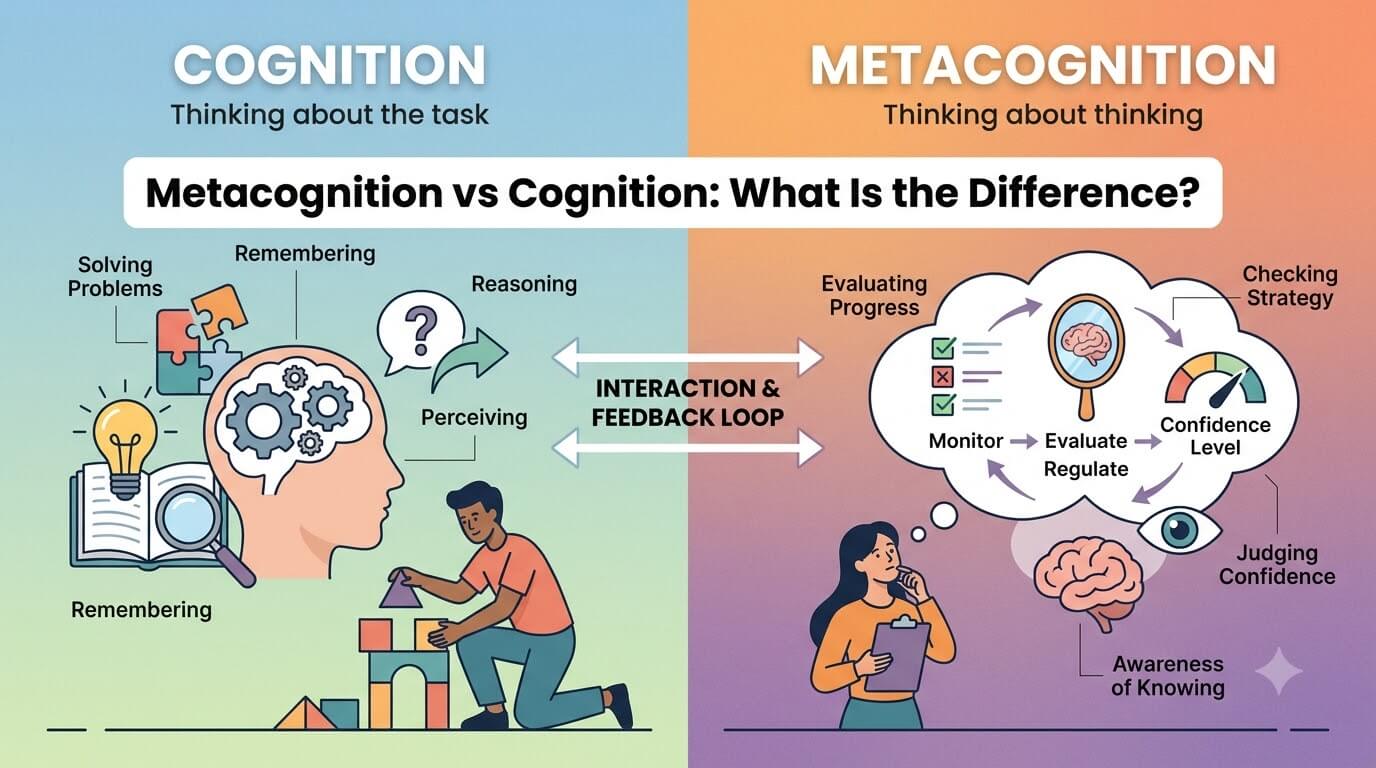
You can solve a problem, remember a name, follow a conversation, or make a judgment without stopping to think about how well your mind is doing those things. That distinction is the heart of metacognition vs cognition. Cognition is the mental work itself. Metacognition is the layer that notices, evaluates, and sometimes changes that mental work.
The difference matters because people often treat any deliberate thought as metacognition. It is not. Thinking carefully about a budget is cognition. Noticing that your estimate depends on a weak assumption, checking the numbers again, and deciding to use a different method adds a metacognitive layer. The same distinction appears in reading, memory, problem-solving, work, and everyday conversations.
The focus here is that boundary. You do not need a survey of every cognitive process to tell the levels apart. A practical test is enough to identify which level is operating in a specific moment.
Quick Answer: Cognition Does the Thinking, Metacognition Checks the Thinking
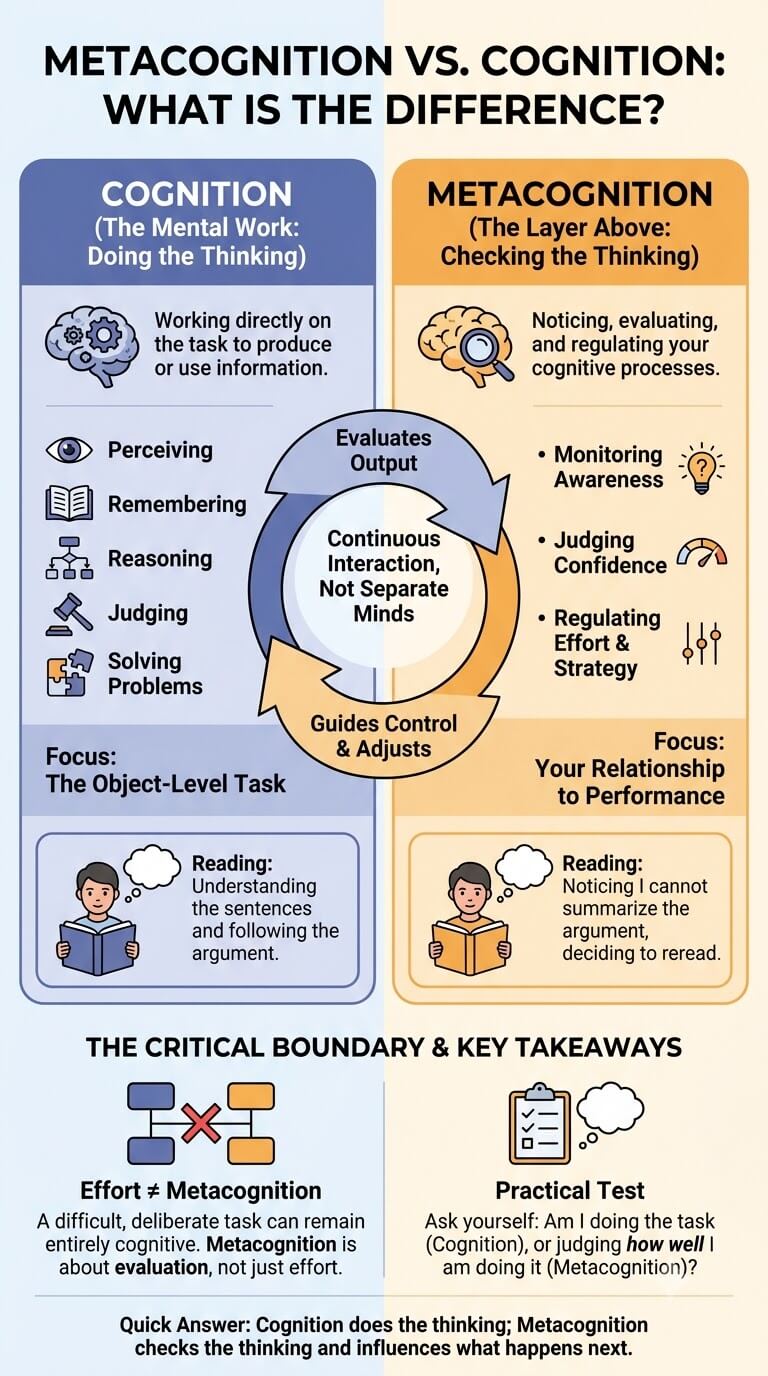
Cognition includes mental activities such as perceiving, remembering, reasoning, judging, imagining, and solving problems. Metacognition involves knowledge about those mental activities plus monitoring and regulating how they are going. In simple terms, cognition produces or uses information; metacognition asks how reliable, complete, effective, or appropriate that process is, then may influence what happens next.
A one-sentence distinction
A useful short version is: cognition works on the task, while metacognition works on your relationship to your own performance on the task.
The APA Dictionary of Psychology describes cognition broadly as forms of knowing and awareness that include perceiving, remembering, reasoning, judging, imagining, and problem-solving. Metacognition sits one level above that activity when you represent, monitor, or regulate what your cognition is doing.
A simple everyday example
Imagine you are reading a news article. Understanding the sentences, recalling background information, and deciding what the argument means are cognitive activities. Halfway through, you realize you cannot explain the main claim in your own words. You reread one paragraph, compare it with another, and lower your confidence in your first interpretation. That noticing, evaluation, and adjustment are metacognitive.
The same person can move back and forth between the two levels in seconds. There is no separate “metacognitive mind.” There is ordinary cognition, plus moments when the mind represents and regulates aspects of its own processing.
What Counts as Cognition?
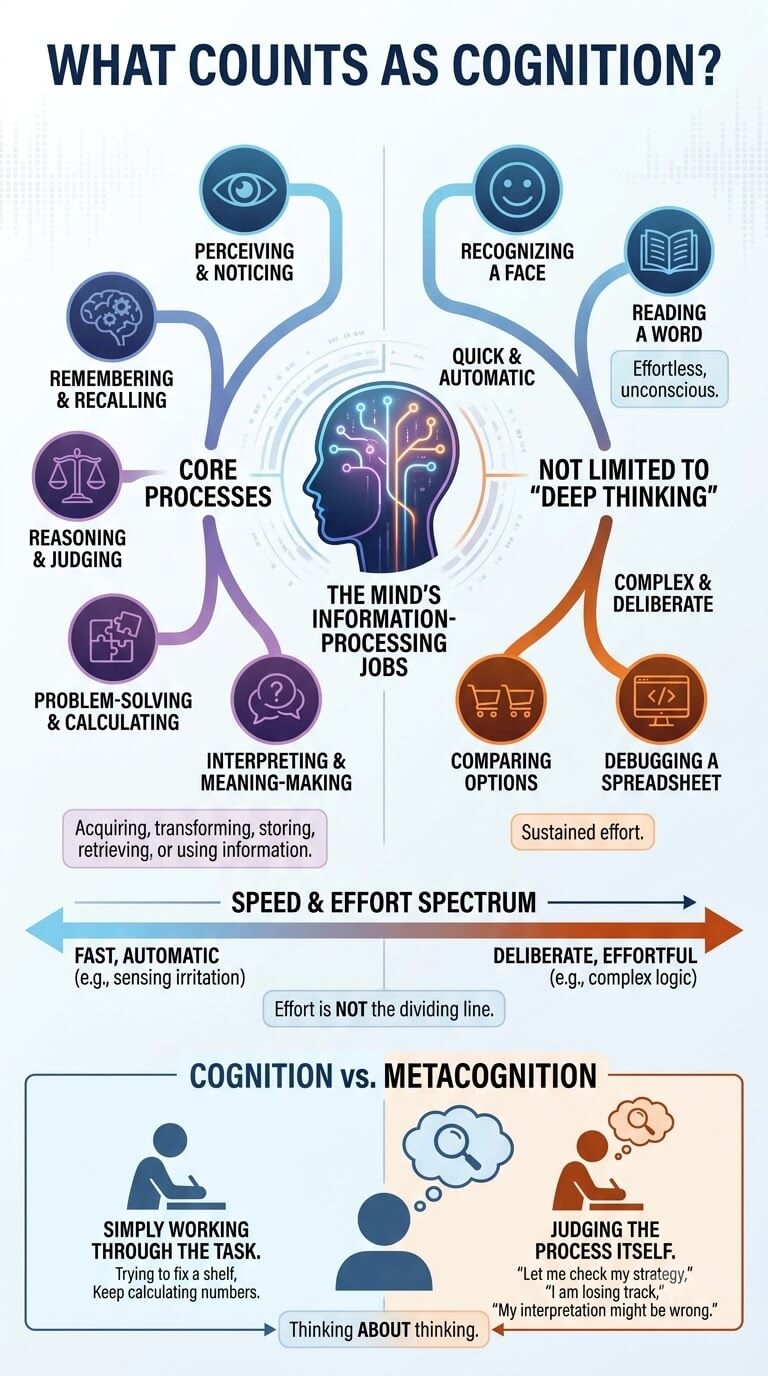
Cognition is a broad term, so the easiest way to understand it is to ask what information-processing job the mind is performing. The answer might involve noticing, remembering, comparing, interpreting, choosing, calculating, or constructing meaning.
Perceiving, remembering, reasoning, judging, and problem-solving
When you recognize a familiar face across a room, recall where you parked, compare two prices, interpret a sarcastic comment, or work out how to fix a loose shelf, you are using cognitive processes. These activities differ from one another, but all involve acquiring, transforming, storing, retrieving, or using information.
Cognitive psychology studies many of these processes in detail. For the present distinction, the important point is simpler: cognition is not limited to “deep thinking.” A quick recognition, a memory retrieval, and a complex logical argument can all count as cognition.
Cognition can be fast, automatic, or deliberate
Some cognition feels effortless. You read a common word without consciously sounding out each letter. You recognize that a friend sounds irritated before you can explain which vocal cue gave you that impression. Other cognition demands sustained effort, such as comparing mortgage options or debugging a complicated spreadsheet.
This matters because effort is not the dividing line between cognition and metacognition. A difficult task can remain entirely at the cognitive level if you simply keep working through it. Metacognition appears when you form a judgment about the process, such as “I am losing track of the conditions in this problem” or “My first interpretation may be based on incomplete information.”
What Counts as Metacognition?
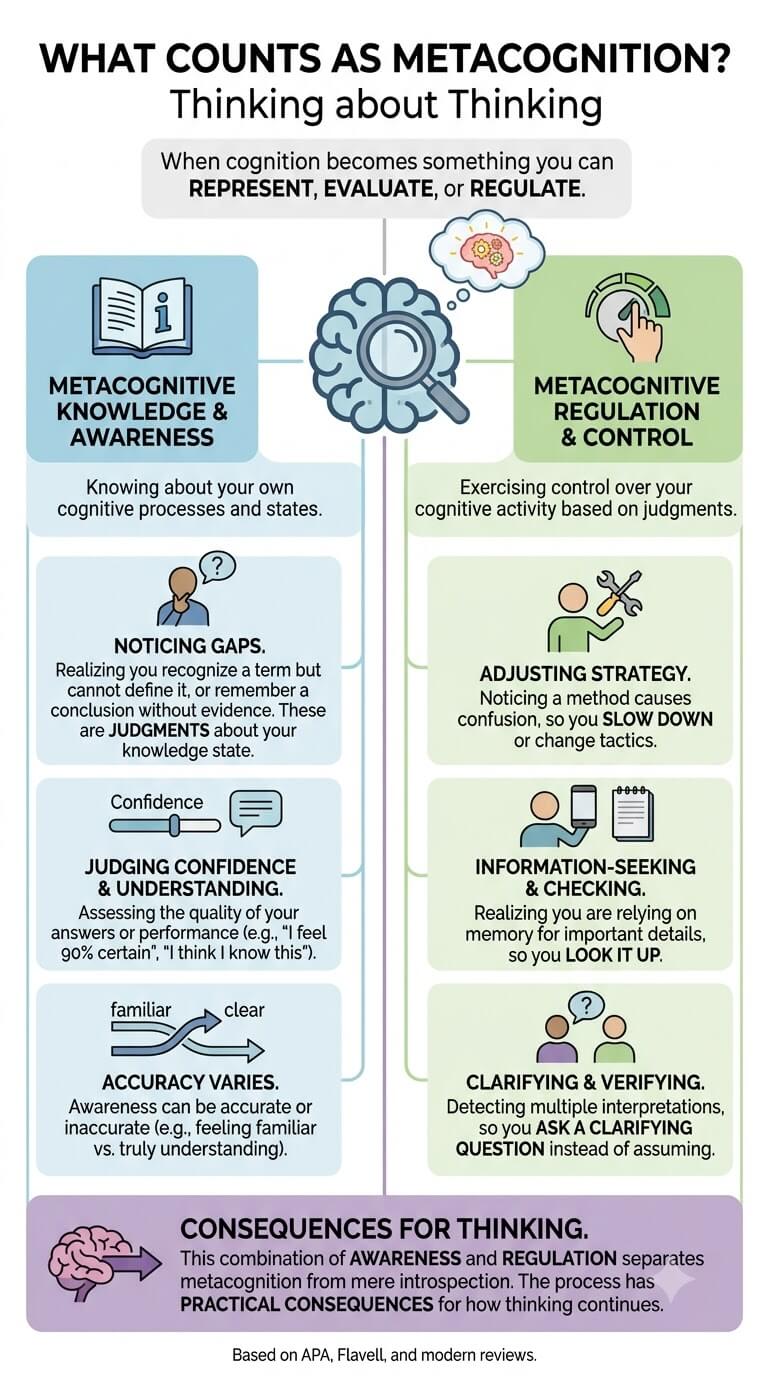
Metacognition begins when your own cognition becomes something you can represent, evaluate, or regulate. The APA Dictionary of Psychology entry on metacognition provides a concise reference point for this higher-order activity. Classic work by John Flavell helped establish the field by describing knowledge about cognitive processes and the monitoring of cognitive activity. Modern reviews still commonly distinguish between knowing about cognition and exercising control over it.
Noticing what you know or do not know
You may realize that you recognize a term but cannot define it, that you remember the conclusion of an argument but not the evidence, or that you are making an assumption about someone’s intention. These are not simply gaps in knowledge. They are judgments about the state of your own knowledge.
This kind of awareness can be accurate or inaccurate. You may correctly notice that your understanding is weak, or you may feel that something is clear because it is familiar. The important feature is that your own cognitive state has become the object of evaluation.
Judging confidence, understanding, or likely success
Suppose you answer a question and feel 90 percent certain that you are right. The answer itself comes from cognition. The confidence judgment concerns the quality of that answer. Research on metacognition often studies precisely this relationship between performance and people’s judgments about their own performance.
A confidence judgment does not have to be numerical. “I think I know this,” “I am not sure,” “I would want to verify that,” and “I can probably explain this without notes” are all everyday forms of metacognitive judgment.
Regulating effort, strategy, checking, or information-seeking
Metacognition becomes especially useful when a judgment changes what you do. You notice that your current method is producing confusion, so you slow down. You realize you are relying on memory for a detail that matters, so you look it up. You detect that two interpretations remain plausible, so you ask a clarifying question rather than committing to one.
A broad review in npj Science of Learning describes metacognition in terms of awareness of cognitive processes and the capacity to regulate them. That combination helps separate metacognition from mere introspection. The process has practical consequences for how thinking continues.
Cognition vs Metacognition Side by Side
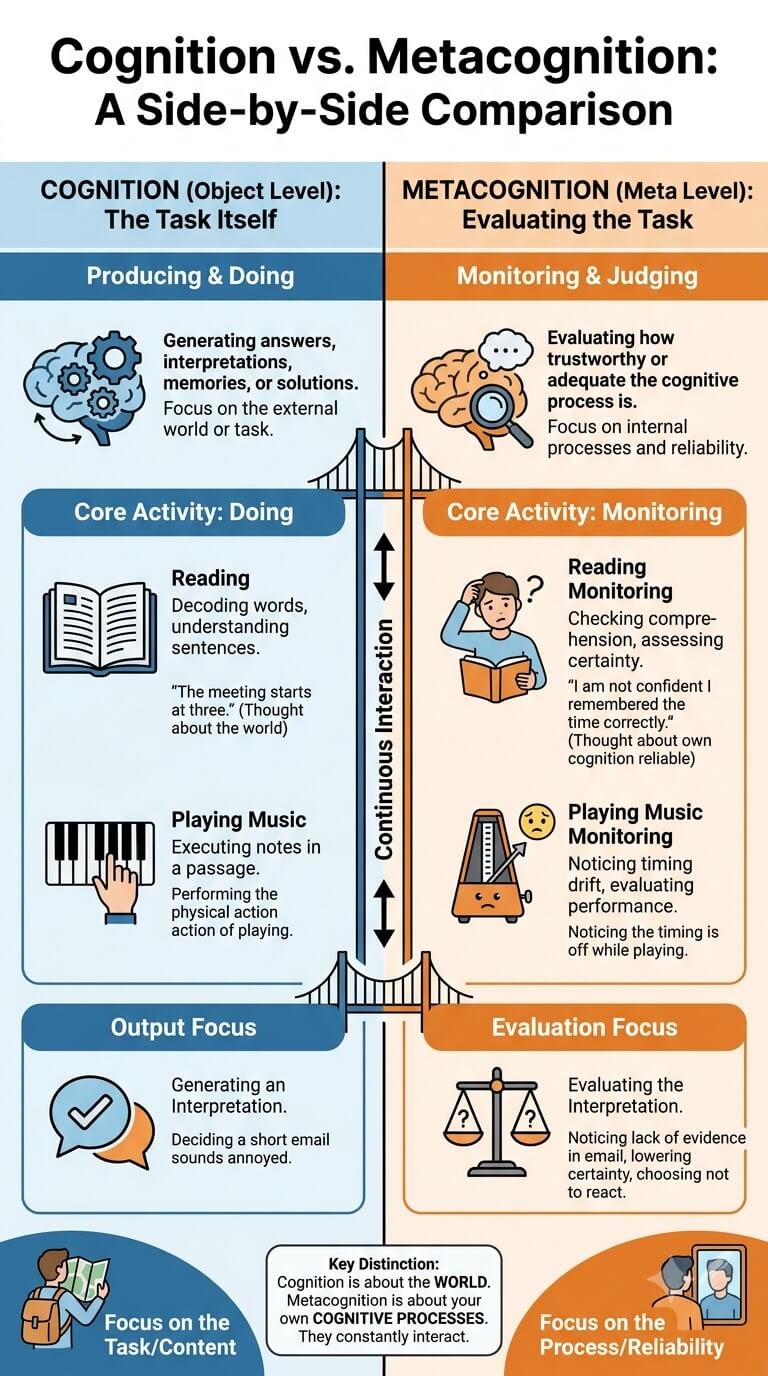
The distinction becomes clearer when the same situation is viewed at two levels. The following comparison is not meant to imply that the levels are independent. In real life they continuously interact.
| Situation | Cognition | Metacognition |
|---|---|---|
| Reading | Understanding the sentences and following the argument | Noticing that you cannot summarize the argument and deciding to reread |
| Memory | Trying to recall a person’s name | Judging that the name feels close but uncertain, then deciding whether to keep searching memory or ask |
| Problem-solving | Applying a method to reach an answer | Checking whether the method fits the problem and switching when it does not |
| Conversation | Interpreting what another person said | Recognizing that your interpretation rests on an assumption and asking for clarification |
| Decision | Comparing available options | Evaluating how confident you are, what information is missing, and whether further checking is worthwhile |
Object-level task versus meta-level judgment
Researchers sometimes describe the distinction as an object level and a meta level. The object level is the task being performed: remembering, choosing, calculating, interpreting, or solving. The meta level contains information about how that object-level process is going.
You do not need the terminology to use the distinction, but it helps explain why two thoughts can have different roles. “The meeting starts at three” is a thought about the world. “I am not confident that I remembered the time correctly” is a thought about the reliability of your own cognition.
Doing versus monitoring
Doing and monitoring often happen close together. A musician plays a passage while noticing that the timing is drifting. A driver follows a route while realizing they are no longer confident that they recognized the correct exit. A presenter speaks while noticing that the audience looks confused and reconsidering how clearly the point was explained.
The monitoring layer is not necessarily a long internal monologue. It may be a brief feeling of uncertainty, a recognition of error, or a judgment that the current approach is working well enough to continue.
Producing an answer versus evaluating the answer
This is one of the cleanest boundary tests. If the mental activity is generating an answer, interpretation, memory, or solution, you are primarily looking at cognition. If the activity is evaluating how trustworthy or adequate that output is, you have moved into metacognition.
For example, deciding that a colleague’s short email sounds annoyed is an interpretation. Noticing that the email provides very little evidence about emotional tone, lowering your certainty, and choosing not to react immediately is metacognitive evaluation and control.
Comparison examples from reading, memory, problem-solving, and conversation
Consider four paired examples:
- Reading: “I understand what this paragraph says” is cognition about the content. “I could not explain the paragraph without looking back” is a judgment about understanding.
- Memory: searching for a password hint in memory is cognition. Deciding that repeated guesses are no longer informative and switching to account recovery is regulation based on monitoring.
- Problem-solving: calculating possible routes is cognition. Realizing that the route comparison ignores traffic conditions and changing the criteria is metacognition.
- Conversation: interpreting a pause as disagreement is cognition. Recognizing that several explanations fit the pause and asking what the person means is metacognitive checking.
These examples show why “thinking about thinking” is useful but incomplete as a definition. What matters is not simply that another thought appears. The second thought represents or evaluates the first process in a way that can guide control.
Can Cognition Happen Without Metacognition?
Yes. Much mental activity proceeds without a clear, reportable judgment about how it is going. You can recognize objects, complete familiar routines, understand ordinary sentences, and make many quick judgments with little deliberate self-monitoring.
Automatic processing and low-awareness performance
Imagine typing a familiar password. You may enter it correctly without consciously recalling each character. Or consider walking through your home while talking on the phone. Perception and movement are coordinated, yet you may devote almost no attention to evaluating those processes.
Even deliberate cognition can contain long stretches with limited metacognitive checking. Someone may spend twenty minutes solving a problem before asking whether the chosen method is appropriate. The cognitive work was real throughout, even though monitoring arrived late.
Why successful performance does not always mean accurate self-evaluation
Good performance and good self-evaluation are related questions, not the same question. A person might solve a task correctly but feel uncertain, or produce a wrong answer with high confidence. Research on confidence highlights this distinction between task accuracy and the quality of judgments about accuracy.
This is one reason metacognition should not be treated as a synonym for intelligence or ability. A person can possess strong knowledge in an area yet misjudge when that knowledge applies. Another person may know less overall but be better at recognizing uncertainty and seeking the information they need.
Can Metacognition Work Without Cognition?
Not in the ordinary psychological sense. Metacognition needs something to monitor. Even when the experience feels like pure self-reflection, the judgment depends on information produced by memory, perception, reasoning, or another cognitive process.
Why metacognition depends on information generated by cognitive processes
If you judge, “I probably remember this correctly,” the judgment depends on a memory attempt. If you think, “I am confused by this explanation,” that judgment depends on trying to understand the explanation. If you decide that your solution method is failing, the judgment depends on information from the problem-solving process.
Metacognition is therefore better understood as a relationship between levels of processing than as a separate mental faculty floating above cognition. Flavell’s foundational account of metacognition and cognitive monitoring emphasized knowledge, experiences, goals, and actions that concern cognitive activity itself.
Why the two levels interact rather than operate as separate minds
The relationship runs in both directions. Cognitive activity gives metacognition something to evaluate. Metacognitive judgments can then redirect cognitive activity. You try to remember, judge that recall is unreliable, check your calendar, and then update your understanding.
This loop can repeat several times. The important point is not to imagine a tiny observer inside the mind watching everything. The “meta” level is simply cognition representing aspects of cognition in a way that allows monitoring or control.
The Boundary With Self-Awareness and Executive Control
Two nearby ideas often make the distinction harder: self-awareness and executive control. Both overlap with metacognition, but neither is an exact substitute.
Self-awareness is broader than monitoring cognitive performance
Self-awareness can include awareness of emotions, values, identity, bodily sensations, social behavior, motives, and personal history. Metacognition is narrower when it concerns your own knowing, remembering, reasoning, understanding, confidence, or strategy use.
For example, “I feel embarrassed in this meeting” is self-awareness. “Because I feel embarrassed, I may be interpreting neutral feedback as harsher than it is, so I should check what was actually said” adds metacognitive evaluation of interpretation.
Executive control changes behavior and attention but is not identical to metacognitive judgment
Executive control refers broadly to processes that help coordinate goal-directed behavior, such as maintaining goals, inhibiting an impulse, shifting attention, or switching tasks. Metacognitive control may recruit some of those abilities, but it is specifically guided by information about your own cognitive state or performance.
Closing distracting browser tabs because you have a deadline is an act of control. Closing them because you notice that repeated switching is making you lose the thread of an argument adds a metacognitive reason for the control. The behavioral action can look similar even though the informational basis differs.
Common Mix-Ups That Make the Terms Seem Identical
Most confusion comes from treating any reflective or effortful mental activity as metacognition. Three distinctions help keep the categories useful.
Reflection is not the whole of metacognition
Reflection can be metacognitive, but it depends on what you are reflecting on. Thinking about why a historical event happened is reflective cognition about history. Thinking about why you repeatedly overlook one kind of evidence in historical arguments is reflection on your own processing.
Metacognition also includes quick monitoring that may not feel reflective at all, such as a brief sense that an answer is uncertain or that you made an error.
Deliberate thinking is not automatically metacognitive
You can reason carefully for an hour and remain focused entirely on the problem. Deliberation describes how effortful or conscious the cognition is. Metacognition describes whether the cognition is monitoring or regulating another cognitive process.
A useful check is to ask, “Am I thinking about the problem, or am I evaluating how I am thinking about the problem?” Sometimes the answer is both, but the distinction still clarifies what each mental move is doing.
Confidence is a metacognitive judgment, not a guarantee of correctness
Confidence tells you how certain you feel about an answer or perception. It does not directly tell you whether the answer is correct. A major review of metacognition and confidence discusses how metacognitive research examines personal judgments and beliefs about performance, including how well confidence tracks actual accuracy.
This distinction becomes especially important in arguments. Feeling certain may be useful information about your internal state, but it is not evidence that another interpretation has been ruled out.
A Four-Question Test for Telling Them Apart
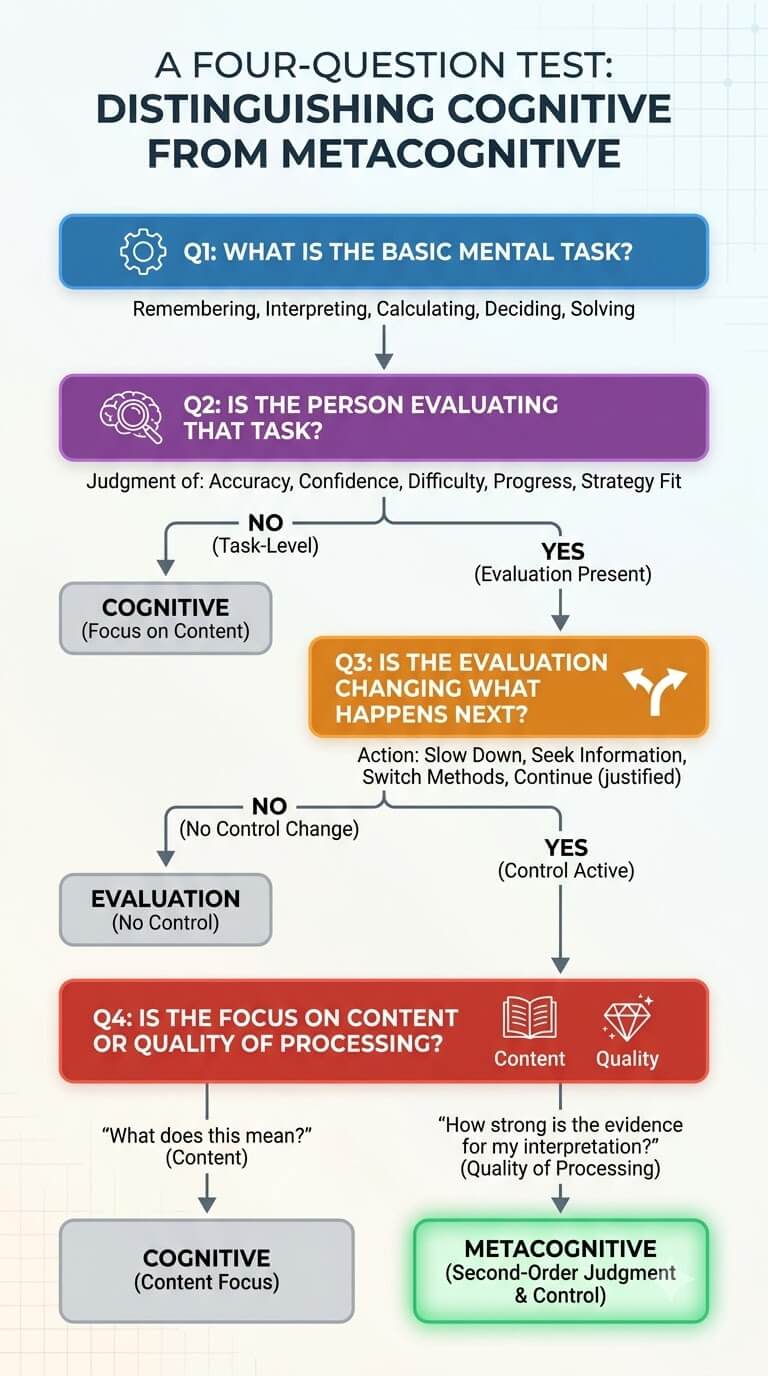
When the terms still feel blurry, use a four-question test. The goal is not to label every thought perfectly. It is to identify whether a second-order judgment is present and whether that judgment affects what happens next.
What mental task is being performed?
Name the basic job first. Are you remembering, interpreting, calculating, comparing, deciding, reading, recognizing, or solving? That is the cognitive task. Starting here prevents every complicated thought from being labeled metacognitive.
Is the person evaluating that task?
Look for a judgment about understanding, accuracy, confidence, difficulty, progress, strategy fit, or missing information. “I have an answer” stays at the task level. “I have an answer, but I am not sure why it is correct” adds evaluation.
Is the evaluation changing what happens next?
Monitoring often leads to control. You may continue because confidence is justified, slow down because errors are increasing, seek information because memory is weak, or switch methods because progress has stalled.
Control is not required for every metacognitive judgment, but when evaluation clearly changes strategy, effort, checking, or stopping, the metacognitive role becomes easier to see.
Is the focus on content or on the quality of processing?
This final question is often decisive. “What does this person mean?” focuses on content. “How strong is the evidence for my interpretation of what this person means?” focuses on the quality of processing.
| If the thought mainly asks… | It is mainly about… |
|---|---|
| What is the answer? | Cognition |
| What does this mean? | Cognition |
| How sure am I that this answer is right? | Metacognition |
| What am I missing? | Metacognition when it concerns your own knowledge state |
| Is my current method working? | Metacognition |
| Should I verify, continue, or change approach? | Metacognitive control |
Which Metacognitive Skill Matters Next?
Once you can separate task-level thinking from monitoring and regulation, the next question depends on where the difficulty occurs. A broader overview of how metacognition works in everyday thinking can provide context, while different problems call for different kinds of self-observation.
For a broader view of how awareness, monitoring, confidence, and control work together, it helps to look at how metacognition works across everyday thinking.
Awareness when the issue is knowing your own state
If the problem is that you often discover too late that you did not understand something, the central issue is awareness of your knowledge state. Useful questions include: “Could I explain this without looking?” “Which part is unclear?” and “What am I assuming rather than actually knowing?”
When the main problem is recognizing the limits of your current understanding, metacognitive awareness becomes the more specific skill to examine.
This is more specific than general self-awareness. The focus is on what you know, do not know, understand, or remain uncertain about.
Self-monitoring when the issue is tracking performance
If you begin with a reasonable plan but fail to notice that performance is drifting, monitoring becomes more important. You might need feedback points that reveal whether errors are increasing, comprehension is dropping, or progress has stalled.
If the issue appears while a task is unfolding, self-monitoring focuses more directly on tracking performance, mistakes, and progress.
The focus here is not merely recognizing your current state once. It is tracking change as the task unfolds.
Strategies when the issue is regulation
If you notice the problem accurately but keep using the same ineffective approach, regulation is the next layer. The practical question becomes: “What should this information change?” You might adjust effort, seek feedback, change strategy, gather more information, or stop when additional work has little value.
When the evaluation needs to change what happens next, metacognitive strategies provide the planning and adjustment side of the process.
The distinction helps prevent a common frustration: being very aware of a problem without converting that awareness into a useful change in behavior.
FAQ About Metacognition vs Cognition
These questions test the boundary in areas where the two ideas commonly overlap. The key is to ask whether the mind is performing a task or evaluating its own performance of that task.
Is attention cognition or metacognition?
Attention is generally treated as a cognitive process. Directing attention toward a task, noticing a sound, or selecting one stream of information over another does not automatically make the process metacognitive. It becomes metacognitive when you evaluate your own attentional state, such as realizing that your focus keeps drifting and deciding to change the environment or the way you approach the task.
Is critical thinking a form of metacognition?
Critical thinking and metacognition overlap, but they are not identical. Evaluating evidence, identifying assumptions, and comparing explanations can be cognitive activities directed at an external claim. They become metacognitive when you also evaluate your own reasoning, confidence, blind spots, or strategy. For example, checking whether you applied the same evidentiary standard to your preferred explanation is metacognitive.
Is self-reflection always metacognitive?
No. Self-reflection can focus on feelings, values, goals, relationships, or identity without evaluating a cognitive process. Reflection becomes metacognitive when the focus is your own knowing, remembering, reasoning, understanding, confidence, or way of approaching a mental task. The subject is not simply “me,” but “how my cognition is operating.”
Is metacognition a cognitive skill?
It is commonly discussed as a higher-order aspect of cognition because it depends on cognitive processes and represents information about them. The useful distinction is functional rather than anatomical: ordinary cognition performs the task, while metacognitive processes monitor or regulate aspects of that performance. The levels interact closely rather than functioning as independent systems.
Key Takeaways
- Cognition includes the mental work of perceiving, remembering, reasoning, judging, and solving problems.
- Metacognition begins when you represent or evaluate your own knowledge, understanding, confidence, strategy, or performance.
- Effortful thinking is not automatically metacognitive. A difficult task can remain focused entirely on its content.
- Confidence is a metacognitive judgment, but confidence and correctness can diverge.
- The clearest practical test is to separate the task from the check: what am I doing, and how am I judging how well I am doing it?
- Metacognitive monitoring becomes especially useful when it informs a change in effort, strategy, checking, information-seeking, or stopping.
A useful next step is to notice one ordinary mental task today and name the two levels separately. First identify the task itself: remembering, interpreting, solving, or deciding. Then ask whether you formed a judgment about the quality of that process and whether the judgment changed what you did. That small distinction makes the difference between cognition and metacognition much easier to recognize in real life.

Michael Reed is the Founder and Lead Writer at Psychology Exposed. He writes about human behavior, relationships, emotional patterns, self-awareness, and practical psychology topics using research-informed, easy-to-understand content.
Read More About Michael Reed: https://psychologyexposed.com/michael-reed/