
You can spend an hour on a task and only afterward discover that you misunderstood the goal. You can reread the same paragraph until it feels familiar while still being unable to explain it. You can work harder on a plan that is not improving, or answer a question confidently without noticing that your response never addressed what was actually asked.
Metacognitive self-monitoring is the process that helps catch those mismatches while there is still time to respond. It involves checking your current understanding, performance, errors, or progress against something meaningful. The comparison may be quick and informal, such as noticing that an explanation no longer makes sense, or more deliberate, such as comparing a draft with a set of requirements before sending it.
This article uses self-monitoring in that metacognitive sense. In social psychology, the same term can refer to adjusting self-presentation across situations. Here, the focus is narrower: how you track the quality and direction of your own thinking and performance. Useful monitoring is not constant self-observation. It is selective checking that gives you information you can act on.
Quick Answer: Self-Monitoring Is the Ongoing Check Between What You Intended and What Is Happening

Self-monitoring in metacognition means checking how your current understanding or performance compares with a goal, expectation, or standard. You might notice confusion, detect an error, compare results with what you expected, or ask whether effort is producing progress. Monitoring is useful when it produces a clear signal. It becomes less useful when checking is constant, vague, or turns into judging yourself rather than evaluating the task.
Monitoring understanding, errors, progress, and performance
Monitoring can focus on several different targets. During reading, you may ask whether you could explain the idea without looking. During a work task, you may compare the current output with the requested result. During problem solving, you may notice that two steps contradict each other. During a longer project, you may ask whether the work completed this week actually reduced the distance to the goal.
These are not identical judgments. Understanding, accuracy, quality, and progress each need their own evidence. Research on measuring metacognitive knowledge, monitoring, and control emphasizes that monitoring can be assessed through judgments such as predictions, confidence ratings, and comparisons between judgments and actual performance. The practical lesson is simple: monitoring works best when you know what you are trying to judge.
Why monitoring is useful only when there is a meaningful standard
Before monitoring, define what counts. If the goal is to understand an argument, page count is a weak standard. If the goal is to make a recommendation, the relevant standard may be whether the conclusion follows from the available evidence. If the goal is to improve a process, activity alone is not enough. You need some indication that the result is getting better.
What Self-Monitoring Means in Metacognition
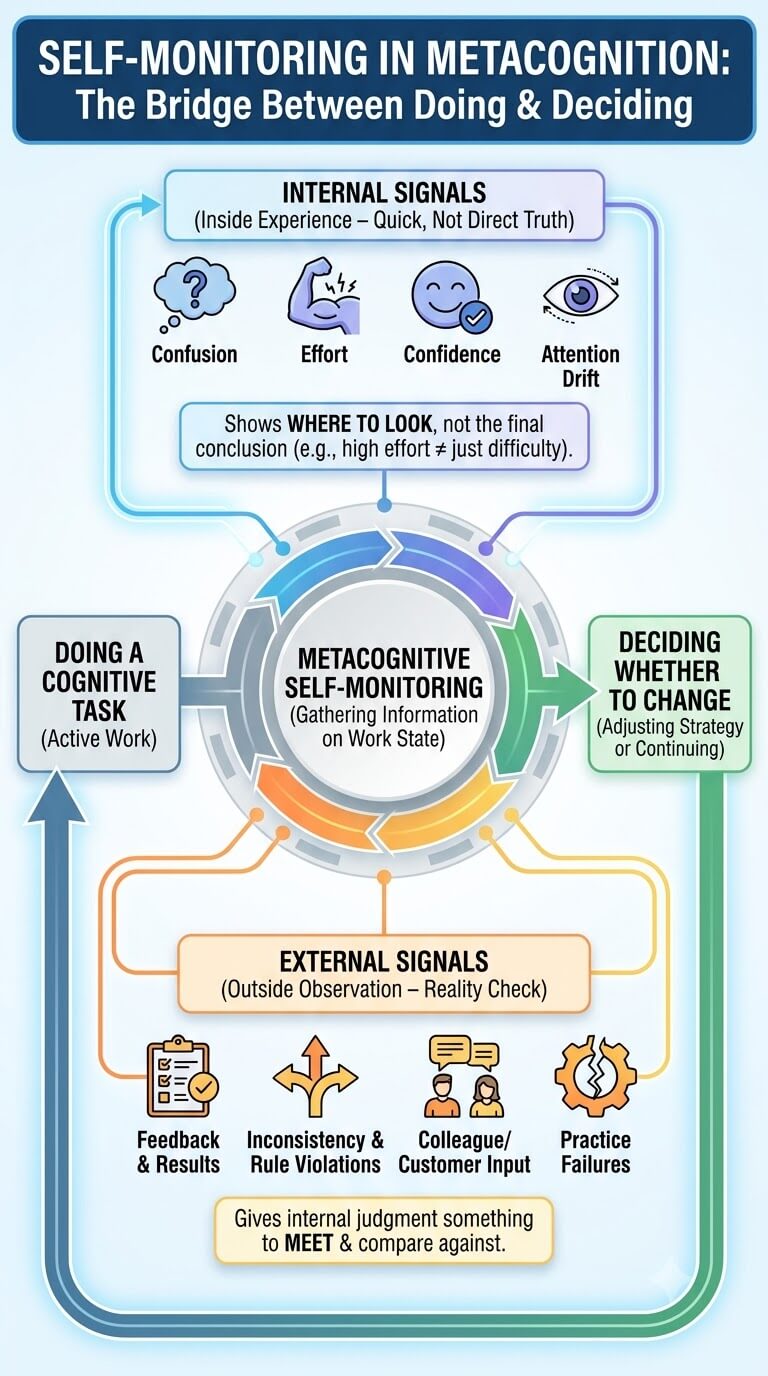
Metacognitive monitoring sits between doing a cognitive task and deciding whether anything needs to change. It gathers information about the state of the work. Some of that information comes from inside your experience, while some comes from results you can observe outside yourself.
Internal signals such as confusion, effort, and confidence
Internal signals include the sense that something is easy or difficult, the feeling that an answer is likely correct, the recognition that attention has drifted, and the moment when a sentence stops making sense. These signals are useful because they are available quickly. You do not need an external score to notice that you have lost the thread of an explanation.
But internal signals are not direct measurements of truth. High effort can mean the task is genuinely difficult, that your method is inefficient, or simply that you are tired. Confidence may track accuracy reasonably in one situation and poorly in another. Confusion can identify a real gap, but it can also appear temporarily while a new idea is being integrated. The signal tells you where to look, not automatically what the final conclusion should be.
External signals such as feedback, results, and inconsistency
External signals give your internal judgment something to meet. A calculation produces a result that violates a known constraint. A colleague says the draft answers a different question from the one requested. A customer keeps getting stuck at the same step. A practice attempt fails even though the procedure felt familiar.
The Four Things People Commonly Monitor

Monitoring becomes more precise when you separate four targets that people often blend together. A task can feel fluent while being inaccurate, require effort while still progressing, or produce a polished output that does not answer the actual question.
Understanding: do I actually follow this?
Understanding monitoring asks whether the idea is represented well enough to use, explain, connect, or question. The strongest check depends on the task. Recognition may be sufficient if you only need to identify a familiar label, but it is weak evidence if you need to explain a mechanism or apply the idea in a new case.
Performance: is the output meeting the goal?
Performance monitoring compares what you are producing with the result the task requires. Imagine writing a proposal. The prose may be elegant, but the proposal can still fail if it does not answer the decision-maker’s main concern. Monitoring performance means checking the output against the criterion rather than checking whether the work merely feels polished.
Errors: where is the mismatch?
Error monitoring begins when the current result conflicts with an expectation, rule, or piece of evidence. Sometimes the error is obvious, such as a total that does not reconcile. Other times it appears as friction: an explanation requires increasingly complicated exceptions, two claims cannot both be true, or a reader repeatedly misunderstands the same sentence.
Progress: am I getting closer or just staying busy?
Progress monitoring asks whether effort changes the relevant outcome over time. This matters in tasks where activity is easy to count. You can answer many emails without moving the critical project forward. You can spend hours reorganizing notes without becoming more able to retrieve or use the material. You can have repeated conversations about the same problem without any change in the behavior that keeps recreating it.
When Monitoring Happens
Self-monitoring is not limited to the middle of a task. Useful judgments can occur before performance begins, while it is underway, and after a result appears. Each timing answers a different question.
Before starting: baseline and expectations
Before you begin, you can estimate what you expect to know, how difficult the task may be, and what success should look like. This baseline matters because later monitoring needs something to compare with. If you predict that a task should take 30 minutes and two hours later you are still stuck at the same step, the discrepancy contains information.
During performance: online checks
During a task, monitoring may be almost immediate. You notice that you cannot remember the previous paragraph, that your answer conflicts with an earlier assumption, or that the person you are speaking with keeps asking the same clarifying question.
These online checks are most useful when brief. You need enough evaluation to catch drift, but not so much that every action is interrupted by another action evaluating it. Research by O’Leary and Sloutsky found that components of metacognition can show meaningful independence, reinforcing the value of distinguishing judgments about performance from the decisions that follow those judgments.
After a result: retrospective evaluation
Retrospective monitoring is especially valuable when feedback is delayed. A salesperson may not know immediately whether a revised message improves responses. A manager may need several project cycles before knowing whether a new process reduces errors. The key is to keep enough record of the original expectation that later feedback can actually update it.
Why Self-Monitoring Misses Problems
Monitoring failure is not always carelessness. Sometimes the task does not provide a clear standard. Sometimes attention is consumed by execution. Sometimes the cues available to you feel persuasive even though they are weak indicators of actual performance.
No clear success criterion
If “better” has not been defined, almost any signal can be interpreted as progress. A meeting can feel productive because many ideas were discussed. A draft can feel improved because it is longer. A learning session can feel successful because the material looks more familiar.
Attention is absorbed by task execution
Experimental work by Peng and Tullis on divided attention, metacognitive monitoring, and control found that attentional load did not affect every metacognitive component in the same way. For everyday use, the cautious takeaway is that doing the task and regulating the task compete for limited attention, so strategically placed checkpoints may be more realistic than trying to inspect everything continuously.
Familiarity masks confusion
Repeated exposure can make material easier to process, and that ease may be mistaken for stronger understanding. You reread the paragraph, recognize every phrase, and conclude that you know it. Only when you try to reproduce the idea do you discover missing links.
Feedback is delayed, noisy, or ignored
When feedback is noisy, avoid treating one outcome as a final verdict. Look for repeated patterns, use more than one indicator where possible, and keep the original prediction visible. Ignoring uncomfortable feedback is one problem, but overreacting to every fluctuation is the opposite problem.
Self-Monitoring vs Metacognitive Awareness
Awareness and monitoring work closely together, but they are not interchangeable. Awareness gives you a useful description of your knowledge or tendencies. Monitoring follows how the current task is unfolding relative to a goal or standard.
Awareness notices a state or tendency
“I often lose details when instructions are only spoken” is awareness. So is “I do not know much about this topic” or “I tend to assume that familiar tasks will be easy.” These observations may exist before the current task begins.
Monitoring compares the changing state with a goal or standard
Monitoring sounds more like: “I have missed two spoken steps, so I need the instructions in writing,” or “I expected the draft to answer three questions, but question two is still missing.” The judgment is tied to current evidence.
For the wider picture, see how people monitor and regulate their own thinking.
Self-Monitoring vs Rumination and Self-Criticism
Useful monitoring narrows uncertainty and helps you choose what to do next. Rumination and self-criticism can keep attention locked on evaluation without producing better evidence or a clearer action. The difference is not simply how long you think. It is what the checking produces.
| Process | Main question | What a useful endpoint looks like |
|---|---|---|
| Self-monitoring | What does the evidence say about my current performance? | A specific signal and a decision about whether action is needed |
| Rumination | Why did this happen, and what if I keep going over it? | Often no new evidence or clear stopping point |
| Self-criticism | What does this mistake say about me? | A global judgment about the person rather than the process |
Monitoring asks what the evidence shows
Monitoring stays attached to observable information. “I made three calculation errors in the same type of step” identifies something that can be checked. “The client asked for a revision because the recommendation did not address cost” identifies a mismatch between output and requirement.
Once the signal is clear enough, monitoring can stop. You have the information needed to decide whether to continue, verify, ask for feedback, or change the method.
Rumination repeats the same evaluation without useful control
Repetition by itself does not make reflection rumination. The problem is when the mind circles the same uncertain material without gaining evidence, refining the question, or reaching a workable next step. “Why did I say that?” may be useful once. Replaying the same conversation twenty times without new information is unlikely to improve the monitoring signal.
If repeated checking or mental review causes significant distress, consumes large amounts of time, or interferes with daily functioning, it may be worth discussing it with a qualified mental health professional. The point of metacognitive monitoring is not to make you inspect yourself all day.
Self-criticism judges the person rather than the process
A process judgment says, “I skipped the verification step.” A self-critical judgment says, “I am incompetent.” The first keeps the problem specific. The second expands one piece of evidence into a conclusion about identity.
A Simple Monitor-Check-Respond Framework
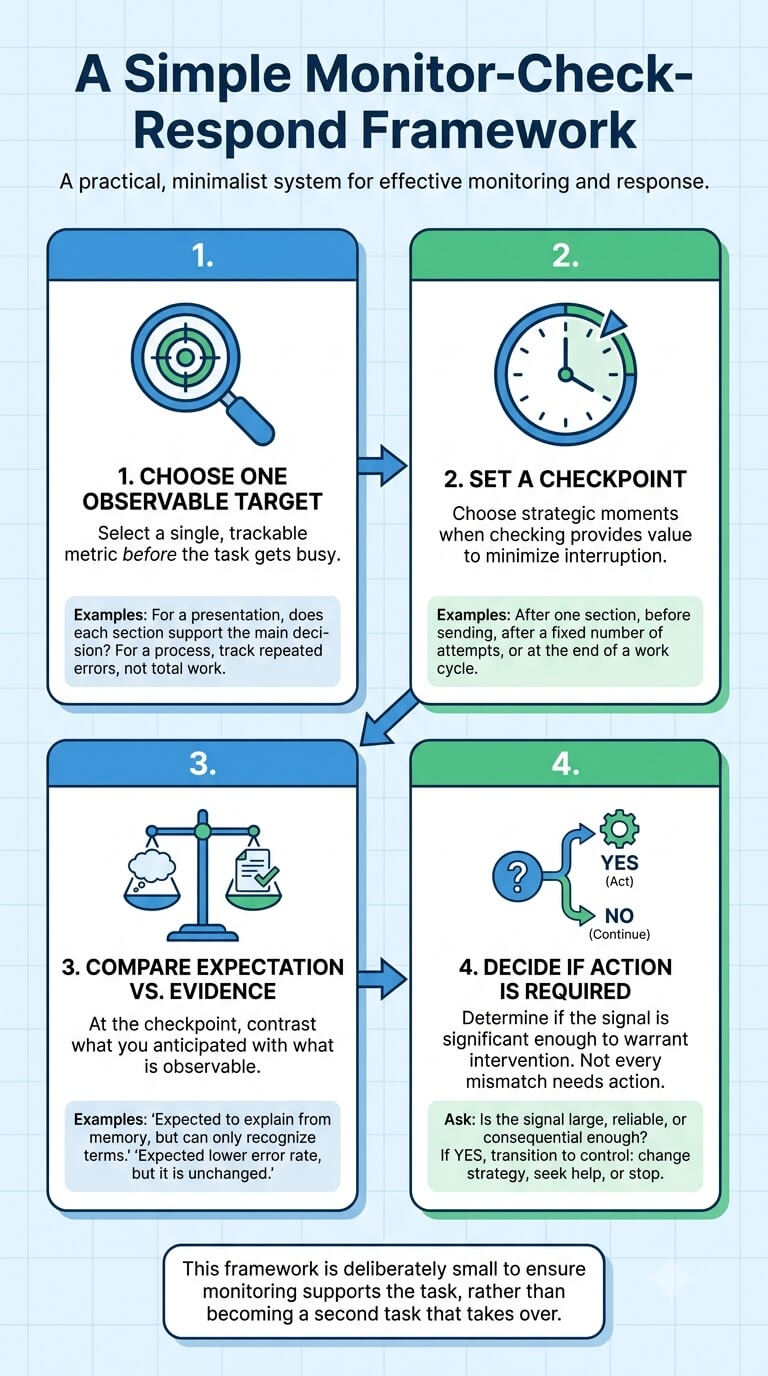
A practical monitoring system does not need dozens of metrics. Use four moves: choose one observable target, set a checkpoint, compare expectation with evidence, then decide whether the signal requires a response. The framework is deliberately small because monitoring should support the task rather than become a second task that takes over.
Choose one observable target
Decide what you are monitoring before the task becomes busy. For a presentation, it might be whether each section supports the main decision. For reading, it might be whether you can explain the central claim after each major section. For a process improvement, it might be the number of repeated errors rather than the amount of work completed.
Set a check point rather than checking constantly
Choose moments when checking provides value: after one section, before sending, after a fixed number of attempts, or at the end of a work cycle. This reduces interruption while still giving you chances to catch drift.
Compare expectation with evidence
At the checkpoint, compare what you expected with what you can observe. “I expected to explain this from memory, but I can only recognize the terms.” “I expected the error rate to fall after the process change, but it is unchanged.” “I thought the answer was clear, but two readers asked the same question.”
Decide whether the signal requires action
Not every mismatch deserves intervention. A small fluctuation may be normal. A one-off error may not justify redesigning the entire process. Ask whether the signal is large enough, reliable enough, or consequential enough to act on.
If yes, monitoring has done its job. The next step belongs to control: change the strategy, seek information, allocate more time, ask for help, or stop. Continuing to evaluate after the decision is clear often adds little.
Everyday Examples of Useful Monitoring

Good self-monitoring is easier to recognize when the signal and next action are concrete. These examples show how small checks can prevent effort from drifting away from the actual goal.
Catching a reasoning gap before sending a work recommendation
Situation: You prepare a recommendation to change a pricing plan. Before sending it, you ask what evidence supports the projected benefit and realize that one major assumption comes from last year’s customer behavior.
What you may feel: The recommendation still seems plausible, but confidence drops slightly. What it may mean: The conclusion is not necessarily wrong, but one supporting link is weaker than the rest. What to do next: Verify whether current customer behavior still supports that assumption or label the uncertainty clearly in the recommendation.
Noticing that you can reread but not recall
Situation: A technical explanation feels increasingly familiar after several readings, but when you look away you cannot reconstruct the main sequence.
What you may feel: Frustration, because the material seemed clear while it was visible. What it may mean: Recognition is improving faster than retrieval. What to do next: Stop rereading temporarily and try to produce the explanation from memory, then return only to the missing parts.
Tracking whether a conversation answer actually addressed the question
Situation: During a tense discussion, you give a long explanation of your intention. The other person asks again, “But will you be there on time tomorrow?” You notice that your explanation has not answered the practical question.
What you may feel: Defensive or misunderstood. What it may mean: Your response may be relevant to the conflict but still miss the immediate information being requested. What to do next: Answer the concrete question first, then return to the broader explanation if it is still needed.
Seeing that more effort is not improving a chosen approach
Situation: You spend several evenings trying to solve the same work bottleneck by adding more manual checks. Errors continue at the same rate.
What you may feel: Pressure to work even harder because you have already invested time. What it may mean: Effort is increasing without evidence of progress. What to do next: Stop using effort as the progress metric and investigate whether the underlying workflow, instructions, or tool needs to change.
If the problem is not effort but the approach itself, cognitive flexibility becomes important because improvement may require switching rather than simply trying harder.
Common Monitoring Mistakes
The most common monitoring problems are not a total absence of checking. They are checking the wrong thing, reacting too quickly, relying on weak signals, or interrupting performance so often that the check itself becomes costly.
Measuring what is easy instead of what matters
Hours worked, pages read, messages sent, and tasks completed are visible. That makes them attractive. But they may be poor substitutes for accuracy, understanding, customer response, decision quality, or genuine progress.
Reacting to every small fluctuation
Performance naturally varies. One difficult attempt, one piece of criticism, or one unusually good result should not automatically trigger a complete strategy change. Useful monitoring looks for signal, not just movement.
Using feelings as the only performance metric
Ease can be informative, but feeling easy is not the same as being accurate. Difficulty can signal a problem, but difficult work can also be productive. Confidence can guide attention, but certainty does not prove correctness.
Checking so often that performance deteriorates
Monitoring is not cost-free. Pausing every few seconds to evaluate whether you are performing well can fragment attention and make skilled behavior feel awkward. Research reviewing reactivity to metacognitive measures notes that asking people for judgments such as confidence ratings can sometimes influence the cognitive process being measured.
What to Do When Monitoring Finds a Problem
A detected mismatch is a handoff point. Monitoring tells you that something may need attention. It does not require you to stay in evaluation mode until you feel perfectly certain.
Verify the signal
First ask whether the mismatch is real enough to act on. Can you reproduce the error? Does another indicator point in the same direction? Is the feedback about the actual goal or only a preference? Does the apparent lack of progress reflect a short time window?
Decide whether to continue, seek feedback, or change strategy
If the signal is meaningful, choose the smallest response that fits. Continue when the deviation is minor and expected. Seek feedback when you cannot evaluate the work reliably from your current perspective. Change strategy when the same approach repeatedly produces the same failure.
When monitoring reveals a real mismatch, metacognitive strategies help decide whether to continue, verify, change effort, or use another method.
Hand off to metacognitive control rather than staying in evaluation mode
Once you know what needs to change, change it. Allocate more time, switch methods, reduce the task, verify a source, ask a clearer question, or stop pursuing an approach that is not working. That transition from evaluation to response is what prevents monitoring from becoming an endless loop.
Monitoring and control are closely related, but research does not require treating them as identical abilities. That distinction is useful in daily life too. You can detect a problem correctly and still choose a poor response, or make a good adjustment after an imperfect initial judgment. Improving one part does not automatically perfect the other.
FAQ About Self-Monitoring Psychology
Self-monitoring becomes easier to use once you separate it from constant introspection and from the later decisions that regulate behavior.
Is self-monitoring always conscious?
No. Some error signals and shifts in performance can influence behavior without a detailed conscious explanation. In everyday metacognitive practice, however, useful monitoring often becomes explicit when you pause long enough to name the mismatch: “I am no longer following this,” “this result conflicts with my expectation,” or “I am busy but not making progress.” You do not need full access to every cognitive process for a monitoring judgment to be useful.
Can too much self-monitoring hurt performance?
Yes, especially when checking interrupts a task that depends on sustained attention or well-practiced execution. The solution is not zero monitoring. It is better timing. Use checkpoints at natural boundaries, increase checking when errors are costly, and reduce unnecessary evaluation during stretches where continuous attention matters more.
What is the difference between error monitoring and confidence?
Error monitoring focuses on detecting a mismatch between an expected and observed result. Confidence is a judgment about how likely you think an answer, memory, or decision is to be correct. The two may interact, but they are not the same. You can feel highly confident and still miss an error, or detect that something is inconsistent without yet knowing which answer is correct.
How can you monitor progress when feedback is delayed?
Define intermediate indicators before the final outcome arrives. Keep your original prediction or baseline, choose a small number of measures that should move if the approach is working, and review them at scheduled intervals. Avoid changing the standard after seeing the result. When eventual feedback arrives, compare it with both your prediction and the intermediate signals so your future judgments have better evidence.
Key Takeaways
- Metacognitive self-monitoring compares current understanding or performance with a meaningful goal, expectation, or standard.
- The four useful targets are understanding, performance, errors, and progress. They need different kinds of evidence.
- Internal cues such as confidence, effort, and confusion are informative, but they should not automatically be treated as proof.
- Awareness identifies a knowledge state or tendency; monitoring tracks what is happening as a task unfolds.
- Useful monitoring stays specific to the process, while rumination and self-criticism can keep evaluation going without producing a better signal.
- A practical sequence is to choose one observable target, set a checkpoint, compare expectation with evidence, then respond only when the signal warrants action.

Michael Reed is the Founder and Lead Writer at Psychology Exposed. He writes about human behavior, relationships, emotional patterns, self-awareness, and practical psychology topics using research-informed, easy-to-understand content.
Read More About Michael Reed: https://psychologyexposed.com/michael-reed/