
A choice can look completely different depending on how you feel when you face it. A job offer may seem exciting in the morning and threatening after a difficult conversation. A purchase may feel urgent when you are frustrated, then unnecessary once the feeling passes. Even when the facts stay the same, emotion can change which facts stand out, how large a reward seems, how close a risk feels, and how quickly you want the uncertainty to end.
That does not mean emotion is the enemy of good judgment. Feelings often carry useful information about what matters to you, what you value, and what deserves attention. The problem is not that emotion enters a decision. The harder question is whether the feeling is relevant to the choice, whether it is accurately calibrated to the situation, and whether a temporary state is being given more authority than your longer-term goals.
This distinction matters because trying to become perfectly emotionless can be just as unhelpful as acting on every strong feeling. A better approach is to understand what emotion is emphasizing, test that signal against evidence and context, and decide how much weight it deserves.
Quick Answer
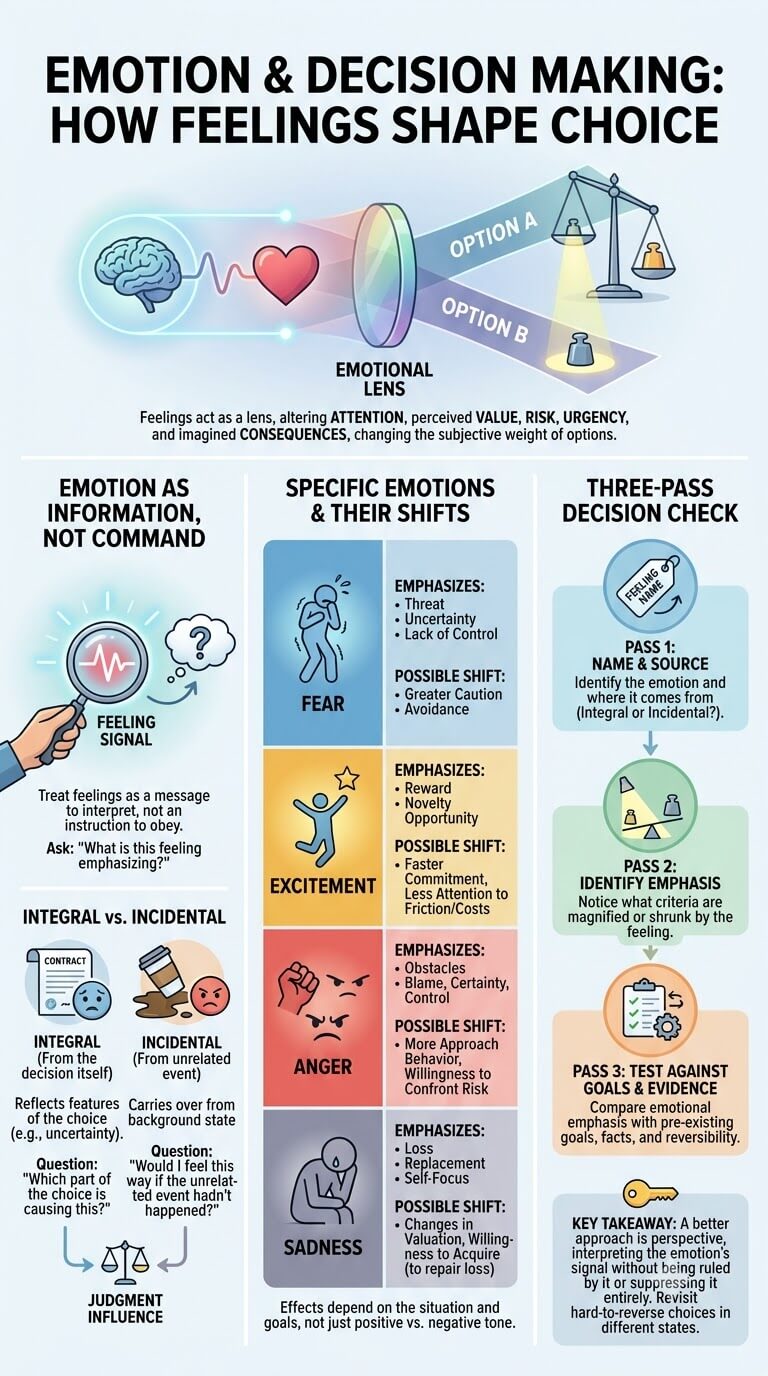
Emotion and decision making are closely connected because feelings influence attention, perceived value, risk, urgency, and the consequences we imagine. Emotions can provide useful information, but they can also carry over from unrelated events or become unusually intense. Better choices usually come from noticing the feeling, identifying its source, and combining it with evidence, goals, and the reversibility of the decision.
Emotion Is Part of Decision Making, Not Noise Outside It
Psychologists do not treat emotion as a separate force that appears only after reasoning is finished. Emotion can shape what enters attention, what feels worth pursuing, and what seems worth avoiding while a decision is still being formed. The APA Dictionary of Psychology describes emotion as a complex reaction pattern involving experiential, behavioral, and physiological elements, which helps explain why a feeling can change both thought and action at once.
Feelings can signal value and relevance
Imagine choosing between two roles with similar pay. One offers more status, while the other gives you more autonomy. If the second option produces relief or genuine interest, that feeling may be telling you something about what you value. It is not a mathematical proof that the second job is better, but it is information that deserves interpretation.
Emotion changes attention and urgency
Emotion also acts like a spotlight. Fear can draw attention toward possible danger. Excitement can make potential gains especially vivid. Anger can make obstacles and unfairness more salient. A strong feeling can therefore alter not only how an option is evaluated, but which parts of the option receive the most mental space.
Emotion can inform a choice without dictating it
A practical distinction is to treat a feeling as a message that needs interpretation, not as an instruction that must be obeyed. “I feel uneasy” is different from “this option is unsafe.” “I feel excited” is different from “this opportunity is definitely good.” The first statement reports an internal state. The second makes a claim about the outside world.
How Emotion Changes the Weight of an Option
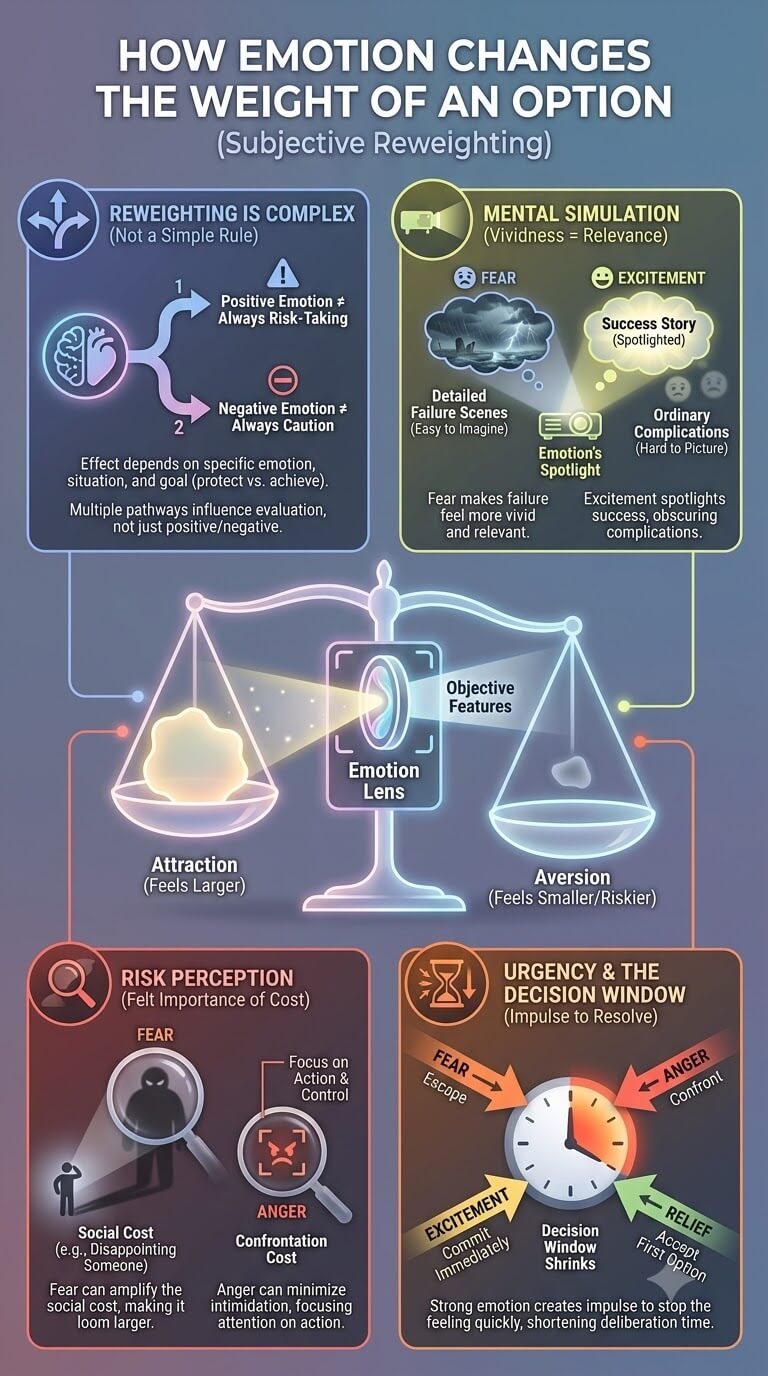
Most meaningful choices involve several features at once. We may care about reward, effort, danger, social consequences, timing, reversibility, and what happens if we do nothing. Emotion can change the subjective weight assigned to each feature, so the same option can feel more or less attractive without any objective detail changing.
Reward can feel larger or smaller
This does not mean positive emotion always causes risk-taking or negative emotion always causes caution. Effects depend on the specific emotion, the situation, and what the person is trying to protect or achieve. A recent review of affective integration in judgment and choice emphasizes that feelings can influence evaluation through several pathways rather than one simple positive-versus-negative rule.
Risk can feel more immediate
Emotion can change the felt importance of a possible loss before it changes any estimate of probability. If you are afraid of disappointing someone, the social cost of saying no may loom much larger than usual. If you are angry, the cost of confrontation may feel less intimidating because the emotion is pushing attention toward action and perceived control.
Consequences can become easier or harder to imagine
Emotion affects mental simulation. When an outcome matches your current feeling, it may be easier to picture. A fearful person may generate detailed scenes of failure. An excited person may easily imagine the success story and struggle to picture ordinary complications. The vividness of a possible future can then make it feel more decision-relevant.
Urgency can shorten the decision window
Strong emotion often creates an impulse to resolve the state. Fear may push for escape. Anger may push for confrontation. Excitement may push for immediate commitment. Relief may push for accepting the first option that ends uncertainty. When the emotional goal becomes “make this feeling stop,” the decision window can shrink.
Integral vs Incidental Emotion
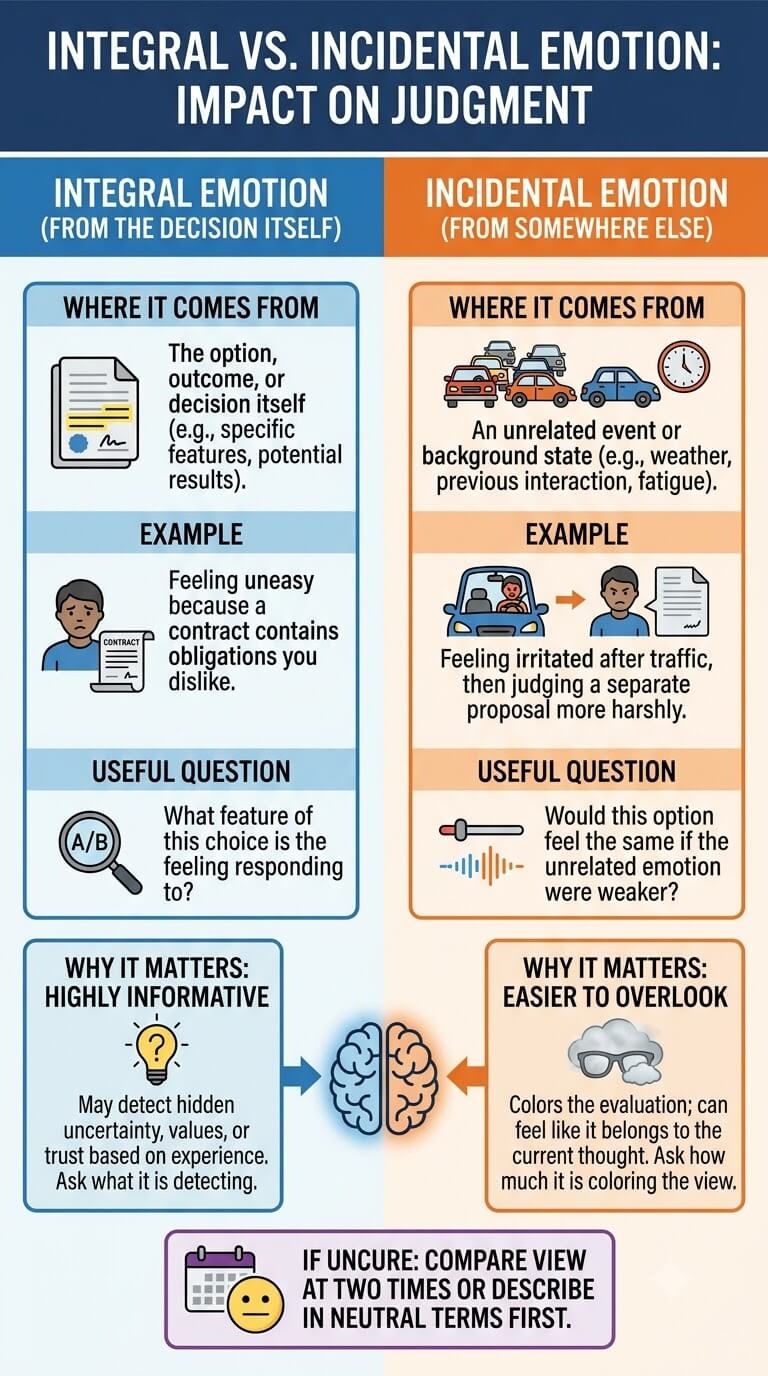
One of the most useful distinctions in this area is whether a feeling comes from the decision itself or from somewhere else. Research on integral and incidental affect shows why both can influence judgment, even though they have different relationships to the choice.
| Type of emotion | Where it comes from | Example | Useful question |
|---|---|---|---|
| Integral emotion | The option, outcome, or decision itself | Feeling uneasy because a contract contains obligations you dislike | What feature of this choice is the feeling responding to? |
| Incidental emotion | An unrelated event or background state | Feeling irritated after an argument, then judging a separate proposal more harshly | Would this option feel the same if the unrelated emotion were weaker? |
Integral emotion comes from the decision itself
Integral emotion can be highly informative. Nervousness about a commitment may reflect uncertainty about the obligations. Warmth toward a person may reflect trust built through repeated experience. Relief after imagining one option may reveal that another option has been violating an important value or creating a burden you had not clearly named.
Incidental emotion comes from somewhere else
Incidental emotion is easier to overlook because it can feel as though it belongs to whatever you are thinking about now. Fatigue after a difficult day can make a neutral option seem burdensome. Pride after receiving praise can make an unrelated plan feel more promising. Irritation from traffic can make a later request seem more unreasonable than it would have felt at another time.
Why the distinction matters before acting
When an emotion is integral, ask what it may be detecting. When it is incidental, ask how much it may be coloring the evaluation. If you cannot tell, compare your view at two different times or describe the decision to yourself in neutral terms before returning to the feeling.
Fear, Excitement, Anger, and Sadness Can Shift Choices Differently
It is tempting to reduce emotion to “positive” and “negative,” but different emotions with the same pleasant or unpleasant tone can have different effects. What matters is not only whether a feeling feels good or bad, but also what it implies about certainty, control, loss, reward, and action.
| Emotion | What may become more salient | Possible choice shift | Useful counter-check |
|---|---|---|---|
| Fear | Threat, uncertainty, lack of control | Greater caution or avoidance | Separate severity from likelihood |
| Excitement | Reward, novelty, opportunity | Faster commitment or less attention to friction | List ordinary costs and failure points |
| Anger | Obstacles, blame, certainty, control | More approach behavior or willingness to confront risk | Check whether confidence exceeds the evidence |
| Sadness | Loss, replacement, self-focus | Changes in valuation or willingness to acquire | Ask whether the choice is trying to repair a different loss |
Fear and threat sensitivity
But fear can also make a low-probability negative outcome dominate the entire decision. Research comparing fear and anger has found that the two can influence risk-taking in opposite directions, with fear associated with more cautious choices in some experimental settings. One open-access study on fear, anger, and risky choice illustrates why specific emotions matter more than a simple negative-emotion category.
Excitement and reward salience
Excitement can make opportunity feel immediate. That can be useful when a person has been stuck in excessive caution and finally recognizes a worthwhile opening. It can also encourage a kind of mental zoom in which the attractive outcome becomes highly detailed while the costs remain vague.
Anger and perceived control
Anger often carries a sense that something is wrong and should be changed. Compared with fear, it can be associated with greater certainty and a stronger sense of control. That may help someone act on a real problem they had previously tolerated, but it can also make consequences seem more manageable than they are.
Sadness and valuation shifts
An open-access replication on sadness and willingness to acquire goods found that sadness can alter valuation in a specific experimental context. The everyday lesson is not that sadness automatically causes overspending. It is that an emotion connected with loss may change what “getting something” means in the moment. If a choice promises replacement, comfort, or a sense of renewal, ask whether you are evaluating the item or opportunity itself, or also asking it to repair an unrelated loss.
Hot-State vs Cooler-State Decisions
A “hot” state is a moment when emotional or physiological arousal is strong enough to narrow attention and increase the pull of immediate action. A cooler state does not mean no emotion. It means the feeling has enough distance that competing goals and future consequences are easier to hold in mind at the same time.
What changes when arousal is high
Under high arousal, the most emotionally relevant cue can dominate. An angry person may rehearse the unfair comment. An excited buyer may focus on the limited-time offer. A frightened traveler may focus on one alarming story. This narrowed field can make other criteria feel temporarily less important.
Why future consequences can shrink in the moment
Immediate emotion is experienced directly, while future consequences must be imagined. That difference gives the present state an advantage. A sharp feeling of relief from quitting, buying, replying, or canceling can outweigh a consequence that is more important but less vivid because it occurs next week or next month.
Why delaying a reversible choice can sometimes help
If a decision is reversible and not truly urgent, a brief delay can reveal whether the preference is stable across emotional states. This is not avoidance when the delay has a clear end point. It is a way of gathering one more piece of information about your own valuation.
Emotion as Information vs Emotion as a Command
The feelings-as-information approach offers a useful middle ground. Research on how emotions inform judgment shows that people can use affective states as information, and that the influence can change when the source of the feeling becomes clear. In practice, this means a feeling deserves a question before it gets a vote.
Ask what the feeling is pointing to
Name the specific concern or attraction beneath the emotion. Fear may be pointing to uncertainty, lack of control, or a serious consequence. Excitement may be pointing to novelty, status, freedom, or a long-delayed goal. Anger may be pointing to a boundary or perceived unfairness. Sadness may be pointing to loss or a wish to replace what is missing.
Check whether the feeling belongs to this decision
Ask what happened immediately before the feeling became strong. Was it caused by the option, by new information about the option, or by something unrelated? A clear external source does not make the feeling irrelevant, but it should reduce your confidence that the feeling is a precise evaluation of the current choice.
Compare the signal with available evidence
Once the emotional message is specific, test it. If fear says “this is unsafe,” ask what evidence indicates danger and what evidence indicates safety. If excitement says “this is a rare opportunity,” ask what makes it rare and whether that claim is independently verifiable. If anger says “they are ignoring the agreement,” compare the memory with the actual agreement.
Emotion and Risk Perception
Emotion can influence how risky an option feels, but perceived danger and measured probability are not the same thing. A vivid negative outcome can feel close even when it is uncommon, while a familiar hazard can feel ordinary despite meaningful probability. This distinction becomes especially important when fear or anger is strong.
Feeling unsafe is not identical to measured probability
A feeling of danger should not be mocked or automatically overruled. It may reflect cues that deserve investigation, especially in interpersonal or physical-safety situations. At the same time, a feeling by itself does not tell you the numerical likelihood of an outcome.
For ordinary decisions, separate three questions: How likely is the outcome? How serious would it be? How much control or reversibility do I have if it occurs? Keeping those questions separate prevents one intense feeling from silently answering all three.
A real signal can still be miscalibrated
A person can notice something real and still overestimate what it predicts. A missed deadline may genuinely indicate poor organization, but it does not automatically prove an entire project will fail. A strange interaction may justify more attention without proving harmful intent. Calibration means preserving the useful signal while matching the conclusion to the amount of evidence available.
If a situation involves credible threats, coercion, stalking, violence, or retaliation, safety takes priority over experiments in emotional detachment or direct confrontation. In those contexts, individualized support from an appropriate professional or safety resource may be more useful than trying to reason the feeling away.
Emotion and Anticipated Regret
Current emotion is not the only feeling that shapes choice. People also imagine how they might feel later. Anticipated regret can change the weight of an option before anything has happened, sometimes encouraging a thoughtful check and sometimes making the mind overfocus on the possibility of choosing “wrong.”
Imagined future emotion can change today’s option weights
If you picture future regret vividly, you may favor the option that seems easiest to defend to your future self. That can increase caution, motivate more information gathering, or make a reversible option more appealing. In other cases, it can push you toward action because the imagined regret of missing out feels worse than the imagined regret of trying.
The key is to ask which regret you are forecasting. Regret from acting and regret from not acting are different. So are regret about the outcome and regret about the process you used to decide.
Regret forecasting is useful but imperfect
Future emotion is a simulation, not a fact. People cannot know exactly how they will feel after adaptation, new information, or changing circumstances. That means anticipated regret is most useful as one perspective among several, not as a final decision rule.
For a hard-to-reverse choice, ask what process your future self would respect even if the outcome turned out badly. That shifts attention from predicting emotion perfectly to making a choice that is explainable in light of what you know now.
A Three-Pass Decision Check
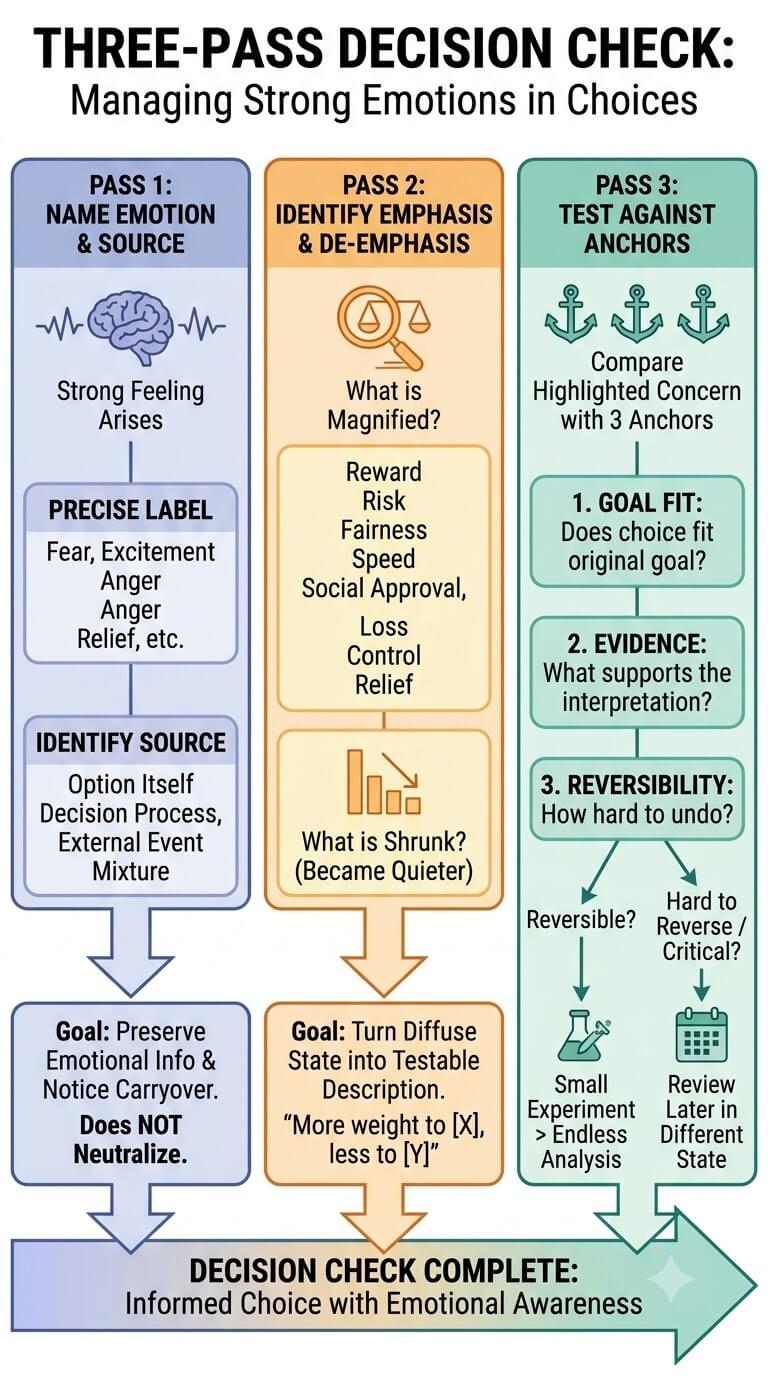
When a feeling is strong enough to change the choice, use three passes rather than trying to settle everything at once. The sequence is designed to preserve emotional information, then test how much decision weight it deserves.
Pass 1: name the emotion and its source
Use a precise label if you can: fear, excitement, anger, disappointment, relief, embarrassment, sadness, or something else. Then identify the most likely source. Did the feeling arise from the option itself, from the decision process, from another event, or from a mixture?
If the source is unclear, write down what changed immediately before the feeling intensified. Naming the source does not neutralize the emotion, but it makes accidental carryover easier to notice.
Pass 2: identify what the emotion is emphasizing
Ask which part of the choice suddenly feels larger. Is it reward, risk, fairness, speed, social approval, loss, control, or relief? Then ask what has become quieter. Strong emotion often creates an imbalance by magnifying one criterion and shrinking another.
A useful sentence is: “Right now, this feeling is making me give extra weight to ___ and less weight to ___.” The sentence turns a diffuse state into a testable description of the decision.
Pass 3: test the choice against goals, evidence, and reversibility
Now compare the emotionally highlighted concern with three anchors. First, does the choice fit the goal you cared about before the feeling intensified? Second, what evidence supports the interpretation? Third, how difficult would it be to undo the choice?
If the decision is reversible, a small experiment may be better than endless analysis. If it is hard to reverse, deserves substantial resources, or affects safety or major obligations, a second review in a different emotional state can be worthwhile.
When Not to Force Yourself Into an Emotionless Decision
Some choices are emotional because the subject itself contains values, relationships, identity, or meaning. Trying to remove all feeling from them can erase information rather than improve reasoning.
Values and relationships naturally involve emotion
Choosing whether to accept a demanding role, move away from family, end a collaboration, or make a major commitment is not only a calculation of measurable outcomes. These choices concern what you care about. Feelings of attachment, grief, hope, pride, or relief may reveal priorities that a spreadsheet cannot supply.
The useful question is not “How do I stop feeling?” but “Which part of this feeling reflects a value I want to honor, and which part reflects a temporary state or untested assumption?” That keeps the decision human without making every emotion decisive.
Suppression can hide information rather than improve reasoning
If you push a feeling away too quickly, you may lose the clue it contains. Irritation may point to a recurring burden. Anxiety may point to uncertainty that needs clarification. Sadness may reveal the cost of giving something up. Relief may reveal that one option has been consuming more energy than you admitted.
After identifying the message, you can still decide that the feeling should receive limited weight. Listening and obeying are not the same action.
What to Do Next When Emotion Is Very Strong
When emotion is intense, the immediate goal is usually not to solve the entire decision faster. It is to create enough room for more than one criterion to be visible at the same time.
Reduce immediate arousal if safe and possible
For non-emergency decisions, change the conditions before changing your life. Step away from the screen, postpone the send button, eat, sleep, walk, or do another ordinary activity that lowers physiological intensity. These are not guarantees of clarity, but they can give you a second vantage point.
If the emotion reflects an immediate safety threat, do not use calming down as a reason to ignore the threat. Physical safety, distance, and appropriate support come first.
Separate urgent from important
Write down the actual deadline. Then write down the deadline your emotion is creating. If they are different, you have found decision space. A sales timer, social pressure, embarrassment, or a desire for relief may create urgency without creating true necessity.
On the other hand, some important opportunities really do have time limits. The point is not to assume every deadline is fake. It is to distinguish external constraints from internal pressure so that you know what is driving the speed.
Revisit hard-to-reverse choices after the state changes
For choices with lasting consequences, record your reasons before taking a pause. When you return, compare the reasons rather than only comparing moods. If the same concerns, values, and evidence remain, your preference has gained stability. If the reasons change dramatically, that is useful information too.
If intense fear, panic, sadness, or distress is persistent, interferes with daily functioning, or makes routine decisions feel unmanageable, it may be worth speaking with a qualified mental health professional. The purpose is not to label normal emotion as a disorder, but to get support when distress itself has become difficult to carry.
FAQ About Emotion and Decision Making
Do emotions make decisions irrational?
No. Emotion can contribute useful information about value, relevance, threat, reward, and personal priorities. It can also distort weighting when a feeling is intense, based on incomplete information, or carried over from an unrelated event. The better question is whether the emotion is relevant and well calibrated to the decision, not whether emotion is present at all.
Can fear ever improve a decision?
Yes. Fear can direct attention toward possible harm and motivate caution, information gathering, or protective action. It becomes less helpful when it makes one negative outcome dominate all other evidence or when the felt danger is treated as proof of probability. In real safety situations, fear may be an important signal that deserves action rather than dismissal.
Why do I make different choices when I am excited?
Excitement can increase the salience of reward, novelty, and opportunity, while ordinary costs or distant consequences receive less attention. That does not automatically make the choice poor. Before committing, make the less exciting parts concrete, including effort, maintenance, obligations, and what happens if the expected reward is smaller than hoped.
Should important decisions be made only when calm?
Not necessarily. Some important decisions naturally involve strong feeling, and waiting for perfect calm may be impossible. A more realistic standard is to avoid making a hard-to-reverse choice at the peak of a temporary state when there is no real deadline. If possible, compare your reasons across more than one emotional state.
How can I tell whether a feeling belongs to the decision or to something else?
Look at timing and source. Ask what happened before the feeling intensified, whether new information about the choice caused it, and whether the same reaction appears after unrelated stress has eased. You may not always separate the sources perfectly, but even noticing that more than one source is possible can prevent a background mood from being mistaken for a precise judgment.
Key Takeaways
- Emotion changes decision making by altering attention and the subjective weight of reward, risk, urgency, and consequences.
- A feeling can be relevant to the choice itself or carried over from an unrelated event, and that distinction changes how much weight it should receive.
- Fear, excitement, anger, and sadness can shift decisions in different ways, so “positive versus negative emotion” is often too simple.
- Strong emotion is most useful when treated as information to investigate rather than a command to obey or noise to suppress.
- The Three-Pass Decision Check asks you to identify the feeling and source, notice what it is emphasizing, then test the choice against goals, evidence, and reversibility.
- For hard-to-reverse choices, comparing your reasons across more than one emotional state can reveal whether the preference is stable.
Final Thoughts
The next time a decision changes shape because your feelings change, do not rush to choose between “trust the emotion” and “ignore the emotion.” Write down the feeling, what caused it, and the part of the choice it is making unusually important. Then test that emphasis against the facts you have, the goal you are trying to serve, and how reversible the choice is.
That small separation between feeling and action preserves what emotion knows without asking it to know everything. A good decision does not require a mind without emotion. It requires enough perspective to decide what the emotion should mean here.

Michael Reed is the Founder and Lead Writer at Psychology Exposed. He writes about human behavior, relationships, emotional patterns, self-awareness, and practical psychology topics using research-informed, easy-to-understand content.
Read More About Michael Reed: https://psychologyexposed.com/michael-reed/