
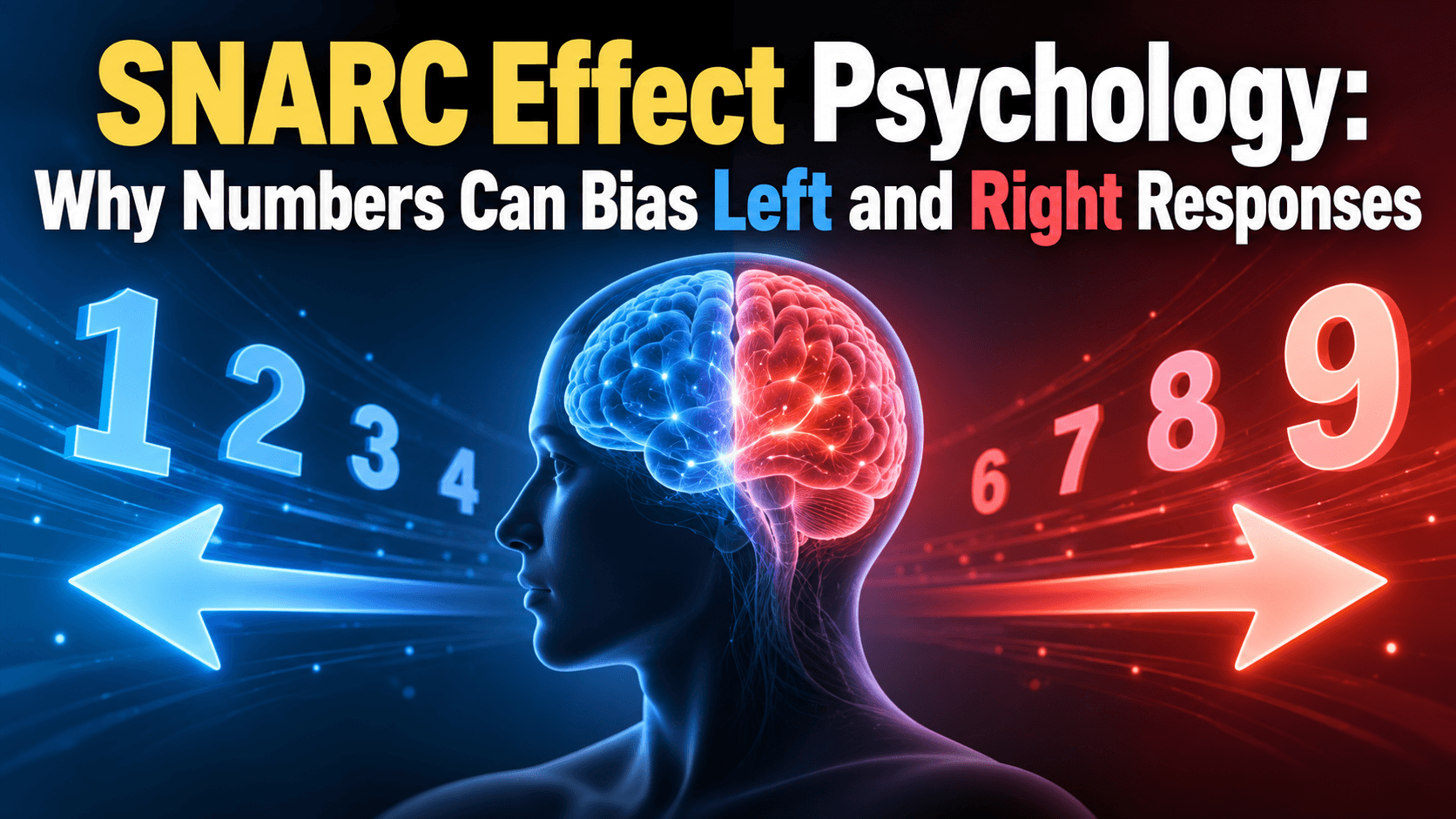
Imagine being asked whether a digit is odd or even. The number’s size is irrelevant to the instruction, yet your response may still be slightly faster when a relatively small number is paired with one side of space and a relatively large number with the other. This is the basic pattern behind the SNARC effect.
SNARC stands for Spatial-Numerical Association of Response Codes. In many experiments with left-to-right readers, smaller numbers are responded to faster with a left-side key and larger numbers with a right-side key. The finding is important because it shows that numerical magnitude can interact with spatial response coding even when magnitude is not the task people are explicitly performing.
But SNARC is not a universal reflex. Its strength and even its direction can change with the number range, task instructions, response arrangement, reading and writing experience, counting habits, working-memory organization, and other contextual factors. It is also not the same thing as the Mental Number Line. SNARC is a specific behavioral response-compatibility effect. The Mental Number Line is a broader theory about spatial organization of number.
Quick Answer
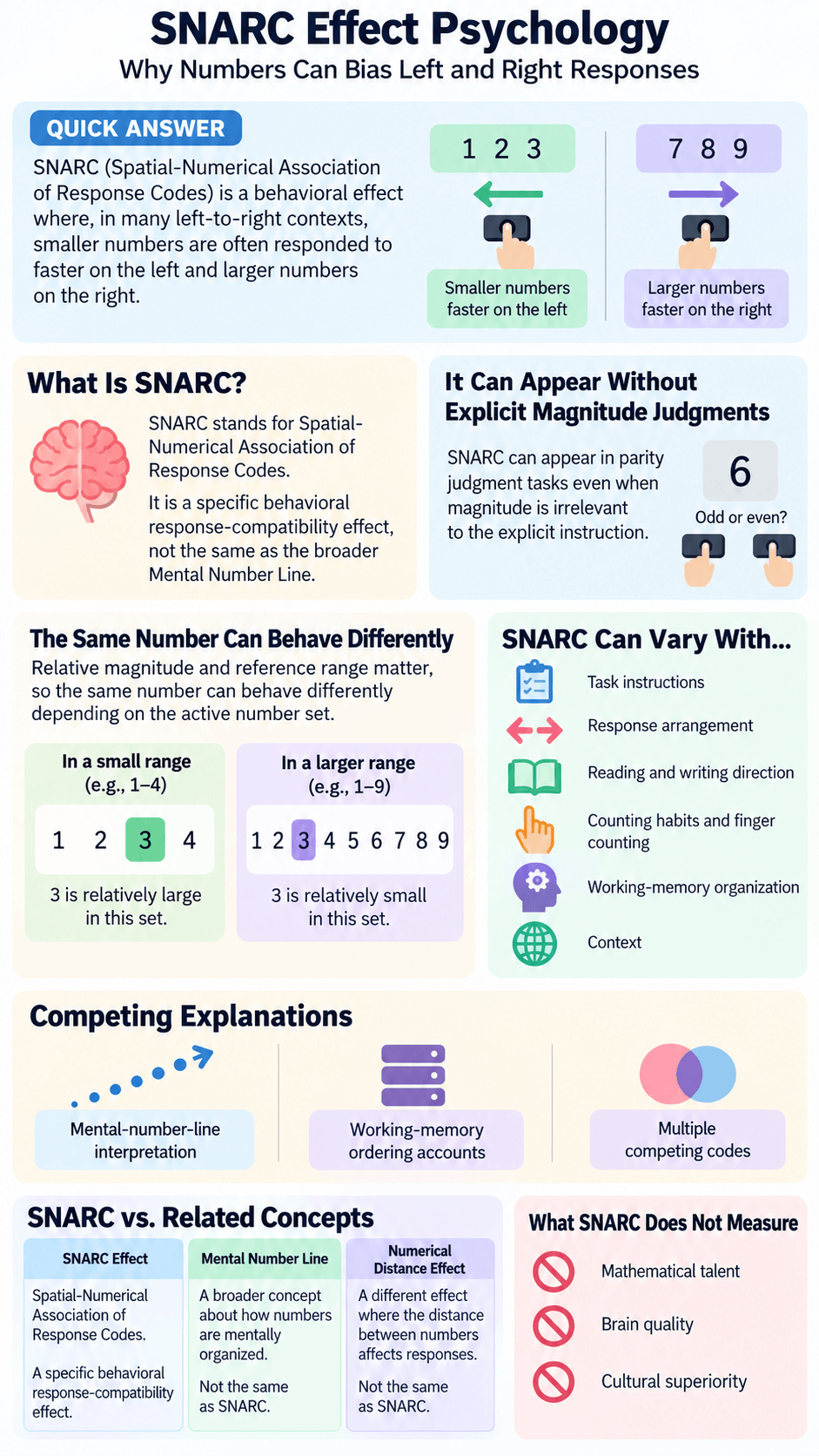
The SNARC effect is a spatial-numerical response-compatibility pattern in which relatively small numbers are often responded to faster on the left and relatively large numbers on the right in common left-to-right contexts. The effect can appear even when numerical magnitude is irrelevant to the task. However, it varies across tasks, number ranges, cultures, and individuals, so it should not be treated as proof of one fixed universal mental number line.
What SNARC Stands For
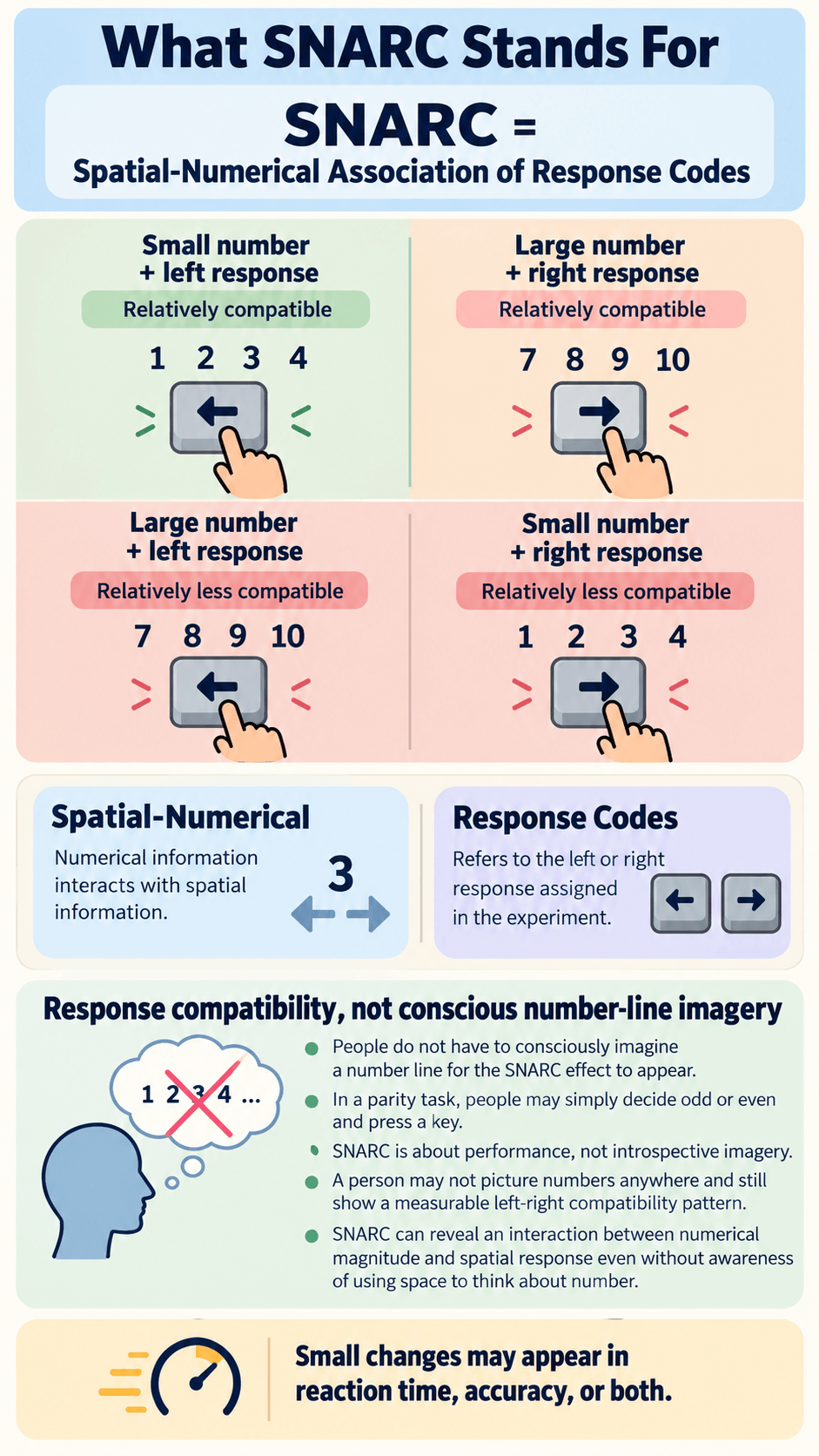
Spatial-Numerical Association of Response Codes
The full name describes the effect precisely. Spatial-Numerical means that numerical information is interacting with spatial information. Response Codes refers to the left or right response assigned in the experiment.
A classic pattern looks like this:
SMALL NUMBER + LEFT RESPONSE → relatively compatible
LARGE NUMBER + RIGHT RESPONSE → relatively compatible
The reverse pairings are often relatively less compatible. The difference can appear as a small change in reaction time, accuracy, or both.
A broad review of number-space interactions describes SNARC as one of the most widely studied demonstrations that numerical processing can interact with spatial response selection. The same review also emphasizes that number-space phenomena are heterogeneous, which is an important warning against treating every spatial-number finding as one mechanism.
Response compatibility rather than conscious number-line imagery
You do not have to consciously imagine a row of numbers stretching from left to right for a SNARC effect to appear. Most participants in a parity task are simply deciding odd or even and pressing a key.
The effect is therefore about performance, not introspective imagery. A person might say, “I do not picture numbers anywhere,” and still show a measurable left-right compatibility pattern across many trials.
This matters because conscious visualization and response coding are different psychological questions. SNARC can reveal an interaction between numerical magnitude and spatial response even when the participant has no awareness of using space to think about number.
The Classic Compatibility Pattern
Small number + left response
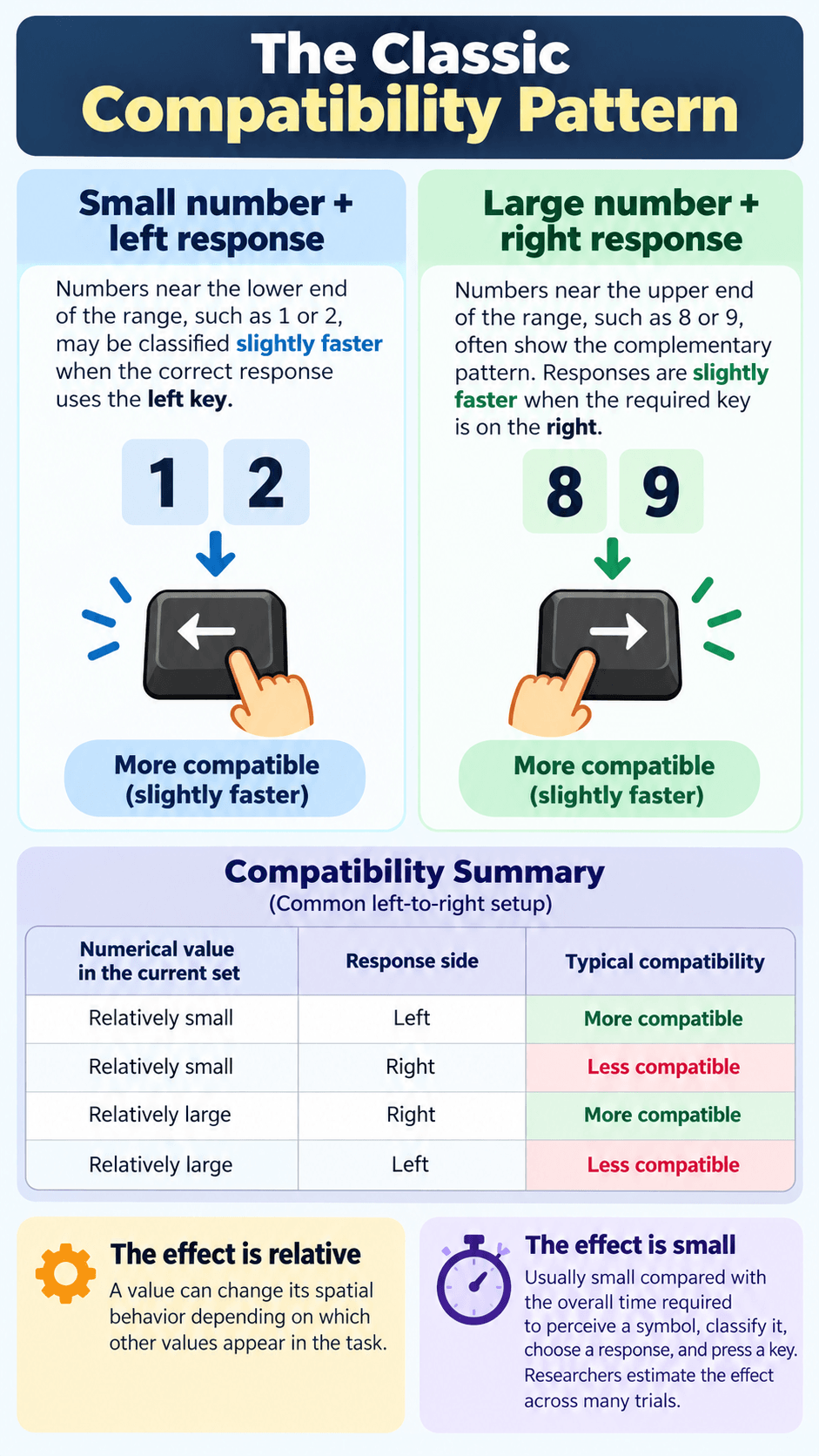
Suppose the experiment uses the digits 1 through 9. In a common left-to-right setup, numbers near the lower end of the range, such as 1 or 2, may be classified slightly faster when the correct response happens to use the left key.
The effect is relative rather than simply tied to one permanently “small” number. A value can change its spatial behavior depending on which other values appear in the task.
Large number + right response
Numbers near the upper end of the active range, such as 8 or 9, often show the complementary pattern. Responses are slightly faster when the required key is on the right.
The size of the effect is usually small compared with the overall time required to perceive a symbol, classify it, choose a response, and press a key. Researchers therefore estimate the effect across many trials rather than expecting it to be obvious on every individual response.
| Numerical value in the current set | Response side | Typical compatibility in a common left-to-right setup |
|---|---|---|
| Relatively small | Left | More compatible |
| Relatively small | Right | Less compatible |
| Relatively large | Right | More compatible |
| Relatively large | Left | Less compatible |
How SNARC Is Studied
Parity judgment
The parity task is the classic example. Participants decide whether a number is odd or even. One hand or key is assigned to “odd,” and the other is assigned to “even.” The assignment is usually reversed across blocks so researchers can separate parity from response side.
The clever feature is that numerical magnitude is not needed to answer the question. You can know that 3 is odd without deciding that it is small. Yet reaction time can still vary according to the compatibility between magnitude and response side.
This makes the task useful for asking whether magnitude-space associations are activated even when magnitude is not the explicit decision.
Magnitude-irrelevant number processing
A SNARC effect in parity judgment is often described as evidence that numerical magnitude becomes available automatically enough to influence response selection. “Automatic,” however, should not be interpreted as “unaffected by context.”
Modern research shows that the effect can depend strongly on task setup. A 2026 study comparing different SNARC task setups found divergent spatial-numerical associations across procedures and argued that broad claims about one stable SNARC pattern should be treated cautiously.
A better description is that magnitude can influence spatial response coding even when it is not directly required, but the form of that influence depends on the task.
Reaction-time differences between compatible and incompatible mappings
Researchers usually calculate a difference between right-hand and left-hand reaction times for each number. They then examine whether this difference changes systematically with numerical magnitude.
If relatively small numbers favor left responses and relatively large numbers favor right responses, the pattern produces the characteristic SNARC slope.
The method is more informative than simply asking whether someone “prefers” one side. It measures how response compatibility changes across the numerical range.
Relative Magnitude and Reference Range
Why “small” and “large” can depend on the task set
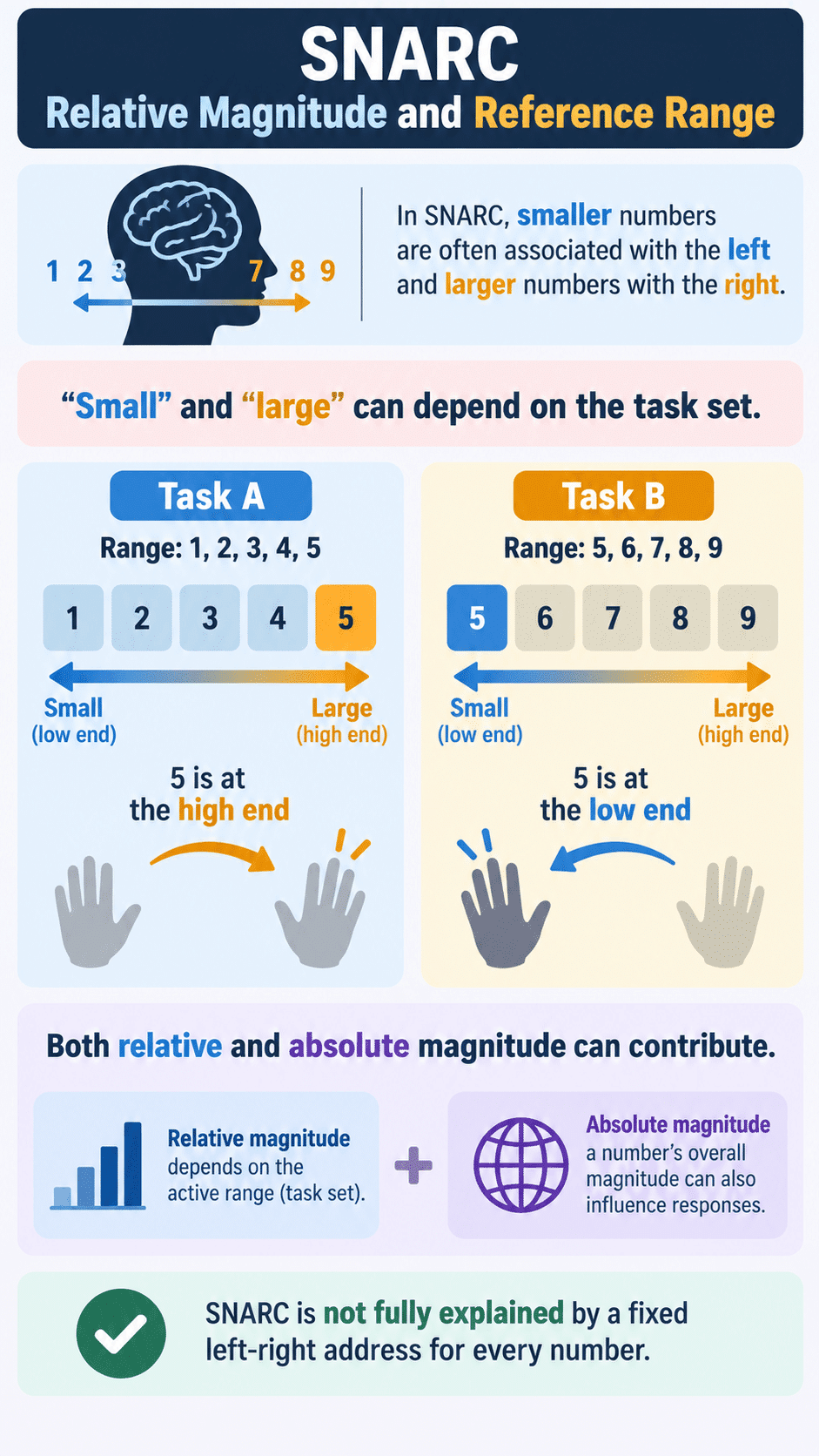
The number 5 is not always spatially coded the same way. In a set containing 1 through 5, it is the largest value. In a set containing 5 through 9, it is the smallest.
Research has shown that SNARC can follow this relative position. This is a major reason not to imagine every digit as having one permanent spatial coordinate.
An open-access study of spatial-numerical and ordinal positional associations discusses evidence that numerical magnitude and ordinal position can operate in parallel, with relative magnitude changing according to the active number range.
How reference range can alter coding
Consider two tasks:
- Task A: numbers 1, 2, 3, 4, 5
- Task B: numbers 5, 6, 7, 8, 9
In Task A, 5 belongs to the high end. In Task B, 5 belongs to the low end. A flexible response-coding system can therefore associate the same digit with different sides depending on the range.
This does not mean absolute magnitude is irrelevant. Recent work suggests that both relative and absolute magnitude can contribute. The stronger conclusion is that SNARC is not fully explained by a fixed left-right address for every number.
Why SNARC Can Vary
Task instructions
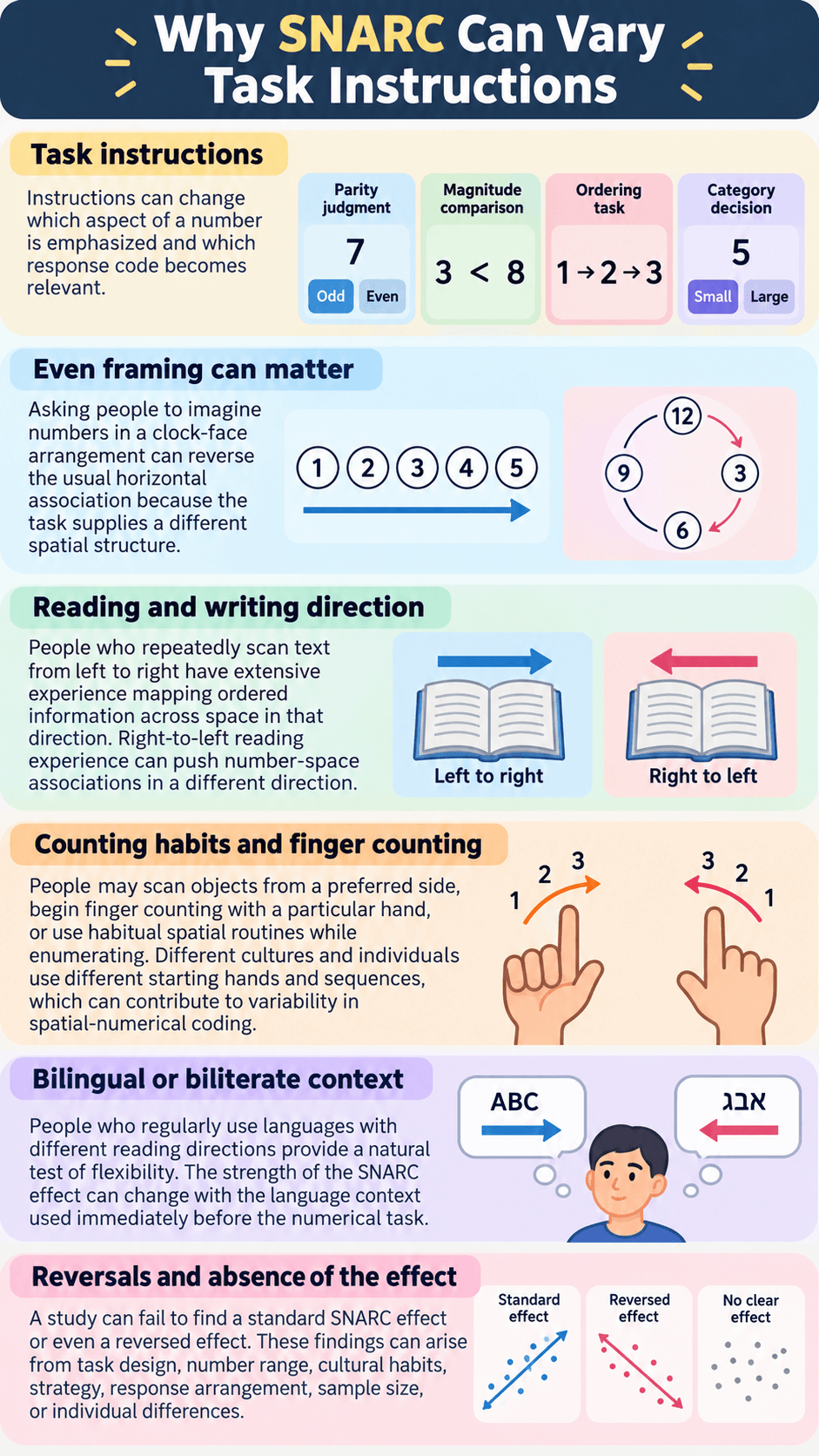
Instructions can change which aspect of a number is emphasized and which response code becomes relevant. A parity judgment, magnitude comparison, ordering task, or category decision may all produce different spatial demands.
Even framing can matter. Earlier experiments showed that asking people to imagine numbers in a clock-face arrangement could reverse the usual horizontal association because the task supplied a different spatial structure.
This flexibility is one reason researchers distinguish long-term numerical knowledge from temporary task coding.
Reading and writing direction
Reading direction is one of the best-known cultural explanations. People who repeatedly scan text from left to right have extensive experience mapping ordered information across space in that direction. Right-to-left reading experience can push number-space associations in a different direction.
However, reading direction alone does not explain every result. The 2026 task-comparison study cited earlier notes that right-to-left readers do not consistently show a simple reversed SNARC effect, and left-to-right readers do not always show a reliable standard effect.
This suggests that literacy experience contributes to the association without acting as a single deterministic cause.
Counting habits and finger counting
Counting also links number and space repeatedly. People may scan objects from a preferred side, begin finger counting with a particular hand, or use habitual spatial routines while enumerating.
Finger counting is especially relevant because it combines numerical sequence, motor action, and body-centered space. Different cultures and individuals use different starting hands and sequences, which can contribute to variability in spatial-numerical coding.
There is no evidence-based reason to treat one finger-counting style as cognitively superior. These habits are interesting because they provide repeated number-space experiences.
Bilingual or biliterate context
People who regularly use languages with different reading directions provide a natural test of flexibility. Their numerical symbols may be identical while the directional habits surrounding language differ.
A review of research on abstract concepts describes experiments in Hebrew-Russian bilingual readers in which the strength of the SNARC effect changed with the language context used immediately before the numerical task. That review of contextual influences on abstract spatial concepts illustrates how recently activated directional habits can shape spatial coding.
These findings do not mean language completely determines numerical space. They show that number-space associations can adapt to current contextual cues.
Reversals and absence of the effect
A study can fail to find a standard SNARC effect without proving that the participants have no numerical magnitude representation. Likewise, a reversed effect does not imply that someone’s “number system is backwards.”
Null and reversed findings can arise from task design, number range, cultural habits, strategy, response arrangement, sample size, or individual differences.
This is why modern research increasingly asks under which conditions a spatial-numerical association emerges rather than assuming that every person should display the same slope.
Competing Explanations
Mental-number-line interpretation
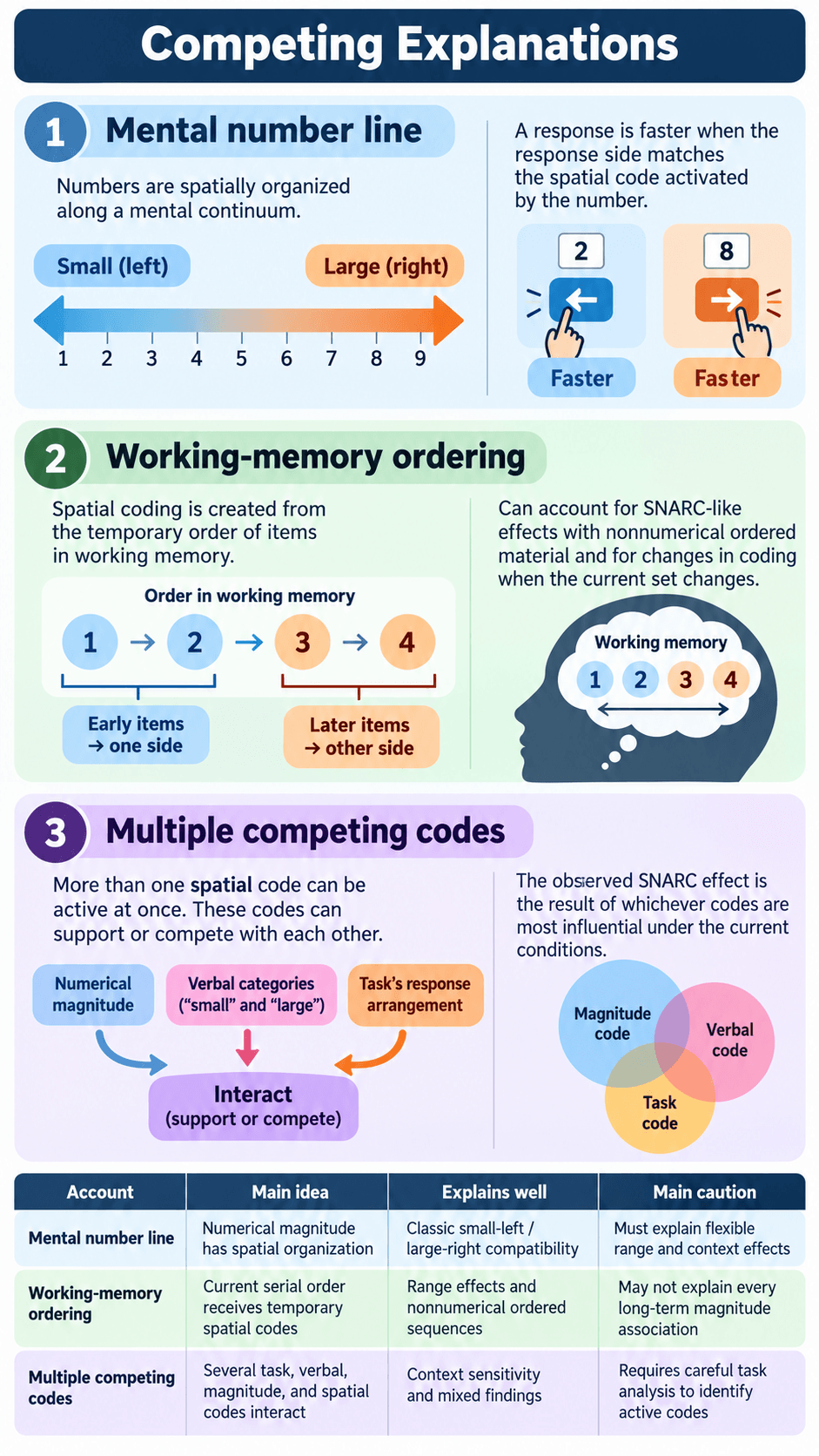
The classic interpretation is that numbers are spatially organized along a mental continuum. In many left-to-right readers, small magnitudes occupy the left side and large magnitudes the right. A response is faster when the response side matches the spatial code activated by the number.
This account explains the classic pattern intuitively. It also connects SNARC with other findings in which numbers shift spatial attention.
The limitation is flexibility. Range effects, reversals, nonnumerical ordering effects, and task-dependent changes require a more adaptable version of the theory than a permanently fixed internal line.
Working-memory ordering accounts
Another account proposes that spatial coding is created from the temporary order of items in working memory. Early items in an active sequence become associated with one side, and later items with the other.
This explanation can account for SNARC-like effects with nonnumerical ordered material and for changes in coding when the current set changes. It also explains why a number’s relative position may matter as much as its absolute value.
A review of number-space mechanisms notes that working-memory ordering is one of several serious alternatives to a fixed mental-number-line account. The same literature also considers reading habits, finger counting, task-specific mappings, verbal coding, and attention.
Multiple competing codes
A third family of explanations argues that more than one spatial code can be active at once. Numerical magnitude may suggest one direction, verbal categories such as “small” and “large” may create another, and the task’s response arrangement may create yet another.
These codes can support or compete with each other. The observed SNARC effect is then the result of whichever codes are most influential under the current conditions.
This approach fits the fact that number-space effects are neither fully fixed nor infinitely flexible. A 2025 registered-report study of relative and absolute numerical magnitude found evidence that spatial-numerical associations depend on both relative and absolute magnitude rather than only one completely flexible coding rule.
| Account | Main idea | What it explains well | Main caution |
|---|---|---|---|
| Mental number line | Numerical magnitude has spatial organization | Classic small-left / large-right compatibility | Must explain flexible range and context effects |
| Working-memory ordering | Current serial order receives temporary spatial codes | Range effects and nonnumerical ordered sequences | May not explain every long-term magnitude association |
| Multiple competing codes | Several task, verbal, magnitude, and spatial codes interact | Context sensitivity and mixed findings | Requires careful task analysis to identify active codes |
SNARC vs Mental Number Line
Specific response-compatibility effect versus broader representation concept
SNARC is something researchers measure in behavior. It is a difference in response efficiency associated with numerical magnitude and response side.
The Mental Number Line is a theoretical concept used to explain spatial organization of number more broadly. It can be discussed in relation to attention, estimation, order, imagery, and several experimental effects.
Confusing the two creates circular reasoning: “SNARC happens because there is a mental number line, and we know there is a mental number line because SNARC happens.” Good theory requires considering alternative explanations and independent evidence.
Why SNARC does not prove a permanent internal layout
If SNARC reflected one permanent location for each number, changing the reference range should not easily alter whether a value behaves as relatively small or large. Context effects therefore challenge the strongest fixed-layout interpretation.
The effect still supports a meaningful link between numerical information and space. What it does not establish is that the link must take one universal permanent form.
SNARC vs Numerical Distance Effect
Left-right response compatibility
SNARC asks whether the response side interacts with numerical magnitude. A typical comparison is not “7 versus 8.” Instead, researchers ask whether a number such as 2 is classified faster with a left response than with a right response.
Close-versus-far magnitude comparison
The Numerical Distance Effect asks a different question. It concerns whether close values such as 7 and 8 are harder to compare than far values such as 2 and 9.
The distance effect can occur without left-right spatial coding. SNARC can occur in a parity task in which participants are not explicitly comparing two numerical magnitudes at all.
| Effect | Main variable | Typical example |
|---|---|---|
| SNARC | Magnitude × response side compatibility | Small number + left response vs small number + right response |
| Numerical Distance Effect | Closeness between numerical values | 7 vs 8 compared with 2 vs 9 |
| Mental Number Line | Broader spatial organization of number | Small-to-large spatial mapping as a theoretical representation |
What SNARC Does Not Measure
Not mathematical talent
A strong SNARC effect does not mean someone is better at mathematics. A weak or absent effect does not imply poor number ability. SNARC is a response-compatibility phenomenon, not an aptitude score.
Studies of highly trained mathematicians have found differences in some spatial-numerical patterns but do not support using SNARC as a simple measure of expertise. An open-access study comparing professional mathematicians with controls also reviews the many competing mechanisms proposed for SNARC.
Not brain quality or hemisphere superiority
Because the task uses left and right responses, it is tempting to convert the effect into a left-brain/right-brain story. That would be misleading. Response side is an experimental variable, not evidence that one hemisphere is “better with small numbers” and the other is “better with large numbers.”
SNARC should not be used to classify people into cognitive types or to make claims about brain quality.
Not a universal cultural trait
Cultural experience influences direction, but cultures should not be ranked by whether they show a standard, reversed, or weak effect. Different reading, writing, gesture, counting, and educational practices create different spatial histories.
The scientific question is how those experiences shape response coding, not which cultural pattern is more advanced.
A Five-Part Check for Interpreting a SNARC Finding
- What task was used? Parity, magnitude comparison, ordering, and other tasks can produce different spatial codes.
- What number range was active? Relative magnitude can change whether a value functions as “small” or “large.”
- What response arrangement was used? Horizontal keys make left-right coding salient, while other layouts may reveal different mappings.
- What directional experience did the participants have? Reading, writing, counting, finger habits, and bilingual context may all matter.
- Was the result standard, reversed, weak, or absent? All four outcomes need interpretation in relation to the specific setup rather than being forced into one theory.
This check prevents a small reaction-time effect from becoming an oversized claim about how all humans represent number. SNARC is informative precisely because it is sensitive to the interaction between numerical information and the current spatial-response system.
FAQ
Do small numbers always belong on the left?
No. Small-left and large-right compatibility is common in many left-to-right reading contexts, but it is not universal. The direction can weaken, disappear, or reverse depending on reading and writing habits, task instructions, response layout, reference range, and other contextual factors.
Does SNARC prove a Mental Number Line?
No. SNARC provides evidence that numerical magnitude can interact with spatial response coding, and a Mental Number Line is one influential interpretation. Working-memory ordering, verbal coding, cultural habits, and task-specific spatial mappings can also contribute. The effect therefore does not prove one permanent internal line.
Can SNARC reverse or disappear?
Yes. Reversed and null effects have been reported. They can reflect cultural directional habits, current task context, number range, response configuration, individual strategy, or methodological differences. A missing standard effect does not mean the participant lacks numerical magnitude representation.
Is SNARC the same as the Numerical Distance Effect?
No. SNARC concerns compatibility between numerical magnitude and response side. The Numerical Distance Effect concerns the difficulty of comparing close versus far numerical values. The two phenomena can coexist, but they answer different experimental questions.
Can reading direction influence SNARC?
Yes, reading and writing direction can influence spatial-numerical associations, especially across populations with different directional literacy experiences. However, current evidence does not support treating reading direction as the only cause. Counting habits, task design, temporary ordering, and other cultural or cognitive factors can also shape the effect.
Key Takeaways
- SNARC stands for Spatial-Numerical Association of Response Codes and describes an interaction between numerical magnitude and response side.
- In many left-to-right contexts, relatively small numbers are responded to faster on the left and relatively large numbers on the right.
- The effect can appear when magnitude is irrelevant to the explicit task, such as during odd-even judgments.
- SNARC is flexible: task instructions, number range, reading and writing experience, counting habits, and temporary ordering can alter the pattern.
- SNARC is not the same as the Mental Number Line or the Numerical Distance Effect, and it does not prove one fixed spatial layout for all numbers.
- The strength or direction of a SNARC effect should not be used as a measure of intelligence, mathematical talent, or cultural superiority.

Michael Reed is the Founder and Lead Writer at Psychology Exposed. He writes about human behavior, relationships, emotional patterns, self-awareness, and practical psychology topics using research-informed, easy-to-understand content.
Read More About Michael Reed: https://psychologyexposed.com/michael-reed/