
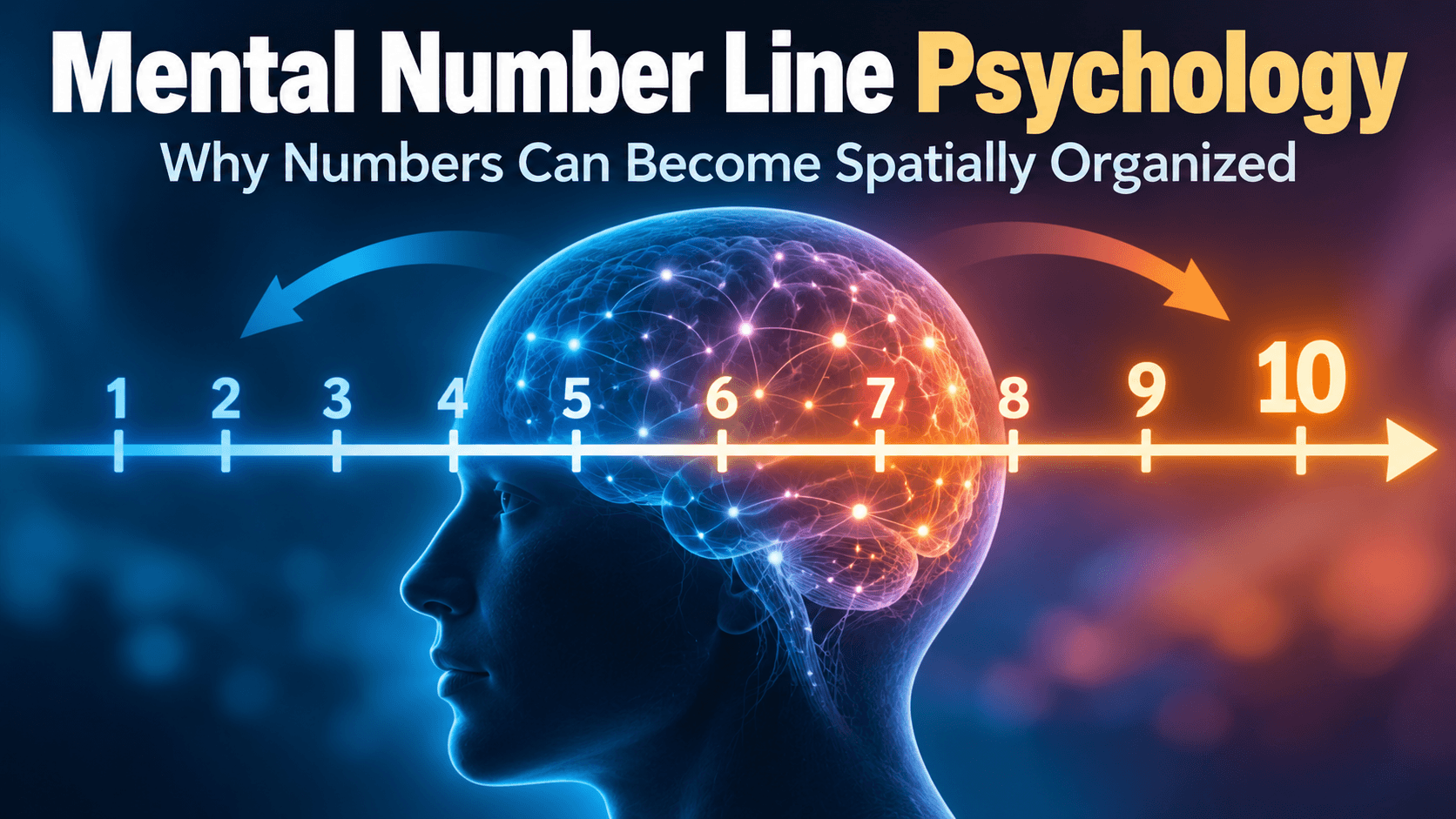
When people think about numbers, they often use spatial language without noticing it. A larger number may feel “farther along.” A sequence may seem to move from one side to another. In many left-to-right reading cultures, smaller numbers are often associated with the left side of space and larger numbers with the right.
Psychologists often describe this family of effects with the idea of a mental number line. The phrase is useful, but it can be misleading if taken literally. Research does not show that every person stores numbers on one fixed internal ruler that always runs from left to right. Number-space associations are flexible, shaped by task demands and experience, and can differ across individuals and cultural contexts.
The most useful way to understand the mental number line is therefore as a model of how numerical magnitude and order can become spatially organized. It helps explain why numbers sometimes bias spatial attention or left-right responses, while leaving room for competing explanations such as working-memory ordering and context-sensitive coding.
Quick Answer
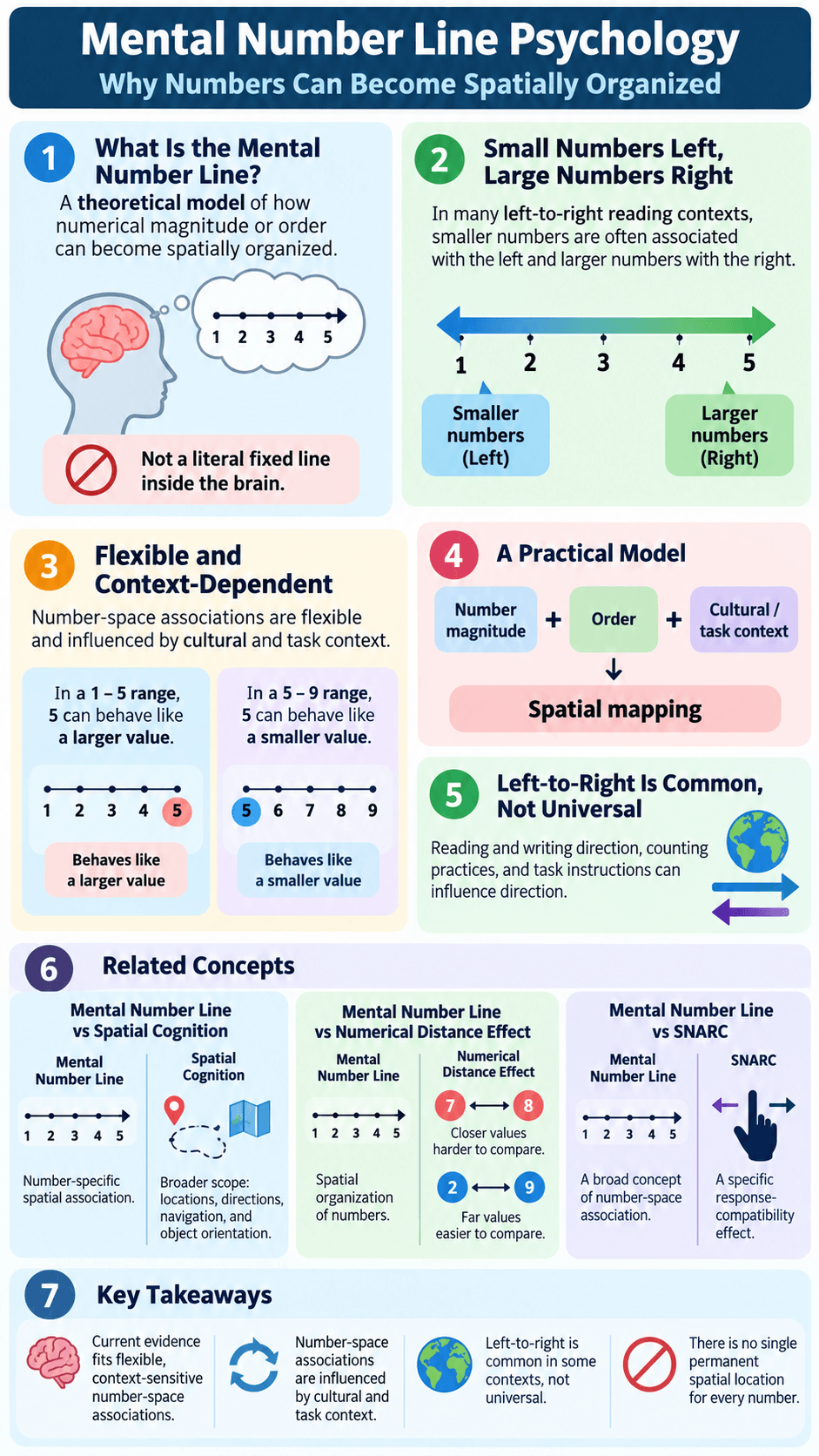
The mental number line is a theoretical way of describing spatial associations with numerical magnitude or order. In many common tasks and left-to-right reading contexts, smaller numbers are associated more strongly with the left and larger numbers with the right. However, the mapping is not universally fixed, literally stored as a line, or identical across cultures and tasks. Reading habits, counting practices, reference ranges, instructions, and temporary ordering in working memory can all influence number-space mappings.
What Psychologists Mean by a Mental Number Line
A theoretical and metaphorical number-space representation
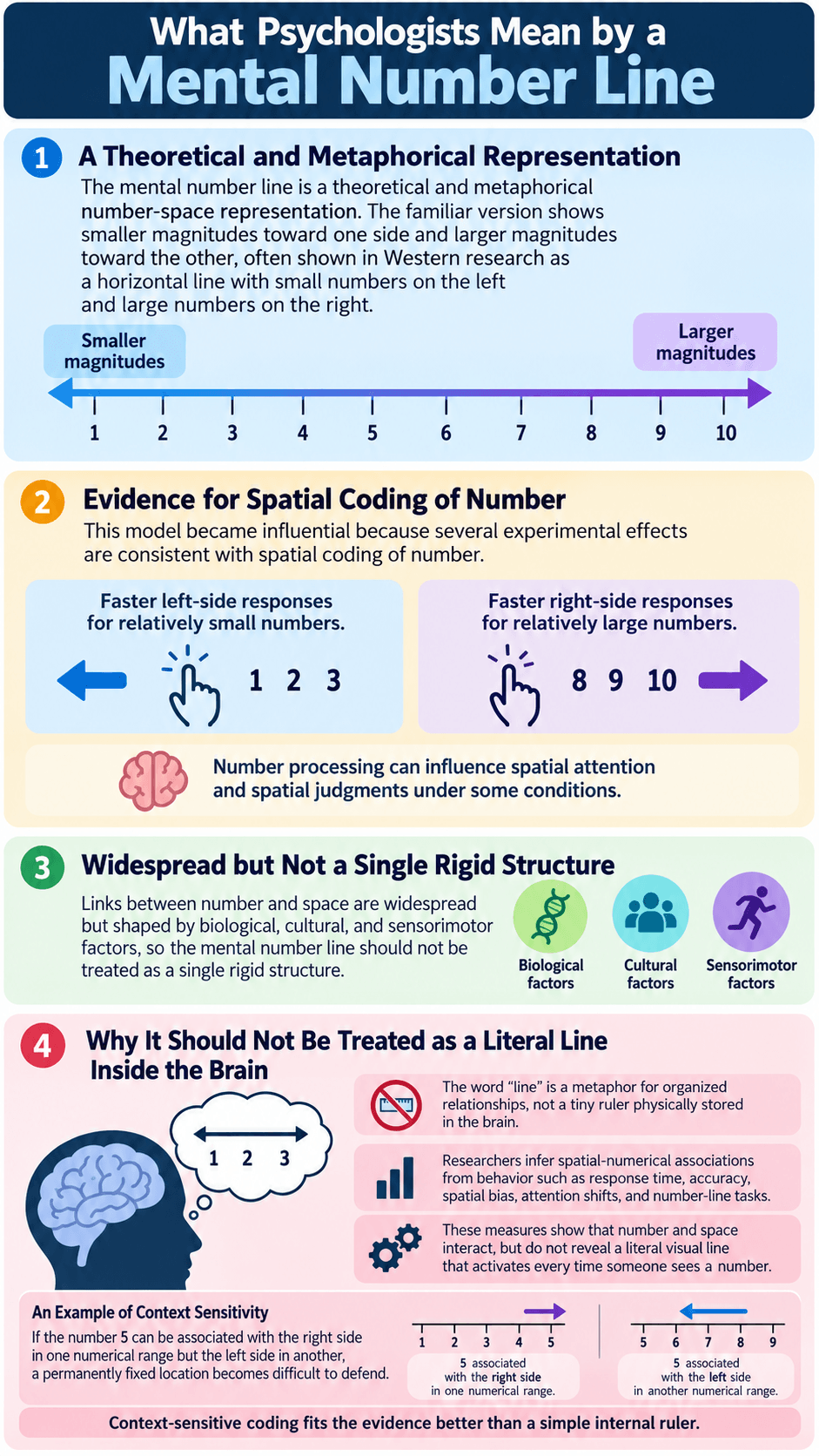
The basic mental-number-line idea proposes that numerical values are related to positions in space. The familiar version places smaller magnitudes toward one side and larger magnitudes toward the other. In Western research traditions, the classic image is a horizontal line running from small values on the left to large values on the right.
This model became influential because several experimental effects appear consistent with spatial coding of number. For example, people often respond faster to relatively small numbers with a left-side response and to relatively large numbers with a right-side response. Number processing can also influence spatial attention and spatial judgments under some conditions.
A major review of spatial-numerical associations concludes that links between number and space are widespread but shaped by an interplay of biological, cultural, and sensorimotor factors. That broader view is more accurate than treating the mental number line as a single rigid structure.
Why it should not be treated as a literal line inside the brain
The word “line” is a metaphor for organized relationships. It should not be imagined as a tiny ruler physically stored in the brain with each integer occupying a fixed coordinate.
Researchers infer spatial-numerical associations from behavior such as response time, accuracy, spatial bias, attention shifts, or performance on number-line tasks. Those measures tell us that number and space interact. They do not reveal a literal visual line that must be activated every time someone sees a number.
The distinction becomes important when evidence is flexible. If the number 5 can be associated with the right side in one numerical range but the left side in another, a permanently fixed location becomes difficult to defend. Context-sensitive coding fits those results better than a simple internal ruler.
What Can Be Mapped Spatially?
Numerical magnitude
Magnitude is the “how much” or “how many” aspect of number. Nine has greater numerical magnitude than four. Spatial-numerical research often asks whether larger and smaller magnitudes become associated with different regions or directions in space.
In a classic horizontal pattern, relatively small numbers are associated with the left and relatively large numbers with the right. Other spatial dimensions are possible too. Some tasks show vertical associations, such as smaller values being linked with lower space and larger values with upper space.
The existence of several possible mappings is already a clue that spatial numerical coding is not one universal left-to-right template.
Ordinal sequence
Numbers also belong to ordered sequences. One comes before two, seven comes before eight, and each familiar integer has neighbors in a learned order.
Spatial organization may therefore reflect order as well as magnitude. People are highly practiced at arranging ordered information spatially, including letters, weekdays, timelines, lists, and number sequences. Some theories propose that spatial coding arises partly because ordered items are temporarily arranged in working memory during a task.
This matters because a “small-to-large line” and a “first-to-last sequence” can produce similar left-right behavior even if the underlying explanation is different.
Left-right and other directional mappings
Left-right associations receive the most attention because they are easy to test with two response keys. But horizontal space is not the only possible dimension.
Numbers can interact with vertical position, near-far arrangements, imagined spatial layouts, and the direction of learned sequences. The direction observed in a task also depends on what response options are available.
For that reason, “mental number line” is best treated as one family of number-space mappings rather than a claim that every numerical representation is always horizontal.
A Flexible Mapping Model
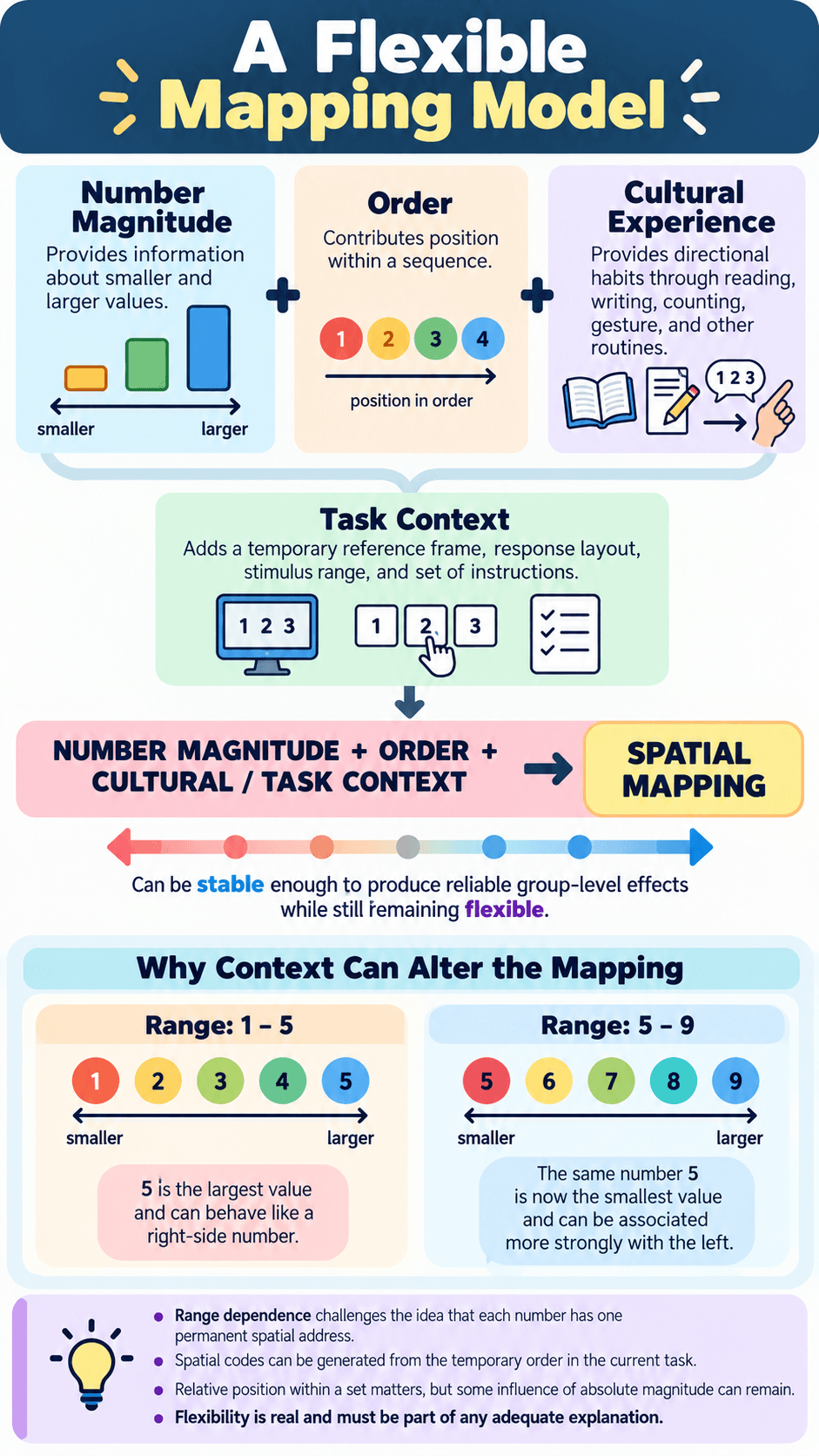
NUMBER MAGNITUDE + ORDER + CULTURAL / TASK CONTEXT → SPATIAL MAPPING
A practical way to organize the evidence is:
NUMBER MAGNITUDE + ORDER + CULTURAL / TASK CONTEXT → SPATIAL MAPPING
Magnitude contributes information about smaller and larger values. Order contributes position within a sequence. Cultural experience provides directional habits through reading, writing, counting, gesture, and other routines. The immediate task adds a temporary reference frame, response layout, stimulus range, and set of instructions.
The resulting spatial mapping can therefore be stable enough to produce reliable group-level effects while still remaining flexible.
Why context can alter the mapping
Suppose a task uses the numbers 1 through 5. Within that set, 5 is the largest value and can behave like a “right-side” number. Now change the set to 5 through 9. The same number 5 is now the smallest value and can become associated more strongly with the left.
This range dependence challenges the idea that each number has only one permanent spatial address. A working-memory account of number-induced spatial biases uses findings like this to argue that spatial codes can be generated from the temporary order of items in the current task.
Recent registered-report work also suggests that number-space associations are flexible without being completely unconstrained. Relative position within a set matters, but some influence of absolute magnitude can remain. The important point is that flexibility is real and must be part of any adequate explanation.
Left-to-Right Is Common in Some Contexts, Not Universal
Reading and writing direction
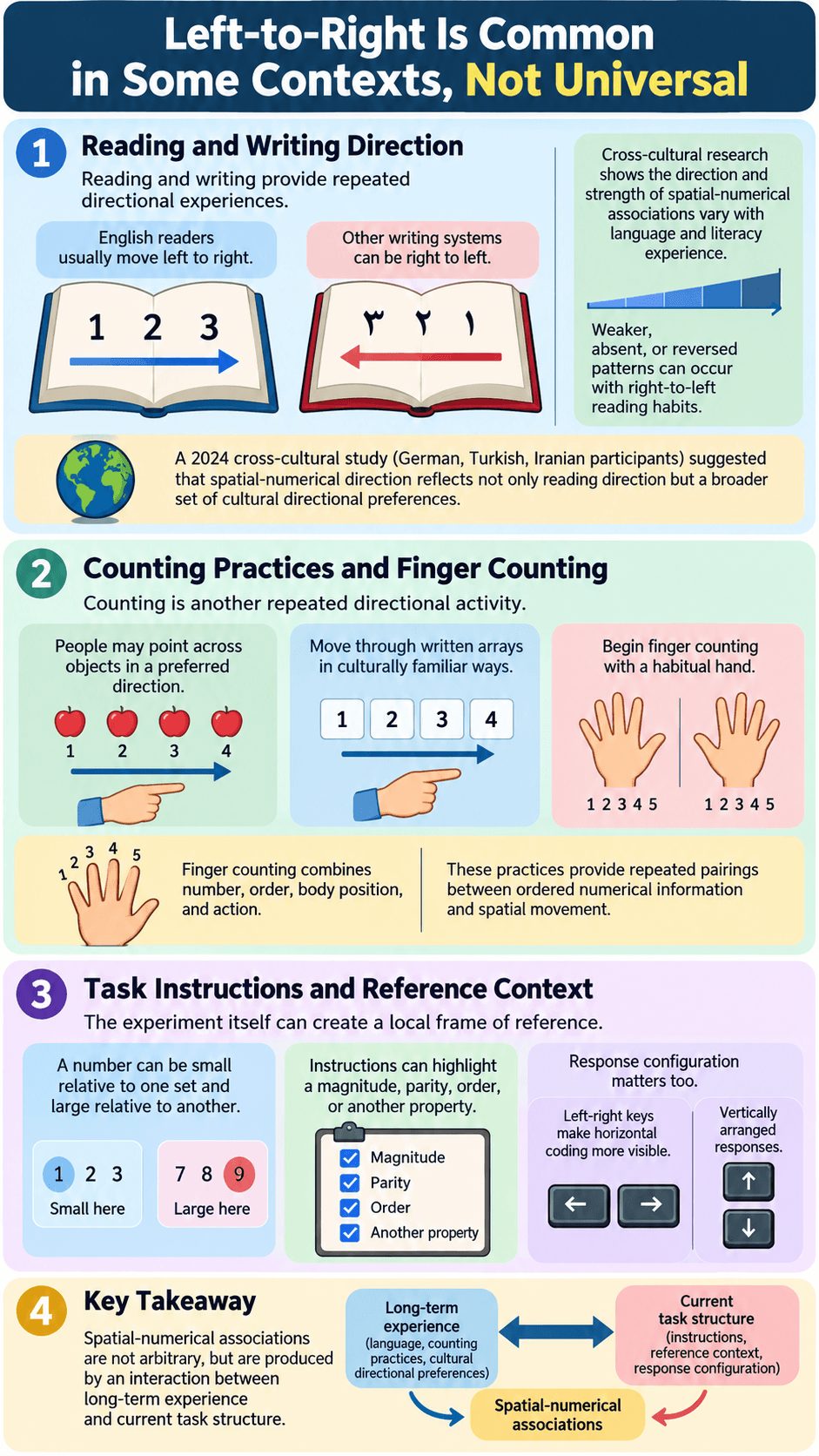
Reading and writing provide thousands of repeated directional experiences. English readers normally move through text from left to right. Other writing systems use right-to-left direction, and some readers regularly work with more than one direction.
Cross-cultural research has repeatedly found that the direction and strength of spatial-numerical associations vary with language and literacy experience. Participants with right-to-left reading habits often show weaker, absent, or reversed versions of the classic left-small/right-large pattern.
A 2024 cross-cultural study of directional preferences and number-space associations compared German, Turkish, and Iranian participants. The findings suggested that spatial-numerical direction reflects not only reading direction but a broader set of cultural directional preferences.
Counting practices and finger counting
Counting is another repeated directional activity. People may point across objects in a preferred direction, move through written arrays in culturally familiar ways, or begin finger counting with a habitual hand.
These practices can provide repeated pairings between ordered numerical information and spatial movement. Finger counting is especially interesting because it combines number, order, body position, and action.
There is no need to rank one counting style as more advanced than another. The research question is whether repeated directional habits contribute to the way numerical order becomes spatially coded.
Task instructions and reference context
The experiment itself can create a local frame of reference. A number can be “small” relative to one stimulus set and “large” relative to another. Instructions can highlight magnitude, parity, order, or another property, changing which associations become relevant.
Response configuration matters too. A two-key left-right task naturally makes horizontal coding more visible than a task with vertically arranged responses.
This does not mean spatial-numerical associations are arbitrary. It means they are produced by an interaction between long-term experience and current task structure.
Linear and Nonlinear Number-Space Models
Linear representation as one model
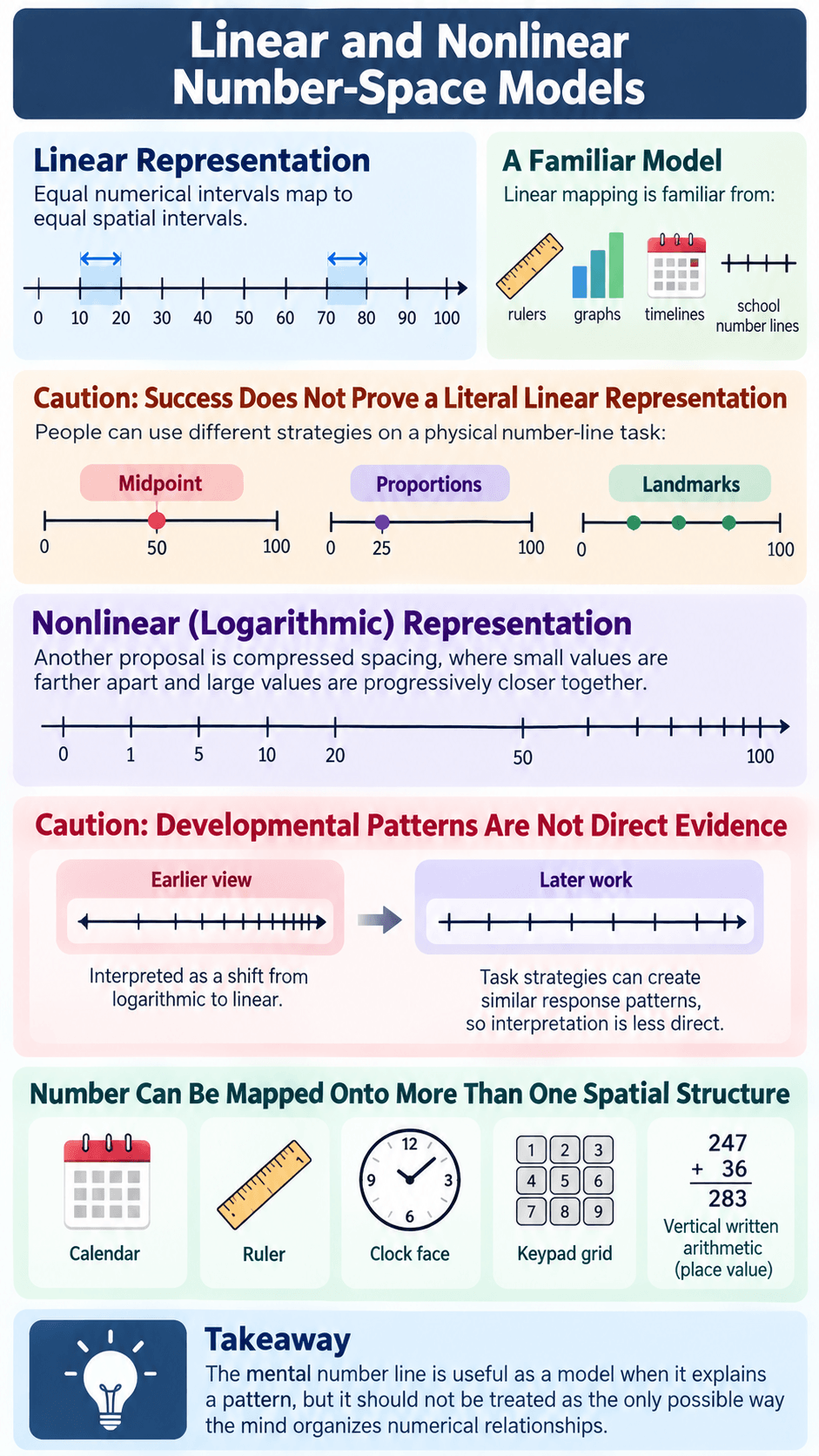
A linear number-space model gives equal numerical intervals equal spatial intervals. On a physical line from 0 to 100, the distance from 10 to 20 equals the distance from 70 to 80.
Linear mapping is familiar because rulers, graphs, timelines, and school number lines use this structure. With experience, people become skilled at using proportional relationships and reference points on such scales.
However, success on a physical number-line estimation task does not prove that internal numerical representations are literally linear. People can use strategies such as identifying the midpoint, estimating proportions, and relying on known landmarks.
Logarithmic versus linear distinctions as historical and model ideas
Another influential proposal is that numerical spacing can be compressed, with small values represented farther apart and large values represented progressively closer together. This is often described as a logarithmic representation.
Developmental number-line research once interpreted changes from curved to more linear placement as direct evidence that internal representation shifts from logarithmic to linear. Later work showed that task strategies can produce similar response patterns, making the interpretation less direct.
A mathematical analysis of number-line estimation tasks describes several competing models, including linear, logarithmic, and scalar-variance accounts, and shows why observed placement patterns should not automatically be read as a literal picture of internal number space.
Why no single layout should be treated as universal
People can use different spatial formats for different purposes. A calendar organizes number differently from a ruler. A clock face uses a circle. A keypad uses a grid. Written arithmetic often places values vertically by place value.
These examples do not disprove spatial-numerical representation. They show that number can be mapped onto more than one spatial structure.
The mental number line remains useful as a model when it explains a particular pattern, but it becomes misleading when treated as the only possible way the mind organizes numerical relationships.
Working-Memory Ordering Accounts at a High Level
Temporary order and task structure
One alternative to a permanently stored number line is that spatial coding is generated when ordered items are held in working memory. Early items may be assigned to one side of an internal workspace and later items to the other.
Under this account, numbers show left-right associations partly because they are familiar ordered items. Similar effects should be possible for nonnumerical sequences when the task encourages ordered spatial coding.
The working-memory theory of number-space associations was developed to explain findings that are difficult for a rigid long-term number-line account, including task-range flexibility and spatial effects for newly ordered material.
Why this explanation does not replace general working-memory psychology
Working memory is a broad cognitive system involved in temporarily maintaining and manipulating information. Number-space research uses that broader mechanism to explain one specific phenomenon: how ordered numerical items may acquire temporary spatial codes during a task.
The relevant point here is not working-memory capacity, overload, or training. It is serial order. If the current task establishes an ordered set, the position of an item within that set may contribute to left-right response tendencies.
This account competes with stronger versions of the long-term mental-number-line view, but the wider literature does not require a single all-or-nothing choice. Long-term numerical knowledge, cultural habits, and temporary task organization may all contribute under different conditions.
Mental Number Line vs Spatial Cognition
Number-specific spatial association
The mental number line concerns spatial coding of numerical information. Its central question is why magnitude or numerical order becomes related to spatial direction or position.
Examples include small-left/large-right response tendencies, spatial attention shifts following numbers, and the use of spatial layouts to reason about numerical order.
Physical and environmental spatial representation is broader
Spatial cognition covers much more than number. It includes representing locations, directions, landmarks, routes, object orientation, reference frames, navigation, and transformations in physical or imagined space.
A person can navigate a city or mentally rotate an object without processing number at all. Likewise, a left-right number association is not the same thing as building a cognitive map of an environment.
The overlap is meaningful because both involve spatial coding, but the psychological questions remain different.
Mental Number Line vs Numerical Distance Effect
Spatial organization hypothesis
The mental-number-line hypothesis concerns whether numerical values become associated with spatial positions or directions.
Evidence relevant to this idea includes response-side compatibility effects, spatial attention biases, and cultural changes in the direction of number-space associations.
Magnitude-comparison phenomenon
The Numerical Distance Effect is different. It refers to the finding that close numerical values such as 7 and 8 are often harder to compare than far values such as 2 and 9.
Distance effects can be explained by magnitude overlap, semantic competition, or other comparison processes without requiring left-right spatial coding. The broad review cited earlier argues that numerical comparison and spatial mapping can occur at separable processing stages.
| Concept | Main question | Typical evidence |
|---|---|---|
| Mental Number Line | How do numbers become spatially organized? | Directional number-space associations |
| Numerical Distance Effect | Why are close magnitudes harder to compare? | Reaction-time and accuracy differences for close vs far pairs |
| Spatial Cognition | How are locations, directions, objects, and environments represented? | Navigation, reference frames, spatial transformations, cognitive maps |
Mental Number Line vs SNARC
Broad number-space concept
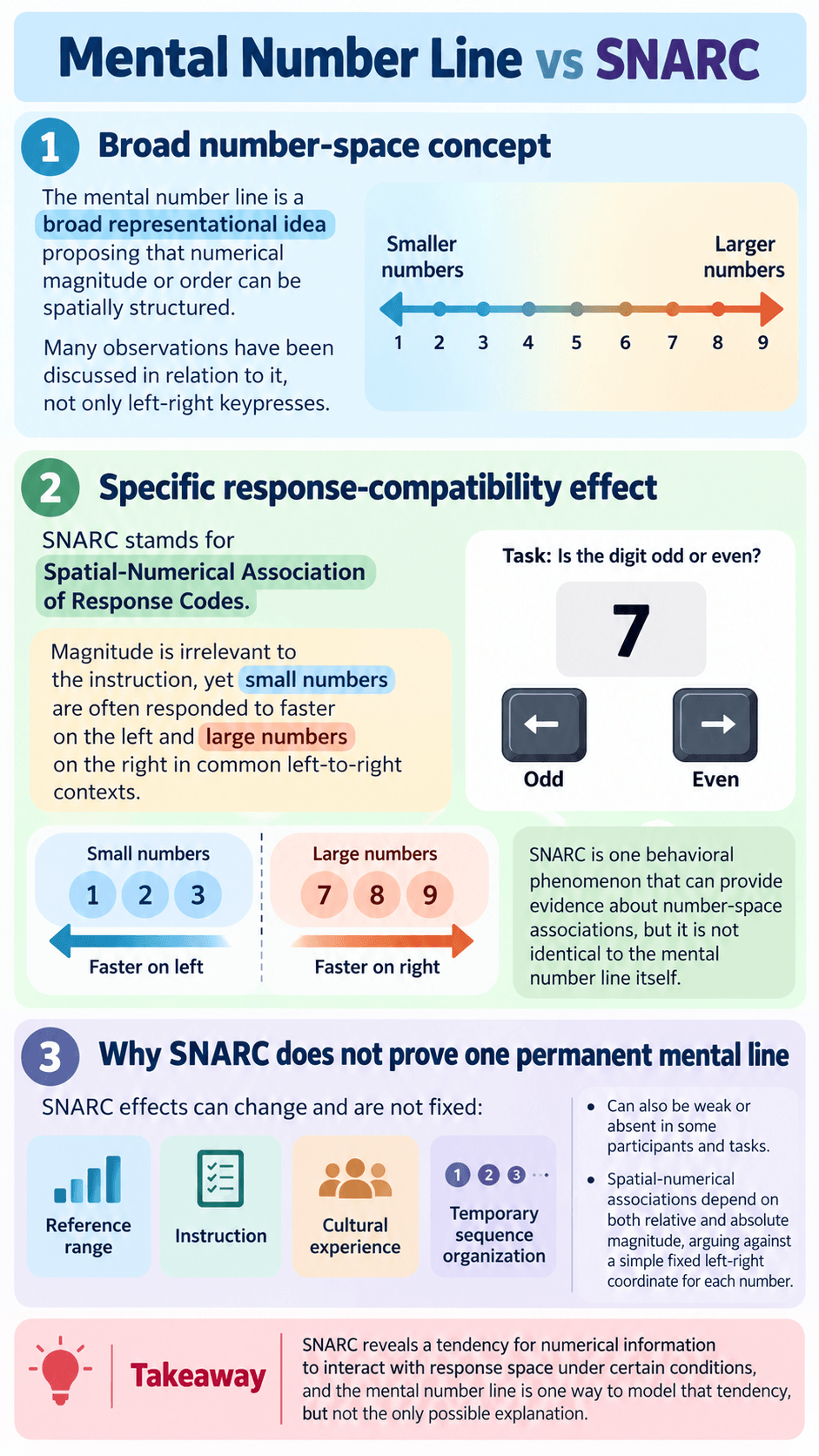
The mental number line is a broad representational idea. It proposes that numerical magnitude or order can be spatially structured.
Many different observations have been discussed in relation to this idea, not only left-right keypresses.
Specific response-compatibility effect
SNARC stands for Spatial-Numerical Association of Response Codes. In a classic task, participants judge whether a digit is odd or even while responding with left and right keys. Magnitude is irrelevant to the instruction, yet small numbers are often responded to faster on the left and large numbers on the right in common left-to-right contexts.
SNARC is therefore one behavioral phenomenon that can provide evidence about number-space associations. It is not identical to the mental number line itself.
Why SNARC does not prove one permanent mental line
SNARC effects can change with reference range, instruction, cultural experience, and temporary sequence organization. They can also be weak or absent in some participants and tasks.
Recent research continues to show that spatial-numerical associations depend on both relative and absolute magnitude, which argues against an extremely simple “each number has one fixed left-right coordinate” view.
A better interpretation is that SNARC reveals a tendency for numerical information to interact with response space under certain conditions. The mental number line is one way to model that tendency, but not the only possible explanation.
Three Misunderstandings That Make the Mental Number Line Too Literal
“Everyone sees numbers left to right”
Some people report vivid spatial forms for numbers, but many do not consciously visualize anything. Laboratory number-space effects can occur without conscious imagery. Direction also varies across cultural and task contexts.
“A mental number line is the same as a school number line”
A physical school number line is an external visual tool with explicit positions and equal spatial intervals. A psychological number-space association is inferred from behavior and may be context-sensitive, compressed, temporary, or multidirectional.
“If numbers interact with space, one spatial model must explain every effect”
Different tasks can tap different processes. A SNARC task, a number-line estimation task, a magnitude-comparison task, and a spatial-attention task should not automatically be treated as interchangeable measures of one internal structure.
Research on the heterogeneous nature of number-space interactions has repeatedly shown dissociations across tasks. This is one reason the field now treats “spatial-numerical associations” as a broader family of phenomena rather than assuming every result comes from one single mechanism.
FAQ
Is the mental number line a literal line in the brain?
No. It is a theoretical model used to describe spatial organization of numerical information. Researchers observe behavioral and cognitive effects that link number with space, but these effects do not reveal a physical ruler with fixed numerical locations inside the brain.
Does everyone map small numbers left and large numbers right?
No. A small-left/large-right pattern is common in many left-to-right reading contexts, but its strength and direction vary with cultural experience, reading and writing habits, task instructions, stimulus range, and individual differences. Other spatial directions can also appear.
Can reading direction influence number-space mapping?
Yes. Cross-cultural studies show that reading and writing direction is associated with differences in spatial-numerical direction. However, reading direction is not necessarily the only influence. Counting practices, gestures, finger counting, broader directional preferences, and task structure may also contribute.
Is SNARC the same as the mental number line?
No. SNARC is a specific response-compatibility effect involving numerical magnitude and left-right responses. The mental number line is a broader representational idea used to explain spatial organization of number. SNARC can inform theories of the mental number line without being identical to it.
Does the Numerical Distance Effect prove spatial mapping?
No. The Numerical Distance Effect shows that close numerical values are often harder to compare than values farther apart. It is relevant to magnitude processing, but nonspatial explanations can produce the effect. Spatial mapping needs evidence that actually involves spatial position, direction, attention, or response compatibility.
Key Takeaways
- The mental number line is a theoretical model of number-space association, not a literal internal ruler.
- Small-left and large-right mappings are common in some contexts but are not universal, innate in one fixed direction, or identical across cultures.
- Reading and writing direction, counting habits, task instructions, stimulus range, and temporary ordering can all influence spatial numerical mappings.
- Linear and logarithmic number-line ideas are models of representation, and performance on physical number-line tasks can also reflect strategies and reference points.
- The mental number line is broader than SNARC and different from the Numerical Distance Effect and from general Spatial Cognition.
- Current evidence is better explained by flexible, context-sensitive number-space associations than by one permanent spatial location for every number.

Michael Reed is the Founder and Lead Writer at Psychology Exposed. He writes about human behavior, relationships, emotional patterns, self-awareness, and practical psychology topics using research-informed, easy-to-understand content.
Read More About Michael Reed: https://psychologyexposed.com/michael-reed/