
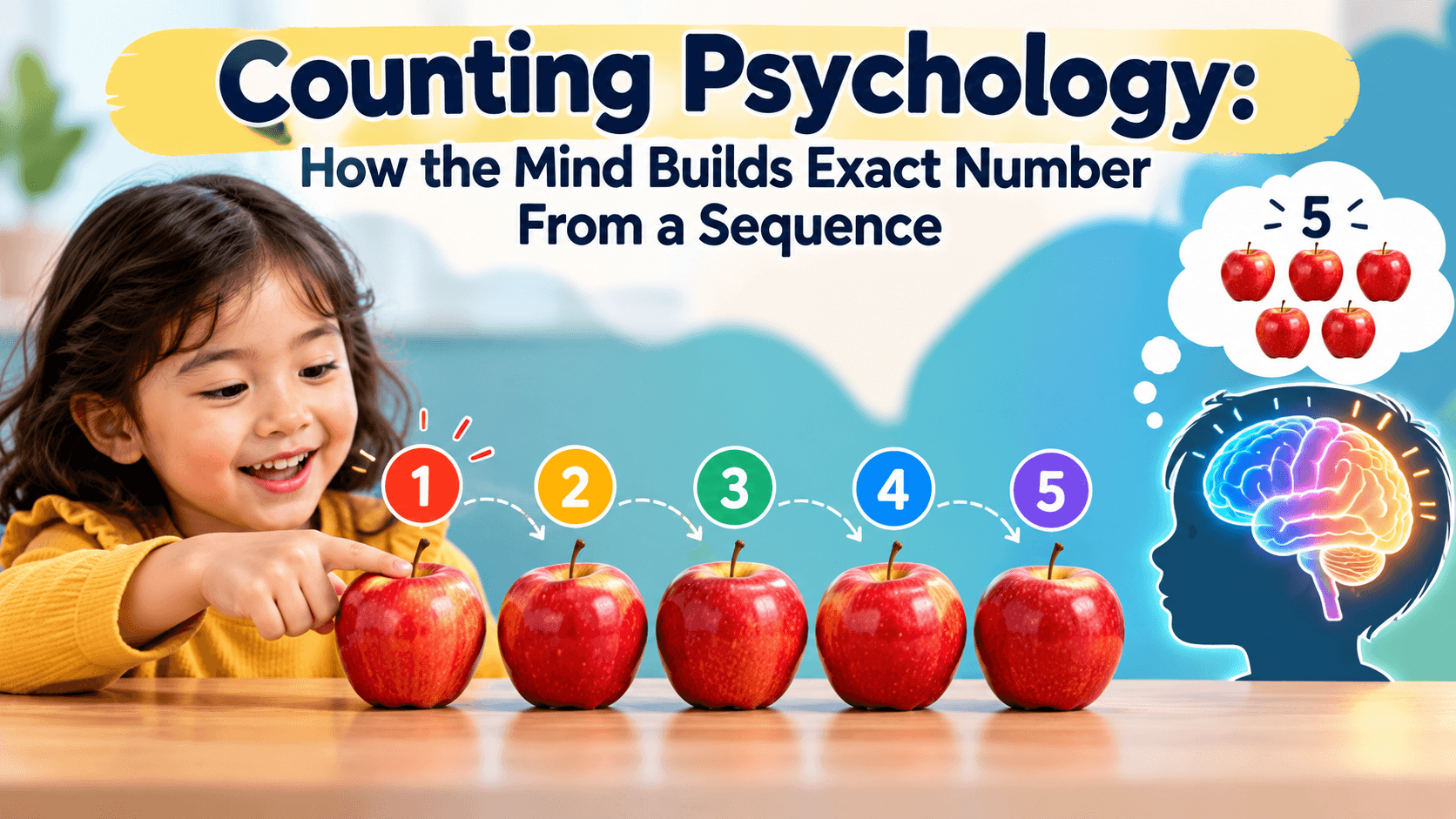
Saying “one, two, three, four, five” sounds simple, but exact counting requires more than knowing a number-word sequence. The counter has to connect one number word to one item, keep the words in a stable order, avoid skipping or double-counting objects, and understand that the final number word tells how many items are in the whole set.
This makes counting a coordinated cognitive process rather than mere recitation. A person can know the verbal sequence “one, two, three, four” yet still fail to use it correctly on a collection of objects. Conversely, someone who counts accurately must manage both the ordered symbolic sequence and the set being enumerated.
Psychologists have described this coordination through several influential principles, especially the framework associated with Rochel Gelman and C. R. Gallistel. These principles are useful for explaining what successful counting accomplishes, but they should not be treated as a checklist that children must consciously memorize before they can count. They describe the structure of successful exact enumeration.
Quick Answer
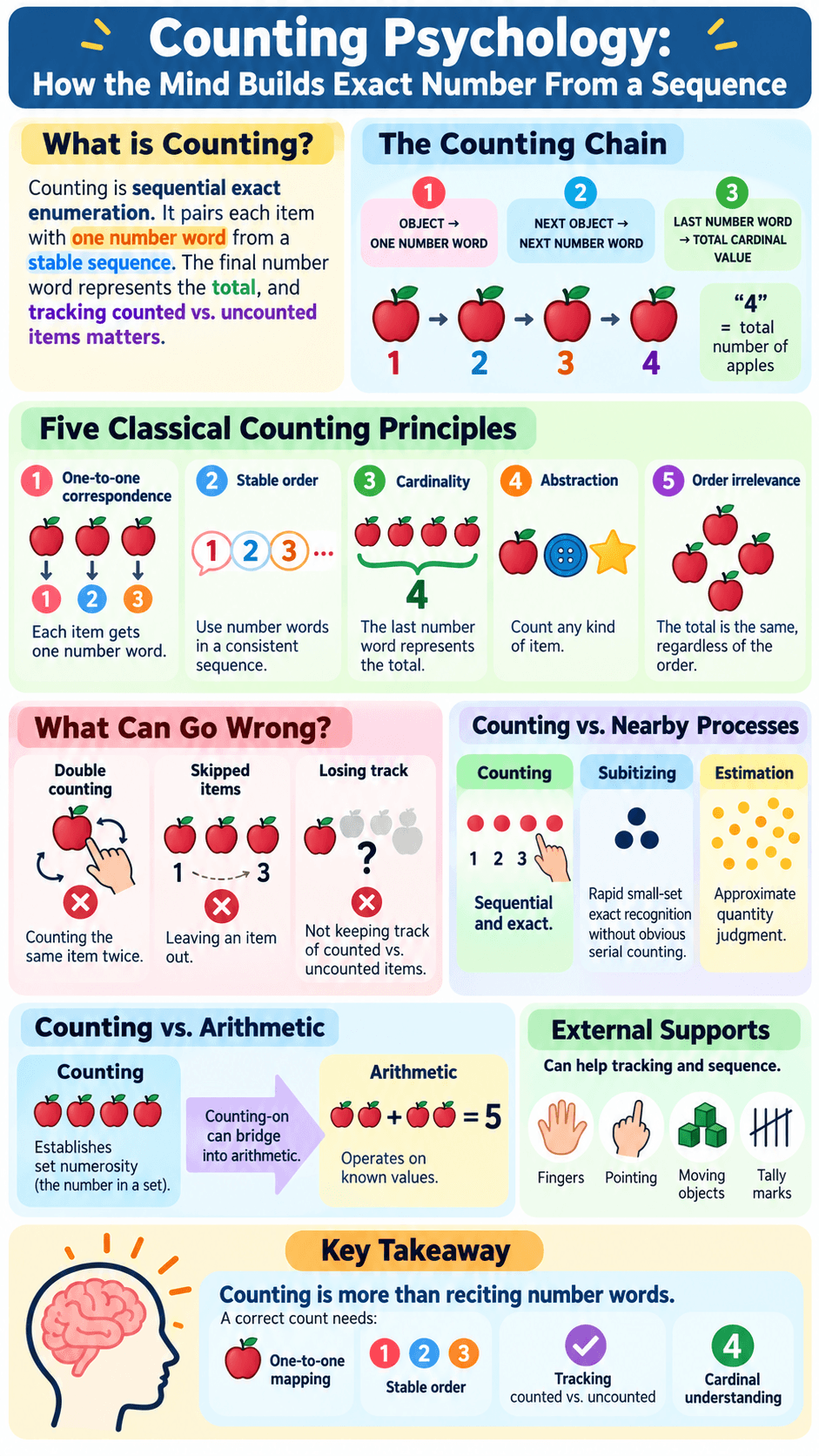
Counting is sequential exact enumeration. It pairs each item in a set with one number word from a stable sequence, then uses the final number word to represent the total cardinal value of the set. Successful counting also requires tracking which items have already been counted. Reciting number words is not enough by itself, and counting differs from subitizing, estimation, and arithmetic because it builds an exact set total through a sequence.
What Counting Is as a Cognitive Process
Sequential exact enumeration
Counting answers the question “Exactly how many items are here?” by proceeding through a sequence. The counter visits items, explicitly or mentally, while assigning successive number words or symbols.
If there are seven buttons on a table, a successful count creates a temporary correspondence: first button → one, second button → two, third button → three, and so on. The sequence ends at seven, and that final value stands for the cardinality of the entire set.
This makes counting different from a rough magnitude judgment. The goal is not “about seven” but exactly seven, assuming the procedure is completed correctly.
Counting objects versus reciting a sequence
Number-word recitation is necessary for ordinary verbal counting, but it is not sufficient. Someone can repeat “one, two, three, four, five” without connecting those words to any objects. That is an ordered verbal sequence, not yet an enumeration of a set.
Research on early number understanding has repeatedly shown that the verbal count list and knowledge of exact cardinal meaning can come apart. A child may produce the words in the correct order before fully understanding what each number word means as the size of a set. A peer-reviewed review of children’s counting knowledge discusses this distinction between reciting number words and using counting in a numerically meaningful way.
The cognitive achievement of counting is therefore not the sound of the sequence. It is the mapping between sequence positions and items, plus the interpretation of the endpoint as the total.
The Core Counting Chain
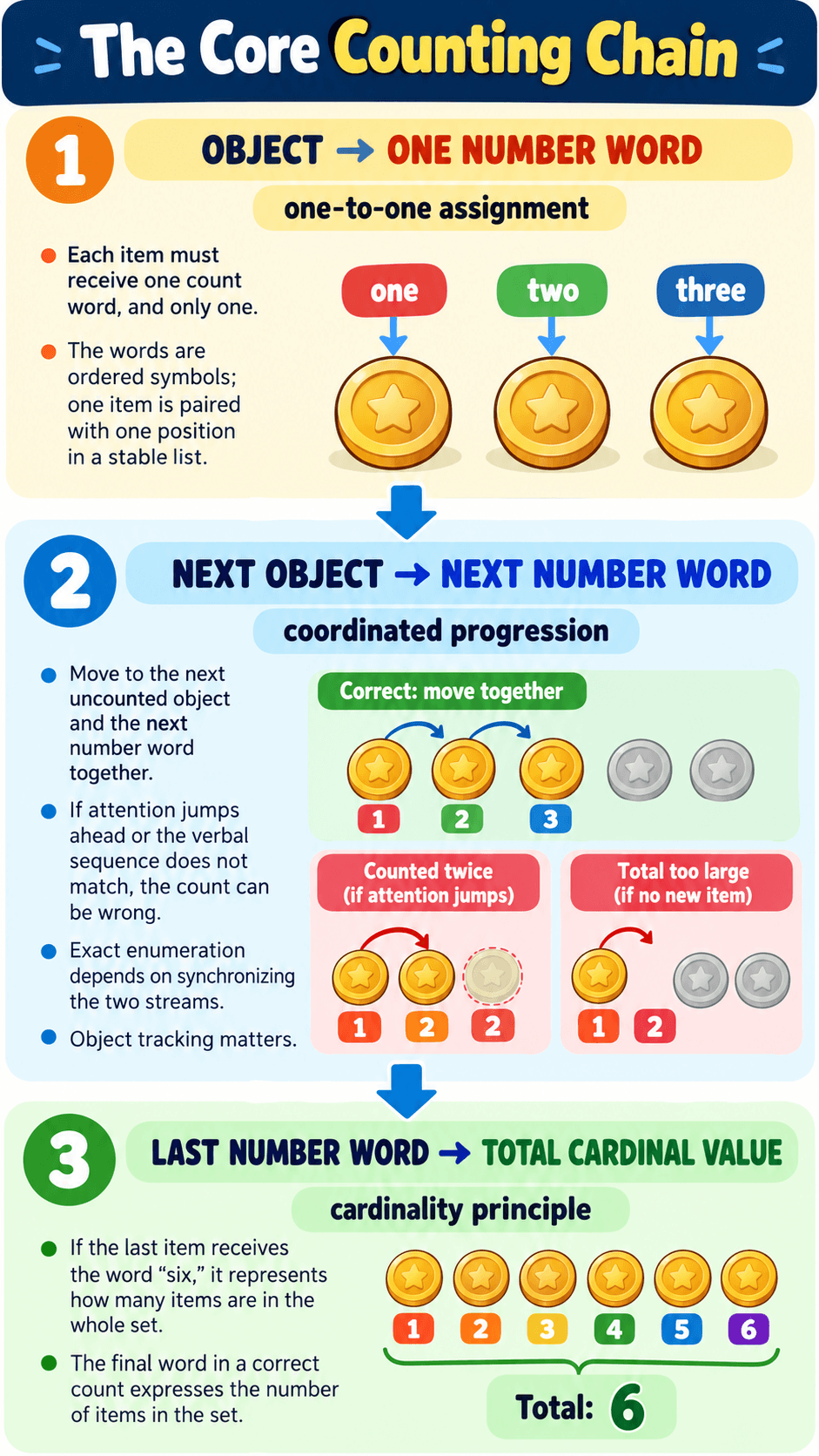
OBJECT → ONE NUMBER WORD
The first requirement is one-to-one assignment. Each item that belongs to the set must receive one count word, and only one.
Imagine six scattered coins. If the first coin receives “one,” the second “two,” and the third “three,” the counter is building a correspondence between individual objects and positions in the number sequence.
The words themselves are ordered symbols. Their exact pronunciation or language can vary, but the procedural structure remains: one item is paired with one position in a stable list.
NEXT OBJECT → NEXT NUMBER WORD
The second requirement is coordinated progression. Moving to the next uncounted object must be paired with moving to the next number word.
If attention jumps ahead in the object set while the verbal sequence does not advance, an item can be counted twice. If the verbal sequence advances while no new item is selected, the total becomes too large. Exact enumeration depends on synchronizing the two streams.
This is why object tracking matters. Counting is not simply a verbal task and not simply a visual task. It requires coordination between an ordered symbolic sequence and a changing distinction between counted and uncounted items.
LAST NUMBER WORD → TOTAL CARDINAL VALUE
The final step gives counting its exact quantitative meaning. If the last item receives the word “six,” then six is not merely the sixth position reached in the sequence. It represents how many items are in the whole set.
This is the cardinality principle. An open-access study of children’s understanding of exact number states the principle clearly: the last word in a correct count expresses the number of items in the set.
Without this interpretation, a person could perform a sequence of pairings correctly yet fail to understand why the final word answers “how many?”
The Five Classical Counting Principles
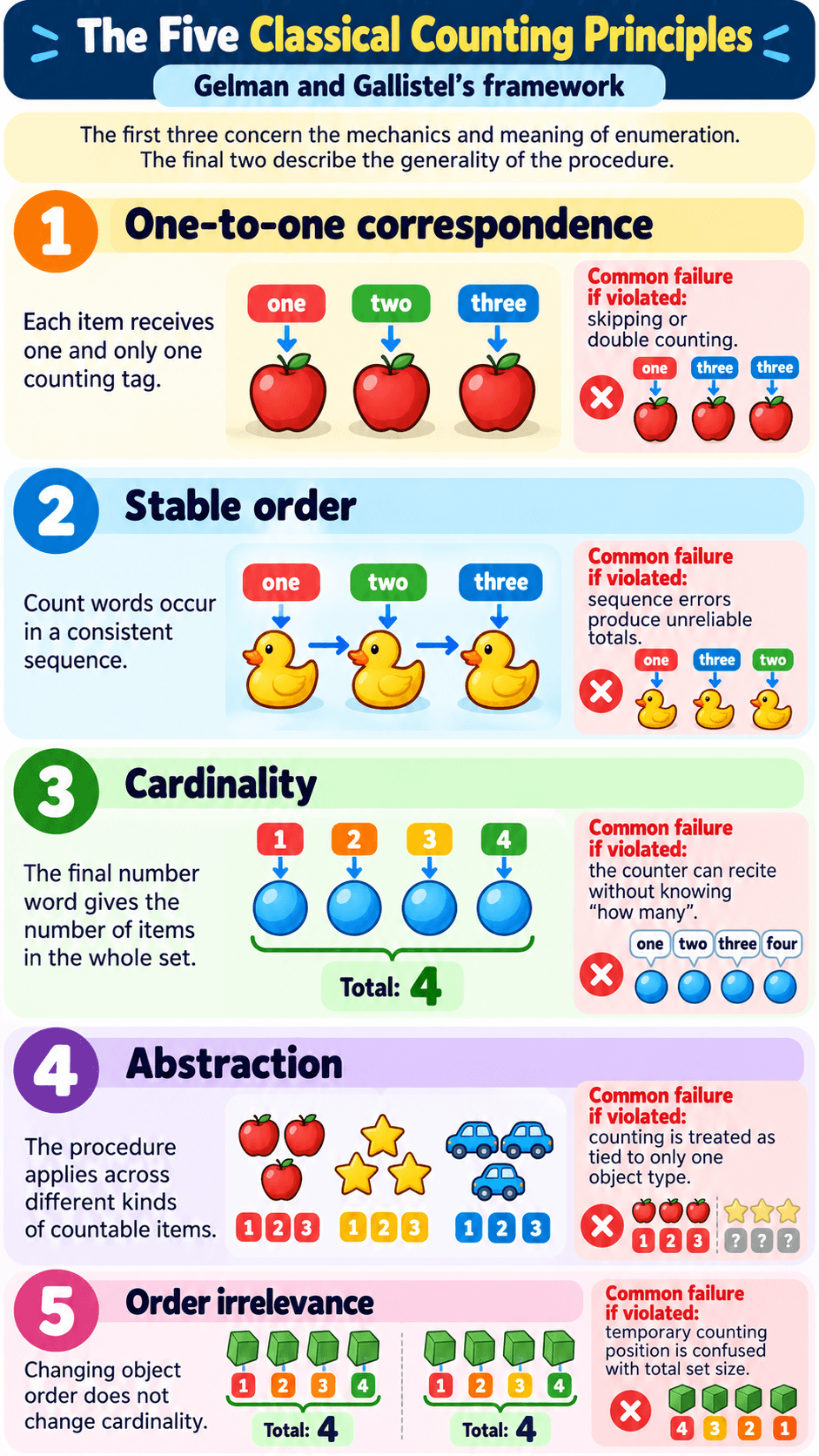
Gelman and Gallistel’s framework describes five properties of successful counting. The first three concern the mechanics and meaning of enumeration. The final two describe the generality of the procedure.
A later theoretical discussion of these ideas notes that the principles are intended to explain how verbal counting represents natural number, while also debating how the principles themselves are learned and represented. That debate is reviewed in an open-access paper on the verbal counting principles.
One-to-one correspondence
Each item receives one and only one counting tag. If eight objects are present, eight distinct assignments must be made.
Violations create familiar errors. Assigning two number words to one object inflates the count. Skipping an object makes the total too small.
One-to-one correspondence therefore ties the symbolic sequence to the actual members of the set.
Stable order
The counting tags must occur in a repeatable order. In English, “one, two, three, four” works because the same ordered sequence can be used across sets.
The essential feature is stability. If the order changed unpredictably every time, reaching “five” would not provide a consistent position in the sequence.
The stable sequence gives counting a reusable structure that can be applied to many collections.
Cardinality
The final number word represents the size of the entire set. After counting “one, two, three, four,” the answer to “how many?” is four.
This principle distinguishes enumeration from merely labeling the last object “fourth.” The final tag has two roles: it occupies the last position in the sequence and, after a correct count, gives the cardinal value of the collection.
Abstraction
The counting procedure can apply to many kinds of discrete items. Stones, sounds, steps, red objects, mixed objects, and imagined events can all be counted if the task defines them as distinct units.
The items do not need to be physically identical. A cup, a pencil, and a book can form a three-item set if the question is simply how many objects are present.
Abstraction concerns the general applicability of the counting procedure, not abstract mathematics in a broader sense.
Order irrelevance
The objects themselves can be counted in different orders without changing the final cardinal value, provided every relevant item is counted exactly once.
If five coins are counted from left to right or right to left, the answer remains five. The temporary number word assigned to a particular coin may change, but the set’s cardinality does not.
This principle separates the identity of individual counting steps from the final quantity of the set.
| Principle | What successful counting requires | Common failure if violated |
|---|---|---|
| One-to-one correspondence | One count word for each item | Skipping or double counting |
| Stable order | Count words occur in a consistent sequence | Sequence errors produce unreliable totals |
| Cardinality | The final word gives the number of items in the whole set | The counter can recite without knowing “how many” |
| Abstraction | The procedure applies across different kinds of countable items | Counting is treated as tied to only one object type |
| Order irrelevance | Changing object order does not change cardinality | Temporary counting position is confused with total set size |
What Can Go Wrong During Enumeration?
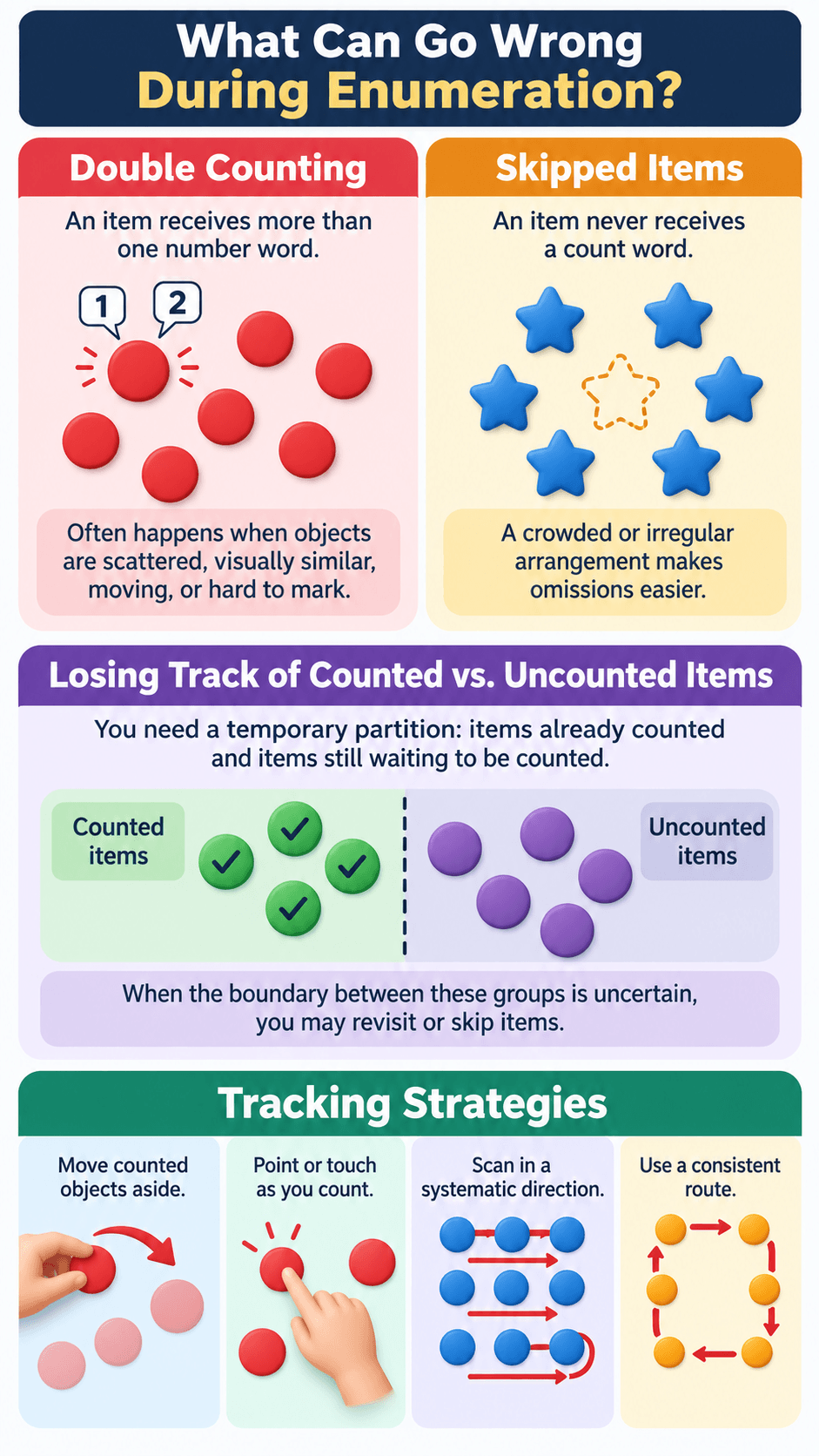
Double counting
Double counting occurs when an item receives more than one number word. This often happens when objects are scattered, visually similar, moving, or difficult to mark as already counted.
The person may know the number sequence perfectly. The error occurs because item tracking fails.
Moving counted objects aside, pointing, touching, or scanning systematically can reduce the problem because these actions externalize the counted-versus-uncounted distinction.
Skipped items
The opposite error occurs when an item never receives a count word. A crowded or irregular arrangement makes omissions easier because attention can jump from one region to another.
Again, the verbal sequence may be flawless. The total is wrong because the mapping from words to objects is incomplete.
Losing track of counted versus uncounted items
Exact counting requires a temporary partition of the set: items already counted and items still waiting to be counted. This partition may exist through visual attention, spatial organization, gestures, physical movement, or memory.
When the boundary between those groups becomes uncertain, the counter risks revisiting or skipping items. Large, scattered sets create a heavier tracking problem than neat rows.
This is one reason arrangement affects counting speed even though cardinality itself is independent of arrangement.
Counting direction and item tracking
A systematic direction can act as a tracking strategy. Moving left to right, clockwise, row by row, or from one region to another reduces uncertainty about where the count began and which objects remain.
The direction itself is not what determines the correct total. Order irrelevance means the set can be traversed in many ways. A consistent route is useful because it supports one-to-one mapping.
Why Number-Sequence Recitation Is Not Enough
Ordered words without set mapping
A memorized number sequence is similar to knowing the alphabet in order. It provides a structured list, but the list must be used appropriately to solve a counting problem.
A person who says “one, two, three, four” while pointing randomly, skipping objects, or tagging one object twice has produced the correct words but not a correct count.
This distinction is important because verbal fluency can make counting look more advanced than it is. The meaningful question is not only “Can the sequence be recited?” but “Can the sequence be coordinated with a set to establish exact cardinality?”
Why the final number must carry cardinal meaning
After a correct count of five objects, asking “How many are there?” should not require starting over if the endpoint is understood cardinally. The final word already summarizes the set.
Research on cardinal-principle knowledge shows that understanding exact number involves more than knowing which word comes next in the count list. The learner must connect the ordered sequence with the idea that a particular word represents an exact set size.
This is why recitation and cardinality are separable forms of knowledge even though mature counting combines them smoothly.
Counting vs Subitizing vs Estimation
Sequential exact enumeration
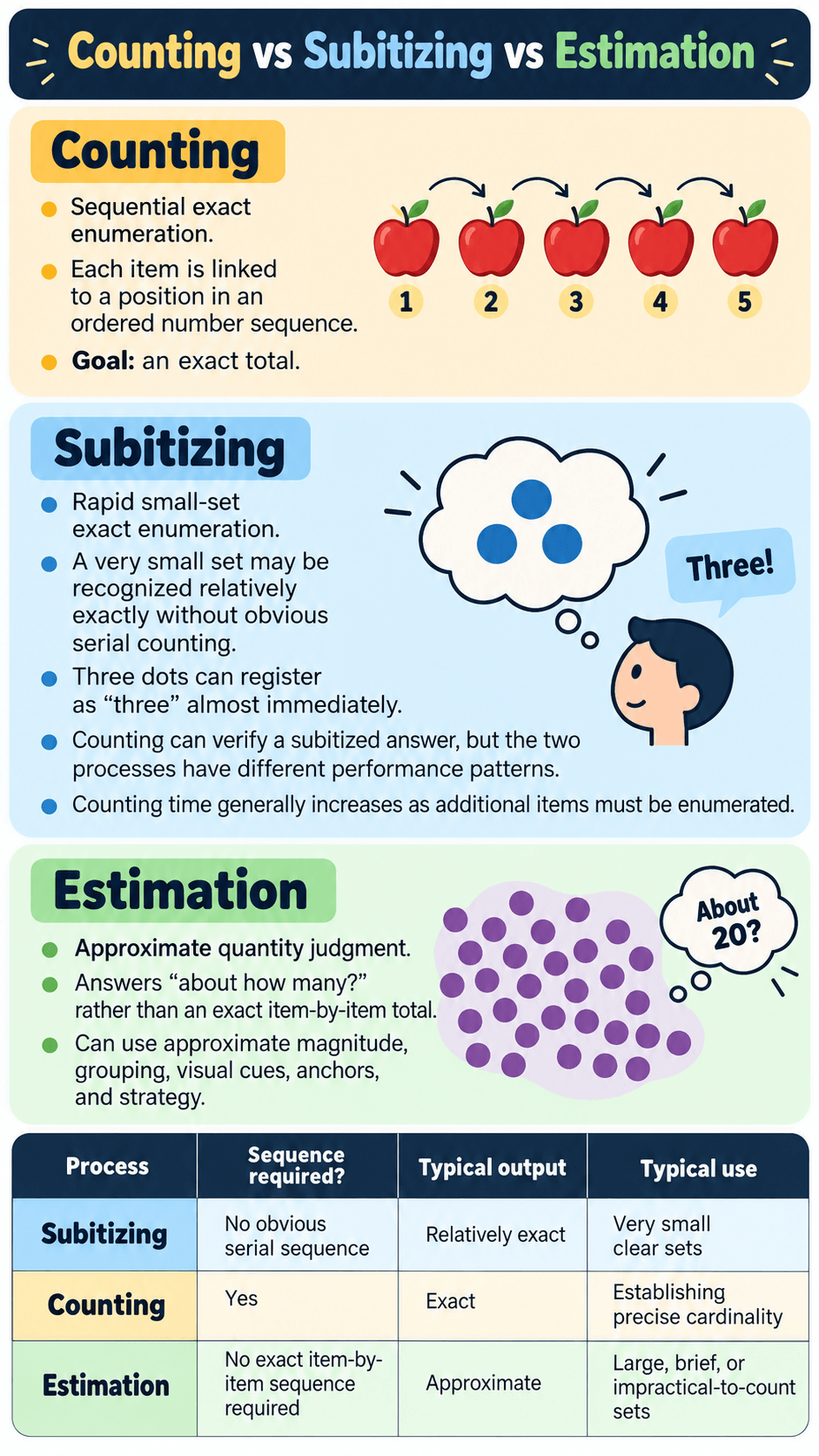
Counting is sequential. Each item is linked to a position in an ordered number sequence. The goal is an exact total.
Rapid small-set exact enumeration
Subitizing is different. A very small set may be recognized relatively exactly without obvious serial counting. Three dots can register as “three” almost immediately.
Counting can verify a subitized answer, but the two processes have different performance patterns. Counting time generally increases as additional items must be enumerated.
Approximate quantity judgment
Estimation answers “about how many?” rather than establishing an exact item-by-item total. It can use approximate magnitude, grouping, visual cues, anchors, and strategy.
| Process | Sequence required? | Typical output | Typical use |
|---|---|---|---|
| Subitizing | No obvious serial sequence | Relatively exact | Very small clear sets |
| Counting | Yes | Exact | Establishing precise cardinality |
| Estimation | No exact item-by-item sequence required | Approximate | Large, brief, or impractical-to-count sets |
Counting vs Arithmetic
Counting establishes set numerosity
Counting begins with a collection and determines how many items it contains. The core output is cardinality.
If six objects are on a table, counting can establish that the set contains six. No arithmetic operation is necessary.
Arithmetic operates on numerical values
Arithmetic begins with numerical values and applies an operation such as addition, subtraction, multiplication, or division. If the known values are 6 and 3, calculating 6 + 3 changes the numerical relation being considered.
Counting and arithmetic can interact, but they answer different cognitive questions. Counting identifies a quantity. Arithmetic transforms or combines known quantities.
Counting-on as a light bridge
Counting can also become a strategy inside arithmetic. To solve 6 + 3, someone might begin from six and count “seven, eight, nine.” This is called counting on.
The procedure uses the count sequence to perform an addition, so it forms a bridge between enumeration knowledge and arithmetic strategy. But the arithmetic problem is broader than counting itself because the goal is to combine values rather than simply enumerate one presented set.
This distinction prevents counting psychology from becoming a general guide to mental calculation.
Fingers and External Supports
Supports for tracking and sequence
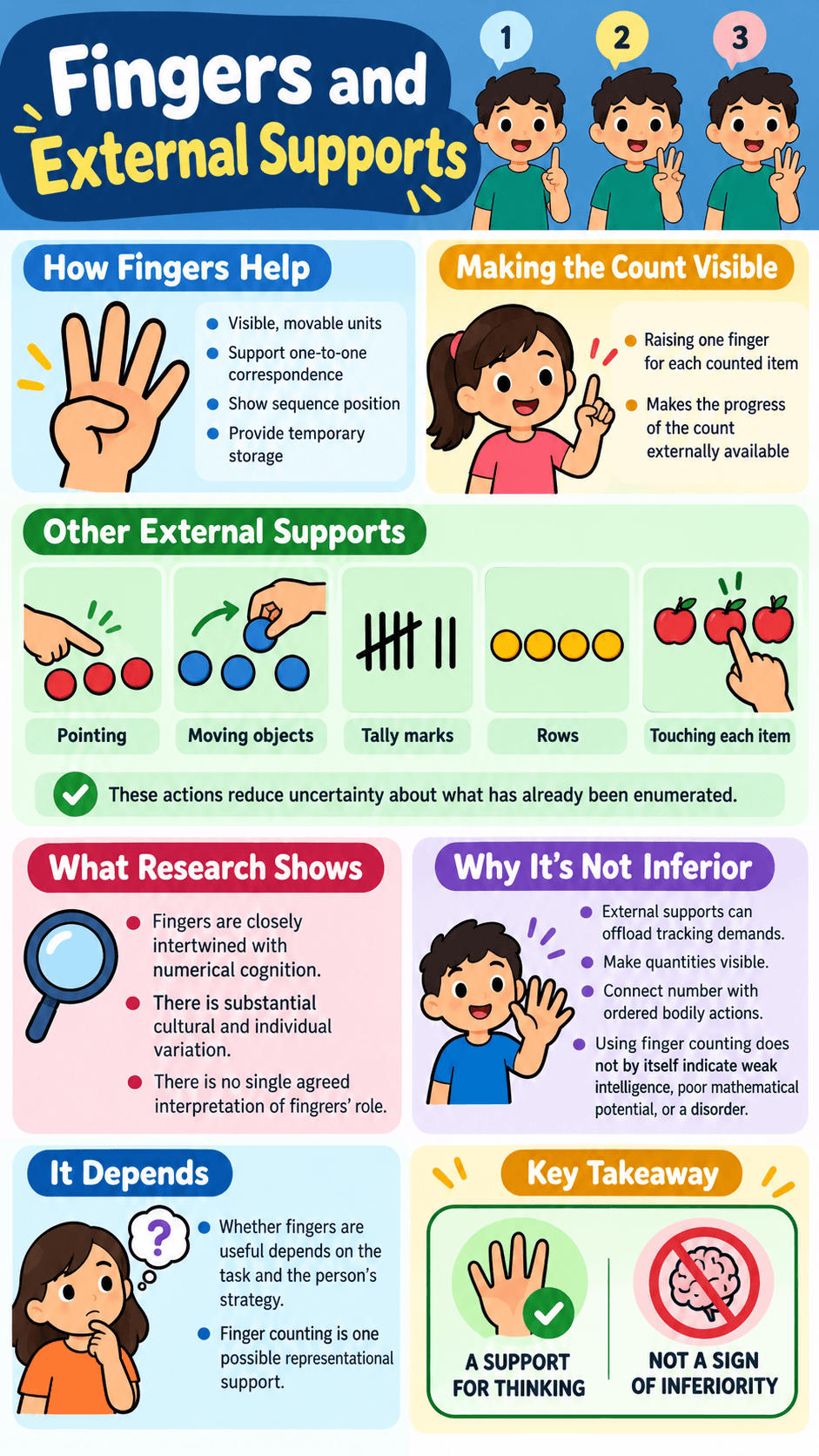
Fingers provide visible, movable units that can support one-to-one correspondence, sequence position, and temporary storage. Raising one finger for each counted item makes the progress of the count externally available instead of relying only on internal tracking.
Other supports can play similar roles: pointing, moving objects, tally marks, rows, or touching each item as it is counted. These actions reduce uncertainty about what has already been enumerated.
Research on finger counting describes fingers as closely intertwined with numerical cognition while also showing substantial cultural and individual variation. An open-access review of finger counting and numerical cognition emphasizes that there is no single agreed interpretation of fingers’ role, but the evidence does not support dismissing finger use as merely irrelevant.
Why finger counting should not be framed as cognitively inferior
Finger use is sometimes treated socially as something a person should “grow out of.” From a cognitive perspective, that judgment is too simplistic.
External supports can offload tracking demands, make quantities visible, and connect number with ordered bodily actions. Whether fingers are useful depends on the task and the person’s strategy.
A more accurate description is that finger counting is one possible representational support. Using it does not by itself indicate weak intelligence, poor mathematical potential, or a disorder.
Developmental Evidence Without a Milestone Guide
Gelman and Gallistel as an influential framework
Much of what psychologists know about counting comes from developmental research because early learning makes the component processes easier to observe separately. Gelman and Gallistel’s five principles became influential because they describe what a counting procedure must accomplish to produce a reliable exact total.
The framework has also been debated. Researchers disagree about how much principle-like knowledge exists before fluent counting, how children construct the principles, and how verbal and conceptual knowledge interact.
Those debates matter because they prevent the framework from being treated as a simple instructional sequence. The principles are best used here as a model of successful counting structure.
Why children need not consciously memorize principles as explicit rules
A child can follow one-to-one correspondence without being able to define the phrase “one-to-one correspondence.” Cognitive competence does not require explicit verbal knowledge of the rule.
The same is true in many domains. Fluent speakers follow grammatical patterns they may not be able to explain. Skilled counters can respect counting constraints without reciting formal principles.
Developmental evidence therefore helps reveal the structure of counting without implying that successful enumeration begins with conscious memorization of five named rules.
A Practical Way to Diagnose a Counting Error Without Diagnosing the Person
When an exact count is wrong, the useful question is where did the counting chain break? Four possibilities cover many everyday errors:
- Sequence error: Was the stable number-word order disrupted?
- Mapping error: Did an item receive zero or two count words?
- Tracking error: Was the boundary between counted and uncounted items lost?
- Cardinality error: Was the final number word understood only as the last tag rather than the total quantity?
This framework describes the task, not the person’s ability or diagnosis. A single error can result from distraction, arrangement, speed, unfamiliarity, movement of the objects, or a temporary loss of place.
Persistent difficulty with basic number concepts may be worth discussing with an appropriate educational or clinical professional when it meaningfully affects learning or daily functioning, but one counting mistake cannot identify its cause.
FAQ
Is counting the same as saying number words in order?
No. Reciting number words provides the stable sequence used in ordinary verbal counting, but exact enumeration also requires mapping one number word to each item, tracking which items have been counted, and understanding that the final number word gives the set’s cardinal value.
What does the cardinality principle mean?
The cardinality principle means that the final number word in a correct count represents how many items are in the whole set. If five objects are counted correctly and the last word is “five,” then five is the exact cardinal value of the collection, not merely the label attached to the final object visited.
How is counting different from subitizing?
Counting is sequential exact enumeration. Subitizing is rapid and relatively exact recognition of a very small set without obvious serial counting. Both can produce an exact answer, but they reach it through different performance patterns.
How is counting different from estimating?
Counting aims for an exact total through one-to-one sequential enumeration. Estimation gives an approximate answer such as “about 40” and may use magnitude impressions, grouping, visual cues, and reference values without enumerating every item exactly.
Is counting itself arithmetic?
Not necessarily. Counting a set establishes its numerosity. Arithmetic applies operations to numerical values. Counting can be used as an arithmetic strategy, such as counting on during addition, but that does not make every act of counting an arithmetic operation.
Key Takeaways
- Counting is sequential exact enumeration, not simply reciting an ordered list of number words.
- A correct count coordinates one-to-one object mapping, a stable number sequence, item tracking, and cardinal interpretation of the final number word.
- Gelman and Gallistel’s five principles are an influential framework for describing successful counting, not a list that must be consciously memorized before counting can occur.
- Counting differs from subitizing because it is serial, and it differs from estimation because its goal is an exact total.
- Counting can support arithmetic through strategies such as counting on, but counting itself establishes quantity rather than performing a general numerical operation.
- Fingers, pointing, movement, and other external supports can help with tracking and sequence and should not be treated as signs of low intelligence or inferior numerical ability.

Michael Reed is the Founder and Lead Writer at Psychology Exposed. He writes about human behavior, relationships, emotional patterns, self-awareness, and practical psychology topics using research-informed, easy-to-understand content.
Read More About Michael Reed: https://psychologyexposed.com/michael-reed/