
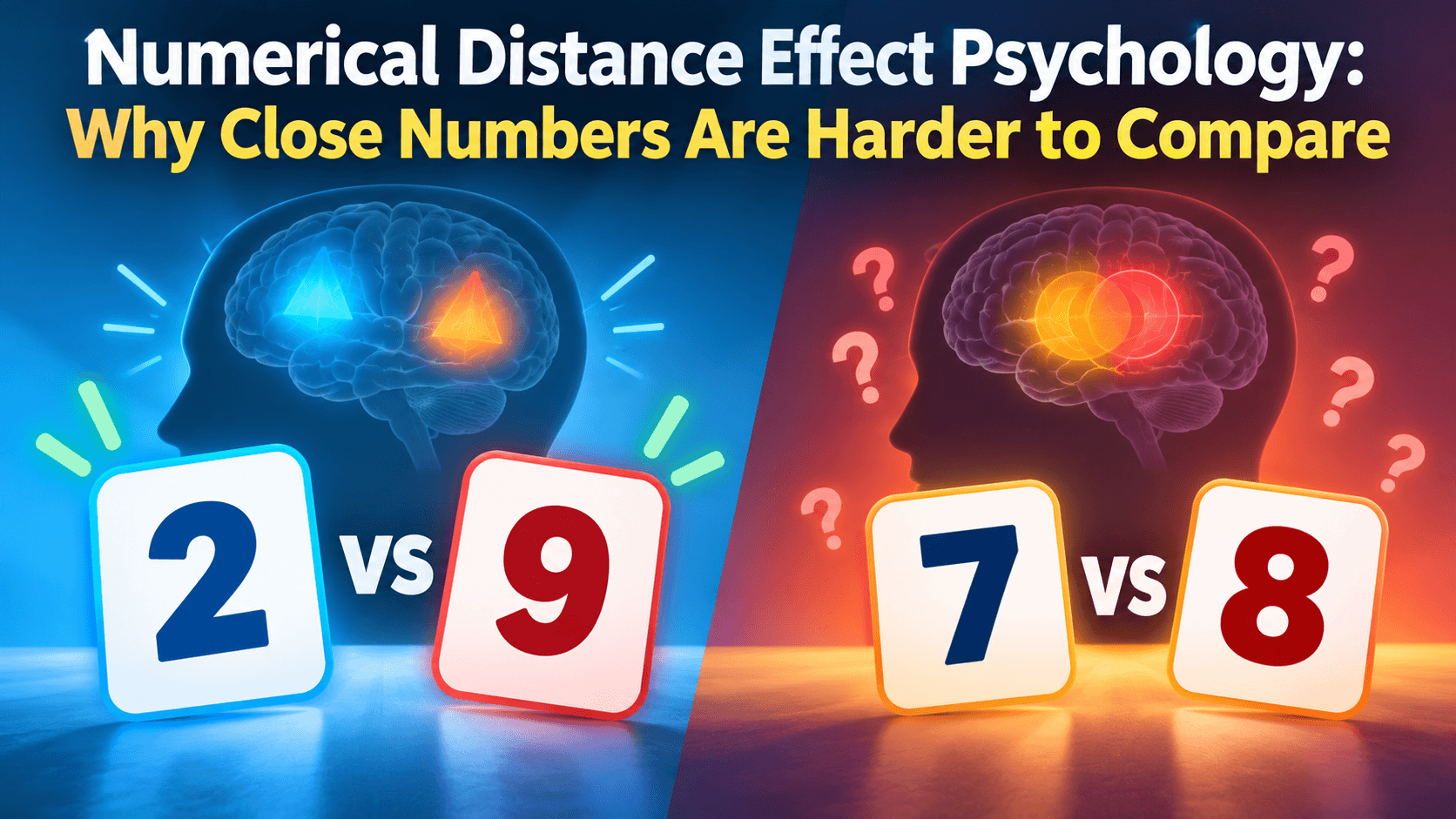
Which comparison feels easier: 2 versus 9 or 7 versus 8? Both pairs contain familiar single-digit numbers, but most people are faster and more accurate when the values are farther apart. Psychologists call this pattern the Numerical Distance Effect.
The effect is simple to demonstrate but easy to overinterpret. It tells us that numerical closeness can change comparison performance. It does not, by itself, prove that numbers are literally stored along a spatial line in the mind. It is also not the same thing as the ratio effect often studied with nonsymbolic dot arrays, and it is not the same as the SNARC effect, which concerns associations between numerical magnitude and left-right response space.
The safest way to understand the Numerical Distance Effect is as an empirical pattern in magnitude comparison. Close values often create more competition, overlap, or difficulty than values separated by a larger numerical distance. The exact reason for that pattern remains theoretically debated.
Quick Answer
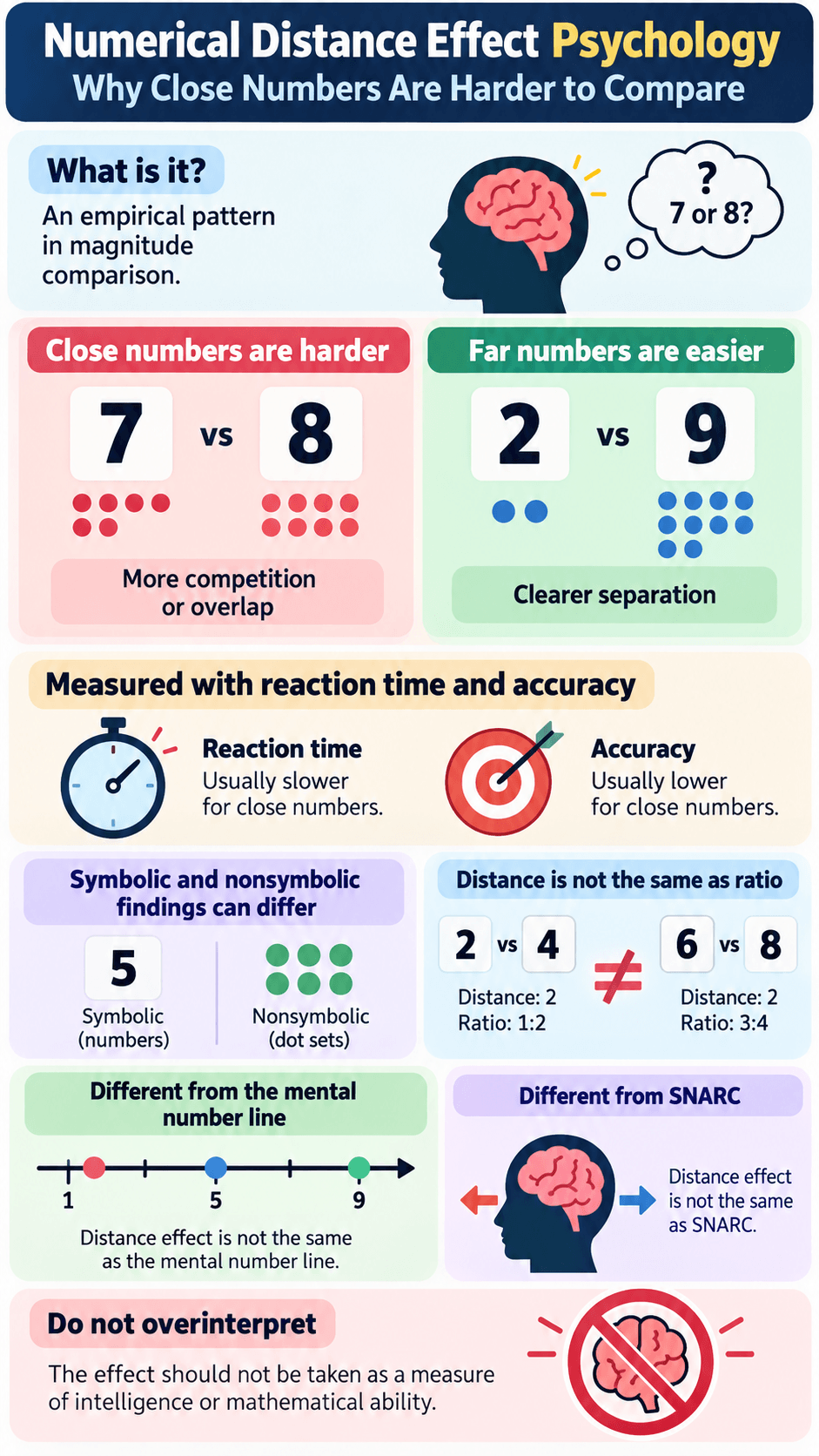
The Numerical Distance Effect is the common finding that people compare close numerical values more slowly or less accurately than values that are farther apart. For example, 7 versus 8 is often harder than 2 versus 9. The effect is relevant to theories of numerical magnitude, but it does not uniquely prove one mental representation, a literal number line, or a particular level of mathematical ability.
What the Numerical Distance Effect Is
The classic close-versus-far comparison pattern
The core task is straightforward. Two numbers appear, and the participant chooses the larger one. If the numbers are far apart, the decision is usually easier. If they are close together, the decision tends to take longer and may produce more errors.
Classic work by Moyer and Landauer established this pattern in symbolic number comparison. Later research has repeatedly observed similar distance-related effects across many numerical tasks. An open-access study of symbolic numerical distance and size effects summarizes the standard finding: comparison becomes easier as numerical distance increases.
Importantly, “distance” here means numerical difference. The distance between 7 and 8 is 1. The distance between 2 and 9 is 7. Nothing about the physical spacing of the printed digits has to change.
Reaction time and accuracy as common measures
Researchers typically measure the effect through reaction time, accuracy, or both. A participant may press one key if the left digit is larger and another if the right digit is larger. Across many trials, close pairs often produce slower responses and more mistakes.
Reaction time is useful because it reveals differences even when accuracy is near ceiling. An adult may answer almost every single-digit comparison correctly, yet still require a few extra milliseconds for 7 versus 8 compared with 2 versus 9.
Accuracy becomes more informative when the task is difficult, the display is brief, the numbers are unfamiliar, or the quantities are nonsymbolic. The two measures can complement one another, but they should not be assumed to reflect exactly the same processing stage.
2 vs 9 and 7 vs 8
Far magnitudes and clearer separation
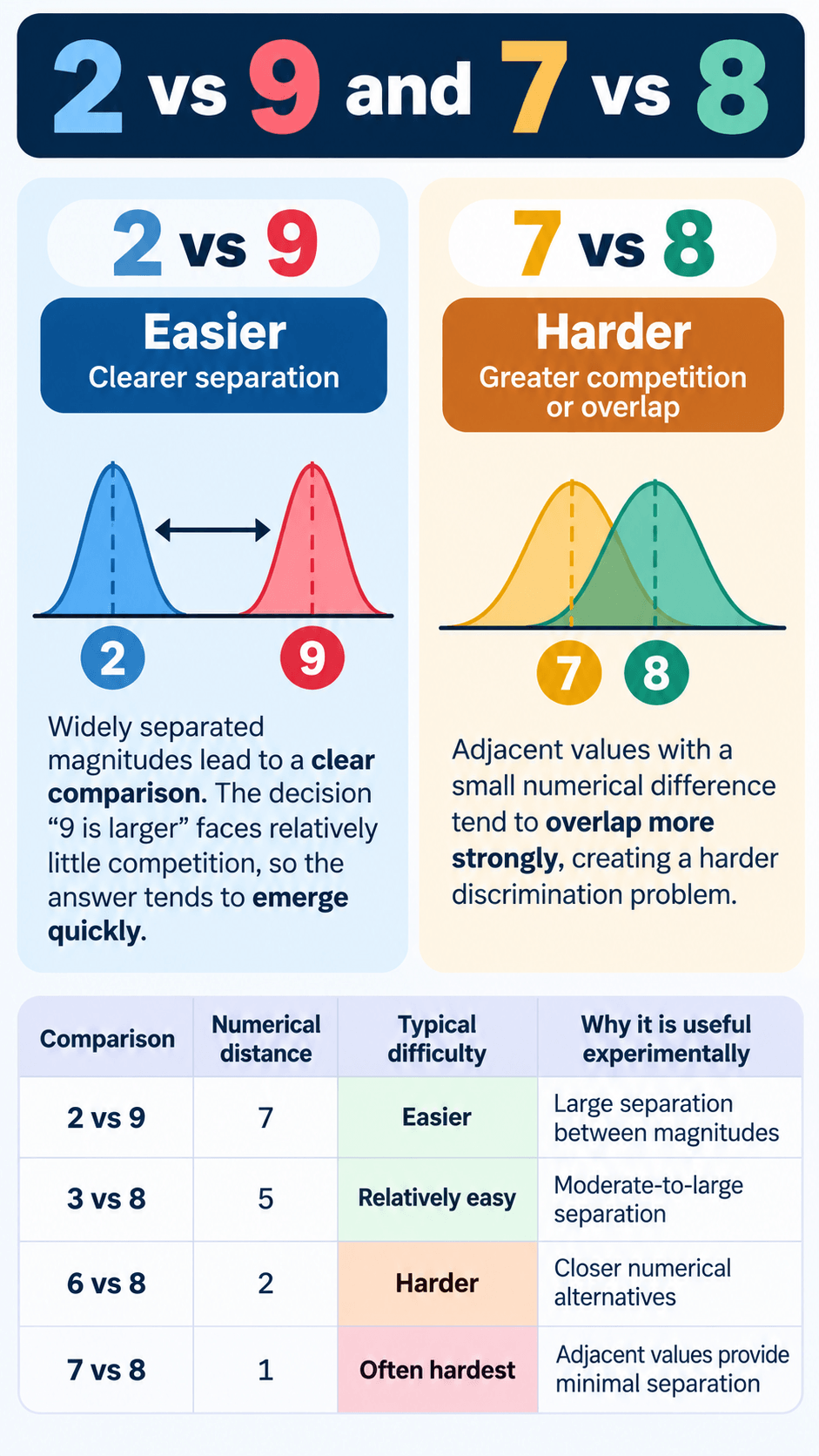
Consider 2 and 9. Their numerical values are widely separated. Whether the mind represents them through overlapping magnitude codes, learned semantic relations, or another mechanism, the decision “9 is larger” faces relatively little competition.
The pair also has strong learned relational structure. Nine appears far above two in the ordered number sequence, and the two symbols rarely compete as near neighbors during everyday numerical judgments.
The result is a clear comparison. The answer tends to emerge quickly because the numerical alternatives are strongly differentiated.
Close magnitudes and greater competition or overlap
Now consider 7 and 8. The values are adjacent. They are near neighbors in the learned number sequence, their numerical difference is small, and theories based on approximate magnitude propose that their internal magnitude distributions overlap more strongly.
Different theories describe this difficulty in different language. An analog-magnitude account emphasizes overlapping noisy magnitude representations. A semantic-network account emphasizes strong relationships between nearby symbols and greater competition among closely related nodes. A decision account may emphasize the evidence needed to discriminate similar alternatives.
Despite these theoretical differences, they converge on the observable pattern: close values create a harder discrimination problem.
| Comparison | Numerical distance | Typical difficulty | Why it is useful experimentally |
|---|---|---|---|
| 2 vs 9 | 7 | Easier | Large separation between magnitudes |
| 3 vs 8 | 5 | Relatively easy | Moderate-to-large separation |
| 6 vs 8 | 2 | Harder | Closer numerical alternatives |
| 7 vs 8 | 1 | Often hardest | Adjacent values provide minimal separation |
A Reader-Friendly Mechanism Map
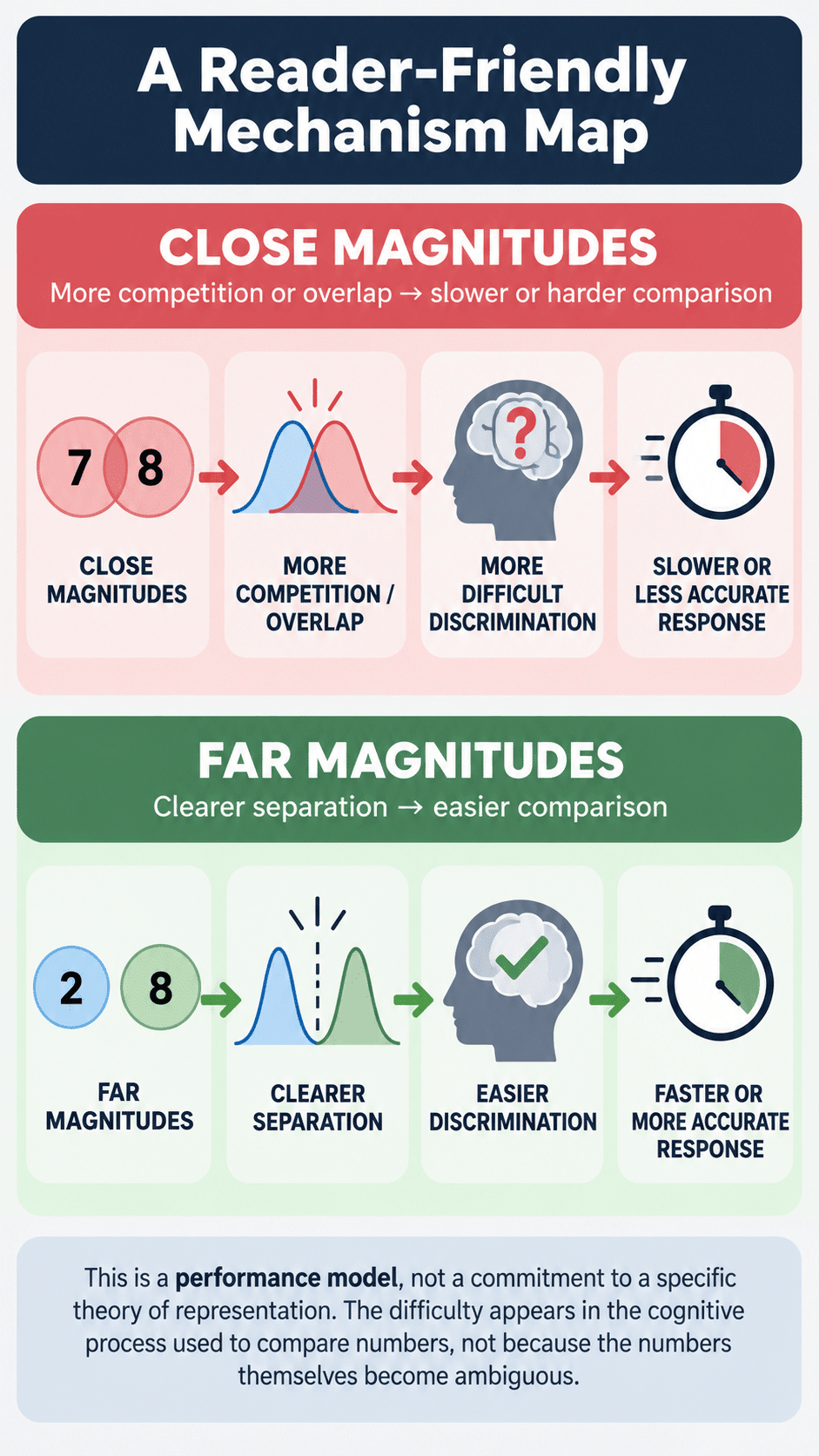
CLOSE MAGNITUDES → more competition or overlap → slower or harder comparison
A practical model is:
CLOSE MAGNITUDES → MORE COMPETITION / OVERLAP → MORE DIFFICULT DISCRIMINATION → SLOWER OR LESS ACCURATE RESPONSE
This model does not commit to one theory of representation. “Overlap” can describe noisy magnitude codes, while “competition” can describe semantic or decision-level alternatives. The shared point is that the comparison signal is less decisive when values are close.
This makes the effect psychologically interesting. The numbers themselves have not become ambiguous in a mathematical sense. Seven and eight remain exact integers. The difficulty appears in the cognitive process used to compare them.
FAR MAGNITUDES → clearer separation → easier comparison
The corresponding far-distance model is:
FAR MAGNITUDES → CLEARER SEPARATION → EASIER DISCRIMINATION → FASTER OR MORE ACCURATE RESPONSE
Again, this is a performance model rather than a literal picture of the brain. It captures the direction of the behavioral effect without claiming that numbers occupy fixed physical locations inside the mind.
Explanations Researchers Have Considered
Representational overlap
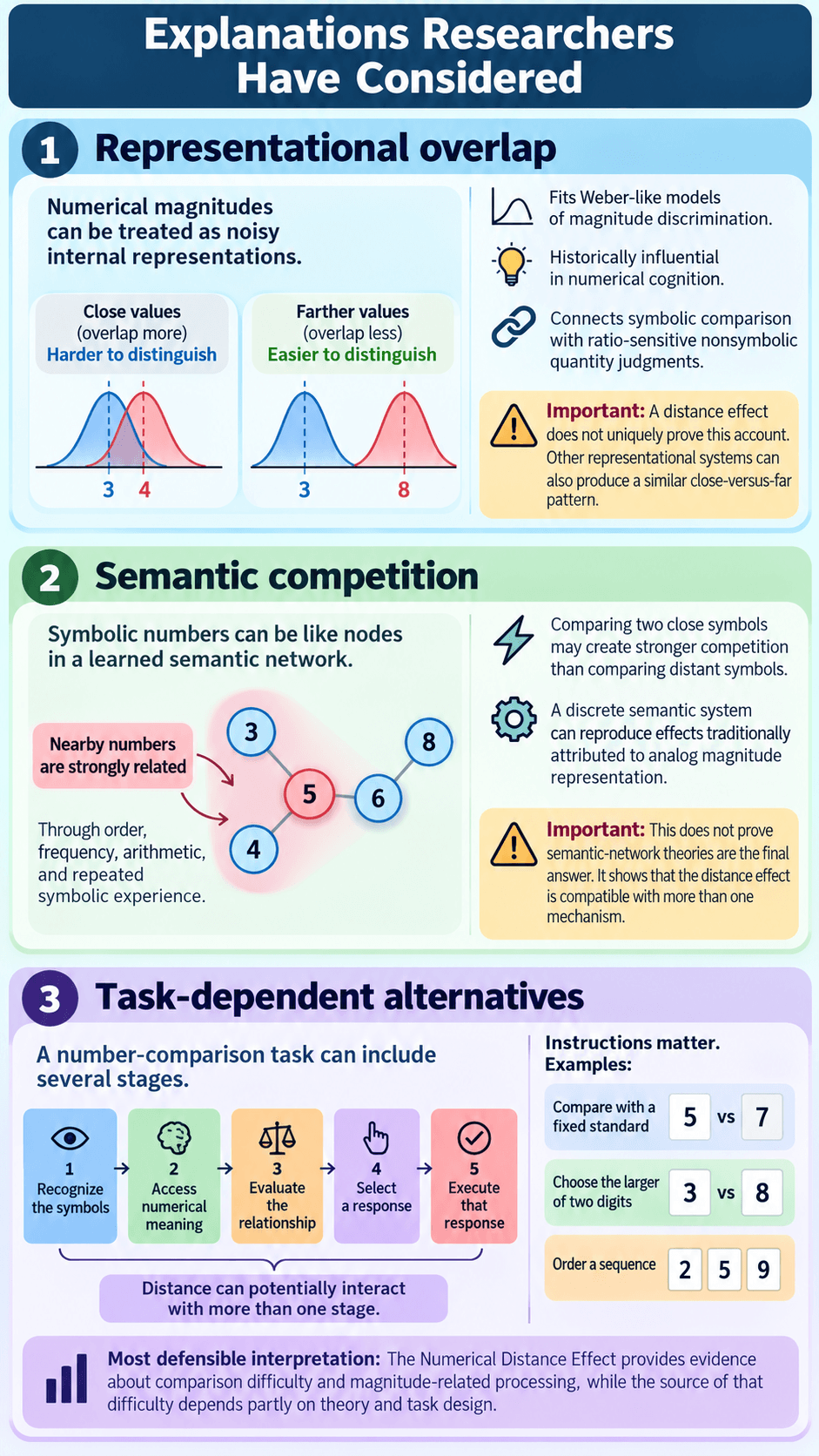
The traditional analog-magnitude explanation treats numerical magnitudes as noisy internal representations. Nearby values produce more overlapping distributions, which makes them harder to distinguish. Farther values overlap less, so the decision becomes easier.
This account fits naturally with Weber-like models of magnitude discrimination and has historically been influential in numerical cognition. It also connects symbolic comparison with ratio-sensitive nonsymbolic quantity judgments.
However, the presence of a distance effect does not uniquely prove this account. Other representational systems can generate a similar close-versus-far performance pattern.
Semantic competition
Alternative models treat symbolic numbers more like nodes in a learned semantic network. Nearby numbers are strongly related through order, frequency, arithmetic, and repeated symbolic experience. Comparing two close symbols may therefore create stronger competition than comparing distant symbols.
An open-access account of symbolic distance and size effects shows that a discrete semantic system can reproduce effects traditionally attributed to analog magnitude representation. This does not prove that semantic-network theories are the final answer. It demonstrates that the distance effect is compatible with more than one mechanism.
Task-dependent alternatives
A number-comparison task includes several stages: recognizing the symbols, accessing numerical meaning, evaluating the relationship, selecting a response, and executing that response. Distance can potentially interact with more than one stage.
Instructions also matter. Comparing each number with a fixed standard, choosing the larger of two simultaneously presented digits, or ordering a sequence may create different decision structures.
For this reason, the most defensible interpretation is that the Numerical Distance Effect provides evidence about comparison difficulty and magnitude-related processing, while the source of that difficulty depends partly on theory and task design.
Symbolic and Nonsymbolic Findings
Digit comparison
Symbolic distance effects are commonly studied with Arabic digits. Participants compare pairs such as 3 and 8 or 7 and 8. Because the symbols are exact and familiar, researchers can examine how numerical relationships affect performance without changing the number of visible objects.
Symbolic comparison is shaped by learned numerical structure. Digits participate in ordered sequences, arithmetic relations, frequency patterns, and culturally acquired number knowledge. These properties make symbolic effects theoretically richer than a simple perceptual discrimination problem.
Some work argues that symbolic distance effects should not automatically be interpreted as direct evidence for the same ratio-based system used in nonsymbolic number processing. An open-access comparison of symbolic and nonsymbolic distance effects reports meaningful differences between the two formats.
Nonsymbolic quantities where relevant
Distance-related performance also appears when people compare collections of objects or dots. If two nonsymbolic quantities are very different, choosing the larger set is easier than when the quantities are similar.
Yet nonsymbolic tasks introduce additional complications. Dot arrays vary in density, total surface area, item size, and array extent. Performance may also be more naturally described through numerical ratio than absolute distance.
This is one reason symbolic and nonsymbolic findings should be compared carefully rather than treated as interchangeable versions of the same effect.
Why similar-looking effects need not imply identical mechanisms
Two tasks can produce the same behavioral signature for different reasons. A symbolic comparison may be influenced by semantic relationships among learned digits, while a nonsymbolic comparison may be strongly shaped by approximate magnitude and perceptual features.
Seeing distance-related slowing in both tasks therefore establishes a useful similarity but not representational identity. The larger question is which cognitive stages are shared and which remain format-sensitive.
Distance vs Ratio
Numerical distance as closeness
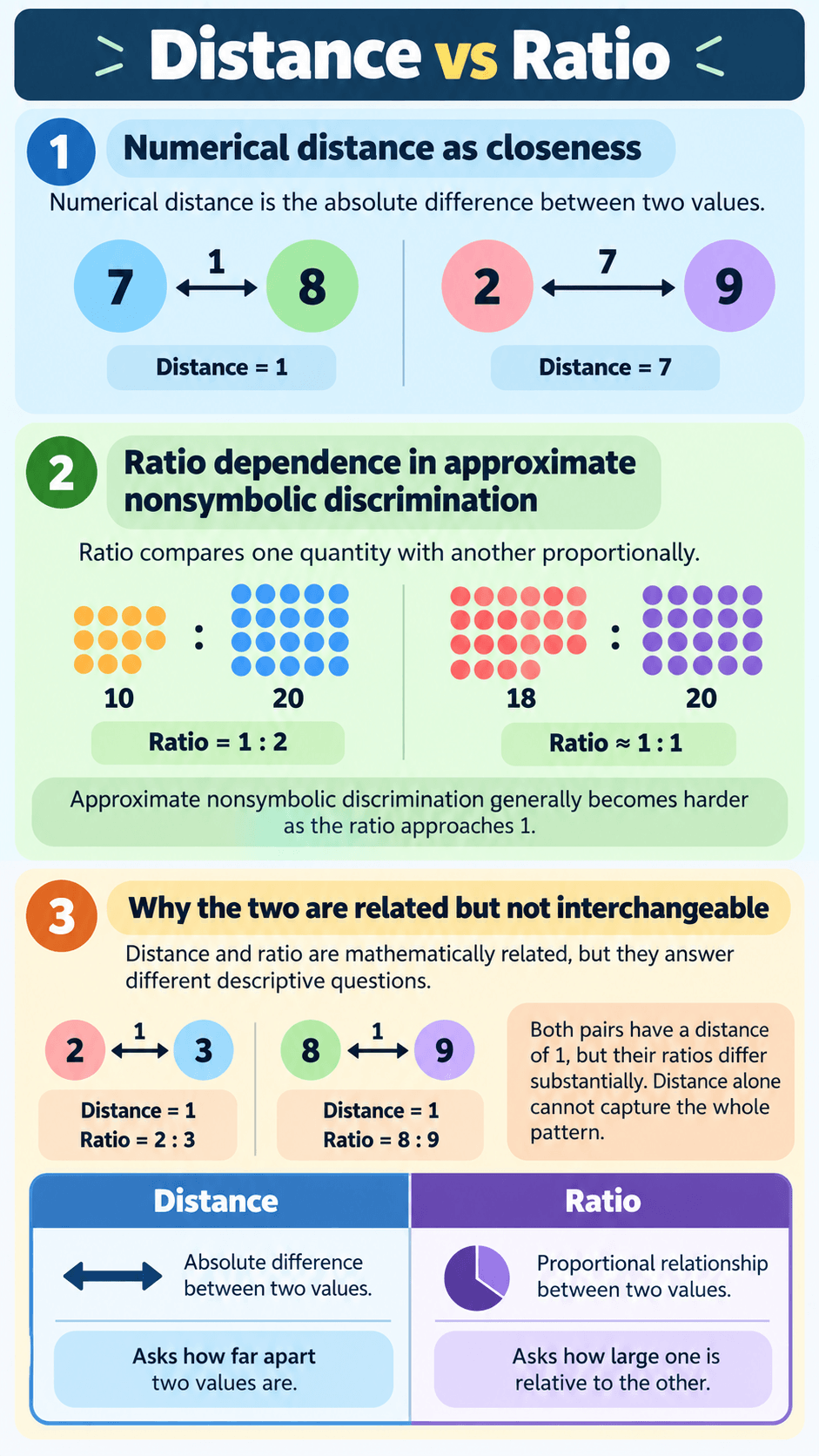
Numerical distance is the absolute difference between two values. For 7 and 8, the distance is 1. For 2 and 9, it is 7.
This measure is intuitive and especially common in symbolic single-digit comparison. It allows researchers to ask whether increasing separation makes a decision easier.
Ratio dependence in approximate nonsymbolic discrimination
Ratio compares one quantity with another proportionally. Ten versus twenty has a 1:2 relationship, while eighteen versus twenty is much closer to 1:1. Approximate nonsymbolic discrimination generally becomes harder as the ratio approaches 1.
A methodological review of Approximate Number System measurement explains why ratio effects are widely used in nonsymbolic comparison tasks and why task design matters when interpreting them.
Why the two are related but not interchangeable
Distance and ratio are mathematically related, but they answer different descriptive questions. Distance asks how far apart two values are in absolute terms. Ratio asks how large one is relative to the other.
Consider 2 versus 3 and 8 versus 9. Both pairs have a distance of 1. Their ratios differ substantially. If performance differs between the pairs, distance alone cannot capture the whole pattern.
For this reason, studies may analyze distance, numerical size, and ratio separately depending on the theoretical question. Treating every close-versus-far effect as “the ratio effect” can obscure meaningful differences between symbolic and nonsymbolic processing.
Why Numerical Size Matters Alongside Distance
The same distance can occur at different numerical sizes
Distance alone does not describe every number pair. Compare 2 versus 3 with 8 versus 9. Both pairs have a numerical distance of 1, yet the overall values are different. Classic symbolic comparison research has often found a numerical size effect, in which larger-number pairs can be harder to compare even when distance is held constant.
This matters because a researcher who sees slower responses for 8 versus 9 than for 2 versus 3 cannot attribute the difference to numerical distance. The distance is identical. The change involves the overall magnitude of the values, the ratio between them, learned symbolic structure, or another property correlated with number size.
Distance, size, and ratio can tell different stories
Distance, size, and ratio are closely related mathematically, especially in small number ranges. That relationship can make theoretical interpretation difficult. An analog-magnitude model may describe distance and size effects as consequences of ratio-sensitive representations, while symbolic semantic accounts may explain them through learned relationships and frequency structure.
The practical lesson is simple: the Numerical Distance Effect is real as a behavioral pattern, but its meaning becomes clearer when other properties of the number pair are considered instead of treating “distance” as the only variable that matters.
| Measure | Main question | Example | Often emphasized in |
|---|---|---|---|
| Distance | How far apart are the values? | 7 vs 8 has distance 1 | Symbolic number comparison |
| Ratio | How large is one value relative to the other? | 10 vs 20 is easier than 18 vs 20 | Nonsymbolic approximate comparison |
| Size | How large are the values overall? | 2 vs 3 compared with 8 vs 9 | Symbolic magnitude research |
Distance Effect vs Mental Number Line
Magnitude comparison does not automatically prove spatial mapping
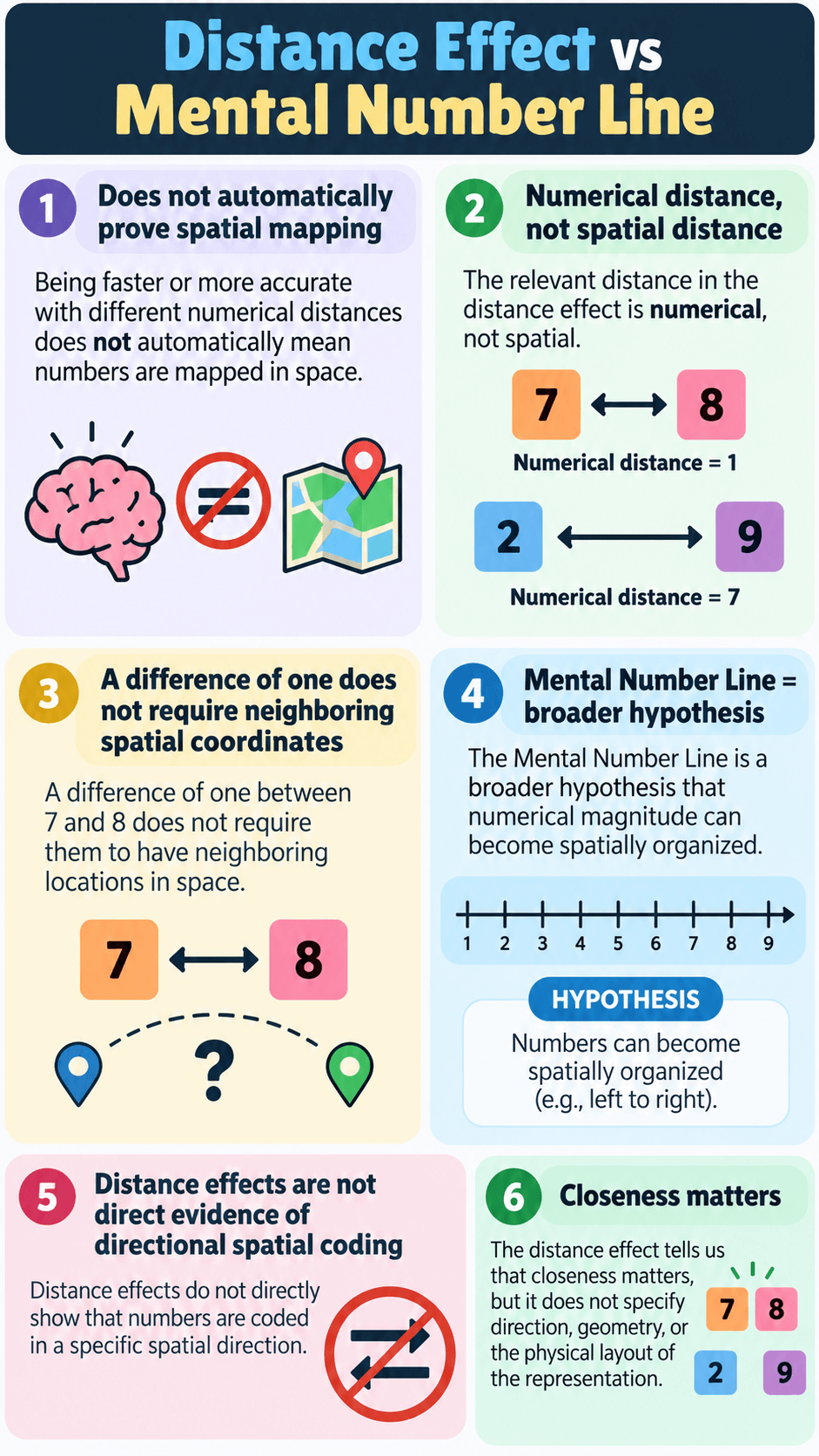
The phrase “distance effect” can make the result sound spatial, but the relevant distance is numerical. A difference of one between 7 and 8 does not require those representations to occupy neighboring spatial coordinates.
The Mental Number Line is a broader hypothesis that numerical magnitude can become spatially organized. Distance effects have historically been discussed in support of analog number representation, but they are not direct evidence of directional spatial coding.
A major review of spatial-numerical associations explicitly distinguishes the distance effect from spatial-number effects, arguing that numerical comparison can occur at a processing stage separate from spatial mapping.
Why a literal left-to-right line is not required by the effect
Nothing about 7 versus 8 being difficult tells us whether 7 is mentally “to the left” of 8. The effect remains possible even if magnitude is represented through nonspatial overlap, semantic relations, or another comparison mechanism.
This distinction is essential because otherwise one behavioral phenomenon is asked to prove too much. The distance effect tells us that closeness matters. It does not specify the direction, geometry, or physical layout of the underlying representation.
Distance Effect vs SNARC
Close-versus-far comparison
The Numerical Distance Effect changes with the numerical separation between values. A close pair such as 7 and 8 is usually harder than a far pair such as 2 and 9.
The response can be made with any convenient keys. Left versus right is not the defining variable.
Left-right response compatibility
SNARC stands for Spatial-Numerical Association of Response Codes. In many common experimental contexts, smaller numbers are responded to faster with one side, often the left, and larger numbers with the other, often the right.
SNARC therefore concerns compatibility between numerical magnitude and response space. The distance effect concerns discrimination difficulty between magnitudes.
They can both appear in numerical experiments, but they answer different questions. A study can show a distance effect without showing a reliable SNARC effect, and a SNARC task can examine spatial-response compatibility without asking participants to compare a close and a far pair.
| Effect | What changes? | Typical contrast | What it does not automatically prove |
|---|---|---|---|
| Numerical Distance Effect | Separation between numerical values | 7 vs 8 compared with 2 vs 9 | A left-to-right spatial layout |
| SNARC | Compatibility between magnitude and response side | Small + left versus small + right | One universal permanent mental number line |
What the Distance Effect Can and Cannot Tell Us
Evidence relevant to magnitude processing
The distance effect is valuable because it reveals that numerical relationships influence comparison performance systematically. It is not random noise. Close values repeatedly create a different cognitive demand from far values.
That makes the effect useful for testing theories of number representation. A theory must explain why closeness matters, whether through representational overlap, semantic organization, decision processes, or a combination.
A broad meta-analysis of numerical cognition research notes that distance effects appear in both symbolic and nonsymbolic formats, while the wider literature still distinguishes task-specific numerical representations and processes.
Not a diagnostic marker or intelligence score
The size of a person’s distance effect should not be treated as a simple measure of intelligence, mathematical talent, dyscalculia, or brain quality. A larger or smaller effect can depend on task design, response strategy, familiarity, speed-accuracy tradeoffs, and the specific numbers used.
Even experts do not necessarily eliminate the phenomenon. Research comparing professional mathematicians with nonmathematicians found similar symbolic distance and size effects, which is another reason to avoid interpreting the effect as a direct index of mathematical expertise.
Educational or clinical assessment requires a much broader picture than reaction-time differences on a comparison task.
A Practical Interpretation Checklist
When you encounter a claim about the Numerical Distance Effect, five questions help keep the interpretation precise:
- Were the stimuli symbolic or nonsymbolic? Digits and dot arrays can produce similar patterns through partly different processing demands.
- Was distance analyzed separately from ratio and numerical size? These variables are related but not identical.
- Was the outcome reaction time, accuracy, or both? Different measures can reveal different aspects of performance.
- Was a spatial conclusion actually tested? A distance effect alone does not establish left-right spatial coding.
- Does the theory fit the evidence uniquely? Several models can explain close-versus-far difficulty.
This checklist turns the effect from a catchy demonstration into a more useful research concept. The observation itself is robust enough to matter, while the interpretation still requires care.
FAQ
Why are 7 and 8 harder to compare than 2 and 9?
Seven and eight are numerically close, so the comparison provides less separation between the alternatives. Traditional accounts describe greater overlap between nearby magnitude representations, while other theories emphasize semantic or decision-level competition. The exact mechanism is debated, but close values reliably tend to create a harder discrimination problem.
Is the Numerical Distance Effect the same as the ANS ratio effect?
No. They are related because both describe easier discrimination when quantities are more clearly separated, but distance and ratio are different measures. Distance is the absolute numerical difference. Ratio describes proportional similarity and is especially central in nonsymbolic approximate-number research. Symbolic distance effects should not automatically be reduced to ANS ratio effects.
Does the Numerical Distance Effect prove a Mental Number Line?
No. The effect is relevant to magnitude processing, but it does not directly show that numbers are stored on a literal or directional spatial line. Numerical comparison and spatial-number mapping can be experimentally distinguished, and nonspatial theories can also explain distance-related slowing.
Is the Numerical Distance Effect the same as SNARC?
No. The distance effect concerns how close two numerical values are. SNARC concerns compatibility between numerical magnitude and left-right response space. Both are studied in numerical cognition, but they measure different phenomena and should not be used as synonyms.
Can task design change the Numerical Distance Effect?
Yes. Stimulus format, number range, comparison rule, response method, timing, accuracy demands, and whether numbers are symbolic or nonsymbolic can all influence performance. A distance effect is therefore best interpreted in the context of the task that produced it rather than as a fixed personal trait.
Key Takeaways
- The Numerical Distance Effect is the finding that close numerical values are often slower or harder to compare than values that are farther apart.
- 2 versus 9 is typically easier than 7 versus 8 because the magnitudes are more clearly separated.
- Representational overlap is one influential explanation, but semantic competition and other task-dependent accounts can also produce distance effects.
- Distance, numerical size, and ratio are related but different measures, especially when comparing symbolic and nonsymbolic number tasks.
- The distance effect does not by itself prove a Mental Number Line and is different from the SNARC left-right response-compatibility effect.
- A person’s distance-effect size is not a standalone measure of intelligence, mathematical expertise, or a learning disorder.

Michael Reed is the Founder and Lead Writer at Psychology Exposed. He writes about human behavior, relationships, emotional patterns, self-awareness, and practical psychology topics using research-informed, easy-to-understand content.
Read More About Michael Reed: https://psychologyexposed.com/michael-reed/