
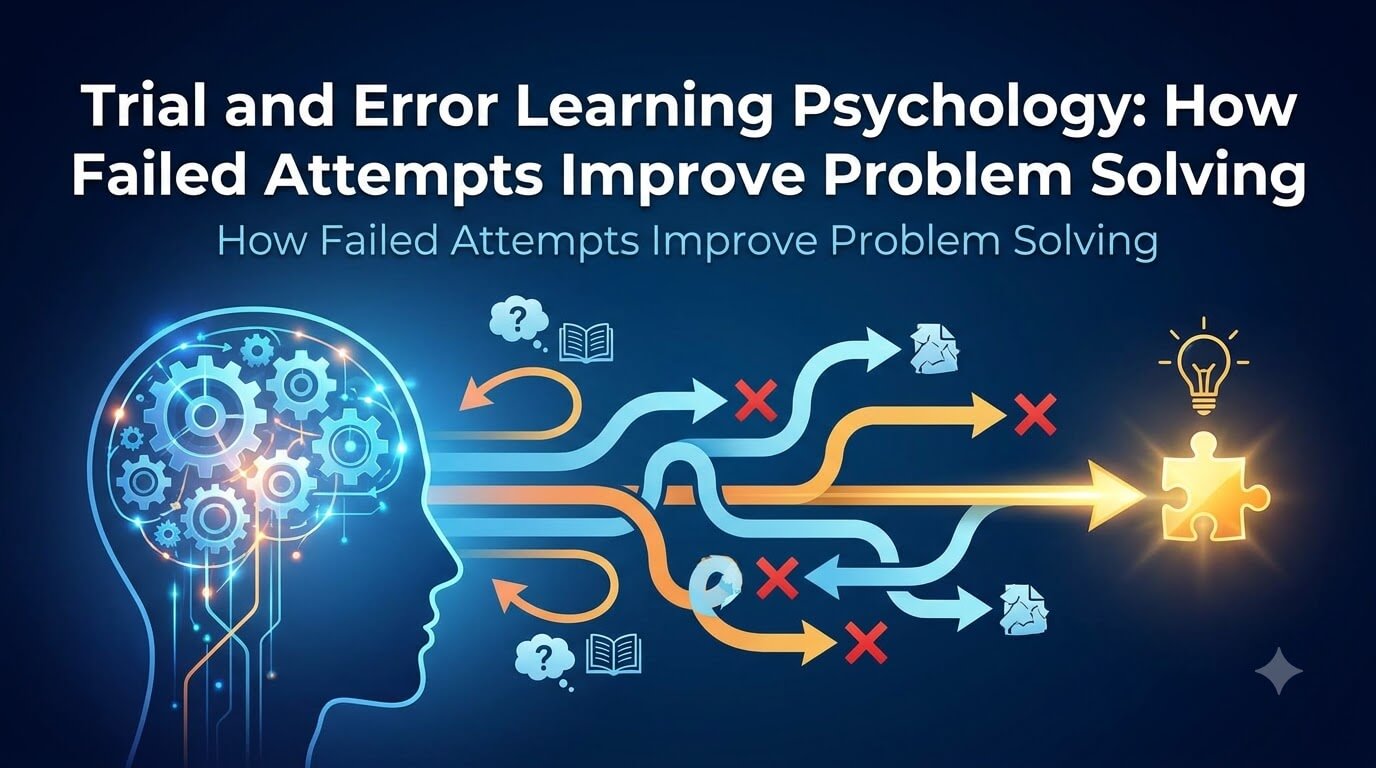
When the right solution is not obvious, trying something can be more useful than thinking about every possibility in advance. The value does not come from failing repeatedly. It comes from making an attempt that reveals something, noticing what happened, and changing the next attempt because of that information.
That distinction matters. Random repetition can waste time and deepen frustration. Well-designed trial and error is different: it turns uncertainty into a series of small questions that reality can answer. Used carefully, it can help with practical problems such as debugging a process, arranging a workspace, improving a routine, troubleshooting a device, or finding a workable way through a task whose best path is not yet known.
Quick Answer
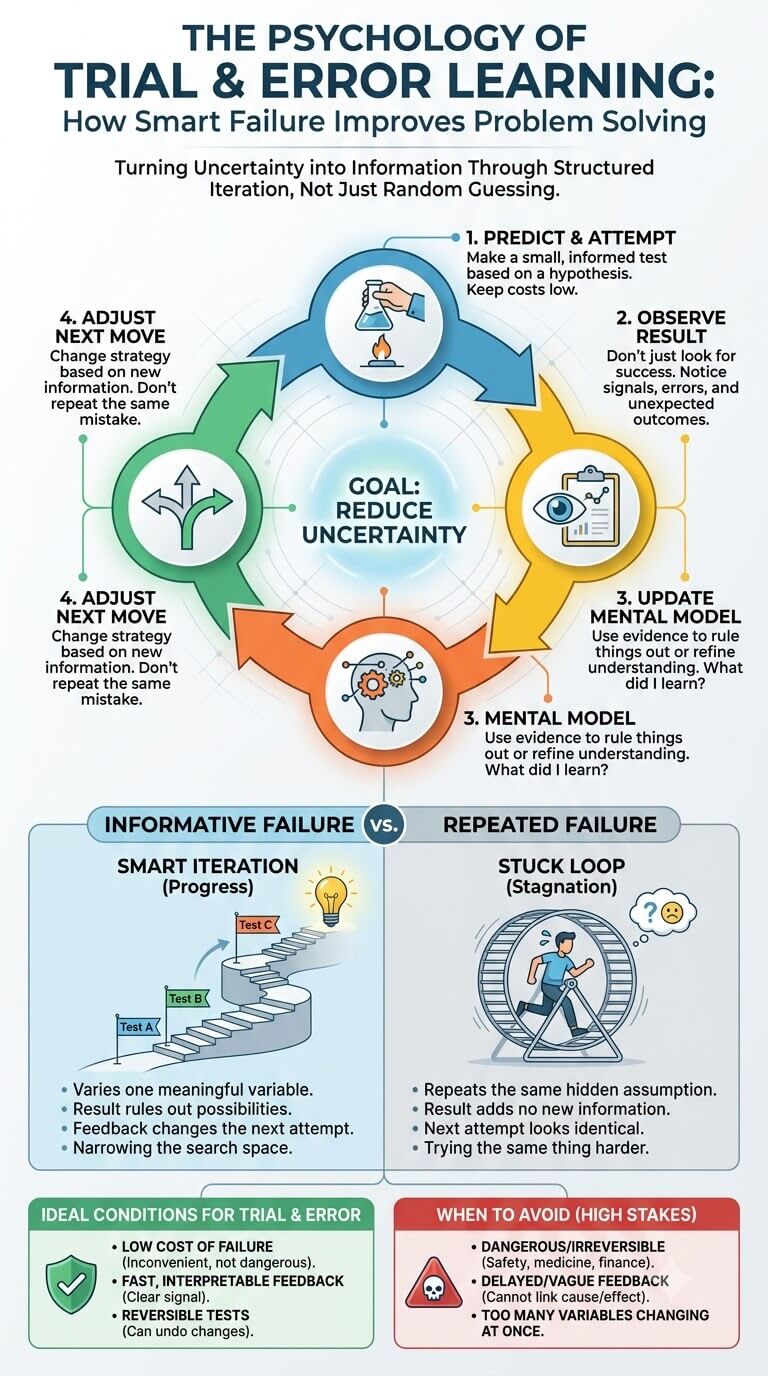
Trial and error learning is a process in which attempts produce feedback that shapes later attempts. In problem solving, it works best when tests are small, reversible, inexpensive, and informative. A failed attempt is useful when it reduces uncertainty or exposes a wrong assumption. Repeating the same move without learning from the result is not effective trial and error. It is simply repetition.
What Trial and Error Means in a Problem-Solving Context
In practical problems, trial and error is most useful when each attempt changes the next one. The process is less about accumulating failures and more about converting outcomes into a better map of what to try next.
Trial and error is one route within the wider problem-solving process, especially when small tests can turn uncertainty into usable feedback.
Attempt, Observe, Update, and Try Again
The APA Dictionary of Psychology describes trial-and-error learning as learning that develops across successive attempts as unsuccessful responses are eliminated and a successful response becomes more likely. In everyday problem solving, the same basic idea can be used without assuming that every situation is a formal learning task.
Imagine that a weekly report keeps arriving late. You could spend an hour listing every possible cause, or you could test a plausible bottleneck. Perhaps you move the data request one day earlier. If the report still arrives late, that result tells you the request timing was probably not the main constraint. The next test should change because the first one taught you something.
A useful cycle therefore looks like this: make an informed attempt, observe the result, compare it with what you expected, update what you believe about the problem, then choose the next move. The cycle becomes more intelligent as the quality of the feedback improves.
Why the Learning Value Matters More Than the Number of Attempts
Ten attempts are not automatically better than three. If all ten repeat the same assumption, they may add almost no information. One carefully chosen test can be more valuable because it separates two competing explanations.
Suppose a lamp will not turn on. Repeatedly flipping the same switch is low-information repetition. Testing the bulb in another working lamp is more informative because the outcome helps distinguish a bulb problem from a power or fixture problem. The useful question is not, “How many times have I tried?” It is, “What did the last attempt rule in, rule out, or make less likely?”
Trial and Error Is Not Random Guessing

The difference between disciplined testing and guessing is the presence of a reason for the attempt and a plan for reading the result. Even a simple everyday test becomes more informative when you know what uncertainty it is meant to reduce.
Useful Attempts Vary One Meaningful Element
Random guessing changes things without a reason. Informative trial and error changes something because the result could teach you about a particular possibility. That does not require laboratory-level control, but it does require enough consistency to understand what the result means.
If a recipe tastes wrong and you simultaneously change the heat, cooking time, salt, liquid, and pan, a better result gives weak feedback. You do not know which change mattered. If you alter one major variable first, you gain a clearer signal.
In messy real-life problems, isolating one variable is not always possible. The practical aim is simpler: make the test interpretable enough that the outcome can guide the next move.
Feedback Changes the Next Move
An attempt becomes part of a learning process only when its result influences what happens next. Research on error management emphasizes that errors can provide information about gaps in a person’s current understanding, especially when there is an opportunity to reflect and adjust. An NCBI Bookshelf overview of error management training describes errors as potential feedback for improving a mental model rather than merely as failed performance.
This does not mean every failure is beneficial. If the feedback is vague, delayed, or misread, the learner may update in the wrong direction. The key is to ask what the outcome actually supports, rather than treating any disappointment as proof that the entire idea was bad.
The Solver Keeps a Memory of What Has Been Ruled Out
Effective trial and error narrows the search space. A failed test should leave behind knowledge. Perhaps a particular tool is not strong enough, a timing assumption is wrong, a route is blocked, or a customer does not respond to a certain message. Each finding reduces the number of possibilities worth testing next.
This is why notes can matter in complex problems. Memory is imperfect, especially when several attempts look similar. A short record of what changed and what happened can prevent cycling back to an option that has already been tested under the same conditions.
When Trial and Error Works Well
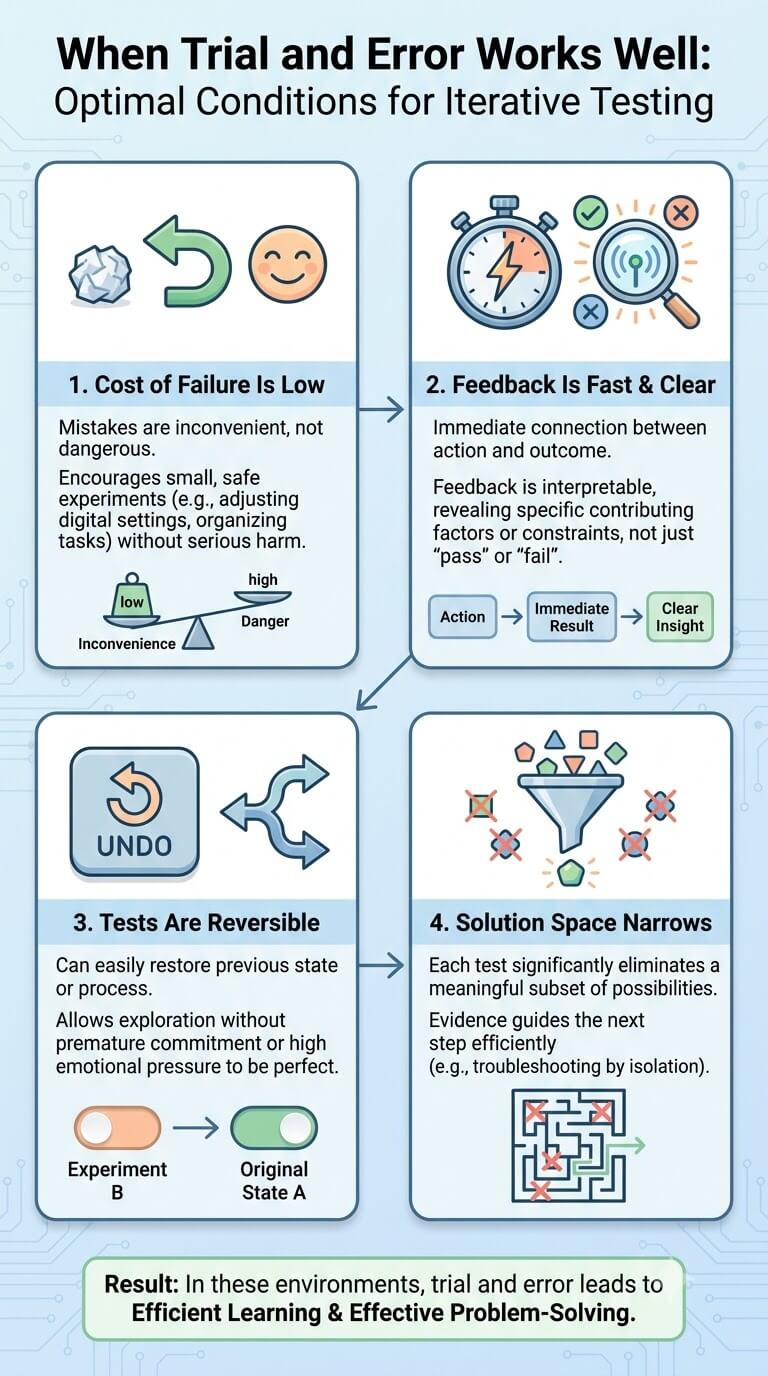
Some environments are naturally suited to iterative testing. The best conditions make mistakes cheap, signals clear, and course corrections easy.
The Cost of Failure Is Low
Trial and error is most attractive when a wrong attempt is inconvenient rather than dangerous. Trying two ways to organize a spreadsheet, adjusting the order of errands, or testing different notification settings usually has a low cost. Small errors in these settings can provide useful information without creating serious harm.
The opposite is also true. A method that is reasonable for arranging furniture is not automatically reasonable for medical treatment, electrical repair, legal decisions, financial commitments, or other situations where a mistake can have large or irreversible consequences.
Feedback Is Fast and Interpretable
Fast feedback keeps the connection between action and outcome clear. If you change one setting and immediately see whether the problem improves, it is easier to learn from the result. When consequences appear weeks later and many other things have changed, interpretation becomes harder.
Good feedback also tells you more than “worked” or “failed.” A partially improved outcome may show that you found one contributing factor but not the entire cause. A new side effect may reveal a constraint that was missing from your original understanding.
Tests Are Reversible
A reversible test allows you to learn without committing too early. You can restore the previous setting, return to the earlier process, or stop the experiment if the result is unhelpful. This makes it easier to explore alternatives without turning every attempt into a major decision.
Reversibility also reduces the emotional pressure to make the first attempt perfect. When the cost of being wrong is small, the question can shift from “Which option must be correct?” to “Which test will teach me the most?”
The Solution Space Can Be Narrowed Through Evidence
Some problems have many possible solutions, but each test eliminates a meaningful subset. Troubleshooting is a good example. If a website displays correctly on one browser but not another, that observation narrows where to look next. If the problem occurs only when a specific extension is active, the search narrows again.
Trial and error is less useful when every test leaves the possibilities almost unchanged. In that case, improving the problem representation, collecting missing information, or asking for expertise may be more efficient than continuing to experiment.
When Trial and Error Works Poorly
The same method becomes weak or unsafe when a test cannot be interpreted or when being wrong carries a serious cost. Recognizing these limits is part of good problem solving, not a failure of persistence.
Failure Is Expensive, Dangerous, or Irreversible
Trial and error should not be treated as a universal problem-solving philosophy. High-stakes situations call for validated procedures, qualified expertise, careful planning, or formal safeguards. A mistake involving medication, structural safety, hazardous materials, legal deadlines, or personal security can carry consequences that are not acceptable as “learning costs.”
A useful rule is simple: the more severe and irreversible the downside, the less appropriate casual experimentation becomes. In those situations, learn through simulation, expert guidance, established protocols, or other safer methods rather than by testing directly on the high-stakes outcome.
Feedback Is Delayed or Ambiguous
If you change a habit today and the relevant outcome might not appear for months, one result may be impossible to interpret. The same problem occurs when many outside factors influence the outcome. You may believe the attempt caused a change when the real cause was unrelated.
When feedback is weak, use intermediate measures if they are meaningful, lengthen the observation period when appropriate, or reduce the number of simultaneous changes. If none of those improves the signal, trial and error may not be the best method.
Too Many Variables Change at Once
Changing everything feels active, but it destroys information. If a team changes the tool, workflow, deadline, roles, and meeting schedule at the same time, a later improvement does not reveal which change helped. Worse, a harmful change can be hidden by another beneficial one.
When possible, stage changes. If several variables must move together, record the bundle explicitly and avoid pretending you learned which individual element caused the result.
Repetition Occurs Without Updating the Strategy
The clearest sign that trial and error has stopped being useful is a repeated attempt that is not meaningfully different from the last one. Clicking the same broken button harder, sending the same request with slightly different wording, or restarting the same plan without addressing why it failed does not create much new information.
At that point, the problem is not a lack of effort. The process needs a different hypothesis, a different test, a different representation, or outside information.
The Attempt-Feedback-Adjustment Cycle
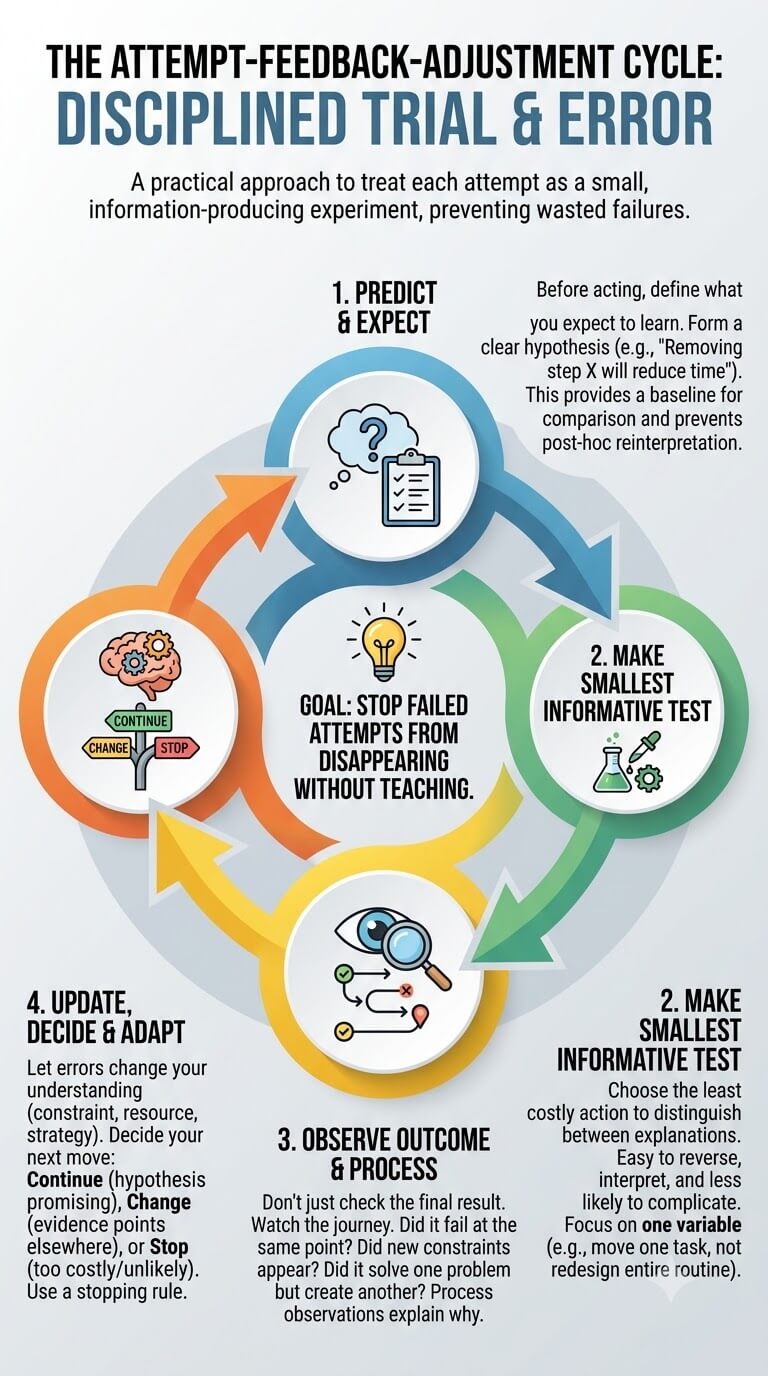
A practical way to make trial and error more disciplined is to treat each attempt as a small information-producing experiment. The cycle below is not about scientific perfection. It is a way to stop failed attempts from disappearing without teaching you anything.
Predict What the Attempt Should Teach
Before acting, write or say what you expect to learn. For example: “If the delay is caused by the approval step, removing that step for one low-risk case should reduce turnaround time.” This prediction gives the result something to compare against.
Without a prediction, people often reinterpret outcomes after the fact. A vague expectation makes almost any result feel consistent with the original idea.
Make the Smallest Informative Test
Choose the least costly action that can distinguish between plausible explanations. A small test is easier to reverse, easier to interpret, and less likely to create new complications.
If you are troubleshooting a morning routine, you might move one task to the night before rather than redesigning the entire routine. If the morning becomes smoother, you have evidence about where the bottleneck may have been.
Observe the Outcome and the Process
Do not look only at the final result. Watch what happened along the way. Did the task fail at the same point? Did a different constraint appear? Did the change solve one problem while creating another?
Process observations often explain why a test worked or failed. They can also show that the original outcome measure was too crude.
Update the Representation, Constraint, or Strategy
An informative error should change something in your understanding. Perhaps a constraint was not real, a resource is weaker than expected, one step depends on another, or the chosen strategy does not fit the situation.
Research on post-error behavior suggests that changing strategy after an error can matter. In a mental arithmetic study, participants who switched strategies after errors improved more than those who repeated the same strategy, as reported in Frontiers in Psychology research on strategy changes after errors. The lesson for everyday problems is not that switching is always best, but that feedback should have the power to change the method when the evidence calls for it.
Decide Whether to Continue, Change, or Stop
Not every failed attempt deserves another attempt. After each cycle, choose among three paths: continue because the hypothesis still looks promising, change because the evidence points elsewhere, or stop because the remaining tests are too costly or unlikely to help.
A stopping rule protects against endless experimentation. It can be as simple as, “If two tests show no improvement, I will revisit the problem definition before trying a third variation.”
Informative Failure vs Repeated Failure
Failure is useful only if it changes your understanding. The table below separates attempts that reduce uncertainty from attempts that merely reproduce the same dead end.
Informative Failure Reduces Uncertainty
A failed attempt can still be successful as a test. If it tells you that a suspected cause is unlikely, reveals a hidden dependency, or rules out a category of solutions, your understanding has improved.
Research on learning from errors repeatedly highlights the importance of feedback rather than error alone. A recent open-access review on learning from errors and failure describes error-related learning as depending on factors such as feedback, reflection, motivation, and context. In other words, mistakes do not automatically become lessons.
| After an attempt | Informative failure | Repeated failure |
|---|---|---|
| What changed? | One meaningful variable or assumption was tested | The same basic move was repeated |
| What was learned? | A cause, constraint, or option became more or less likely | The result adds little beyond “it failed again” |
| What happens next? | The next attempt changes because of the evidence | The next attempt looks almost identical |
| When to pause? | When the next test would add little information | As soon as repetition is replacing revision |
Repeated Failure With the Same Assumption Is a Stuck Loop
Sometimes the visible action changes while the underlying assumption stays fixed. A person may try five productivity apps while keeping an impossible daily workload. A team may rewrite a message repeatedly while assuming the message, rather than the offer or audience, is the problem.
This is where trial and error should hand the problem back to deeper diagnosis. Ask what belief all the failed attempts have in common. If that assumption is wrong, more variations inside the same frame will keep producing dead ends.
Trial and Error vs Insight Problem Solving
Both processes can produce solutions, but they feel and unfold differently. One advances mainly through feedback across attempts, while the other may involve a sudden restructuring of how the problem is understood.
Gradual Evidence-Based Adjustment
Trial and error usually feels incremental. Attempt one changes what you know. Attempt two narrows the options further. Over time, a workable solution becomes more likely because the search is increasingly informed.
The process may still contain surprises, but the central mechanism is feedback across attempts.
Sudden Restructuring and the Aha Experience
Insight problem solving is commonly associated with a sudden change in how the problem is understood. The APA Dictionary’s description of insight learning emphasizes mental rearrangement or restructuring that produces sudden understanding.
That differs from simply testing options one by one. A person may stop trying to open a stuck container by increasing force and suddenly realize the lid is designed to be pressed before turning. The important change is not another attempt at the old strategy. It is a new way of seeing the problem.
How the Two Can Interact in Real Problems
Real problem solving often combines both processes. Trial and error can create the evidence that makes restructuring possible. Several failed attempts may reveal that a hidden assumption is wrong. That recognition can then produce an abrupt new idea.
The reverse can also happen. An Aha moment may generate a promising solution, but trial and error is still useful for testing and refining it. Sudden confidence does not remove the need for feedback.
Trial and Error in Problem Solving vs Broader Learning
Trial and error is one way people learn, but this discussion stays focused on using feedback to solve a current problem. That is narrower than the many mechanisms involved in learning skills, knowledge, habits, and concepts over time.
Current-Problem Solution Search Is the Focus Here
In a problem-solving setting, trial and error is useful because each attempt helps answer a current practical question: What move works here? Which constraint matters? Which cause is plausible? What should change next?
The knowledge gained may transfer to future situations, but the immediate purpose is to find or improve a solution to the present problem.
Broader Learning Includes More Than Solution Testing
Learning psychology covers much more than trial-and-error problem solving. People learn through observation, instruction, practice, memory processes, feedback, social interaction, and many other mechanisms. Skill development can also involve hundreds or thousands of repetitions where the goal is improving performance rather than solving one uncertain problem.
Keeping those goals separate prevents a common misunderstanding. Practicing a piano passage repeatedly is not automatically trial-and-error problem solving. It becomes closer to it when the player tests a specific change in fingering or tempo, observes the effect, and updates the approach because of the result.
A Practical Micro-Experiment Template
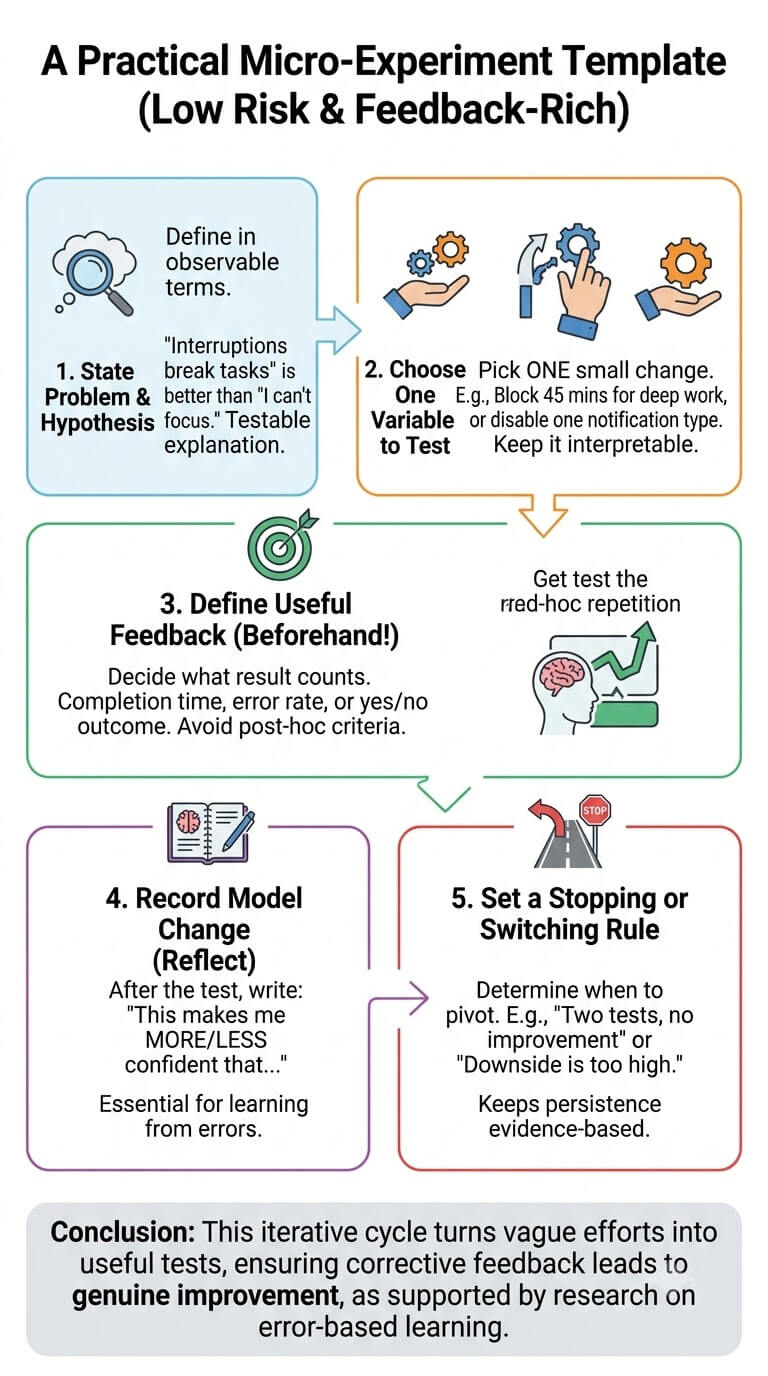
When the situation is low risk and feedback is available, the following template can turn vague trying into a more useful test.
State the Problem and Current Hypothesis
Describe the problem in observable terms, then name the explanation you are testing. “My afternoon work stalls because interruptions break long tasks into pieces” is more useful than “I am bad at focusing.” The first statement suggests something that can be examined.
Choose One Variable or Move to Test
Pick one change that would matter if your hypothesis were correct. You might block a 45-minute interruption-free period for one task, move a recurring meeting, or disable one category of notifications. Keep the change small enough that you can interpret it.
Define What Result Would Count as Useful Feedback
Decide in advance what you will observe. It could be completion time, number of interruptions, error rate, waiting time, or a clear yes/no outcome. Avoid inventing the success criterion only after seeing the result.
Record What Changed in Your Model
After the test, write one sentence: “This makes me more confident that…” or “This makes me less confident that…” A test that changes neither sentence may not have been informative enough.
This reflective step matters because making an error is not the same as learning from one. Research reviews of error-based learning emphasize that corrective feedback and processing the mistake are central to improvement. For example, an open-access review of the benefits of errors during training notes that feedback after errors is essential when errors are used as learning opportunities.
Set a Stopping or Switching Rule
Before the next attempt, decide what would make you change direction. Examples include “two tests with no measurable improvement,” “the downside becomes larger than expected,” or “the same failure occurs at a different point than predicted.”
A switching rule keeps persistence connected to evidence. It also makes it easier to leave an attractive idea when the results no longer support it.
How Feedback Helps Break a Mental Set
Feedback matters most when it is allowed to challenge a familiar method. If every disappointing result is explained away, an old strategy can survive long after the problem has changed.
Contradictory Outcomes Should Trigger Strategy Review
A mental set can keep a familiar strategy active even after it stops fitting the problem. Feedback is one of the strongest reasons to question that strategy. If a method worked in the past but repeatedly fails under the current conditions, the mismatch deserves attention.
Instead of asking, “How can I execute this method better?” try, “What result would I expect if this method were actually appropriate?” If reality keeps violating that expectation, improvement may require a different strategy rather than more effort.
Poor Feedback Can Keep a Solver Stuck
Weak feedback allows an old strategy to survive because nothing clearly disproves it. This happens when outcomes are delayed, measures are vague, or the person notices only evidence that supports the preferred approach.
Improving the feedback loop can therefore be more useful than brainstorming more options. Shorten the test cycle, make the success criterion clearer, or ask someone else to review what the result actually shows. Better information gives the problem-solving process a reason to move.
FAQ
Trial and error is simple in principle, but the quality of the method depends on how the attempts and feedback are structured.
Is Trial and Error an Effective Way to Solve Problems?
Yes, in the right conditions. It is especially useful when the solution is uncertain, failed attempts are inexpensive, feedback arrives quickly, and each test can narrow the possibilities. It is less suitable when mistakes are dangerous, irreversible, very costly, or too ambiguous to teach you anything.
How Many Failed Attempts Are Too Many?
There is no universal number. The better question is whether each attempt is still adding information. If several attempts reproduce the same result without changing your understanding, pause before adding another. Revisit the assumption, representation, or strategy that all of those attempts share.
What Makes an Error Informative?
An error is informative when you can connect it to a testable expectation and use the result to update the next move. It may rule out a cause, expose a constraint, reveal a missing variable, or show that your strategy does not fit the problem. An error that produces only frustration but no interpretable signal offers much less value.
Is Trial and Error the Same as Experimentation?
They overlap, but they are not identical. Formal experiments usually use tighter controls, predefined measures, and systematic methods for drawing conclusions. Everyday trial and error can be looser. It becomes more experiment-like when you make a prediction, change one meaningful factor, observe a clear outcome, and revise the next attempt based on evidence.
Key Takeaways
- Trial and error becomes useful when each attempt changes what you know about the problem.
- Small, reversible tests are usually more informative and safer than large uncontrolled changes.
- A failed attempt can still be valuable if it rules out an explanation or reveals a hidden constraint.
- Repeating the same strategy without updating is not effective trial and error.
- Insight and trial and error can work together: feedback can trigger restructuring, and insight-generated ideas still need testing.
- High-risk, irreversible, medical, legal, financial, or safety-critical problems should not be approached through casual experimentation.
If you are stuck on a practical problem, the next useful move is often not “try harder.” Choose one low-cost test and write down what it is supposed to teach you. If the result cannot change your next move, redesign the test before you run it.

Michael Reed is the Founder and Lead Writer at Psychology Exposed. He writes about human behavior, relationships, emotional patterns, self-awareness, and practical psychology topics using research-informed, easy-to-understand content.
Read More About Michael Reed: https://psychologyexposed.com/michael-reed/