

When a problem refuses to move, the natural response is often to push harder. You reread the details, generate another idea, ask someone else, or spend more time thinking. Sometimes that works. Sometimes it simply adds effort to the same bottleneck.
Barriers to problem solving are not all the same. A person may be working from an inaccurate picture of the problem, missing a critical fact, treating an assumption as a rule, relying on a once-useful strategy, holding too many pieces in mind, or receiving feedback that is too vague to guide the next attempt. In group settings, several people may even be solving different versions of the problem without realizing it.
The useful question is therefore not only, “Why can’t I solve this?” It is, “Where is the process breaking down?” Once the location of the bottleneck becomes clearer, the next move can become smaller and more specific.
Quick Answer
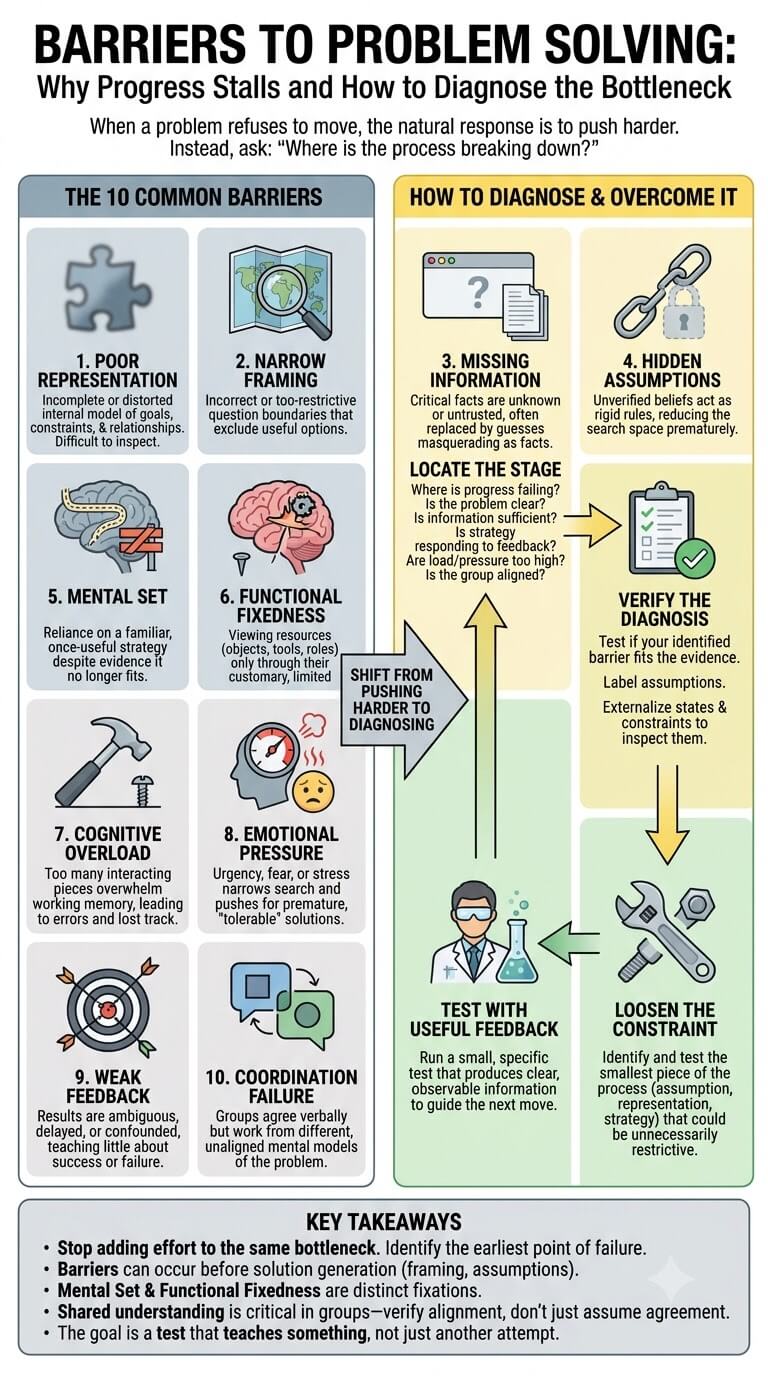
Common barriers to problem solving include a poor mental model of the problem, narrow framing, missing information, hidden assumptions, mental set, functional fixedness, cognitive overload, emotional pressure, weak feedback, and poor coordination. The best response depends on the barrier. Instead of trying harder at the same step, identify where progress is failing, test that diagnosis, and change the smallest part of the process that could restore useful feedback.
A Barrier Can Occur at Any Stage of Problem Solving

The APA Dictionary of Psychology describes problem solving as the process of trying to overcome difficulties or move from a starting situation toward a desired goal using higher mental functions such as reasoning. That broad definition matters because failure can occur before a solution is ever generated, while a strategy is being used, during testing, or after results arrive.
A simple way to troubleshoot is to locate the stage first. If the stage is wrong, the remedy is often wrong too. More brainstorming does little when the real problem is missing information. More data does little when the real problem is a rigid assumption. More persistence can even deepen a strategy fixation that feedback has already shown to be unhelpful.
Before solution generation
Early barriers affect what the problem appears to be. The goal may be vague, constraints may be misread, a key relationship may be invisible, or the question may be framed too narrowly. A person can then generate many ideas that are perfectly reasonable for the wrong version of the problem.
During strategy use
Once a method has been chosen, progress can stall because the method is too rigid, because attention stays on familiar resources, or because the task exceeds what can be managed mentally at one time. At this stage, the issue is often not a lack of effort. It is the mismatch between the strategy and the structure of the task.
During testing and feedback
A trial is useful only if it teaches something. When the result is ambiguous, delayed, confounded by several changes at once, or judged by the wrong measure, the solver may repeat attempts without learning why they succeed or fail.
During revision or collaboration
After feedback arrives, people still have to interpret it and decide what to revise. Individuals may defend an earlier idea, while groups may fail to combine different pieces of information. The bottleneck has shifted from “finding a solution” to updating a shared understanding of what is happening.
Barrier 1: The Problem Is Poorly Represented
Before you can solve a problem, you need some representation of it: what is true now, what outcome is wanted, which constraints matter, and how the pieces relate. If that internal model is incomplete or distorted, every later step inherits the error.
This is why a difficult problem sometimes becomes easier after it is drawn, restated, mapped, or turned into a timeline. The solution may not have changed. The representation has become easier to inspect.
The goal, constraints, or relationships are unclear
Imagine a small business trying to “fix low sales.” That phrase hides several different problems. Traffic may be low. Visitors may arrive but not trust the offer. Existing customers may buy once and never return. A vague representation groups these possibilities into one large failure, making it hard to know what evidence to collect next.
Research on task representation shows that how a task is mentally represented can affect which strategies become available and which are selected. A 2025 Frontiers in Psychology study on task representation and strategy selection illustrates why the solver’s model is not merely a description sitting in the background. It can shape the strategy search itself.
Diagnostic questions
- Can I state the current state and desired state separately?
- Which constraints are confirmed, and which are merely assumed?
- What relationships between variables am I relying on?
- If I drew this problem, what would have to appear on the page?
- What fact, if changed, would make my current model wrong?
A strong first move is to externalize the problem in a form that exposes relationships, such as a diagram, timeline, flow, table, or list of states and constraints. The goal is not to make it pretty. It is to make hidden structure inspectable.
Barrier 2: The Problem Is Framed Too Narrowly or Incorrectly
A representation describes the structure you think the problem has. A frame sets the boundaries and organizing question. The frame determines what counts as relevant and what kind of answer seems possible.
The wrong question organizes the search
“How do I make this meeting shorter?” invites one class of solutions. “What information actually requires synchronous discussion?” invites another. Both refer to the same meeting, but the second question changes what the solver is trying to optimize.
Narrow framing becomes a barrier when the original wording quietly excludes useful options. The problem may be defined around preserving a current process, protecting a preferred explanation, or solving the most visible symptom rather than the mechanism producing it.
Diagnostic questions
- What outcome am I really trying to create?
- What does my current wording assume must stay the same?
- Am I solving the cause, the symptom, or a convenient proxy?
- How would someone with a different role describe this problem?
Reframing is not pretending facts are different. A useful reframe preserves important evidence while testing whether the current question, scope, or objective is unnecessarily restrictive.
Barrier 3: Important Information Is Missing or Untrusted
Some problems cannot be solved well because the required information is not yet available. The danger is that unknowns often become invisible. A guess gets repeated until it starts to feel like a fact, or a missing measurement is replaced by confidence.
Unknowns are mistaken for facts
Suppose a team assumes customers abandon a checkout because the form is too long. They redesign the form repeatedly, but nobody has checked where users actually leave. The barrier is not idea generation. It is that an unverified explanation is occupying the place where evidence should be.
A useful diagnostic is to label statements as known, estimated, assumed, or unknown. This simple separation prevents confidence from masquerading as information.
More data versus more useful data
Missing information does not mean “collect everything.” More data can increase noise and delay. Ask which uncertainty is currently changing the choice of next test. If knowing one fact would cause you to choose a different strategy, that fact has high value. If it would not alter the next move, it may not be the information you need yet.
Try this question: What is the smallest piece of evidence that would meaningfully change what I do next? That turns information gathering into part of solving rather than a way to postpone action.
Barrier 4: Assumptions Create Invisible Constraints

An assumption becomes a barrier when it acts like a rule without being tested as one. These assumptions are especially difficult to notice because they often feel like part of the problem itself.
Rules that were never actually required
A student may assume a project must be completed in the same order it was assigned. A manager may assume only one department can own a task. A homeowner may assume a replacement must fit the exact layout of the old object. Each assumption reduces the search space before alternatives are evaluated.
Hidden assumptions can also come from examples. A previously shown solution may make certain features feel necessary even when they were only features of that example. A systematic review of fixation research in Frontiers in Education describes how externally provided information and internally activated knowledge can constrain search, and how effective defixation depends partly on the source of that fixation and the type of problem.
How to surface assumptions without rejecting all constraints
The answer is not to challenge every rule. Real constraints protect budgets, safety, deadlines, physical limits, laws, or quality standards. Instead, write down the constraints and mark their origin.
| Constraint | Where it came from | Can it be tested? |
|---|---|---|
| The result must be ready Friday | Client deadline | Probably fixed |
| We must use the current sequence | Habit | Yes |
| Only one person can review it | Old workflow | Yes |
This preserves legitimate boundaries while exposing restrictions that exist only because nobody has asked whether they are still necessary.
Barrier 5: Mental Set Locks the Strategy
A mental set can make a familiar method come to mind quickly. That efficiency is useful when the environment is stable. It becomes a barrier when prior success keeps one strategy dominant after the problem has changed.
Prior success keeps one method dominant
The clue is not simply repetition. The clue is repeated use despite relevant evidence that the method no longer fits. A marketer keeps increasing ad spend when the real bottleneck is conversion. A technician keeps replacing the same component even though the failure pattern has changed. A student keeps applying a memorized formula without checking whether the conditions for that formula are present.
When feedback should trigger a strategy change
Before another attempt, state what result would count as evidence that the current method is wrong for this problem. If every outcome can be explained away, the strategy is protected from feedback.
A practical reset is to ask: If I were forbidden to use my current method, what class of approach would I test next? You do not have to abandon the old method immediately. The exercise reveals whether one familiar route has crowded out the rest.
Barrier 6: Functional Fixedness Narrows Resource Use
Functional fixedness is narrower than mental set. The obstacle is not mainly the strategy. It is the way a resource is categorized. An object, tool, piece of information, or role is seen primarily through its familiar use, so alternative functions are difficult to notice.
Available tools are seen only in familiar roles
A container is seen only as something that holds objects, not as a spacer or measuring reference. A spreadsheet is seen only as a record, not as a way to reveal a pattern. A colleague is seen only through a job title, even though they hold experience that could help explain the problem.
Property-based reconsideration
Instead of asking what an available resource is “for,” list what properties it has. Is it rigid, flat, transparent, searchable, movable, heat-resistant, reversible, or able to signal a state? Then compare those properties with the action the problem requires.
This is a thinking exercise, not permission to improvise unsafely. Reusing tools or materials should still respect electrical, chemical, mechanical, hygiene, legal, and human-safety constraints.
Barrier 7: Cognitive Load Overwhelms the Working Model
Some problems are hard because too many interacting pieces must be kept active at once. Working memory is limited, and interference increases as more information has to be maintained and manipulated. A review of working-memory architecture available through PubMed Central describes this limited capacity and notes that meaningful grouping can reduce the number of active elements that must be handled separately.
Too many interacting pieces
Cognitive overload often feels like “I understand every part, but I lose the whole thing when I try to combine them.” You may reread the same information, forget what a previous step established, switch between details without integrating them, or make errors that disappear when the task is broken apart.
Externalize, sequence, and reduce simultaneous demands
Do not treat the solution as a memory test. Put intermediate states on paper. Track constraints in a table. Separate calculation from interpretation. Solve stable subproblems before variable ones. If five items can be represented as one meaningful group, group them.
The purpose is not to simplify the real problem until it becomes inaccurate. It is to reduce how much must be actively manipulated at the same instant.
Barrier 8: Emotion and Threat Narrow the Search
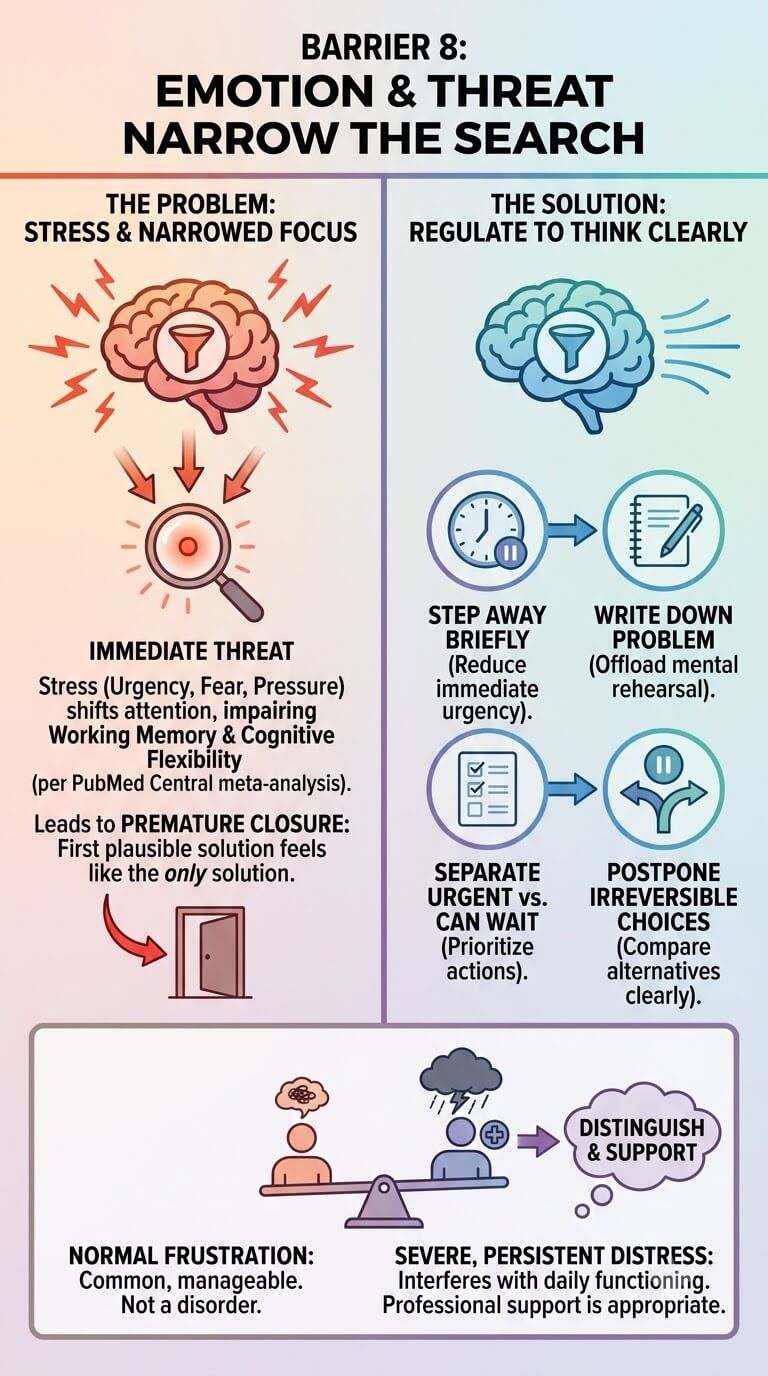
Problem solving is not detached from emotion. Urgency, embarrassment, anger, fear of being wrong, or pressure from consequences can shift attention toward immediate threat and away from slower exploration. This does not mean ordinary frustration is a disorder, nor does it mean every difficult problem requires emotional work before thinking.
Stress can shift attention and urgency
A meta-analysis in PubMed Central on acute stress and executive functions found overall impairments in working memory and cognitive flexibility under acute stress, while effects varied across measures and conditions. In everyday terms, pressure may make it harder to hold several possibilities in mind or switch away from a dominant response.
One sign is premature closure: the first plausible solution starts to feel like the only tolerable solution because uncertainty itself feels costly.
Regulate enough to think without making stress the whole article
When possible, reduce avoidable urgency before solving: step away for a short period, write down the problem so you do not have to keep rehearsing it, separate what must happen now from what can wait, and postpone irreversible choices until you can compare alternatives more clearly.
If distress is severe, persistent, or significantly interfering with daily functioning, professional support may be appropriate. That is different from treating normal frustration as a clinical problem.
Barrier 9: Feedback Is Weak, Delayed, or Misread
A failed attempt is only informative when you can connect the result to what was tested. If ten variables change at once, if success is measured vaguely, or if results arrive months later, the attempt may generate activity without learning.
The attempt teaches too little
Consider someone trying to improve sleep who changes bedtime, caffeine, exercise, screen use, room temperature, and supplements in the same week. If sleep improves, the person does not know which change mattered. If it worsens, the same uncertainty remains. The test produced an outcome, but little diagnostic information.
Build smaller tests with clearer signals
Before acting, write a prediction: “If this explanation is correct, I expect X to change when I alter Y.” Then choose a result you can observe soon enough to guide the next step. Small, reversible tests are especially useful when the problem allows iteration.
Feedback also has to be interpreted honestly. A single success does not prove a general rule, and a single failure does not always disprove an approach. Ask whether the test actually isolated the thing you intended to learn.
Barrier 10: Coordination Fails in Group Problems
Groups add resources, but they also add another place for a problem to break down. People can hold different goals, definitions, assumptions, evidence, and interpretations while using the same words.
Different people are solving different versions of the problem
A product team may say it wants to “improve onboarding,” while design means fewer screens, support means fewer questions, engineering means fewer failure states, and management means faster activation. Each person may contribute sensible ideas that pull in different directions because the shared problem was never made explicit.
Unique information never enters the shared model
Group performance also suffers when relevant knowledge remains distributed across members. Research on collaborative problem solving emphasizes the need to establish and maintain shared understanding, including identifying what others know and repairing gaps in common ground. An open-access review in PubMed Central on collaborative problem solving describes shared understanding as a central part of effective collaboration.
A useful meeting question is not “Does everyone agree?” but “What does each person know that the rest of us may not?” Agreement can occur around an incomplete picture.
Barrier-to-Response Matrix
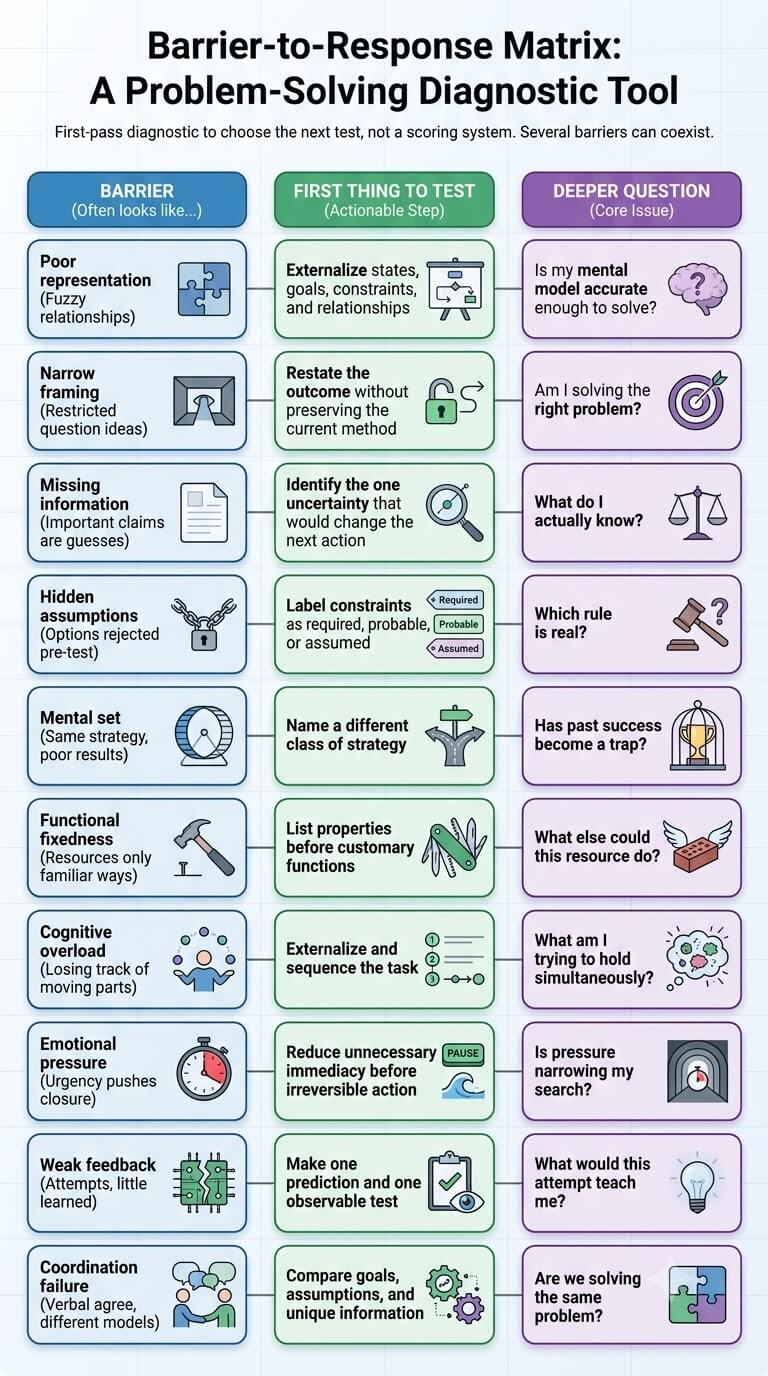
The table below is a first-pass diagnostic, not a scoring system. Several barriers can coexist. Use it to choose the next thing to test rather than treating every stalled problem as the same kind of difficulty.
What the barrier looks like
What to test first
Which deeper topic it connects to
| Barrier | What it often looks like | First thing to test | Deeper question |
|---|---|---|---|
| Poor representation | The pieces are known but their relationships remain fuzzy | Externalize states, goals, constraints, and relationships | Is my mental model accurate enough to solve? |
| Narrow framing | Many ideas, all within the same restricted question | Restate the outcome without preserving the current method | Am I solving the right problem? |
| Missing information | Important claims are guesses | Identify the one uncertainty that would change the next action | What do I actually know? |
| Hidden assumptions | Possible options are rejected before testing | Label constraints as required, probable, or assumed | Which rule is real? |
| Mental set | The same strategy returns despite poor results | Name a different class of strategy | Has past success become a trap? |
| Functional fixedness | Available resources seem usable only in familiar ways | List properties before customary functions | What else could this resource do? |
| Cognitive overload | You lose track while combining many moving parts | Externalize and sequence the task | What am I trying to hold simultaneously? |
| Emotional pressure | Urgency pushes premature closure | Reduce unnecessary immediacy before irreversible action | Is pressure narrowing my search? |
| Weak feedback | Attempts happen, but little is learned | Make one prediction and one observable test | What would this attempt teach me? |
| Coordination failure | People agree verbally but act from different models | Compare goals, assumptions, and unique information | Are we solving the same problem? |
Barriers to Problem Solving vs Feeling Stuck
These ideas overlap, but they are not identical. A barrier is a mechanism that interferes with progress. Feeling stuck is the lived experience of not knowing how to move forward.
A barrier is a diagnosable obstacle
You can often describe a barrier in structural terms: the goal is unclear, a constraint is assumed, working memory is overloaded, feedback is uninformative, or group members hold incompatible models. That description suggests a specific test.
Feeling stuck is the lived experience that may come from one or several barriers
Feeling stuck may include frustration, repeated thought, sunk effort, uncertainty, fear of changing direction, or the sense that every new attempt leads back to the same place. One person may feel stuck because of a single hidden assumption. Another may be dealing with several barriers at once, such as overload plus weak feedback plus pressure to succeed.
This distinction matters because “get unstuck” is not one intervention. The useful reset depends on what is creating the loop.
A First Diagnostic Pass
When you are unsure what is blocking progress, use the following questions in order. The sequence follows the logic of fixing earlier errors before optimizing later steps.
Is the problem clear?
Write the current state, desired state, known constraints, and the relationship you think connects them. If you cannot do this without vague terms, representation or framing may be the first place to work.
Is the information sufficient?
Separate known facts from estimates, assumptions, and unknowns. Then identify which unknown could actually change the next move. Do not collect information merely because uncertainty feels uncomfortable.
Is the strategy responding to feedback?
Look at the last few attempts. Did the strategy change when evidence changed? If not, ask whether mental set is keeping one approach dominant. If attempts changed but taught little, redesign the feedback loop instead.
Is emotional or cognitive load too high to test well?
If you keep losing track of pieces, externalize them. If urgency is pushing you toward the first tolerable answer, reduce unnecessary pressure before making an irreversible move. These are different bottlenecks, even though both can feel like mental fog.
Are multiple people aligned on the same problem?
Ask each person to state the goal, the main obstacle, one important assumption, and one piece of information they believe others may not have. Differences become useful data when they are visible.
A compact troubleshooting cycle is Locate → Verify → Loosen → Test. Locate where progress is failing. Verify that your diagnosis fits the evidence. Loosen one constraint, assumption, representation, or strategy that may be unnecessarily restrictive. Then run a test that produces information you can actually use. If the result does not help, return to the diagnosis rather than automatically increasing effort.
FAQ
These questions address common confusion about diagnosing a problem-solving obstacle without turning every difficult task into a psychological label.
What is the most common barrier to problem solving?
There is no single barrier that is most common across every kind of problem. Familiar tasks may be limited by mental set, novel tasks by representation or missing information, complex tasks by working-memory demands, and group tasks by coordination. A better approach is to identify the earliest point at which the process stops producing useful information or progress.
Are assumptions always a problem?
No. Assumptions help people act without rechecking every fact from the beginning. They become problematic when they are uncertain but treated as fixed constraints, especially when they rule out promising options. The goal is not to eliminate assumptions but to make important ones visible enough to test.
How can stress interfere with problem solving without making the problem clinical?
Ordinary stress can increase urgency, consume attention, and make it harder to hold or switch among possibilities. That does not mean frustration or pressure is a disorder. A practical response may be to reduce unnecessary time pressure, externalize information, or delay an irreversible choice until thinking is clearer. Persistent or severe distress that interferes with daily functioning is a separate reason to consider qualified support.
When does more information stop helping?
More information stops being useful when it does not reduce an important uncertainty, change the next action, or improve the test. Collecting extra material can create its own overload. Before searching further, name the decision or hypothesis the new information is supposed to clarify. If you cannot do that, the next need may be synthesis rather than collection.
Key Takeaways
- Stalled progress is often easier to fix when you identify where the process is breaking rather than simply adding more effort.
- Poor representation, narrow framing, missing information, and hidden assumptions can block progress before a useful strategy is even chosen.
- Mental set and functional fixedness are different: one keeps an old strategy dominant, while the other narrows how available resources are perceived.
- Cognitive overload and emotional pressure can both narrow problem solving, but they call for different first responses.
- Attempts only improve a solution when feedback is clear enough to teach what should change next.
- In group problems, shared understanding matters because people can appear aligned while solving different versions of the task.

Michael Reed is the Founder and Lead Writer at Psychology Exposed. He writes about human behavior, relationships, emotional patterns, self-awareness, and practical psychology topics using research-informed, easy-to-understand content.
Read More About Michael Reed: https://psychologyexposed.com/michael-reed/