

You solve a problem successfully, so the next time something similar appears, you reach for the same method. That is usually sensible. Experience saves time, reduces uncertainty, and helps you avoid rediscovering what already works. The difficulty begins when yesterday’s successful route becomes today’s automatic answer, even though the problem has changed.
In psychology, this tendency is often described as a mental set. A familiar strategy becomes so available that other possibilities receive less attention. You may work harder at the known method, add more steps, or explain away poor results instead of asking whether the method itself needs to change.
This does not mean persistence or expertise is bad. The useful question is more precise: are you continuing because the strategy still fits the problem, or because familiarity is making it feel like the only reasonable route?
Quick Answer
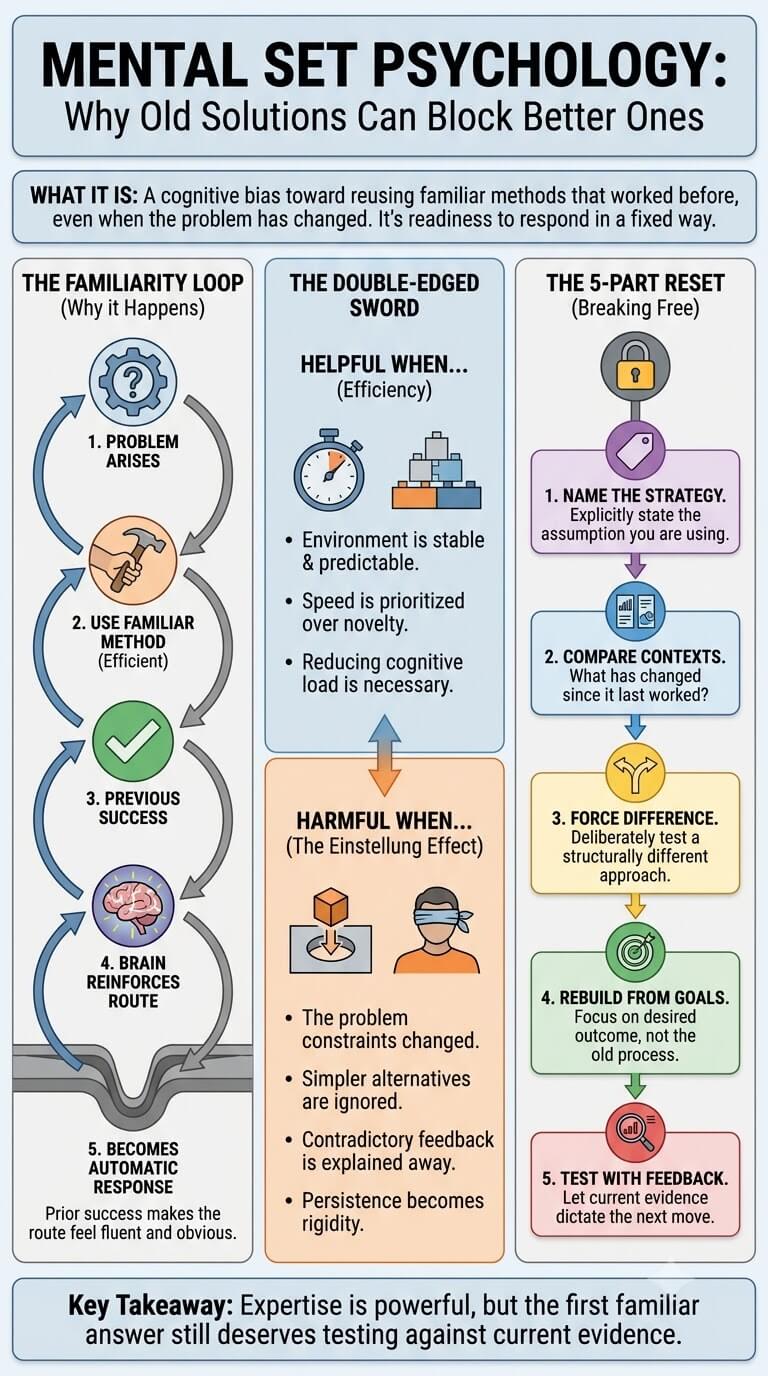
A mental set is a readiness to approach a problem in a familiar way, especially when that approach worked before. It can make routine problem solving faster, but it may also hide simpler or better alternatives when circumstances change. The practical antidote is not constant novelty. It is learning to notice when feedback no longer supports the familiar strategy and deliberately testing a genuinely different route.
What a Mental Set Is
A mental set is best understood as a bias toward a particular way of responding. The APA Dictionary of Psychology describes a set as a temporary readiness to respond in a certain way, and gives a successful tactic reused in another situation as an example of a mental set. In problem solving, that readiness can shape what you notice, which steps you try first, and how long you stay with them.
The key idea is not simply repetition. A person can repeat a method because it remains effective. Mental set becomes more interesting when prior success narrows the search for alternatives before the current evidence has earned that confidence.
Prior Success Creates an Expected Route
Imagine a team that has fixed several software problems by restarting a service. When a new failure appears, restarting is an efficient first move because it has a good track record. After two unsuccessful restarts, however, the same history can work against them. They may keep adjusting the restart procedure while overlooking a permissions change, corrupted file, or network issue.
The old solution does not have to be irrational. Its previous success is exactly why it becomes attractive. Familiar procedures feel fluent: you know the sequence and can predict what happens next. That fluency can be mistaken for fit.
The Einstellung Effect as a Form of Strategy Fixation
The German term Einstellung is commonly used for a classic form of mental-set effect. In laboratory tasks, people can be trained on a recurring solution method and then continue to favor that method when a better route becomes available. Research using anagram problems describes mental set as prior exposure triggering a familiar but inappropriate solution and reducing consideration of alternatives. The Frontiers in Psychology study on the Einstellung effect also shows why familiarity can guide attention toward an expected answer.
This matters because the trap is often subtle. You may believe you are searching widely while your attention keeps circling features that support the first familiar strategy. The result is not necessarily total failure. Sometimes you find a workable answer, but miss a simpler, faster, or more appropriate one.
Why Mental Sets Form

A mind that never reused successful procedures would be inefficient. We learn partly by noticing regularities, retaining useful responses, and applying them again when a situation looks similar. Mental set grows from this normally helpful economy of thought.
Efficiency Favors Familiar Procedures
Many everyday tasks do not need reinvention. If a standard budgeting method works each month, repeating it saves effort. If a mechanic recognizes a familiar symptom pattern, starting with the most likely cause may be efficient. If a student has a reliable way to check arithmetic, using it again is sensible.
Problems arise when efficiency becomes premature closure. The brain’s preference for a practiced route can reduce the amount of exploration that happens after the first plausible method appears. Instead of asking, “What approaches fit this version of the problem?” the solver effectively asks, “How do I make my usual approach work here?”
Expertise Creates Strong Retrieval Cues
Expertise usually improves performance because experts have more organized knowledge, recognize meaningful patterns quickly, and retrieve useful procedures with less effort. Yet strong knowledge can also make a familiar answer arrive very early. That first answer may shape what the expert looks at next.
Eye-movement research in chess found that familiar solution ideas could continue to attract attention even when a better move existed. In the PLOS ONE study of the Einstellung effect in chess, solvers who eventually found the optimal move were better able to disengage from features associated with the familiar but suboptimal move. The finding is useful as a caution, not a verdict on expertise: knowledge is powerful, but the first expert answer still deserves testing.
Repetition Reduces Search for Alternatives
A short run of similar problems can also create a temporary set. When the same procedure works several times in succession, the next problem is easily interpreted through that procedure. Research on short-term mental set notes that repeatedly practicing a particular solution can strengthen perseveration of that approach. One Frontiers in Psychology study of short-term mental set examined how prior practice can continue to influence later problem solving.
This helps explain why mental set can appear even without years of habit. A person may become fixed after only a sequence of recent successes. The more alike the situations seem on the surface, the easier it is to assume the underlying structure is also the same.
When a Mental Set Helps
It would be a mistake to treat every familiar response as cognitive rigidity. Reusing knowledge is one of the reasons skilled performance is possible. A useful mental set provides a starting point, especially when the environment is predictable and the cost of testing a known method is low.
Familiar Problems Can Be Solved Faster
Suppose you manage recurring customer requests. If the same account setting causes the same error repeatedly, a practiced diagnostic sequence may resolve the problem in minutes. Deliberately inventing a fresh process each time would add work without adding value.
In these cases, the familiar route functions like a well-organized shortcut. You do not need to search the entire space of possible explanations. Prior experience lets you begin with the most plausible path and conserve attention for unusual cases.
Stable Environments Reward Reusable Procedures
Mental sets are especially useful when the rules remain stable. A laboratory protocol, a safety checklist, a bookkeeping routine, or a known troubleshooting sequence may need consistency more than creativity. Repetition helps reduce avoidable variation.
The important condition is that the environment actually remains similar enough for the old procedure to fit. A reusable process is an asset when it is treated as a tested default. It becomes a liability when it is treated as proof that alternatives do not need consideration.
When a Mental Set Becomes a Problem

Strategy fixation is easiest to spot when the evidence and the behavior begin moving in opposite directions. The method keeps being repeated while the results increasingly suggest that something about the approach, assumptions, or problem definition needs review.
The Task Changes but the Strategy Does Not
A familiar approach may have been designed for an earlier version of the problem. A manager keeps adding meetings because meetings once improved coordination, even though the current bottleneck is unclear ownership. A student keeps rereading because it helped with a vocabulary-heavy course, even though the new course requires practice applying concepts. A household keeps cutting small expenses although the real change is a large fixed cost.
The warning sign is not that the method failed once. It is that meaningful features of the task have changed while the strategy remains untouched.
A Simpler Solution Is Overlooked
Mental set can also make a complicated familiar procedure feel more legitimate than a simple unfamiliar one. People may add patches to an old process because each patch preserves the overall method. Eventually, maintaining the workaround takes more effort than replacing the approach.
A useful check is to ask what you would try if you had never seen the previous solution. You do not have to accept the answer, but the question temporarily removes the authority of history and makes simplicity easier to notice.
Contradictory Feedback Is Explained Away
Feedback should help distinguish between a strategy that needs more time and one that needs reconsideration. Under a strong mental set, however, poor results may be interpreted only as evidence that the familiar strategy needs to be applied harder, longer, or more precisely.
For example, a team might say, “The process is fine, people just need to follow it better,” after repeated failures that occur even when people follow the process. That explanation protects the method from evaluation. A more informative response would separate execution problems from strategy problems and test both possibilities.
The Solver Stops Exploring the Problem Space
Problem solving involves searching among possible moves, explanations, and intermediate states. The APA Dictionary describes search in problem solving as trying to find an answer or solution among alternatives. A mental set can narrow that search before the alternatives have been seriously considered.
You can sometimes hear this narrowing in language: “There is only one way to do this,” “We already know what the problem is,” or “Nothing else will work.” Those statements may be accurate, but when they appear before alternatives are examined, they are worth treating as hypotheses rather than conclusions.
Everyday Examples of Mental Set
Mental set is easier to recognize when you look at the strategy being repeated rather than the topic of the problem. The same basic process can appear at work, in learning, in technical troubleshooting, and in personal conversations.
Work Process That Survives After the Constraint Disappears
A company creates a three-stage approval process during a period of high risk. Months later, the risk is gone, but every small decision still passes through the same chain. Delays increase, yet the response is to remind people to complete the old process faster.
The familiar strategy once solved a real problem. The mental-set risk is failing to notice that the constraint that justified it has changed. A useful next step is to name the original purpose of each stage and ask which stages still serve that purpose now.
Study Method Reused for a Different Kind of Task
A learner earns good grades by highlighting and rereading factual material. They enter a course where exams require comparing theories and solving novel examples, but they respond to poor results by rereading even more.
What the learner may feel is confusion or frustration: “I am studying harder, so why am I not improving?” What it may mean is that effort is being invested in a strategy mismatched to the new performance requirement. The next move is to practice the kind of retrieval or application the assessment actually demands.
Troubleshooting Sequence Repeated Despite New Evidence
A home internet connection drops repeatedly. Restarting the router worked last month, so the person restarts it every time. The connection now fails again within minutes, yet they repeat the same restart sequence instead of checking whether the provider is down, a cable is damaged, or a device-specific issue is involved.
The restart was not a foolish idea. It simply stopped being diagnostic once the pattern of failure changed. A better next step is to identify what new evidence the repeated attempt produced and let that evidence change the next test.
Relationship Problem Approached With the Same Ineffective Script
Two people repeatedly disagree about household responsibilities. One person responds by giving longer and more detailed explanations of why the current arrangement feels unfair. The other keeps hearing the conversation as another debate about who worked harder that week. More explanation produces more argument.
The strategy may be fixed around proving the case. A different route might be to define a shared outcome, list recurring tasks, and agree on a visible division of responsibility. This example does not mean every recurring relationship conflict is a mental set. It shows how a familiar conversational strategy can keep reproducing the same result even when both people want change.
Mental Set vs Functional Fixedness

Mental set and functional fixedness are related forms of fixation, but they are not interchangeable. The cleanest distinction is to ask what has become fixed: the procedure or the possible use of a thing.
Strategy Fixation Versus Object-Function Fixation
| Question | Mental set | Functional fixedness |
|---|---|---|
| What is narrowed? | The strategy, rule, or procedure considered for solving the problem | The possible function of an object, resource, or familiar element |
| Typical thought | “This is how problems like this are solved.” | “This thing is for its usual purpose.” |
| Example | Repeating the same troubleshooting sequence after evidence changes | Failing to see that a container could also support or hold something in a new way |
| Useful interruption | Generate a structurally different method | List properties and possible functions beyond the usual use |
Keeping the distinction clear matters because the intervention differs. If the strategy is fixed, you need another route. If the function of a resource is fixed, you need another way of seeing what that resource could do.
How Both Can Appear in the Same Problem
Suppose someone is trying to organize a small room. They may be stuck on the strategy “buy another storage unit,” which is a procedure-level fixation. At the same time, they may see a bench only as seating and overlook its potential storage space, which is closer to functional fixedness.
Changing only one level may not solve the whole problem. Seeing the bench differently creates a new resource, while questioning the purchase-first strategy creates a new route. This is why identifying the location of fixation is more useful than simply telling yourself to “think outside the box.”
Mental Set vs Persistence
Persistence is often necessary for difficult work. Many solutions require repeated effort, skill building, debugging, or waiting for delayed results. The difference is not whether you keep going. It is whether the strategy remains responsive to evidence.
Persistence Uses Feedback to Continue Intelligently
Adaptive persistence can keep the same goal while changing tactics. A researcher repeats an experiment but changes a measurement problem identified in the first attempt. A runner follows a training plan but reduces intensity when recovery data shows accumulated fatigue. A student keeps preparing for the same exam but replaces passive review with practice questions after noticing weak recall.
The person is still persistent. What changes is the route. Feedback is allowed to modify the plan instead of being treated as an interruption to it.
Mental Set Repeats the Route Despite Evidence to Reconsider
Strategy fixation often sounds like determination from the inside: “I just need to try again.” The more useful question is, “What did the last attempt teach me that should alter this attempt?” If the honest answer is “nothing,” repetition may be producing activity without information.
This distinction protects against two extremes. You do not abandon a sound method at the first obstacle, and you do not confuse loyalty to a method with commitment to the goal.
How to Break a Mental Set Without Abandoning Useful Expertise
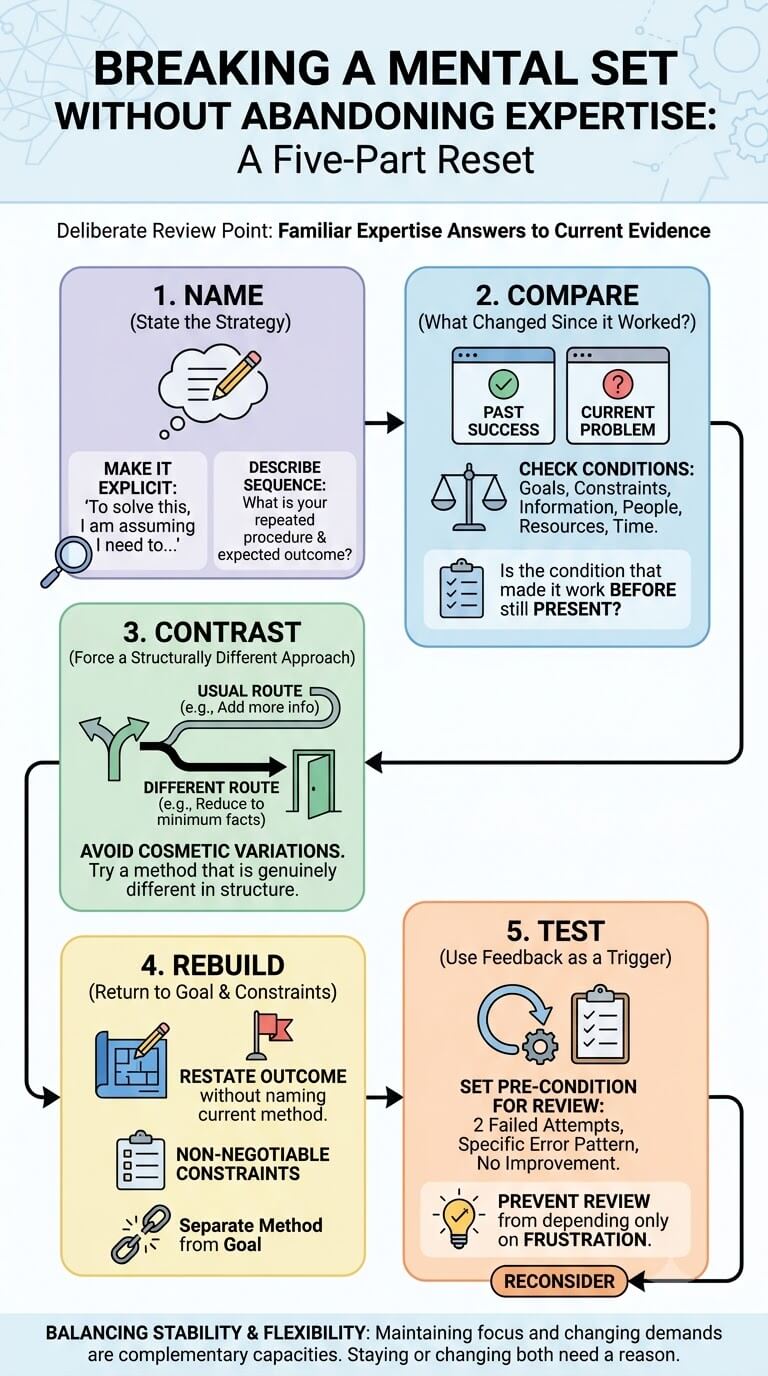
The goal is not to become suspicious of every routine. It is to create a deliberate review point where familiar expertise has to answer to current evidence. A simple five-part reset is: Name, Compare, Contrast, Rebuild, Test. Name the assumed strategy, compare the current situation with the one where it worked, contrast it with a genuinely different route, rebuild from the present goal and constraints, then test what the new attempt teaches you.
State the Strategy You Are Assuming
Write the procedure as a sentence: “To solve this, I am assuming I need to…” Making the strategy explicit separates it from the problem itself. “We need more meetings” becomes “I am assuming more meetings will improve coordination.” The second statement is easier to examine.
If you cannot name the strategy, describe the sequence you keep repeating. What do you do first, second, and third? What outcome do you expect each step to produce?
Ask What Has Changed Since the Strategy Last Worked
Compare the current problem with the earlier successful case. Look at goals, constraints, available information, people involved, time pressure, resources, and the definition of success. Surface similarity is not enough.
A useful prompt is: “Which condition made this strategy work before, and is that condition still present?” This keeps respect for experience while testing whether the experience actually transfers.
Force One Structurally Different Approach
Do not generate five cosmetic variations of the same method. If your usual route is “add more information,” try reducing the problem to the minimum facts. If your usual route is “optimize the existing process,” ask what replacing the process would look like. If your usual route is “solve alone,” ask what information another person has that you do not.
The alternative does not need to be better. Its purpose is to make genuine comparison possible.
Return to the Goal and Constraints Instead of the Familiar Procedure
When people become attached to a method, the method can quietly replace the goal. A team starts by wanting faster customer responses and ends up defending a ticketing workflow. A learner starts by wanting durable understanding and ends up defending a favorite study routine.
Restate the desired outcome without naming the current method. Then list the non-negotiable constraints. This often reveals that several routes could satisfy the goal, including some that were invisible while the familiar procedure dominated attention.
Use Feedback as a Trigger for Strategy Review
Set a condition in advance for reconsideration: two failed attempts, a specific error pattern, no improvement after a defined period, or new evidence that contradicts the original assumption. This prevents strategy review from depending entirely on frustration.
Research on cognitive control emphasizes that adaptive behavior involves both maintaining focus and changing task demands when circumstances shift. A review of task focus and task switching describes stability and flexibility as complementary capacities rather than opposites. In everyday problem solving, the practical lesson is similar: staying with a method and changing a method are both useful, but each needs a reason.
A Short Mental-Set Self-Check
You do not need a formal test to notice possible strategy fixation. These questions are most useful after a method has produced weak or confusing feedback, especially when you feel pulled to repeat it automatically.
Am I Repeating a Method Because It Fits or Because It Is Familiar?
List the evidence that the strategy fits the current problem. “It worked last time” is evidence, but it is not the only kind you want. Add current observations: what is similar, what is different, and what result the latest attempt produced.
What Evidence Would Make Me Try a Different Strategy?
If the answer is “nothing,” the method has become difficult to test. Decide in advance what would count as meaningful disconfirmation. That could be repeated failure, a newly discovered constraint, a lower-cost alternative, or feedback from someone who sees a part of the problem you do not.
Is There a Simpler Move I Have Not Tested?
Complexity sometimes hides inside expertise. Ask whether the goal can be reached with fewer assumptions, fewer steps, or a smaller first experiment. A simpler option is not automatically superior, but comparing it with the established method can expose unnecessary structure that accumulated over time.
When Strategy Fixation Turns Into a Broader Stuck Loop
Mental set is one specific reason people get stuck, but it rarely operates in isolation. A familiar strategy can combine with incomplete information, emotional pressure, sunk effort, unclear goals, or a misleading representation of the problem. That combination can make changing course feel harder than the evidence alone would predict.
Barriers Can Stack With Mental Set
Consider someone trying to solve a work problem under a deadline. They may default to an old strategy because it is familiar, ignore new information because attention is overloaded, and resist changing course because several hours have already been invested. The result looks like stubbornness, but several mechanisms may be contributing at once.
This is why labeling yourself “rigid” is usually less helpful than locating the bottleneck. Is the strategy familiar? Is key information missing? Is the goal unclear? Are you too overloaded to compare alternatives? Different barriers call for different resets.
Reframing or Re-Representation May Open a New Route
Sometimes the strategy is not the only thing that needs to change. You may need to redefine the problem or rebuild your understanding of its structure. If you keep asking, “How do I make this old process faster?” the deeper question may be, “Which outcome is this process supposed to produce, and what other systems could produce it?”
That shift changes more than the next move. It changes what counts as a possible solution. When repeated strategy switching still leads back to the same dead end, revisiting how the problem is framed or represented can be more productive than generating another variation of the same plan.
FAQ
These questions address the distinctions that most often create confusion when people first encounter the idea of mental set.
Is Mental Set Always Harmful?
No. A mental set can make familiar tasks faster by letting you reuse a procedure that has worked before. It becomes costly when the current problem differs in an important way and the familiar strategy prevents serious consideration of better alternatives. The aim is not to eliminate familiar methods, but to keep them responsive to evidence.
What Is the Einstellung Effect?
The Einstellung effect is a well-known example of mental set in which a previously successful solution method biases later problem solving. People may continue to use, search for, or attend to the familiar route even when a simpler or more effective solution is available. Laboratory findings illustrate the mechanism, but they should not be used to label every repeated everyday behavior as irrational.
How Is Mental Set Different From a Habit?
A habit is a broader pattern in which a behavior becomes likely in response to familiar cues. Mental set is narrower in this context: it concerns the way a person approaches a problem, particularly the strategy or rule they expect to use. A habitual routine can contribute to a mental set, but the two concepts are not identical.
Can Expertise Make Mental Set Stronger?
It can in some situations because expertise makes useful patterns and solutions easier to recognize and retrieve. That same advantage can make an early familiar answer especially compelling. This does not mean experts are generally worse problem solvers. It means strong knowledge works best when paired with a willingness to test whether the familiar solution still fits the current structure of the problem.
Key Takeaways
- A mental set is a readiness to reuse a familiar problem-solving strategy, often because that strategy succeeded before.
- The same mechanism can be efficient in stable situations and restrictive when the task, goal, or constraints have changed.
- Mental set fixes the strategy or procedure, while functional fixedness narrows how an object or resource is seen.
- Persistence remains adaptive when feedback can change the route; fixation keeps repeating the route despite evidence to reconsider.
- A practical reset is to name the assumed strategy, compare past and present conditions, test a structurally different approach, and define when feedback should trigger review.
- If changing tactics still leads to the same dead end, the problem may also need to be reframed or represented differently.

Michael Reed is the Founder and Lead Writer at Psychology Exposed. He writes about human behavior, relationships, emotional patterns, self-awareness, and practical psychology topics using research-informed, easy-to-understand content.
Read More About Michael Reed: https://psychologyexposed.com/michael-reed/