
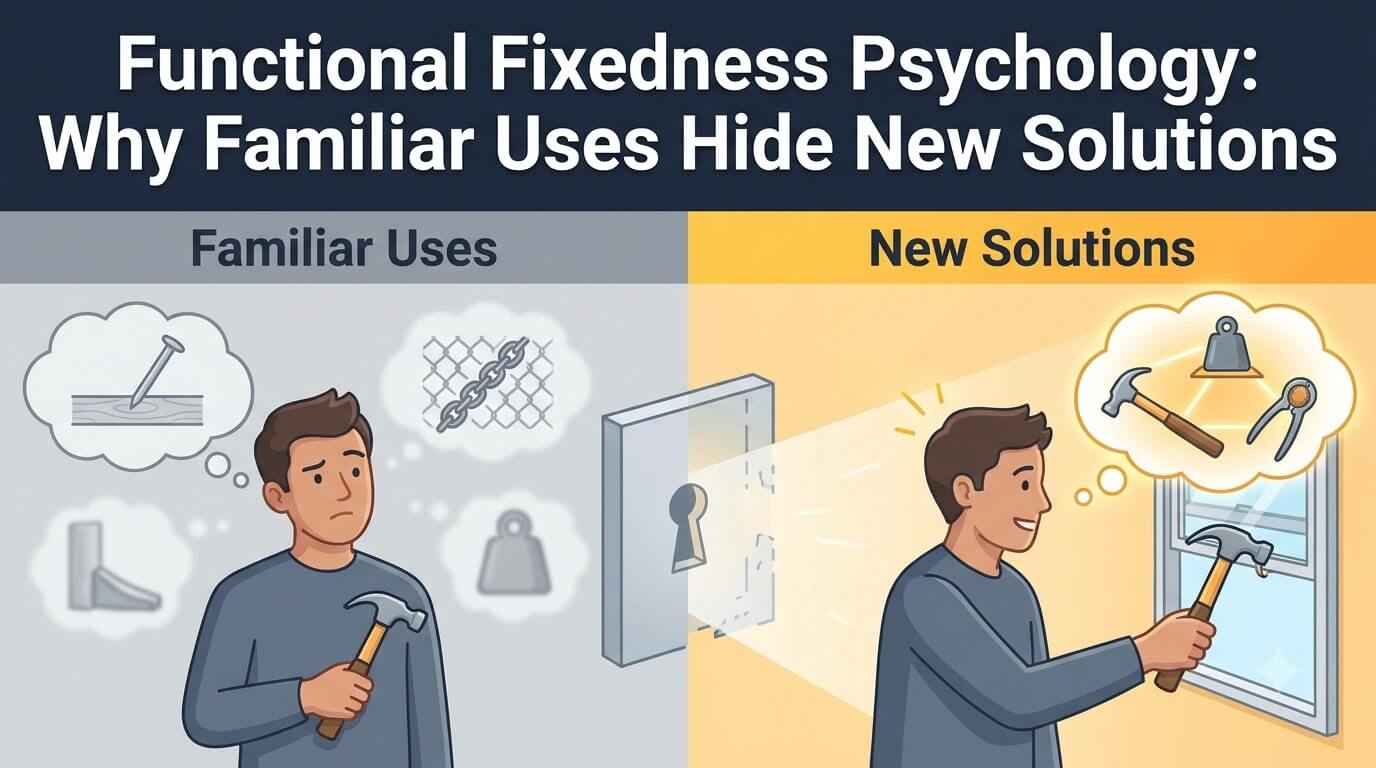
You can have everything needed to solve a problem sitting in front of you and still fail to see the solution. The missing piece is sometimes not a new tool, more information, or greater effort. It is a different way of seeing what the available tool can do.
Functional fixedness is one of several constraints on problem solving, so it is most useful as a diagnosis when resource use, rather than the entire strategy, has become narrow.
Functional fixedness describes this kind of constraint. A familiar object, process, space, or other resource becomes mentally tied to its usual purpose, so alternative functions are harder to notice. A box looks like a container. A paper clip looks like something for holding papers together. A meeting room looks like a place for meetings. Those familiar meanings are useful most of the time, but they can narrow problem solving when the current situation requires an unusual use.
The concept is especially helpful when you keep thinking, “I do not have what I need,” even though the relevant properties may already be available in a form you have not considered. The aim is not to become unconventional for its own sake. It is to separate what something is usually for from what it is physically or practically capable of doing.
Quick Answer

Functional fixedness is the tendency to see an object or resource mainly through its familiar function, which can make alternative uses harder to notice during problem solving. It differs from a mental set: mental set fixes you on a familiar strategy, while functional fixedness fixes you on what a particular resource is “for.” A useful reset is to describe properties and possible actions before returning to the usual label.
What Functional Fixedness Means
Functional fixedness is a specific obstacle in problem solving. The resource is available, but its conventional use dominates how it is represented. Research describes the effect as focusing on a common function while overlooking another function that could help solve the problem. A peer-reviewed article available through PubMed Central summarizes the idea using classic object-use problems in which a familiar function interferes with noticing a useful alternative.
This is an ordinary feature of learned knowledge, not evidence that a person lacks intelligence or imagination. Knowing what objects are for makes daily life efficient. You do not need to reconsider every possible function of a spoon before eating soup. The difficulty appears when the usual function remains mentally dominant after the problem has changed.
Familiar Function Becomes the Default Representation
Objects arrive with histories. You have seen keys open locks, cups hold drinks, folders organize files, and chairs support sitting. Repeated use creates strong associations between an object and the actions normally performed with it. When the object appears, the familiar function often comes to mind faster than unusual possibilities.
That default is normally helpful because it reduces search. If you need to tighten a screw and see a screwdriver, the conventional function is exactly what matters. Functional fixedness becomes relevant when the goal requires a property that the object has, but that property is overshadowed by the object’s usual purpose.
The Resource Is Present but Its Alternative Use Is Not Mentally Available
Imagine you need to keep a lightweight door from closing while you carry several boxes through it. You do not have a doorstop. You may scan the room and conclude that no suitable tool exists, even though a thick rubber-soled shoe, a folded piece of cardboard, or another stable object could provide the friction or wedge shape required.
The crucial distinction is between physical availability and mental availability. The object is there, but the useful function has not entered consideration. That is why simply “looking harder” can fail. More attention to the same labels may strengthen the same interpretation instead of expanding it.
The Classic Logic Behind Functional Fixedness
The best-known demonstrations of functional fixedness use simple objects precisely because the problem does not require specialized knowledge. The solver usually understands the goal and possesses the necessary materials. What blocks progress is how one of those materials is being interpreted.
The Duncker Candle Problem as an Illustration
Karl Duncker’s candle problem is the classic example. Participants are asked to attach a candle to a wall using materials that include a candle, matches, and a box of thumbtacks. One solution requires emptying the box, attaching it to the wall, and using the box as a platform for the candle. The challenge is that the box is easily represented as a container for tacks rather than as a flat support.
Modern reviews still use this task to illustrate how prior knowledge can interfere with an unusual object use. A review of insight research in PubMed Central describes Duncker’s work as showing that making an object’s usual use salient can reduce success when a different use is required.
The candle task matters because the solution does not depend on obtaining a new resource. The shift occurs when the solver stops treating the box’s customary role as its only relevant role.
Why Labels and Prior Use Can Narrow Perception
A label compresses many features into a convenient category. Calling something a “box” highlights containment, while properties such as flatness, rigidity, edges, weight, surface area, or ability to be attached may receive less attention. The label is not wrong. It is simply selective.
Prior use can make that selectivity stronger. If you just used a container to hold something, its containment function is especially active. Studies of object-use cognition show that familiar or canonical functions can constrain nonstandard uses. A Frontiers in Psychology discussion of alternative object use distinguishes an object’s culturally expected function from other operations its physical properties may permit.
How Functional Fixedness Develops in Everyday Thinking
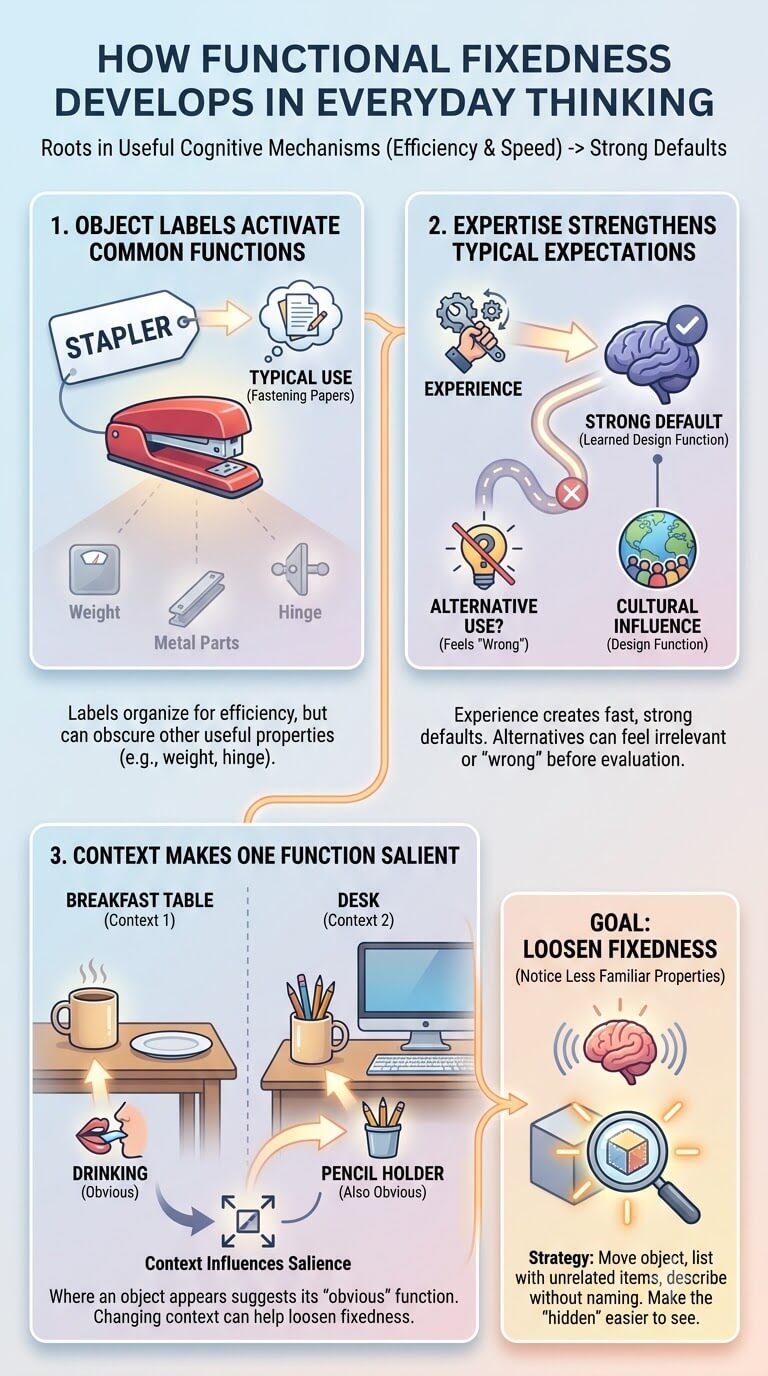
Functional fixedness is not simply “being closed-minded.” It grows from mechanisms that are often useful: learning object categories, remembering successful interactions, using context to predict what matters, and relying on expertise. These mechanisms help people act quickly. They also make some interpretations much easier to retrieve than others.
Object Labels Activate Common Functions
When you hear “stapler,” “calendar,” or “bookshelf,” a familiar purpose comes with the word. The label organizes knowledge about how the object is normally used. This can be efficient because you rarely need a complete inventory of every property each time you encounter it.
But a problem may care about properties the category name hides. A stapler has weight, a flat base, a hinge, and metal parts. A calendar is also a grid, a sequence, and a visual allocation of space. A bookshelf is also a series of horizontal surfaces at different heights. Describing those properties does not guarantee a useful idea, but it broadens what can be considered.
Expertise Can Strengthen Typical-Use Expectations
Experience usually improves tool use because it teaches what works. Yet expertise can also strengthen expectations about proper function. A highly practiced user may recognize an object’s standard role so quickly that alternative uses feel irrelevant or even “wrong” before they are evaluated.
Research across different cultural settings suggests that learned design function can exert a strong influence on problem solving. In a study indexed by the U.S. National Library of Medicine, functional fixedness appeared even in a technologically sparse culture, supporting the idea that knowledge about an artifact’s intended function can meaningfully shape how people think about using it.
This does not mean expertise necessarily harms flexible thinking. The more accurate conclusion is that strong knowledge creates strong defaults. Skilled problem solving sometimes requires knowing when to suspend those defaults long enough to inspect other properties.
Context Makes One Function More Salient Than Others
The same object may suggest different possibilities depending on where it appears. A ceramic mug on a breakfast table strongly suggests drinking. The same mug on a desk may also be seen as a pencil holder. A stack of books in a library suggests reading material, while beside a wobbly monitor stand it may suggest height or support.
Context therefore influences which functions feel obvious. If you want to loosen fixedness, changing the physical or mental context can help. Move the object away from where it is normally used, list it among unrelated items, or describe it without naming its category. The goal is to make less familiar properties easier to notice.
Everyday Examples Beyond Physical Objects

The clearest research examples involve physical artifacts, but the same practical lesson can be applied cautiously to other resources: familiar labels can narrow what you consider possible. The analogy should not be stretched into a claim that every rigid assumption is technically functional fixedness. It is more useful as a way to inspect whether a conventional role is hiding an available function.
Tools Used Only for Their Marketed Purpose
A phone tripod is marketed for holding a phone, but its useful properties may include adjustable height, a stable base, a clamp, and an angle-changing joint. In a harmless home setup, one of those properties might help hold a lightweight light, position a small card, or keep a camera reference at eye level, provided the equipment is compatible and stable.
Likewise, spreadsheet software may be thought of only as a place for calculations, even though its grid and sorting features can support simple planning or comparison. A note-taking app may be seen only as a writing tool even though tags and links can help map a process. The fixedness lies in allowing the marketed identity to define the entire capability set.
Space, Time, or People Treated as Fixed Resources
A room labeled “conference room” may sit unused for most of the day while someone believes they have no quiet place for concentrated work. A 20-minute gap may be dismissed because it is “not enough time to work,” even though it could be enough to prepare materials, review a short document, or complete a clearly bounded task.
With people, the idea needs more care. People are not tools to be repurposed. The useful question is whether a rigid role assumption is hiding someone’s voluntary skills or perspective. A teammate known for design may also have strong customer knowledge. A family member who usually handles logistics may not need to remain the default organizer forever. Any change should respect consent, workload, capability, and boundaries.
Information or Processes Seen Only in Their Usual Role
A customer complaint may be treated only as something to resolve, when it can also reveal where instructions are confusing. A failed prototype may be treated only as wasted effort, when it can reveal which constraint matters most. A routine checklist may be seen only as a compliance step, when its repeated entries could reveal where a process commonly breaks.
Here the resource is not an object but information already generated by the system. The useful shift is from “What is this normally used for?” to “What information, structure, or capability does this already contain?”
Functional Fixedness vs Mental Set
Functional fixedness and mental set are closely related because both allow prior experience to narrow problem solving. They are not interchangeable. The fastest way to separate them is to ask what has become fixed: the function of a resource or the strategy used to solve the problem.
Fixed Function Versus Fixed Strategy
| Question | Functional Fixedness | Mental Set |
|---|---|---|
| What is restricted? | What an object or resource is seen as capable of doing | Which procedure or strategy the solver keeps using |
| Typical thought | “That is a container, not a platform.” | “This method worked before, so I should keep using it.” |
| Useful reset | Describe properties and alternate functions | Compare the familiar strategy with structurally different approaches |
| What may remain unchanged? | The overall strategy may be fine once a resource is seen differently | The resources may be understood correctly while the procedure remains stuck |
A person can experience either one without the other. You might know exactly what every tool can do but keep applying the same ineffective procedure. Or you might be willing to change strategies yet still overlook a needed use because one object’s familiar function remains dominant.
An Example Where Both Create the Same Dead End
Suppose a small team wants to display printed cards upright for a temporary event. They keep trying variations of tape because tape is their familiar mounting strategy. That is a mental-set problem if they continue changing tape arrangements while ignoring other strategies.
At the same time, several large binder clips are on the table, but everyone sees them only as devices for holding paper together. They do not consider that an opened clip can act as a small stand. That is functional fixedness. The two effects can reinforce each other: one narrows the method, while the other narrows the perceived use of available materials.
Functional Fixedness vs Creativity Psychology
Because overcoming functional fixedness sometimes produces an unusual idea, the topic can sound like a general lesson in creativity. That would be too broad. Functional fixedness describes one specific constraint: a conventional function is preventing another useful function from being considered.
This Concept Focuses on a Specific Obstacle in Problem Solving
The relevant question is not “How creative am I?” It is “Am I treating the usual function of this particular thing as though it were the only function that matters?” That makes the concept useful even in ordinary, noncreative tasks such as troubleshooting, organizing a workspace, adapting a process, or improvising with limited materials.
A person can be highly imaginative in one domain and still become functionally fixed in another. Fixedness depends partly on what knowledge is active in a specific situation, not on a global creative identity.
Divergent Thinking and Creativity Training Belong Elsewhere
Broad creativity work may involve generating many ideas, combining distant concepts, exploring aesthetic possibilities, or developing originality. Those are larger topics. In functional fixedness, the problem is narrower: one familiar use is dominating attention so strongly that an alternative function fails to enter the solution set.
This distinction also keeps the practical response focused. You do not need to brainstorm fifty wild ideas. Often you need to inspect one overlooked property of one available resource.
Ways to Loosen Functional Fixedness
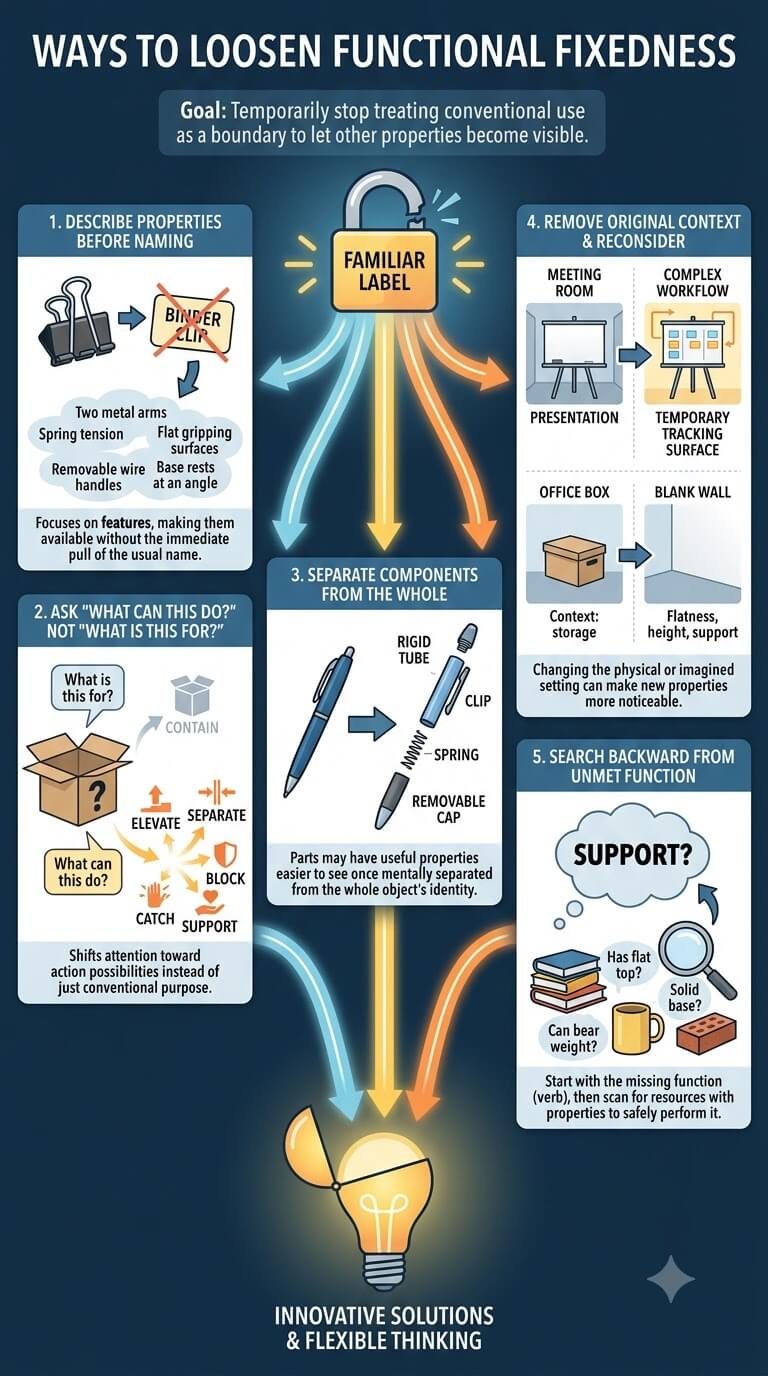
The most useful techniques reduce the grip of a familiar label long enough for other properties to become visible. The goal is not to discard conventional knowledge. It is to temporarily stop treating conventional use as a boundary.
Describe Properties Before Naming the Object
Take the object you are overlooking and describe it without using its name. Instead of “binder clip,” try: two metal arms, spring tension, flat gripping surfaces, removable wire handles, and a base that can rest at an angle. Instead of “mug,” try: rigid hollow cylinder, open top, handle, flat base, heat-resistant material.
This works because names often imply functions. A property description makes features available without immediately pulling you back to the usual use. Research on functional fixedness has explored similar ideas by training people to reconsider possible functions. An experimental study indexed in PubMed found that training designed to promote representation change improved solution rates on functional-fixedness problems, although transfer was specific to the trained type of problem.
Ask What the Resource Can Do, Not What It Is For
“What is this for?” invites the conventional answer. “What can this do?” shifts attention toward action. A box can contain, elevate, separate, protect, block, catch, or support. A rubber band can bind, create tension, provide friction, mark a position, or store a small amount of elastic energy.
Keep the list realistic. The exercise is useful because it broadens function, not because every possibility deserves testing. If a proposed use involves heat, electricity, pressure, chemicals, food safety, structural loads, moving machinery, or other hazards, use purpose-built equipment or qualified guidance rather than improvising.
Separate Components From the Whole
An object’s standard identity often belongs to the whole object. Its parts may have useful properties that are easier to see once mentally separated. A pen is a writing instrument, but it also contains a rigid tube, a clip, a spring in some designs, and a removable cap. A cardboard shipping box is packaging, but it is also several flat panels, folds, edges, and strips of corrugated material.
This idea has been tested directly. Research on the generic-parts technique examined whether decomposing objects and noticing less obvious features could help people overcome functional fixedness in problem tasks. The practical lesson is simple: if the whole object’s name is too restrictive, zoom in.
Remove the Original Context and Reconsider Available Functions
Move the object physically if possible, or imagine it in a different setting. A box filled with office supplies strongly signals storage. The same empty box beside a wall may make flatness, height, or support more noticeable. A whiteboard in a meeting room suggests presentation; imagined beside a complicated workflow, it may suggest a temporary visual tracking surface.
You can also change the verbal context. Instead of asking, “Which office item solves this?” ask, “What do I have that is rigid?” or “What can create separation?” The new question sorts resources by required property rather than category.
Look for an Unmet Function, Then Search Resources Backward
Sometimes the best reset begins with the problem rather than the object. State the missing function in plain verbs: support, absorb, connect, separate, signal, raise, protect, hold, redirect, measure, compare, or contain. Then scan the environment for anything with properties that could safely perform that function.
This reverses the usual search. Instead of moving from object to conventional use, you move from required action to possible resource. It is particularly helpful when you keep saying, “I need a special tool,” because it forces you to specify what the special tool would actually need to accomplish.
A Resource-Reframing Exercise

Use this short exercise when a problem seems blocked by lack of equipment or resources. It is designed for ordinary, low-risk situations, not for repairs or improvisations where failure could cause injury, electrical damage, fire, contamination, or structural harm.
List Available Resources Without Their Usual Labels
Write down three to five things available to you. For each one, avoid the common noun on the first pass. Describe material, shape, movement, size, surface, strength, flexibility, information contained, or actions it allows.
For example, instead of “calendar,” write “dated grid with visible empty and occupied spaces.” Instead of “books,” write “stackable rigid rectangles of several thicknesses.” Instead of “unused meeting room,” write “enclosed reservable space with a table, chairs, power outlets, and a door.”
Match Properties to the Function the Problem Requires
Now define the missing function in one short sentence. “I need to raise this lightweight screen by five centimeters.” “I need to make this workflow visible at a glance.” “I need a quiet 30-minute place for focused review.”
Compare the required action with your property descriptions. Do not ask whether the resource was intended for the task. Ask whether its relevant properties fit the requirement safely and without creating a larger problem.
Test One Unconventional but Realistic Use
Choose the lowest-risk option that is easy to reverse. A useful test should teach you something even if it does not become the final solution. If it works partly, note which property helped and which requirement is still unmet. If it fails, update the function you are searching for rather than returning automatically to the old label.
A compact way to remember the process is Function → Properties → Components → Required Action → Safe Test. First notice the familiar function, then describe properties, break the resource into parts if needed, define the action the problem requires, and test only options that are sensible for the context.
How Representation Changes Can Lead to Insight
Functional fixedness sits at an interesting point between how a problem is mentally represented and the sudden feeling of seeing a solution. A solver may understand the goal perfectly but still encode one object too narrowly. Changing that single representation can reorganize the available options very quickly.
New Representations Can Expose Hidden Functions
If “box of tacks” becomes “small rigid platform plus removable fasteners,” the problem space changes even though the physical materials do not. If “complaint” becomes “information about a failure point,” a process problem may reveal a new use for data already being collected.
This is why re-description can be more powerful than simply generating more ideas. If the underlying representation remains fixed, brainstorming often produces variations that respect the same hidden constraint. Change the representation, and a different family of solutions may become available.
A Changed Function Can Trigger an Aha Experience
Sometimes the new use appears suddenly. You stop seeing the box as a container and immediately see it as a platform. That subjective “Aha” can feel mysterious, but the useful change may be quite concrete: a previously suppressed or overlooked function has become available.
Not every solution arrives through insight, and not every insight is correct. The important point is that suddenness does not remove the need for testing. A surprising use still has to meet the real constraints of the problem.
FAQ
These questions address the distinctions that most often cause confusion when people first encounter functional fixedness.
Is Functional Fixedness the Same as Being Uncreative?
No. Functional fixedness concerns a specific situation in which a familiar function limits what you notice about an object or resource. Creativity is much broader and can involve originality, idea generation, artistic expression, design, recombination, or discovering new relationships. Someone can be creative overall and still become fixed on the standard use of a familiar tool in a particular task.
Can Functional Fixedness Apply to Ideas as Well as Objects?
The classic research concept is most directly associated with objects and tools. In everyday reasoning, a similar function-based narrowing can occur with processes, information, spaces, or roles, but it is better to treat those as practical extensions rather than assume every rigid interpretation is the same laboratory phenomenon. The most useful test is whether a familiar purpose is hiding another relevant capability.
Why Does Naming an Object Sometimes Make Fixedness Stronger?
Names help retrieve category knowledge, including what the object is normally used for. That makes everyday action fast, but it can also foreground the conventional function while less typical properties receive less attention. Describing shape, material, movement, components, or physical effects before naming the object can temporarily reduce that pull.
What Is the Difference Between Functional Fixedness and Mental Set?
Functional fixedness concerns what a resource is seen as being able to do. Mental set concerns which strategy or procedure you keep applying. In one case, the alternative use of an available object is hidden. In the other, alternative methods of solving the problem are underexplored. Both can occur at the same time, but they point to different resets.
Key Takeaways
- Functional fixedness makes a familiar function dominate how an object or resource is understood, which can hide useful alternative functions.
- The problem is often not lack of resources but failure to notice a relevant property, component, or capability of something already available.
- Functional fixedness differs from mental set: one fixes the perceived function of a resource, while the other fixes the strategy used to solve the problem.
- Useful resets include describing properties before labels, separating an object into components, changing context, and searching backward from the function the problem requires.
- Overcoming fixedness does not require constant novelty or broad creativity training. Often one overlooked property is enough to open a new route.
- Alternative uses still need practical judgment. Unconventional does not automatically mean safe, appropriate, or better.

Michael Reed is the Founder and Lead Writer at Psychology Exposed. He writes about human behavior, relationships, emotional patterns, self-awareness, and practical psychology topics using research-informed, easy-to-understand content.
Read More About Michael Reed: https://psychologyexposed.com/michael-reed/