

You know something needs to change, but what kind of thinking does the situation actually require? Sometimes you need to invent a workable path because none is obvious. Other times you already have several reasonable options and the real task is choosing between them. Treating those two situations as the same can create unnecessary work.
Both processes may involve reasoning, judgment, uncertainty, memory, and feedback. The difference is the immediate job your mind is trying to do. Problem solving works toward a usable path when the route is blocked or unclear. Decision making selects among alternatives that are already concrete enough to compare.
Many real-life situations contain both processes. The useful skill is noticing when you are trying to create options, when you are trying to choose among them, and when you need to move back and forth between the two.
Quick Answer
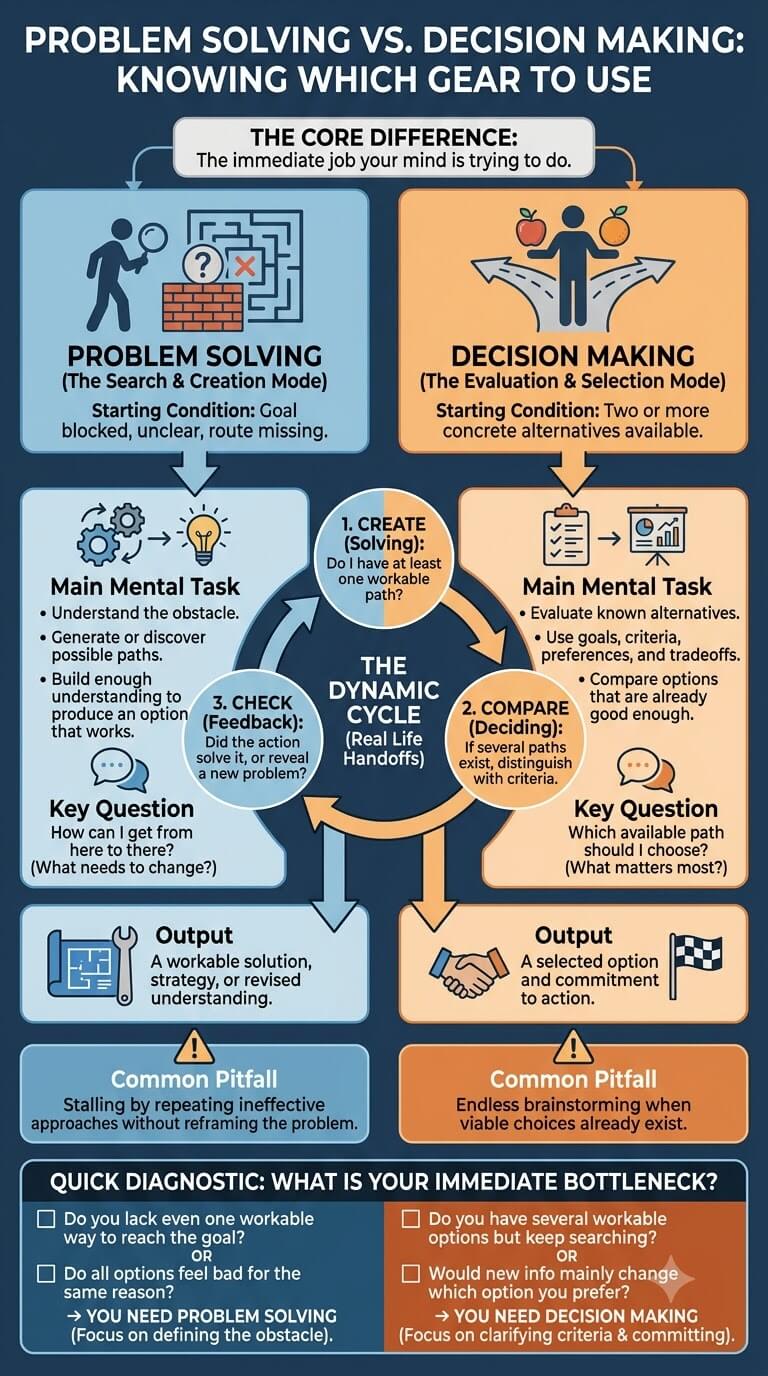
Problem solving is mainly about finding or creating a workable way forward when the path is missing, blocked, or unclear. Decision making is mainly about choosing among two or more alternatives. In everyday life, they often happen in sequence: you solve enough of the problem to create viable options, then decide which option to use.
The Core Difference in One Sentence
The cleanest distinction is this: problem solving asks, “How can I get from here to there?” while decision making asks, “Which available path should I choose?”
That distinction matches the way the APA Dictionary of Psychology defines problem solving, as a process of overcoming difficulties or moving from a starting situation toward a desired goal.
By contrast, the APA Dictionary definition of decision making centers on choosing between two or more alternatives. The two definitions overlap in everyday reasoning, but they place the immediate task in different places.
Problem solving creates or discovers a workable path
Imagine that your laptop keeps disconnecting from Wi-Fi during video calls. You do not yet have a clear set of viable solutions. You need to work out what is happening, what conditions matter, and what actions might fix it. You may check whether the problem appears on another network, restart the router, test a wired connection, update a driver, or compare what happens on another device.
The central task is not choosing the “best” option from a stable menu. It is building enough understanding to produce an option that actually works. Each attempt can reveal information about the problem, which may change what you try next.
Decision making selects among alternatives
Now suppose you discover that the laptop hardware is failing and repair is not worthwhile. You have narrowed the situation to three realistic replacements that all meet your basic needs. The task has changed. You are no longer searching for a way to make the old machine reliable. You are comparing price, battery life, weight, performance, warranty, and perhaps how long you expect to keep the new device.
At this stage, generating twenty more laptop models may make the task worse rather than better. The useful move is to decide which criteria matter most and make a choice among options that are already good enough to consider.
A Side-by-Side Psychological Comparison

The boundary becomes easier to see when you compare the two processes by what they start with, what they require, and what counts as progress.
| Feature | Problem Solving | Decision Making |
|---|---|---|
| Starting condition | A goal is blocked, unclear, or lacks a workable path | Two or more alternatives are available for comparison |
| Main cognitive task | Understand the obstacle and generate or discover possible ways forward | Evaluate alternatives using goals, criteria, preferences, and tradeoffs |
| Typical output | A workable solution, strategy, test, or revised understanding | A selected option or course of action |
| Role of feedback | Often helps reveal whether the problem model or strategy needs to change | May change later choices or show that the selected option needs revision |
| Common failure mode | Repeating an ineffective approach or solving the wrong version of the problem | Comparing poorly defined options or using criteria that do not match the goal |
Starting condition
A problem-solving task usually begins with a gap between the present situation and a desired one, without a clear route between them. A student cannot make an argument work, a team is missing deadlines without knowing why, or a household cannot identify where meaningful savings are possible.
A decision task begins with alternatives that are concrete enough to compare, such as choosing between two class times, vendors, or apartments that already meet basic requirements.
Primary cognitive task
Problem solving asks the mind to search, represent, test, combine, revise, or restructure. Decision making asks the mind to evaluate. Those activities overlap, but they place attention in different places.
Research on option generation in decision research highlights an important bridge between them: alternatives do not always arrive ready-made. People often have to mentally generate candidate actions before they can evaluate or choose among them. That is one reason the boundary can feel blurry in everyday situations.
Typical output
The output of problem solving is often something that was not clear at the start: a route, revised plan, testable explanation, or workable strategy. The output of decision making is commitment to an alternative, even though implementation and later revision may still follow.
Role of uncertainty and feedback
Both processes involve uncertainty, but uncertainty serves different roles. In problem solving, uncertainty often concerns the structure of the problem itself: what is causing it, what information is missing, which constraints are real, or which actions might work. Testing is valuable because the result can improve your understanding.
In decision making, uncertainty may concern consequences, probabilities, tradeoffs, or future preferences. The alternatives may be known even though their outcomes are not. This difference matters because “I do not know what will happen” is not the same as “I do not yet have a workable way forward.”
Common failure mode
Problem solving often stalls when a person keeps attacking the same interpretation with slightly different versions of one strategy. Decision making often stalls when someone keeps generating alternatives even though the real challenge is comparison.
Ask: Would one more option help me, or would clearer criteria help me more? The answer often reveals whether the bottleneck is still solving or has shifted to choosing.
When a Situation Is Mainly a Problem-Solving Task

The clearest signal is that you cannot yet point to a viable route and say, “Any of these could work.” Before comparison becomes useful, the situation needs enough structure to produce at least one credible path forward.
The path is missing or blocked
A situation is mainly a problem-solving task when you cannot yet see a reliable route from the current state to the desired state. The obstacle may be practical, informational, technical, social, or conceptual.
Suppose a small business receives plenty of website visits but very few inquiries. “Should we use the blue button or the green button?” is a choice, but it may be premature. The deeper problem is that the team does not yet understand where visitors lose confidence or what prevents them from taking the next step. Before choosing a button color, they may need to investigate the page, message, offer, load time, trust signals, or contact process.
Here, the best next move is a test that teaches something about the obstacle, not a preference-based choice between two surface-level options.
The problem itself may need representation or reframing
Sometimes the difficulty is not a shortage of effort. The person is solving a version of the problem that is incomplete or misleading. “How do I fit everything into my day?” sounds like a scheduling problem. But if the workload exceeds the hours available even under an efficient schedule, the real problem may concern priorities, commitments, staffing, expectations, or what can be dropped.
Changing the question changes the set of possible actions. This is not the same as simply choosing among alternatives. It happens before useful alternatives are fully visible.
Examples from work, learning, and everyday life
| Situation | Why it is mainly problem solving | Useful next question |
|---|---|---|
| A report keeps taking twice as long as expected | The cause of delay is not known | Where does time actually disappear in the process? |
| A student rereads notes but still cannot explain the concept | The current study method is not producing understanding | What kind of practice would reveal what I do not understand? |
| A room feels cluttered despite repeated organizing | The storage approach may not fit the amount or type of possessions | Is the bottleneck placement, capacity, categories, or volume? |
| Two teams keep duplicating the same work | The workflow and responsibility boundaries are unclear | Where is ownership ambiguous? |
In each example, making a choice may eventually be necessary. But a good choice depends on first discovering what needs to be changed.
When a Situation Is Mainly a Decision Task
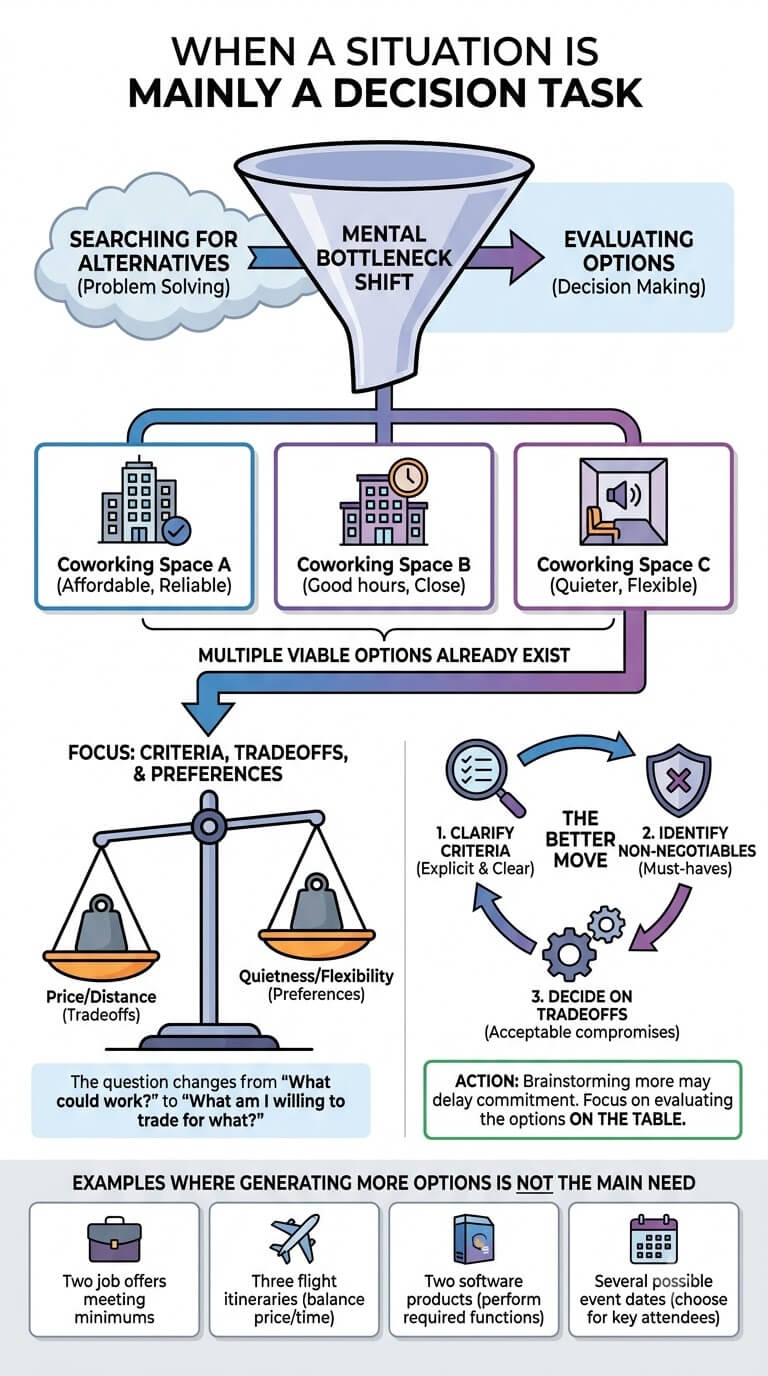
Once several alternatives can realistically meet the goal, the mental bottleneck changes. More searching may still uncover something better, but the immediate value often comes from evaluating the options already on the table.
Multiple viable options already exist
A situation is mainly a decision task when you already have alternatives that could reasonably satisfy the goal. The problem is not “Can anything work?” but “Which workable option fits best?”
For example, suppose you want a quieter place to work two days a week and you have identified three nearby coworking spaces. All three are affordable, have reliable internet, and offer the hours you need. You do not need to invent a fourth type of workplace before choosing. You need to compare the alternatives on the dimensions that matter to you.
Criteria, tradeoffs, and preferences become central
Choices become easier to reason about when the criteria are explicit. One option may be cheaper but farther away, another quieter but less flexible. The question changes from “What could work?” to “What am I willing to trade for what?” Adding more complexity does not necessarily improve the choice.
A classic distinction in an NCBI Bookshelf chapter on problem solving and decision making describes problem solving as moving from a present state toward a desired state, while decision making involves evaluating possible solutions and selecting one for implementation. The chapter is focused on learning and aging, but that conceptual distinction is useful well beyond that context.
Examples where generating more options is not the main need
- You have two job offers that both meet your minimum salary and role requirements.
- You have three flight itineraries and need to balance price, travel time, and arrival schedule.
- You have narrowed a software purchase to two products that both perform the required functions.
- You have several possible dates for an event and need to choose the one that works for the most important attendees.
In these cases, brainstorming more possibilities may delay commitment without solving a meaningful problem. The better move is to clarify criteria, identify non-negotiables, and decide what tradeoffs are acceptable.
When Problem Solving and Decision Making Happen in the Same Sequence
Most meaningful real-world tasks are not pure examples of one process. They contain handoffs. You generate possibilities, choose a test, learn something, revise the problem, choose again, and eventually commit to a course of action.
One recent open-access discussion of problem solving and decision making through the lens of bounded rationality revisits Herbert Simon’s distinction between the two while emphasizing adaptation and feedback. The practical lesson is not that every task follows one fixed order. It is that creating a path and choosing among paths are related but separable jobs.
Solve first, decide second
Suppose your monthly expenses are consistently higher than your income. At first, you may not know what changes are realistically available. You review recurring costs, identify flexible categories, find subscriptions you no longer use, explore refinancing, examine additional work hours, and estimate how much each change could contribute.
That is primarily problem solving because you are constructing workable paths to close the gap. Once you have three realistic plans, such as reducing discretionary spending, adding a small amount of freelance work, or combining smaller cuts across categories, the task shifts. Now you decide which plan best fits your time, stability, priorities, and tolerance for disruption.
Decide on a test, solve again after feedback
Sometimes a decision is embedded inside problem solving. A team trying to reduce customer support delays might generate three explanations: unclear documentation, uneven staffing, or too many tickets being routed to the wrong specialist. They decide which explanation to test first.
That choice does not end the larger solving process. The test produces evidence. If routing changes reduce delays only slightly, the team has learned something and returns to the problem with a better model. The next step may involve a different test, a revised explanation, or a combination of changes.
Why switching between modes matters
People lose time when they stay in one mode after the task has changed. A habitual brainstormer may keep generating possibilities after there are enough, while a quick chooser may commit before the problem is understood well enough to produce strong alternatives.
Use this three-part handoff:
- Create: Do I have at least one genuinely workable path?
- Compare: If I have several, what criteria distinguish them?
- Check: After acting, did the result solve the original problem or reveal a new one?
The sequence is simple, but it prevents a common mistake: judging options that should not yet be treated as final options.
A Simple Solve-or-Decide Diagnostic
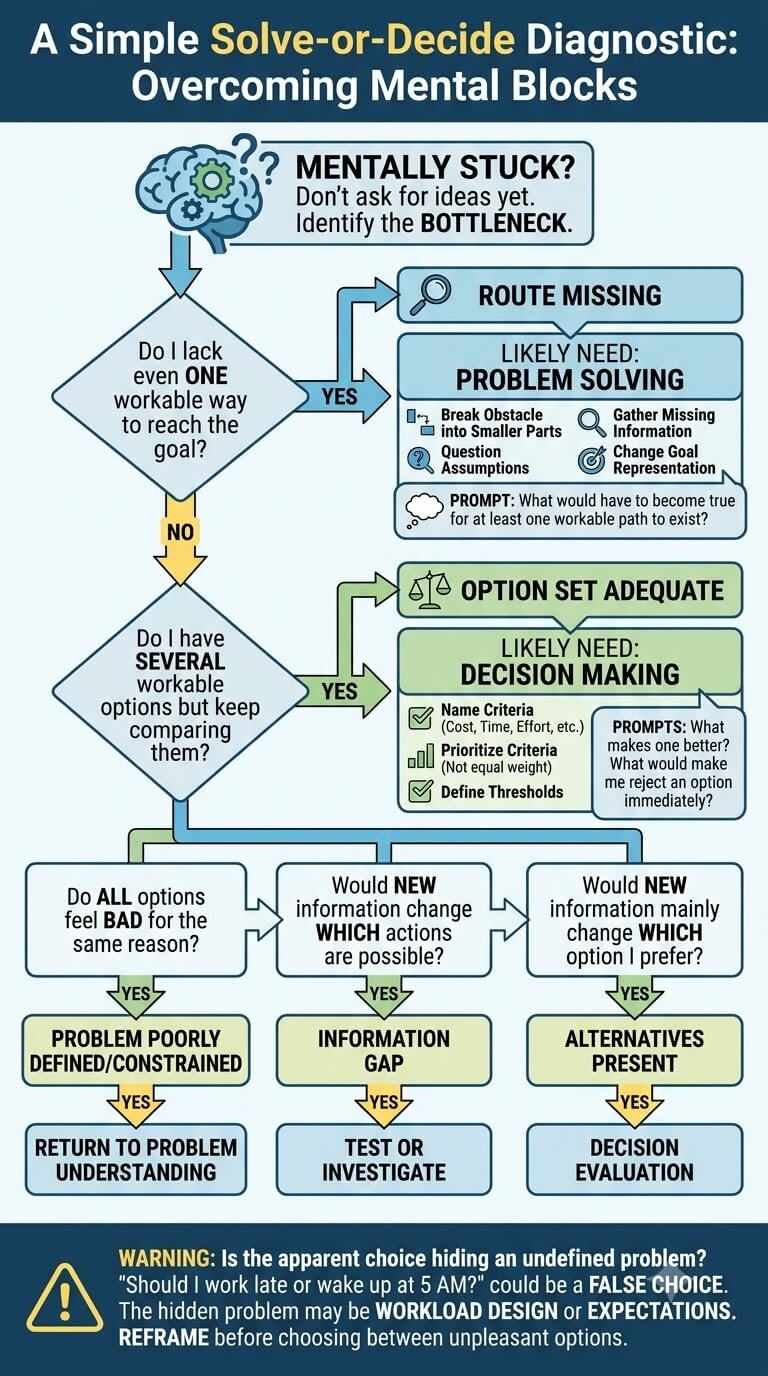
When you feel mentally stuck, do not immediately ask for more ideas or more certainty. First identify the kind of bottleneck you have.
| Question | If yes | Likely need |
|---|---|---|
| Do I lack even one workable way to reach the goal? | The route is still missing | Problem solving |
| Do I have several workable options but keep comparing them? | The option set is adequate | Decision making |
| Do all my options feel bad for the same reason? | The problem may be poorly defined or constrained | Return to problem understanding |
| Would new information change which actions are possible? | There is an information gap | Test or investigate |
| Would new information mainly change which existing option I prefer? | The alternatives are already present | Decision evaluation |
Do I lack a workable option?
If the answer is yes, comparison is premature. Your next step may be to break the obstacle into smaller parts, gather missing information, question an assumption, or change how you have represented the goal.
A useful prompt is: “What would have to become true for at least one workable path to exist?” That question directs attention toward constraints and missing conditions rather than forcing a choice from poor alternatives.
Do I already have options but need to choose?
If two or more alternatives could realistically work, ask what makes one better for this situation. Name the criteria before you continue comparing. Cost, time, reversibility, effort, reliability, values, and downstream consequences may matter, but not every criterion deserves equal weight.
You can also ask, “What would make me reject an option immediately?” This reveals thresholds. For example, if any commute above 45 minutes is unacceptable, a cheaper apartment that requires a 70-minute commute is not truly competitive, even if it looks attractive on price alone.
Is the apparent choice actually hiding an undefined problem?
Some “decisions” are false choices created by a narrow frame. “Should I work late tonight or wake up at 5 a.m.?” sounds like a decision. But if both choices are attempts to absorb a workload that is repeatedly impossible within normal hours, the hidden problem may be workload design, deadlines, delegation, or expectations.
Before choosing between two unpleasant options, ask whether they are the only meaningful alternatives or merely the first alternatives you noticed.
Common Mix-Ups That Waste Effort
Confusion between solving and deciding often looks like “thinking harder” without getting closer to action. The issue is not lack of intelligence or discipline. The person is applying a reasonable mental operation at the wrong stage of the task.
Comparing options before the problem is well defined
You want to improve team communication, so you compare Slack, Teams, and email rules. But what is actually failing? People may be missing decisions, unclear about ownership, overloaded by notifications, or unable to find past information. Different problems require different solutions.
Choosing a tool before naming the failure can produce a polished answer to the wrong question. Clarify what success would look like first, then decide whether a tool choice is even central.
Brainstorming endlessly when a choice is already ready
The opposite mistake is continuing to create alternatives because choosing feels uncomfortable. Imagine you need a meeting time and already have two slots that work for every essential participant. Looking for six more slots adds work but little value.
A sign that you have crossed from useful generation into avoidance is that new alternatives do not change the tradeoff. They simply create more items to compare.
Treating one preferred option as if it were the problem itself
This happens when the desired solution gets embedded in the problem statement. “How do I convince my manager to approve software X?” assumes software X is the answer. The underlying problem may be slow reporting, duplicate data entry, inconsistent records, or lack of visibility.
A broader statement such as “How can we reduce the time and errors in weekly reporting?” opens the possibility that software X is useful, but it also allows process changes, automation, role clarification, or a different tool to compete on merit.
Why Representation and Framing Come Before Either Process
Before you generate a solution or choose an option, your mind has already selected what seems relevant, what goal counts, and what constraints appear to matter. That setup quietly shapes everything that follows.
Why the same situation can create different option sets
The options you see depend partly on what you believe the problem is. If a café owner defines falling afternoon sales as “not enough advertising,” the obvious alternatives may be social ads, flyers, or promotions. If the same situation is defined as “not enough reasons for nearby workers to visit after lunch,” the options may include faster takeaway service, a quieter workspace, a different menu, loyalty offers, or partnerships with nearby offices.
The facts have not changed, but the mental structure has. This is why problem definition is not a trivial prelude to choosing. It shapes what becomes available to choose.
When a better frame changes both the solution and the later choice
A better frame does not guarantee a good outcome, but it can change the quality of the alternatives. Once the problem is represented more usefully, problem solving can generate paths that were previously invisible. Decision making can then compare those paths using criteria that actually match the goal.
That is also why the same situation can move backward. If every available option fails an essential requirement, you may not need a more sophisticated comparison. You may need to revisit the assumptions, goal, or boundaries that produced the option set.
What to Do Next
A useful next step is not to label the whole situation forever as either “solving” or “deciding.” Identify what is missing right now, then use the process that fits that missing piece.
If no workable option exists, return to problem solving
Write down the present state, the desired state, and the main obstacle between them. Then separate facts from assumptions. Identify one missing piece of information that would change what you can try. Finally, create a small test rather than demanding a complete solution immediately.
For example, if you cannot find a way to fit exercise into a crowded week, do not begin by choosing among fitness apps. First examine the real constraint. Is it time, energy, location, childcare, unrealistic session length, or the belief that exercise only counts if it lasts an hour? Different constraints produce different solutions.
If several workable options exist, move to decision criteria
List the alternatives and choose three to five criteria that actually matter. Mark any non-negotiables. Then compare the remaining options rather than reopening the entire search every time you notice a small drawback.
If the decision is reversible, you may not need perfect certainty. A short trial can turn an abstract comparison into concrete feedback. If the decision is difficult to reverse or has major consequences, it makes sense to spend more time checking assumptions and consequences before committing.
FAQ
These questions address the places where the two concepts most often overlap in ordinary tasks.
Is decision making part of problem solving?
It often is, but the terms are not identical. A larger problem-solving process may contain decisions about which strategy to try, which information to collect, or which final solution to implement. Still, decision making can also occur without much problem solving, such as choosing between two already acceptable travel times. Keeping the concepts separate helps you notice whether you need more viable options or a clearer way to choose.
Can you solve a problem without making any decisions?
In everyday life, probably not in the strictest sense, because even simple solving usually includes small choices about what to try or attend to. The useful distinction is about the dominant cognitive task. If the main challenge is discovering a workable route, you are primarily solving. If the main challenge is evaluating known alternatives, you are primarily deciding.
Why do some decisions require problem solving first?
Because the alternatives needed for a meaningful choice may not exist yet. If you want to reduce a long commute but cannot move house or change jobs immediately, you may need to generate new possibilities before comparing them. That could include changing work hours, combining remote days, using a different route, carpooling, or negotiating a schedule. Once viable alternatives exist, decision making becomes more useful.
Which process should come first when the problem is unclear?
Clarify the problem before investing heavily in comparison. Identify what is happening now, what outcome you want, what is blocking it, and which constraints are certain versus assumed. You do not need perfect understanding before acting, but you need enough structure to avoid comparing solutions to a problem you have not actually defined.
Key Takeaways
- Problem solving is mainly about creating or discovering a workable path when the route to a goal is missing or blocked.
- Decision making is mainly about selecting among alternatives that are already concrete enough to compare.
- The same real-world situation can move from solving to deciding and back again as new feedback appears.
- If you have no viable option, clearer criteria will not fix the problem. If you already have enough viable options, endless brainstorming may only delay the choice.
- How you define and represent a problem affects which alternatives become visible in the first place.
- A practical reset is to ask whether you currently need a better option, better information, or a better way to compare the options you already have.

Michael Reed is the Founder and Lead Writer at Psychology Exposed. He writes about human behavior, relationships, emotional patterns, self-awareness, and practical psychology topics using research-informed, easy-to-understand content.
Read More About Michael Reed: https://psychologyexposed.com/michael-reed/