

A group can have smart people, useful experience, and plenty of ideas yet still struggle to solve a shared problem. One person may think the real issue is time, another sees missing information, and a third assumes the goal is different from what everyone else has in mind. The discussion then moves quickly into preferred solutions before the group has agreed on what it is actually trying to solve.
Collaborative problem solving is not simply putting several people in a room or asking everyone for an opinion. It requires people to build enough shared understanding to combine what they know, notice what only one person knows, test competing explanations, and coordinate the next move. The quality of the process depends less on perfect agreement than on whether disagreement produces better information.
This matters in project teams, families, partnerships, volunteer groups, classrooms, and any situation where the knowledge needed for a solution is spread across people. Collaboration can add perspectives that no individual holds alone, but it can also fail when status, premature consensus, or repeated shared information hides what the group most needs to hear.
Quick Answer
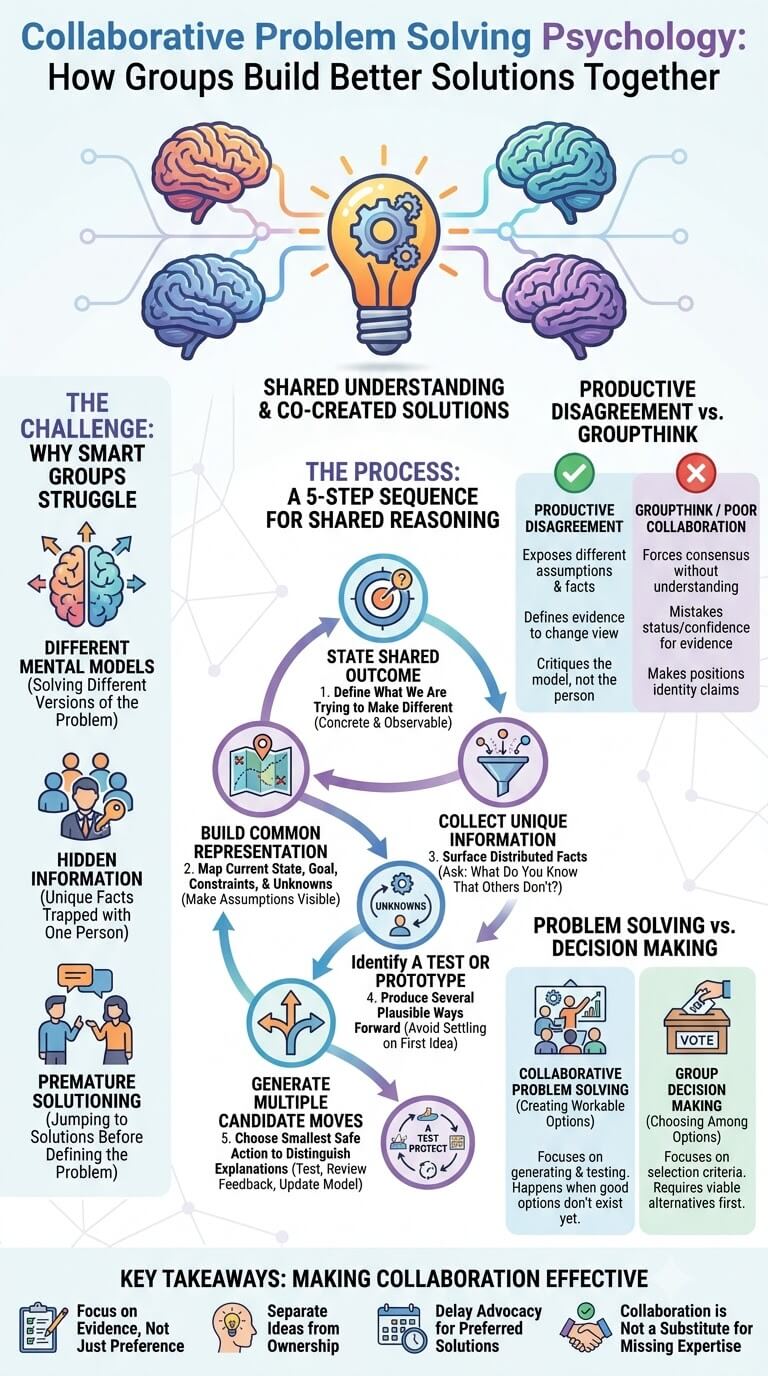
Collaborative problem solving is the process of two or more people building a shared understanding of a problem, combining distributed information, generating possible solutions, testing ideas, and updating their plan together. It is different from simply making a group decision because the group may first need to create viable options before choosing among them. Good collaboration makes assumptions and evidence visible rather than treating agreement as the main goal.
What Makes Problem Solving Collaborative?
The Solution Is Built Through Shared Reasoning
The OECD framework for collaborative problem solving describes the process as people pooling understanding and effort while working toward a solution. The important part is not that several people happen to be present. Their reasoning has to interact.
Consider a small business trying to reduce late customer orders. Operations knows where packages slow down. Customer support knows which complaints repeat. Sales knows which promises are creating unrealistic expectations. Finance knows which proposed changes would be too expensive. No one person begins with the whole picture.
Collaboration becomes useful when those partial views are combined into a clearer model of the problem. That may change what the group initially thought it needed to fix.
Information, Perspectives, and Actions Are Distributed Across People
In individual problem solving, one person carries most of the relevant information and controls the next step. In collaborative work, knowledge and responsibility are distributed. One member may know the technical constraint, another may understand the history, and another may be the only person who sees what happens after implementation.
This creates both an advantage and a coordination problem. The advantage is that the group can access more knowledge than one person alone. The difficulty is that information does not automatically become shared simply because the people who hold it are in the same conversation.
The First Challenge: Build a Shared Problem Representation
People May Be Solving Different Versions of the Same Situation
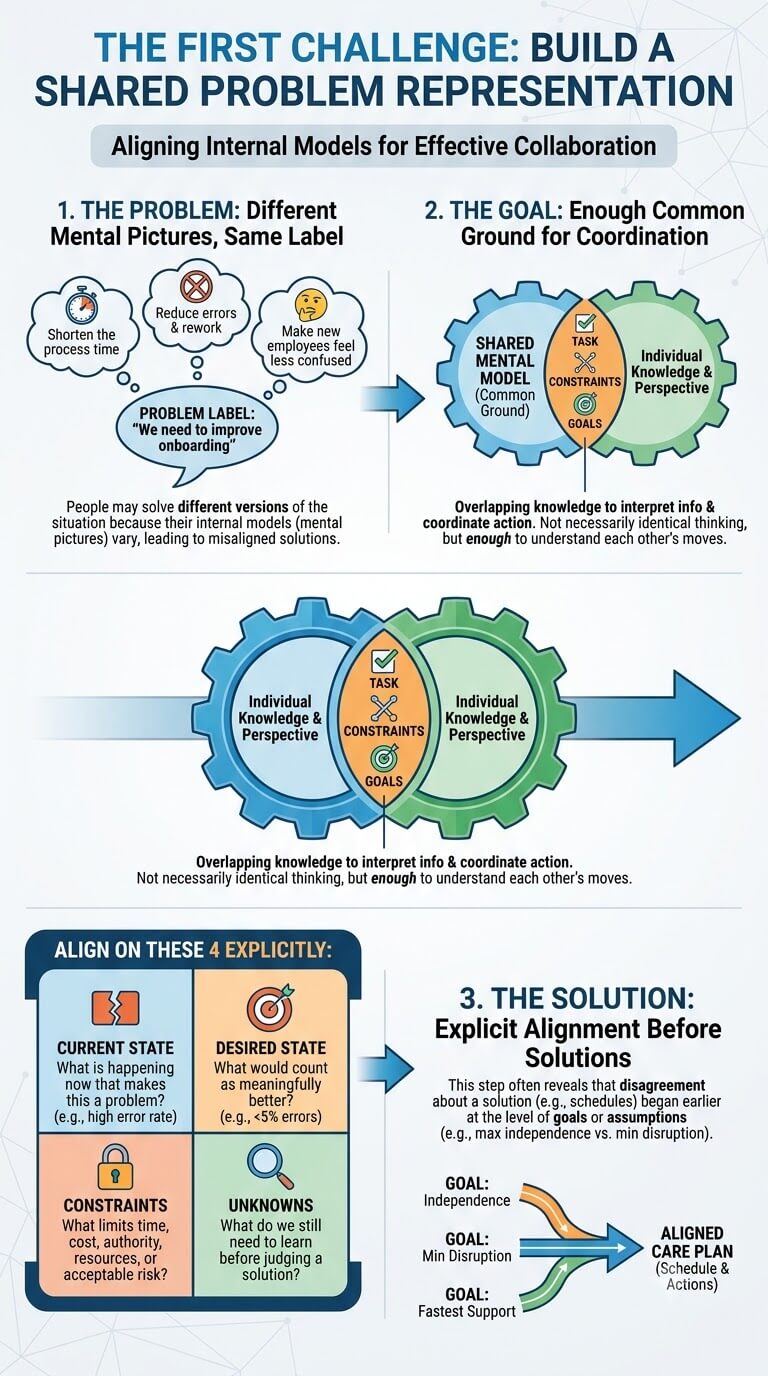
Two people can use the same problem label while holding very different mental pictures. “We need to improve onboarding” might mean shortening the process to one person, reducing errors to another, and making new employees feel less confused to a third. Their proposed solutions will naturally pull in different directions because their internal models are different.
Research on teams often uses the idea of a shared mental model to describe overlapping knowledge that helps members interpret information and coordinate action. The practical lesson is not that everyone must think identically. The group needs enough common ground about the task, constraints, and goals to understand what each proposed move is trying to accomplish.
Align on Current State, Goal, Constraints, and Unknowns
Before discussing solutions, a group can make four things explicit:
- Current state: What is happening now that makes this a problem?
- Desired state: What would count as meaningfully better?
- Constraints: What limits time, cost, authority, resources, or acceptable risk?
- Unknowns: What do we still need to learn before we can judge a solution?
This simple alignment step often reveals that disagreement about a solution began earlier, at the level of goals or assumptions. A family planning care for an older relative, for example, may appear to disagree about schedules when the real difference is whether the goal is maximum independence, minimum disruption, or the fastest possible support.
The Second Challenge: Surface Unique Information
Shared Information Is Easier to Repeat
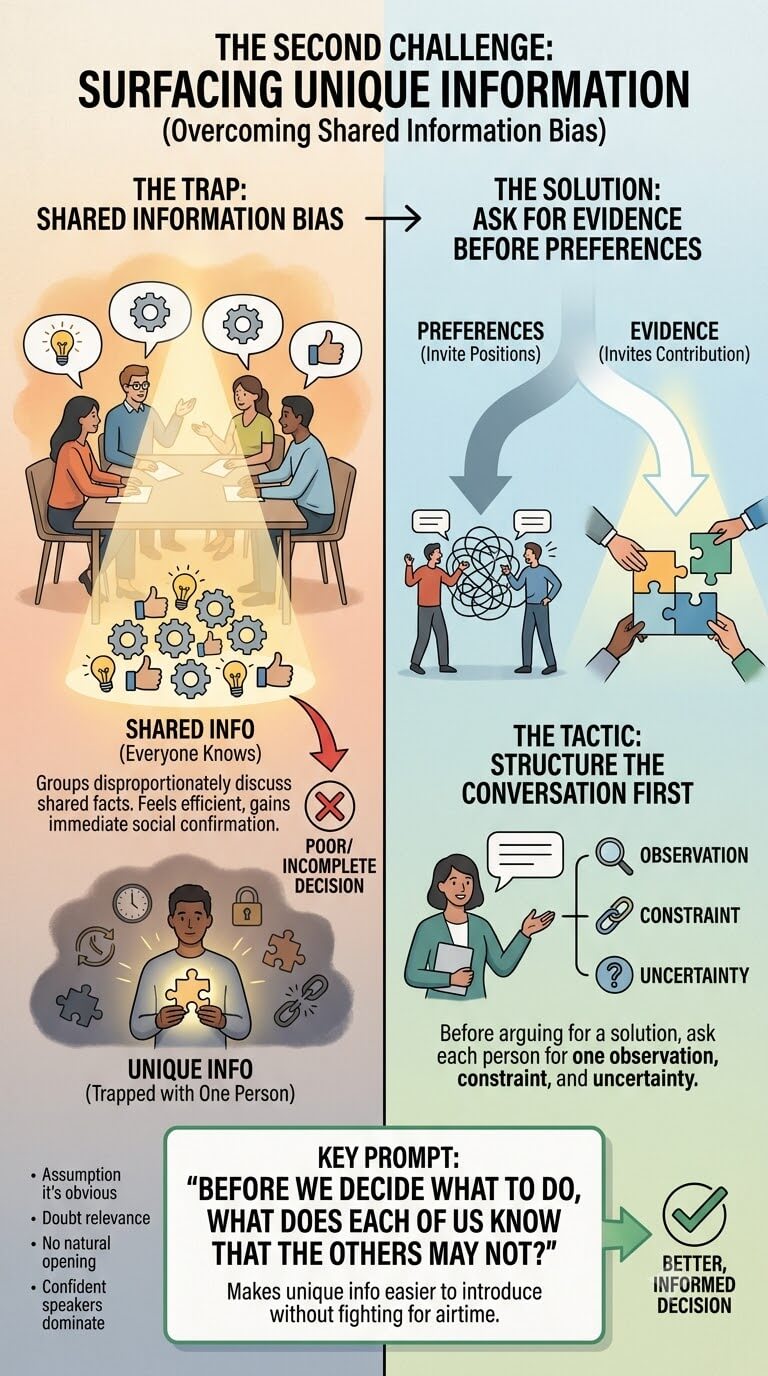
Groups often spend disproportionate time discussing facts everyone already knows. That feels efficient because shared information receives immediate recognition. It also creates social confirmation: several people can nod, add examples, and reinforce the same point.
A large review of group decision processes describes the shared information bias, sometimes studied through hidden-profile tasks, in which groups tend to focus on information known by multiple members while potentially underusing important information held by only one person. That is especially relevant to collaborative problem solving because the group often exists precisely because different people know different things.
Useful Facts Can Remain Trapped With One Person
A team may spend twenty minutes debating a new workflow while one member knows that a required system cannot support it. A couple may plan a household change while one partner silently assumes a schedule constraint the other does not know about. A project group may evaluate ideas without hearing the only person who has tested a similar approach before.
The risk is not always intentional withholding. People may assume their information is obvious, feel it is too minor to mention, doubt its relevance, or wait for a natural opening that never appears. Confident speakers can also create the impression that the group already understands the problem well enough.
Ask for Evidence, Observations, and Missing Constraints Before Preferences
One way to improve information pooling is to separate “What do you prefer?” from “What do you know that could change our understanding?” Preferences invite positions. Evidence invites contribution.
A facilitator might ask each person to name one observation, one constraint, and one uncertainty before anyone argues for a solution. In a family discussion, the equivalent can be: “Before we decide what to do, what does each of us know that the others may not?” This makes unique information easier to introduce without requiring someone to fight for airtime.
The Third Challenge: Separate Ideas From Ownership
Positions Become Harder to Revise When They Become Identity Claims
A useful idea can become harder to evaluate once it turns into “my idea.” The person defending it may hear criticism as a judgment about competence, while other members may become more interested in defeating the position than understanding what it gets right.
This creates a subtle shift from solving the problem to protecting social standing. The group begins tracking who proposed what instead of which explanation best fits the evidence.
Critique the Model or Test, Not the Person
Groups can reduce this pressure by making claims more testable. Instead of saying, “Jordan’s plan will not work,” say, “This plan assumes the bottleneck is scheduling. What evidence would tell us that assumption is wrong?” The disagreement now has an object that everyone can examine.
Language matters because it changes the task. “Prove your idea” tends to create defense. “What would we need to observe for this idea to remain plausible?” turns the discussion toward evidence and revision.
Productive Disagreement in Problem Solving
Disagreement Can Reveal Hidden Assumptions
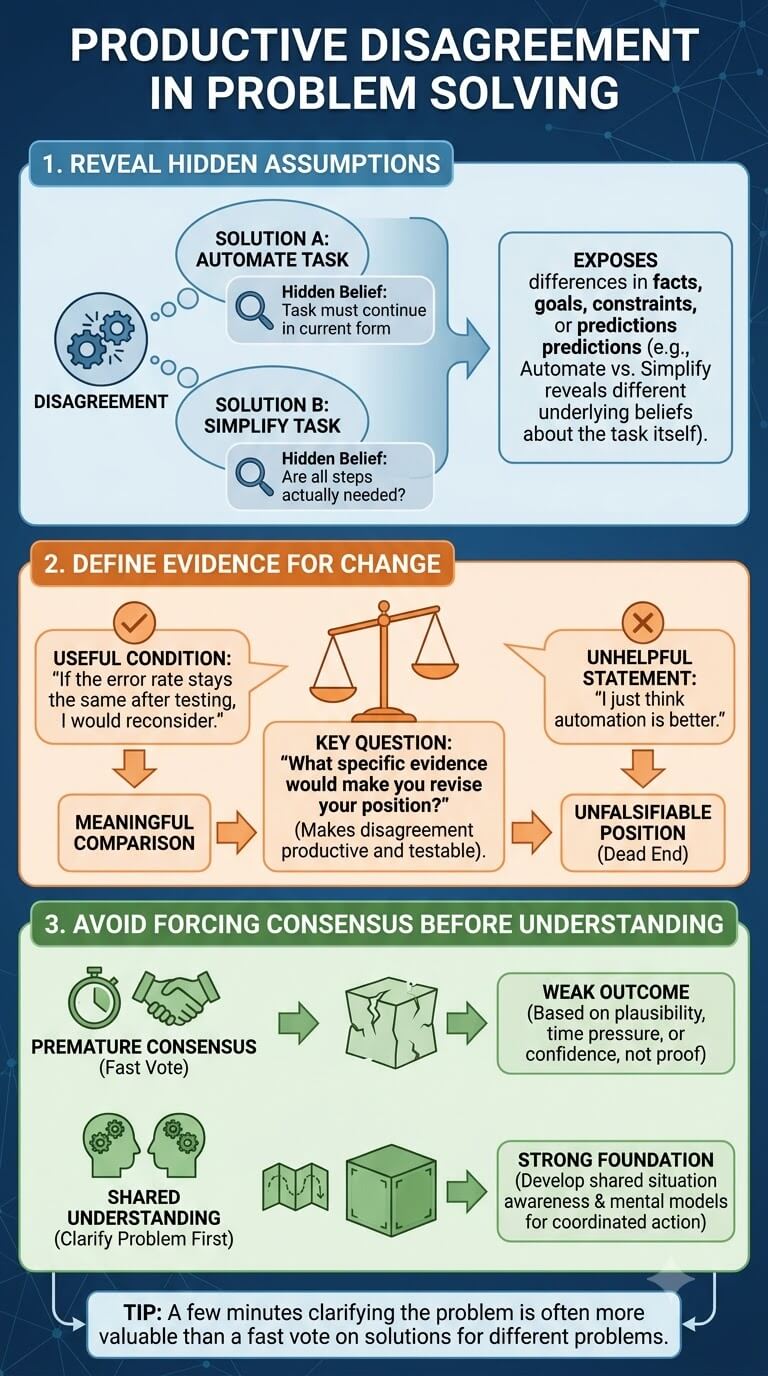
Agreement feels smoother, but disagreement can be valuable when it exposes a difference in facts, goals, constraints, or predictions. If two people favor different solutions, asking why can uncover assumptions that were previously invisible.
For example, one team member wants to automate a task while another wants to simplify it. The disagreement may reveal two different beliefs: one assumes the task must continue in its current form, while the other questions whether several steps are needed at all. That is useful information even before the group chooses a solution.
Coordination failure, hidden information, and premature agreement can become group-level barriers to problem solving even when every individual member is capable.
Define What Evidence Would Change Each View
A disagreement becomes more productive when each side can name what would make it revise its position. “If the error rate stays the same after the simplified process is tested, I would reconsider” is more useful than “I just think automation is better.”
This question also exposes unfalsifiable positions. If no possible result would change someone’s view, the group is no longer comparing explanations in a meaningful way.
Avoid Forcing Consensus Before the Problem Is Understood
Consensus is an outcome, not proof that the reasoning was good. A group can agree quickly because the first proposal sounds plausible, because time is short, or because no one wants to challenge a confident person.
Complex team problem-solving research emphasizes the importance of developing a shared view of the situation before coordinated action. An open-access study of complex problem solving in teams discusses shared situation awareness and shared mental models as foundations for coordinated, goal-directed behavior. In practice, a few minutes spent clarifying the problem can be more valuable than a fast vote on solutions that address different problems.
A Collaborative Problem-Solving Sequence
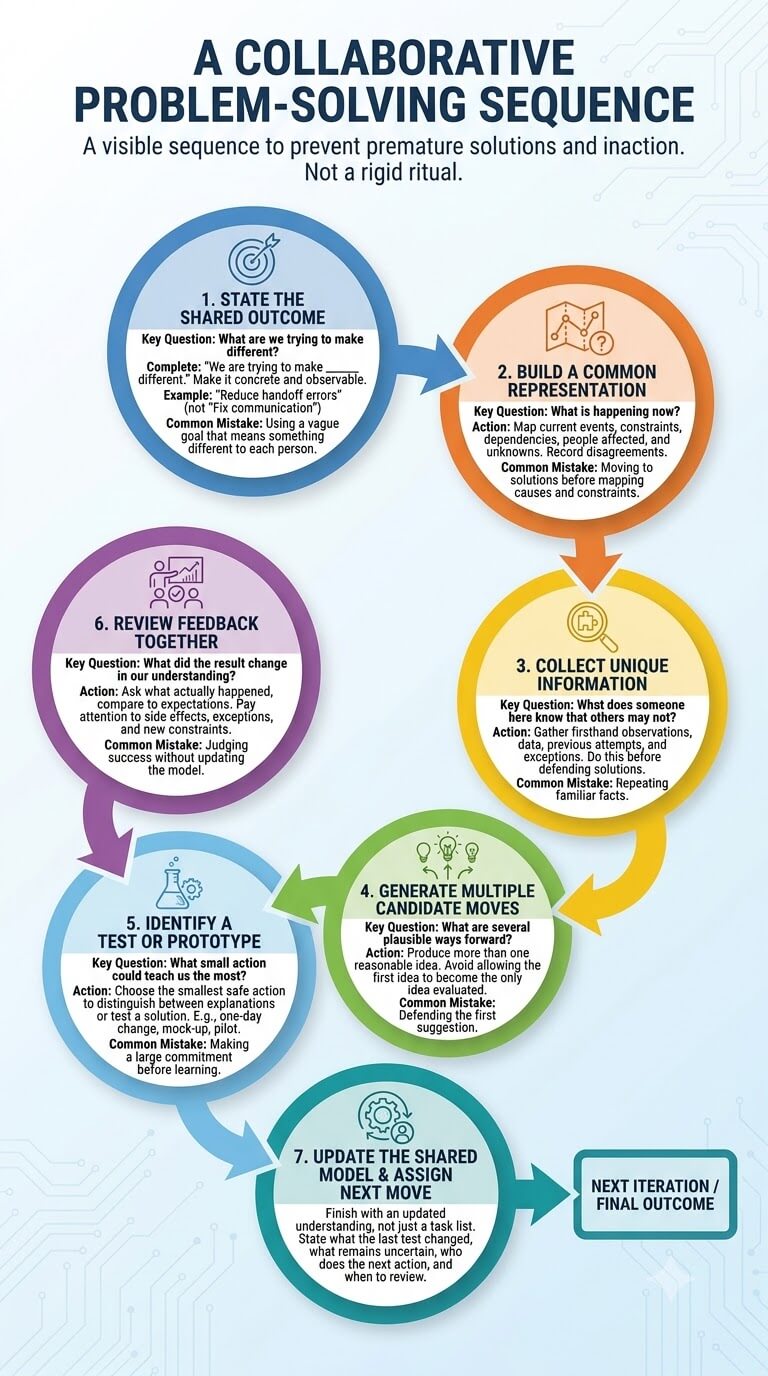
A group does not need a rigid meeting ritual, but a visible sequence helps prevent two common failures: jumping to solutions too early and talking without converting discussion into a testable next step.
1. State the Shared Outcome
Complete the sentence: “We are trying to make ______ different.” Keep it concrete enough that members can recognize improvement. “Fix communication” is vague. “Reduce handoff errors between the morning and evening shifts” gives the group something observable.
2. Build a Common Representation
Map what is happening now. Include the sequence of events, constraints, dependencies, people affected, and important unknowns. If members disagree about the map, record the disagreement instead of hiding it.
3. Collect Unique Information
Give each person a deliberate chance to add information that others may not have. Ask for firsthand observations, data, previous attempts, external constraints, and exceptions. Do this before asking everyone to defend a preferred solution.
4. Generate Multiple Candidate Moves
Once the problem is clearer, produce more than one plausible move. The purpose is not endless brainstorming. It is to avoid allowing the first reasonable idea to become the only idea the group evaluates.
5. Identify a Test or Prototype
Choose the smallest safe action that can distinguish between competing explanations or reveal whether a proposed solution is workable. A prototype may be a one-day workflow change, a mock-up, a small pilot, or a low-cost trial rather than a full commitment.
The underlying problem-solving sequence still matters in groups: represent the problem, generate options, test, read feedback, and adjust.
6. Review Feedback Together
Ask what actually happened, not who predicted it correctly. Compare the outcome with the group’s expectations. Pay attention to side effects, exceptions, and new constraints that appeared during the test.
7. Update the Shared Model and Assign the Next Move
The group should finish with an updated understanding, not merely a task list. State what the last test changed about the problem, what remains uncertain, who will do the next action, and when the group will review the result.
| Stage | Key question | Common mistake |
|---|---|---|
| Shared outcome | What are we trying to make different? | Using a vague goal that means something different to each person |
| Common representation | What is happening now? | Moving to solutions before mapping causes and constraints |
| Unique information | What does someone here know that others may not? | Repeating familiar facts |
| Candidate moves | What are several plausible ways forward? | Defending the first suggestion |
| Test | What small action could teach us the most? | Making a large commitment before learning |
| Feedback | What did the result change in our understanding? | Judging success without updating the model |
Collaborative Problem Solving vs Group Decision Making
Groups May Need to Create a Workable Option Before Choosing Among Options
Decision making asks which option to choose. Problem solving may begin earlier, when the group does not yet have good options. If a team knows it must reduce customer wait time but all existing approaches are unacceptable, choosing among them is not the main task. The group needs to understand the causes and create a workable alternative.
The difference between problem solving and decision making matters in groups because members may need to create a workable option before comparing alternatives.
This distinction explains why voting too early can feel unproductive. A vote can choose among proposals, but it cannot repair a weak problem definition or generate missing information.
Choice Criteria Matter After Viable Alternatives Exist
Once several workable options exist, the task can shift toward decision making. The group may compare cost, speed, reversibility, fairness, risk, or other criteria. At that stage, a choice process is appropriate because there is something meaningful to choose among.
The two processes can alternate. A group chooses an option, tests it, discovers a new constraint, then returns to problem solving to modify the solution.
Common Group Failure Modes
Premature Solutioning
Someone names a solution within the first few minutes, and the rest of the discussion becomes an argument about that proposal. The group has not yet asked whether everyone agrees on the problem, so alternatives are evaluated inside an untested frame.
A practical correction is to delay advocacy briefly. Require a one-sentence problem statement, key constraints, and important unknowns before discussing preferred solutions.
One Voice Defines the Frame Too Early
A senior, confident, or fast-speaking member may define the situation in a way that feels settled before others have contributed. The issue is not confidence itself. The risk is that the first frame becomes the default and later information is interpreted through it.
Ask at least one person to offer an alternative definition: “What might we call this problem if the current explanation is incomplete?” This creates room for correction without turning the exchange into a personal challenge.
Information Pooling Fails
The group discusses what everyone knows and never reaches the facts that justified having different people present. A useful sign is repeated agreement without much new information entering the conversation.
Structured prompts can help. Team-science guidance reviewed in an open-access review of team development interventions includes questions about shared goals, whether perspectives from different disciplines are being considered, and whether teams are integrating their knowledge. Those questions translate well beyond research teams because they make missing perspectives visible.
Status or Confidence Is Mistaken for Evidence
A person may be worth listening to because of experience, but experience does not make every claim correct. Groups work better when confidence and status influence attention less than the quality of the evidence relevant to the current problem.
When possible, ask for the observation behind the claim. “What have you seen that makes you think this step is the bottleneck?” allows expertise to contribute without turning authority into automatic proof.
No One Records What the Last Test Actually Taught
Groups often remember the decision but forget the learning. A pilot fails, everyone moves on, and three months later someone proposes almost the same idea because the reason for failure was never captured.
After a test, record three lines: what we expected, what happened, what we now believe. This small habit turns collective experience into usable memory.
Practical Facilitation Prompts
The following prompts are designed to slow the conversation only where slowing it improves reasoning. A group does not need to use all of them.
“What Problem Are We Solving in One Sentence?”
If the answers differ substantially, the group is not ready to debate solutions. Compare the sentences and identify which differences concern facts, goals, or scope.
“What Does Each Person Know That Others May Not Know?”
This invites unique information before the conversation rewards only familiar points. Give everyone a turn, especially people whose knowledge comes from a different role or direct contact with the problem.
“Which Assumption Are We Treating as a Fact?”
List the assumptions that would materially change the solution if they were wrong. Examples might include “customers care most about speed,” “this step is legally required,” or “we cannot change the schedule.” Then verify the most important ones.
“What Is the Smallest Test That Can Distinguish Our Competing Explanations?”
If two explanations predict different outcomes, design a small, safe test that makes those predictions visible. This is often more productive than debating which explanation sounds more persuasive.
“What Would Make Us Revise the Plan?”
A plan becomes easier to update when the group decides in advance what evidence would count against it. This reduces the tendency to protect a chosen direction simply because time and identity have already been invested in it.
When Collaboration Reveals a Representation or Framing Problem
Different Models Can Expose Hidden Constraints
One of the greatest benefits of collaboration is not more ideas. It is the chance to discover that different people are carrying different models of the same situation.
A developer may see a technical performance problem, while customer support sees a confusing workflow. Both can be correct. Putting the models together may reveal that the technical issue appears only because users repeat a step the interface does not explain clearly. The combined representation creates a different solution space.
A New Shared Frame Can Unlock New Solution Paths
Groups can also discover that the question itself is too narrow. “How do we make this meeting shorter?” assumes the meeting must continue. “What information must be exchanged each week, and what is the simplest reliable way to exchange it?” opens additional possibilities.
Reframing is especially useful when the group keeps producing variations of the same unsuccessful solution. The aim is not positive thinking. It is to test whether the current definition of the problem excludes useful options.
Group discussions can go off course when one person’s problem framing becomes the default before alternative definitions are surfaced.
When Collaboration Is Not Enough
Missing Expertise or Authority
A group can reason well and still lack the knowledge required to solve the problem. If no one understands a technical requirement, regulation, medical issue, or specialized system, more discussion among the same people may simply produce greater confidence in incomplete information.
At that point, the next move is to obtain the missing expertise or clarify who has authority to act. Collaboration cannot substitute for knowledge the group does not possess.
High-Stakes Decisions That Require Formal Professional Input
Problems involving health, law, financial risk, structural safety, or other serious consequences may require qualified professional guidance and established procedures. A group discussion can help organize questions and information, but it should not be treated as a replacement for appropriate expertise.
Relationship or Workplace Safety Concerns Require a Different Response
Collaborative techniques assume people can disagree, disclose information, and revise positions without fear of retaliation. If a situation includes coercion, threats, humiliation, stalking, intimidation, or meaningful risk for speaking honestly, “better collaboration” may not be the appropriate first goal.
In those situations, protecting safety, documenting concerns where appropriate, using formal workplace processes, or seeking qualified support may take priority over trying to create a more open joint discussion.
FAQ
Collaborative problem solving overlaps with teamwork and group decisions, but its defining feature is joint construction and revision of a solution.
Is Collaborative Problem Solving the Same as Teamwork?
No. Teamwork is broader. A team can coordinate routine tasks without solving a new problem. Collaborative problem solving begins when people need to combine understanding and effort because the path to the goal is not already clear. It may happen inside a team, but it can also happen between partners, family members, departments, or temporary groups.
How Is Collaborative Problem Solving Different From Group Decision Making?
Group decision making focuses on choosing among alternatives. Collaborative problem solving may include that step, but it often starts earlier. Members may need to define the problem, combine distributed information, create possible solutions, and test them before a meaningful choice can be made.
What If the Group Cannot Agree on What the Problem Is?
Do not force a single sentence too quickly. Write the competing problem definitions side by side and ask what evidence, goal, or constraint makes each version different. The disagreement may reveal that members are looking at different parts of the system. A shared representation can include genuine uncertainty rather than pretending the group already knows the correct explanation.
Can Disagreement Improve a Solution?
Yes, when disagreement exposes different information, assumptions, predictions, or constraints and the group can evaluate them without turning the discussion into a status contest. Disagreement becomes less useful when positions cannot be revised, evidence is ignored, or members are punished for raising inconvenient information.
Key Takeaways
- Collaborative problem solving works by combining partial knowledge into a shared understanding that can guide coordinated action.
- Groups should clarify the current state, desired outcome, constraints, and unknowns before defending preferred solutions.
- Unique information deserves deliberate attention because group discussions can overfocus on facts everyone already knows.
- Productive disagreement identifies assumptions and defines what evidence would justify revising a position.
- A useful group process moves from shared representation to information pooling, candidate solutions, small tests, feedback, and an updated model.
- Collaboration is not a substitute for missing expertise, formal safeguards, or safety support when people cannot participate without fear or retaliation.
The next time a group feels stuck, do not begin by asking everyone for a preferred solution. Ask each person to describe the problem, contribute one piece of information the others may not have, and name one assumption worth testing. Those three moves often show whether the group truly has a solution problem or still needs to build a shared picture of what is happening.

Michael Reed is the Founder and Lead Writer at Psychology Exposed. He writes about human behavior, relationships, emotional patterns, self-awareness, and practical psychology topics using research-informed, easy-to-understand content.
Read More About Michael Reed: https://psychologyexposed.com/michael-reed/