
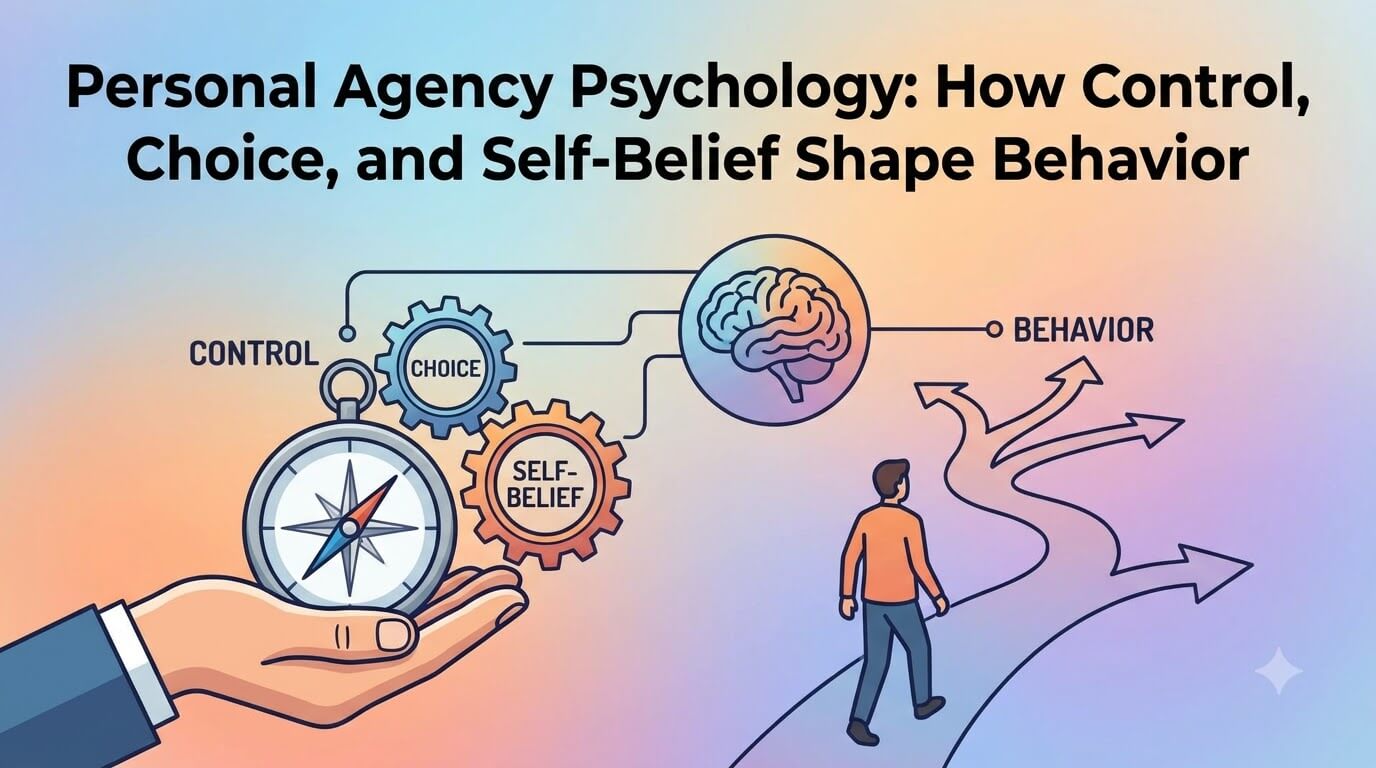
You can want something badly and still feel unable to move toward it. You can also face a difficult situation, have only a few realistic options, and still feel able to choose a next step. That difference is central to personal agency psychology.
Personal agency is not the belief that you control everything. It is the experience of being an active participant in your own behavior: someone who can choose, initiate action, adjust, and sometimes influence what happens next. The APA Dictionary of Psychology defines agency in terms of being active and having the power or capability to produce an effect or exert influence. In everyday life, that sense of influence is often built from several judgments happening at once.
Quick Answer
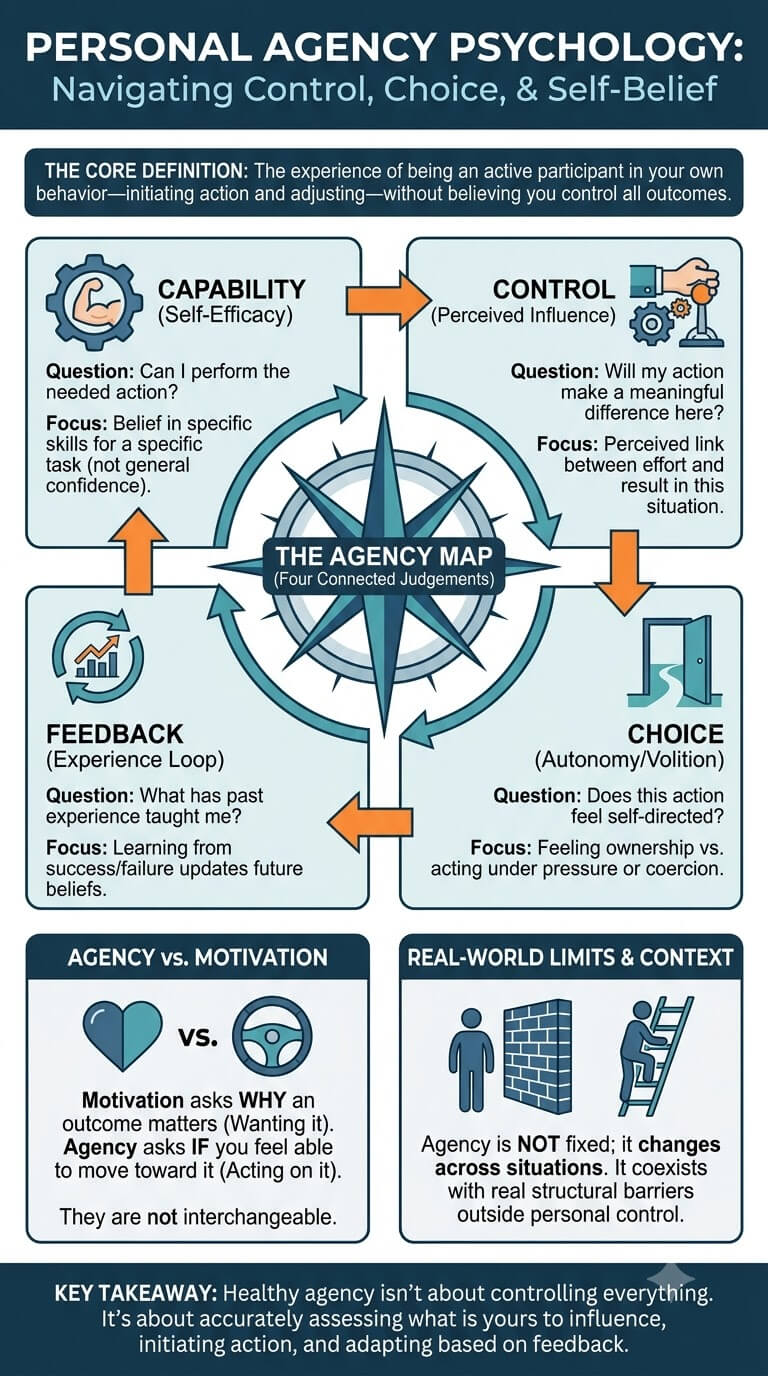
Personal agency is the sense that you can make choices, initiate actions, and have some influence on what happens, even when outcomes are uncertain or partly outside your control. It depends not only on motivation, but also on whether you believe you can perform the needed action, whether the situation seems influenceable, whether the action feels self-directed, and what past experience has taught you.
What Personal Agency Means in Psychology
Agency is about being an actor, not controlling everything
Agency becomes clearer when you separate action from outcome. You may control whether you apply for a job, prepare carefully, ask for feedback, or try again. You do not control the employer’s final decision. Agency lives in the part of the situation where your choices and actions are real, not in a belief that effort guarantees a result.
A grounded view asks two questions: “What is mine to influence?” and “What remains uncertain, shared, or outside my control?” High agency can coexist with a realistic understanding of limits.
The difference between having options and feeling able to use them
Choice on paper is not the same as usable choice. A person may technically have options yet experience none as workable because of cost, fear, lack of skill, social pressure, exhaustion, or previous failure.
Someone considering whether to ask a manager for a workload change may wonder whether they can explain the problem clearly, whether speaking up could affect anything, and whether they are genuinely free to ask. Those judgments shape whether the option feels available in practice.
Why Agency Matters for Everyday Behavior
Starting, persisting, adapting, and disengaging
A sense of agency influences whether people begin, but also what they do when the first attempt fails. Someone who believes their actions matter may change strategy, seek information, ask for help, or decide a route is no longer worth the cost.
Persistence alone is therefore a poor measure of agency. Sometimes changing direction or stopping an ineffective pursuit is the more self-directed choice.
How low agency can narrow behavior before ability is tested
Low agency can change behavior before a person has good evidence about what they can do. If the expectation is “nothing I do will matter,” fewer actions are attempted, which also means less feedback that could update the belief.
A student may avoid asking a question because they assume they will still be confused, or an employee may stop proposing ideas after repeated dismissal. These examples do not prove a fixed condition. They show how expectations about influence can shrink the behavior that would generate new evidence.
The Agency Map: Capability, Control, Choice, and Feedback
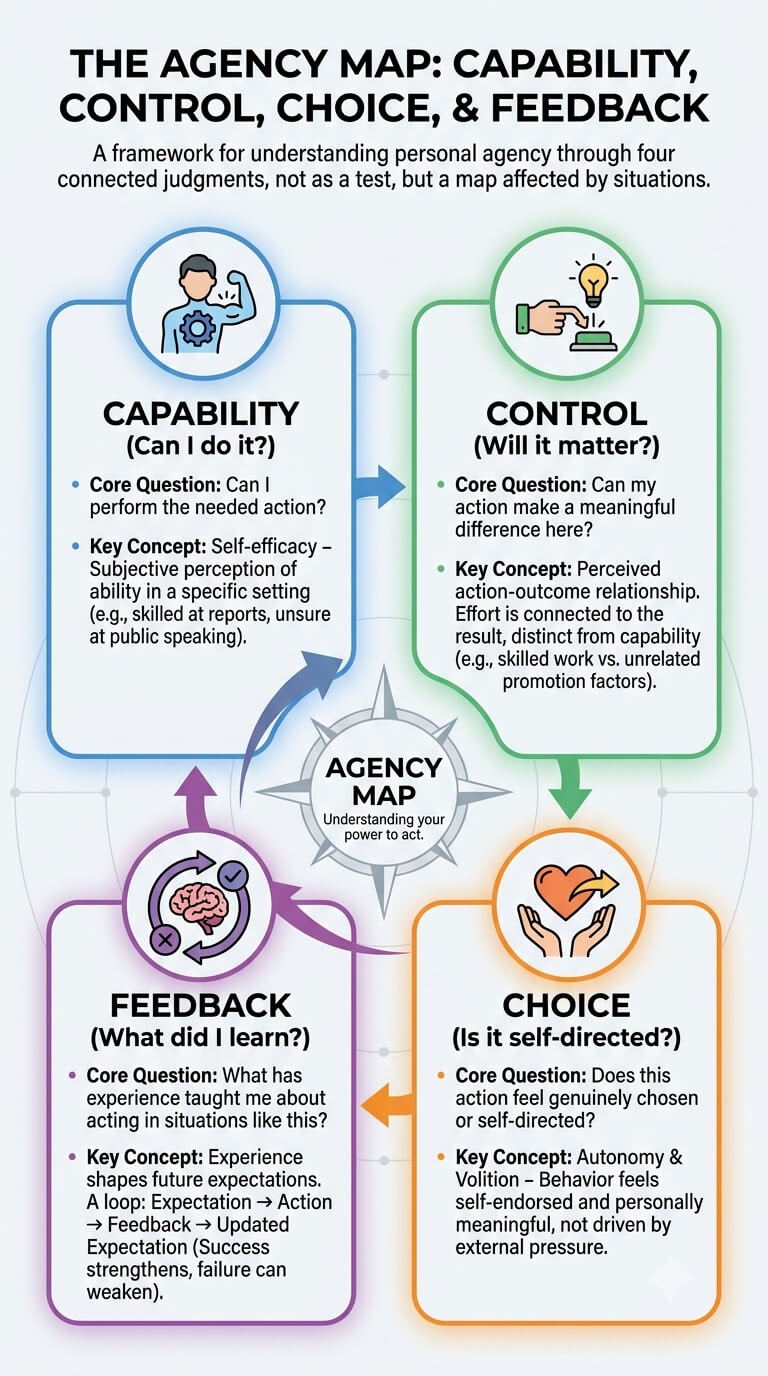
A useful way to understand personal agency is to look at four connected judgments. Think of them as an Agency Map, not as a test or diagnosis. Different situations can weaken or strengthen different parts of the map.
| Part of the map | Core question | Everyday example |
|---|---|---|
| Capability | Can I perform the needed action? | “Can I give this presentation clearly?” |
| Control | Can my action make a meaningful difference here? | “Will changing my study method affect my result?” |
| Choice | Does this action feel genuinely chosen or self-directed? | “Am I doing this because I endorse it, or only because I feel pressured?” |
| Feedback | What has experience taught me about acting in situations like this? | “When I tried a different approach before, did anything change?” |
Capability belief: Can I do the required action?
This is where self-efficacy becomes relevant. The APA definition of self-efficacy focuses on a person’s subjective perception of capability in a given setting or for a desired result. The important point is specificity: you may feel highly capable at writing reports and very unsure about public speaking.
Low capability belief can reduce agency even when the situation is influenceable. You may know that asking for clarification would help but doubt your ability to ask effectively.
Control appraisal: Can my action make a difference here?
You can believe, “I can do the action,” while also believing, “It will not change anything.” That is a control appraisal. It concerns the perceived relationship between action and outcome.
A skilled employee may produce excellent work yet believe promotions are decided by unrelated factors. The issue is not capability, but whether effort seems connected to the result.
Volition: Does this action feel chosen or self-directed?
Agency also has a choice component. Autonomy concerns whether behavior feels volitional or self-endorsed rather than simply whether a person can act alone. The APA entry on autonomy helps clarify that distinction.
Two students may study equally hard, but one sees the work as personally meaningful while the other feels driven mainly by intense external pressure. Both are acting, yet the subjective quality of choice differs.
Feedback: What does experience teach me about future action?
Agency is updated by what happens after action. A successful attempt may strengthen the expectation that effort matters. A failed attempt may weaken it, especially if no alternative strategy seems available.
This creates a loop: expectation affects action, action produces feedback, and feedback shapes the next expectation. A PubMed Central review of controllability and resilience describes how experiences of control have played a central role in research on later behavior under stress.
Personal Agency Is Not the Same as Motivation
Wanting an outcome versus believing you can influence it
Motivation asks why an outcome matters enough to pursue. Agency asks whether you experience yourself as able to choose and act in ways that can influence what follows. They often support each other, but they are not interchangeable.
You might be highly motivated to improve your finances while feeling little agency because the available decisions seem limited. You might be only moderately motivated to reorganize a room yet feel high agency because the actions are clear and within reach.
Why high motivation can coexist with low agency
A person may care deeply about repairing a relationship, entering a program, finding safer housing, or recovering from a financial setback. Caring more does not automatically create more control, skill, or choice.
When motivation is high but agency feels low, identify the weak part of the Agency Map. Is the person unsure what action to take, doubtful of their capability, facing an unresponsive system, or acting mainly under pressure? The next step depends on the answer.
Which Psychology Concept Best Fits the Problem?
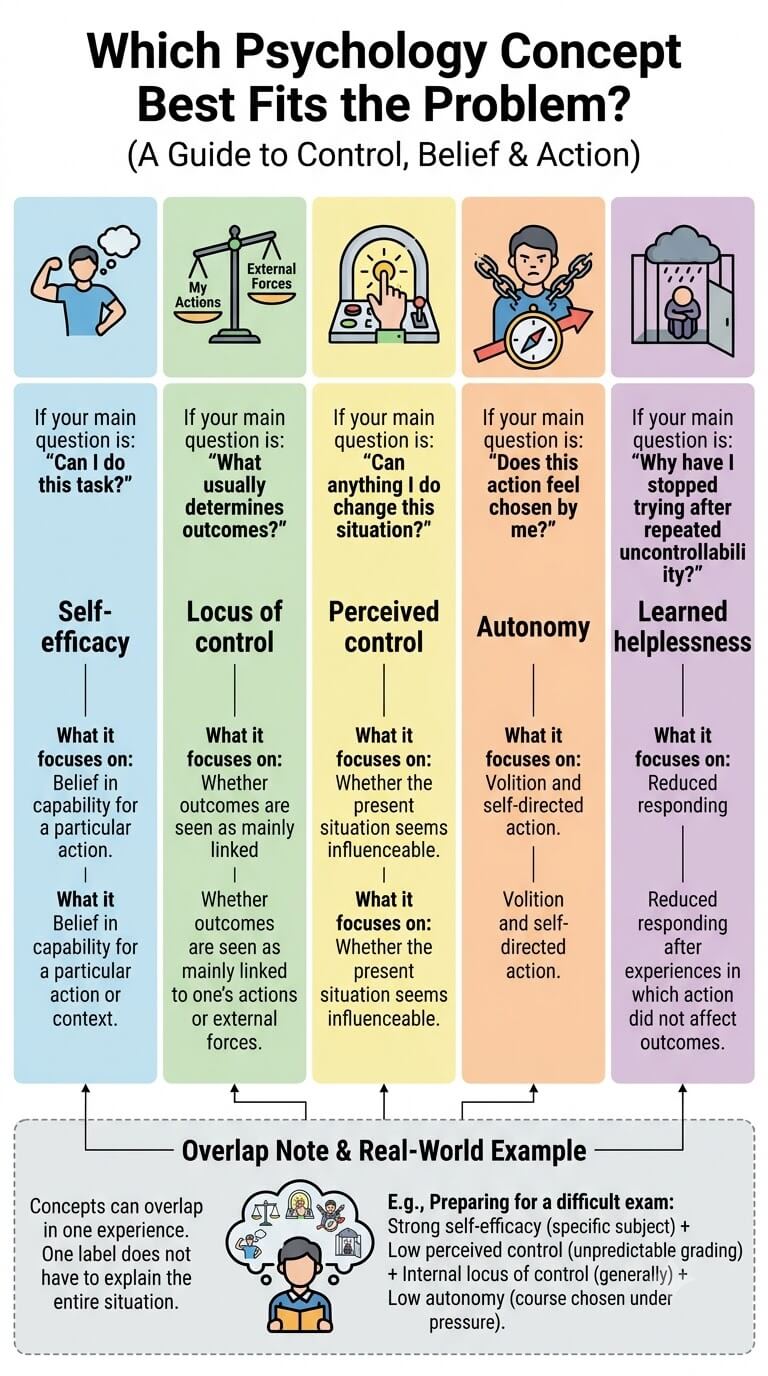
Several concepts in this area sound similar because they all involve control, belief, or action. The fastest way to separate them is to look at the question each one answers.
| If your main question is… | The most useful concept is… | What it focuses on |
|---|---|---|
| “Can I do this task?” | Self-efficacy | Belief in capability for a particular action or context |
| “What usually determines outcomes?” | Locus of control | Whether outcomes are seen as mainly linked to one’s actions or external forces |
| “Can anything I do change this situation?” | Perceived control | Whether the present situation seems influenceable |
| “Does this action feel chosen by me?” | Autonomy | Volition and self-directed action |
| “Why have I stopped trying after repeated uncontrollability?” | Learned helplessness | Reduced responding after experiences in which action did not affect outcomes |
The categories can overlap in one experience. Someone preparing for a difficult exam may have strong self-efficacy in one subject, low perceived control over an unpredictable grading system, a generally internal locus of control, and low autonomy because the course was chosen under pressure. One label does not have to explain the entire situation.
Self-Efficacy: “Can I Do This Task?”
Self-efficacy is the narrowest capability question in the map. It concerns whether you believe you can organize and carry out the action a particular situation requires. That makes it more specific than a general statement such as “I am a confident person.”
A person can have strong self-efficacy for cooking, negotiating prices, or caring for a child while having low self-efficacy for public speaking. These beliefs matter because they can influence which tasks people attempt, how much effort they invest, and how they interpret setbacks. Personal agency is broader because it also includes whether the environment seems responsive and whether the action feels like one’s own choice.
Self-Efficacy vs Self-Confidence: Why the Difference Matters
In everyday language, people often use “confidence” to cover many kinds of self-belief. Self-efficacy is more precise. It points to a judgment about capability in a particular task or setting, while self-confidence is commonly used as a broader sense of assurance in oneself.
This distinction is useful when someone says, “I need more confidence.” The next question is: confidence about what? If the problem appears only when making sales calls, driving in heavy traffic, or speaking another language, a task-specific capability belief may explain more than a broad self-image. That helps keep the solution connected to evidence, practice, and context rather than turning one difficult area into a verdict on the whole self.
If the word ‘confidence’ feels too broad, separating self-efficacy from self-confidence can clarify whether the issue is one specific capability or a wider sense of assurance.
Locus of Control: “What Tends to Shape Outcomes?”
Locus of control concerns how people tend to understand the sources of outcomes. The APA Dictionary description of locus of control distinguishes beliefs that outcomes arise more from one’s own actions and abilities from beliefs that outcomes arise more from outside forces.
This is not the same as asking whether you can act right now. Someone may usually believe that preparation affects success yet face a specific event where luck plays a large role. Another person may generally attribute outcomes to external forces while still taking decisive action in a particular situation. Locus of control describes an orientation toward causality, not a simple measure of strength, responsibility, or worth.
Internal vs External Locus of Control: More Than Two Boxes
It is tempting to treat internal and external orientations as two personality types, with “internal” framed as good and “external” as bad. Real life is less tidy. Different domains contain different levels of actual control, and psychologically accurate beliefs sometimes require recognizing external forces.
A student may reasonably see study habits as internally influenceable while recognizing that a scholarship decision also depends on competition and institutional rules. A worker may take responsibility for meeting deadlines while acknowledging that layoffs are decided at an organizational level. A useful control belief is not “everything is up to me.” It is closer to “I can identify what my actions affect and what they do not.”
Perceived Control: “Can I Influence This Situation Now?”
Perceived control focuses on the current situation. Imagine two people with similar skills and similar general beliefs about responsibility. One is working in a flexible environment where effort quickly changes results. The other is in a rigid system where decisions are made elsewhere. Their moment-to-moment sense of control may be very different.
This lens is useful because it prevents a common mistake: assuming passivity must come from poor confidence. Sometimes a person has the ability and desire to act but correctly recognizes that the available action has little leverage. The practical question then becomes whether there is another point of influence, a different timeframe, another person to involve, or a limit that must be acknowledged rather than fought.
Learned Helplessness: When Uncontrollability Changes Later Attempts
Learned helplessness is a specific concept with a research history, not a casual synonym for feeling discouraged. It grew from work examining what happens after exposure to events that are not controllable. Later research has refined the original account, including the importance of learning about control itself.
The relevant idea for personal agency is that repeated experiences in which responses do not change outcomes can affect later attempts. A person may become less likely to test new possibilities, even when a later situation offers more influence. That does not mean every person who stops trying has learned helplessness. Fatigue, realistic constraints, fear of consequences, lack of information, or low self-efficacy can produce similar-looking behavior for different reasons.
Why People Feel Powerless: One Feeling, Many Possible Causes
“I feel powerless” describes an experience, not its cause. The feeling may reflect genuinely limited options, repeated rejection, uncertainty about what to do, dependence on someone else’s decision, low task capability, social pressure, financial constraints, or a history of efforts that produced no visible change.
That is why the most useful first question is not “How do I become more powerful?” It is “Where is the bottleneck?” If capability is the problem, practice and support may matter. If the situation is not responsive to action, trying harder may waste energy. If coercion or retaliation is limiting choice, the issue is not a mindset failure at all. Accurate agency begins with an accurate reading of the situation.
Autonomy: “Does This Action Feel Like Mine?”
Autonomy is about the subjective quality of choice. It does not require isolation, independence, or the absence of obligations. You can freely endorse a commitment to a partner, family member, workplace, or community and still experience the behavior as self-directed.
The distinction becomes clearer when two identical actions feel psychologically different. Staying late at work might feel self-chosen when you decide a project matters to you, or pressured when you fear punishment for leaving on time. Personal agency includes the ability to act, while autonomy highlights whether the action feels owned rather than imposed.
Mastery Experiences: How Action Produces Evidence
Agency becomes more stable when it is supported by experience rather than slogans. A mastery experience occurs when direct performance gives you evidence that you can handle a task, especially when success follows effort, strategy, learning, or adaptation.
One way capability beliefs become grounded in evidence is through mastery experiences, where direct performance provides information about what a person can actually do.
The important part is not simply collecting easy wins. Useful feedback connects action with a believable lesson: “When I practiced this component, I improved,” or “When I asked a more specific question, I got a clearer answer.” That evidence can update capability beliefs and make future action more likely. It also helps distinguish grounded self-belief from reassurance that has not yet been tested.
Personal Agency vs Locus of Control: Two Different Questions
Personal agency and locus of control overlap because both involve influence, but they describe different things. Agency concerns experiencing yourself as someone who can choose and act. Locus of control concerns where you believe important outcomes tend to come from.
A person can therefore have high agency and still recognize strong external control. A skilled advocate may act decisively in a bureaucratic system while knowing the final decision belongs to an institution. Conversely, someone may strongly believe that personal effort matters in life but freeze in a specific situation because they do not know how to act. Separating the two concepts prevents “take responsibility” from becoming a simplistic answer to every control problem.
Common Misunderstandings About Agency
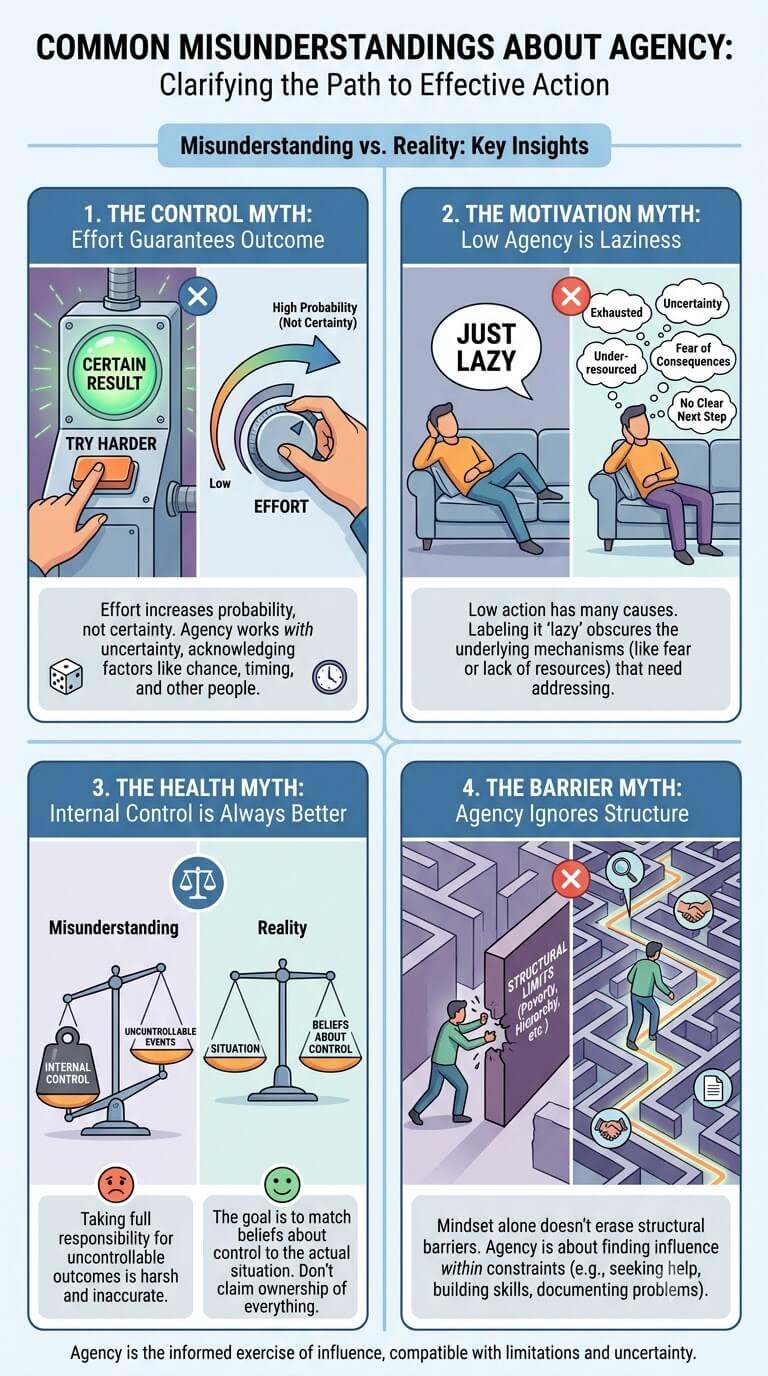
“If I try hard enough, I can control the outcome”
Effort often affects probability, not certainty. You can improve preparation, choose a better strategy, and increase your chances without controlling the final result. Agency is compatible with uncertainty. In fact, a mature sense of agency usually includes knowing when an outcome depends partly on other people, timing, systems, or chance.
“Low agency means laziness”
Low action has many possible causes. A person may be exhausted, uncertain, under-resourced, afraid of consequences, unconvinced that effort matters, or unable to see a workable next step. Calling the behavior lazy skips the mechanism that would explain what could actually help.
“Internal control is always healthier than external control”
An internal orientation can support responsibility when actions genuinely matter, but taking personal responsibility for uncontrollable outcomes can become inaccurate and harsh. The goal is not to claim ownership of everything. It is to match beliefs about control to the situation as closely as possible.
“Agency means ignoring structural limits”
Personal agency does not erase poverty, discrimination, disability, legal restrictions, organizational hierarchy, caregiving demands, or other real constraints. Mindset alone cannot remove structural barriers.
A grounded question is where influence remains within the constraint. That might mean seeking assistance, documenting a problem, building a skill, changing environments, joining with others, or deciding not to spend limited energy on a currently closed outcome.
How Agency Can Change Across Situations
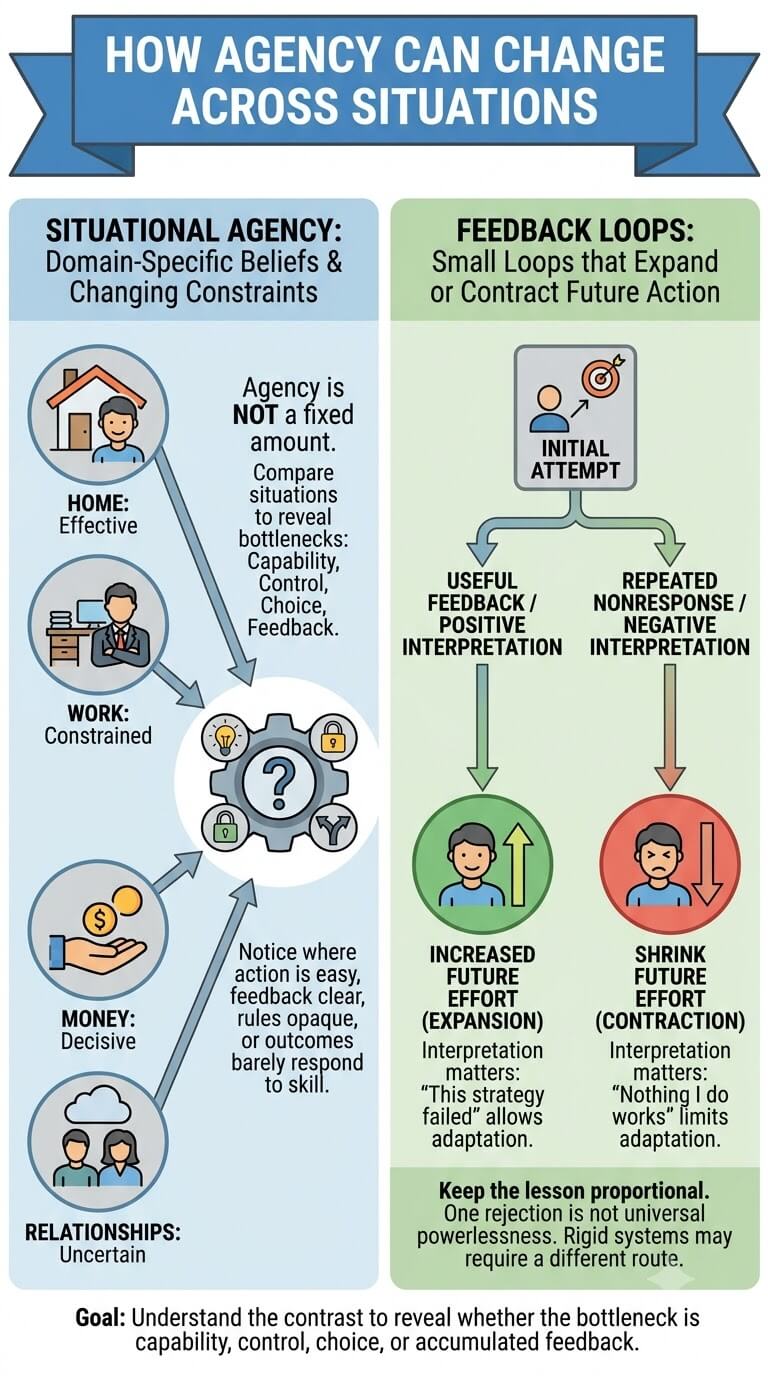
Domain-specific beliefs and changing constraints
Agency is not a fixed amount carried into every setting. You may feel effective at home and constrained at work, decisive with money and uncertain in relationships, or confident in familiar tasks and passive in unfamiliar systems.
Compare situations instead of concluding “I have no agency.” Notice where action comes easily, where feedback is clear, where rules are opaque, and where outcomes barely respond to skill. The contrast can reveal whether the bottleneck is capability, control, choice, or accumulated feedback.
Small feedback loops that expand or contract future action
Agency often changes through repeated loops. An attempt that produces useful feedback can make the next attempt more likely, while repeated nonresponse may shrink future effort. Interpretation matters too: “This strategy failed” leaves more room for adaptation than “Nothing I do works.”
Keep the lesson proportional to the evidence. One rejection does not prove universal powerlessness. Repeated failure in the same rigid system may reasonably suggest that a different route is needed.
When Low Agency Is More Than a Self-Help Problem
Distinguish ordinary uncertainty from severe distress, coercion, or unsafe conditions
Feeling stuck does not automatically mean something is clinically wrong. Many periods of low agency are understandable responses to uncertainty, major transitions, repeated setbacks, or situations with genuinely limited options. Educational reflection can help when the main problem is identifying a workable next step.
Different priorities apply when choice is being restricted through intimidation, threats, humiliation, isolation, stalking, financial control, or retaliation. Those conditions should not be reframed as a failure to think positively or become more confident. The National Domestic Violence Hotline’s warning-sign guidance describes behaviors that can interfere with a person’s ability to make decisions safely. In an unsafe situation, safety planning and specialized support can matter more than direct confrontation or ordinary communication advice.
When professional or safety support may be appropriate
Consider professional support if a persistent sense of powerlessness is accompanied by severe distress, major loss of functioning, or hopelessness that is hard to interrupt. A qualified mental health professional can help explore whether mood, anxiety, stress, past learning, current conditions, or several factors are involved without reducing the problem to willpower.
If another person may retaliate against you for asserting choices, the goal is not to prove agency through confrontation. Private planning, accurate information, trusted support, or the safest available option may be more appropriate.
FAQ About Personal Agency Psychology
Is personal agency a personality trait?
Not in the simple sense of a fixed trait that is equally strong everywhere. Agency can vary with skills, experience, available choices, social conditions, and actual constraints. Comparing settings where your sense of influence rises or falls is often more useful than giving yourself a global label.
Can someone have high agency but low confidence?
Yes. A person may feel nervous or uncertain and still believe they can choose a course of action, try it, gather feedback, and adjust. Agency concerns the capacity to act and influence, while confidence is a broader and less precise everyday term.
Is agency the same as free will?
No. Free will is a broad philosophical question about whether human choices are genuinely free. Personal agency in psychology is more practical: how people experience themselves as actors who can initiate behavior and influence events.
Can external barriers reduce agency even when motivation is high?
Yes. Someone may care deeply and work hard while facing financial limits, discrimination, lack of access, other people’s authority, or unsafe consequences. Recognizing those barriers helps separate what may respond to personal action from what requires support, collective action, a different environment, or acceptance of a real limit.
Key Takeaways
- Personal agency is the experience of being able to choose, initiate action, and exert some influence without assuming total control over outcomes.
- A useful way to understand agency is through four questions about capability, control, choice, and feedback.
- Self-efficacy, locus of control, perceived control, autonomy, and learned helplessness overlap with agency but answer different psychological questions.
- Low action does not automatically mean laziness or lack of motivation. The limiting factor may be skill, low perceived influence, pressure, repeated failure, or a real external constraint.
- A stronger sense of agency comes from better-calibrated action and feedback, not from pretending that every outcome is controllable.
- When fear, coercion, threats, stalking, humiliation, or retaliation restrict choice, safety and specialized support take priority over self-help advice.
Final Thoughts
Take one situation where you feel stuck and locate the problem on the Agency Map: “Can I perform the action?”, “Can this action affect anything?”, “Does it feel like my choice?”, and “What has previous feedback taught me?” The point is not to make every answer positive. It is to make the next move more accurate.
Sometimes agency means trying. Sometimes it means learning a skill, asking for support, changing strategy, or recognizing that a particular outcome is not yours to command.

Michael Reed is the Founder and Lead Writer at Psychology Exposed. He writes about human behavior, relationships, emotional patterns, self-awareness, and practical psychology topics using research-informed, easy-to-understand content.
Read More About Michael Reed: https://psychologyexposed.com/michael-reed/