
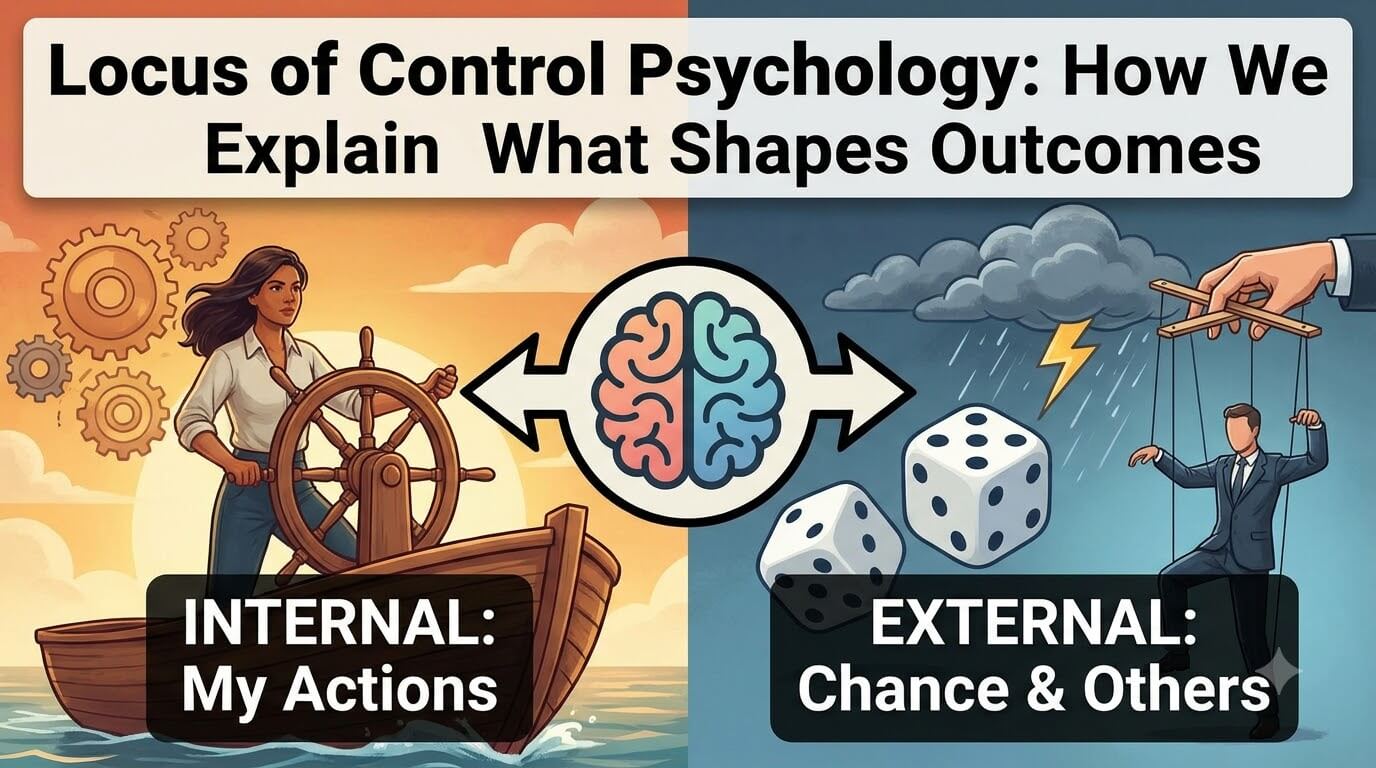
You work hard on a presentation and it goes well. Do you mainly think, “My preparation made the difference,” or “I got lucky with the audience”? Now imagine it goes badly. Do you look first at what you could change, or at the timing, the rules, other people, or plain chance?
Those explanations are not just after-the-fact stories. Over time, they can shape whether you try again, seek feedback, change strategy, wait for conditions to improve, or decide that effort is unlikely to matter. Psychology uses the term locus of control to describe this broad way of thinking about where the causes of important outcomes tend to lie.
The useful question is not whether you are an “internal person” or an “external person.” Real life is more complicated. A realistic control belief should leave room for effort, skill, luck, social power, systems, timing, and circumstances. The goal is to understand which explanation fits the situation well enough to guide the next decision.
Quick Answer
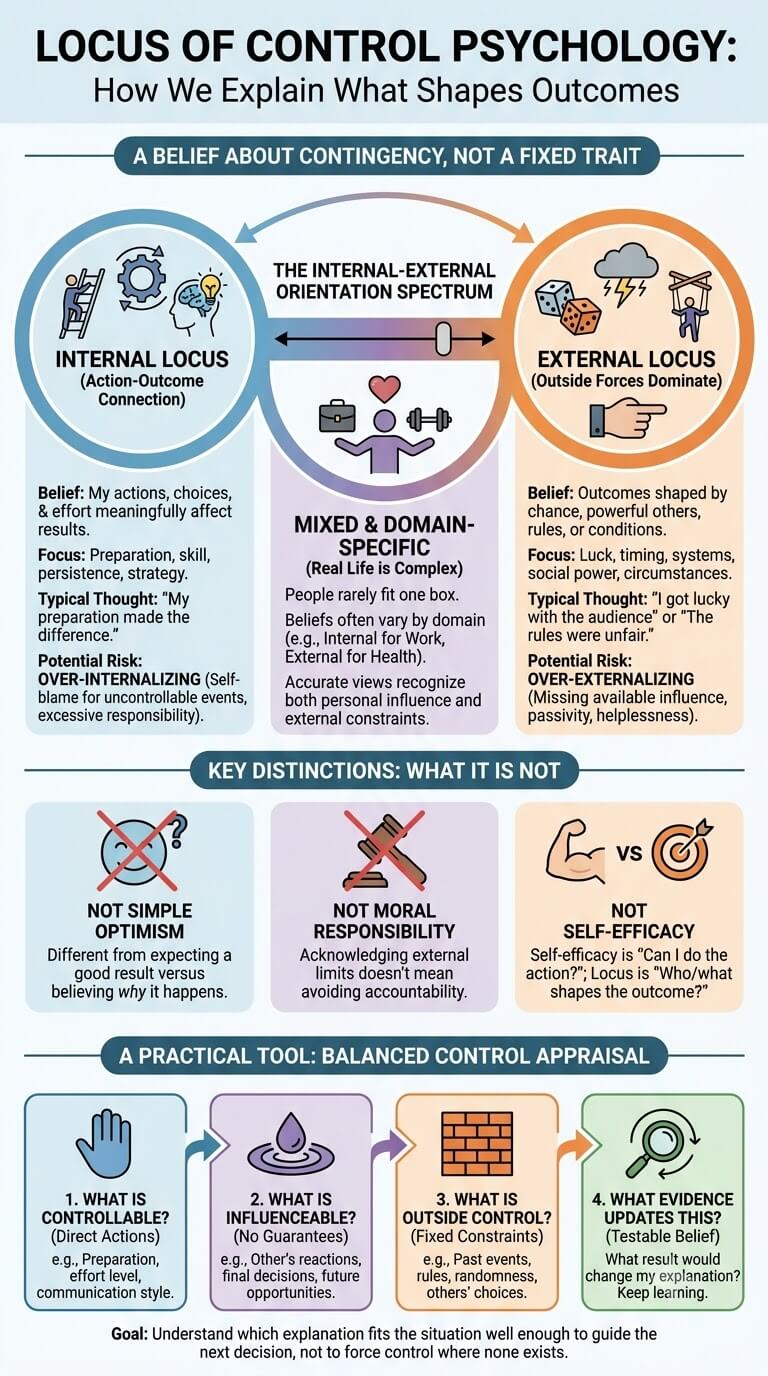
Locus of control is a psychological concept describing whether people tend to see outcomes as more connected to their own actions or more influenced by outside forces such as chance, powerful others, or conditions they cannot control. It is a belief about where control tends to reside, not proof of how much control a person actually has in every situation.
What Locus of Control Means in Psychology
The APA Dictionary of Psychology definition of locus of control centers on people’s perceptions of control over the conditions and outcomes of their lives. In everyday language, the concept asks a simple question: “What usually makes the difference between one outcome and another?”
That question can be answered in many ways. A student may believe study habits strongly affect grades. An employee may believe promotions depend mostly on management politics. A person managing a health habit may believe daily choices matter while also recognizing genetics, access to care, money, and medical circumstances they cannot change.
Outcome contingency rather than simple optimism
Locus of control is best understood as a belief about contingency. Does action A tend to make outcome B more likely? If you believe the connection is strong, your thinking leans more internally for that outcome. If you believe the connection is weak because luck, rules, other people, or unpredictable events dominate, your thinking leans more externally.
This is different from optimism. An optimistic person may expect a good result while believing it will come from good fortune. A more pessimistic person may believe their actions matter but expect that they have not prepared enough. Positive expectation and perceived source of control are related in some situations, but they are not the same psychological question.
Why it is not the same as personal responsibility
Control beliefs are also different from moral responsibility. Saying “my actions influence this outcome” does not mean “everything that happens is my fault.” Likewise, recognizing an external constraint does not automatically mean avoiding responsibility.
Imagine two people are laid off because their company closes a division. One thinks, “I could improve my résumé and network, but I did not cause the closure.” That is neither helpless nor self-blaming. It separates influence over the next step from responsibility for the event that already happened.
Where the Concept Came From
The concept makes more sense when it is viewed as a learned expectation rather than a permanent label.
Rotter, reinforcement expectations, and learning history
Psychologist Julian Rotter introduced locus of control within social learning theory. The basic idea was that people learn expectations about whether their behavior is connected to reinforcement and outcomes. When actions repeatedly appear to matter, a person may become more likely to expect similar actions to matter in related situations. When outcomes seem disconnected from behavior, external explanations can become more plausible.
A modern validation study of the Internal-External Locus of Control scale describes the construct as emerging from cognition, perception, and learning across social situations. Experiences can generalize, but they do not have to produce one identical belief across every area of life.
Why modern interpretation should avoid turning it into a fixed type
Labels are tempting because they make a complex concept easy to remember. “Internal” sounds active and capable. “External” can sound passive. But people rarely fit one box across work, money, relationships, health, learning, family, and civic life.
You might feel highly internal about learning a software program because practice reliably improves your skill. You might be more external about a company restructuring because executives make the decision. You might have mixed beliefs about health because behavior matters, but biology and access to care matter too.
Research on health locus of control illustrates this domain-specific approach. A recent systematic review of health locus of control discusses internal beliefs alongside several external sources, including chance and powerful others. That is a good reminder that “outside my control” is not one single category.
Internal and External Orientations at a Glance
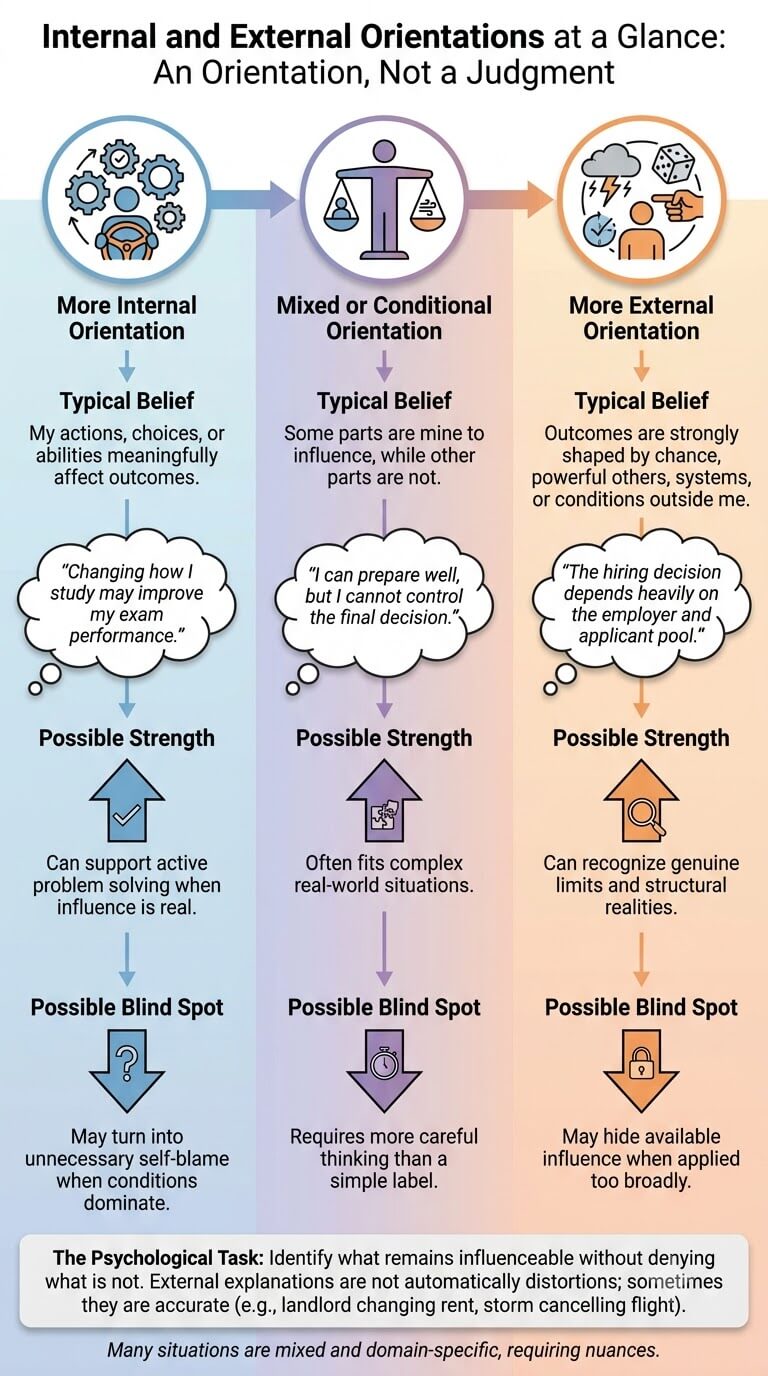
The internal-external distinction is useful as a starting point, as long as it is treated as an orientation rather than a judgment about character.
The broad concept becomes easier to apply when you examine internal and external locus of control as flexible orientations rather than fixed personality types.
| Orientation | Typical belief | Everyday example | Possible strength | Possible blind spot |
|---|---|---|---|---|
| More internal | My actions, choices, or abilities meaningfully affect outcomes. | “Changing how I study may improve my exam performance.” | Can support active problem solving when influence is real. | May turn into unnecessary self-blame when conditions dominate. |
| More external | Outcomes are strongly shaped by chance, powerful others, systems, or conditions outside me. | “The hiring decision depends heavily on the employer and applicant pool.” | Can recognize genuine limits and structural realities. | May hide available influence when applied too broadly. |
| Mixed or conditional | Some parts are mine to influence, while other parts are not. | “I can prepare well, but I cannot control the final decision.” | Often fits complex real-world situations. | Requires more careful thinking than a simple label. |
Internal: outcomes are seen as more contingent on one’s actions
An internal orientation emphasizes the connection between behavior and consequence. After a disappointing result, a person may ask what they could adjust. After success, they may credit preparation, skill, persistence, or judgment.
External: outcomes are seen as more influenced by chance, powerful others, or conditions
An external orientation places more weight on forces beyond personal action. Those forces may include luck, market conditions, family decisions, institutional rules, discrimination, illness, another person’s choices, or events that are simply unpredictable.
Broader control beliefs interact with a person’s ability to choose and act, but they do not by themselves determine whether someone experiences useful agency.
External explanations are not automatically distortions. Sometimes they are accurate. If a landlord changes the rent, a storm cancels a flight, or a supervisor applies an unfair rule, personal effort may have little effect on the immediate outcome. The psychological task is to identify what remains influenceable without denying what is not.
Mixed and domain-specific patterns are common
Many situations contain both kinds of causality. A job interview depends partly on preparation and communication, partly on the employer’s needs, partly on competing applicants, and sometimes on factors the candidate will never know.
How Locus of Control Shows Up in Everyday Life
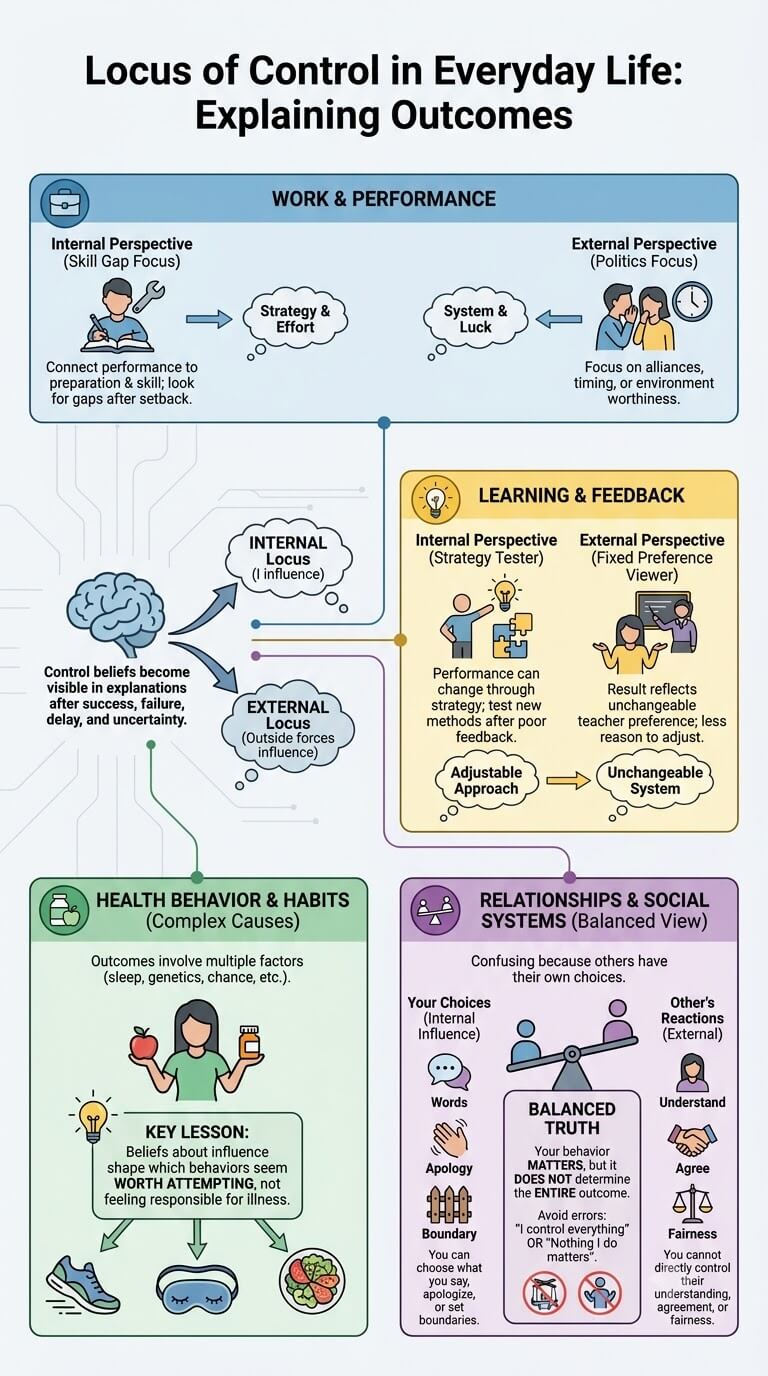
Control beliefs become visible in the explanations people reach for after success, failure, delay, and uncertainty.
Work and performance
At work, locus of control may influence how someone interprets feedback, promotions, mistakes, and stalled progress. A person who sees performance as strongly connected to preparation may look for a skill gap after a setback. Someone who believes organizational politics dominates may focus more on alliances, timing, or whether the environment is worth staying in.
Health behavior and habits
Health makes the distinction especially clear because outcomes usually involve multiple causes. Sleep routines, exercise, medication adherence, food choices, stress exposure, genetics, medical conditions, access to care, and chance can all matter in different proportions.
Research examining locus of control and health treats locus of control as distinct from self-control, even though the two may be related. One open-access study found that a more internal locus of control was associated with self-control and several health outcomes, while also emphasizing that these are separate psychological constructs. The practical lesson is not that people should feel responsible for illness. It is that beliefs about influence can shape which behaviors seem worth attempting.
Learning and feedback
A learner who thinks performance can change through strategy is more likely to test another method after poor feedback. A learner who thinks the result mostly reflects an unchangeable teacher preference may see less reason to adjust.
Relationships and social systems
Control beliefs can become confusing in relationships because another person has their own choices. You can choose what you say, whether you apologize, what boundary you set, or whether you stay in a conversation. You cannot directly control whether the other person understands, agrees, changes, or treats you fairly.
A balanced view protects against two opposite errors: “If I communicate perfectly, I can make this relationship work,” and “Nothing I do matters because the other person decides everything.” Often the truth is that your behavior matters, but it does not determine the entire outcome.
Locus of Control vs Perceived Control
These ideas overlap, but one describes a broader expectation while the other concerns the amount of influence felt in a particular situation.
Generalized outcome beliefs versus current situation appraisal
Locus of control and perceived control are close enough to be confused, but they operate at different levels. Locus of control concerns broader expectations about what tends to shape outcomes. Perceived control is more immediate: “How much influence do I have in this situation right now?”
For example, you may generally believe effort affects career progress, which reflects a more internal work orientation. During a hiring freeze, however, you may accurately perceive very little control over promotion timing. Your broad belief has not vanished. The present situation simply has unusually tight constraints.
Why someone can have an internal orientation yet feel little control in one setting
This distinction prevents a common mistake: interpreting low situational control as a personal weakness. A person can strongly believe in preparation, skill, and persistence while still recognizing that a court decision, medical result, visa process, corporate merger, or another person’s behavior is not theirs to command.
Locus of Control vs Self-Efficacy
Separating control from capability helps explain why people can feel skilled yet powerless, or influential yet unprepared.
“Who or what shapes the outcome?” versus “Can I perform the action?”
Self-efficacy is a belief about capability for a particular action or task. Locus of control is about the perceived source of outcomes. The distinction matters because you can feel capable while believing the environment will not reward the action, or feel that action matters while doubting your ability to perform it.
Consider public speaking. “If I prepare and practice, the talk will probably improve” is a control belief. “I can deliver the talk clearly under pressure” is a capability belief. They often support each other, but they answer different questions.
Four combinations of capability and control belief
| Capability belief | Control belief | What it may sound like | Likely practical need |
|---|---|---|---|
| High | High | “I can do this, and doing it well should matter.” | Act, monitor results, and keep beliefs calibrated. |
| High | Low | “I can do the work, but the decision is mostly out of my hands.” | Identify available influence and avoid over-owning the result. |
| Low | High | “My performance matters, but I am not ready yet.” | Build skill and task-specific capability. |
| Low | Low | “I do not feel able to do much, and I doubt it would change anything.” | Separate skill needs from real constraints before drawing a global conclusion. |
What Shapes Locus-of-Control Beliefs
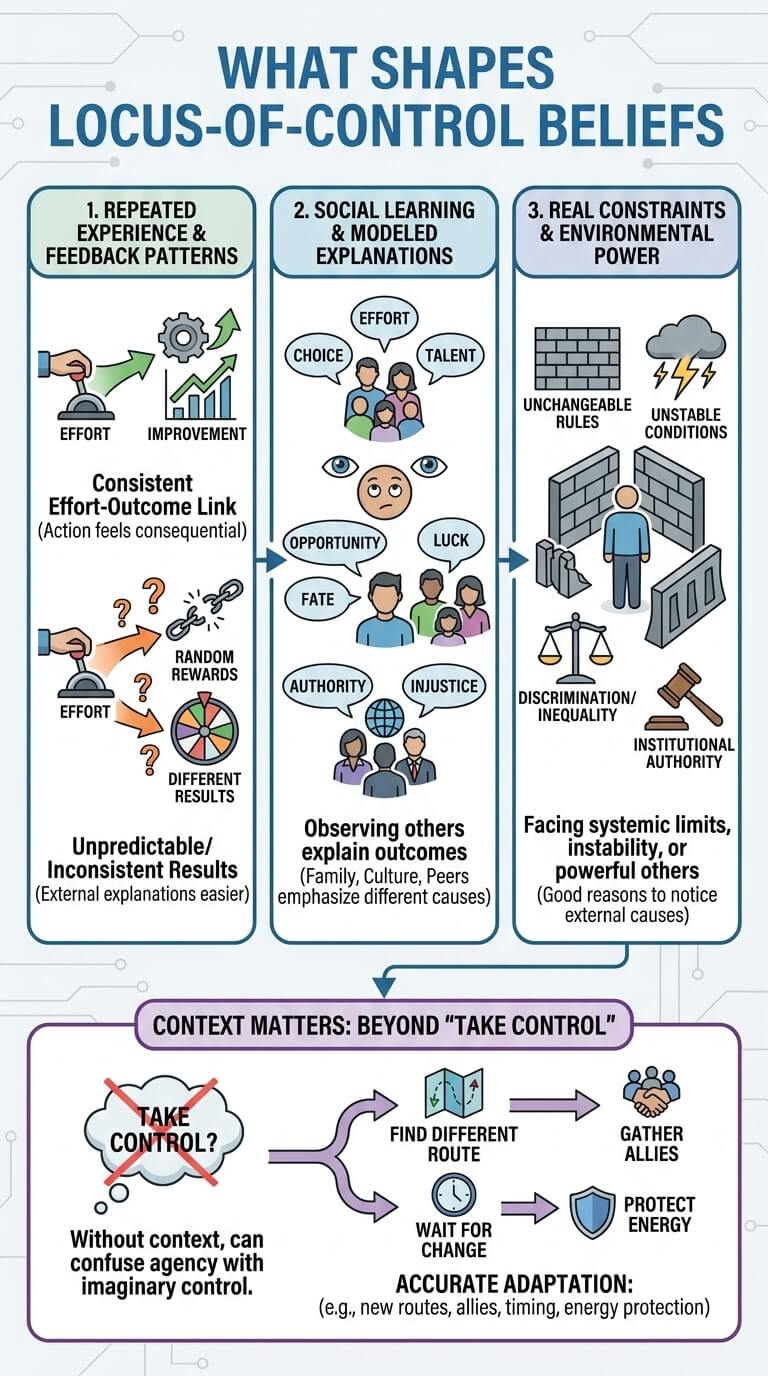
Control expectations are built from experience, observation, feedback, and the real conditions in which a person has had to act.
Repeated contingencies and feedback
People learn from patterns. When effort is repeatedly followed by improvement, action feels consequential. When rewards arrive unpredictably or the same effort produces wildly different results, external explanations become easier to understand.
Social learning and modeled explanations
People also learn how to explain outcomes by watching others. Families, teachers, managers, peers, and cultures can repeatedly emphasize effort, fate, authority, opportunity, luck, talent, injustice, or personal choice.
Longitudinal research on children’s locus of control supports the idea that early experience and family context are associated with later control expectations. One study examining early home-life antecedents of locus of control found links between aspects of early parent-child interaction and children’s later orientation. Such findings describe associations, not a simple formula that fixes a child’s future.
Real constraints, randomness, and institutional power
Control beliefs do not develop in a vacuum. A person who repeatedly faces rules they cannot change, unstable conditions, discrimination, financial limits, caregiving demands, or decisions controlled by authorities may have good reasons to notice external causes.
That is why context matters when interpreting an external orientation. Telling someone to “take control” without examining the environment can confuse psychological agency with imaginary control. Sometimes the most accurate next step is not trying harder. It may be finding a different route, gathering allies, waiting for a condition to change, appealing a decision, or protecting energy from an unwinnable fight.
Because responsibility and personal influence are easily confused, the difference between personal agency and locus of control is worth keeping explicit.
The Risk of Over-Internalizing Control
Seeing personal influence everywhere can sound empowering while quietly turning uncertainty and external barriers into self-blame.
Self-blame for outcomes that were not realistically controllable
An internal orientation becomes unhelpful when it expands beyond evidence. A person may assume that every rejection proves poor performance, every conflict could have been prevented by better communication, or every health setback reflects insufficient discipline.
This can create excessive responsibility for outcomes involving other people, uncertainty, biology, or structural constraints. The corrective question is not “How do I stop taking responsibility?” It is “Which part was actually mine?”
Why accurate external attribution can be adaptive
Recognizing an external cause can protect judgment. If a train is cancelled, a market collapses, a policy changes, or another person breaks an agreement, locating the cause outside yourself may be more accurate than searching for a personal flaw.
External attribution is especially useful when it frees attention for the next controllable action. “I did not cause this, but I can decide what I do now” is very different from “I did not cause this, so nothing I do matters.”
The Risk of Over-Externalizing Control
The reverse problem appears when outside causes are given so much weight that usable influence is no longer noticed.
Missing influence that is genuinely available
The opposite error is treating a partly controllable situation as fully fixed. Someone might assume they are “bad at interviews” because hiring is subjective, while overlooking preparation, examples, pacing, or the kinds of roles they apply for. Another person may say family conflict is “just how everyone is” while never testing a clearer boundary.
How passivity can be reinforced by repeated expectations
If people repeatedly expect that action will not affect outcomes, they may invest less effort, seek less feedback, or stop testing alternatives. That reduced action can then produce fewer opportunities for corrective evidence.
A Balanced Control-Appraisal Framework
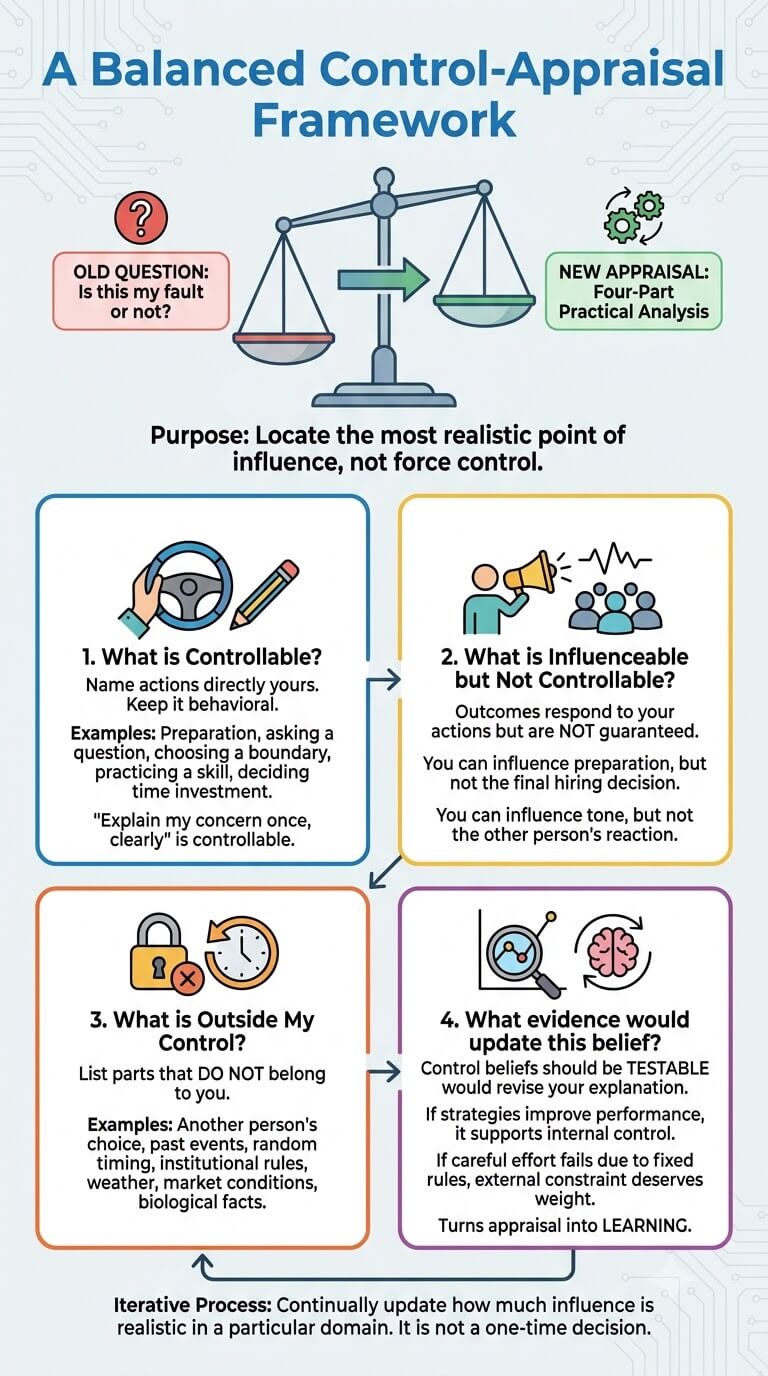
A practical way to use locus of control is to replace the question “Is this my fault or not?” with a four-part appraisal. The purpose is not to force control where none exists. It is to locate the most realistic point of influence.
1. What is controllable?
Name actions that are directly yours: preparation, asking a question, choosing a boundary, practicing a skill, applying for another role, making an appointment, or deciding how much time to invest.
Keep this list behavioral. “Make them understand me” is not directly controllable. “Explain my concern once, clearly and respectfully” is.
2. What is influenceable but not controllable?
Some outcomes respond to your actions without being guaranteed by them. You can influence how prepared you are for an interview, but not the final hiring decision. You can influence the tone of a conversation, but not the other person’s reaction.
3. What is outside my control?
List the parts that do not belong to you: another person’s choice, past events, random timing, institutional rules you cannot alter today, weather, market conditions, or biological facts.
4. What evidence would update this belief?
Control beliefs should be testable. Ask what result would make you revise your current explanation. If three different preparation strategies improve performance, that supports more internal control for that task. If careful effort repeatedly fails because a fixed rule blocks every route, the external constraint deserves more weight.
This final step turns control appraisal into learning rather than ideology. You do not have to decide once and forever whether “I control my life.” You can keep updating how much influence is realistic in a particular domain.
When a Simple Internal or External Label Is Not Enough
A single label becomes less useful when different areas of life have taught very different lessons about control.
Profiles and mixed cases need a closer comparison
People often search for a simple answer to “Am I internal or external?” but a single label can hide useful detail. Someone may be highly internal about work, mixed about health, and external about family decisions. Another person may believe effort matters while also believing powerful others determine which opportunities are available.
When Control Beliefs Shift Toward “Nothing I Do Matters”
External explanations and helpless expectations are not interchangeable, even though they can sometimes appear beside each other.
How this differs from a general external orientation
An external control belief does not automatically mean helplessness. You can recognize that an outcome depends on external conditions and still take effective action elsewhere. For example, you may accept that a medical diagnosis was not under your control while actively choosing treatment questions, routines, or support.
A more concerning shift happens when repeated uncontrollability starts producing a broader expectation that effort is pointless even when circumstances change. That territory is closer to learned helplessness, which involves how experiences of uncontrollability can reduce later attempts. The distinction matters because not every realistic external attribution should be treated as a problem.
FAQ About Locus of Control Psychology
These questions clarify where the concept is most often oversimplified.
Is locus of control a personality trait?
It is often studied as a relatively stable individual-difference construct, especially when researchers measure generalized expectations across situations. However, stability does not mean absolute rigidity. People can hold different control beliefs across domains, and new experiences can update expectations over time.
Can locus of control change?
Yes, control beliefs can change as people accumulate new experiences, enter different environments, gain skills, encounter constraints, or receive clearer feedback about what their actions affect. Change is usually more believable when it comes from evidence rather than slogans.
If someone has repeatedly seen effort fail, telling them to “believe they are in control” may not be persuasive. A better approach is to identify a small area where action can produce observable feedback and let the belief update from experience.
Is an internal locus always better?
No. Internal beliefs are useful when personal action truly influences the outcome. They become less accurate when they encourage self-blame for chance, other people’s decisions, structural barriers, or conditions outside personal control.
Can locus of control differ across areas of life?
Yes. A person may believe effort strongly affects learning while seeing financial outcomes as heavily influenced by the economy, or feel substantial control over exercise habits while recognizing limited control over a chronic condition. Domain-specific differences are normal and often more informative than one global label.
Key Takeaways
- Locus of control describes beliefs about what tends to shape outcomes, not the amount of control a person objectively has in every situation.
- An internal orientation emphasizes the connection between personal action and results; an external orientation gives more weight to chance, powerful others, systems, or conditions.
- Neither orientation is automatically good or bad. Accuracy depends on whether the explanation fits the actual situation.
- Locus of control is different from self-efficacy: one asks what shapes the outcome, while the other asks whether you can perform the required action.
- A balanced appraisal separates direct control, partial influence, outside constraints, and the evidence that would make you update your belief.
- Recognizing real limits can be adaptive, while overlooking available influence can unnecessarily narrow your choices.
Final Thoughts
The most useful way to think about locus of control is not “I control my life” versus “life controls me.” Most meaningful outcomes are produced by a mixture of personal action and conditions no one person controls.
Choose one situation that currently feels frustrating and divide it into three zones: what you directly control, what you can influence without guaranteeing, and what is outside your control. Then add one final question: “What evidence would make me change this map?” That turns locus of control from a label into a practical way of thinking more accurately about action, limits, and the next move.

Michael Reed is the Founder and Lead Writer at Psychology Exposed. He writes about human behavior, relationships, emotional patterns, self-awareness, and practical psychology topics using research-informed, easy-to-understand content.
Read More About Michael Reed: https://psychologyexposed.com/michael-reed/