
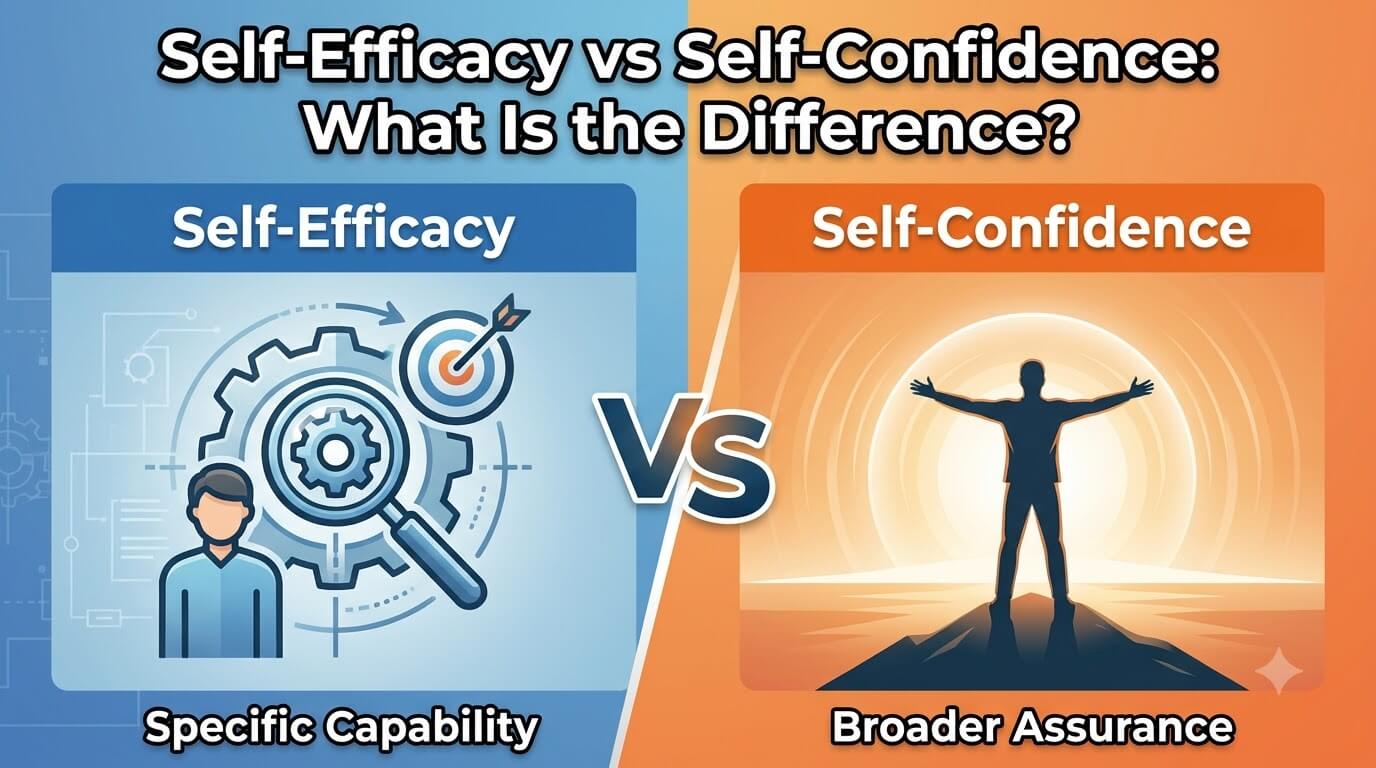
When people say, “I just need more confidence,” they may be describing several very different problems. A new manager might feel comfortable speaking with coworkers but doubt their ability to lead a difficult performance review. A student may feel awkward socially yet be certain they can solve a familiar calculus problem. An experienced runner may trust their training but still feel nervous before a race.
Those examples sound like confidence issues in everyday language, but psychology gives us a more precise way to separate them. Self-efficacy is a belief about whether you can perform a particular action or handle a particular task in a given context. Self-confidence is a broader term for trust, assurance, or belief in yourself. The distinction matters because a vague instruction to “be more confident” is not very useful when the real problem is a missing skill, weak evidence, low control, or ordinary performance nerves.
Quick Answer
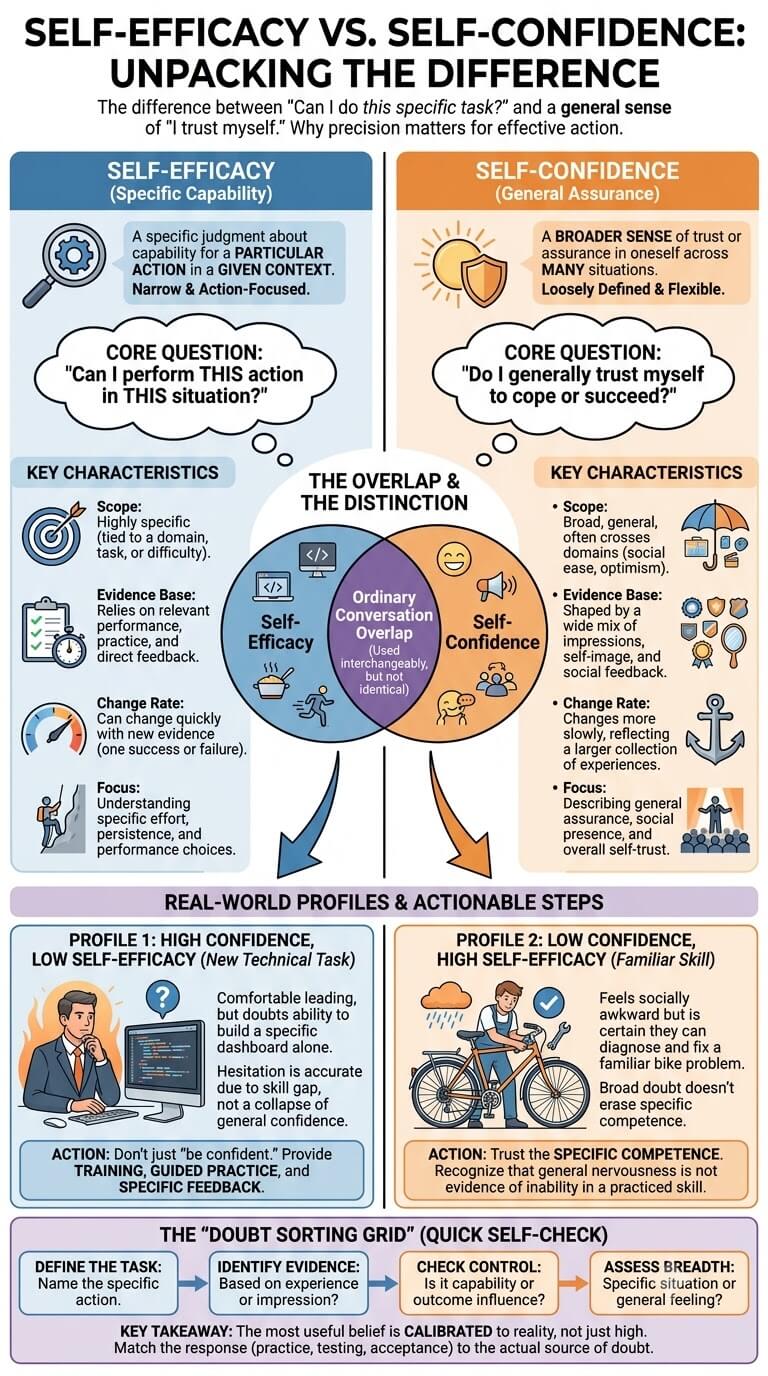
Self-efficacy is a specific judgment about capability: “Can I do this task in this situation?” Self-confidence is a broader sense of assurance in yourself and may apply across many situations. The terms overlap in ordinary conversation, but they are not identical. A person can feel generally confident while having low self-efficacy for one unfamiliar task, or feel broadly unsure of themselves while being highly capable and certain in a well-practiced skill.
The Core Difference in One Question
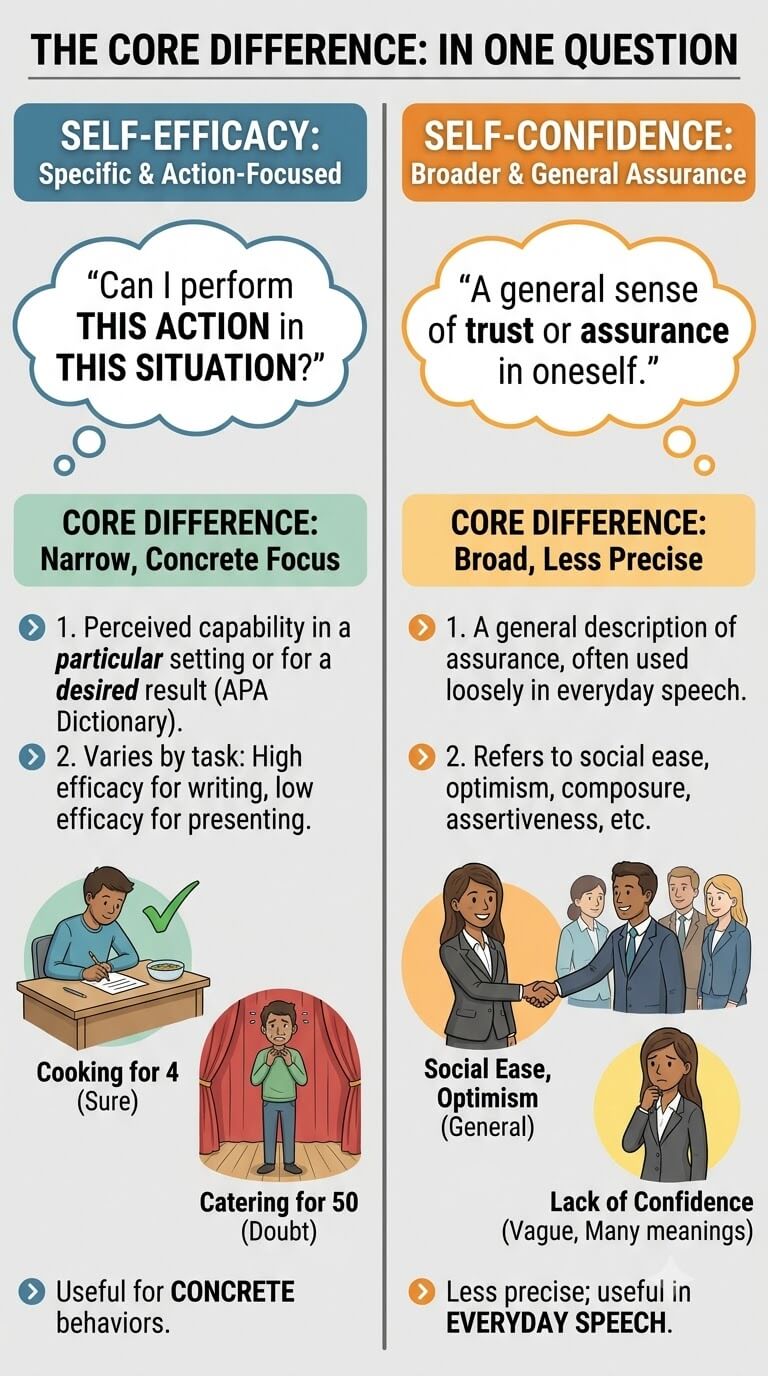
The easiest way to separate self-efficacy from self-confidence is to listen to the question underneath the doubt. One concept is narrow and action-focused. The other is broader and often less precisely defined.
Self-efficacy asks “Can I perform this action in this situation?”
The APA Dictionary of Psychology definition of self-efficacy centers on a person’s perceived capability in a particular setting or in relation to a desired result. That specificity is the key. You do not simply “have” one fixed amount of self-efficacy for your whole life.
You may have high self-efficacy for writing a report but low self-efficacy for presenting it to a large audience. You may believe you can cook dinner for four people but doubt that you can cater an event for fifty. You may feel sure you can complete a workout you know, yet uncertain about returning to exercise after a long break.
Self-efficacy is therefore useful when the behavior can be made concrete. The more clearly you can name the task, conditions, and required actions, the more meaningful the judgment becomes.
Self-confidence is a broader everyday sense of trust or assurance in oneself
Self-confidence is commonly used as a more general description of assurance. The APA Dictionary of Psychology entry for self-confidence provides a psychology reference point for the term, but in everyday speech people use “confidence” loosely. It may refer to social ease, optimism, composure, assertiveness, appearance, willingness to take risks, or a general belief that one will cope.
That flexibility makes confidence useful in everyday speech, but less precise. Two people who both say “I lack confidence” may need different responses. One may need practice, another may be reading nervousness as inability, and a third may be competent in a situation where effort has limited influence on the outcome.
If the problem extends beyond capability into choice and influence, the broader agency framework explains how those parts work together.
Side-by-Side Comparison: Self-Efficacy vs Self-Confidence
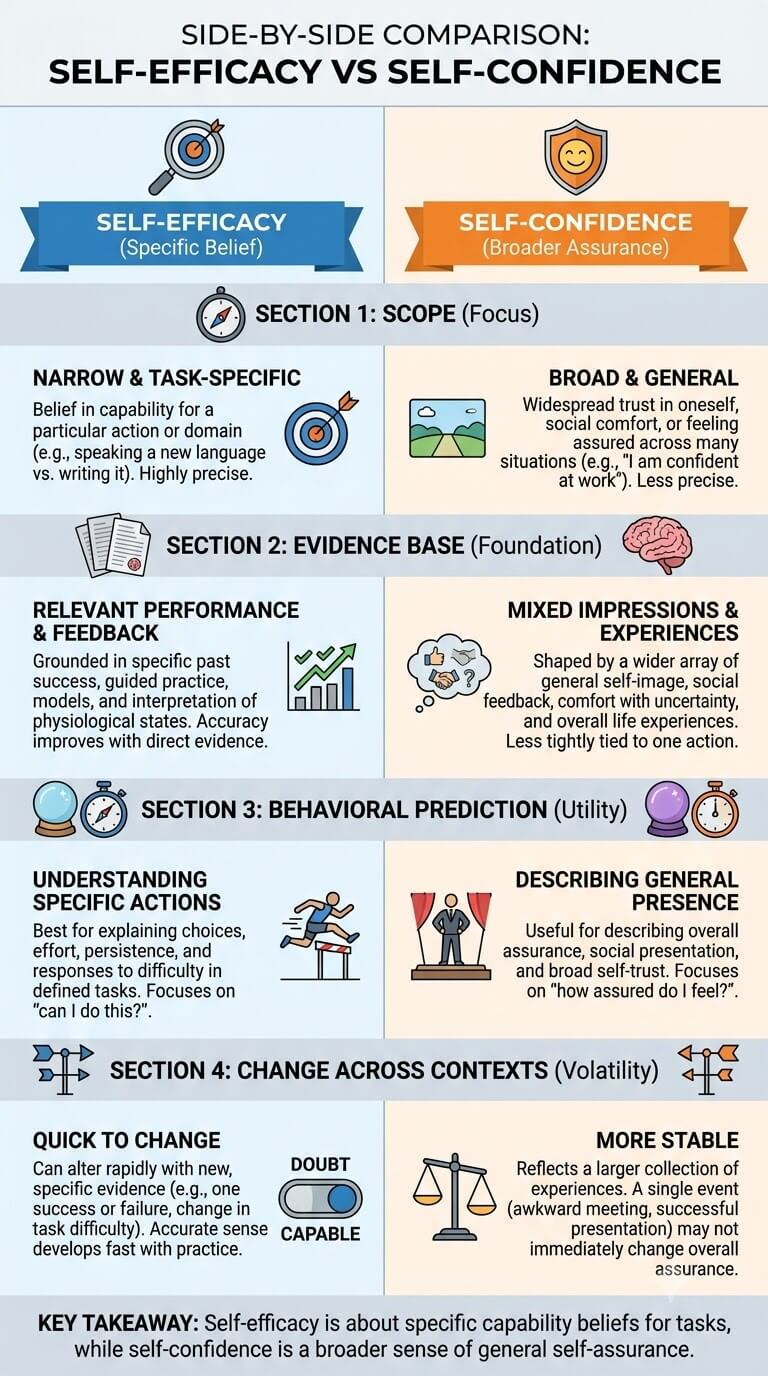
A comparison becomes clearer when the two ideas are separated by scope, evidence, prediction, and context.
| Question | Self-efficacy | Self-confidence |
|---|---|---|
| What does it describe? | Belief in capability for a specific task or action | Broader assurance or trust in oneself |
| How specific is it? | Usually tied to a domain, task, difficulty, or situation | Can be broad, general, or loosely defined |
| What evidence matters most? | Relevant performance, practice, feedback, models, and interpretation of arousal | May draw on many experiences, self-image, social feedback, and general impressions |
| Can it vary sharply by task? | Yes | Yes, but everyday use often treats it as more global |
| When is it most useful? | Understanding specific action, effort, persistence, and performance beliefs | Describing general assurance, social presentation, or broad self-trust |
Scope: specific versus broad
Research and measurement of self-efficacy usually work best when the task is clearly specified. A 2024 open-access study on speaking self-efficacy notes that domain specificity is a central feature of the construct and that beliefs can differ across activities even within the same broad domain. Someone can feel capable in writing a second language while doubting their ability to speak it spontaneously. You can see this task-specific approach in research on speaking self-efficacy.
Self-confidence does not always carry that level of precision. A person might say, “I am confident at work,” which could mean they trust their judgment, feel socially comfortable, know the systems well, or simply do not feel easily intimidated. That statement is meaningful, but it does not tell us exactly what behavior they believe they can perform.
Evidence base: performance information versus general self-impression
Self-efficacy tends to become more accurate when it is connected to relevant evidence. If you have successfully negotiated several similar contracts, that experience gives you information about your ability to negotiate another one. If you have never used a new software tool, your uncertainty may reflect a genuine evidence gap rather than a damaged sense of self.
General confidence can be shaped by a wider mix of impressions. A person may feel confident because they have broad experience, because others respond positively to them, because they are comfortable with uncertainty, or because they habitually expect themselves to cope. None of those are automatically inaccurate, but they are less tightly tied to one defined action.
Behavioral prediction: when specificity matters
If you want to understand why someone is avoiding a specific task, a specific belief is often more informative than a broad label. A systematic review of pre-event self-efficacy in sports distinguishes self-efficacy from broader self-confidence and examines how beliefs about performing specific tasks relate to performance. The review illustrates why researchers often prefer the narrower construct when the outcome itself is specific. See the open-access review of self-efficacy and sports performance.
Self-efficacy does not guarantee success. You can believe you can perform a task and still make mistakes. Its value is that the belief is framed closely enough to the action to help explain choices, effort, persistence, and responses to difficulty.
How quickly each can change across contexts
Because self-efficacy is specific, it can change quickly when new evidence arrives. One successful attempt, one clearly understood failure, or one change in task difficulty may alter your estimate. You might arrive at work doubting your ability to run a new reporting system, receive guided practice, complete two reports successfully, and leave with a more accurate sense of capability.
Broader self-confidence may change too, but it often reflects a larger collection of experiences. A single awkward meeting may not erase a generally confident person’s self-trust. Likewise, one successful presentation may improve someone’s confidence, but it may not immediately change how assured they feel in every social situation.
Four Everyday Profiles That Show the Difference
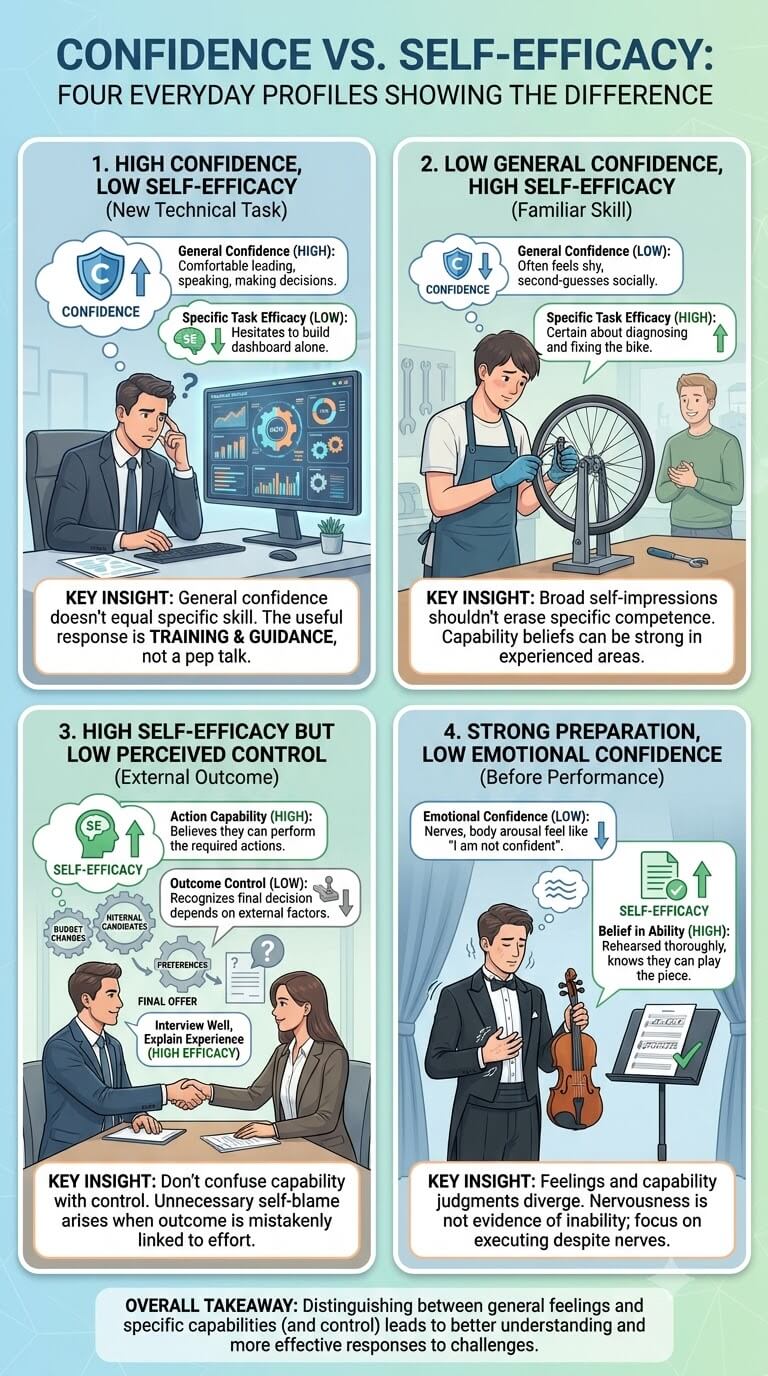
The distinction becomes most useful when real people do not fit a simple “confident versus not confident” box.
High confidence, low self-efficacy for a new technical task
Imagine a confident marketing director who is comfortable making decisions, speaking in meetings, and leading a team. Their company introduces a complex analytics platform they have never used. They hesitate to build a dashboard alone.
The hesitation does not necessarily mean their overall confidence has collapsed. Their specific judgment may be accurate: “I do not yet know how to perform this task without help.” The useful response is probably training, guided attempts, and feedback, not a pep talk about believing in themselves.
Low general confidence, high self-efficacy in a familiar skill
Now imagine someone who often feels shy and second-guesses themselves socially but has repaired bicycles for ten years. A customer brings in a familiar braking problem. They may feel uncomfortable making small talk while being completely certain they can diagnose and fix the bike.
This profile shows why broad self-impressions should not erase specific competence. A person who says “I am not a confident person” may still hold strong, well-calibrated capability beliefs in areas where they have real experience.
High self-efficacy but low perceived control
A skilled job applicant may be certain they can interview well, explain their experience clearly, and complete the technical exercise. At the same time, they may recognize that the final hiring decision depends on budget changes, internal candidates, or preferences they cannot influence.
Here, capability is not the main problem. The person believes they can perform the actions. What is limited is control over the outcome. Confusing these ideas can create unnecessary self-blame: “If I were more confident, I could make this happen.” Sometimes you can be highly capable and still face a result you do not control.
Strong preparation but low emotional confidence before performance
An experienced musician may have rehearsed thoroughly and know they can play the piece, yet still feel shaky before walking onstage. The body’s arousal can feel like “I am not confident,” even when the person’s actual belief about their ability remains fairly strong.
This is a useful reminder that feelings and capability judgments can diverge. Nervousness is not automatically evidence that you cannot do the task. The better question is whether you still expect yourself to execute the required actions despite the nerves.
Why “Just Be More Confident” Can Miss the Real Problem
Confidence language becomes unhelpful when it hides the source of the doubt. Before trying to change how you feel about yourself, it helps to identify what information the doubt is actually giving you.
Skill gap, evidence gap, control gap, or emotional arousal?
Four problems can sound almost identical in your head:
- Skill gap: “I do not yet know how to do part of this.”
- Evidence gap: “I may be able to do it, but I have too little relevant experience to know.”
- Control gap: “I can do my part, but my actions may not determine the outcome.”
- Emotional arousal: “I feel tense, exposed, or uncertain, and I am interpreting that feeling as inability.”
Those are not the same problem. Treating all four as low confidence can lead to the wrong next step. Skill gaps need learning. Evidence gaps need tests. Control gaps need realistic boundaries around influence. Arousal may need preparation, pacing, or a different interpretation of what nervousness means.
Matching the response to the actual problem
Suppose you have to facilitate a meeting. If you cannot explain the agenda or handle the software, more positive self-talk will not replace preparation. If you know the process but have never led a meeting before, a smaller practice session may provide useful evidence. If you are ready but afraid senior leaders will dislike the decision, the uncertainty may be about outcome control rather than facilitation skill.
Precision reduces wasted effort. Instead of asking, “How do I become more confident?” ask, “What exactly do I doubt, and what kind of information would change that judgment?”
Self-Efficacy vs Self-Esteem: A Brief Boundary
Self-efficacy and self-esteem are also easy to mix because both involve beliefs about the self, but they answer different questions.
Capability judgment is not personal worth
Self-efficacy is about whether you believe you can perform an action. Self-esteem concerns how positively or negatively you evaluate yourself more broadly. The APA Dictionary description of self-esteem focuses on evaluation of qualities and characteristics in one’s self-concept.
You can conclude, “I cannot code this feature yet,” without concluding, “I am inadequate as a person.” Keeping capability separate from worth makes it easier to learn from accurate limits without turning every difficult task into a verdict on identity.
Keep the distinction short to avoid drifting into identity content
If your main question is whether you can perform a specific task, stay with self-efficacy. If the distress is mainly about worth, shame, or a broad negative evaluation of yourself, self-esteem may be the more relevant lens. They can interact, but one should not be used as a substitute for the other.
When the Self-Efficacy Lens Is More Useful
The self-efficacy lens is especially useful when you can name the action, define the conditions, and gather evidence about performance.
Specific performance, learning, rehabilitation, work, and study tasks
Examples include giving a presentation, solving a type of equation, using a tool, following an exercise plan, speaking a new language, managing a work process, or practicing a physical skill. In these situations, “confidence” can be narrowed into questions such as:
- Can I perform the first step without assistance?
- Can I do this at the required difficulty?
- Can I continue when something goes wrong?
- Can I use the strategy under realistic conditions?
An open-access systematic review of mathematics interventions describes mathematics self-efficacy as situation-specific and discusses why task-specific measures can be more useful than broad judgments. That distinction is explored in research on mathematics self-efficacy.
Situations where measurable feedback is available
Self-efficacy is particularly valuable when reality can answer back. You attempt the task, observe what happened, identify which part worked, and adjust your belief. This makes it possible to move from “I think I can” or “I think I cannot” toward a more calibrated estimate.
Calibration matters in both directions. Very low self-efficacy may discourage attempts that could succeed. Very high self-efficacy can also be inaccurate if it is not grounded in current skill or conditions. The goal is not maximum belief. It is a belief accurate enough to guide useful action.
When “Confidence” Is the Better Everyday Word
Not every conversation needs a technical distinction. Sometimes “confidence” is exactly the right word because the experience itself is broad.
Broad social assurance and general self-presentation
You might describe someone as confident because they speak directly, tolerate disagreement, recover after awkward moments, or seem comfortable being seen. These observations may involve many beliefs at once, not one clearly defined capability judgment.
If a friend says, “I want to feel more confident meeting new people,” a technical definition is unnecessary. Precision matters when you are trying to identify what is blocking action or what kind of change would actually help.
Why ordinary language does not always need a technical label
Psychological concepts are tools, not replacements for normal speech. Saying “I felt confident today” can simply mean you felt steady, prepared, and willing to act. There is no need to correct the sentence.
The distinction matters when the broad word hides a solvable problem. If “confidence” means “I have never practiced,” practice is relevant. If it means “I can do it but feel nervous,” the issue is different. If the result depends heavily on someone else, capability may not be the problem at all.
A Simple Self-Check: What Kind of Doubt Is This?
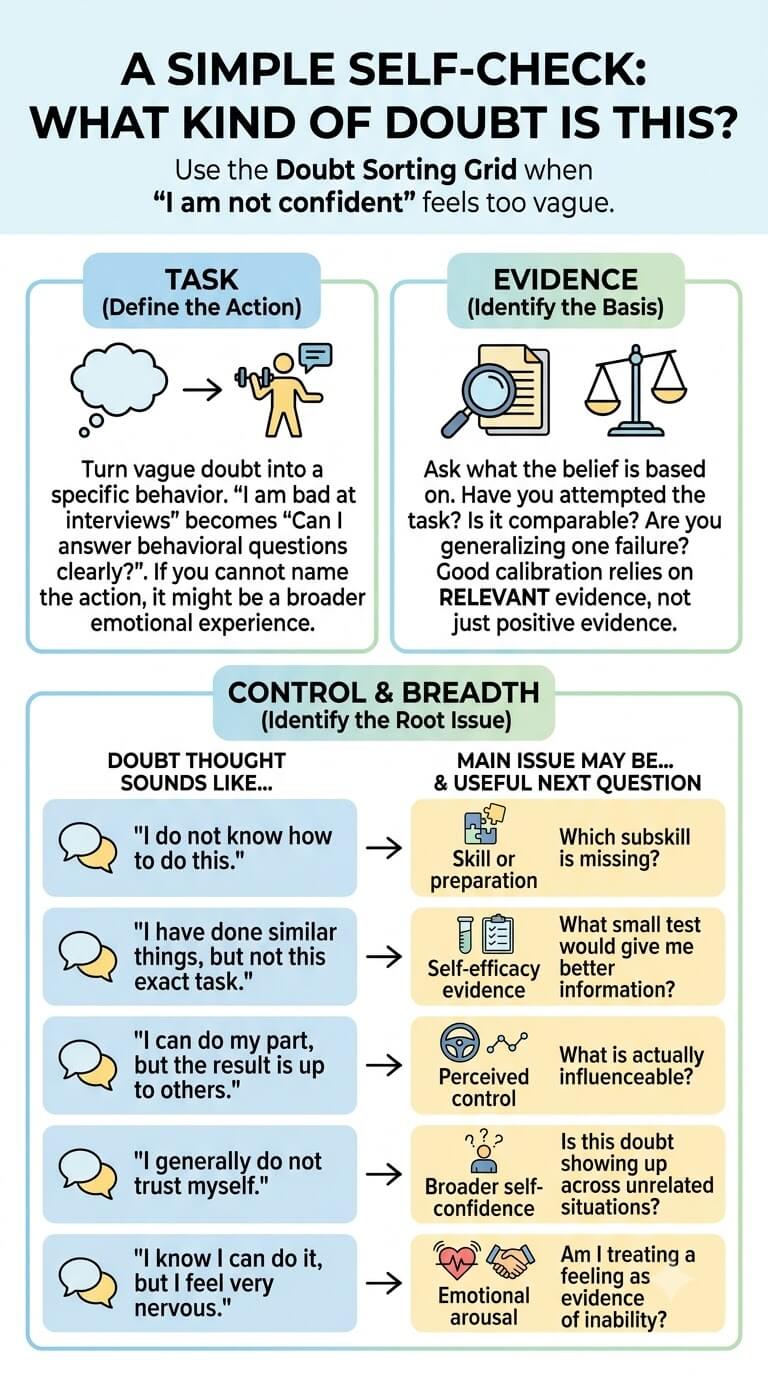
Use the following Doubt Sorting Grid when “I am not confident” feels too vague. The grid has four questions: Task, Evidence, Control, and Breadth.
Define the task
Turn the doubt into a behavior. “I am bad at interviews” becomes “I am not sure I can answer behavioral questions clearly without rambling.” “I am not confident at the gym” becomes “I do not know whether I can perform this lift with safe technique.”
If you cannot name the action, you probably do not yet have a self-efficacy question. You may be describing a broader emotional or self-evaluative experience.
Identify the evidence behind the doubt
Ask what the belief is based on. Have you attempted the task? Was the task comparable to the one you face now? Did you receive usable feedback? Are you treating one failure as universal evidence, or one easy success as proof that every harder version will go well?
Good calibration depends on relevant evidence, not simply positive evidence. An honest “I need more practice” can be more useful than forced certainty.
Ask whether the issue is capability, control, preparation, or broad self-belief
| If your thought sounds like… | The main issue may be… | A useful next question |
|---|---|---|
| “I do not know how to do this.” | Skill or preparation | Which subskill is missing? |
| “I have done similar things, but not this exact task.” | Self-efficacy evidence | What small test would give me better information? |
| “I can do my part, but the result is up to others.” | Perceived control | What is actually influenceable? |
| “I generally do not trust myself.” | Broader self-confidence | Is this doubt showing up across unrelated situations? |
| “I know I can do it, but I feel very nervous.” | Emotional arousal | Am I treating a feeling as evidence of inability? |
What to Do Next Based on the Answer
Once the doubt is sorted, the next step can be smaller and more concrete.
If capability belief is low: create a small mastery test
Choose an attempt that is challenging enough to produce information but small enough to be realistic. Instead of deciding whether you are “good at public speaking,” record a two-minute explanation, review it, and repeat with one improvement. The point is to gather evidence about a defined capability.
If skill is low: practice the missing subskill
Low belief is sometimes accurate. If you cannot yet perform the action, break the task down. A person struggling with presentations may need help organizing slides, answering questions, or pacing speech. Improving the relevant skill gives later confidence something real to rest on.
If control is low: evaluate what is actually influenceable
Do not demand self-belief to solve an uncontrollable situation. Separate your actions from the final outcome. You may be able to prepare carefully for an interview without controlling who else applies. You may be able to communicate clearly without controlling how another person responds.
This distinction protects against both helplessness and excessive responsibility. Agency is not the same as total control.
If broader confidence is the issue: widen the question carefully
If doubt appears across many unrelated settings, a task-specific test may only answer part of the problem. It may help to notice how you evaluate yourself, what situations reliably undermine assurance, and whether you discount competence even when evidence is strong. That is a broader inquiry than this comparison can resolve.
How Mastery Experiences Build Task-Specific Belief
One reason self-efficacy can change is that direct performance gives the brain better evidence. Completing a difficult but manageable task after effort can update the prediction from “I probably cannot do this” to “I have now done a version of this successfully.”
Successful performance evidence matters more than vague reassurance
Encouragement can help, but it is not always enough to overturn repeated contradictory experience. If someone says, “You will be great,” while you have no idea how to perform the task, the statement may feel supportive without changing your capability estimate.
A well-designed attempt is different because it creates information. What did you do? What worked? Which part failed? Was the difficulty appropriate? Could you repeat the result? That is why small mastery experiences are more useful than collecting compliments when the uncertainty is specifically about performance.
FAQ About Self-Efficacy vs Self-Confidence
These questions clarify points of confusion between broad confidence and specific capability beliefs.
Can you have self-confidence without self-efficacy?
Yes. You can feel generally assured, socially comfortable, or trusting of yourself while doubting your ability to perform a new or highly specific task. A confident professional may have low self-efficacy for coding, public speaking, or another unfamiliar skill. The narrow belief does not automatically describe the person’s broader confidence.
Is self-efficacy just another word for believing in yourself?
Not quite. “Believing in yourself” is broad and can include hope, self-esteem, confidence, optimism, or resilience. Self-efficacy is more specific: it concerns your perceived capability to organize and perform actions required in a particular task or setting. The specificity is what makes the concept useful for understanding behavior.
Which predicts performance better in a specific task?
A well-matched, task-specific self-efficacy judgment is often more informative than a vague global confidence rating because it refers to the same kind of action you are trying to predict. That still does not make it a guarantee. Actual skill, opportunity, difficulty, health, resources, feedback, and external constraints also matter.
Can confidence be high but poorly calibrated?
Yes. Feeling certain does not prove that the belief is accurate. Someone may underestimate a task, rely on outdated experience, or overlook changed conditions. The same is true in the other direction: a capable person may underestimate themselves. Useful confidence is not simply high. It is connected to relevant evidence and updated when reality provides new information.
Key Takeaways
- Self-efficacy asks whether you believe you can perform a specific action in a particular situation.
- Self-confidence is a broader everyday term for assurance or trust in yourself and may not identify the exact source of doubt.
- A person can be generally confident but have low self-efficacy for an unfamiliar task, or broadly unsure while being highly capable in a familiar skill.
- “Low confidence” may actually reflect a skill gap, evidence gap, control gap, or nervous arousal.
- Task-specific doubts are best tested with relevant practice and feedback rather than vague reassurance alone.
- The most useful belief is not always the highest belief. It is one calibrated closely enough to reality to guide effective action.
Final Thoughts
The next time you catch yourself saying, “I am not confident,” make the sentence more specific before trying to fix it. Name the task, look at the evidence, separate capability from control, and ask whether the doubt is narrow or broad. That small distinction can change the response from generic encouragement to something much more useful: practice a missing skill, run a realistic test, accept an external limit, or recognize that nervousness and inability are not the same thing.
Educational note: This article explains psychological concepts for general education and self-reflection. It is not a diagnosis or a substitute for individualized mental health or medical care.

Michael Reed is the Founder and Lead Writer at Psychology Exposed. He writes about human behavior, relationships, emotional patterns, self-awareness, and practical psychology topics using research-informed, easy-to-understand content.
Read More About Michael Reed: https://psychologyexposed.com/michael-reed/