
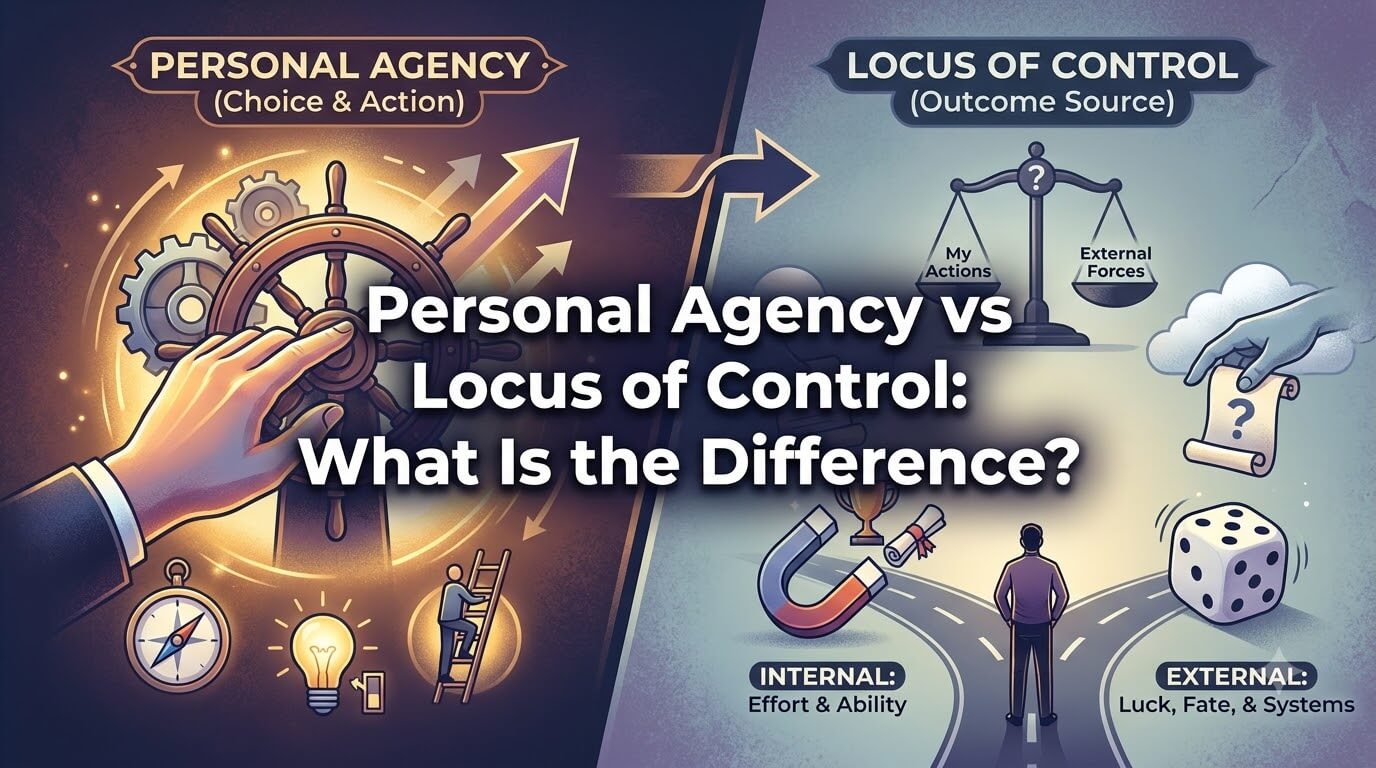
You can feel capable of taking action and still believe that the final outcome depends heavily on timing, systems, luck, or other people. You can also believe that your choices matter while feeling unable to make the choice you think is required. Those combinations are exactly why personal agency and locus of control should not be treated as interchangeable ideas.
Both concepts deal with control, but they point to different psychological questions. Personal agency is about yourself as an actor: whether you can choose, initiate, adjust, and exert influence through what you do. Locus of control is about outcomes: whether you tend to see results as mainly connected to your own actions and abilities or to forces outside you.
Separating the two gives you a more precise way to understand hesitation, responsibility, persistence, and frustration. It also prevents a common mistake: assuming that an internal locus of control always means strong personal power, or that an external locus automatically means passivity.
Quick Answer
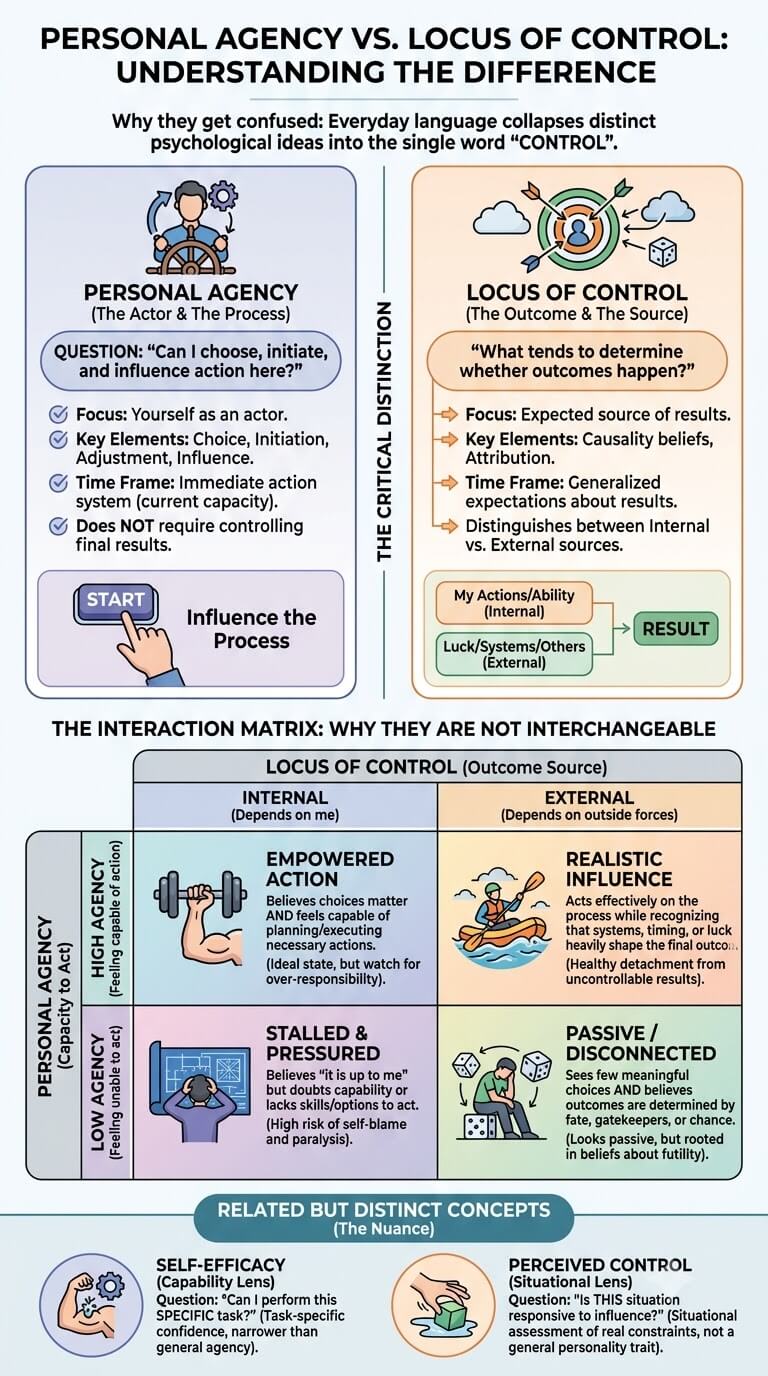
Personal agency concerns your experience of being able to choose and act in ways that influence a situation. Locus of control concerns your broader beliefs about what tends to determine outcomes. They overlap because both involve control, but they answer different questions. A person can have strong agency while recognizing major external influences, or an internal locus while still feeling unable to act effectively.
Why Personal Agency and Locus of Control Get Confused
The confusion is understandable because everyday language often compresses several ideas into one word: control. Saying “I have control” might mean you can make a decision, you have the skill to carry it out, your action can change the situation, or you believe success depends mostly on you. Psychology separates those questions because the answers do not always move together.
Both involve control beliefs but answer different questions
The APA Dictionary of Psychology defines agency in terms of being active and having the power or capability to produce an effect or exert influence. That places agency close to action, authorship, and influence. Research on the sense of agency similarly describes the experience of controlling one’s actions and their consequences, while noting that the experience has several components rather than one simple “control” feeling.
Locus of control asks something broader about how outcomes are explained. The APA definition of locus of control distinguishes orientations in which life outcomes are viewed as arising more from one’s own agency and abilities versus external circumstances. The concepts touch at the idea of influence, but locus of control is especially concerned with expected sources of outcomes.
Everyday language collapses action, control, responsibility, and confidence
Imagine someone says, “I don’t feel in control of my career.” Four different problems could be hiding inside that sentence. They may not know what action to take. They may know what to do but doubt their capability. They may be highly capable but work in a labor market with few openings. Or they may believe employers, networks, and timing matter more than individual effort.
Those are not the same psychological issue. Calling all four “low agency” or “external locus” can lead to the wrong conclusion about what would actually help.
The Core Questions Each Concept Answers
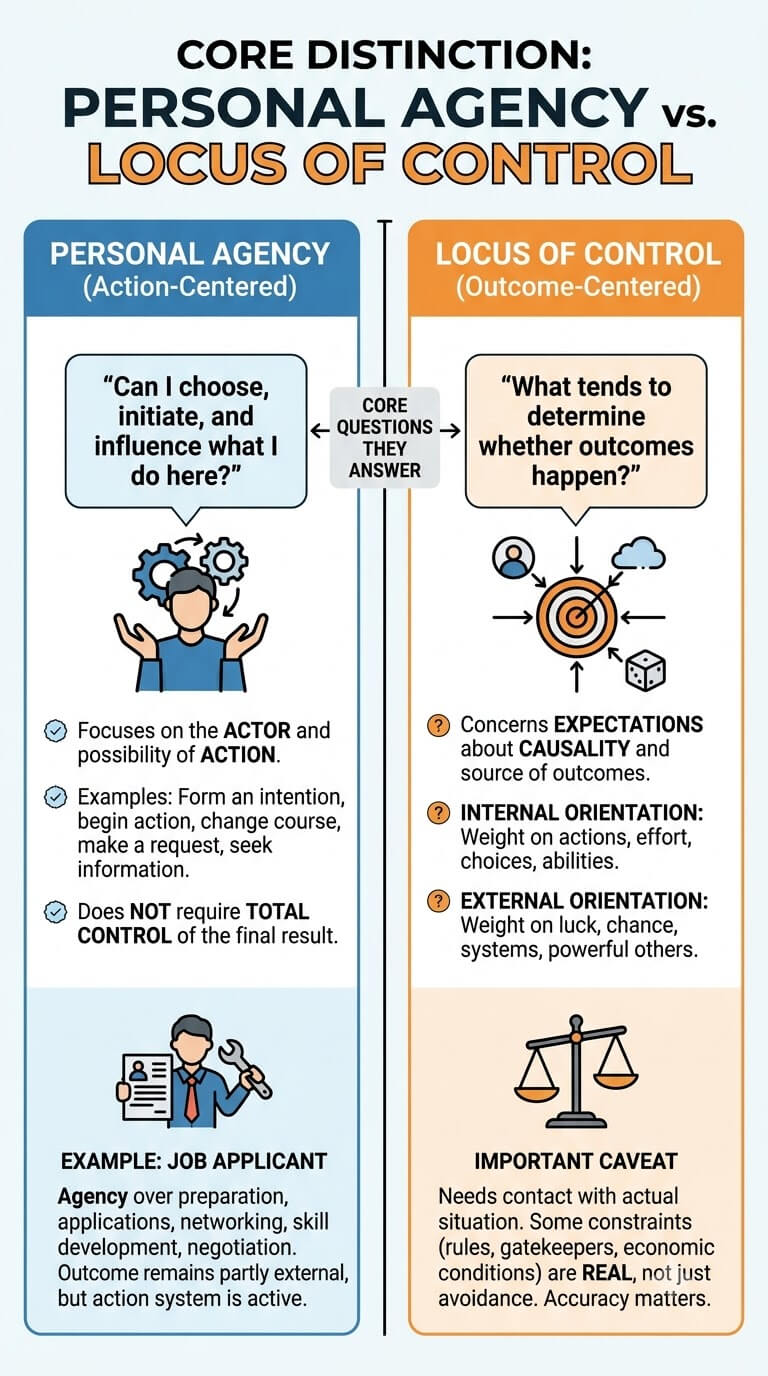
A useful distinction is to ask what the person is trying to explain. Agency centers the actor and the possibility of action. Locus of control centers the expected source of outcomes.
Personal agency: “Can I choose, initiate, and influence what I do here?”
Agency becomes visible when you consider whether you can form an intention, begin an action, change course, make a request, refuse an option, seek information, or shape part of what happens next. It does not require total control of the final result. You can act with agency even in a situation where your influence is modest.
For example, a job applicant cannot force a company to hire them. They may still have meaningful agency over preparation, applications, networking, skill development, negotiation, and which opportunities they pursue. The outcome remains partly external, but the action system is not empty.
Locus of control: “What tends to determine whether outcomes happen?”
Locus of control concerns generalized expectations about causality and reinforcement. An internal orientation gives more weight to one’s actions, effort, choices, or abilities. An external orientation gives more weight to luck, chance, fate, systems, or powerful others.
That does not mean every internal explanation is accurate or every external explanation is avoidance. Some outcomes really are strongly constrained by rules, random events, gatekeepers, discrimination, economic conditions, illness, or another person’s choices. A useful control belief needs contact with the actual situation, not a moral preference for one side.
Side-by-Side Comparison: Agency vs Locus of Control
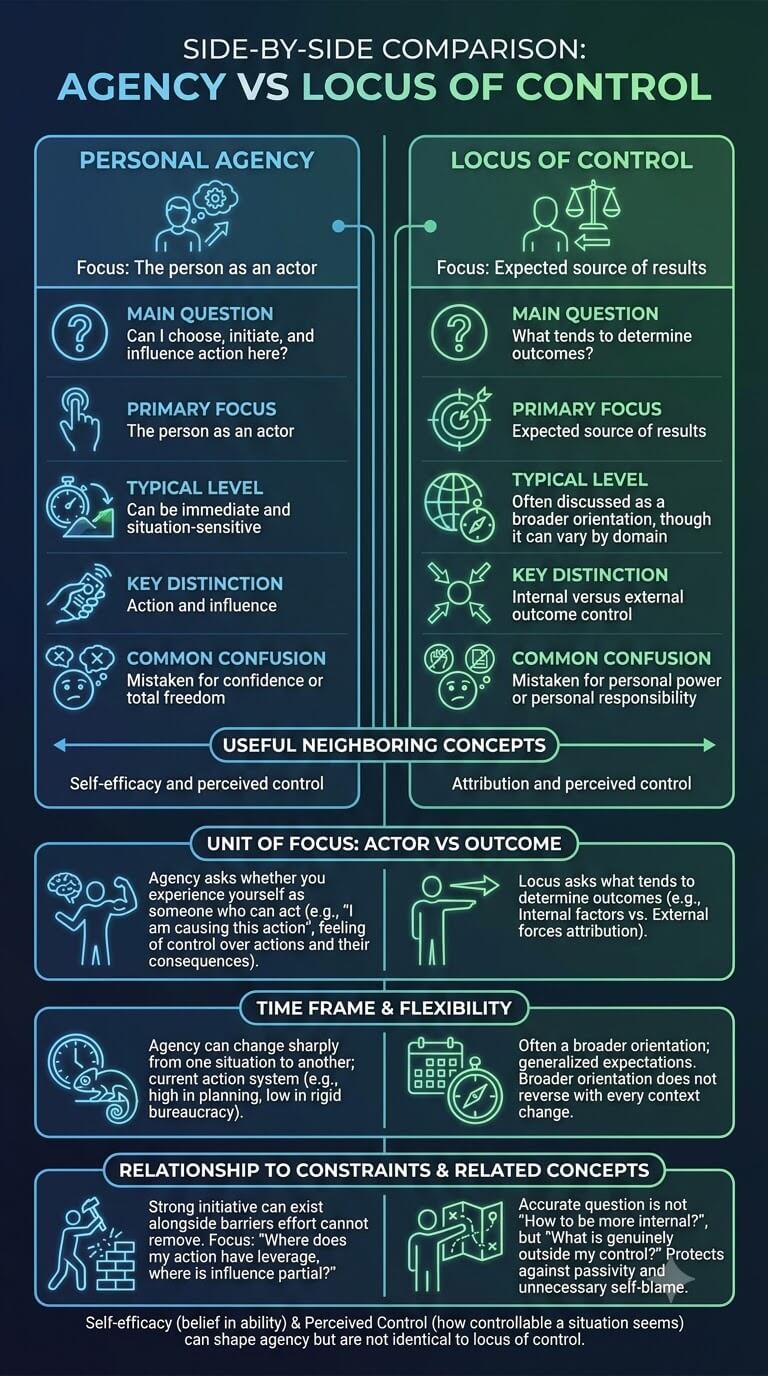
The clearest way to separate the concepts is to compare what each one is measuring. The table below shows why they can correlate without being identical.
| Dimension | Personal agency | Locus of control |
|---|---|---|
| Main question | Can I choose, initiate, and influence action here? | What tends to determine outcomes? |
| Primary focus | The person as an actor | Expected source of results |
| Typical level | Can be immediate and situation-sensitive | Often discussed as a broader orientation, though it can vary by domain |
| Key distinction | Action and influence | Internal versus external outcome control |
| Common confusion | Mistaken for confidence or total freedom | Mistaken for personal power or personal responsibility |
| Useful neighboring concept | Self-efficacy and perceived control | Attribution and perceived control |
Unit of focus: actor experience versus outcome attribution
Agency asks whether you experience yourself as someone who can act. In research on sense of agency, that may include the feeling that “I am causing this action” and “my action is producing this effect.” A widely cited review in PubMed Central on the sense of agency describes it as the feeling of control over actions and their consequences.
Time frame: current action system versus generalized expectations
Agency can change sharply from one situation to another. You may feel highly agentic when planning your own workday but much less so inside a rigid bureaucracy where every meaningful decision requires approval. Your broader control orientation does not have to reverse every time the context changes.
Relationship to actual constraints
Neither concept should be used to erase reality. A person may have strong initiative and still encounter a barrier that their effort cannot remove. Conversely, a person may have many available options but fail to recognize or use them.
The accurate question is not “How do I become more internal?” It is “Where does my action have leverage, where is influence only partial, and what is genuinely outside my control?” That distinction protects against both passivity and unnecessary self-blame.
Relationship to self-efficacy and perceived control
Two nearby concepts make the separation easier. Self-efficacy asks whether you believe you can perform a particular behavior or task. Perceived control asks how controllable or influenceable a current situation seems. These can shape agency, but neither is identical to locus of control.
Four Profiles That Show They Are Not the Same
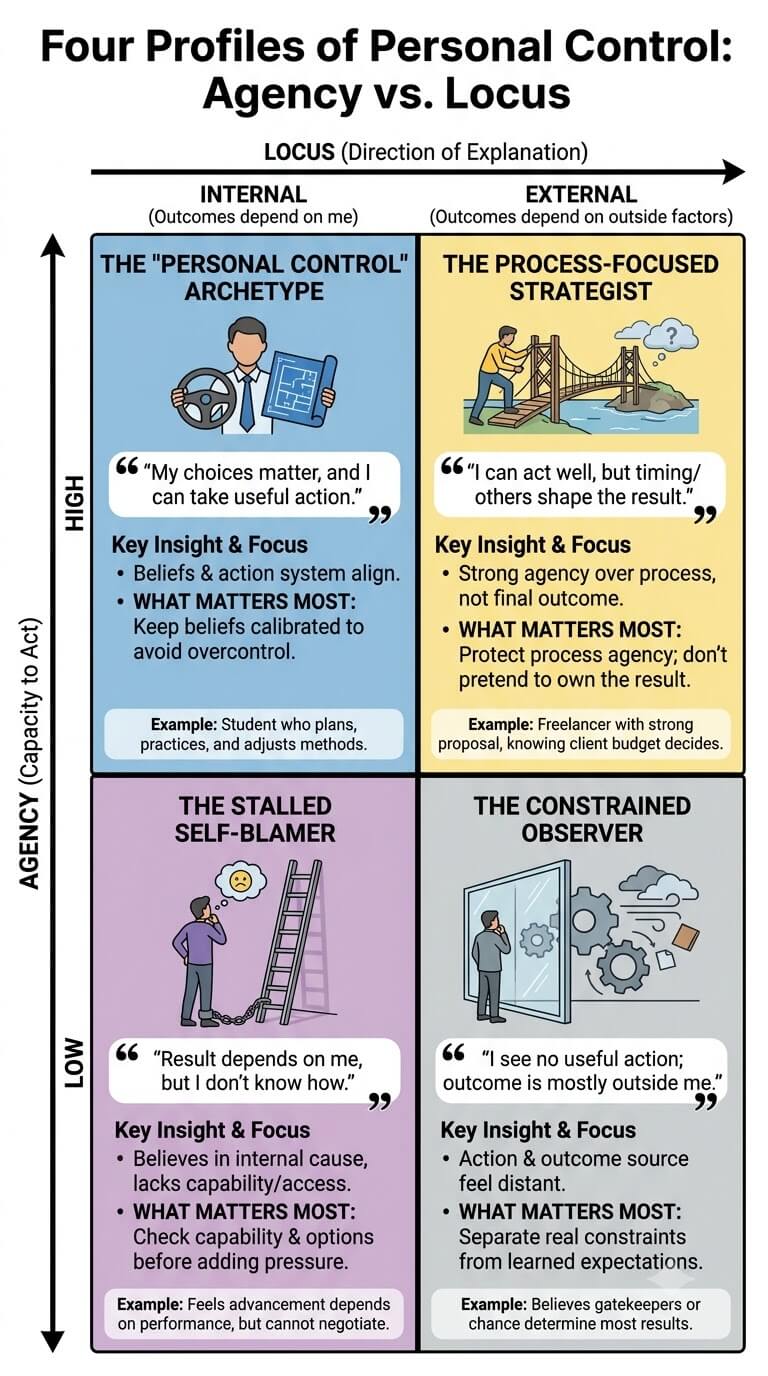
A simple two-by-two matrix makes the distinction concrete. Think of agency as the person’s capacity or experience of acting, and locus as the direction in which they tend to explain outcomes.
| Profile | What it may sound like | What matters most |
|---|---|---|
| High agency + internal locus | “My choices matter, and I can take useful action.” | Keep beliefs calibrated so responsibility does not become overcontrol. |
| High agency + external locus | “I can act well, but timing and other people still shape the result.” | Protect process agency without pretending to own the outcome. |
| Low agency + internal locus | “I think the result depends on me, but I do not know how to do what is needed.” | Check capability, options, and access before adding pressure. |
| Low agency + external locus | “I do not see a useful action, and the outcome feels mostly outside me.” | Separate real constraints from overlooked influence and learned expectations. |
High agency + internal locus
This is the combination people often imagine when they hear “personal control.” A student believes study choices affect performance and also feels able to plan, practice, ask for feedback, and adjust methods. The beliefs and the action system point in the same direction.
High agency + external locus
Consider a freelance designer bidding for a large contract. They may have strong agency over the proposal, pricing, portfolio, follow-up, and whether they apply. At the same time, they may reasonably believe the final choice depends heavily on the client’s budget, internal politics, competing bids, and timing.
Low agency + internal locus
This profile is particularly important because it shows why an internal locus is not the same as feeling powerful. A person may believe that advancement depends on their performance yet feel unable to speak in meetings, negotiate, learn a required skill, or choose among competing paths.
That outcome orientation can be examined more closely through internal and external locus of control.
Low agency + external locus
Here, both the action system and the expected source of outcomes feel distant. Someone may see few meaningful choices and believe that gatekeepers, chance, or circumstances determine most results. This combination can look passive from the outside, but the explanation matters.
High Agency With an External Locus: How Is That Possible?
This combination becomes easy to understand once control is divided into process and outcome. You may have considerable control over what you do next while having much less control over what the world gives back.
Acting effectively while recognizing luck, systems, or other people shape outcomes
A founder can research a market, build a product, test pricing, and talk with customers while recognizing that economic conditions and competitor moves matter. A patient can follow a treatment plan while recognizing that biology affects results. A person can communicate clearly in a relationship while recognizing that another adult remains free to respond differently.
Agency can focus on process even when outcome control is limited
A process-focused question sounds like, “What action is mine to take, and what would make that action more effective?” An outcome-focused question sounds like, “Can I make the desired result happen?” The first may have a useful answer even when the second is uncertain.
Internal Locus With Low Agency: How Is That Possible?
The opposite combination also occurs. A person can strongly believe that their own behavior matters while lacking the capability, options, energy, authority, or confidence to act in the way they think is required.
Believing outcomes depend on your actions but doubting capability or available options
Suppose an employee believes promotions largely depend on demonstrating leadership. They may have an internal explanation for advancement, yet freeze when asked to lead a difficult meeting. The problem is not necessarily where they locate outcome control. It may be that they do not believe they can perform the specific behavior effectively.
This is one reason self-efficacy should be kept separate from locus of control. A 2023 review examining control-related constructs notes that locus of control and self-efficacy are conceptually distinct, even though both can relate to behavior and outcomes.
Why this can increase self-blame rather than action
If someone believes “the result is up to me” but cannot identify a workable action, the belief may create pressure rather than empowerment. They may interpret difficulty as a personal failure instead of asking whether the task requires training, support, permission, time, money, or cooperation.
An internal orientation is most useful when paired with accurate limits. Responsibility should follow actual influence, not expand to cover every event connected to you.
Where Self-Efficacy Fits
Self-efficacy is the capability lens in this comparison. It asks whether you believe you can organize and execute the behavior required for a particular task or goal. That is narrower than asking where outcomes generally come from.
Self-efficacy answers the capability question
“Can I make a good presentation?” “Can I hold this boundary?” “Can I learn this software?” “Can I complete a five-kilometer run?” These questions are about perceived capability. They can vary dramatically from task to task even within the same person.
Contemporary work continues to distinguish self-efficacy from broader constructs such as generalized locus of control. A review proposing an agent-action-aim framework emphasizes that self-efficacy judgments are tied to an agent, an action, and an aim, which helps explain why “I can do this task” is not the same belief as “outcomes are generally under my control.”
Why capability can explain some “low agency” experiences better than locus of control
When a person has choices and their actions would matter, but they repeatedly avoid acting because they doubt their ability, capability is the cleaner place to look. Changing an attributional label may do little if the real barrier is “I do not know how to do this yet.”
Where Perceived Control Fits
Perceived control sits close to both ideas because it asks how much influence a person thinks they have over a particular situation. It helps explain why someone can hold a fairly internal orientation in life while correctly recognizing that one current event is difficult to control.
Situation-specific controllability bridges agency and locus concepts
Imagine a skilled manager during a company-wide restructuring. They may normally believe effort and decisions matter. They may also have strong agency over how they support their team. Yet they may correctly perceive very little control over whether headquarters closes their division.
A current low-control situation does not define a person’s general locus
One uncontrollable event does not automatically make someone “external.” Recognizing genuine limits can be accurate rather than pessimistic. Conversely, believing you control something does not make it so. APA’s description of personal control explicitly distinguishes the sense of being able to shape what happens from situations in which actual control may be low.
Which Lens Should You Use?
Instead of choosing one concept as the “best” explanation, identify the question you are actually trying to answer. The same situation may involve all four lenses, but one usually explains the immediate difficulty more precisely.
Use agency when the issue is action, choice, initiative, or influence
Ask about agency when the central problem is, “What can I initiate or change?” This is useful when someone feels stuck between options, waits for permission they may not need, or overlooks forms of influence that remain available.
Use locus of control when the issue is how outcomes are explained or expected
Ask about locus when the central issue is, “What do I believe determines the result?” Pay attention to whether the explanation gives realistic weight to effort, ability, chance, systems, and other people.
Use self-efficacy when the issue is capability
Ask about self-efficacy when the person knows what action matters but doubts their ability to perform it. The next useful question is usually task-specific: which part feels beyond current skill, and what evidence would update that belief?
Use perceived control when the issue is current controllability
Ask about perceived control when the person is capable of acting but unsure whether action will have any effect in this particular environment. That directs attention to responsiveness, constraints, and the size of the leverage actually available.
Common Comparison Mistakes
The concepts become much easier to use once several popular shortcuts are removed. Most of these mistakes come from turning descriptive beliefs into character judgments.
Treating internal locus as personal power
An internal locus says more about where a person expects outcomes to come from than about how powerful they feel in the moment. Someone can believe effort matters and still lack the skill, authority, options, or energy to act effectively.
Treating external locus as helplessness
External explanations are sometimes accurate. A lottery result depends on chance. A visa decision depends partly on authorities. A partner’s decision belongs to that partner. Seeing these external causes clearly is not the same as believing no action ever matters.
Ignoring structural constraints
Control beliefs become distorted if they require people to treat every barrier as a mindset problem. Economic conditions, discrimination, disability access, organizational hierarchy, caregiving responsibilities, legal rules, and resource shortages can alter what options are realistically available.
Agency means working with the real field of action, not pretending the field has no boundaries.
Using one label across every domain
A person may be highly internal about learning, more external about health, highly agentic in friendships, and low in agency at work. Domain differences are often more informative than a single global identity such as “I am an internal person.”
A Short Concept-Sorting Exercise
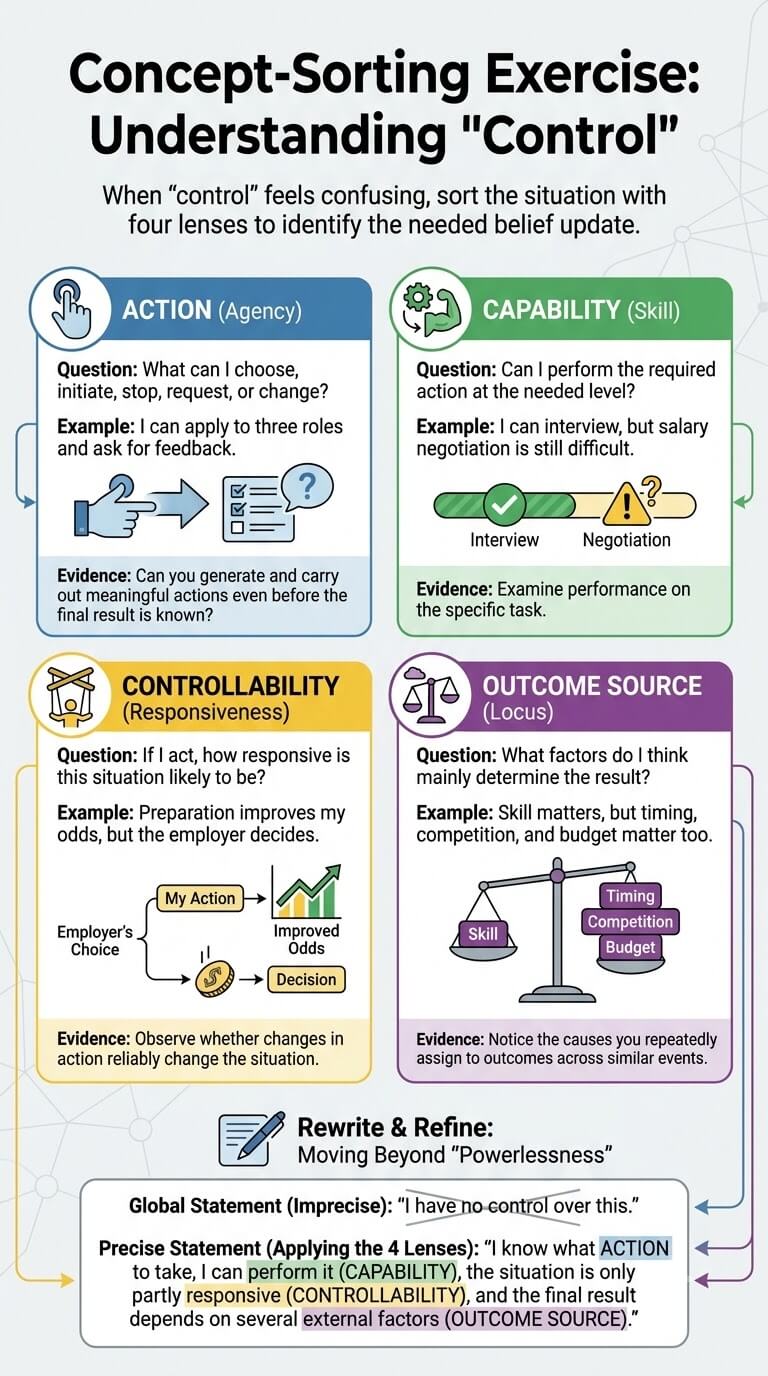
When “control” feels confusing, sort the situation with four questions. The purpose is not to score yourself. It is to identify which belief needs the most accurate update.
| Lens | Question | Example |
|---|---|---|
| Action | What can I choose, initiate, stop, request, or change? | I can apply to three roles and ask for feedback. |
| Capability | Can I perform the required action at the needed level? | I can interview, but salary negotiation is still difficult. |
| Controllability | If I act, how responsive is this situation likely to be? | Preparation improves my odds, but the employer decides. |
| Outcome source | What factors do I think mainly determine the result? | Skill matters, but timing, competition, and budget matter too. |
What is the person trying to explain: capability, action, control, or outcome source?
Take one sentence such as “I have no control over this” and rewrite it four ways. You may discover that only one part is actually low. For example: “I know what action to take, I can perform it, the situation is only partly responsive, and the final outcome depends on several external factors.” That picture is far more precise than a global statement of powerlessness.
What evidence would distinguish the concepts?
Look for evidence at the same level as the question. To test capability, examine performance on the specific task. To test controllability, observe whether changes in action reliably change the situation. To examine locus, notice the causes you repeatedly assign to outcomes across similar events. To examine agency, ask whether you can generate and carry out meaningful actions even before the final result is known.
What to Read Next Based on the Question
Once the distinction is clear, the next useful concept depends on what is still unresolved. There is no advantage in studying a broader control idea when your actual problem is narrow and specific.
Capability belief → Self-Efficacy Psychology
If your main question is whether you believe you can perform a particular behavior, focus on self-efficacy. That lens is especially useful for learning, performance, persistence, and task-specific doubt.
Situation controllability → Perceived Control Psychology
If you are capable of acting but do not know whether action can change the current environment, perceived control is the more precise lens. It helps separate real constraints from assumptions about responsiveness.
Internal versus external orientation → Internal vs External Locus of Control
If you want to compare how internal and external orientations differ, focus on the causes you tend to assign to outcomes. Keep the comparison contextual rather than using it as a personality verdict.
Broad action map → Personal Agency Psychology
If your question is broader, such as how choice, capability, control, and self-belief combine to shape action, personal agency provides the larger map. The important point is that acting as an agent does not require believing you control every result.
FAQ About Personal Agency vs Locus of Control
These questions address the distinctions that most often remain after comparing the concepts side by side.
Is an internal locus of control the same as high agency?
No. An internal locus means you tend to see outcomes as connected to your own actions or abilities. High agency means you experience meaningful capacity to choose, initiate, and influence action. A person can believe outcomes depend on them while lacking skill, options, authority, or confidence to act effectively.
Can someone have high agency and still believe outcomes depend on luck?
Yes. You can act deliberately while recognizing that luck affects the final result. An entrepreneur can make careful decisions while acknowledging market timing. An applicant can prepare thoroughly while knowing competition and hiring preferences matter. Agency concerns the quality and availability of your action, not ownership of every outcome.
Is locus of control part of personal agency?
They overlap, but it is more accurate to treat them as distinct control-related concepts rather than making one simply a part of the other. Locus of control concerns generalized beliefs about outcome sources, while agency concerns being an actor who can initiate and influence action. Depending on the theory or measure, researchers may define neighboring terms somewhat differently, so context matters.
Which concept is more useful for understanding passivity?
Neither explains passivity by itself. If a person does not act, check several possibilities: they may doubt capability, perceive little situational control, see few available choices, expect outcomes to depend on external forces, or face real constraints. The most useful concept is the one that matches the mechanism actually limiting action.
Key Takeaways
- Personal agency is primarily about being able to choose, initiate, and influence action; locus of control is about where you expect outcomes to come from.
- An internal locus does not guarantee high agency, and an external locus does not automatically mean helplessness or passivity.
- High agency can coexist with realistic recognition that luck, systems, and other people influence final outcomes.
- When the problem is “Can I do this task?”, self-efficacy is often more precise than either agency or locus of control.
- When the problem is “Will my action matter in this situation?”, perceived control deserves separate attention.
- A useful control belief matches responsibility to actual influence instead of maximizing either self-blame or external blame.

Michael Reed is the Founder and Lead Writer at Psychology Exposed. He writes about human behavior, relationships, emotional patterns, self-awareness, and practical psychology topics using research-informed, easy-to-understand content.
Read More About Michael Reed: https://psychologyexposed.com/michael-reed/
1 thought on “Personal Agency vs Locus of Control: Differences”