
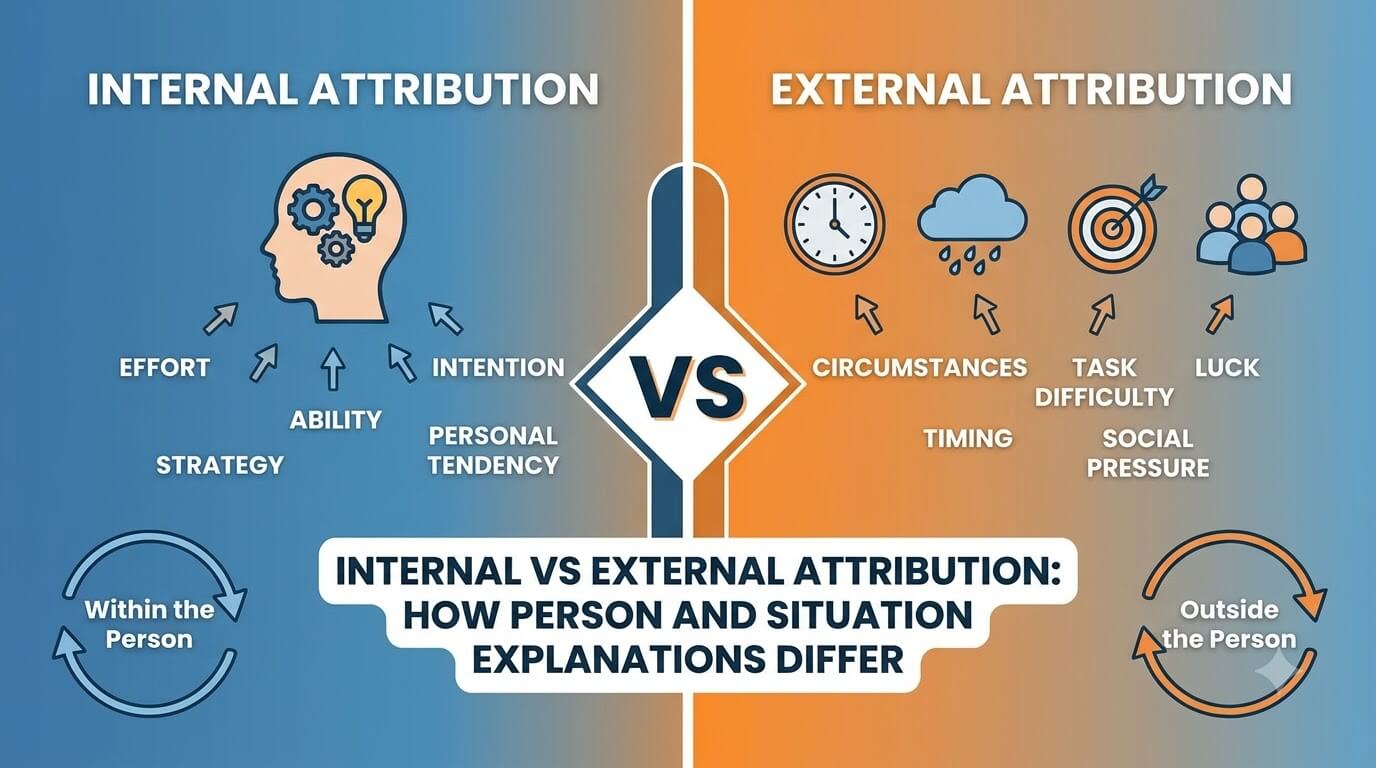
A team misses an important deadline. One explanation points inward: someone planned poorly, underestimated the work, or did not put in enough effort. Another points outward: the brief changed, a supplier failed, or the available time was unrealistic. Both explanations may sound plausible, and both may contain part of the truth.
That is the central problem behind internal and external attribution. Real behavior often develops from a mix of choices, abilities, resources, pressures, opportunities, and chance. Separating those causes can improve judgment without turning every mistake into a character verdict or every circumstance into an excuse.
Quick Answer
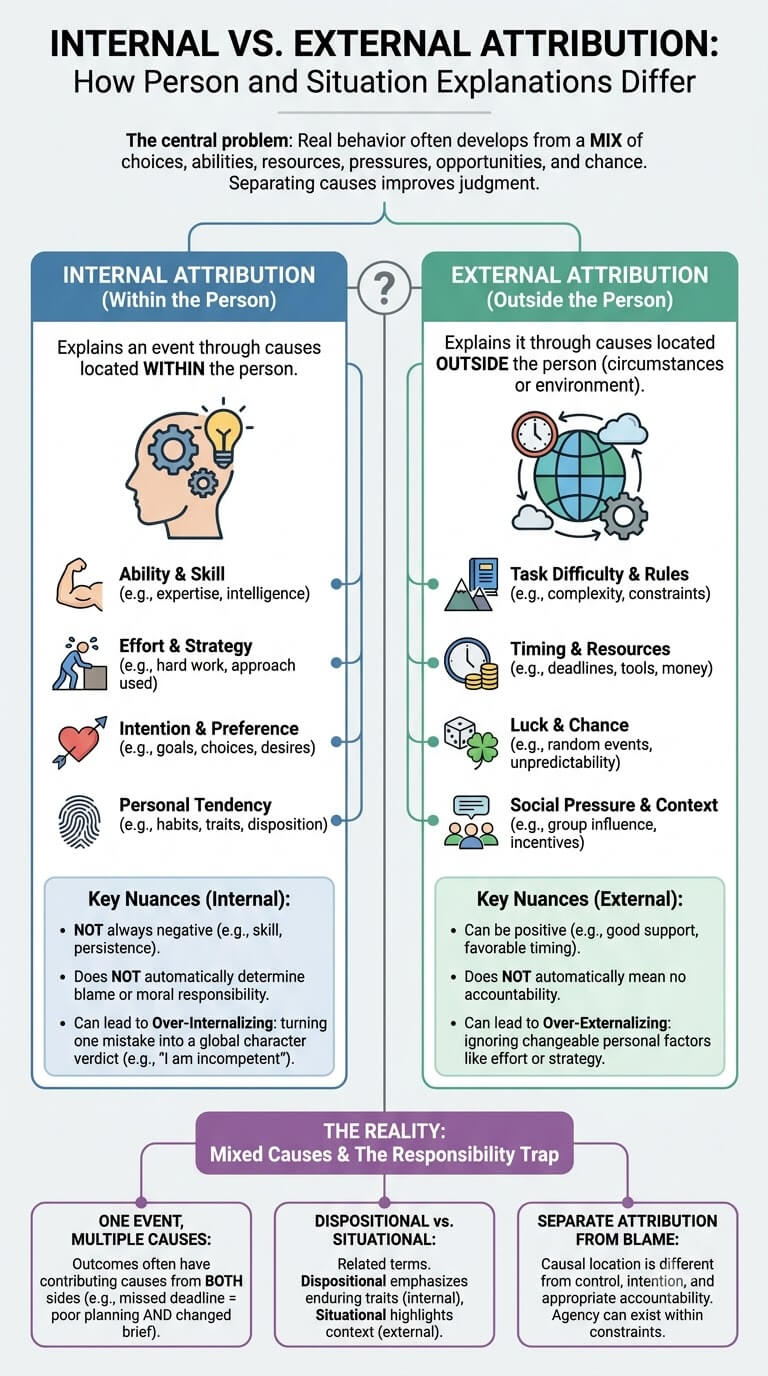
Internal attribution explains an event through causes located within the person, such as effort, ability, intention, preference, or a personal tendency. External attribution explains it through causes outside the person, such as circumstances, rules, task difficulty, timing, luck, or social pressure. The distinction is useful, but many outcomes involve both. Neither type of explanation automatically determines blame, responsibility, or future control.
The Core Difference Between Internal and External Attribution
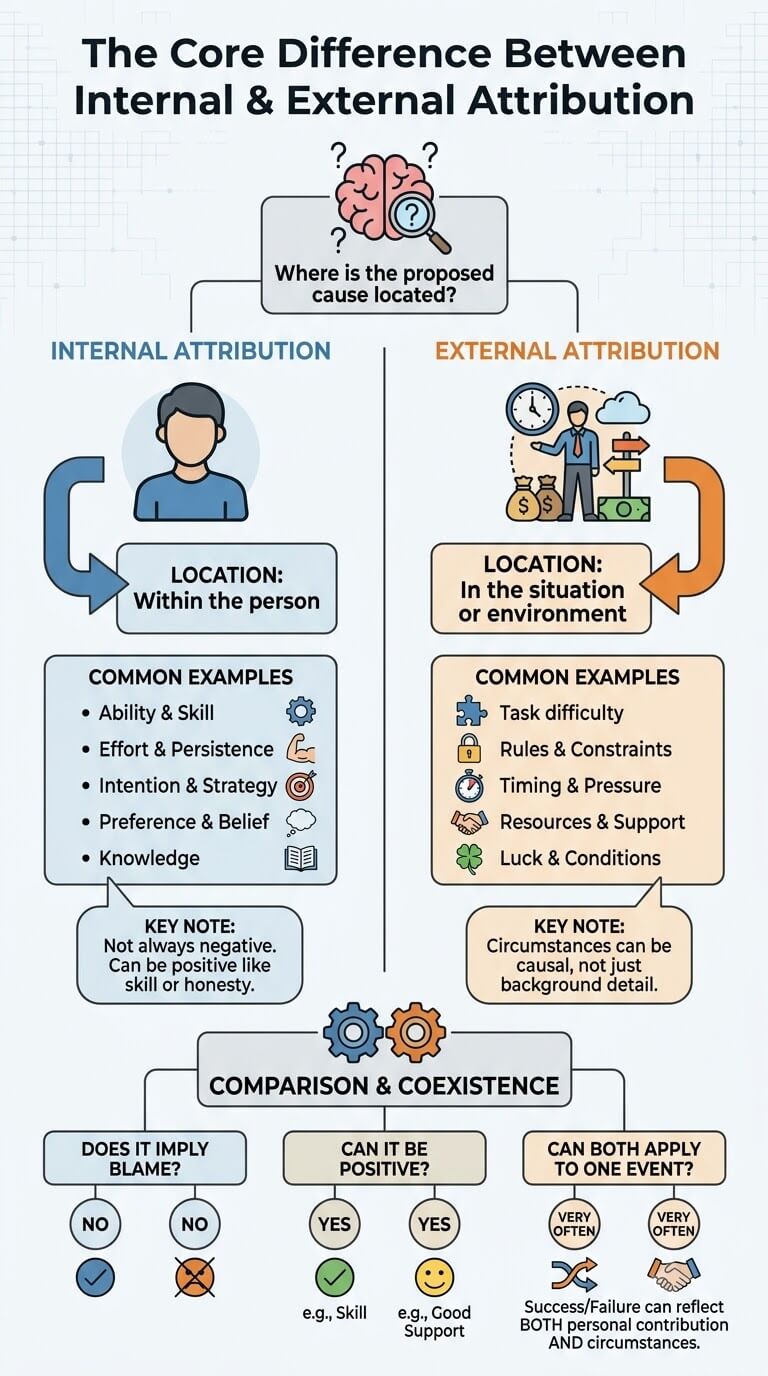
The distinction starts with where the proposed cause is located, not whether that cause is good, bad, fair, or blameworthy.
Internal causes locate explanation within the person
An internal attribution answers the causal question by pointing toward something about the person. The APA Dictionary of Psychology entry on attribution describes attribution as the process of assigning a cause to behavior or an event. When that cause is internal, the explanation may involve what the person wanted, knew, believed, tried, chose, or was able to do.
Suppose a student receives a strong grade. An internal explanation might be, “She understood the material,” “She studied carefully,” or “She used a better strategy.” If the grade is poor, an internal explanation might be, “She did not prepare enough,” “She misunderstood a key concept,” or “Her strategy did not fit the test.” Notice that internal does not mean negative. Skill, patience, preparation, honesty, persistence, and good judgment can all be internal causes too.
External causes locate explanation in circumstances or environment
An external attribution points toward something outside the person. The cause may be immediate, such as a train delay, or structural, such as unclear instructions, limited resources, a difficult task, an incentive system, or a rule that constrained the available choices.
For the same student, an external explanation might involve an unusually difficult exam, disrupted preparation, or a noisy testing room. Success might also reflect tutoring, team support, or favorable timing. Circumstances do not always outweigh personal contribution, but they can be causal rather than mere background detail.
| Question | Internal attribution | External attribution |
|---|---|---|
| Where is the proposed cause? | Within the person | In the situation or environment |
| Common examples | Ability, effort, intention, strategy, preference | Task difficulty, rules, timing, resources, luck, pressure |
| Does it imply blame? | No | No |
| Can it be positive? | Yes, such as skill or persistence | Yes, such as good support or favorable conditions |
| Can both apply to one event? | Very often | |
What Counts as an Internal Attribution?
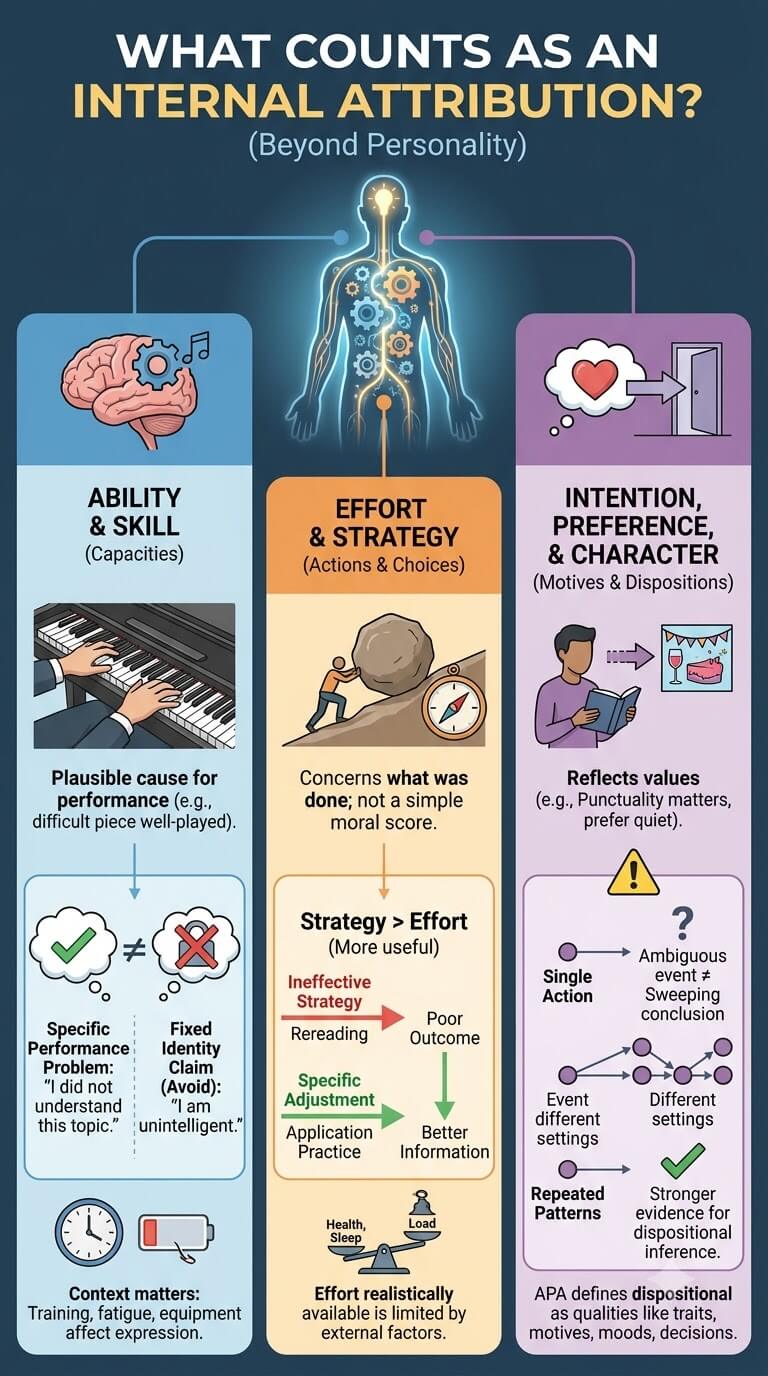
Internal causes cover more than personality. They include capacities, actions, intentions, and temporary choices that arise within the person.
Ability and skill
Ability is one of the clearest internal explanations. If a pianist performs a difficult piece well, skill is a plausible cause. If a new employee struggles with unfamiliar software, limited current skill may also matter. Yet ability is rarely the only cause. Training quality, time to practice, fatigue, equipment, and task difficulty may change how much skill can actually be expressed.
This matters because people sometimes turn an ability explanation into a fixed identity claim. “I did not understand this topic” is narrower than “I am unintelligent.” The first describes a performance problem that may have several causes. The second converts one outcome into a global statement about the person. Those are not equivalent conclusions.
Effort and strategy
Effort is internal because it concerns what the person did, but it is not a simple moral score. Someone can work hard and still use an ineffective strategy. Health, workload, sleep, resources, and competing responsibilities can also affect how much effort is realistically available.
Strategy is often a more useful internal cause because it is specific. “I revised by rereading, but the exam required application” gives more information than “I failed because I did not try hard enough.” A specific attribution can point toward a more specific adjustment.
Intention, preference, and character
Internal explanations can also concern intention or preference. A person may arrive early because punctuality matters to them. They may decline an invitation because they genuinely prefer a quiet evening. In social judgment, however, internal explanations can easily jump from a single action to a broad character label.
The APA Dictionary entry on dispositional attribution describes explanations based on qualities of the person, such as traits, motives, moods, attitudes, decisions, abilities, and effort. A behavior can support a dispositional inference, but one episode does not always justify a sweeping conclusion. Repeated patterns across settings provide stronger evidence than a single ambiguous event.
What Counts as an External Attribution?
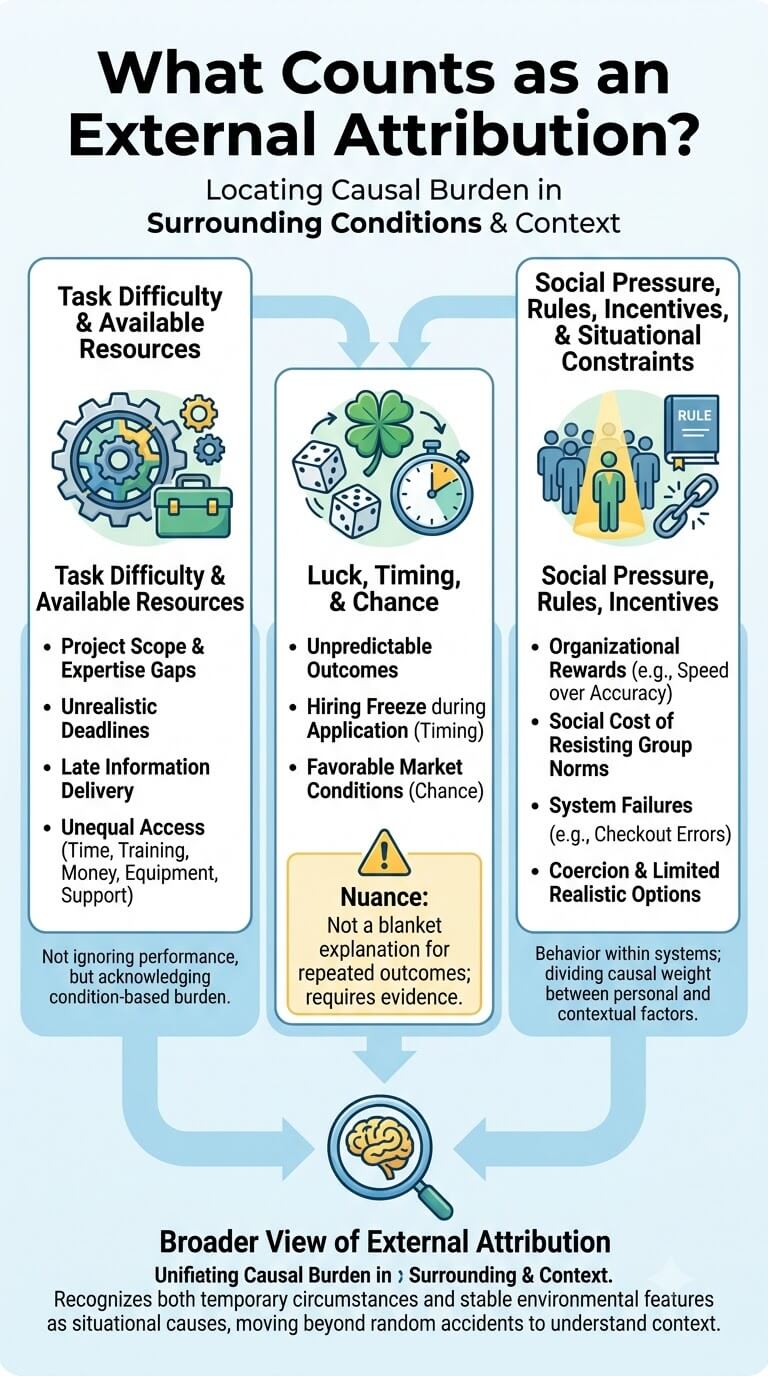
External causes become clearer when the surrounding conditions are named specifically rather than treated as vague background circumstances.
Task difficulty and available resources
Some tasks are genuinely harder than others. A project may require expertise the team does not have, a deadline may be too short for the scope, or important information may arrive late. Calling those factors external is not the same as pretending performance does not matter. It simply locates part of the causal burden in the task conditions.
Resources matter in the same way. Two people may be equally motivated but have different access to time, training, money, equipment, transportation, quiet space, or social support. When an explanation ignores these differences, it can make behavior look more freely chosen than it really was.
Luck, timing, and chance
Chance is uncomfortable because it weakens the feeling that outcomes are fully predictable. Yet luck can matter. A qualified candidate may apply during a hiring freeze, or a sound business decision may benefit from favorable timing that nobody controlled.
Luck should not become a blanket explanation either. If the same outcome repeats across many attempts, it becomes less satisfying to attribute everything to chance without checking other factors. External explanations deserve evidence just as internal ones do.
Social pressure, rules, incentives, and situational constraints
Behavior happens inside systems. A worker may follow a bad process because the organization rewards speed over accuracy. A teenager may laugh along with a group because resisting carries a social cost. A customer may abandon a purchase because the checkout system fails. A person under coercion may have far fewer realistic options than an outside observer assumes.
Research on person and situation attribution has long examined how observers divide causal weight between personal and contextual factors. One open-access study discussing person and situation attributions notes that both temporary states and enduring personal characteristics can be treated as person causes, while circumstances and stable environmental features can function as situational causes. That broader view is useful because “external” is not limited to random accidents.
Dispositional vs Situational Attribution: Same Family, Slightly Different Language
These terms overlap with internal and external attribution, but they place slightly different emphasis on traits and context.
Why dispositional often emphasizes traits or tendencies
Internal and dispositional are often used almost interchangeably, but dispositional language usually puts more emphasis on relatively characteristic qualities of the person. “He interrupted because he is impatient” is a dispositional explanation. “He interrupted because he misheard the pause and thought the speaker was finished” is still person-related in one sense, but it does not necessarily imply an enduring trait.
This difference is useful when a judgment starts hardening into identity. An internal cause can be narrow and temporary. A dispositional claim tends to say more about what the person is generally like.
Why situational highlights context
Situational attribution emphasizes circumstances that help produce the behavior. The APA Dictionary entry on situational attribution describes an explanation that locates the cause in factors external to the person.
Consider someone who seems unusually quiet during a meeting. A dispositional explanation might be that they are withdrawn. A situational explanation might be that they joined late, do not yet know the team, or learned that their role is being restructured five minutes before the meeting. The behavior is visible in both cases, but the proposed cause changes.
Why this distinction stays inside this article
For everyday understanding, the most useful move is not to multiply labels but to ask what kind of cause is being proposed. Is the explanation about the person’s skill, effort, intention, or tendency? Is it about the surrounding task, social environment, resources, timing, or chance? Is it a combination?
That keeps the vocabulary connected to the real problem: deciding what evidence supports a causal explanation.
One Event Can Have Multiple Causes
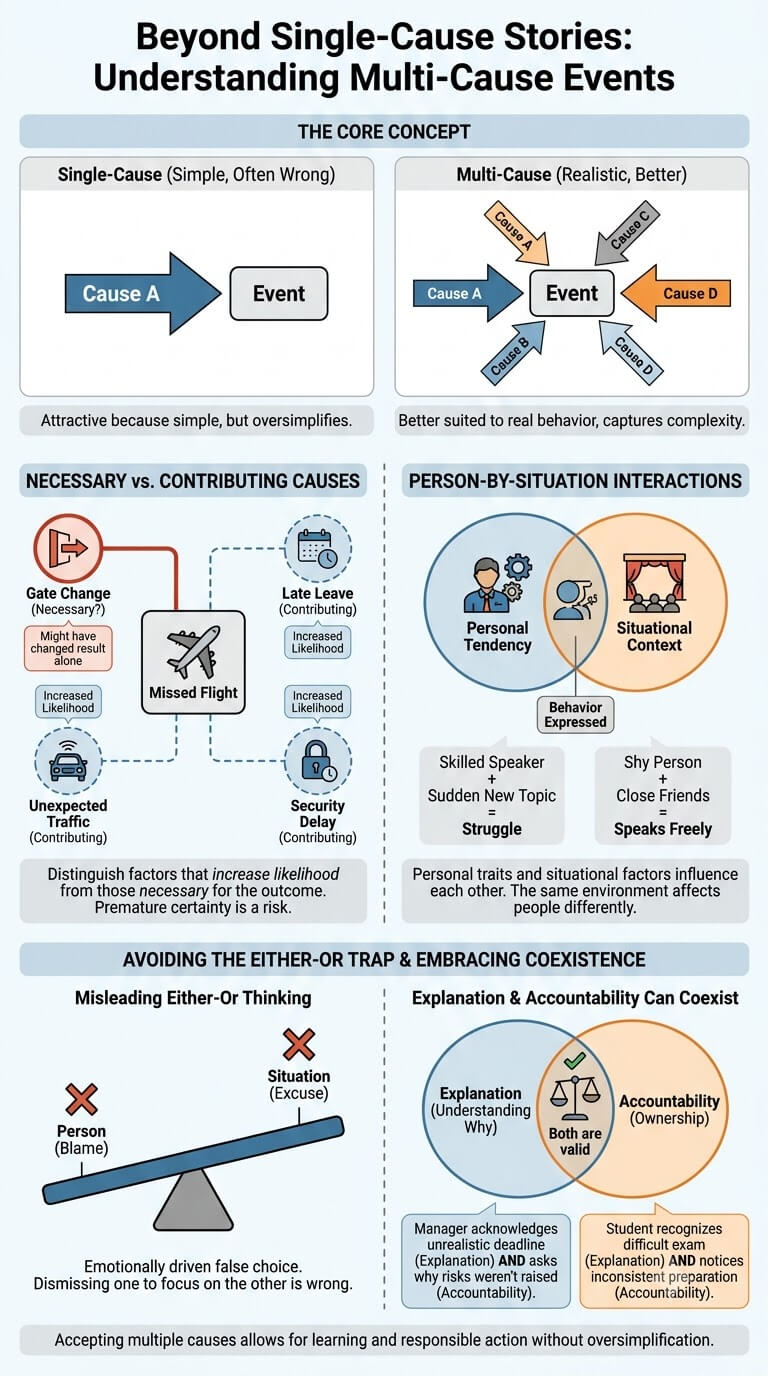
Single-cause stories are attractive because they are simple. Multi-cause explanations are often better suited to real behavior.
Necessary versus contributing causes
Many outcomes have several contributing causes. A missed flight might involve leaving home late, unexpected traffic, a security delay, and a gate change. Any one factor might have changed the result without making the others irrelevant.
It helps to distinguish a cause that was necessary for the outcome from a factor that merely increased its likelihood. Everyday life does not always give enough evidence to make that distinction cleanly, but asking the question prevents premature certainty.
Person-by-situation interactions
Personal and situational causes also interact. A skilled speaker may perform well under normal conditions but struggle after being given a completely different topic seconds before presenting. A shy person may speak freely with close friends but remain quiet in a large unfamiliar group. The situation changes how a personal tendency is expressed.
The same environment also affects people differently because they bring different skills, histories, and goals into it. A realistic explanation can allow person and situation to influence each other.
Why either-or explanations can be misleading
Either-or thinking often appears when responsibility feels emotionally important. If the person mattered, we may feel pressure to dismiss the situation. If the situation mattered, we may feel pressure to excuse the person. That is a false choice.
A manager can acknowledge that a deadline was unrealistic and still ask why risks were not raised earlier. A student can recognize that an exam was difficult and still notice that preparation was inconsistent. A friend can understand that someone was stressed and still expect an apology for hurtful behavior. Explanation and accountability can coexist.
Four Everyday Cases Where the Attribution Changes
The examples below show how different evidence can shift causal weight without requiring a completely different event.
A missed deadline
Situation: A coworker submits an important report two days late. What you may feel: irritation, distrust, or pressure because your work now has to be delayed. What it may mean: an internal explanation might involve poor planning, while an external explanation might involve a changed brief, another urgent assignment, or missing data. What to do next: ask what happened before deciding whether the problem is reliability, workload, process, or some combination.
The useful question is which causes fit the evidence and what would reduce the chance of repetition.
An exam result
Situation: A student performs worse than expected. What they may feel: disappointment or embarrassment. What it may mean: ability, preparation, strategy, sleep, task difficulty, unclear questions, or test anxiety may all contribute. What to do next: compare this result with previous performance, preparation methods, and the specific sections that went poorly.
Jumping immediately to “I am bad at this” discards useful information. So does “the test was unfair” when there is no evidence that it was. A better explanation narrows the next step.
A tense conversation
Situation: A partner answers sharply during a discussion about plans. What you may feel: hurt or dismissed. What it may mean: the response may reflect impatience, accumulated resentment, exhaustion, feeling cornered, or misunderstanding the question. What to do next: address the observable behavior and ask about the context without assuming motive.
This is also where suspicion psychology can become relevant. When motives are unclear, the mind may fill gaps with a hidden-intention story. That possibility deserves checking, not automatic belief.
A successful project
Situation: A team launch performs much better than expected. What you may feel: pride, relief, or surprise. What it may mean: strong preparation, experienced team members, good timing, customer demand, supportive leadership, and favorable market conditions may all have contributed. What to do next: identify what can be repeated and what depended on conditions that may not recur.
Balanced attribution matters for success too. Over-crediting brilliance can inflate confidence, while crediting only luck can hide skills worth repeating.
The Responsibility Trap
Causal language becomes risky when “inside the person” is treated as guilty and “outside the person” is treated as innocent.
Why internal does not automatically mean blame
An internal cause simply locates some part of the explanation within the person. It does not answer whether the person intended the outcome, could foresee it, had realistic alternatives, or deserves moral blame.
Someone can make an honest mistake because they lacked knowledge. That is still partly an internal cause, but it is different from knowingly ignoring a clear risk. A person can also have limited capacity in a situation because of exhaustion, illness, or competing responsibilities. Causal location is only one piece of responsibility.
Why external does not automatically mean no accountability
Context can explain behavior without eliminating accountability. Stress may help explain why someone snapped during a conversation, but it does not make the impact disappear. An unrealistic workload may explain why a project slipped, while a team member may still have been responsible for communicating the risk sooner.
This distinction also matters for personal agency. Situational constraints can be real while some room for choice remains. Agency is often partial rather than absolute.
Separating influence, control, intention, and responsibility
A clearer responsibility judgment asks four different questions:
| Question | What it clarifies |
|---|---|
| What influenced the outcome? | The full causal picture |
| What could the person realistically control? | The range of available action |
| What did the person intend or knowingly risk? | The meaning of the choice |
| What repair or accountability is appropriate now? | The practical response |
These questions keep attribution from doing more work than it can support. A cause is not automatically a verdict.
Over-Internalizing a Negative Outcome
Internal explanations lose precision when one mistake is stretched into a total judgment about identity or character.
Turning one event into a global judgment about the person
Over-internalizing happens when a specific event becomes evidence for a much broader conclusion about the self or another person. “I handled that meeting badly” becomes “I am incompetent.” “He forgot this commitment” becomes “He does not care about anyone.”
The problem is not that personal causes never matter. The problem is the size of the inference. A narrow event may support a narrow conclusion before it supports a global one.
What evidence would support a more balanced explanation
Look for comparison points. Does the behavior happen across settings or mainly under one condition? Is it repeated over time? Do other people face the same difficulty in the same environment? Did performance change when resources, instructions, or pressure changed?
Research on integrating situational information into social judgment shows why context can alter attribution rather than merely decorate it. In one study of situational information and attribution outcomes, participants used contextual information when deciding whether behavior was better explained by a disposition or the situation. The practical lesson is not that context always wins, but that it belongs in the evidence.
Over-Externalizing a Negative Outcome
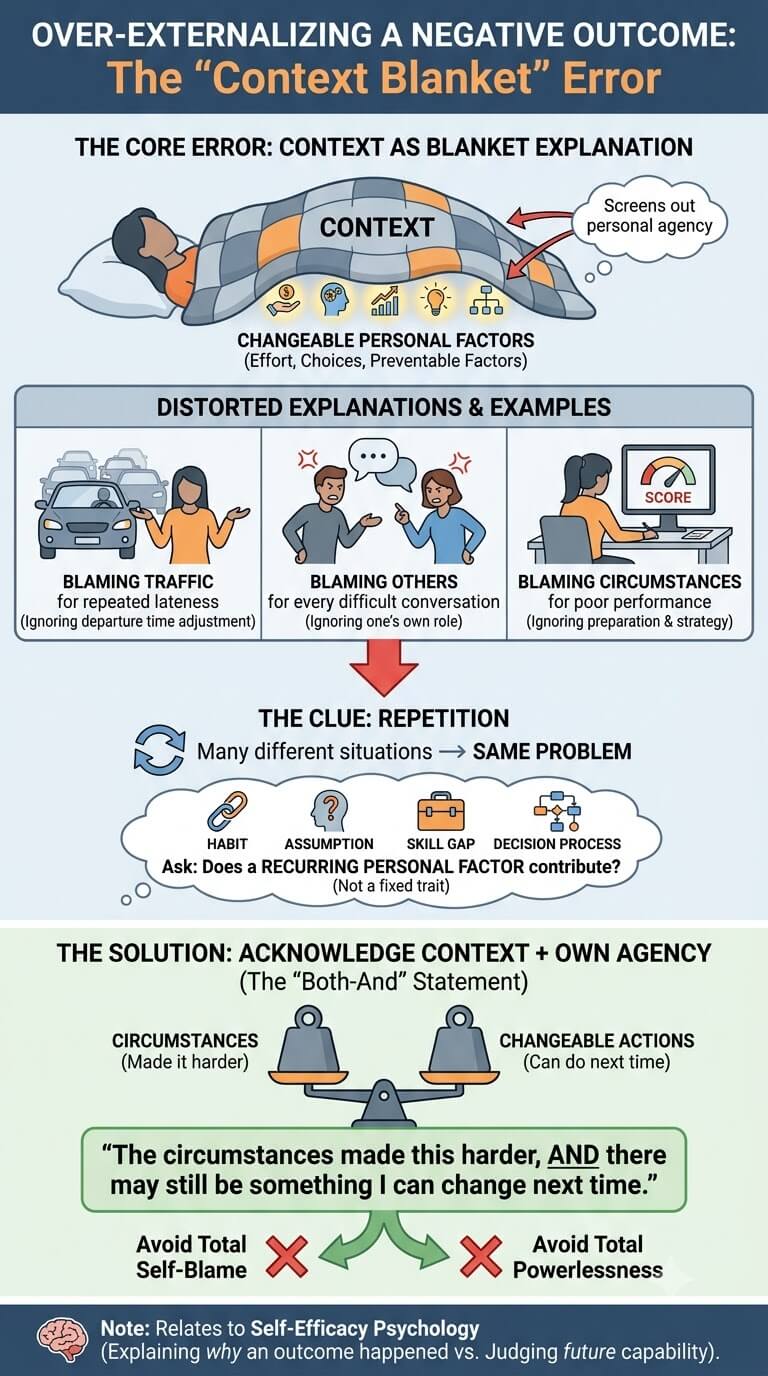
The opposite error is possible too: context can become a blanket explanation that screens out changeable personal factors.
Ignoring effort, choices, or preventable factors
External explanations can become distorted too. A person may blame traffic for repeated lateness without adjusting departure time, blame every difficult conversation on the other person, or treat poor performance as entirely caused by circumstances while ignoring preparation and strategy.
One clue is repetition. If many different situations produce the same problem, it is worth asking whether a recurring personal factor contributes. That factor may be a habit, assumption, skill gap, or decision process rather than a fixed trait.
How to acknowledge context without erasing agency
Try a both-and statement: “The circumstances made this harder, and there may still be something I can change next time.” This avoids two unhelpful extremes, total self-blame and total powerlessness.
The distinction also relates to self-efficacy psychology. Explaining why an outcome happened differs from judging whether you can perform a specific action in the future.
Internal vs External Attribution and Attribution Style
A single explanation and a recurring explanatory tendency answer related but different psychological questions.
One event-specific classification versus a repeated explanatory pattern
Internal and external attribution can describe how you explain one event. Attribution style asks whether similar explanations repeat across events. A person may internally attribute one failed presentation to poor preparation without having a broad tendency to blame themselves for every setback.
That distinction matters because one attribution is evidence about one explanation, not a personality test.
Why stable and global dimensions add information
Two internal explanations can have very different consequences. “I used the wrong strategy this time” is internal but relatively specific and changeable. “I fail at everything because I am incapable” is internal, broad, and framed as enduring.
Adding stability and scope helps explain why the simple internal/external distinction does not tell the whole story. It describes where the cause is located, not how permanent, broad, or changeable the cause seems.
Internal vs External Attribution Is Not Locus of Control
The shared words “internal” and “external” create confusion, but the concepts operate at different levels.
Event-specific cause versus generalized control expectation
Attribution asks, “Why did this particular event happen?” Locus of control psychology concerns a broader expectation about what generally determines outcomes. The overlap in internal and external language makes the concepts easy to confuse, but the time scale and question are different.
You can attribute one outcome to an external cause without believing your life is generally controlled by outside forces.
Why an external attribution can coexist with an internal locus of control
If a flight is canceled by severe weather, a traveler can make an external attribution for the missed meeting while still believing their actions usually influence outcomes. They might rebook, notify the client, and arrange an alternative meeting.
The external cause explains what happened this time. The broader control expectation concerns how the person generally sees their influence across situations.
A Balanced Attribution Check for Real Situations
When the cause is uncertain, four questions can slow a confident story long enough to compare person and situation evidence.
What factors were inside the person’s realistic control?
List actions that were genuinely available, not actions that become obvious only after knowing the outcome. Ask what the person could choose, change, communicate, prepare, or avoid with the information and capacity they actually had.
What constraints or conditions mattered?
Name the situation rather than using “circumstances” as a vague category. Was there a time limit, unclear rule, social pressure, missing information, financial constraint, illness, competing obligation, technical failure, coercion, or chance event?
What evidence supports each cause?
Separate facts from interpretation. “The report was submitted late three times this month” is evidence. “She is lazy” is an inference. “The deadline changed after the work began” is evidence. “Nothing was her responsibility” is another inference.
If the explanation concerns your own thinking, the cognitive biases overview can help you notice how causal judgment may become systematically skewed. The goal here, however, is not to label every imperfect attribution as a bias. It is to improve the causal picture.
What would change the explanation?
A strong explanation should be revisable. Ask what new information would make you give more weight to the person or more weight to the situation. If no possible evidence could change the conclusion, the attribution may be functioning more like a fixed belief than an evidence-based explanation.
A useful final sentence is: “The current evidence suggests these causes, but I may be missing information.” That wording protects uncertainty without preventing accountability.
FAQ About Internal and External Attribution
These questions address the places where the internal/external distinction most often becomes oversimplified.
Is effort an internal attribution even when circumstances affect effort?
Usually, yes. Effort is commonly treated as an internal cause because it concerns the person’s behavior. But available effort is not independent of context. Sleep, illness, workload, caregiving, resources, incentives, and time pressure can all affect what a person can realistically sustain. Calling effort internal does not mean circumstances are irrelevant.
Is luck always an external attribution?
Luck is generally classified as external because it refers to chance rather than a quality or action of the person. Still, saying “it was luck” may be too broad. A useful explanation asks what random event mattered and how much causal weight it deserves compared with preparation, skill, strategy, or other conditions.
Is dispositional attribution the same as internal attribution?
They overlap strongly, but dispositional attribution often emphasizes relatively characteristic qualities of the person, such as traits, attitudes, motives, or tendencies. Internal attribution is a broader label that can also include temporary states, effort, a one-time decision, or a particular strategy. In everyday writing, the terms are often used closely together.
Can both internal and external attributions be correct?
Yes. Many outcomes result from interacting causes. A person may make a planning error while also facing an unrealistic deadline. A student may prepare inconsistently and also face unusually difficult questions. Recognizing multiple causes is not indecision. It can be a more accurate model of what happened.
How is external attribution different from an external locus of control?
An external attribution explains one specific outcome through an outside cause. An external locus of control describes a broader tendency to expect outcomes to be shaped by external forces. Someone can make an external attribution about one event while still believing that their actions usually matter across life.
Key Takeaways
The most useful habit is to treat attribution as a causal hypothesis that can become more precise when better evidence appears.
- Internal attribution locates a cause within the person, while external attribution locates a cause in circumstances, context, or chance.
- Ability, effort, intention, and strategy are common internal causes; task difficulty, timing, resources, pressure, and luck are common external causes.
- Many real outcomes involve both person and situation factors, so an either-or explanation can hide useful information.
- Internal does not automatically mean blame, and external does not automatically mean excuse. Control, intention, foreseeability, and repair need separate consideration.
- Attribution explains a particular event. Locus of control describes a broader expectation about what tends to determine outcomes.
- For a practical next step, write down one person-based cause, one situation-based cause, and the evidence for each before deciding what the event means.

Michael Reed is the Founder and Lead Writer at Psychology Exposed. He writes about human behavior, relationships, emotional patterns, self-awareness, and practical psychology topics using research-informed, easy-to-understand content.
Read More About Michael Reed: https://psychologyexposed.com/michael-reed/