
You can be perfectly capable of doing something and still feel strangely disconnected from the action. You meet the deadline, attend the event, follow the plan, or agree to the request, but internally it feels more like compliance than choice. That difference is where autonomy psychology becomes useful.
Autonomy is not the same as getting your own way. It is also not a requirement to live without obligations, depend on nobody, or reject every outside influence. In psychology, autonomy is more closely connected to volition: whether your behavior feels self-endorsed, meaningful, and sufficiently chosen rather than pushed by pressure you cannot comfortably question.
Quick Answer
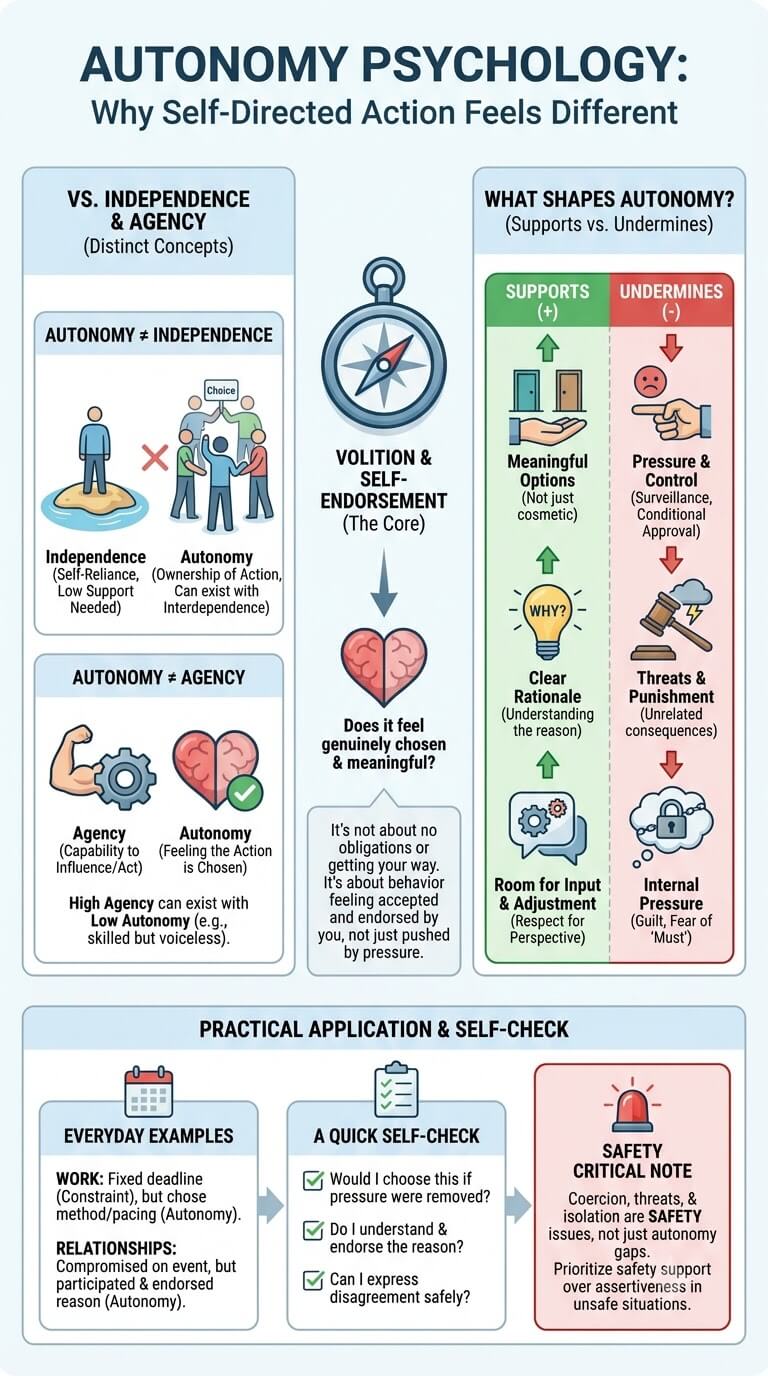
Autonomy in psychology is the experience of acting with volition and self-endorsement. An action can be autonomous even when it happens within rules, commitments, or shared responsibilities, as long as you understand the reason and experience meaningful ownership of what you are doing. Low autonomy feels different: behavior may be driven mainly by pressure, guilt, surveillance, fear of consequences, or a sense that your perspective has no legitimate place.
What Autonomy Means in Psychology
The useful question is not simply, “Did I choose this?” Many real-life decisions happen inside limits. A better question is, “To what extent does this action feel like something I can stand behind as my own?”
Volition, self-endorsement, and meaningful choice
The APA Dictionary of Psychology entry on autonomy provides a useful starting point for understanding independence and self-governance. In motivation research, autonomy is often discussed more specifically as a sense of volition: acting because the action feels accepted or endorsed by the person rather than experienced mainly as coercion.
Why autonomy can exist within rules, commitments, and interdependence
Autonomy is compatible with constraint. A student cannot usually choose whether an assignment exists, but may have meaningful choice about topic, method, pacing, or how to ask for help. A parent may not feel free to ignore a child’s needs, yet can still experience caregiving as deeply self-endorsed.
The distinction is between having limits and being psychologically controlled. Rules can leave room for voice, explanation, and ownership. Pressure becomes more autonomy-undermining when disagreement is treated as disloyalty, when choices are cosmetic, or when consequences are used to make refusal feel impossible.
Autonomy Is Not the Same as Independence
Autonomy and independence overlap in everyday language, but they answer different questions. Confusing them can make ordinary dependence look like weakness or make isolation look like psychological freedom.
Independence concerns reliance on others
Independence usually refers to how much a person relies on other people for decisions, resources, care, information, or practical support. Someone who manages their own finances, lives alone, and makes decisions without consultation may be highly independent.
Autonomy concerns whether behavior feels personally endorsed
Autonomy is about ownership of action. You might ask a friend for advice, accept a doctor’s recommendation, follow a coach’s program, or coordinate closely with a partner and still experience the final choice as your own.
You can be interdependent and still autonomous
Healthy interdependence involves mutual reliance without erasing either person’s perspective. Consider two partners deciding where to live. One may compromise because the other has a stronger career reason to stay near a city. The compromise can still be autonomous if the person understands the tradeoff, participates meaningfully in the decision, and remains able to express concerns.
Autonomy vs Personal Agency
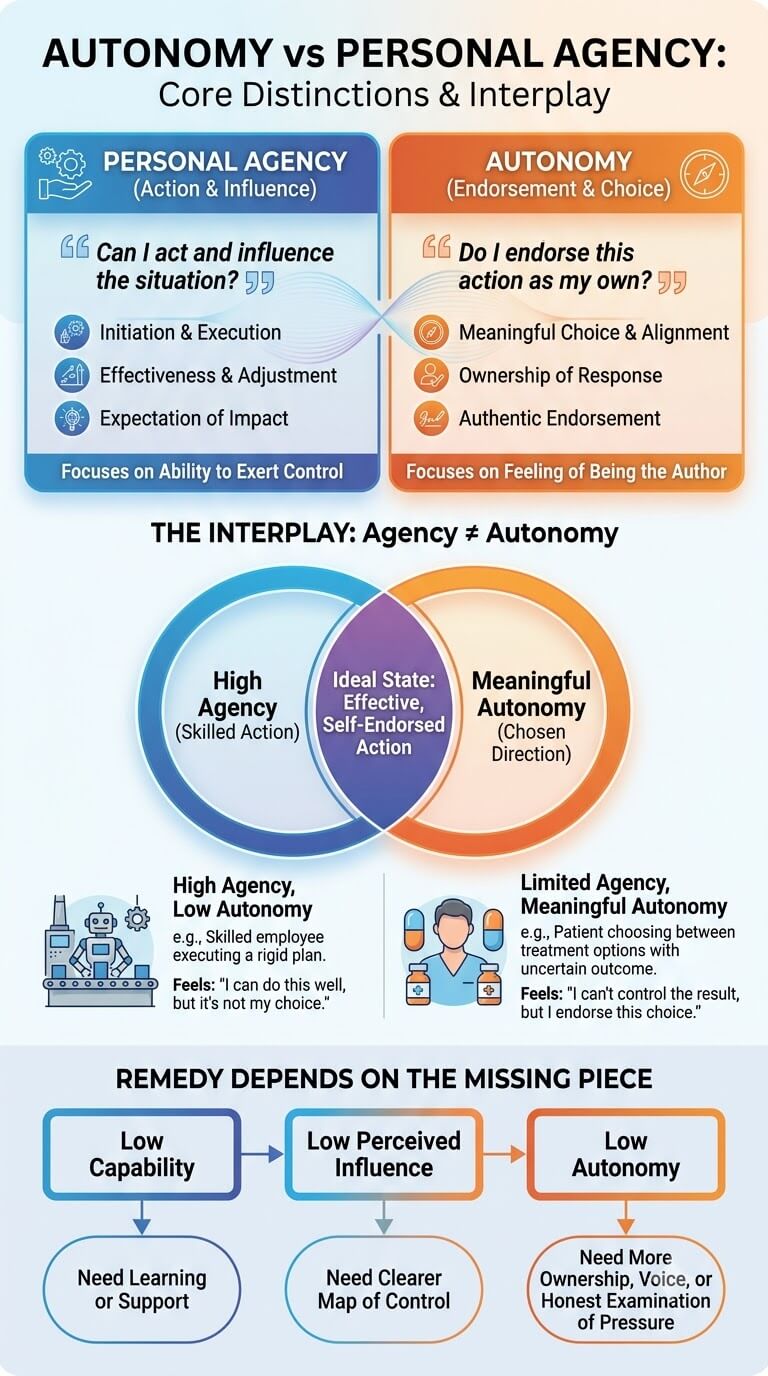
Autonomy and personal agency often travel together, but they are not interchangeable. One describes how chosen an action feels. The other concerns being able to initiate action and exert influence.
Agency asks whether I can act and influence
A sense of agency becomes relevant when you wonder, “Can I do something here that changes the situation?” It includes initiation, effectiveness, adjustment, and some expectation that action can matter.
Autonomy asks whether the action feels chosen by me
Autonomy asks a different question: “Do I experience this as an action I can endorse?” A person may have limited influence over the final outcome while still having meaningful autonomy over how they respond.
Examples of high agency with low autonomy and low agency with meaningful autonomy
| Situation | Agency | Autonomy | What it may feel like |
|---|---|---|---|
| A skilled employee executes a manager’s plan but feels unable to question any priority | High | Low | “I can do this well, but none of it feels like my choice.” |
| A patient chooses between two reasonable options while accepting that the medical outcome is uncertain | Limited over outcome | Meaningful | “I cannot control the result, but I can endorse this choice.” |
| A student chooses a personally meaningful project but lacks the skills to complete it yet | Developing | High | “This is my direction, but I need help learning how to do it.” |
| A person efficiently follows family expectations they privately resent | High | Low | “I know exactly how to comply, but I do not feel represented in the decision.” |
This comparison matters because the remedy depends on the missing piece. Low capability calls for learning or support. Low perceived influence calls for a clearer map of control. Low autonomy calls for more ownership, voice, or honest examination of the pressure shaping the choice.
Autonomy and Self-Determination Theory: The Boundary
Autonomy is strongly associated with Self-Determination Theory, often shortened to SDT. That broader theory covers more than autonomy, so it is helpful to use it as context without turning every question about choice into a complete motivation theory.
Autonomy is one basic psychological need in SDT
Within SDT, autonomy is commonly described alongside competence and relatedness. A PubMed Central synthesis discussing autonomy support emphasizes that autonomy is not identical to independence or freedom from all external influence. It centers on choices that become self-endorsed and are carried out with a sense of volition.
Keep competence and relatedness in their proper place
Competence concerns feeling effective and capable. Relatedness concerns connection and belonging. Both can affect motivation, but neither should be used as a synonym for autonomy.
The lived experience of volition is the central issue here
For everyday self-reflection, autonomy becomes easier to notice when you focus on the felt quality of the reason behind an action. “I want to,” “I value this,” and “I choose this because the tradeoff makes sense to me” usually have a different psychological quality from “I must,” “I am not allowed to disagree,” or “I will be punished if I do not comply.”
What Supports a Sense of Autonomy
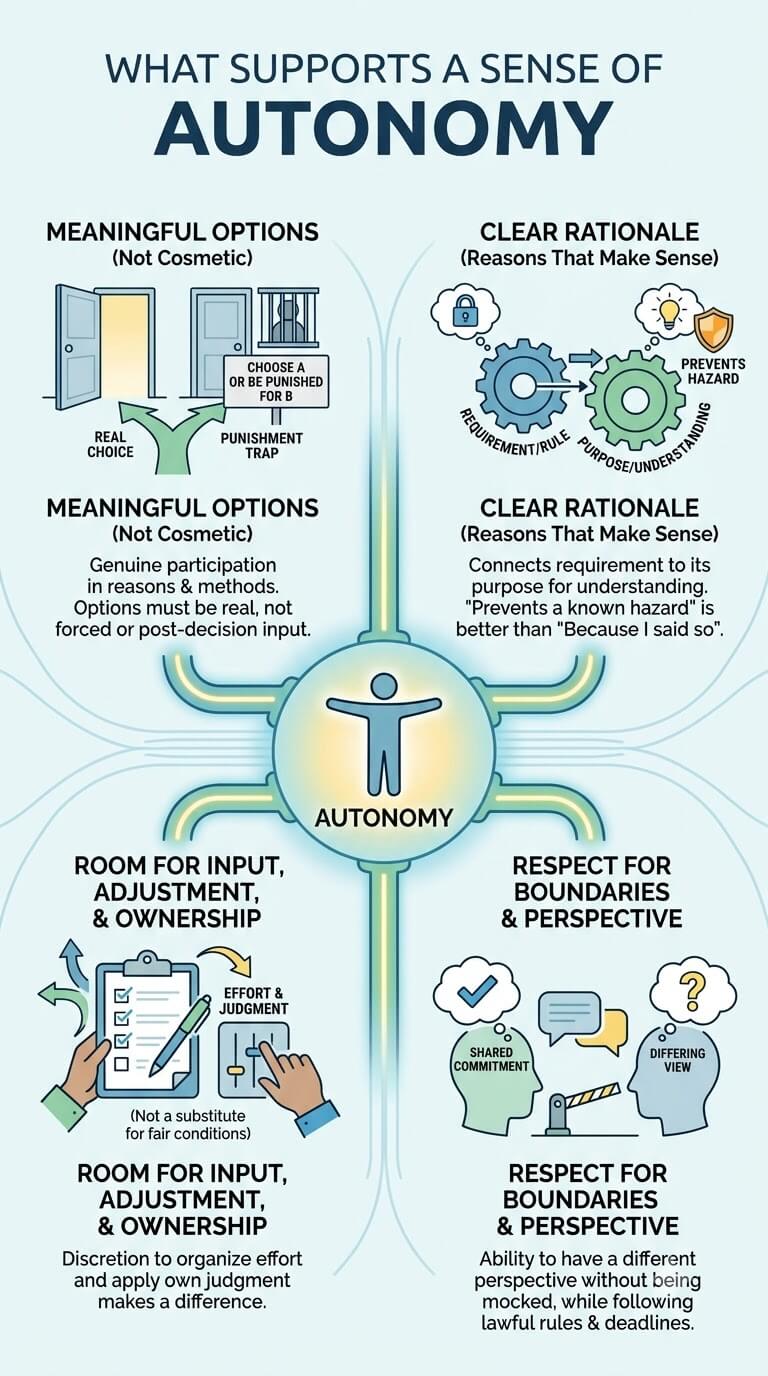
Autonomy tends to grow when people have genuine room to participate in the reasons, methods, and boundaries of their behavior. The number of options matters less than whether the available choice is meaningful.
Meaningful options rather than cosmetic choice
“You can choose option A or option B, but I will punish you if you choose B” is not meaningful choice. Neither is asking for input after the real decision has already been made and cannot be discussed.
Reasons that make sense to the person
People do not need to invent every rule themselves in order to endorse it. A clear rationale can help someone connect a requirement to its purpose. “Complete this safety check because it prevents a known hazard” gives more room for understanding than “Because I said so.”
Research on autonomy-supportive environments often emphasizes rationale and perspective-taking. A workplace study of autonomy-supportive relationships discusses how supportive social contexts can shape self-determined behavior and well-being at work.
Room for input, adjustment, and ownership
Small areas of discretion are not a substitute for fair conditions, but they can make a real difference when they affect how a person organizes effort and applies judgment.
Respect for boundaries and perspective
Autonomy support includes the ability to have a perspective that differs from the person in authority. You may still need to follow a lawful workplace rule, meet a deadline, or honor a shared commitment, but your concerns do not have to be mocked or treated as evidence of disloyalty.
What Undermines Autonomy
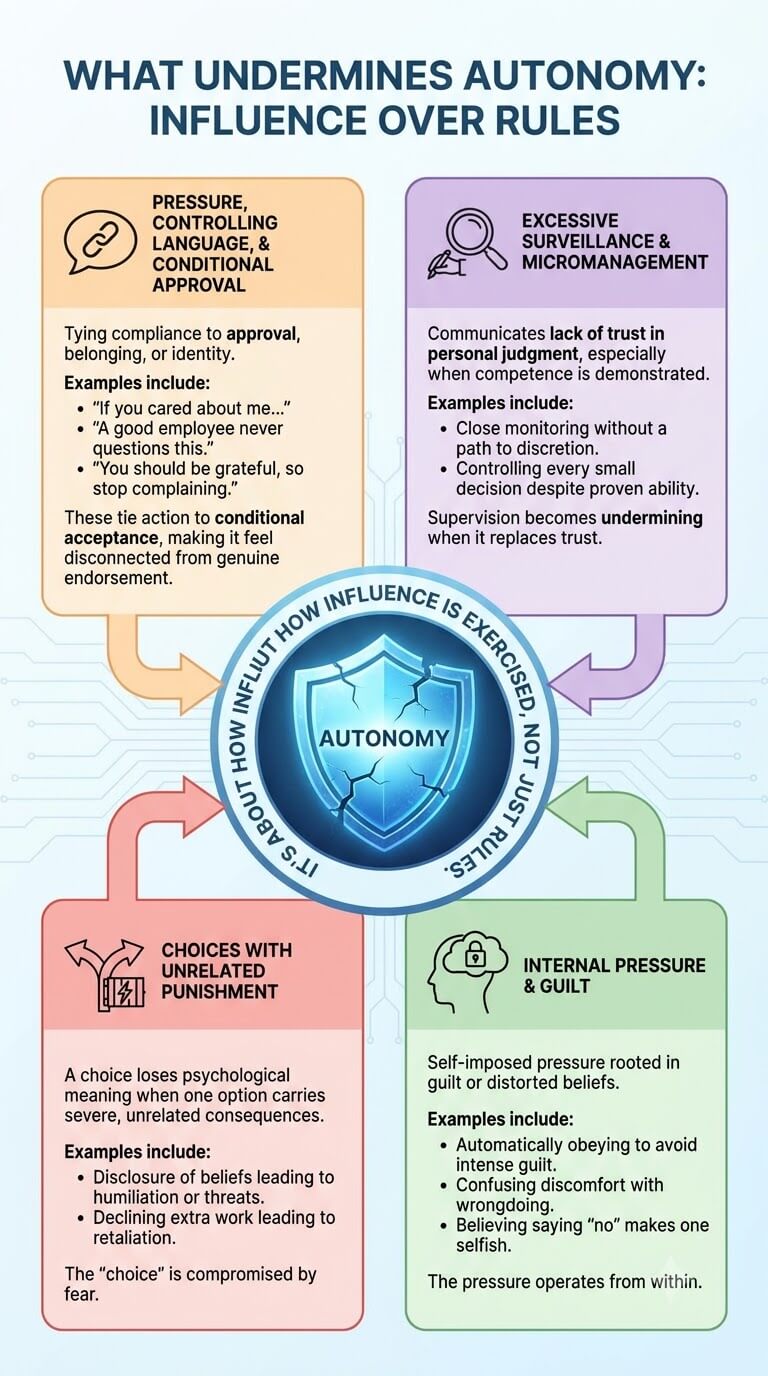
Low autonomy is often less about the sheer number of rules and more about how influence is exercised. Pressure can come from other people, institutions, or internalized expectations.
Pressure, controlling language, and conditional approval
Language such as “If you cared about me, you would do this,” “A good employee never questions this,” or “You should be grateful, so stop complaining” ties compliance to approval, belonging, or identity. The person may act, but the action can feel increasingly disconnected from genuine endorsement.
Excessive surveillance or micromanagement
Close monitoring can communicate that personal judgment is not trusted. In some settings, supervision is necessary for safety, training, or accountability. It becomes more autonomy-undermining when every small decision is controlled despite demonstrated competence and when there is no path toward greater discretion.
Choices with punishment attached
A choice loses much of its psychological meaning when one option carries severe, unrelated punishment. A teenager technically “chooses” whether to disclose a personal belief, but disclosure is not meaningfully free if it predictably brings humiliation or threats. An employee may technically decline unpaid extra work, but the choice is compromised if refusal reliably leads to retaliation.
Internal pressure such as “I have no right to say no”
Pressure can also operate inside the person. Someone may automatically obey expectations because saying no evokes intense guilt, even when no current person is threatening them. They may confuse discomfort with wrongdoing or believe that choosing differently would make them selfish.
Autonomy Does Not Mean Maximum Choice
More options are not automatically better. Autonomy depends on meaningful ownership, not on turning every decision into an unlimited menu.
Why too many options can create overload
Choice requires attention. When a person must compare dozens of options with uncertain tradeoffs, choice can become cognitively expensive rather than liberating. The person may postpone the decision, default to whatever is easiest, or become preoccupied with whether a better option was missed.
Structure can support autonomy when the rationale is clear
Structure tells you what the boundaries are. Autonomy tells you whether you can operate within those boundaries with understanding and some ownership. These are not opposites.
For example, a training program can set weekly practice targets while letting participants choose when to practice and which exercises address their needs. Research on self-regulation has likewise examined how autonomy-supportive contexts can encourage personally meaningful behavior change rather than mere compliance. One PubMed Central article on autonomy support and self-regulation describes autonomous regulation as goals experienced as self-generated or freely chosen rather than controlled mainly by pressure.
Everyday Examples of Autonomy
Autonomy becomes easier to recognize when you compare the same obligation under different psychological conditions. The outer behavior may be similar while the sense of ownership changes substantially.
Work: ownership within constraints
Situation: A team must deliver a client report by Friday. The deadline is fixed, but the manager lets the team decide who handles each section and how to schedule review.
What you may feel: Pressure from the deadline, but also ownership of how you respond. What it may mean: Constraint and autonomy are coexisting. What to do next: Notice which parts of the process are genuinely yours to shape rather than treating the entire assignment as imposed.
Learning: choosing approach while meeting requirements
Situation: A course requires a research project, but you can choose the question and format. What you may feel: More investment in the work even though the assignment itself is mandatory.
What it may mean: Meaningful choice is increasing self-endorsement. What to do next: Choose an option that connects the requirement to a real curiosity or skill you want to develop.
Relationships: consent, preferences, and negotiated commitments
Situation: Your partner wants to attend a family event you would rather skip. You discuss why it matters, what makes it difficult for you, and agree to attend for part of the evening.
What you may feel: Compromise without erasure. What it may mean: You did not get your first preference, but you participated in the decision and can endorse the negotiated choice. What to do next: Look for reciprocity over time, not perfect equality in every individual decision.
Health habits: self-endorsed reasons versus external pressure
Situation: Two people follow the same walking plan. One does it mainly to stop family criticism. The other chooses it because mobility and energy matter to them.
What you may feel: The first version may feel like monitoring and compliance; the second may feel more personally owned. What it may mean: The behavior alone does not reveal the quality of motivation. What to do next: Identify a reason you can genuinely endorse rather than relying only on approval or guilt.
A Self-Check for Low Autonomy
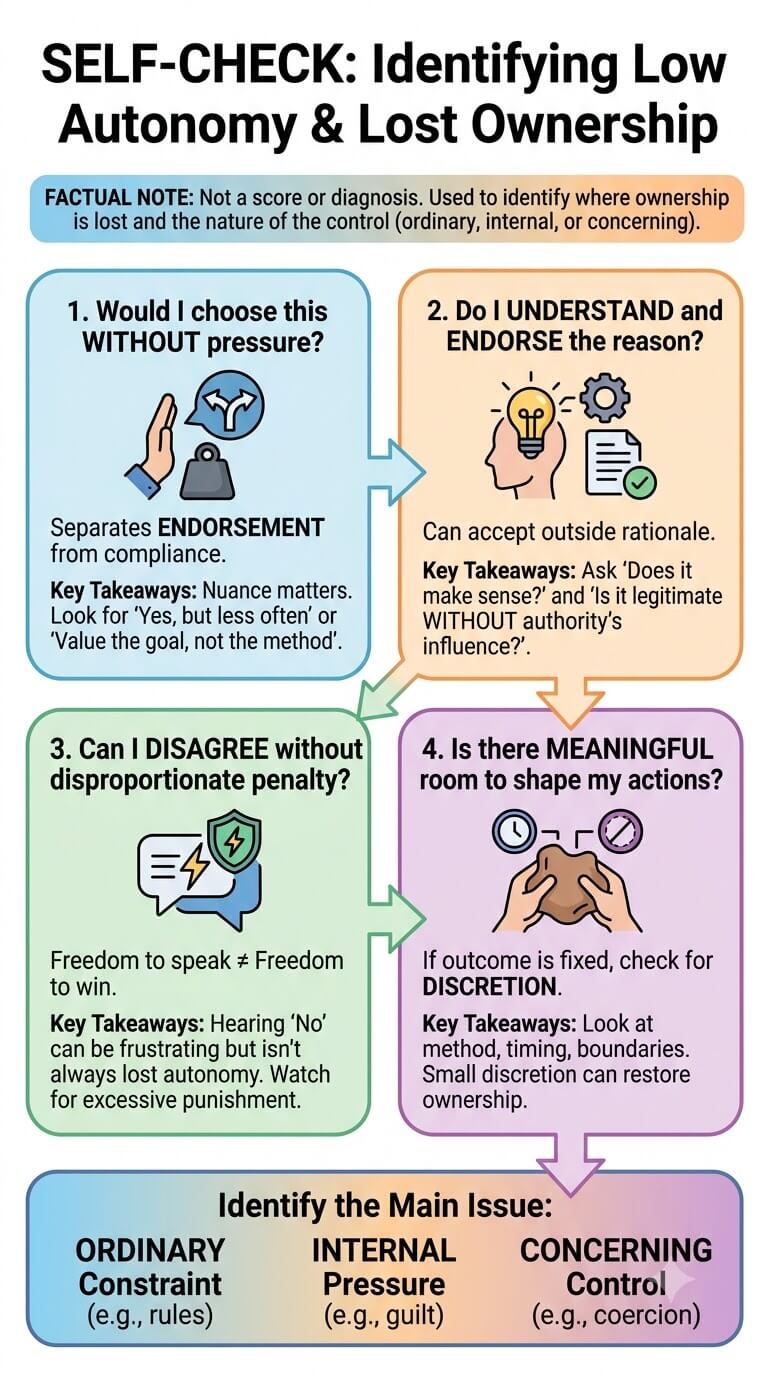
This self-check is not a score or diagnosis. Use it to identify where ownership is being lost and whether the main issue is ordinary constraint, internal pressure, or a more concerning form of control.
Would I choose this if pressure were removed?
This question separates endorsement from compliance. The answer does not have to be a simple yes or no. You might discover, “I would still do it, but less often,” or “I value the goal but not the way I am being pushed toward it.”
Do I understand and endorse the reason?
You can accept a reason you did not invent. Ask whether the rationale makes sense to you and whether you would still consider it legitimate if the person presenting it were not in a position of authority.
Can I express disagreement without disproportionate punishment?
This question is especially important because the freedom to speak is different from the freedom to win. You may voice disagreement and still hear “no.” That can be frustrating without necessarily undermining autonomy.
Is there any meaningful room to shape how I act?
When the outcome is fixed, look at method, timing, sequence, boundaries, support, and degree of participation. Sometimes a small amount of real discretion restores ownership. Sometimes there is genuinely none.
First Steps to Increase Autonomy Without Demanding Total Control
The most practical autonomy changes are usually specific. Instead of trying to make an entire life situation feel free, identify one decision where greater ownership would materially change your experience.
Ask for choice over method, timing, or sequence
If the goal is fixed, negotiate the process. At work, that might sound like, “I understand the deadline. Can I choose whether I complete the analysis or the presentation first?” In a shared household, it might be, “I agree this needs to get done. Can we divide the tasks differently?”
Translate “have to” into the real constraint and remaining choice
“I have to go to work” may translate into, “I need income and I am choosing this job for now because the alternatives carry costs I do not want to accept yet.” That sentence does not magically remove constraint. It simply makes the tradeoff visible.
State a preference or boundary where it is safe to do so
A preference can be small and concrete: “I can help Saturday morning, not the whole weekend,” or “I want to hear the reason before I agree.” The purpose is not to win a confrontation. It is to make your perspective part of the decision where the environment allows it.
Identify commitments you still actively endorse
Obligations feel different when you reconnect them to a value you continue to choose. You may dislike an early morning school run while strongly endorsing your commitment to your child. You may dislike studying on Friday night while endorsing the career goal behind the course.
How Autonomy, Self-Efficacy, and Agency Work Together
Several experiences that look like “motivation problems” are actually different questions occurring at the same time. Separating them makes the next step much clearer.
Wanting to choose, believing you can act, and believing action can matter are separate questions
| Question | Concept it points toward | Example |
|---|---|---|
| “Does this action feel like something I can genuinely endorse?” | Autonomy | You can do the task, but every priority feels imposed. |
| “Am I capable of performing this specific action?” | Self-efficacy | You want the role but doubt your ability to give the presentation. |
| “Can I initiate action and exert some influence here?” | Personal agency | You see several possible moves and believe you can use them. |
| “Will anything I do make a difference in this situation?” | Perceived control | You are capable of asking, but doubt that the decision-maker will respond. |
A person can be high on one and low on another. That is why generic advice to “be more confident” or “take control” often misses the real bottleneck. If the problem is autonomy, the relevant issue is ownership of action, not merely courage or competence.
When Low Autonomy Becomes a Safety Concern
Not every low-autonomy situation is unsafe. Workplaces, families, schools, and relationships all contain legitimate constraints. Safety becomes more relevant when another person uses fear, surveillance, isolation, threats, humiliation, financial restriction, stalking, or retaliation to make disagreement dangerous.
Coercion, threats, stalking, retaliation, forced isolation, or financial control
The National Domestic Violence Hotline’s overview of types of abuse describes behaviors such as isolation, monitoring, threats, humiliation, stalking, and financial control as forms that can be used to exert power over a partner. In that context, “just be more assertive” can be unsafe advice.
Safety support comes before autonomy exercises in unsafe relationships
When there is credible fear or coercion, prioritize safer ways to gather support and information. That may mean contacting a trusted person, a local specialist service, or an advocate from a device and location that are safe to use.
FAQ About Autonomy Psychology
These questions address common points of confusion that appear when autonomy is treated as either total freedom or complete independence.
Is autonomy the same as independence?
No. Independence is mainly about how much you rely on others, while autonomy is about whether your behavior feels volitional and self-endorsed. You can depend on family, colleagues, medical professionals, or a partner for support and still make choices that feel genuinely yours. You can also be highly independent while living according to pressure you have never freely reconsidered.
Can you have autonomy when you have obligations?
Yes. Obligations limit options, but they do not automatically remove autonomy. You may endorse a commitment because it reflects a value, a promise, or a tradeoff you continue to accept. Autonomy is weaker when you feel unable to question the commitment, cannot express a perspective safely, or act mainly to avoid disproportionate punishment.
Is autonomy the same as personal agency?
No. Personal agency concerns being able to initiate action and influence what happens. Autonomy concerns whether the action feels chosen and self-endorsed. A capable employee can have high agency but low autonomy if they can execute decisions effectively yet have no meaningful voice. Someone can also have limited influence over an outcome while autonomously choosing how to respond.
Can structure support autonomy?
Yes. Clear expectations, useful feedback, and reasonable limits can support autonomy when people understand the rationale and retain meaningful room for participation. Structure becomes more controlling when it relies on unnecessary surveillance, shame, threats, or arbitrary punishment, or when input is invited only as a performance with no real possibility of being considered.
Key Takeaways
- Autonomy is the experience of acting with volition and self-endorsement, not the absence of rules, obligations, or outside influence.
- Autonomy differs from independence: you can rely on other people and still make choices that feel genuinely your own.
- Personal agency asks whether you can act and influence; autonomy asks whether the action feels meaningfully chosen.
- Meaningful options, understandable reasons, room for input, and respect for perspective tend to support autonomy more than cosmetic choice or micromanagement.
- Low autonomy may come from ordinary constraints, internalized pressure, or controlling environments, so the appropriate next step depends on the cause.
- When choice is restricted through threats, stalking, humiliation, forced isolation, financial control, or retaliation, safety support takes priority over assertiveness exercises.
Educational note: These ideas are intended for understanding everyday psychology and behavior. They are not a diagnosis and do not replace individualized mental health, medical, legal, or safety guidance.

Michael Reed is the Founder and Lead Writer at Psychology Exposed. He writes about human behavior, relationships, emotional patterns, self-awareness, and practical psychology topics using research-informed, easy-to-understand content.
Read More About Michael Reed: https://psychologyexposed.com/michael-reed/