
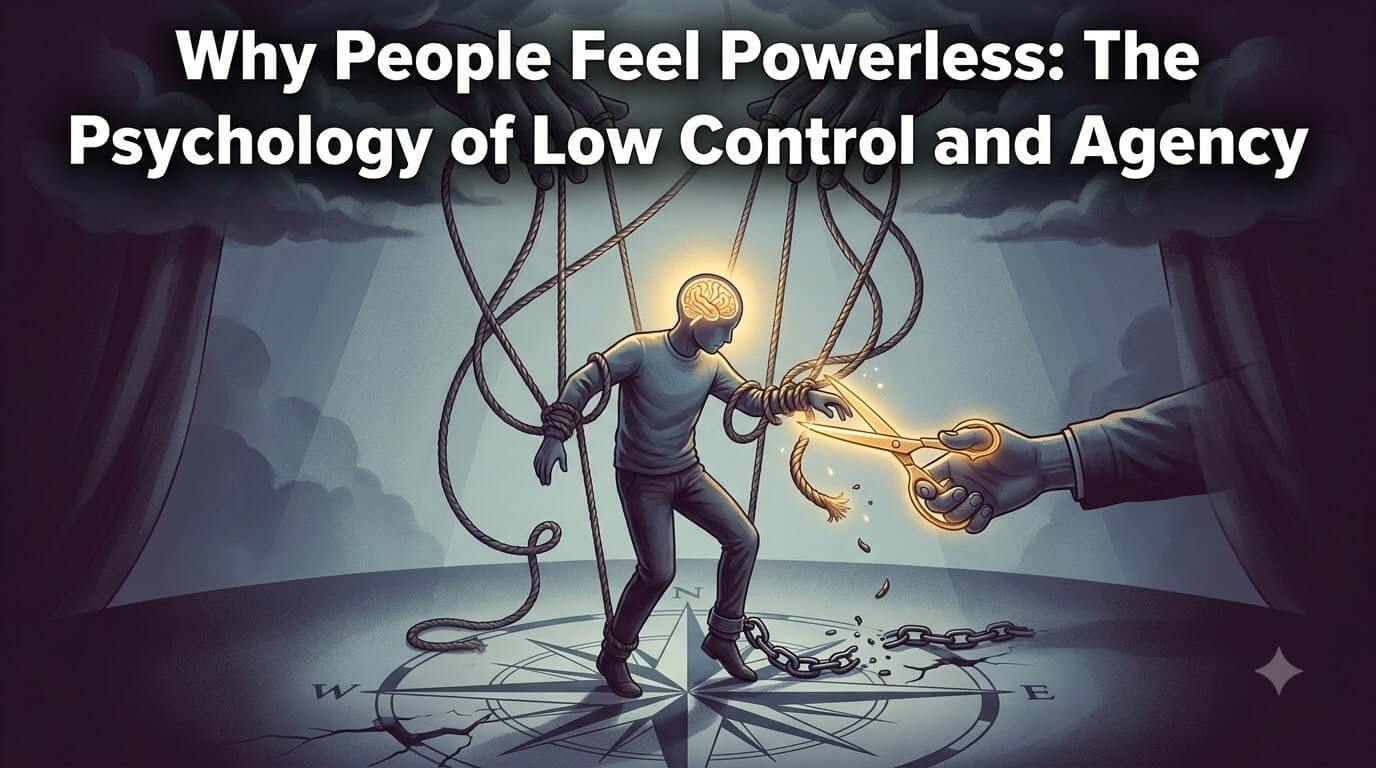
Feeling powerless often sounds like a simple thought: “Nothing I do will change this.” But that thought can come from very different places. Sometimes the situation really gives you little control. Sometimes there is a small amount of influence that is hard to see. Sometimes you have options but doubt your ability to use them. Repeated failure, uncertainty, exhaustion, dependence on other people, and fear of retaliation can all produce a similar feeling even though they call for different responses.
That distinction matters because “try harder” is not a universal answer. A skill gap may call for practice, a rigid system may require leverage or alternatives, and a coercive situation may require safety planning rather than confrontation. The first task is identifying what kind of limit you are facing.
Quick Answer
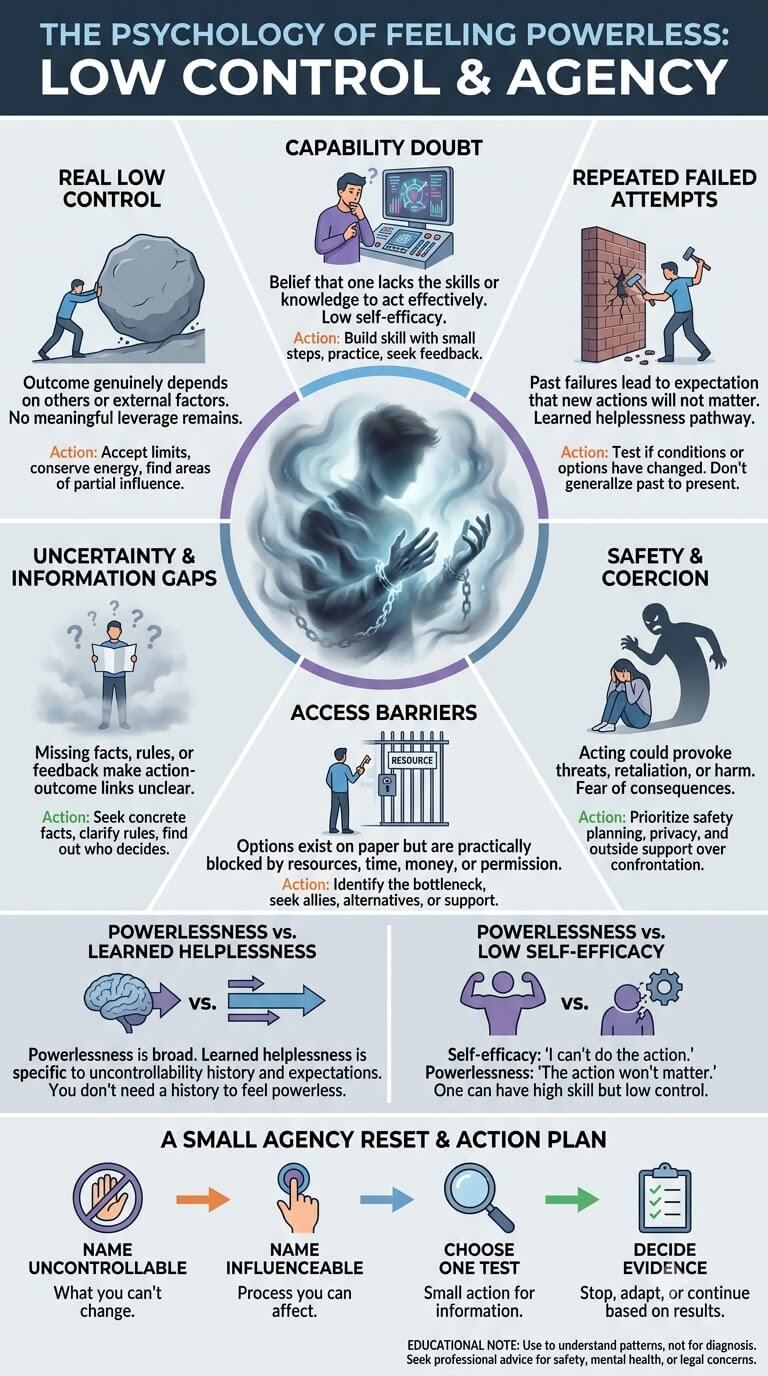
People may feel powerless when they have little real control, expect their actions not to matter, doubt their ability to act effectively, lack information or resources, depend heavily on other people, or face coercion and retaliation. The feeling is not a diagnosis. The most useful response depends on whether the main problem is capability, control, access, uncertainty, learned expectation, or safety.
Feeling Powerless Is a Signal, Not a Diagnosis
Powerlessness describes an experience, not a complete explanation of why that experience exists. The APA Dictionary of Psychology definition of helplessness describes a state associated with believing there is little one can do to improve a negative situation. That definition is useful precisely because it leaves room for both the situation and the person’s interpretation of it.
Subjective powerlessness can be accurate, exaggerated, learned, temporary, or context-specific
Powerlessness can be highly context-specific. Someone may be decisive at work yet feel unable to influence a family situation, or confident about learning while feeling stuck with a landlord, waiting list, or unresponsive institution. The feeling can also change when new information reveals an appeal, advocate, alternative route, or confirms that the constraint is real.
Why blaming the person misses the role of real constraints
Income, disability access, discrimination, caregiving demands, legal restrictions, health limits, institutional decisions, and other people’s choices can genuinely narrow options. Recognizing those limits is not giving up. A more accurate question is, “Which parts are mine to influence?” The APA definition of personal control also highlights that perceived and actual control do not always match.
Six Common Routes to Feeling Powerless
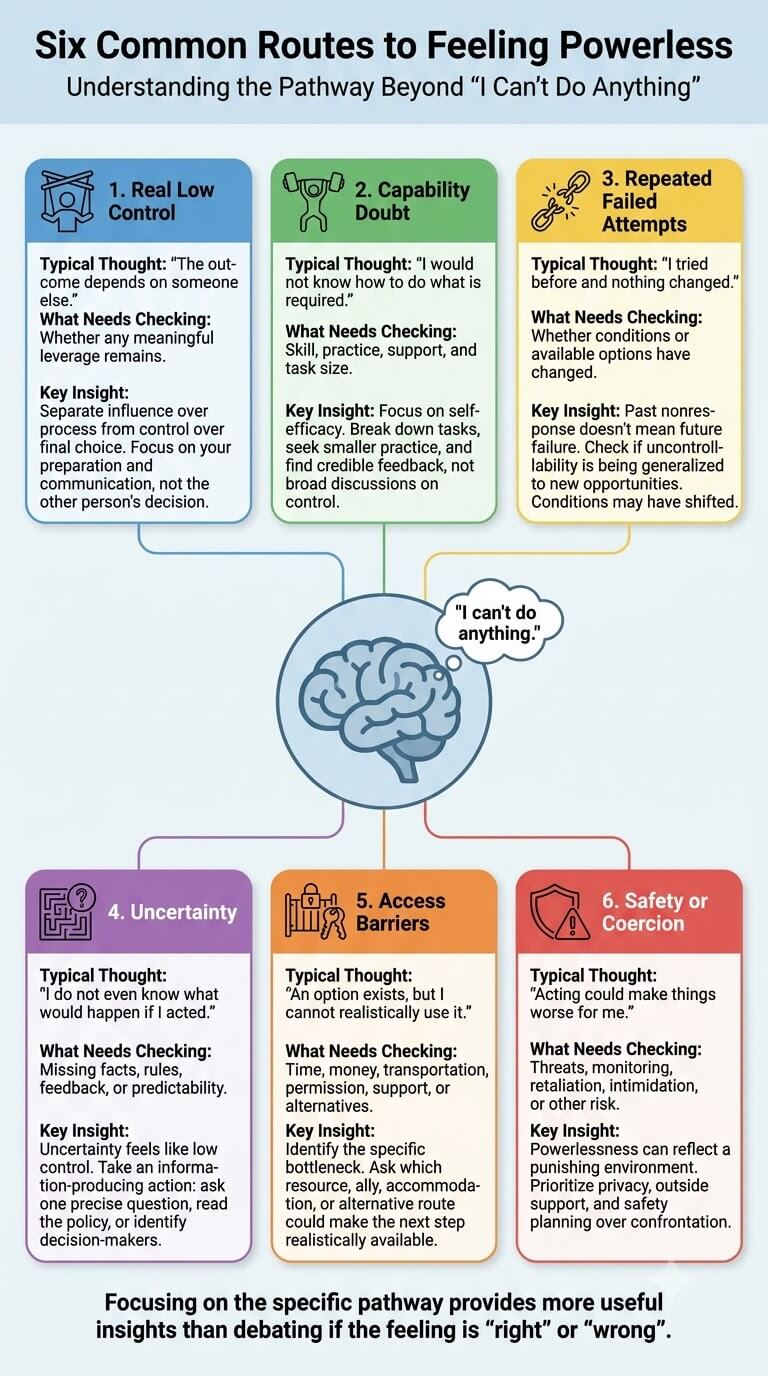
Different pathways can end in the same sentence, “I can’t do anything.” Sorting the pathway is more useful than debating whether the feeling is “right” or “wrong.”
| Route | Typical thought | What needs checking |
|---|---|---|
| Real low control | “The outcome depends on someone else.” | Whether any meaningful leverage remains |
| Capability doubt | “I would not know how to do what is required.” | Skill, practice, support, and task size |
| Repeated failed attempts | “I tried before and nothing changed.” | Whether conditions or available options have changed |
| Uncertainty | “I do not even know what would happen if I acted.” | Missing facts, rules, feedback, or predictability |
| Access barriers | “An option exists, but I cannot realistically use it.” | Time, money, transportation, permission, support, or alternatives |
| Safety or coercion | “Acting could make things worse for me.” | Threats, monitoring, retaliation, intimidation, or other risk |
The outcome genuinely depends on someone or something else
Some outcomes are not yours to decide. You can prepare for an interview without controlling whom another person hires, or communicate clearly without controlling whether another adult changes. Separating influence over the process from control over the final choice prevents one disappointing outcome from becoming proof that all effort is meaningless.
You do not believe you can perform the needed action
Sometimes the issue is not “My action will not matter” but “I do not think I can carry it out.” That is closer to self-efficacy, which the APA Dictionary of Psychology defines as perceived capability in a given setting. If a certification would improve your options but you doubt you could pass the exam, smaller practice tasks and credible feedback fit the problem better than a broad discussion about control.
Previous efforts repeatedly failed to change anything
Repeated nonresponse can change expectations. After being ignored, blocked, or repeatedly unsuccessful, another attempt may look pointless. That may be accurate, or the expectation may outlast the original conditions. Learned helplessness is one possible pathway, but the key question is whether past uncontrollability is being generalized to new opportunities.
The situation is unpredictable or information is missing
Uncertainty often feels like low control because missing rules, timelines, consequences, or options make action-outcome links hard to see. An information-producing action may help first: ask one precise question, read the policy, request written criteria, or identify who actually makes the decision.
Too many barriers make available options feel unusable
An option on paper is not always usable in practice. Money, transportation, childcare, time, disability access, permission, or safety may block it. When access is the bottleneck, ask which resource, ally, accommodation, alternative route, or timing change could make a next step realistically available.
Fear, coercion, threats, or retaliation make action unsafe
Powerlessness can accurately reflect an environment where independent action is punished. Relationship abuse can involve intimidation, threats, isolation, manipulation, and financial control. The National Domestic Violence Hotline describes abusive behavior that harms, intimidates, manipulates, or controls a partner. If retaliation is a concern, privacy, outside support, and safety planning matter more than proving you can confront the person.
Powerlessness from Real Constraints vs Perceived Constraints
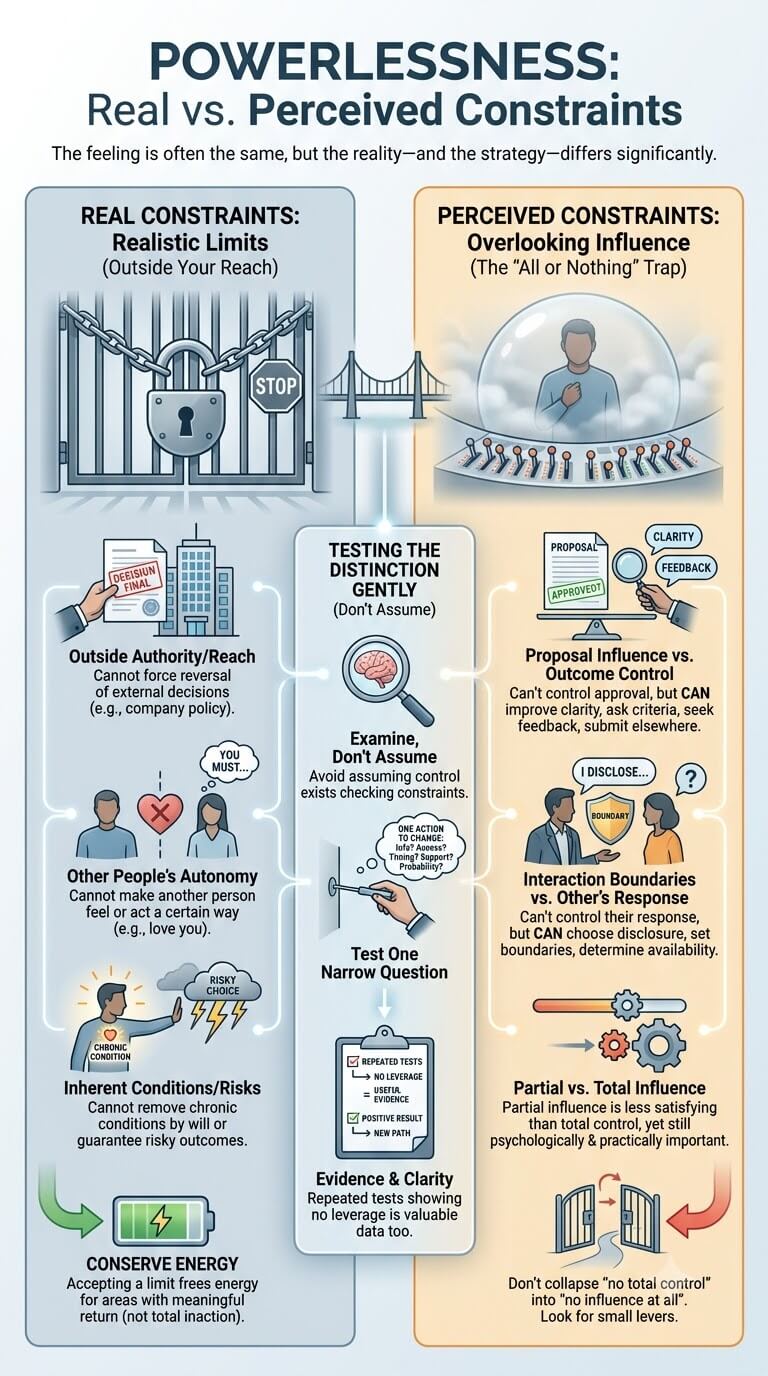
The difference between a real limit and an inaccurate prediction is rarely obvious from the feeling alone. Both can produce tension, withdrawal, indecision, or the urge to stop trying.
When “I cannot change this” is realistic
A realistic limit is one where the relevant decision or condition is genuinely outside your authority or practical reach. You cannot force a company to reverse a decision, make another person love you, remove a chronic condition by willpower, or guarantee that a risky choice will work out.
Accepting a limit can conserve energy for areas where action has a meaningful return. That is different from saying the situation does not matter or that you have no choices at all.
When partial influence is being overlooked
At the other extreme, people sometimes collapse “I cannot control the whole outcome” into “I cannot influence anything.” You may not control whether a proposal is approved, but you might be able to improve its clarity, ask what criteria matter, obtain feedback, or submit elsewhere. You may not control another person’s response, but you can choose what you disclose, what boundary you set, and whether you remain available for the same interaction.
Partial influence is often less satisfying than total control, yet it is still psychologically and practically important.
Why the distinction should be tested gently, not assumed
Do not assume someone has more control than they think without examining the constraints. Test one narrow question instead: “Is there one action that could change information, access, timing, support, or probability?” If repeated tests show no leverage, that is useful evidence too.
Powerlessness vs Learned Helplessness
These experiences overlap, but they are not interchangeable. Feeling powerless is broad. Learned helplessness refers to a more specific process involving uncontrollability and expectations about whether action changes outcomes.
Feeling powerless does not require a learned history
You can feel powerless the first day you encounter a genuinely restrictive situation. A sudden legal decision, an emergency, a closed system, or dependence on someone with greater authority can create low control without a long history of failed attempts.
That is why it is inaccurate to label every discouraged or constrained person as having learned helplessness.
Signs that repeated uncontrollability may have generalized
A learned expectation becomes more plausible when earlier failures keep shaping predictions after conditions change, such as staying silent with a new manager because an old one ignored every suggestion. A recent open-access review of learned helplessness and controllability discusses how action-outcome learning contributes to perceived control. The practical question is whether old evidence is being applied too broadly.
Powerlessness vs Low Self-Efficacy
These two experiences often feel similar because both can reduce action, but the internal question differs.
“I cannot do the action” versus “The action will not matter”
Low self-efficacy is primarily about capability: “I do not think I can perform this task.” Powerlessness about control is closer to: “Even if I perform the task, the outcome will not respond.”
A person can have high capability and low control. A skilled employee may know exactly how to produce excellent work but believe promotion decisions are arbitrary. Another person may have high control but low capability: a course is available and would clearly help, but the person doubts they can complete it.
Why the intervention differs
Capability doubts respond best to skill-building, graded practice, demonstrations, feedback, and tasks that provide interpretable evidence. A control problem requires a different move: identify leverage, clarify decision rules, change the environment, seek an alternative channel, or accept what cannot be influenced.
Practicing harder does not fix a system that ignores the action. Conversely, analyzing the system does not replace learning a skill you genuinely do not yet have.
Powerlessness vs Low Autonomy
Autonomy is about whether action feels chosen and self-directed. Powerlessness is more about whether you can meaningfully affect what happens. The two often travel together, but they can separate.
Having little choice versus feeling incapable
You may be highly capable in a role you did not choose. A caregiver can competently manage appointments, medication schedules, and logistics while still feeling that life offers almost no room for self-directed choice. A student can be capable of completing an assigned subject while resenting that the path was imposed.
Low autonomy is therefore not proof of low ability.
Doing something under pressure can preserve competence but reduce volition
A person may continue performing well while feeling trapped by obligation, financial dependence, family expectations, or institutional requirements. In that case, telling them to build confidence misses the problem. The more relevant questions concern choice, consent, alternatives, and which parts of the situation can become more self-directed.
The Powerlessness Sorting Map
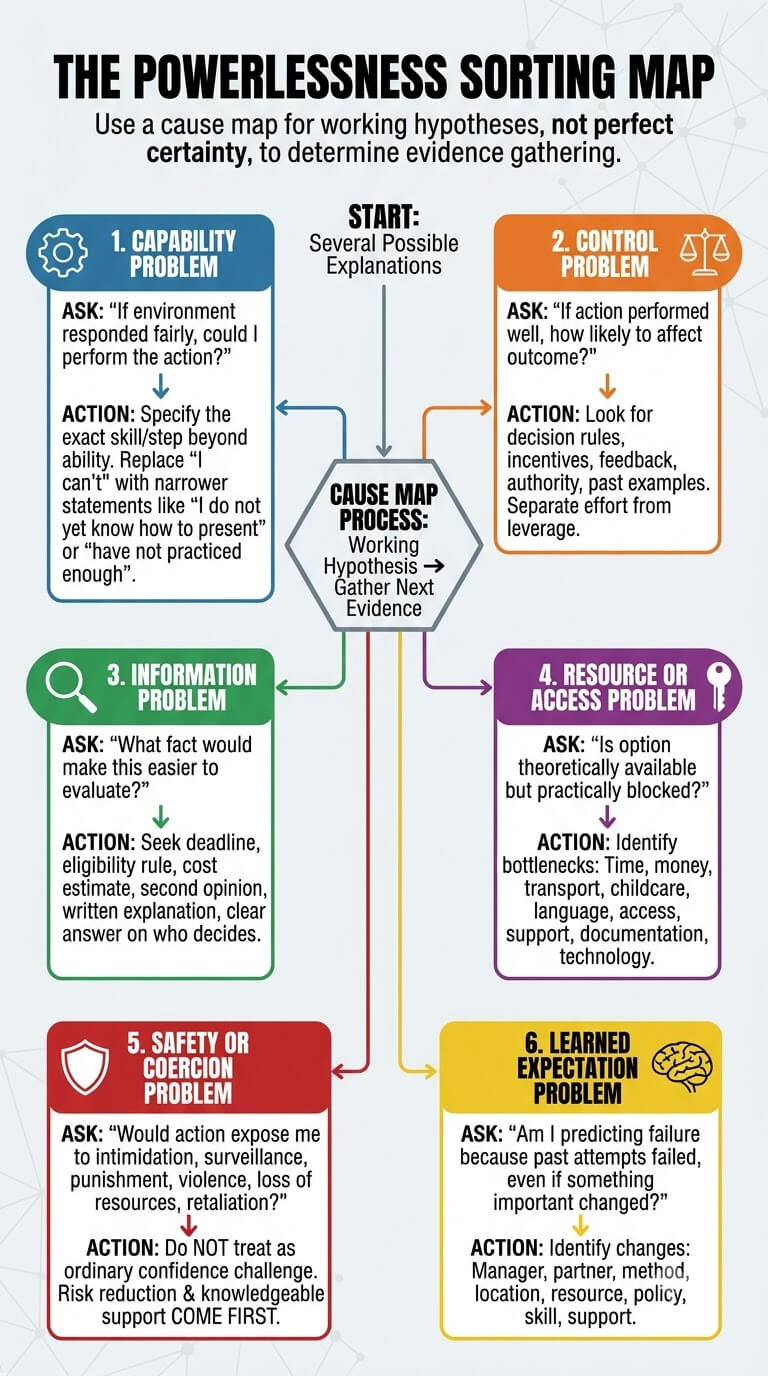
When several explanations are possible, use a cause map before choosing a response. You do not need perfect certainty. You only need a working hypothesis that tells you what evidence to gather next.
Capability problem
Ask: “If the environment responded fairly, do I believe I could perform the action?” If not, specify the skill or step that feels beyond your current ability. Replace “I can’t do this” with a narrower statement such as “I do not yet know how to present this proposal” or “I have not practiced the technical part enough.”
Control problem
Ask: “If I performed the action well, how likely is it to affect the outcome?” Look for actual decision rules, incentives, feedback, authority, and past examples. This separates effort from leverage.
Information problem
Ask: “What fact would make this situation easier to evaluate?” You may need a deadline, eligibility rule, cost estimate, second opinion, written explanation, or clear answer about who decides.
Resource or access problem
Ask: “Is the option theoretically available but practically blocked?” Time, money, transport, childcare, language, disability access, social support, documentation, or technology may be the real bottleneck.
Safety or coercion problem
Ask: “Would taking action expose me to intimidation, surveillance, punishment, stalking, violence, loss of essential resources, or retaliation?” If yes, do not treat the issue as an ordinary confidence challenge. Risk reduction and knowledgeable support come first.
Learned expectation problem
Ask: “Am I predicting failure mainly because similar attempts failed before, even though something important has changed?” Changes may include a different manager, partner, teacher, method, location, resource, policy, skill level, or amount of support.
What to Do First for Each Type of Powerlessness
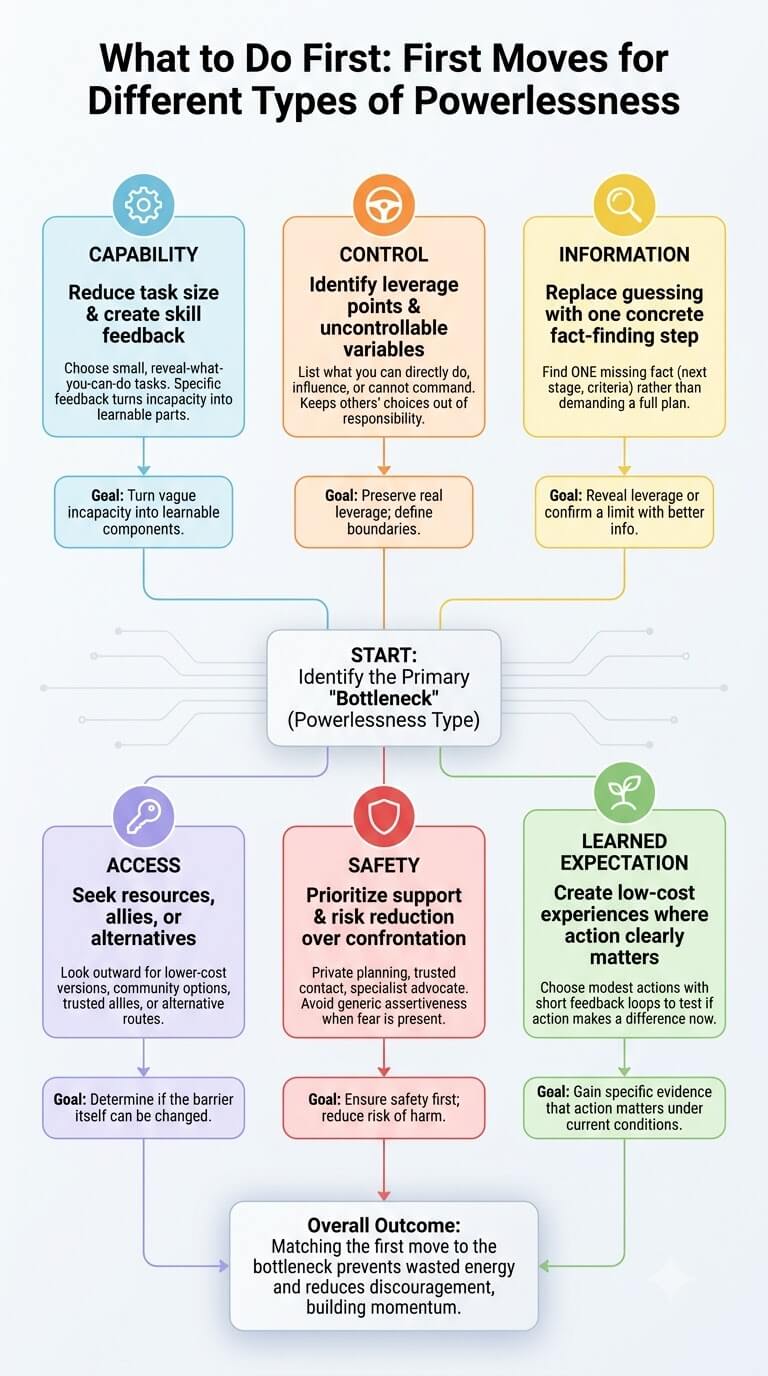
The first useful move should match the bottleneck. A mismatch wastes energy and may deepen discouragement.
Capability: reduce task size and create skill feedback
Choose a task small enough to reveal what you can currently do. Record a two-minute explanation instead of trying to “become good at speaking,” or organize one month of transactions instead of “fixing finances.” Specific feedback turns vague incapacity into learnable components.
Control: identify leverage points and uncontrollable variables
List what you can directly do, what you cannot command, and what you can influence without guaranteeing. This keeps another person’s choices or random outcomes out of your responsibility while preserving real leverage.
Information: replace guessing with one concrete fact-finding step
Find one missing fact rather than demanding a full plan. Ask about the next stage, written criteria, an appeal, or realistic alternatives. Better information can reveal leverage or confirm a limit.
Access: seek resources, allies, or alternatives
If the helpful option is inaccessible, look one level outward for a lower-cost version, accommodation, community resource, transportation option, trusted ally, flexible schedule, or alternative route. The question is whether the barrier itself can be changed.
Safety: prioritize support and risk reduction over confrontation
When fear or coercion is present, generic assertiveness advice can be unsafe. Safer choices may include private planning, protecting digital privacy, contacting a trusted person, or speaking with a specialist advocate rather than confronting the person directly.
Learned expectation: create low-cost experiences where action clearly matters
Choose a modest action with a short feedback loop. If earlier help requests were ignored, try a channel with a defined response process; if one study method failed repeatedly, test a different method on a small task. The aim is specific evidence about whether action matters under current conditions.
Common Mistakes That Make Powerlessness Worse
Powerlessness can deepen when the problem is framed too broadly or responsibility is placed in the wrong location.
Trying to control another person’s choices
You can ask, negotiate, set a boundary, make a request, or leave an interaction. You cannot directly control whether someone becomes honest, cooperative, affectionate, accountable, or fair. Building a plan around another person finally choosing differently makes your sense of control dependent on them.
Treating every failure as proof of permanent inability
A failed attempt tells you that one approach, at one time, under one set of conditions, did not produce the desired result. Sometimes that is evidence to stop. Sometimes it points to missing skill, bad timing, poor fit, weak feedback, or an external barrier. The conclusion should be no broader than the evidence.
Forcing optimism when the environment is actually restrictive
“You can do anything if you believe in yourself” can create self-blame when outcomes depend heavily on health, money, systems, other people, or chance. Realistic agency includes deciding where more effort is not useful.
Taking total responsibility for systemic or random outcomes
Responsibility helps when it points toward genuine choices. It becomes distorted when every outcome is treated as a personal verdict. Rejection, illness, economic conditions, family crises, and another person’s misconduct can affect you without being caused by insufficient effort.
A Small Agency Reset
When you feel overwhelmed, use a four-part reset that narrows the problem without denying its seriousness.
Name one outcome you cannot control
Name the uncontrollable part plainly: “I cannot control whether they approve the request” or “I cannot make another person respond respectfully.” This stops hidden attempts to command the outcome from consuming all your attention.
Name one process you can influence
Choose something behavioral and specific: prepare documents, ask for clarification, seek a second opinion, protect resources, practice one subskill, contact support, or decide your own participation.
Choose one action that produces information or feedback
Use a small test rather than a heroic commitment. It can reveal whether the environment responds, a skill improves, an option exists, or a boundary is respected.
Decide what evidence would mean stop, adapt, or continue
Set the interpretation rule before you act. “If I receive no response after two documented attempts, I will use the appeal route.” “If this practice method does not improve accuracy after three sessions, I will change methods.” “If raising this topic leads to threats, I will stop treating it as a communication problem and focus on safety.”
This step matters because agency is not endless persistence. It includes updating your behavior when evidence changes.
When Powerlessness Is Connected to Unsafe Dynamics
Some situations should not be treated as experiments in confidence or communication. If another person uses fear to limit your choices, the sense that action is dangerous may be grounded in real risk.
Fear, threats, humiliation, stalking, coercion, financial control, or retaliation
Monitoring, restricting money, threatening people or pets, isolation, humiliation, or punishing independence can make ordinary actions costly or dangerous. These are not problems solved by a stronger mindset.
Why “be more assertive” can be unsafe advice
Assertiveness assumes direct expression is reasonably safe. In coercive situations, confrontation can provoke escalation. If stalking or monitoring is possible, consider digital privacy and specialized support before deciding what to say or do.
Seek appropriate safety support rather than testing control through confrontation
If you are in immediate danger, use local emergency services when it is safe to do so. For threats, stalking, coercion, or retaliation, a domestic violence or stalking service can help with individualized planning. The aim is to increase safety and options, not to prove freedom through confrontation.
When to Get Professional Support
Feeling powerless for a short period during a difficult situation does not automatically mean you need mental health treatment. Support becomes more worth considering when the feeling is persistent, spreads across many areas of life, or is accompanied by severe distress or major difficulty functioning.
Persistent hopelessness, severe distress, major functional impairment, or self-harm thoughts
The National Institute of Mental Health recommends seeking professional help when severe or distressing symptoms persist and interfere with usual activities. A clinician can help explore whether low energy, anxiety, depression, chronic stress, grief, burnout, or another concern is affecting how much control and possibility you can perceive.
If you are thinking about harming yourself, feel you cannot stay safe, or believe you may act on suicidal thoughts, seek urgent help. In the United States, call or text 988. Elsewhere, contact your local crisis line or emergency service. Do not rely on a self-help exercise during an immediate safety crisis.
Support can help distinguish emotional, situational, and safety factors
A qualified professional can help map what is actually constrained, what you fear will happen, what you have tried, what has changed, and what resources are available. This can reduce two errors: blaming yourself for a real barrier or assuming an old barrier still controls a changed situation.
FAQ About Feeling Powerless
These questions address common points of confusion about control, choice, exhaustion, and learned expectations.
Why do I feel powerless even when I have choices?
Having choices does not guarantee that they feel usable. A choice may require skills you do not trust yet, resources you do not have, risks you cannot afford, or information that is missing. Past experiences can also shape expectations so that a technically available option does not feel consequential. Instead of counting choices, ask which choices are safe, practical, and likely to affect something you care about.
Is feeling powerless the same as learned helplessness?
No. Feeling powerless is a broad experience that can arise from real constraints, uncertainty, low self-efficacy, exhaustion, dependence, coercion, or repeated failure. Learned helplessness is a more specific concept involving experience with uncontrollability and reduced use of control opportunities. You do not need a history of learned helplessness to feel powerless in a genuinely restrictive situation.
Can being exhausted make control feel lower than it is?
Yes. Exhaustion can reduce attention, planning capacity, persistence, and the ability to compare options, so an influenceable problem may temporarily feel impossible. That does not mean every control problem is caused by fatigue. A useful check is whether your appraisal changes after rest, practical support, or reducing the number of decisions you are trying to solve at once.
What if the situation truly is outside my control?
Then the task changes from controlling the outcome to choosing your response to the limit. That may mean protecting resources, adjusting expectations, grieving what cannot be changed, seeking support, making a contingency plan, or redirecting effort toward a different goal. Accepting a real limit is compatible with agency because you are still choosing where your attention and action go next.
Key Takeaways
- Feeling powerless can come from real low control, capability doubts, repeated failure, uncertainty, access barriers, or unsafe coercive dynamics.
- Powerlessness is not automatically learned helplessness, low self-efficacy, low autonomy, or a mental health diagnosis.
- The most useful first step depends on the bottleneck: build skill, clarify leverage, gather information, improve access, test an updated expectation, or prioritize safety.
- Partial influence is worth separating from total control. You may affect a process even when you cannot guarantee the outcome.
- Real constraints should not be reframed as mindset failures, and unsafe environments should not be treated as opportunities to practice confrontation.
- A practical next move is to name one uncontrollable outcome, one influenceable process, one small test, and the evidence that would tell you to stop, adapt, or continue.
Final Thoughts
“Nothing I do matters” is a starting point for sorting the problem. Ask whether the missing piece is skill, leverage, information, access, updated evidence, or safety. Then match the next step to that cause. The aim is not to believe everything is controllable. It is to see your actual choices more accurately, including when to adapt, seek help, or stop pushing where effort is ineffective or unsafe.
Educational note: Use these ideas to understand patterns of control and choice, not to diagnose yourself or replace individualized mental health, legal, medical, or safety guidance.

Michael Reed is the Founder and Lead Writer at Psychology Exposed. He writes about human behavior, relationships, emotional patterns, self-awareness, and practical psychology topics using research-informed, easy-to-understand content.
Read More About Michael Reed: https://psychologyexposed.com/michael-reed/