
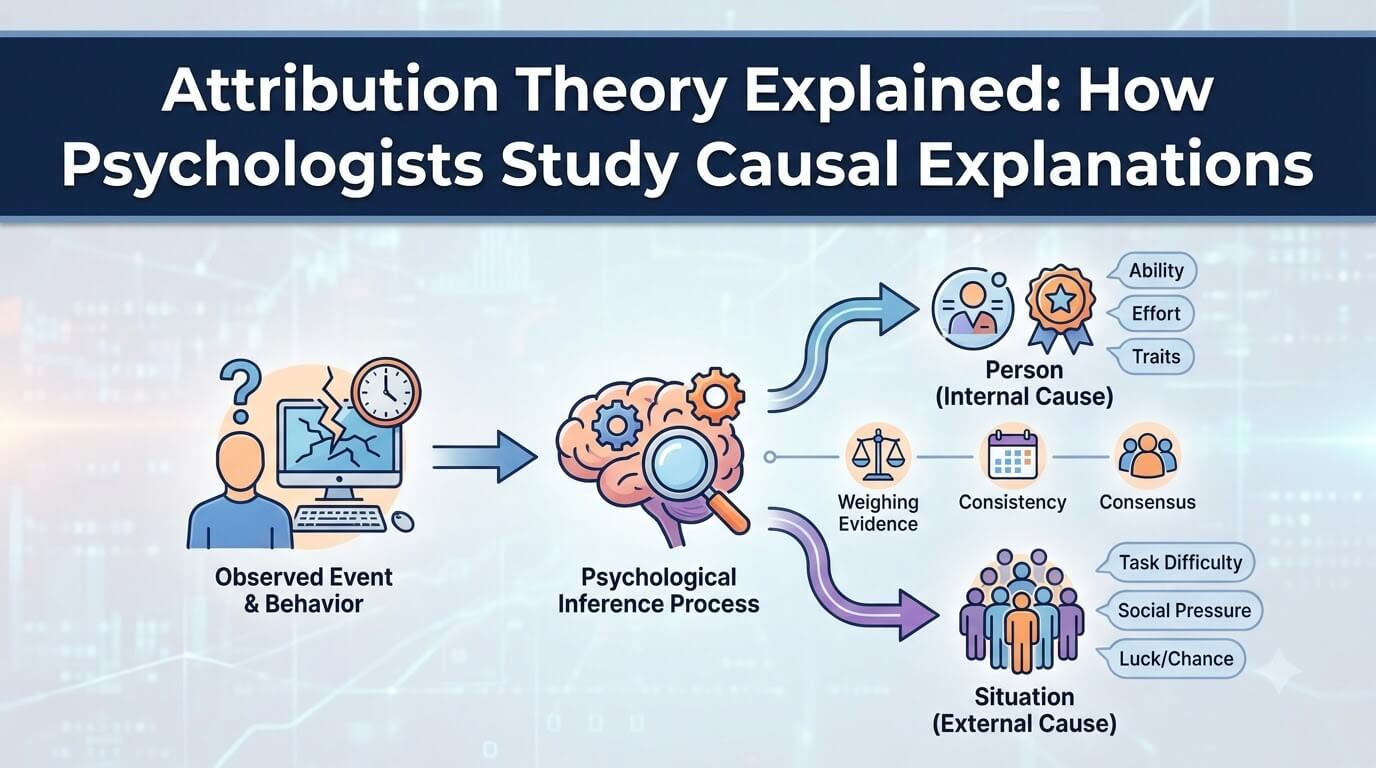
A coworker misses an important deadline. A friend suddenly becomes quiet at dinner. A student performs much better on one exam than the last. In each case, the visible event is only the beginning. Almost immediately, the mind asks a second question: Why did that happen?
Attribution theory examines how people answer that question. It is not one single rule for deciding what caused behavior. Instead, it is a family of ideas about how we infer causes from limited evidence, how we divide attention between the person and the situation, and how those explanations shape what we expect next. The same behavior can support very different interpretations depending on what information is available.
This matters because causal explanations are rarely neutral. If you decide that a colleague missed a deadline because they are careless, you may respond differently than if you learn the project requirements changed the night before. Understanding attribution theory gives you a more disciplined way to ask what the evidence actually supports before treating an explanation as a fact.
Quick Answer
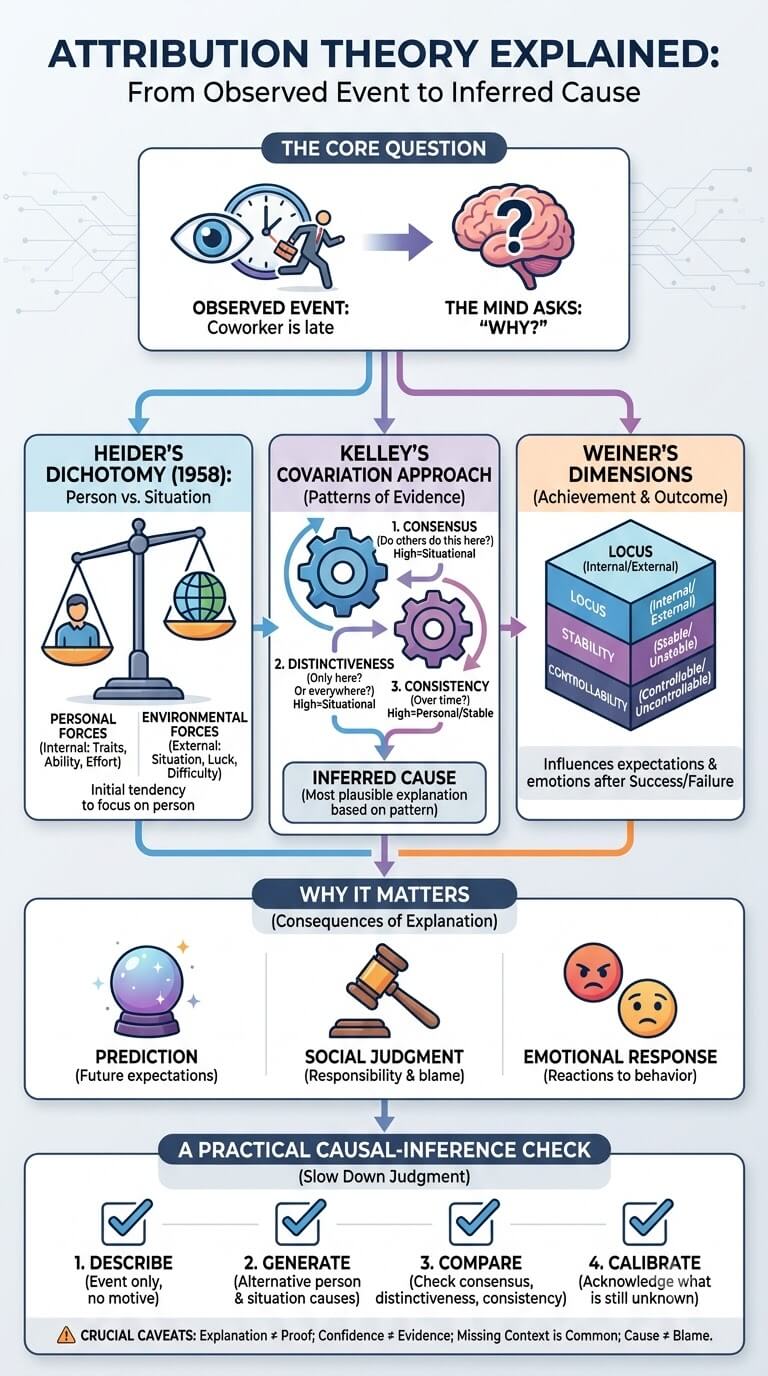
Attribution theory studies how people infer the causes of behavior and events. Early work emphasized the difference between causes located in the person and causes located in the situation. Later models asked what evidence makes one explanation more plausible than another, and how explanations of success or failure influence future expectations. The central lesson is simple: an observed outcome does not reveal its cause by itself.
What Attribution Theory Tries to Explain
From observed event to inferred cause
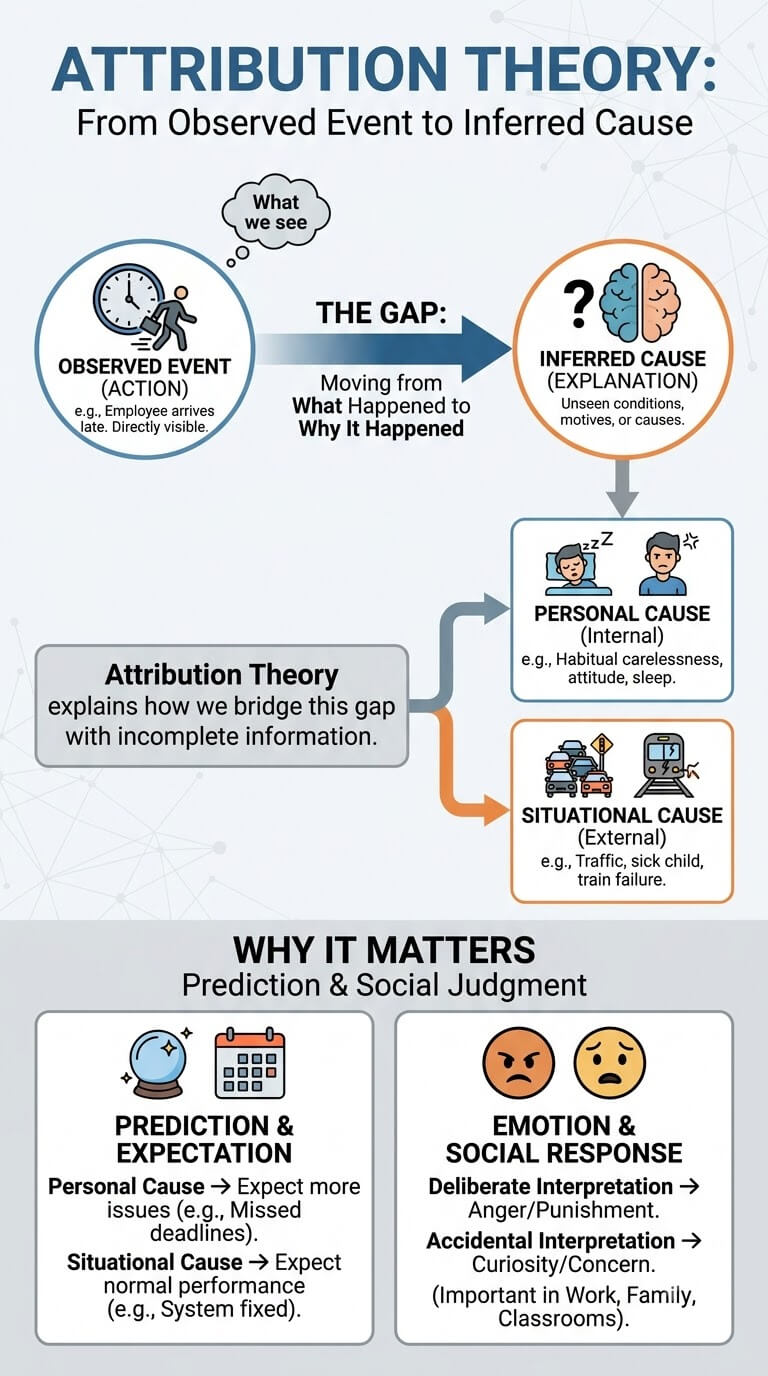
The APA Dictionary of Psychology definition of attribution theory describes a set of ideas about how people assign causes or motives to behavior, especially whether those causes are personal or situational. That sounds straightforward, but the psychological problem is surprisingly difficult. We usually see an action more clearly than we see the conditions that produced it.
Imagine that a manager sees an employee arrive late. The manager can observe the lateness directly. They cannot immediately observe traffic conditions, a sick child, the employee’s sleep, their attitude toward work, whether the train stopped, or whether lateness happens every week. The cause has to be inferred from incomplete information.
That gap between observation and explanation is the territory attribution theory tries to understand. The theory asks how people move from what happened to why they think it happened.
Why causal explanations matter for prediction and social judgment
A causal explanation does more than make the past feel understandable. It also changes what you predict. If you think an employee is habitually careless, you may expect more missed deadlines. If you think a one-time software failure caused the problem, you may expect normal performance once the system is fixed.
The explanation can also change emotion and social response. A behavior interpreted as deliberate disrespect may produce anger, while the same behavior interpreted as accidental may produce curiosity or concern. This is one reason attribution is important in friendships, families, classrooms, workplaces, and public judgment.
Heider’s Starting Point: People as Everyday Cause-Seekers
Personal forces and environmental forces
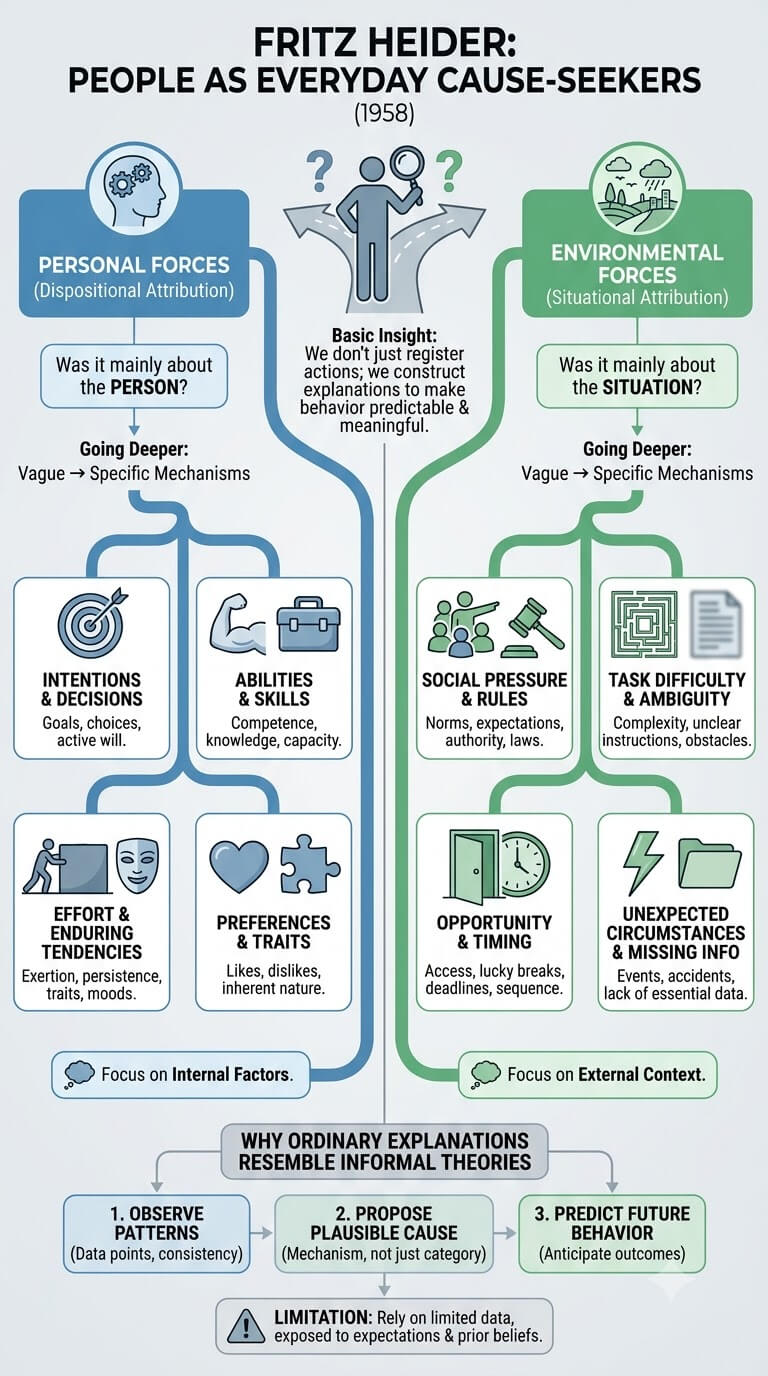
Fritz Heider’s 1958 work is often treated as a foundation of modern attribution thinking. His basic insight was that ordinary people act like informal cause-seekers. We do not merely register what others do. We try to construct an explanation that makes their behavior predictable and meaningful.
One broad distinction in this tradition separates causes associated with the person from causes associated with the environment. Personal explanations might involve intentions, abilities, effort, preferences, or enduring tendencies. Environmental explanations might involve social pressure, task difficulty, opportunity, rules, timing, or unexpected circumstances.
These categories organize a common everyday question: Was this mainly about the person, or mainly about the situation? The APA Dictionary entry on dispositional attribution describes explanations located within the person, including traits, moods, decisions, abilities, and effort.
Intention, ability, effort, difficulty, and opportunity
Heider’s approach becomes more useful when internal or external causes are not treated as interchangeable. If someone fails to solve a problem, “it was something about the person” is too vague. Lack of skill, low effort, distraction, and misunderstood instructions are different causal stories.
The same applies to the environment. A task may be difficult because instructions are ambiguous, time is short, or essential information is missing. “The situation caused it” is still only the beginning of an explanation.
This is an important limit on simple person-versus-situation thinking. A useful attribution should identify a plausible mechanism, not merely place the cause on one side of a divide.
Why ordinary explanations resemble informal theories
People build explanations from patterns. If a friend becomes quiet whenever one subject appears, the subject may seem important. If the friend is quiet in almost every setting, a broader personal explanation may seem more plausible.
Everyday explanation therefore resembles informal theory-building: observe a pattern, propose a cause, predict what may happen next. The problem is that ordinary judgments usually rely on limited data and are more exposed to expectations and prior beliefs.
From Person vs Situation to Evidence About Causes
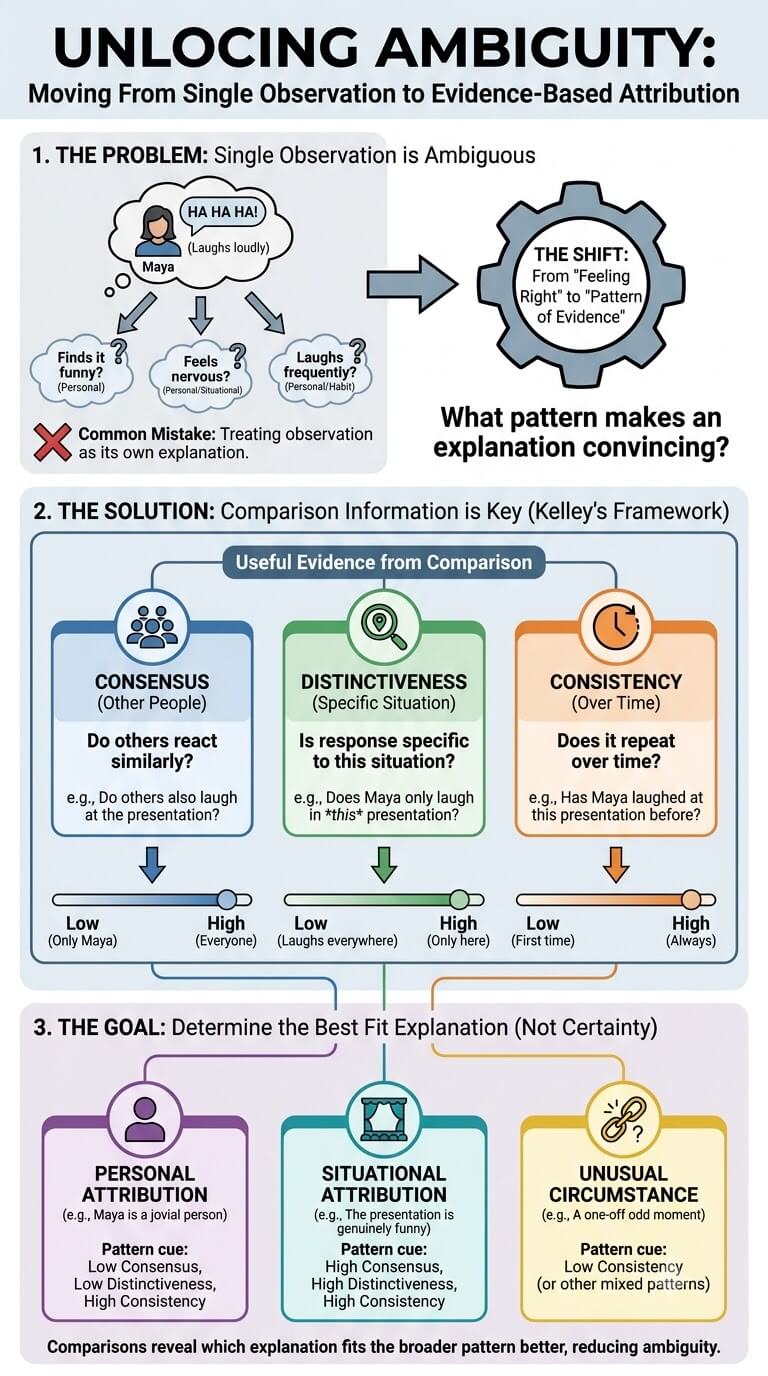
Why a single observation is often ambiguous
A common mistake is treating one observation as if it contains its own explanation. Suppose Maya laughs loudly during a presentation. She may find it funny, feel nervous, or laugh frequently in meetings. Without comparison information, several explanations remain plausible.
This is where attribution theory becomes more than a vocabulary lesson. The question changes from “Which explanation feels right?” to “What pattern of evidence would make one explanation more convincing than another?”
What additional information can change an attribution
Useful evidence often comes from comparison. Do other people react similarly? Is the response specific to this situation? Does it repeat over time?
These comparisons do not guarantee certainty, but they can reveal whether a personal, situational, or unusual-circumstance explanation fits the broader pattern better.
Kelley’s Covariation Approach
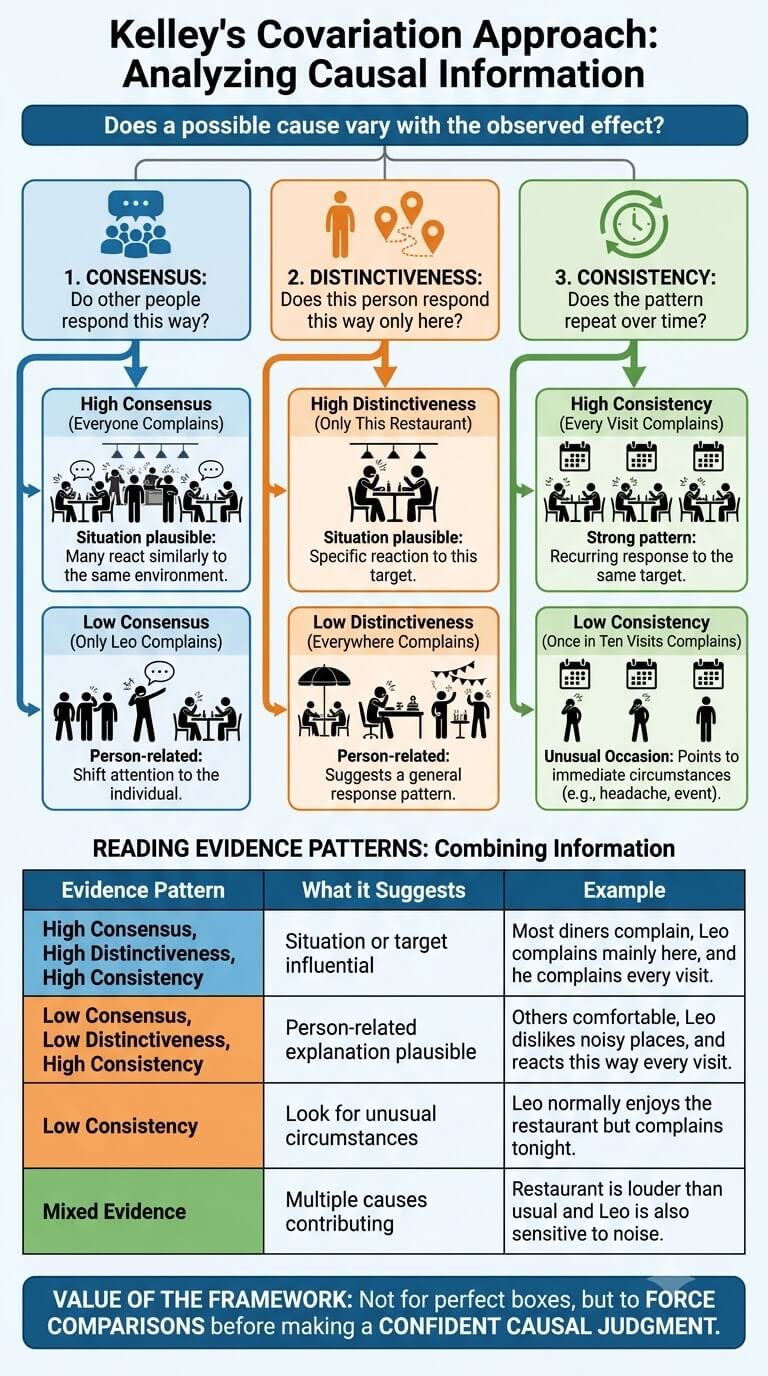
Harold Kelley developed a more structured way to think about causal information. His covariation approach asks whether a possible cause varies together with the observed effect. In plain language, if you think something caused a behavior, you should look for a pattern in which the behavior tends to appear when that factor is present and tends not to appear when it is absent.
A useful modern summary of the model appears in an open-access review discussing the covariation principle, which describes three major information types: consensus, distinctiveness, and consistency.
Consensus: do other people respond this way?
Consensus asks how other people react to the same target or situation. Suppose Leo complains that a restaurant is painfully noisy. If almost everyone in the group complains too, consensus is high. If nobody else notices a problem, consensus is low.
High consensus can make a situational explanation more plausible because the same environment produces a similar response in many people. Low consensus may shift attention toward something specific about Leo, although it does not prove that the cause is personal.
Distinctiveness: does this person respond this way only here?
Distinctiveness asks whether the person’s reaction is specific to this target or happens across many targets. If Leo rarely complains about noise but finds this particular restaurant unbearable, distinctiveness is high. If he complains about sound in nearly every café, office, and social gathering, distinctiveness is low.
High distinctiveness makes the current situation look more special. Low distinctiveness suggests that something more general about the person’s response pattern may be involved.
Consistency: does the pattern repeat over time?
Consistency asks whether the same person reacts similarly to the same target across occasions. If Leo complains every time he visits this restaurant, consistency is high. If he has visited ten times and complained only once, consistency is low.
Low consistency is especially useful because it points toward something unusual about the present occasion. Perhaps the restaurant has a loud event tonight, Leo has a headache, or a construction crew is working next door. The immediate circumstances deserve attention.
Reading combinations of consensus, distinctiveness, and consistency
| Evidence pattern | What it suggests | Example |
|---|---|---|
| High consensus, high distinctiveness, high consistency | The situation or target may be especially influential | Most diners complain, Leo complains mainly here, and he complains every visit |
| Low consensus, low distinctiveness, high consistency | A person-related explanation becomes more plausible | Others are comfortable, Leo often dislikes noisy places, and he reacts this way every visit |
| Low consistency | Look for unusual circumstances on this occasion | Leo normally enjoys the restaurant but complains tonight |
| Mixed evidence | Multiple causes may be contributing | The restaurant is louder than usual and Leo is also more sensitive to noise than his friends |
The value of this framework is not that every real situation fits a perfect box. Its value is that it forces you to ask for comparisons before making a confident causal judgment.
A Worked Covariation Example
One behavior, three evidence patterns, different conclusions
Imagine that Nina becomes unusually tense whenever her supervisor gives feedback. You might initially conclude that Nina “cannot handle criticism,” but the covariation questions change the picture.
Pattern one: most employees become tense with this supervisor, Nina is relaxed when receiving feedback from other people, and her tension appears reliably with this supervisor. High consensus, high distinctiveness, and high consistency make something about the supervisor or interaction context worth examining.
Pattern two: other employees seem comfortable, Nina becomes tense with many kinds of feedback, and this response happens repeatedly. A person-related explanation becomes more plausible, although you still do not know whether the relevant factor is confidence, past experience, uncertainty, temperament, or something else.
Pattern three: Nina usually handles feedback well, including feedback from this supervisor, but she is tense today. Low consistency suggests looking for a temporary circumstance. She may be exhausted, worried about another issue, or reacting to something unusual about today’s conversation.
What to do when the evidence is incomplete
Real life rarely provides complete information. You may not know how others react, how the person behaves elsewhere, or whether this event is typical. A tentative explanation is reasonable, but certainty should match the available evidence.
A useful sentence is: “One possible explanation is X, but I do not yet know Y.” That small addition keeps inference separate from fact. It is especially valuable when the attribution could affect trust, discipline, conflict, or a judgment about someone’s character.
Weiner’s Contribution at a High Level
Why achievement outcomes need more than person-versus-situation
Success and failure often produce explanations that are not captured well by a single person-versus-situation question. A student may explain a poor result as low ability, insufficient effort, an ineffective strategy, a difficult exam, bad timing, or simple luck. Some of these causes are internal, but they differ in whether they are stable and controllable.
Bernard Weiner’s work on achievement attribution expanded the framework by emphasizing dimensions such as locus, stability, and controllability. A peer-reviewed discussion of attribution and academic performance summarizes how these dimensions can influence expectations and emotional responses after success or failure.
Locus, stability, and controllability as classification dimensions
Locus asks whether the proposed cause is located mainly within the person or outside the person. Stability asks whether the cause is expected to remain similar over time or change. Controllability asks whether the person can realistically influence the cause.
For example, “I used the wrong study strategy” is internal, relatively changeable, and potentially controllable. “The exam included material that was never taught” is external and not directly controllable by the student. “I am simply bad at this subject” is an internal and stable-sounding explanation, but that description may be too broad to fit the actual evidence.
Weiner’s use of the word locus should not be confused with the broader concept explained in locus of control psychology. One classifies the perceived cause of a particular outcome; the other concerns more general expectations about what tends to determine outcomes.
Why the detailed model belongs in a separate explanation
The point is not to memorize every causal combination. Attribution theory moved from asking “person or situation?” toward asking more precise questions about a cause. Two internal explanations can produce different expectations if one seems changeable and the other fixed.
Why People Seek Causal Explanations
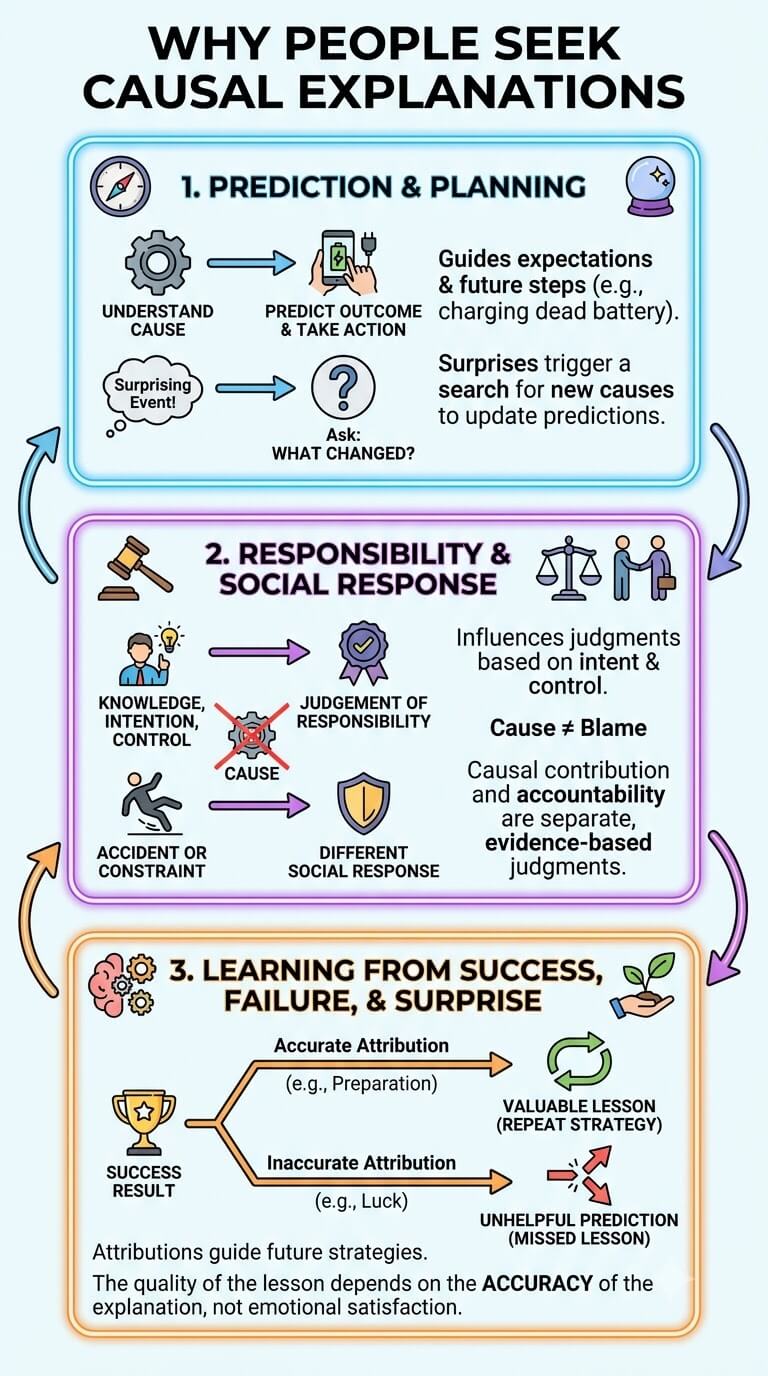
Prediction and planning
Causes help people predict. If a phone failed because its battery was empty, charging it should change the outcome. Social life is less mechanical, but explanations still guide expectations and next steps.
This is one reason surprising behavior attracts attention. When an event violates your expectation, the mind has a stronger reason to ask what changed.
Responsibility and social response
Causal explanation also influences responsibility judgments. If someone had knowledge, intention, and realistic control over an action, observers may respond differently than if the outcome resulted from an accident or constraint.
Still, attribution theory does not justify collapsing cause into blame. A person can contribute causally to an outcome without being fully responsible for it, and a situational influence can be important without removing all accountability. Those are separate judgments that require separate evidence.
Learning from success, failure, and surprise
Explanations can guide learning. If a presentation goes well because you prepared carefully for difficult questions, that attribution suggests a strategy worth repeating. If you decide it went well only because the audience was unusually friendly, you may take a different lesson from the same result.
The quality of the lesson depends on the quality of the attribution. An inaccurate explanation can produce an unhelpful prediction, even when the explanation feels emotionally satisfying.
Attribution Theory vs Internal and External Attribution
A theory explains the process; internal/external labels classify one dimension
Internal and external attribution are important terms, but they are not the whole theory. An internal explanation assigns a cause to something about the person. An external explanation assigns a cause to circumstances outside the person. The APA Dictionary definition of situational attribution includes factors such as luck, pressure from other people, and external circumstances.
Attribution theory asks a broader question: how did the person arrive at that explanation, what evidence influenced it, what alternative causes were available, and what does the explanation imply?
Why dispositional and situational language is useful but incomplete
Person-versus-situation language gives you a first sorting tool, not a final verdict. “She missed the meeting because she is disorganized” is more specific than merely calling the cause internal, but it still needs evidence. Does she miss many meetings? Was the calendar invite wrong? Did the meeting move at the last minute? How does she behave in comparable situations?
A strong causal explanation should survive those questions better than its alternatives.
Where Attribution Theory Meets Attribution Style
Event-by-event inference versus recurring explanatory patterns
Attribution theory can describe how someone explains a single event. Over time, however, people may show recurring tendencies in how they explain positive and negative outcomes. For example, someone may frequently treat setbacks as evidence of a stable personal flaw, while another person may usually focus on temporary and specific causes.
Those recurring tendencies are better understood through attributional or explanatory style. The distinction matters because one unusual explanation does not establish a stable pattern.
Why stable, global, and personal explanations deserve separate attention
An explanation such as “I struggled because I was tired today” differs sharply from “I struggle because I am incapable at everything.” Both are self-focused, but the second also sounds stable and global. The added dimensions change what the explanation predicts about future outcomes.
Keeping these concepts separate prevents an internal attribution from being treated as automatically negative. “I succeeded because I practiced” is internal too, but it carries a very different meaning from a sweeping judgment about fixed ability.
What Attribution Theory Does Not Tell You Automatically
An explanation is not proof
Coherent explanations can still be wrong. A story that fits the visible facts does not prove causation, especially when several explanations remain plausible.
Research on social attribution also shows that cultural and cognitive context can influence how readily people emphasize personal characteristics or situational information. An open-access review of culture and attribution highlights why attribution tendencies should not be treated as identical across all people and settings.
Cause is not the same as blameworthiness
If a person forgot to send a document, their action may be part of the causal chain. Whether they deserve blame depends on further questions: Was the responsibility clear? Could they reasonably have remembered? Were there competing emergencies? Did they knowingly ignore reminders? What harm followed?
Cause answers one question. Responsibility and moral judgment answer others.
Missing context can make a confident attribution weak
Confidence often rises faster than evidence. A brief video, a single argument, or one workplace error can tempt observers to infer personality from a narrow slice of behavior. The broader cognitive biases involved in everyday judgment can make that temptation even stronger.
A better habit is to notice what information would meaningfully challenge your explanation. If no imaginable evidence could change your view, you may no longer be testing a causal hypothesis. You may be defending a conclusion.
A Practical Causal-Inference Check
When an explanation matters, use a four-part check before acting on it. The purpose is not to eliminate intuition. It is to slow the jump from observation to certainty.
| Step | Question | Why it helps |
|---|---|---|
| 1. Describe | What actually happened, without adding motive or character? | Separates observation from interpretation |
| 2. Generate | What person-based, situation-based, and temporary causes could fit? | Prevents one explanation from becoming automatic |
| 3. Compare | What do consensus, distinctiveness, and consistency suggest? | Adds pattern evidence |
| 4. Calibrate | What is still unknown, and how certain should I be? | Keeps confidence proportional to evidence |
What happened?
Write the event in language a camera could roughly confirm. “He interrupted me twice” is an observation. “He does not respect me” is already an interpretation. The interpretation may eventually be justified, but it should not be mistaken for the starting evidence.
What person-based and situation-based causes fit the facts?
Generate at least one plausible explanation from each side. For the interruption example, a person-based possibility might be habitual impatience. A situational possibility might be a fast-moving meeting in which several people are talking over one another. Another possibility could be a misunderstanding about when you had finished speaking.
Generating an alternative does not mean endorsing it. It simply prevents the first explanation from receiving an unfair advantage.
What evidence would distinguish among them?
Look for comparison information. Does the person interrupt many people? Do most people interrupt in this meeting? Does the behavior occur mainly when one topic is discussed? Has it happened consistently across time?
This step turns a vague impression into a testable question.
What information is still missing?
Name the gap directly. You might not know what happened before the meeting, how the person behaves elsewhere, or whether the same pattern has been noticed by others. If the information matters, seek it. If it cannot be obtained, keep the conclusion appropriately tentative.
This kind of calibrated uncertainty also protects personal agency. You can choose a sensible next action without pretending you possess perfect knowledge of another person’s motives.
FAQ About Attribution Theory
Who developed attribution theory?
Fritz Heider is commonly credited with providing an important foundation in 1958 by describing how ordinary people try to understand behavior through personal and environmental causes. Harold Kelley later developed influential ideas about covariation and the information people use to infer causes. Bernard Weiner extended attribution thinking in achievement settings by emphasizing dimensions such as locus, stability, and controllability. Attribution theory therefore developed through several related traditions rather than one single model created all at once.
What is the difference between Heider’s and Kelley’s approaches?
Heider provided a broad conceptual starting point for understanding how people distinguish personal forces from environmental forces when explaining behavior. Kelley made the process more systematic by asking how patterns of consensus, distinctiveness, and consistency can change causal judgment. A simple way to remember the difference is that Heider helps frame the causal question, while Kelley gives a structured way to compare evidence across people, situations, and time.
What are consensus, distinctiveness, and consistency?
Consensus asks whether other people respond similarly in the same situation. Distinctiveness asks whether the person responds this way mainly to this particular target or across many targets. Consistency asks whether the same person responds similarly to the same target over time. Together, these comparisons can make a person-based, situation-based, or unusual-circumstance explanation more or less plausible.
Is Weiner’s theory part of attribution theory?
Yes. Weiner’s work is an influential attribution approach, especially for explaining success and failure. It adds dimensions such as whether a cause is internal or external, stable or unstable, and controllable or uncontrollable. Those dimensions help explain why two causes that are both internal, such as ability and strategy, can lead to very different expectations about what might happen next.
Does attribution theory say people are rational cause-seekers?
No. Attribution models describe important ways people use causal information, but everyday reasoning is not perfectly objective or complete. People may lack evidence, rely on prior expectations, notice some information more than other information, or prefer explanations that fit an existing view. Attribution theory is most useful when it helps you ask better causal questions, not when it is treated as proof that people always reason like careful scientists.
Key Takeaways
- Attribution theory examines how people move from observing behavior or outcomes to inferring what caused them.
- Heider’s early framework emphasized personal and environmental forces, while Kelley focused on comparison information that can strengthen or weaken different explanations.
- Consensus, distinctiveness, and consistency are useful because they force a causal judgment to consider patterns beyond one vivid event.
- Weiner’s work shows that causes can also differ in stability and controllability, which changes what people expect after success or failure.
- A causal explanation is not the same as proof, responsibility, or moral blame. The strength of the conclusion should match the strength of the evidence.
- When an attribution matters, describe the event, generate alternatives, compare patterns, and name what is still unknown before acting with certainty.
Final Thoughts
The most useful lesson from attribution theory is not that every behavior has one hidden cause waiting to be discovered. It is that explanations improve when they are treated as hypotheses rather than instant verdicts. The next time an outcome surprises you, try delaying the character judgment long enough to ask what else would have to be true for your explanation to hold.
A good first step is simple: describe what happened without motive language, then identify one personal cause, one situational cause, and one piece of missing information. That small exercise often reveals how much of the story was observed and how much was inferred.
About the author: Michael Reed is the Founder & Lead Writer at Psychology Exposed, where he explains human behavior, relationships, emotional patterns, self-awareness, and everyday decisions in clear, research-aware language.

Michael Reed is the Founder and Lead Writer at Psychology Exposed. He writes about human behavior, relationships, emotional patterns, self-awareness, and practical psychology topics using research-informed, easy-to-understand content.
Read More About Michael Reed: https://psychologyexposed.com/michael-reed/