
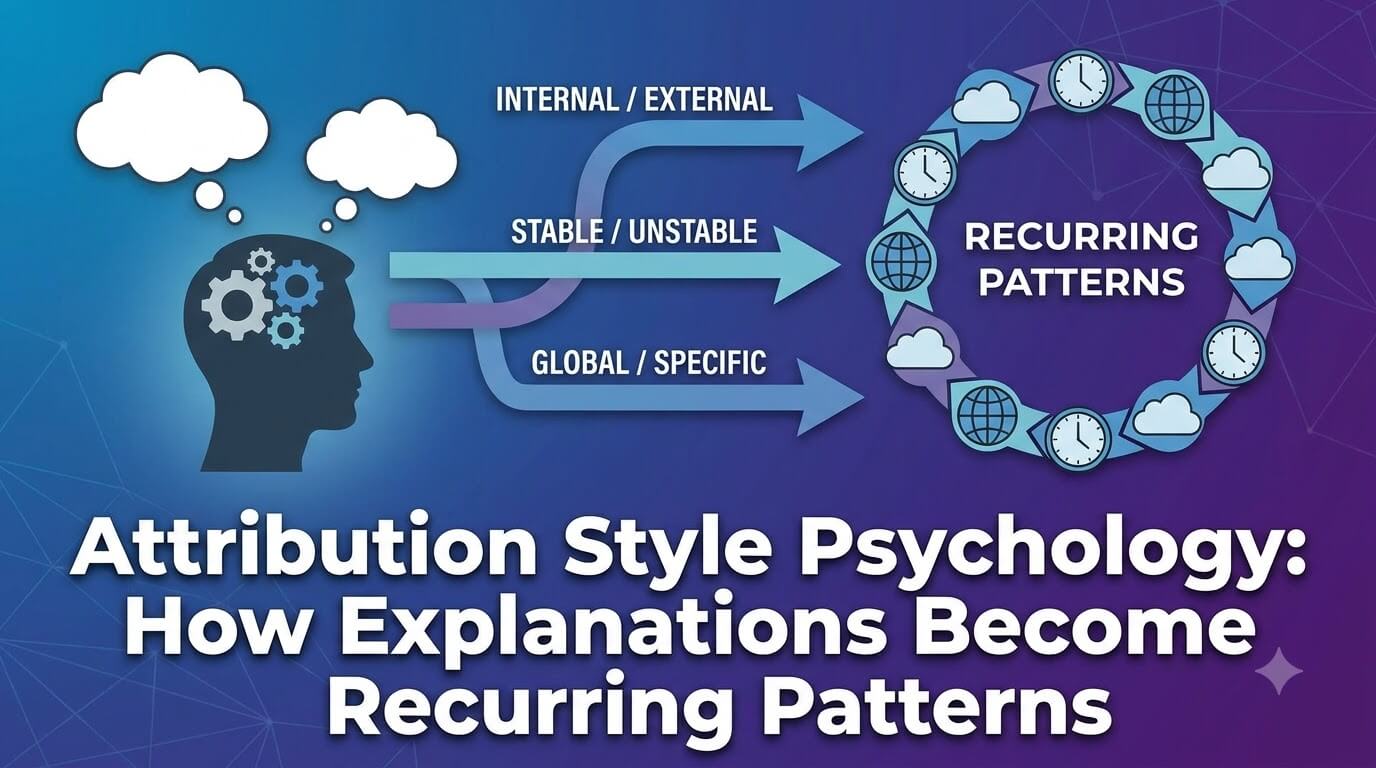
One disappointing result can be explained in many ways. You might think, “I used the wrong strategy this time,” “I am simply not good at this,” “The conditions were unusually difficult,” or “Nothing ever works out for me.” Each sentence points to a cause, but they do more than explain one event. When similar explanations appear again and again, they can form a recognizable way of interpreting success, failure, rejection, and setbacks.
Psychologists use attribution style, also called explanatory style, to describe these recurring patterns of causal explanation. The idea is not that people fit into one fixed type. A person may explain work problems differently from relationship problems, or become more specific and flexible as new experience changes what seems plausible.
The most useful question is not, “Am I an optimistic or pessimistic person?” It is, “What kinds of causes do I repeatedly choose, how broad are those explanations, how permanent do they feel, and do they fit the evidence?”
Quick Answer
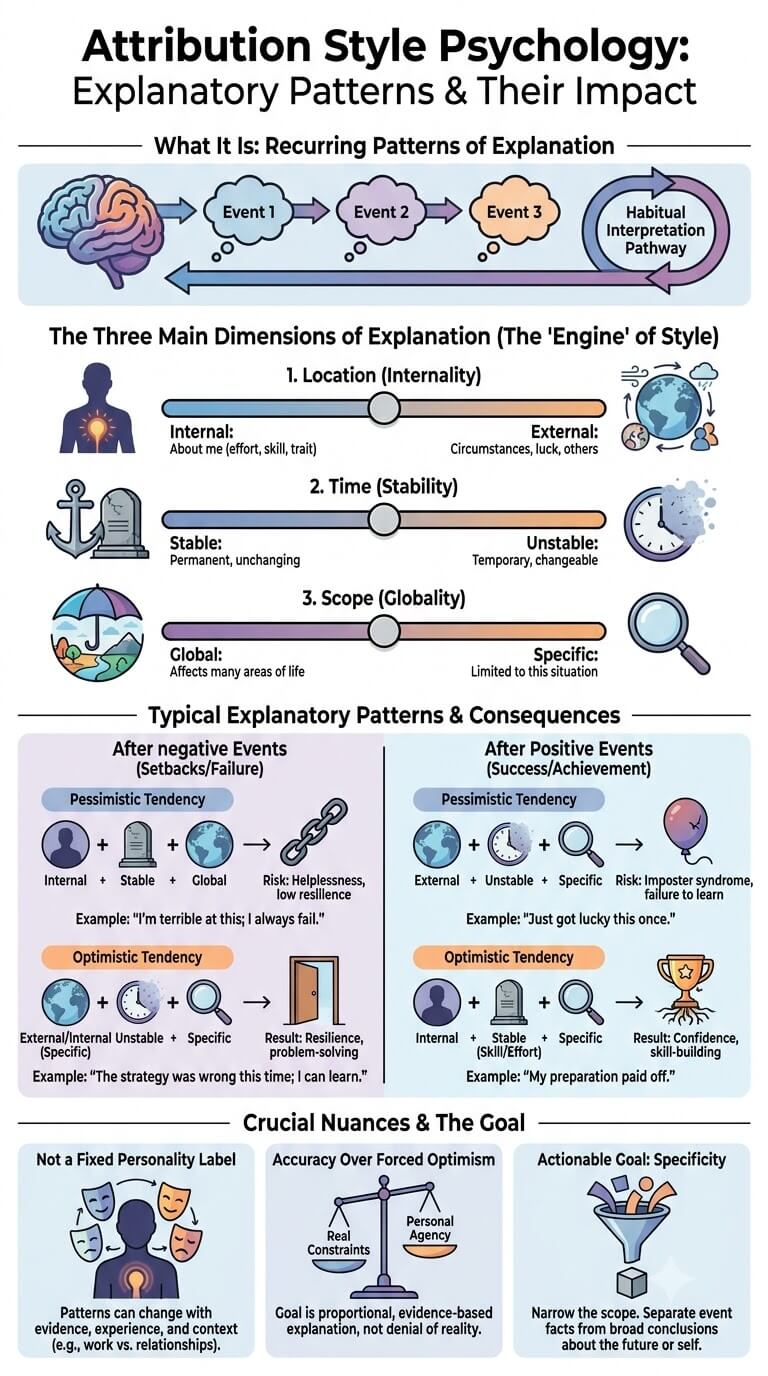
Attribution style psychology examines recurring ways people explain why events happen. Common dimensions include whether a cause is internal or external, stable or unstable, and global or specific. These patterns can shape expectations after success or failure, but they are not permanent personality labels. A more useful goal is to make explanations specific, evidence-based, and sensitive to real context.
What Attribution Style Means
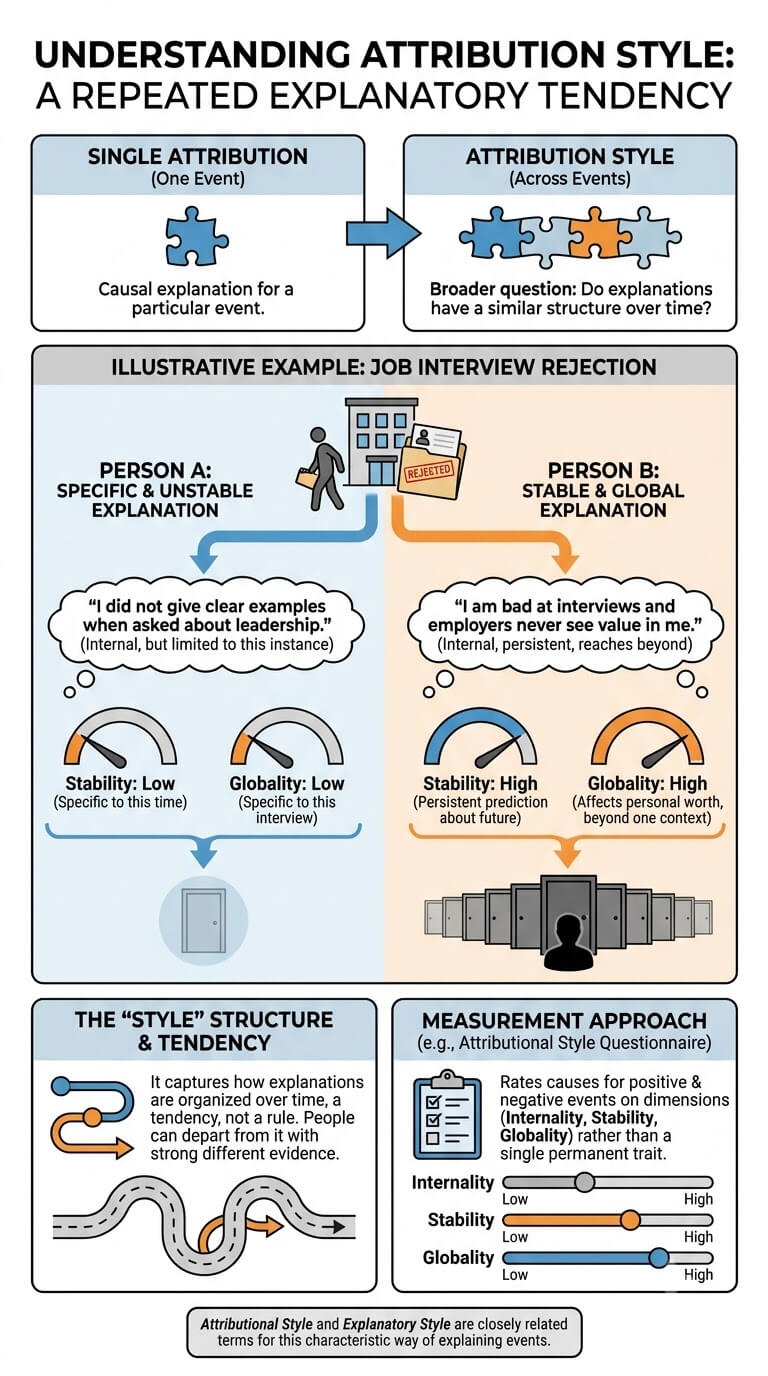
An attribution is a causal explanation for a particular event. Attribution style asks a broader question: across different events, does a person tend to explain causes in similar ways?
From one attribution to a repeated explanatory tendency
Imagine that two people are rejected after job interviews. One thinks, “I did not give clear examples when they asked about leadership.” The other thinks, “I am bad at interviews and employers never see value in me.” Both explanations are internal in some sense, but the second is also more stable and more global. It reaches beyond one interview into a prediction about future interviews and personal worth.
That repeated structure is what makes attribution style useful. It captures how explanations are organized over time, not merely which cause is chosen once. Research commonly measures these tendencies by asking people to consider positive and negative events, generate a likely cause, and rate that cause on dimensions such as internality, stability, and globality. One overview of the Attributional Style Questionnaire describes this event-by-event rating approach rather than treating explanatory style as a single permanent trait.
Attributional style and explanatory style as closely related terms
The terms attributional style and explanatory style are often used for the same general idea. The APA Dictionary of Psychology definition of explanatory style describes an individual’s characteristic way of describing and explaining events or personal history.
The important word is “style.” It suggests a tendency, not a rule. People can depart from a familiar explanation when different evidence is strong, which is why explanatory style should not be treated as destiny.
The Three Main Dimensions Used in Explanatory Style
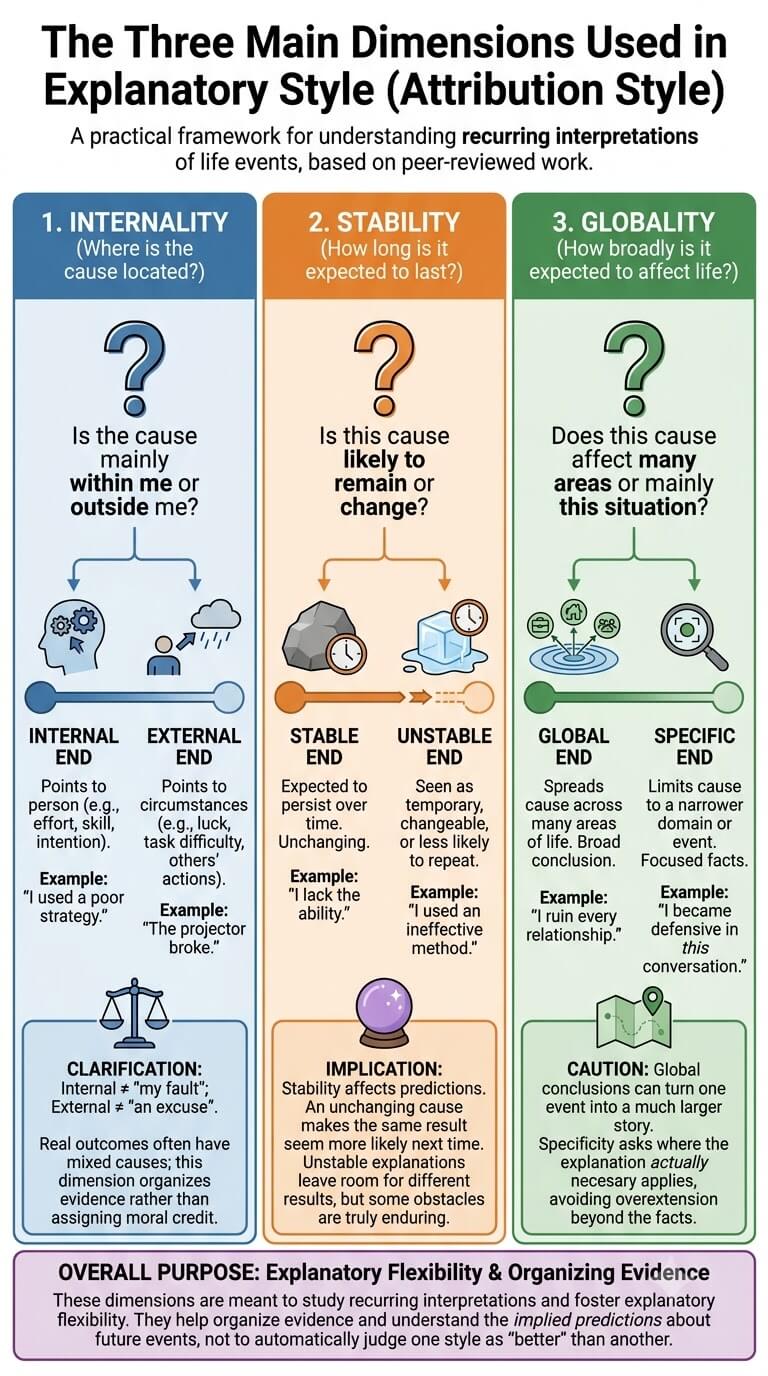
A practical way to understand attribution style is to separate three questions. Where is the cause located? How long is it expected to last? How broadly is it expected to affect life? Peer-reviewed work on explanatory style and explanatory flexibility uses these dimensions to study recurring interpretations of life events.
| Dimension | One end | Other end | Core question |
|---|---|---|---|
| Internality | Internal | External | Is the cause mainly within me or outside me? |
| Stability | Stable | Unstable | Is this cause likely to remain or change? |
| Globality | Global | Specific | Does this cause affect many areas or mainly this situation? |
Internal versus external
An internal explanation points toward something about the person, such as effort, skill, strategy, intention, or a personal tendency. An external explanation points toward circumstances, such as timing, luck, available support, task difficulty, or another person’s actions.
Internal does not mean “my fault,” and external does not mean “an excuse.” A failed presentation could involve weak preparation and a broken projector. Real outcomes often have mixed causes, so this dimension organizes evidence rather than assigning moral credit.
Stable versus unstable
A stable cause is expected to persist over time. An unstable cause is seen as temporary, changeable, or less likely to repeat in the same form. “I lack the ability for this kind of work” is more stable than “I used an ineffective method.” “This market is always impossible” is more stable than “Demand was unusually weak this month.”
Stability matters because explanations contain predictions. A cause that seems unchanged can make the same result feel more likely next time, while a temporary or modifiable cause leaves more room for a different result. Some obstacles really are enduring, so unstable explanations are not automatically better.
Global versus specific
A global explanation spreads a cause across many areas of life. A specific explanation limits it to a narrower domain or event. After a disagreement, “I ruin every close relationship” is global. “I became defensive during this conversation about money” is much more specific.
Global conclusions can turn one event into evidence for a much larger story. Specificity asks where the explanation actually applies. If the evidence belongs to one task, relationship, week, or decision, extending it to life as a whole goes beyond the facts.
How the Dimensions Combine
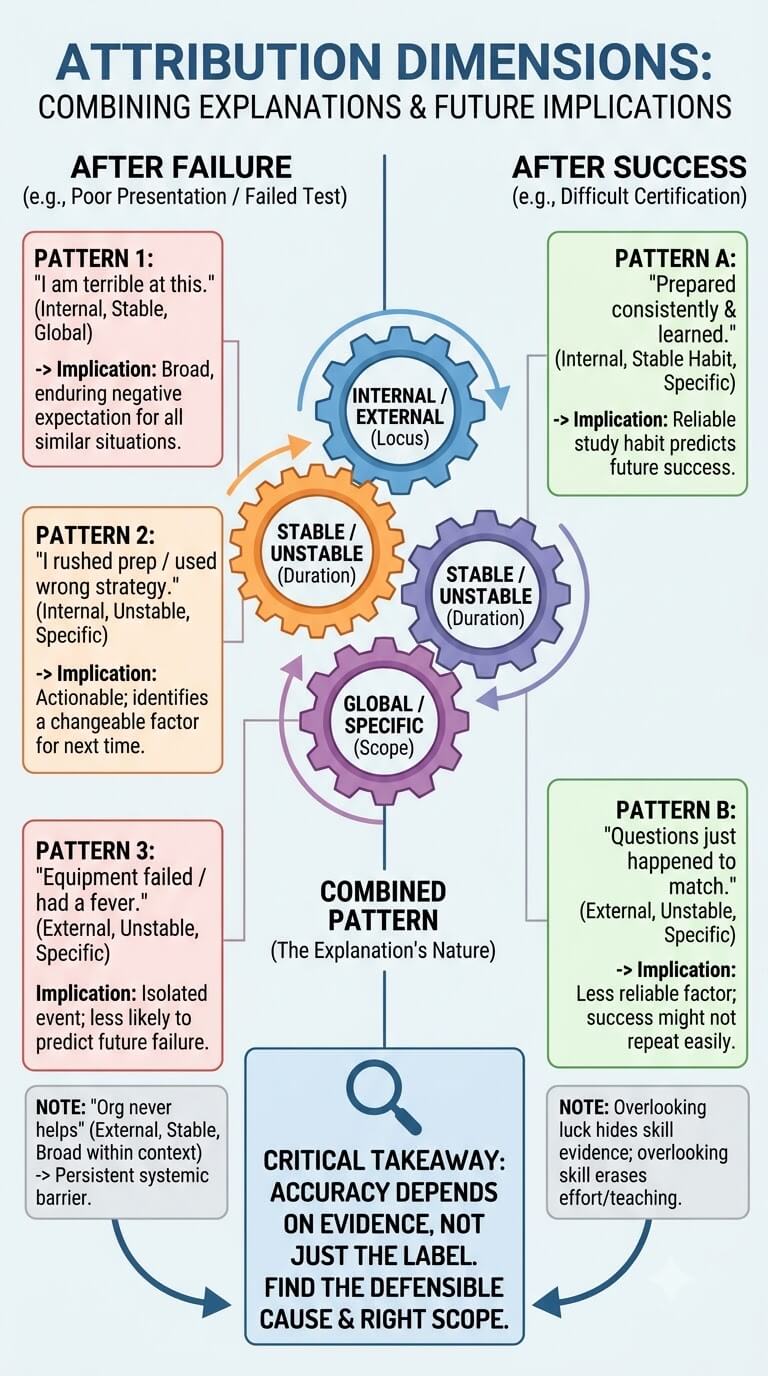
The dimensions become more informative when they are combined. Two explanations can both be internal while carrying very different implications for the future.
Why the same outcome can be explained in several patterns
Suppose you give a poor presentation. “I am terrible at speaking” is internal, relatively stable, and broad if you apply it to all speaking situations. “I rushed my preparation this week” is internal, unstable, and specific. “The room equipment failed” is external, unstable, and specific. “This organization never gives presenters what they need” is external but potentially stable and broad within that workplace.
Those labels do not tell you which explanation is true. They show what kind of claim is being made. Accuracy still depends on evidence and on keeping the explanation within the facts.
Combination examples after success
Positive events reveal attribution patterns too. Imagine that you complete a difficult certification. One explanation is, “I passed because I prepared consistently and learned the material.” That is internal and may contain a stable element if it reflects a reliable study habit. Another is, “The questions happened to match what I reviewed,” which emphasizes an external and less stable factor.
Both may contribute. Explaining every success as luck can hide evidence about skill and effort, while explaining it entirely through personal ability can erase teaching, teamwork, resources, and opportunity.
Combination examples after failure
Now imagine that you do not pass. “I am incapable of learning technical material” is internal, stable, and global if you extend it across similar domains. “I practiced recall but the test required application” is internal, unstable, and specific because it identifies a strategy that can change. “I had a fever on exam day” is external to ability, time-limited, and highly specific.
A repeated tendency to make broad, enduring explanations after setbacks can affect what people expect from future attempts. At the same time, replacing every negative explanation with a pleasant one would miss the point. The task is to identify the most defensible cause and the right level of scope.
Attribution Style After Negative Events
Setbacks are especially revealing because people often want a fast answer to “Why did this happen?” The first explanation may protect, criticize, motivate, or discourage, but its emotional effect is separate from whether it is accurate.
Permanent versus temporary explanations
Compare “I always freeze when I have to speak” with “I froze today because I had not slept and I was unprepared for that question.” The first treats the cause as enduring. The second identifies conditions that may not repeat.
A permanent-sounding explanation is not necessarily irrational. If a problem has occurred repeatedly across years and situations, stability may be part of the evidence. The mistake is assuming permanence from a single event. Ask what the history actually shows.
Broad-life conclusions versus situation-specific explanations
After rejection, disappointment can quickly widen into “Nobody wants me,” “I never belong,” or “Everything is going wrong.” Those statements contain more than an explanation for the immediate event. They generalize from one domain to many.
A situation-specific explanation might be, “This role required experience I have not developed yet,” or “This friendship became strained around one recurring disagreement.” Specific explanations can still be painful and still contain responsibility. Their advantage is that they keep the causal claim close to the available evidence.
Personal responsibility versus contextual explanation
Internality often becomes emotionally loaded because people confuse personal causation with total responsibility. If your action contributed to an outcome, that contribution matters. It does not follow that every other cause disappears.
This is one place where personal agency is worth separating from attribution. Attribution looks backward at why an outcome occurred. Agency concerns the capacity to choose and act now. You can acknowledge that external conditions mattered while still asking what is realistically within your influence next.
Attribution Style After Positive Events
People also develop habits around explaining what goes well. Those habits can affect how much useful information they carry forward from success.
Owning skill and effort without ignoring support or luck
Suppose a team praises your contribution to a successful launch. An accurate explanation may include your preparation, judgment, persistence, colleagues’ expertise, a realistic deadline, and favorable market timing. Recognizing internal contribution does not require denying external support.
This matters for learning. If you know which parts of success came from repeatable actions, you can use them again. If you know which parts depended on favorable circumstances, you can avoid assuming the same conditions will always return.
When people discount their own contribution
Some people repeatedly explain positive outcomes as luck, easy tasks, low standards, or other people’s help even when their own effort and skill are visible in the evidence. That may make success feel less informative about what they can do.
Here it is useful to distinguish explanation from capability belief. Self-efficacy psychology concerns whether someone believes they can perform a particular action. Attribution style concerns how they explain why an outcome occurred. The two can influence each other, but they are not the same construct.
How Explanatory Patterns May Develop
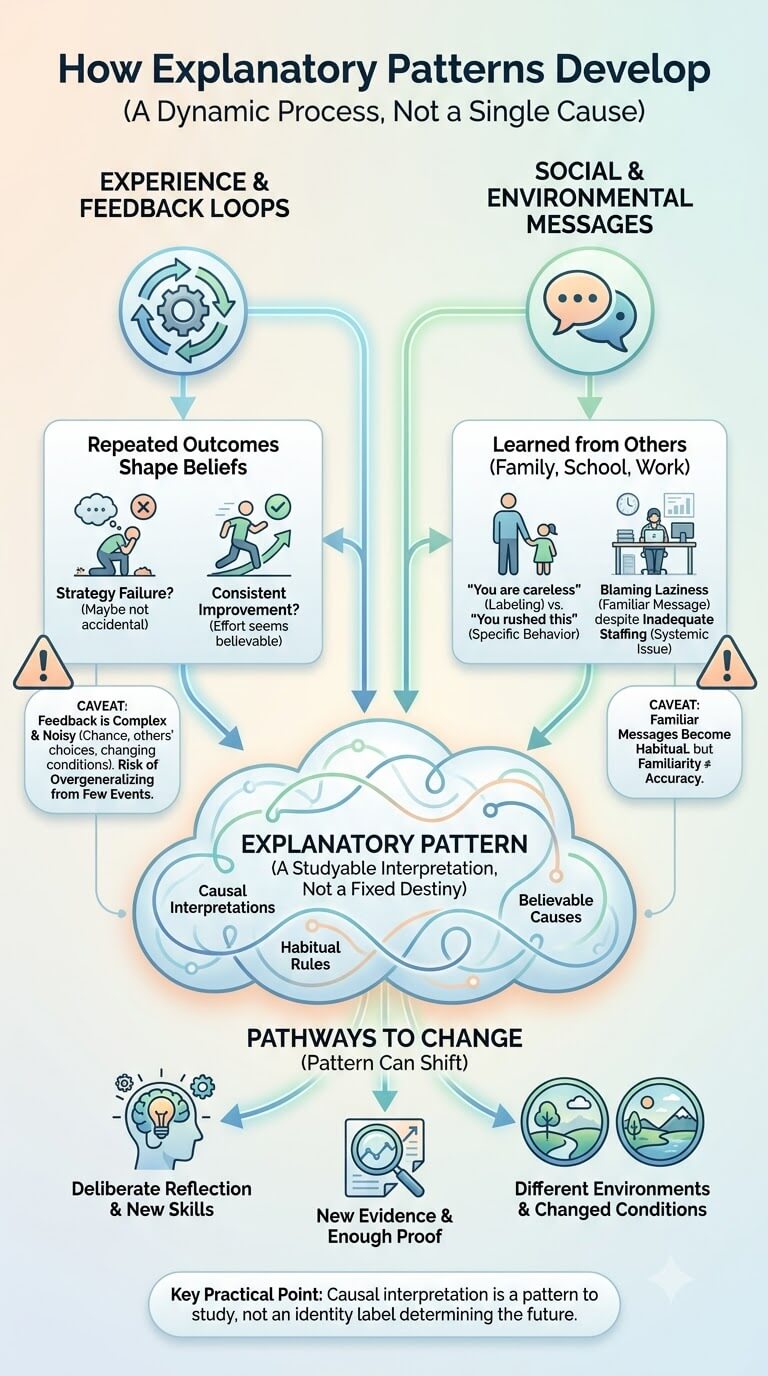
No single experience explains a person’s attribution style. Repeated feedback, social learning, personal history, and the actual structure of someone’s environment can all contribute to which causes feel believable.
Feedback and repeated outcomes
Patterns can emerge from genuine experience. Repeated strategy failure may stop looking accidental, while consistent improvement after practice can make effort a more believable cause. Yet feedback also contains chance, other people’s choices, and changing conditions, so people can learn overly broad rules from a small set of memorable events.
Family, school, work, and social messages
Other people also supply causal explanations. A child may repeatedly hear “You are careless” rather than “You rushed this task.” A workplace may blame missed targets on laziness despite inadequate staffing. Repeated messages can become familiar language for new events, even though familiarity does not make them accurate.
Learning history without treating it as destiny
Attribution style grew partly from research traditions concerned with how people explain difficult events, but that history should not be turned into a diagnosis. One peer-reviewed overview notes that attributional and explanatory style are often used for the same mechanism and describes how explanations can be examined across positive and negative situations. The important practical point from this research on explanatory style is that causal interpretation is a pattern that can be studied, not an identity label that determines a person’s future.
New evidence, new skills, different environments, and deliberate reflection can all change which explanations seem justified. Sometimes the environment changes before the explanation does. Sometimes the explanation changes because a person finally has enough evidence to see the situation differently.
Attribution Style Is Not a Personality Label
Calling someone “a pessimistic attributor” can sound more fixed than the evidence warrants. Explanatory tendencies are better treated as patterns that may vary by event, domain, and context.
Context can change explanations
A person may explain one work failure internally because they know they made a preventable mistake, yet explain another externally because the project was cancelled after a budget cut. That is not inconsistency. It may be accurate causal discrimination.
Research on explanatory flexibility also makes an important distinction between the content of an explanation and how flexibly explanations shift across situations. A review of explanatory flexibility describes variability across situations as conceptually distinct from simply having a more positive or negative explanatory pattern. In everyday terms, good causal reasoning should be able to respond to different evidence.
People may explain different life domains differently
Someone might be specific and balanced about work setbacks but global and self-critical in relationships. Another person may confidently own athletic success while dismissing academic success as luck. A single score or label can hide these domain differences.
When reflecting on your own explanations, look for where the pattern appears. “I tend to globalize rejection” is more informative than “I have a bad attribution style.” The first names a context in which closer checking may be useful.
Style describes a tendency, not a fixed identity
A tendency can be strong without being permanent. New evidence and more specific feedback can change how events are explained. This does not mean every difficult explanation should be challenged: some problems are genuinely stable or broad. Accuracy matters more than making every explanation feel encouraging.
Attribution Style vs Optimistic and Pessimistic Explanatory Style
These ideas overlap, but they answer different levels of the question. Attribution style is the broader framework. Optimistic and pessimistic explanatory styles are particular patterns within that framework.
The broad framework versus a focused pattern comparison
The broad framework asks how a person tends to explain events across internality, stability, and globality. A focused optimistic-versus-pessimistic comparison asks whether negative and positive outcomes are repeatedly explained in patterns that make causes seem more temporary or enduring, more specific or pervasive, and more personal or contextual.
Keeping those levels separate prevents the entire subject from collapsing into “think positively.” Attribution style can describe many combinations, including explanations that do not fit a neat optimistic or pessimistic label.
Why realistic accuracy matters more than forced optimism
Imagine an employee whose department has been cut three times. Telling them to view the situation as temporary may be less accurate than acknowledging a stable organizational problem. Or imagine someone who repeatedly misses deadlines because they underestimate task length. Explaining every miss through circumstances may protect self-image while blocking useful learning.
A better standard is proportionality. Does the explanation match the number of events, the time period, the domain, the available evidence, and the person’s realistic control? A helpful explanation can still be uncomfortable.
Attribution Style vs Locus of Control
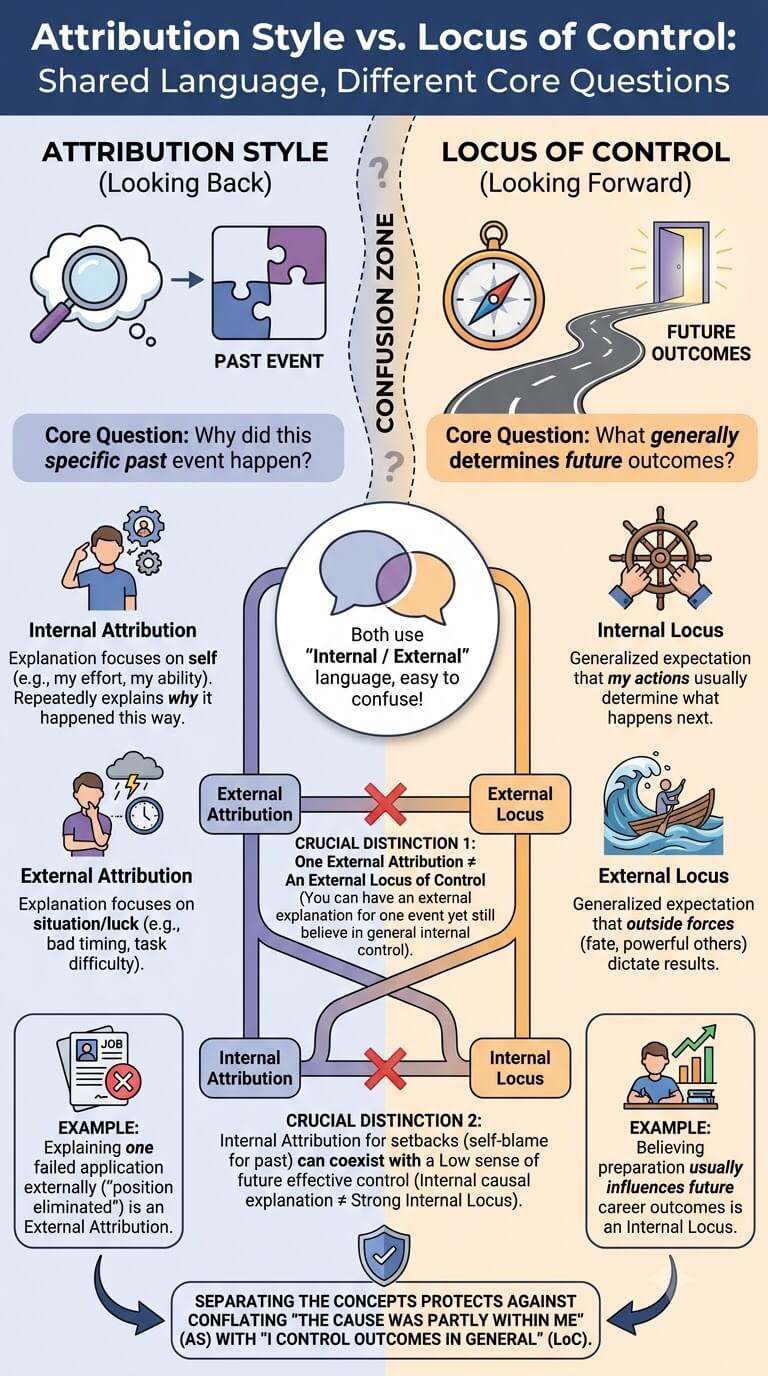
The two concepts both use internal and external language, which makes them easy to confuse. Their core questions are different.
Repeated explanations of events versus generalized expectations about control
Attribution style asks how you repeatedly explain why events happened. Locus of control psychology asks what you generally expect to determine outcomes: your own actions or forces outside your control.
You could explain one failed application externally because the position was eliminated, yet still believe your preparation and choices usually influence future career outcomes. One external attribution does not establish an external locus of control.
Why internal attribution style does not equal internal locus of control
The reverse can also happen. A person might repeatedly blame themselves for setbacks while feeling unable to change what happens next. That is an internal causal explanation paired with a low sense of effective control, not proof of a strong internal locus.
Separating the concepts also protects against self-blame. “The cause was partly within me” and “I control outcomes in general” are different claims. Neither statement, by itself, determines moral responsibility.
A Reflective Attribution-Pattern Check
Reflection is most useful when it examines actual explanations rather than trying to assign yourself a personality category. Choose two or three recent outcomes and write the first cause that came to mind for each.
What explanations do I repeat after setbacks?
Look for repeated words and structures. Do your explanations often begin with “I am,” “people always,” “nothing ever,” “this always happens,” or “I just got lucky”? Repetition can reveal a preferred causal shortcut.
Then ask whether the same explanation appears when the facts are different. If “I am bad with people” is used to explain awkwardness with a stranger, conflict with a sibling, and a rejected job application, one broad cause may be absorbing several unrelated situations.
Do I treat causes as permanent or changeable?
Underline the part of each explanation that implies time. “I did not prepare enough” leaves open the possibility of different preparation. “I cannot do this kind of thing” predicts that the cause will persist.
Check the history. Has the problem truly remained unchanged across repeated attempts? Are there exceptions? Did performance improve when conditions, strategy, or support changed? Stability should come from evidence, not simply from how final the sentence sounds.
Do I generalize one outcome across unrelated areas?
Draw a boundary around the event. If a friendship ended, what exactly does that event support? It may say something about that relationship, a recurring interpersonal habit, or a mismatch between two people. It does not automatically provide evidence about every friendship, your work ability, or your worth as a person.
Specificity is not denial. It is a way of keeping the conclusion within the area where the evidence actually exists.
What evidence supports or challenges the explanation?
For each proposed cause, list one piece of supporting evidence and one fact that complicates it. If the explanation is “I only succeeded because it was easy,” supporting evidence might be that the task was familiar. Challenging evidence might be that others found it difficult and that you prepared for weeks.
This step is especially useful because cognitive biases can influence how people notice and weigh evidence. The goal here is not to label every attribution as biased, but to make the causal claim testable.
How to Make Explanations More Specific and Evidence-Based
You do not need to replace every negative explanation with a positive one. A stronger approach is to improve the precision of the explanation.
Separate event facts from global conclusions
Write the event in concrete language first: “Three clients declined the proposal this month.” Then write the interpretation separately: “My work is no longer valuable.” The first sentence is observable. The second is a causal or evaluative conclusion that needs more evidence.
This separation makes it easier to notice when one event has expanded into a statement about identity, permanence, or the future.
Name temporary and controllable factors when supported
Look for factors that could realistically change: preparation method, timing, information, skill practice, communication, sleep, staffing, or strategy. Do not add a controllable factor merely to feel more powerful. Name it only when the evidence supports a meaningful connection to the outcome.
A useful reframe might be, “I struggled because I had not practiced this format,” rather than “I am terrible at presentations.” That reframe is not automatically kinder. It is better only if lack of format-specific practice actually contributed.
Preserve real constraints rather than forcing a positive spin
Some outcomes are strongly shaped by other people’s choices, economic conditions, discrimination, illness, caregiving demands, limited resources, coercion, or chance. An evidence-based attribution makes room for those constraints.
You can still ask what action is possible now. That question belongs to future influence, not to rewriting the past as if everything had been controllable. Accurate explanations protect both accountability and fairness.
FAQ About Attribution Style
These questions address the distinctions that most often become confusing once attribution is viewed as a recurring explanatory tendency rather than a one-time judgment.
Is attribution style the same as explanatory style?
They are commonly used as closely related or interchangeable terms for recurring ways of explaining why events happen. Different research traditions may emphasize somewhat different measures or applications, so the exact operational definition can vary. For general psychology, both terms point to patterns in causal explanation rather than a single isolated attribution.
Can someone have different attribution styles in work and relationships?
Yes. People do not necessarily explain every life domain in the same way. Someone may be specific and flexible about professional setbacks while becoming highly global after interpersonal rejection. Looking at domain-specific patterns is often more informative than applying one broad label to the whole person.
Does a pessimistic explanation always mean a pessimistic personality?
No. One stable, global, or internal explanation does not establish a personality type. The explanation may fit the facts of that event, or it may be a temporary reaction. A style refers to a recurring tendency across relevant situations, and even then it should not be treated as a fixed identity.
Can attribution style change with new evidence and experience?
It can. People may revise causal explanations after repeated feedback, changes in environment, new skills, or deliberate examination of old assumptions. Change is not guaranteed, and it does not require replacing every difficult explanation with an optimistic one. The useful shift is toward explanations that are more flexible and proportionate to evidence.
How is attribution style different from locus of control?
Attribution style concerns recurring explanations for why particular events happened. Locus of control concerns a broader expectation about whether outcomes generally depend more on one’s own actions or on external forces. Because both use internal and external language, they can sound similar, but an attribution about one event does not automatically reveal a person’s locus of control.
Key Takeaways
- Attribution style describes recurring patterns in causal explanation, not a permanent personality category.
- Three useful dimensions are internal versus external, stable versus unstable, and global versus specific.
- The same outcome can be explained through several combinations, and the labels do not determine which explanation is accurate.
- Positive events matter too. Repeatedly discounting your own contribution can hide useful information about skill and effort.
- Specificity and flexibility are often more useful goals than forced optimism because they keep conclusions close to the evidence.
- A practical next step is to review two recent outcomes and test each explanation for scope, stability, context, and supporting evidence.

Michael Reed is the Founder and Lead Writer at Psychology Exposed. He writes about human behavior, relationships, emotional patterns, self-awareness, and practical psychology topics using research-informed, easy-to-understand content.
Read More About Michael Reed: https://psychologyexposed.com/michael-reed/