
Someone criticizes dishonesty but hides information when honesty would cost them. A parent demands calm communication while raising their own voice. A friend excuses an ally’s behavior as a mistake but treats the same behavior from an outsider as proof of bad character.
These contradictions are often called hypocrisy, but the label is easy to misuse. People can fail to meet a standard without pretending the standard does not apply to them. They can change their minds, make a genuine mistake, face competing obligations, or discover that a rule is harder to follow than they expected. Moral hypocrisy is more specific. It involves protecting the appearance of morality, or the benefits of a moral standard, while applying that standard more leniently to oneself or a preferred group.
Understanding the psychology does not excuse double standards. It helps explain why they are difficult to recognize from the inside, why confrontation often creates defensiveness, and what consistent accountability looks like without turning one inconsistency into a permanent judgment about someone’s character.
Quick Answer
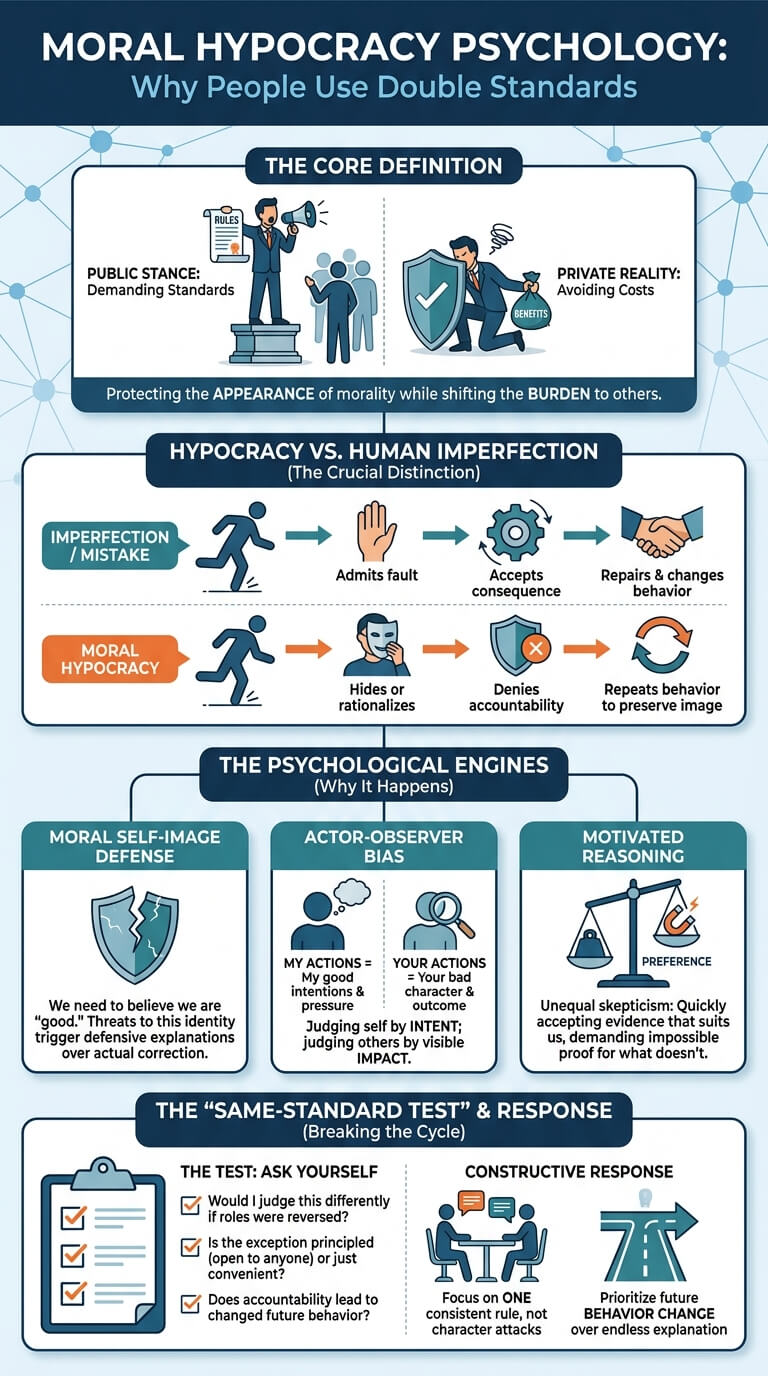
Moral hypocrisy occurs when a person wants to appear moral, preserve a positive self-image, or demand a standard from others while avoiding the same cost themselves. It may appear as self-versus-other double standards, public virtue paired with private exceptions, or stated values that repeatedly fail to guide behavior. Not every inconsistency is hypocrisy. The key questions are whether the same rule is applied consistently, whether exceptions are principled, and whether accountability changes future behavior.
What Moral Hypocrisy Means
Moral hypocrisy is not simply the gap between ideals and reality. Nearly everyone holds values they follow imperfectly. The concept becomes more useful when the person preserves the moral benefit of a standard while shifting its burden elsewhere.
Researchers have described moral hypocrisy as a desire to appear moral without consistently accepting the cost of moral action. A study on moral character and moral double standards examined how people’s positive views of their own character can relate to greater leniency toward themselves than toward others.
Interpersonal double standards
Interpersonal hypocrisy appears when people use stricter standards for others than for themselves. They may judge their own conduct by intention while judging another person by outcome. They may treat their own exception as necessary and someone else’s as selfish.
For example, a person may say, “I interrupted because the point was urgent,” but accuse someone else who interrupts of being disrespectful. The behaviors may not be perfectly identical, and context can matter. The double standard appears when relevant differences are ignored and the favorable interpretation consistently flows toward the self.
Intrapersonal value-behavior inconsistency
Intrapersonal hypocrisy concerns the distance between a person’s stated moral standards and repeated behavior. Someone may speak strongly about loyalty while regularly sharing private information. Another may value fairness but consistently choose arrangements that benefit them when no one is watching.
A single failure does not establish a pattern. What matters is whether the person acknowledges the inconsistency, accepts responsibility, and changes the conditions that made repetition likely. Moral language without behavioral correction protects identity more than it protects the value.
Group-based hypocrisy and selective judgment
Double standards can follow group boundaries. People may excuse an ally’s conduct as complicated while condemning a rival’s similar conduct as obvious wrongdoing. They may demand evidence before believing an accusation against someone close, yet accept a weak claim against an outsider immediately.
Group loyalty can create real special obligations. It does not justify changing the definition of harm, honesty, or responsibility solely according to who benefits.
Hypocrisy Is Not the Same as Imperfection
The word hypocrisy often ends discussion too quickly. It may identify a real double standard, but it can also become a way to dismiss a person’s argument without examining whether the argument itself is valid.
| Situation | What it may represent | What distinguishes it from hypocrisy |
|---|---|---|
| A person breaks a rule once and admits it | Ordinary failure | The standard is still accepted and repair follows |
| A person changes a previous belief openly | Learning or revision | The change is acknowledged rather than hidden |
| A person makes an exception for a relevant difference | Principled flexibility | The same exception would apply in comparable cases |
| A person values something but struggles to practice it | Values-behavior gap | They acknowledge the gap and work to reduce it |
| A person condemns others while protecting their own similar conduct | Moral hypocrisy | The standard changes to preserve self-interest or image |
A mistake followed by accountability
A mistake can reveal carelessness, poor judgment, or weak self-control without proving hypocrisy. If someone says, “I violated the rule I expect others to follow,” accepts the consequence, repairs the impact, and changes their behavior, the response moves toward integrity.
Hypocrisy becomes more likely when the person treats accountability as unnecessary because their intentions were good, their identity is positive, or their past behavior should exempt them.
A changed belief openly acknowledged
People are allowed to revise moral judgments. New evidence, experience, or reflection can change what someone believes is fair or responsible. A person who says, “I used to think this, but I now see the problem differently,” is not necessarily being hypocritical.
Not every conflict between moral standards is hypocrisy, because sincere moral disagreement can arise when people weight the same values, facts, or responsibilities differently.
The concern appears when someone pretends they never held the earlier position, condemns others for following advice they previously promoted, or changes standards only when their own interests shift.
Competing obligations and imperfect choices
People sometimes face situations where every option violates something they value. A person may break confidentiality to protect someone from immediate danger, or disappoint one family member to meet another urgent responsibility. The inconsistency may reflect a moral tradeoff rather than image protection.
Ask whether the person can name the conflict honestly and accept the cost of the choice. Hypocrisy hides the cost or rewrites the rule after the preferred outcome is known.
A repeated exception protected by self-serving explanations
Repeated exceptions deserve closer attention when the explanation always benefits the same person. “My situation is different” may be true, but the difference should be clear, relevant, and available to anyone in a comparable position.
If the exception cannot be stated as a general rule, it may be serving convenience rather than principle.
The Moral Self-Image Problem
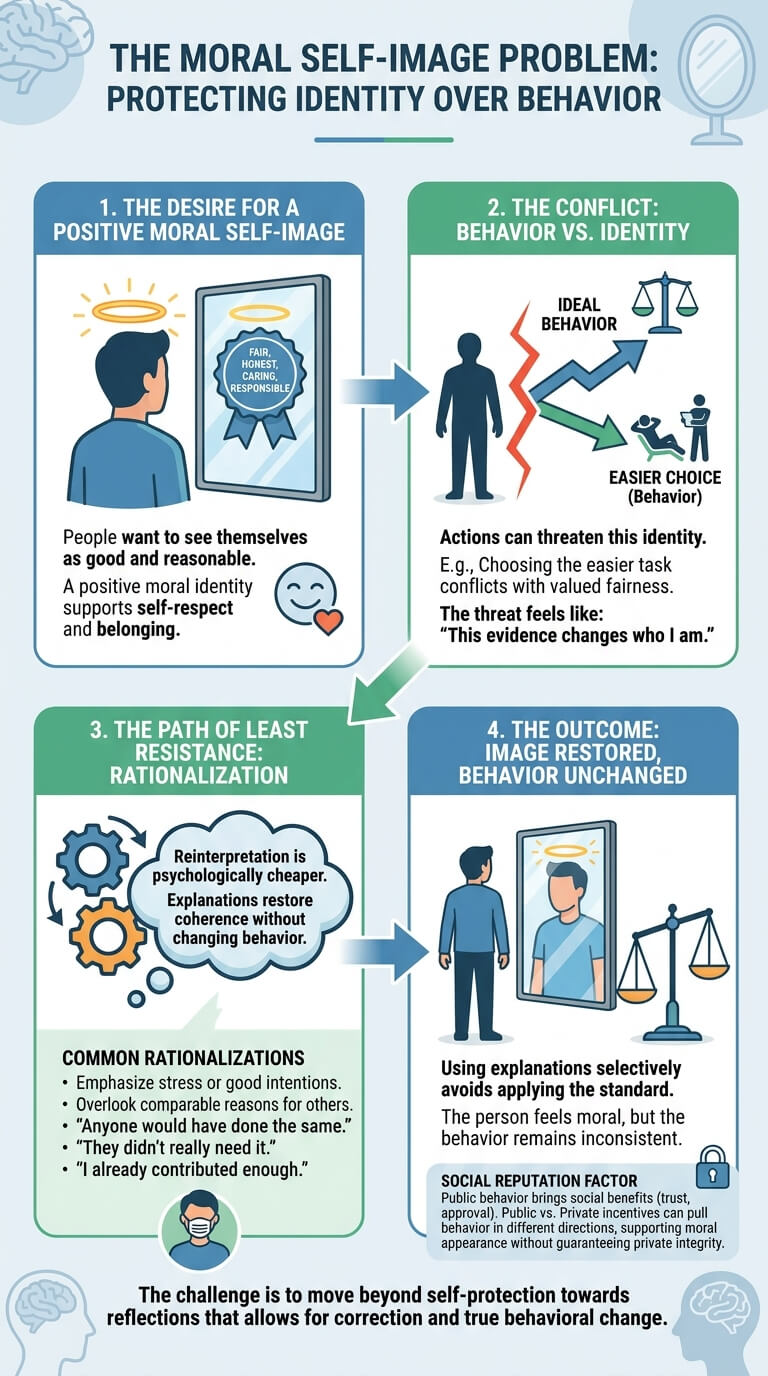
People want to see themselves as good and reasonable
A positive moral identity supports self-respect and belonging. Most people prefer to believe that they are fair, honest, caring, and responsible. That belief can encourage good behavior, but it also creates something to protect when conduct falls short.
The threat is not only “I did something wrong.” It may feel like “This evidence changes who I am.” When identity is at stake, explanations that preserve the self can become more attractive than explanations that improve behavior.
Behavior can threaten that identity
Suppose someone who values fairness gives themselves the easier task. The choice conflicts with their self-image. They can correct the choice, admit self-interest, or reinterpret the situation so the choice appears fair.
Reinterpretation is often psychologically cheaper. The person may emphasize their stress, previous effort, good intentions, or special responsibility while overlooking comparable reasons another person might have.
Explanations restore coherence without changing behavior
Rationalization reduces discomfort by changing the story around the action. “Anyone would have done the same.” “They did not really need the opportunity.” “I have already contributed more than enough.” Some explanations may contain truth. The problem is using them selectively to avoid applying the stated standard.
A more honest explanation can include self-interest without making the self irredeemable: “I chose what benefited me, and I used a convenient reason to make it sound principled.” That statement creates room for correction.
Social reputation can become more important than the standard
Public moral behavior brings social benefits. It can increase trust, approval, authority, or belonging. Private behavior may involve less reputational risk, which makes the cost of inconsistency easier to avoid.
Research on moral superiority and public versus private behavior found that self-enhancement motives can support moral appearance without guaranteeing private moral integrity. This does not mean public goodness is false. It means public and private incentives can pull behavior in different directions.
Psychological Mechanisms Behind Double Standards
Motivated reasoning
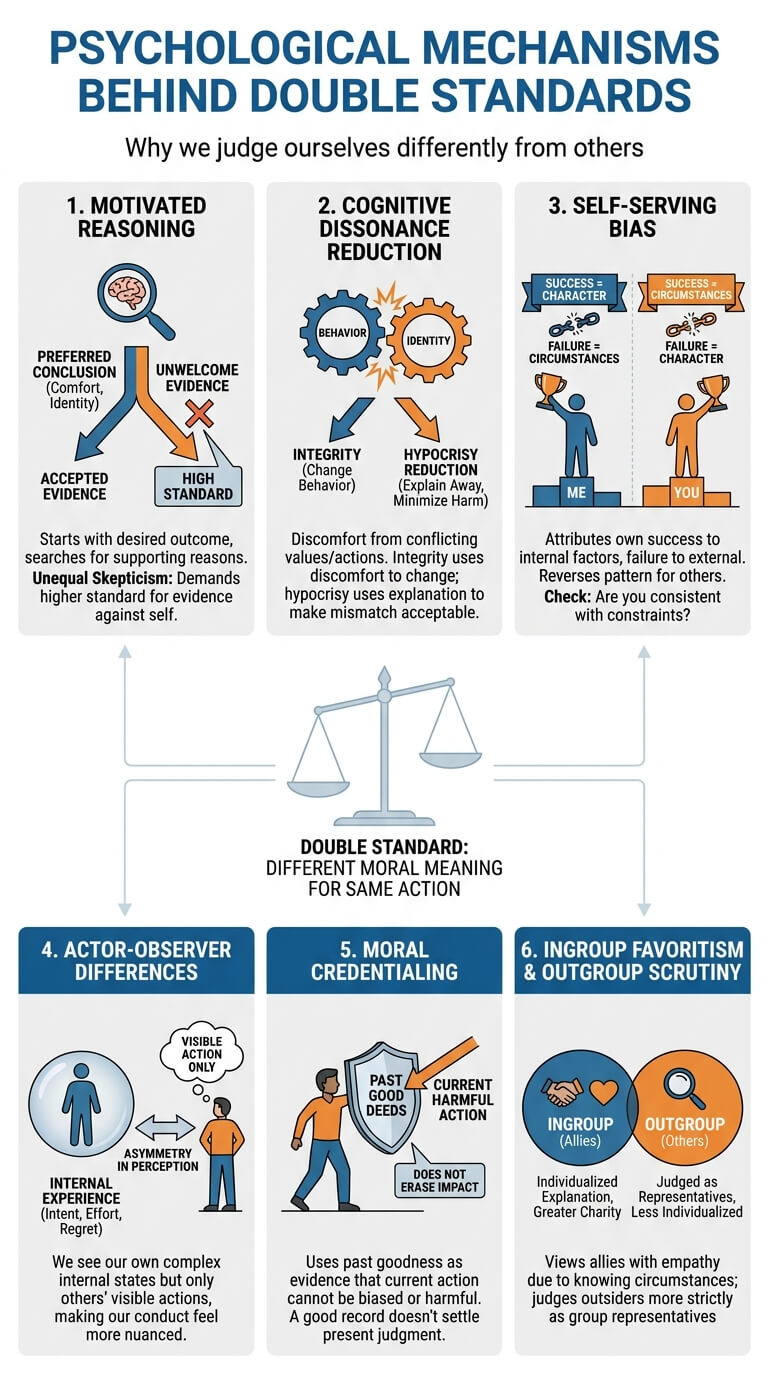
Motivated reasoning begins with a preferred conclusion and searches for reasons that support it. The person may not consciously decide to deceive themselves. Attention, memory, and interpretation lean toward the outcome that protects comfort, identity, status, or group loyalty.
A useful sign is unequal skepticism. Evidence against an opponent is accepted quickly, while evidence against oneself or an ally must meet a much higher standard.
Cognitive dissonance reduction
When behavior conflicts with a valued identity, psychological discomfort may follow. A person can reduce that discomfort by changing behavior, changing the standard, minimizing the harm, or denying responsibility.
Integrity uses discomfort as information: “My conduct and my standard do not match.” Hypocrisy reduction uses explanation to make the mismatch feel acceptable without changing what happens next.
Self-serving bias
People often interpret their successes through character and their failures through circumstances. They may reverse that pattern for others. In moral judgment, this creates a familiar asymmetry: “I acted badly because I was under pressure; you acted badly because you are selfish.”
Context matters for everyone. The consistency check is whether you are willing to consider another person’s constraints with the same seriousness you give your own.
Actor-observer differences
You experience your own uncertainty, intention, effort, and regret from the inside. You see another person mainly through visible action. This difference makes your own conduct feel more complicated and theirs more obvious.
Research on how people perceive their own and others’ hypocrisy found asymmetries in the way people recall and describe hypocritical behavior. The practical implication is that confidence in another person’s hypocrisy should be matched by deliberate examination of your own comparable cases.
Moral credentialing and exception-making
A person may point to past goodness as evidence that a current action cannot be selfish, biased, or harmful. “I am the one who usually helps.” “I have always supported fairness.” “No one who knows me would think I meant harm.”
Past behavior provides context, but it does not settle the present judgment. A good record may make a mistake surprising. It does not make the impact disappear.
Ingroup favoritism and outgroup scrutiny
People often know more about allies’ circumstances and view them with greater charity. Outsiders are more likely to be judged as representatives of a group and less likely to receive an individualized explanation.
The double standard becomes clearer when the same action receives different moral meaning depending on who performs it.
Common Forms of Moral Hypocrisy
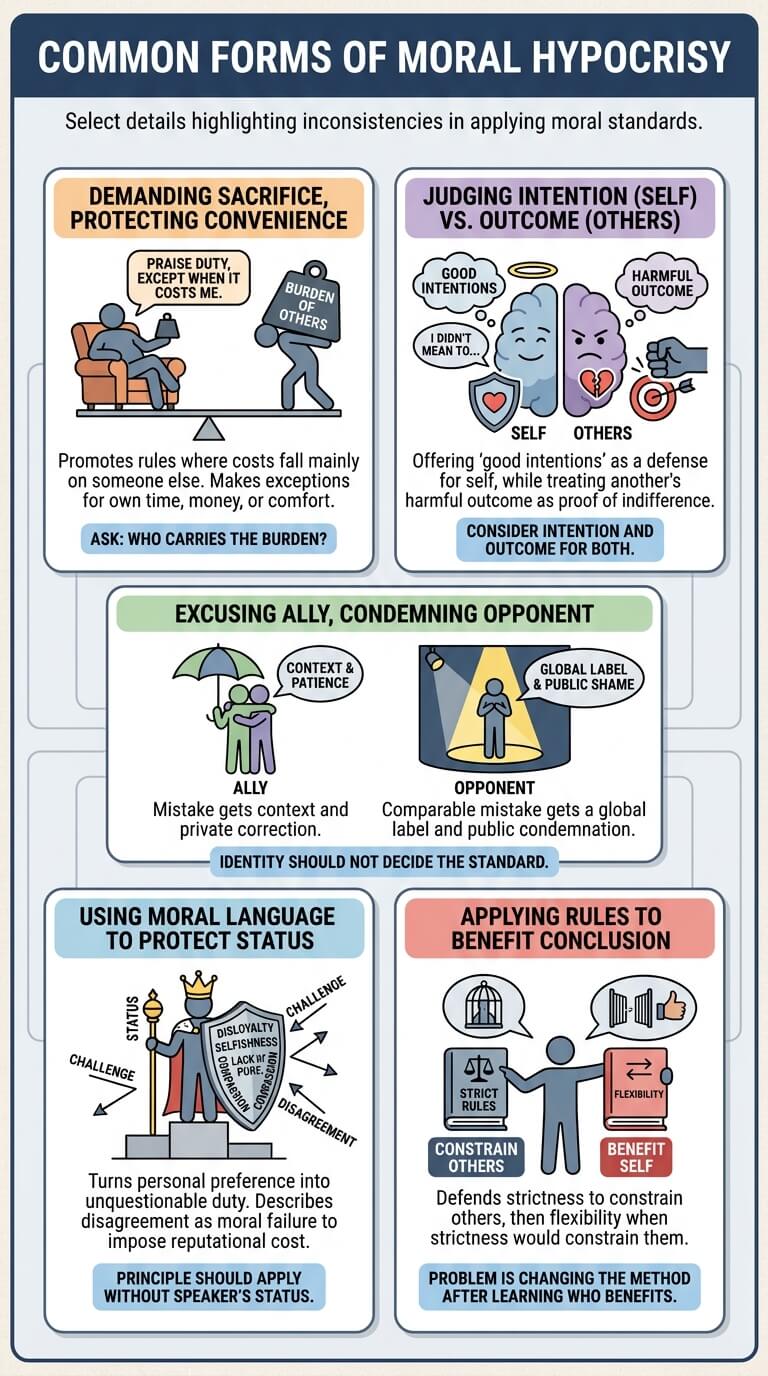
Demanding sacrifice from others while protecting personal convenience
A person may promote a rule whose costs fall mainly on someone else. They praise duty, patience, honesty, or generosity while making exceptions whenever the same standard requires their own time, money, status, or comfort.
Ask who carries the burden. A standard is easier to endorse when the speaker receives its benefits but avoids its cost.
Judging intention for oneself and outcome for others
“I did not mean to hurt anyone” may be offered as a complete defense, while another person’s harmful outcome is treated as proof of indifference. A consistent judgment considers intention and outcome for both parties.
Excusing an ally while condemning an opponent
An ally’s mistake receives context, patience, and private correction. An opponent’s comparable mistake receives a global label and public condemnation. Relevant differences may exist, but identity alone should not decide the standard.
Using moral language to protect status or reputation
Moral language can turn a personal preference into an unquestionable duty. A person may describe disagreement as disloyalty, selfishness, or lack of compassion so that challenging them carries a reputational cost.
The standard should survive without the speaker’s status. Ask what principle applies and whether it can be stated without praise for one person or contempt for another.
Applying a rule only when it benefits the preferred conclusion
Someone may defend strict rules when those rules constrain others, then defend flexibility when strictness would constrain them. The problem is not flexibility itself. It is changing the decision method after learning who benefits.
Why Hypocrisy Is Easier to See in Other People
Access to our own reasons but not theirs
Your own behavior comes with a detailed internal explanation. You know what you feared, intended, misunderstood, and tried to accomplish. Another person’s behavior arrives without that access, so character becomes a convenient explanation.
Memory edits and selective examples
People remember the examples that support a coherent self-story. Their own inconsistency may feel like several unrelated exceptions. Another person’s inconsistency may be organized into one obvious pattern.
Written comparison helps. List two or three genuinely similar situations involving yourself, an ally, and someone you dislike. Compare the evidence and standards rather than relying on the feeling that the cases are different.
Threat to identity when feedback feels accusatory
The word hypocrite is a global character label. It often triggers a defense of identity rather than examination of conduct. A more useful statement identifies the rule and the mismatch: “You asked me to disclose this information, but you withheld the same type of information when it affected you.”
Group narratives normalize exceptions
Groups develop stories explaining why their own behavior is necessary, defensive, or misunderstood. Similar behavior from outsiders is interpreted as evidence of dangerous values. Repetition makes the explanation feel like fact.
Consistency requires asking whether the group’s exception could be offered fairly to others under the same conditions.
Moral Hypocrisy Versus Moral Licensing
| Concept | Core pattern | Typical thought | Main question |
|---|---|---|---|
| Moral hypocrisy | Standards are applied unevenly to preserve image or advantage | “My case is different, but yours proves something about you.” | Would the same rule apply if roles changed? |
| Moral licensing | Prior goodness becomes permission for a later questionable choice | “I have already done enough good to deserve this exception.” | Would this action seem acceptable without the earlier good deed? |
| Ordinary inconsistency | A person fails to meet a value without protecting the failure | “I did not live up to my standard.” | Does accountability lead to repair and changed behavior? |
Double standards versus permission after a good act
Hypocrisy compares standards across people, groups, or public and private behavior. Licensing compares behavior across time. A person does something good, feels morally secure, and becomes more willing to permit a later exception.
Image protection can exist in both
Both processes can rely on moral self-image. Hypocrisy protects the belief that one’s own case deserves leniency. Licensing protects the belief that accumulated goodness offsets the current choice.
Examples that separate the two concepts
A manager condemns lateness from one employee but excuses the same lateness from a favored employee. That is a double standard. A manager stays late to help the team, then uses that good act to justify taking credit for someone else’s work. That is licensing.
The Same-Standard Test
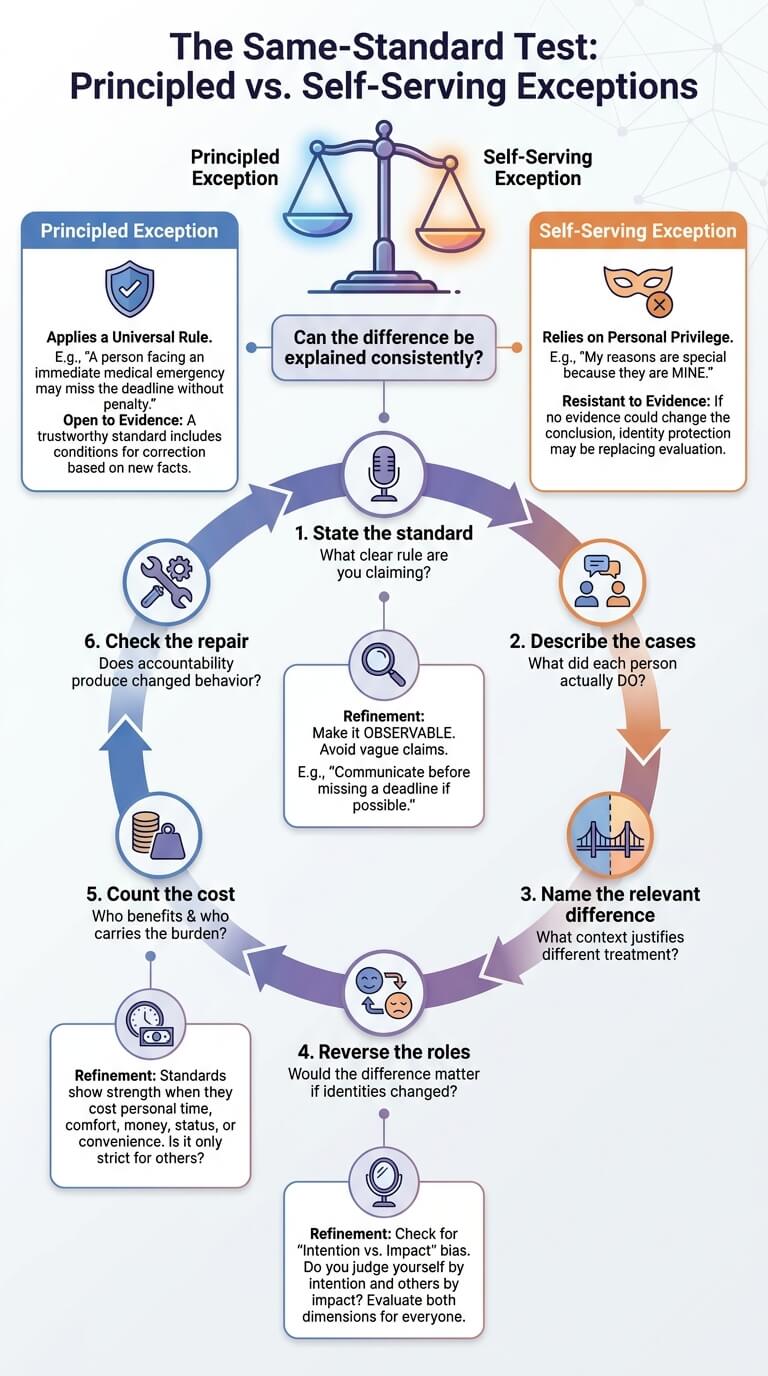
The Same-Standard Test helps distinguish a principled exception from a self-serving one. It does not assume that every case must receive identical treatment. It asks whether the difference can be explained consistently.
- State the standard: What rule or value are you claiming?
- Describe the cases: What did each person actually do?
- Name the relevant difference: What context justifies different treatment?
- Reverse the roles: Would the difference still matter if identities changed?
- Count the cost: Who benefits and who carries the burden?
- Check the repair: Does accountability produce changed behavior?
What standard am I stating?
A vague claim such as “People should be responsible” allows convenient shifts. Make the rule observable: “Anyone who commits to a deadline should communicate before missing it when reasonably possible.”
What cost does following the standard require?
Standards reveal their strength when they cost time, comfort, money, status, or convenience. If the rule is strict only when someone else pays, the moral commitment may be more symbolic than behavioral.
Would I judge the same action differently if roles changed?
Imagine the conduct performed by someone you admire, someone you dislike, and yourself. Notice whether intention, context, or consequence suddenly becomes more important in one version.
Am I using intention for myself and impact for others?
Evaluate both dimensions for both people. Good intention does not erase impact, and harmful impact does not always prove malicious intention.
What exception am I granting, and is it principled?
State the exception as a rule that could apply to comparable cases. “A person facing an immediate medical emergency may miss the deadline without penalty” is principled. “My reasons are special because they are mine” is not.
What evidence would make me revise my judgment?
If no evidence could change the conclusion, identity protection may be replacing evaluation. A trustworthy moral standard includes conditions for correction.
How to Respond to Hypocrisy Without Copying It
Describe the mismatch rather than attack character
Use specific behavior: “You asked for full transparency from me, but you did not disclose the same information.” This gives the person something concrete to answer. “You are a hypocrite” invites a defense of the whole self.
Ask for one consistent rule
Try, “What rule should apply to both of us next time?” A shared rule reduces endless argument about motives. It also reveals whether the person is willing to accept the cost they demand from others.
Acknowledge relevant differences before comparing cases
Do not force two situations to be identical. Name differences in knowledge, power, urgency, obligation, and impact. Then ask whether those differences actually justify the unequal judgment.
Focus on accountability and future behavior
The goal is not to win a confession to hypocrisy. Ask what will change, who will repair the impact, and how the standard will be applied in the future. Words matter, but consistent behavior provides stronger evidence.
When a double standard affects a real choice, a structured ethical decision-making check can make personal interests, competing duties, and accountability more visible.
Set boundaries when double standards create repeated harm
You may need to reduce participation, refuse an unequal arrangement, document agreements, or require decisions to be made through a clearer process. Understanding the psychology does not require remaining available for repeated exploitation.
If double standards are enforced through threats, humiliation, stalking, coercion, financial control, or retaliation, prioritize safety and qualified support rather than trying to expose the inconsistency through confrontation.
Repairing Your Own Values-Behavior Gap
Admit the inconsistency without global self-condemnation
Say what happened plainly: “I held you to a rule I did not follow.” This is more useful than declaring yourself a terrible person or building a long defense of good intentions.
Identify the cost or pressure that drove the exception
Was the exception protecting convenience, reputation, group loyalty, fear, status, or a real competing duty? Understanding the pressure helps prevent repetition. It should explain the choice without erasing responsibility.
Make the standard specific and observable
Replace “I should be fair” with a behavior: “I will use the same evidence standard before sharing accusations about allies and opponents.” Specific standards are easier to test.
Repair impact and change the decision environment
Apologize, correct false information, redistribute a burden, restore a resource, or acknowledge an overlooked contribution. Then change the process that enabled the exception, such as deciding criteria before knowing who benefits.
Track recurrence rather than relying on moral intention
Intentions are important but incomplete. Review behavior across several comparable situations. Integrity becomes visible when the same standard survives inconvenience and identity threat.
How Bias, Licensing, and Group Loyalty Protect Double Standards
Cognitive biases that protect self-image
Selective memory, motivated reasoning, attribution differences, and confirmation bias can all make the preferred exception seem objective. Naming the bias is not enough. Use written criteria, outside feedback, and role reversal to change the decision process.
When a good deed becomes a license
Past goodness can make present scrutiny feel insulting. A person may believe their record proves that their motives cannot be questioned. Evaluate the current action separately from the moral credit attached to earlier behavior.
When group identity changes moral standards
Groups often describe their own violations through necessity and outsiders’ violations through character. Consistency improves when actions are described without group labels first, then evaluated through the same evidence and harm criteria.
Frequently Asked Questions About Moral Hypocrisy
Is everyone morally hypocritical sometimes?
Most people are vulnerable to self-serving explanations and unequal standards, but frequency and impact vary. Occasional inconsistency followed by honest correction differs from a repeated pattern of demanding moral costs from others while protecting oneself.
Can a hypocrite still be correct about the rule?
Yes. A person’s failure to follow a standard does not automatically make the standard false. Their inconsistency may weaken trust or authority, but the claim still deserves evaluation on its own evidence and consequences.
Is changing your mind a form of hypocrisy?
Not when the change is acknowledged and based on new information, experience, or reflection. Hypocrisy is more likely when someone hides the change, condemns others for following their former position, or shifts standards only when personal benefit changes.
How is moral hypocrisy different from lying?
Lying involves knowingly presenting false information. Hypocrisy may involve deception, but it can also operate through biased interpretation, selective attention, and sincere self-justification. A person may believe their own exception is principled even when the standard is unequal.
Why does confronting hypocrisy often create defensiveness?
The accusation threatens moral identity and social reputation. A global label encourages the person to prove they are good rather than examine one mismatch. Specific comparisons, consistent rules, and concrete future expectations make accountability more likely.
Key Takeaways
- Moral hypocrisy involves protecting moral appearance or advantage while applying standards more leniently to oneself or a preferred group.
- Imperfection, changed beliefs, competing duties, and acknowledged mistakes are not automatically hypocrisy.
- Moral self-image, motivated reasoning, self-serving bias, actor-observer differences, and group loyalty can maintain double standards.
- Moral hypocrisy differs from moral licensing, which uses prior goodness as permission for a later exception.
- The Same-Standard Test examines the rule, relevant differences, role reversal, cost, and evidence of repair.
- Accountability is strongest when it changes future behavior rather than protecting a reputation through explanation alone.
Take one standard you have recently applied to someone else and test it against a similar situation involving yourself. Identify any relevant difference clearly. If the difference disappears when roles are reversed, the next step is not self-condemnation. It is one consistent rule, one repair, and one observable change.
Author note: Michael Reed is the Founder and Lead Writer at Psychology Exposed. He explains human behavior, emotional patterns, self-awareness, relationships, and everyday decisions in clear, research-aware language. This material is educational and is not a substitute for mental health, legal, safety, or crisis support.

Michael Reed is the Founder and Lead Writer at Psychology Exposed. He writes about human behavior, relationships, emotional patterns, self-awareness, and practical psychology topics using research-informed, easy-to-understand content.
Read More About Michael Reed: https://psychologyexposed.com/michael-reed/