
Two people can care deeply about fairness, kindness, responsibility, and human dignity, yet reach opposite conclusions about the same situation. One person sees a necessary boundary. Another sees rejection. One sees equal treatment. Another sees a refusal to consider need. One sees loyalty. Another sees favoritism.
Moral disagreement becomes especially confusing when both sides appear sincere. It is tempting to assume that one person must be selfish, ignorant, dishonest, or secretly uncaring. Sometimes bad faith is real. But many conflicts arise because people are using different information, weighing the same values differently, interpreting intention and impact in different ways, or protecting different people from different feared outcomes.
Understanding the structure of the disagreement does not require pretending that every position is equally sound or harmless. It helps you identify what is actually being disputed, which makes clearer judgment, firmer boundaries, and more honest conversation possible.
Quick Answer
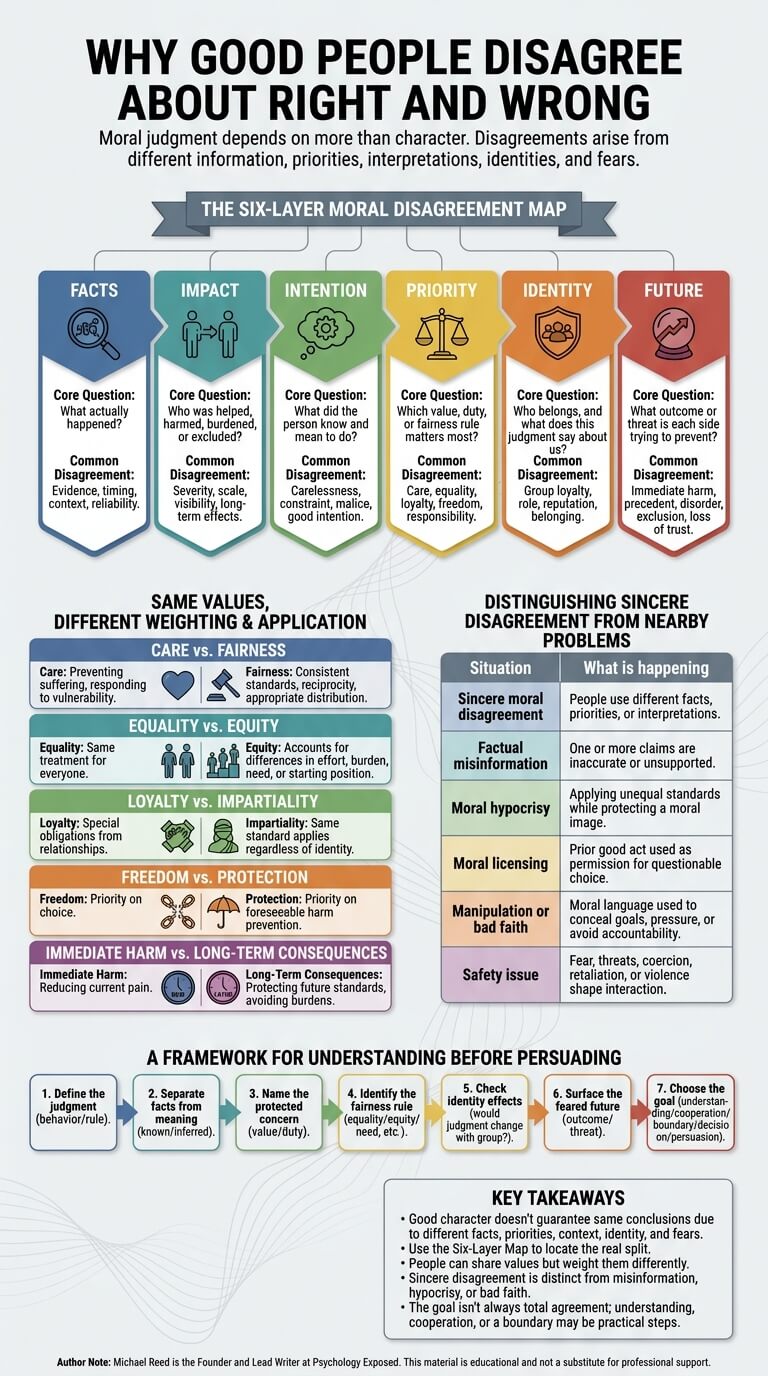
Good people disagree about right and wrong because moral judgment depends on more than character. People may have different facts, experiences, cultural expectations, value priorities, interpretations of intention, fairness rules, group loyalties, and fears about future harm. Sincere disagreement becomes easier to understand when you separate the factual, emotional, moral, identity, and practical layers instead of treating the conflict as proof that one side has no values.
Moral Disagreement Does Not Always Mean Bad Character
Sincere people can prioritize different moral concerns
A person may care most about preventing immediate harm. Another may care most about preserving freedom, loyalty, due process, honesty, or equal treatment. Both may be trying to protect something important, but the priorities point toward different decisions.
This does not mean every priority is equally appropriate in every situation. It means the disagreement should be examined at the level of what each person is protecting, rather than reduced immediately to “good person versus bad person.”
The same principle can produce different conclusions
Even when people agree on a principle, they may apply it differently. Two people may both value fairness. One defines fairness as equal rules for everyone. The other defines fairness as adjusting for unequal burdens or needs. Both use the language of fairness, but they are protecting different versions of it.
The same problem appears with honesty. One person believes truth should be stated directly. Another believes timing and foreseeable impact matter. The disagreement may concern how to apply honesty, not whether honesty matters.
Facts, interpretation, and values can be mixed together
Moral arguments often look like value conflicts when the deeper disagreement is factual. People may disagree about what happened, how much harm occurred, whether the act was intentional, or what alternatives were available. If the factual picture changes, the moral conclusion may change too.
The reverse also happens. Two people may agree on every fact but still disagree because they assign different weight to loyalty, fairness, care, autonomy, responsibility, or long-term consequences. Separating facts from values prevents both sides from arguing past each other.
A broad review of the psychology of morality describes moral judgment as shaped by identity, social relationships, shared standards, emotion, and behavior. That wider view helps explain why moral conclusions cannot be reduced to one simple trait.
The Six-Layer Moral Disagreement Map
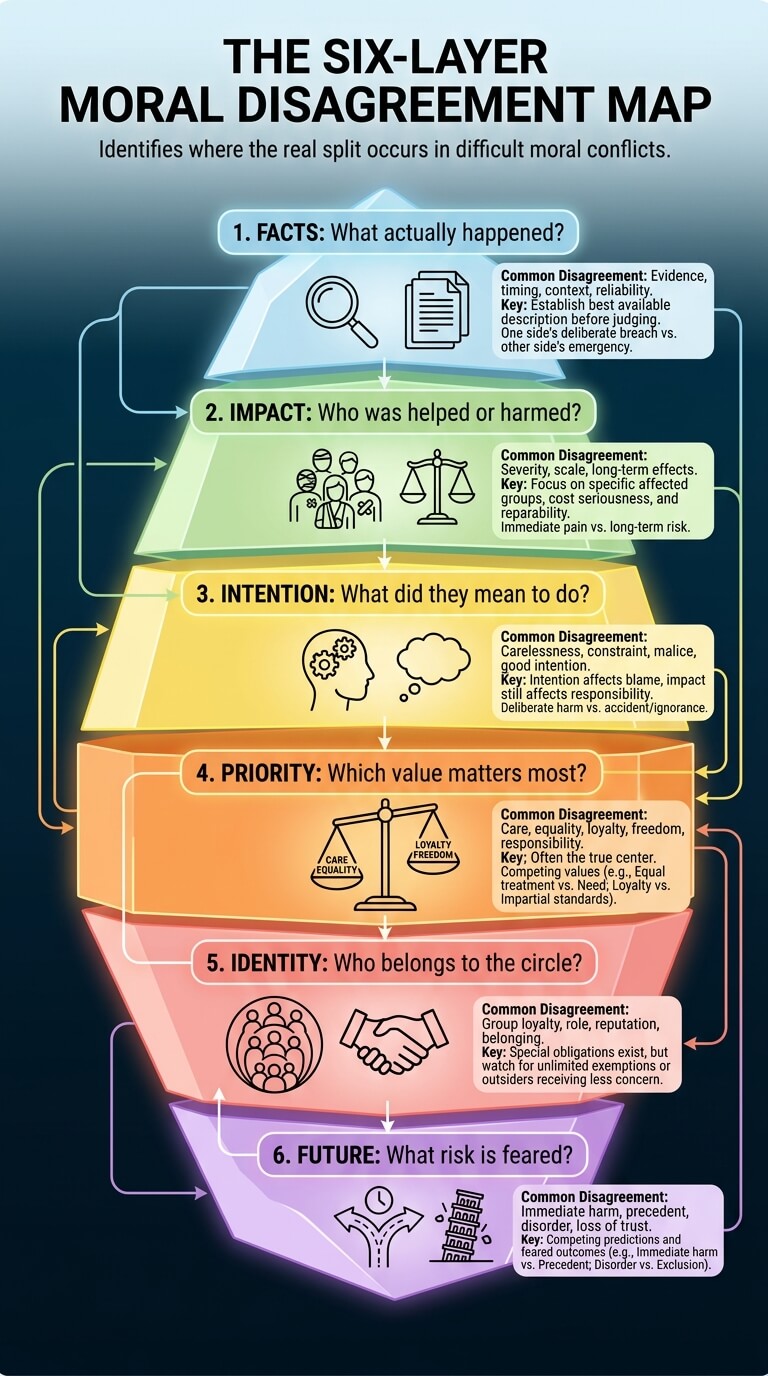
Most difficult moral conflicts contain several layers at once. The Six-Layer Moral Disagreement Map helps identify where the real split occurs.
| Layer | Core question | Common disagreement |
|---|---|---|
| Facts | What actually happened? | Evidence, timing, context, reliability |
| Impact | Who was helped, harmed, burdened, or excluded? | Severity, scale, visibility, long-term effects |
| Intention | What did the person know and mean to do? | Carelessness, constraint, malice, good intention |
| Priority | Which value, duty, or fairness rule matters most? | Care, equality, loyalty, freedom, responsibility |
| Identity | Who belongs, and what does this judgment say about us? | Group loyalty, role, reputation, belonging |
| Future | What outcome or threat is each side trying to prevent? | Immediate harm, precedent, disorder, exclusion, loss of trust |
What happened? The factual layer
Before deciding what an event means morally, establish the best available description. What was observed directly? What comes from another person’s account? What remains uncertain? A disagreement about facts cannot be solved only by repeating values more strongly.
For example, one family member may believe a promise was deliberately broken. Another may believe an emergency made the promise impossible to keep. The moral interpretation changes depending on which factual account is accurate.
Who was harmed or protected? The impact layer
People may notice different harms. One side sees the immediate pain caused by a decision. The other sees a longer-term risk that the decision was meant to prevent. One notices the visible person. Another notices less visible people affected by the same rule.
Impact disagreements improve when people specify who bears the cost, how serious the cost is, how likely it is, and whether it can be repaired. “This hurts people” is too broad when each side has a different group in mind.
What was intended? The motive layer
Intention changes moral judgment because deliberate harm is usually evaluated differently from accident, ignorance, or constraint. Yet intentions are often inferred rather than known. People give themselves and their allies more access to context while judging outsiders mainly by outcomes.
A useful distinction is: intention affects blame, while impact still affects responsibility. Someone may not have intended harm and still need to acknowledge and repair it.
Which rule, duty, or value matters most? The priority layer
This is often the true center of the disagreement. One person prioritizes equal treatment. Another prioritizes need. One protects loyalty to a friend. Another protects impartial standards. One emphasizes honesty. Another emphasizes care and timing.
When the priorities are named, the disagreement becomes more precise. Instead of “You do not care about fairness,” the conflict may be “You are using equality as the fairness rule, while I am using need.”
Who belongs to the circle of concern? The identity layer
Moral attention is not always distributed evenly. People may feel greater obligation toward family, friends, coworkers, community members, or others who share an identity. Special responsibility can be legitimate. A parent does not owe every child in the world exactly what they owe their own child.
The problem begins when loyalty becomes unlimited exemption, when outsiders receive less concern simply because they are outsiders, or when criticism of one member feels like an attack on the entire group.
What future risk is feared? The threat layer
Moral disagreements often contain competing predictions. One side fears immediate harm if nothing changes. Another fears the precedent created by changing the rule. One fears exclusion. Another fears disorder, dependency, loss of freedom, or collapse of trust.
Research on moral values and threat-based cognition suggests that perceived threat can interact with values and intergroup attitudes. The practical lesson is that people may be protecting different futures, not merely disagreeing about the present.
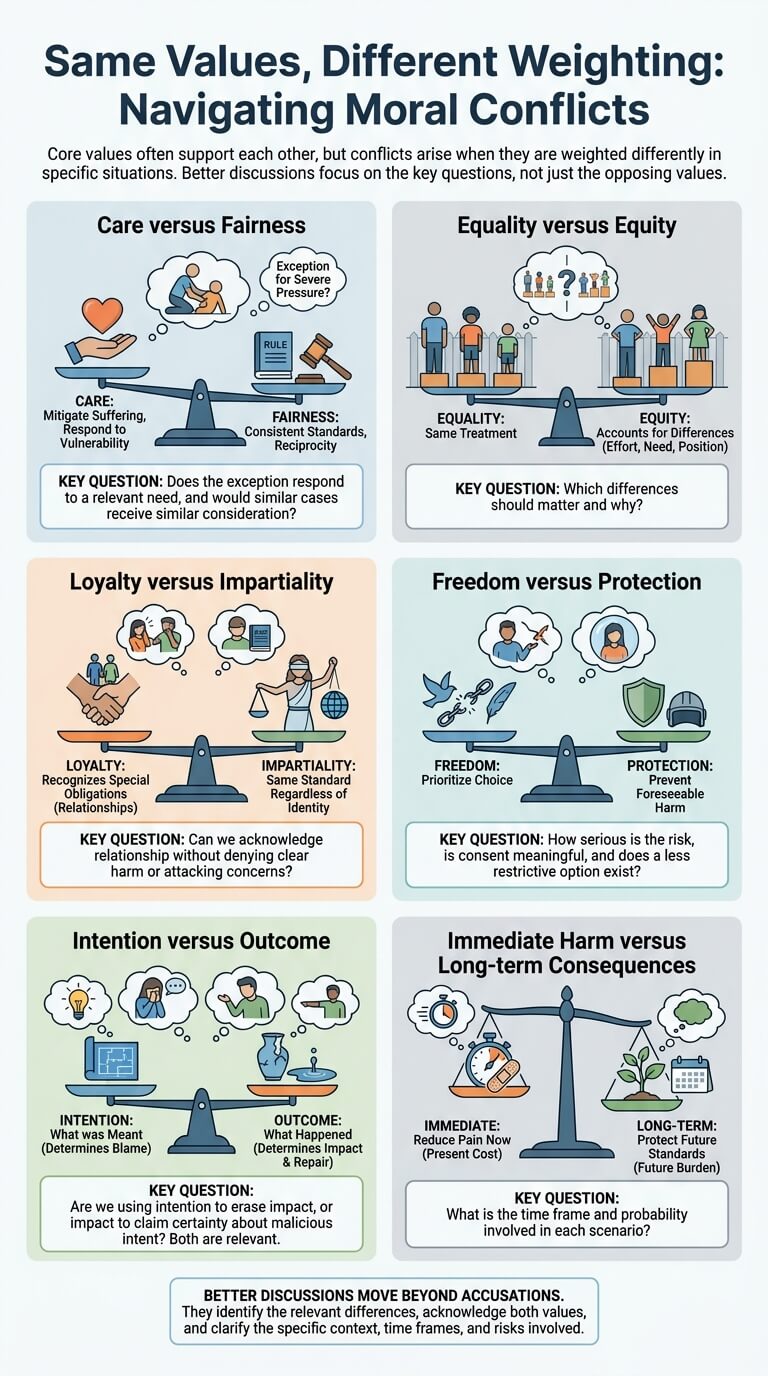
Same Values, Different Weighting
Care versus fairness
Care focuses on preventing suffering and responding to vulnerability. Fairness focuses on consistent standards, reciprocity, and appropriate distribution. These values often support each other, but they can conflict.
Suppose a group makes an exception for someone under severe pressure. One person sees compassion. Another sees unequal treatment. The question becomes whether the exception responds to a relevant need and whether similar cases would receive similar consideration.
Equality versus equity
Equality gives people the same treatment. Equity accounts for differences in effort, burden, need, or starting position. A person who favors equality may fear favoritism or arbitrary exceptions. A person who favors equity may fear that identical treatment preserves unequal disadvantage.
The disagreement is easier to discuss when both sides identify which differences they believe should matter and why.
Loyalty versus impartiality
Loyalty recognizes special obligations created by relationships and shared commitments. Impartiality asks whether the same standard would apply regardless of identity. Both can be morally serious.
A friend may deserve support during a difficult time, but loyalty does not require denying clear harm or attacking anyone who raises a concern. Impartiality does not require treating close relationships as morally meaningless.
Freedom versus protection
One person may prioritize the freedom to choose. Another may prioritize protection from foreseeable harm. Disagreement grows when each side treats the other value as evidence of bad character: freedom becomes selfishness, or protection becomes control.
A better discussion asks how serious the risk is, who bears it, whether consent is meaningful, and whether a less restrictive protective option exists.
Intention versus outcome
Some people place greater weight on what the person meant to do. Others focus on what actually happened. Both are relevant. Intention helps determine blame, while outcome helps determine impact and repair.
Arguments become distorted when a person uses intention to erase impact or uses impact to claim certainty about malicious intent.
Immediate harm versus long-term consequences
A decision that reduces pain now may create a future burden. A decision that protects a long-term standard may impose serious immediate cost. People differ in how they discount future consequences and how certain they believe those consequences are.
Ask each side to name the time frame and probability involved. “What do you think will happen next, and how sure are you?” often reveals the real disagreement.
Different Contexts Create Different Moral Maps
Family roles and personal history
People learn moral expectations through repeated experience. Someone raised in a family that emphasized duty may see caregiving as non-negotiable. Someone raised around controlling obligation may see the same demand as a threat to autonomy.
Personal history can make one risk emotionally vivid. That does not automatically make the judgment wrong, but it can influence which evidence receives attention.
Cultural norms and learned expectations
Culture shapes how people understand responsibility, hierarchy, independence, harmony, obligation, and acceptable disagreement. A review of culture and decision making notes that cultural context can influence which information people consider and how choices are interpreted.
Cultural explanation should not become stereotyping. People within the same culture vary widely, and individuals participate in several social worlds at once. Culture is one influence, not a complete prediction.
Scarcity, safety, and uncertainty
When resources feel scarce or danger feels close, people often narrow moral attention. Immediate survival, loyalty, and protection may become more important than broad impartiality. Under calmer conditions, the same person may be more open to compromise.
Uncertainty also changes judgment. People who believe the situation is unstable may favor strict rules or rapid action. Others may resist acting strongly until the evidence is clearer.
Power differences and responsibility
The same behavior can carry different moral weight depending on power. A supervisor, parent, teacher, caregiver, or gatekeeper may have responsibilities that a peer does not. A person with fewer alternatives may be more vulnerable to pressure that appears voluntary on the surface.
Ignoring power can make equal treatment look fair when the consequences are not equal. Exaggerating power can also erase personal agency. The useful question is what options each person realistically had.
Direct experience versus abstract principle
Someone who has personally experienced a harm may notice details that an outside observer misses. An outsider may see a general principle that the directly affected person finds too detached. Both forms of attention can contribute useful information.
Experience should be heard without becoming the only possible interpretation. Abstract principles should be tested against real consequences rather than treated as complete on their own.
A review of universality and cultural diversity in moral reasoning emphasizes that moral judgment reflects both shared concerns and culturally shaped variation. This supports caution toward claims that one personal viewpoint is simply universal.
How Identity Changes Moral Interpretation
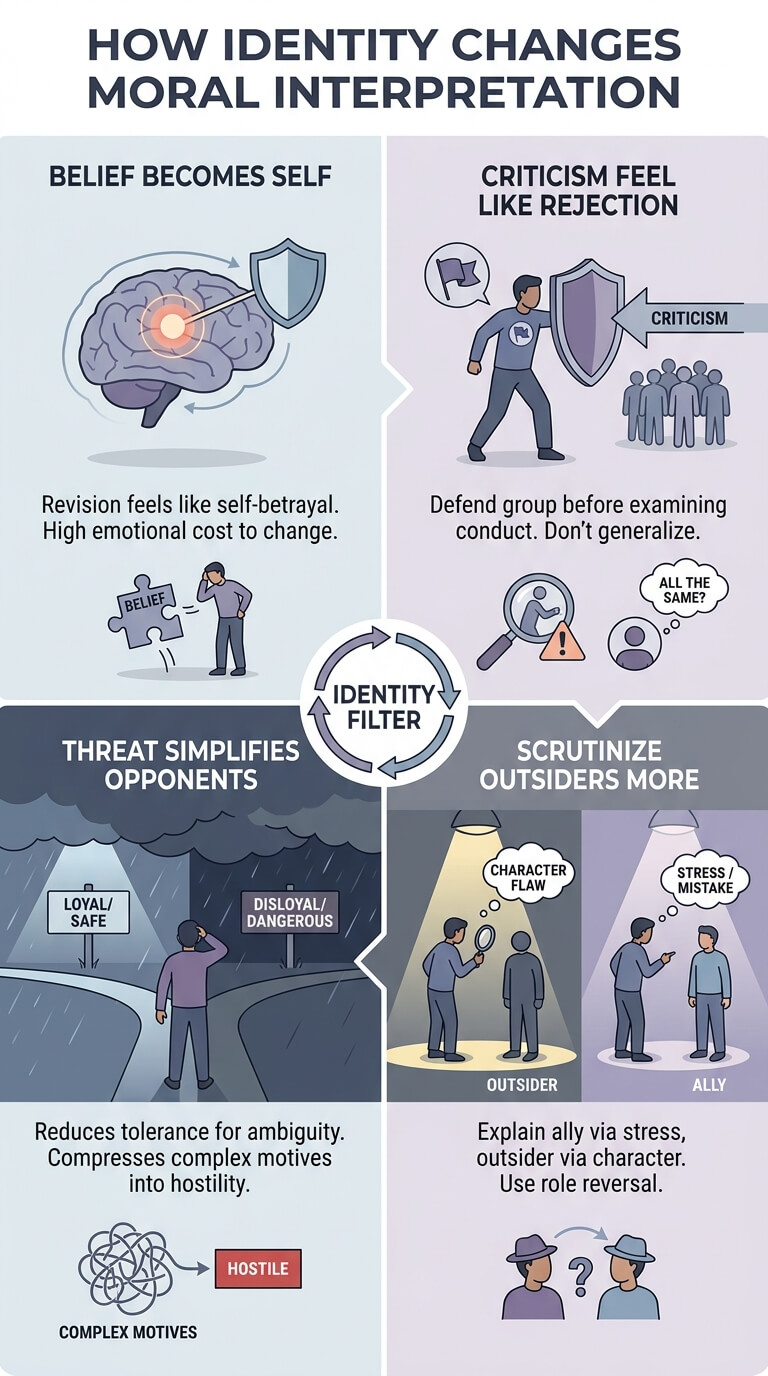
A belief can become part of the self
Some moral beliefs are not experienced as ordinary opinions. They become evidence of who a person is. Questioning the belief may then feel like questioning the person’s goodness, loyalty, intelligence, or belonging.
This makes revision emotionally costly. Changing a conclusion may feel like betraying a group or admitting that the self was morally wrong, not merely factually mistaken.
Criticism can feel like rejection of the group
When identity is involved, criticism of one act can be interpreted as contempt for the entire community. The person may defend the group before examining the conduct. Outsiders may also overgeneralize from one member to everyone who shares the label.
Keep the unit of judgment clear. Criticize the specific behavior, rule, or decision instead of assigning a total character to the group.
Threat increases certainty and simplifies opponents
Threat can reduce tolerance for ambiguity. People may divide the conflict into loyal and disloyal, caring and cruel, safe and dangerous. Complex motives are compressed into one hostile explanation.
Before accepting that simplification, ask what evidence would distinguish disagreement, ignorance, self-interest, fear, and deliberate harm. Different causes may require different responses.
Why people scrutinize outsiders more than allies
People usually know more about allies’ circumstances and intentions. They may explain an ally’s behavior through stress or mistake while explaining an outsider’s behavior through character. This creates unequal moral standards without requiring conscious dishonesty.
Role reversal is useful here: if the identities changed but the conduct stayed the same, would the judgment change?
Moral Conviction: Strength and Risk
Conviction can support courage and consistency
Moral conviction helps people act when compliance would be easier. It can support whistleblowing, boundary-setting, defense of vulnerable people, and persistence under social pressure.
A person with no stable standards may adapt every judgment to convenience. Conviction gives behavior continuity and makes certain lines harder to cross.
Certainty can reduce curiosity and compromise
The strength of a conviction can make opposing evidence feel morally contaminated. Compromise may appear like surrender, and questions may appear like disloyalty. This can make the person less willing to distinguish imperfect allies from genuine threats.
A recent integrative review of moral conviction discusses how strong moralized beliefs can increase confidence and resistance to opposing views. The point is not that conviction is bad. It is that moral certainty changes how information and disagreement are processed.
Feeling morally certain is not the same as having complete information
Certainty is an internal experience. Completeness concerns the quality and range of evidence. A person can feel deeply certain while relying on partial information, and can feel uncertain while reasoning carefully.
Use confidence as a reason to articulate the standard clearly, not as proof that checking is unnecessary.
The difference between a boundary and dehumanization
A boundary states what conduct you will accept, what action you will take, and what responsibility belongs to you. Dehumanization treats the other person as less worthy of basic dignity or factual fairness.
You can refuse cooperation, end contact, report misconduct, or oppose a decision without claiming that the other person is beyond human concern.
Moral Disagreement Versus Nearby Problems
| Situation | What is happening | What helps clarify it |
|---|---|---|
| Sincere moral disagreement | People use different facts, priorities, or interpretations | Name the layers and compare standards |
| Factual misinformation | One or more claims are inaccurate or unsupported | Check evidence before debating values |
| Moral hypocrisy | A person applies unequal standards while protecting a moral image | Use role reversal and compare similar cases |
| Moral licensing | A prior good act becomes permission for a later questionable choice | Evaluate the present action on its own |
| Manipulation or bad faith | Moral language is used to conceal goals, pressure others, or avoid accountability | Watch behavior, consistency, incentives, and response to evidence |
| Safety issue | Fear, threats, coercion, retaliation, or violence shape the interaction | Prioritize safety and qualified support |
Disagreement versus factual misinformation
If two people rely on different factual claims, clarify those claims before treating the conflict as a values debate. A false premise can make a moral argument appear coherent while pointing toward the wrong conclusion.
Disagreement versus hypocrisy
Hypocrisy involves inconsistency between stated standards and actual application. Sincere disagreement involves different standards or priorities applied in good faith. The distinction matters because understanding may help one problem, while accountability for double standards is needed for the other.
Disagreement versus moral licensing
Moral licensing occurs when past goodness makes a present exception feel earned. The person may not be disagreeing about the rule at all. They may believe their previous conduct gives them permission not to follow it this time.
Disagreement versus manipulation or bad faith
Some people use moral language strategically. Signs may include changing standards whenever convenient, refusing any evidence that could count against the preferred conclusion, pressuring others through shame, or demanding sacrifice that they will not accept themselves.
Do not label bad faith solely because someone is stubborn or emotional. Look for repeated inconsistency between stated principles and behavior.
Disagreement versus a safety issue
A moral conversation is not an equal exchange when one person fears threats, retaliation, humiliation, stalking, financial control, or violence. In those conditions, the goal should not be mutual understanding at any cost.
Prioritize safety, documentation, trusted support, and qualified help. Communication techniques cannot make coercion safe.
A Framework for Understanding Before Persuading
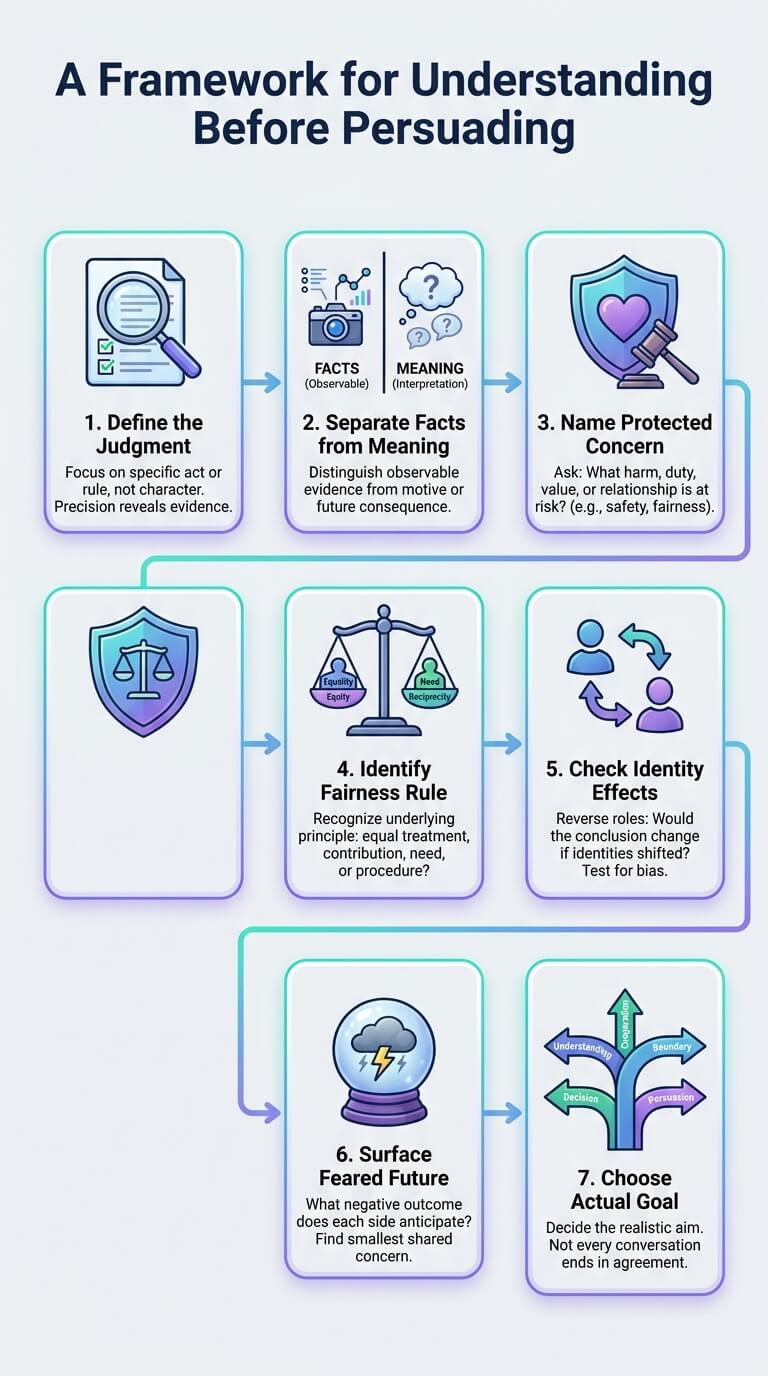
- Define the judgment: What behavior, rule, or decision is being evaluated?
- Separate facts from meaning: What is known, inferred, and disputed?
- Name the protected concern: Which harm, duty, relationship, value, or right matters most to each person?
- Identify the fairness rule: Is each side using equality, equity, need, reciprocity, procedure, or proportionality?
- Check identity effects: Would the judgment change if the people or groups involved changed?
- Surface the feared future: What outcome does each side think will follow?
- Choose the actual goal: Understanding, cooperation, boundary, decision, or persuasion?
State the decision or behavior being judged
Avoid debating the entire character of a person or society. Choose the specific act, rule, or outcome. Precision makes evidence and alternatives visible.
Ask which harm, duty, value, or relationship each person is protecting
Try, “What feels most at risk to you here?” The answer may reveal safety, freedom, loyalty, fairness, dignity, trust, or future stability. You do not need to agree with the weighting to understand it.
Separate evidence from interpretation
Write two columns if needed. In one, list observable facts. In the other, list explanations of motive, character, or future consequence. This prevents interpretation from being presented as if it were direct observation.
Identify the fairness rule each side is using
Ask whether the argument depends on equal treatment, recognition of contribution, response to need, reciprocal obligation, fair procedure, or proportionate consequences. Many conflicts become clearer when the hidden fairness rule is named.
Test whether standards change with group membership
Reverse the identities while keeping the behavior the same. If your conclusion changes, identify the relevant difference. Loyalty may justify special responsibility, but it should not automatically erase harm.
Find the smallest shared concern
Shared ground may be narrow. Both sides may want fewer people harmed, more trustworthy evidence, protection from arbitrary power, or rules that can be explained consistently.
Decide whether the goal is understanding, cooperation, boundary, or persuasion
Not every conversation should end in agreement. Sometimes the realistic goal is understanding why the judgment differs. Sometimes a practical decision must be made. Sometimes a boundary is necessary because the values conflict affects behavior toward you.
Questions That Reveal the Real Disagreement
- What outcome are you most afraid of? This reveals threat and time frame.
- Which responsibility feels non-negotiable? This reveals duty and role.
- What evidence would change your view? This tests openness and factual standards.
- Would your judgment change if the people involved changed? This tests group-based inconsistency.
- Which tradeoff do you think the other person is ignoring? This reveals competing costs.
- Are we disagreeing about facts, values, or application? This locates the conflict.
These questions are most useful when asked with genuine curiosity. If they are used as traps, the conversation becomes another contest over status and intelligence.
When Agreement Is Not the Right Goal
Respectful coexistence with different moral priorities
Some disagreements remain after the facts and values are clear. People may choose different lifestyles, responsibilities, or boundaries. Coexistence becomes possible when each person can act without coercing the other into false agreement.
Boundaries when values affect behavior toward you
You do not need consensus to set a boundary. “I understand why you see this differently, but I will not participate in that decision” is a complete position. Understanding the disagreement does not create an obligation to accept its consequences.
Ending discussion when there is contempt, coercion, or retaliation
A conversation stops being constructive when one person uses humiliation, threats, repeated intimidation, or punishment for disagreement. Continuing to explain yourself may increase risk rather than understanding.
End the interaction when safe to do so, seek support, and prioritize practical protection over winning recognition of your moral position.
How Fairness, Group Loyalty, and Ethical Tradeoffs Shape the Conflict
Fairness rules beneath the disagreement
Many moral conflicts become more precise when people identify whether they are using equality, equity, need, reciprocity, procedure, or proportionality. The word “fair” is too broad until the rule is visible.
Ingroup loyalty and selective concern
People may protect allies, excuse familiar behavior, or notice harm more readily when it affects their own group. Special loyalty is not automatically wrong, but it should not make outsiders’ harm invisible.
Decision-making under competing harms and duties
Some disagreements cannot be solved by naming one value because several legitimate concerns remain. A person may need to choose between honesty and confidentiality, loyalty and impartiality, immediate care and long-term consistency.
In those cases, the goal is not to prove that one value is fake. It is to make the tradeoff explicit, reduce preventable harm, and accept responsibility for the cost of the chosen option.
Frequently Asked Questions About Moral Disagreement
Can two opposite moral judgments both be sincere?
Yes. People can sincerely prioritize different values, rely on different facts, or predict different consequences. Sincerity does not make both conclusions equally accurate or harmless. It means the disagreement should not be explained automatically as dishonesty.
Why do facts rarely end a values conflict?
Facts can clarify what happened and what consequences are likely, but they do not always determine which value should receive the greatest weight. Two people may agree on the evidence and still disagree about loyalty, fairness, freedom, care, or responsibility.
Does culture determine morality?
No. Culture influences norms, attention, expectations, and interpretation, but it does not predict every individual judgment. People share some broad moral concerns while differing in how those concerns are expressed, prioritized, and applied.
Is refusing to compromise always closed-minded?
No. Some boundaries protect safety, dignity, rights, or deeply held responsibilities. Refusing compromise becomes less trustworthy when the person cannot state the principle consistently, apply it across groups, or consider evidence that would change the factual picture.
How can I tell sincere disagreement from bad faith?
Look at whether the person can state the opposing view fairly, acknowledge relevant evidence, apply standards consistently, and identify what could change their conclusion. Bad faith is more likely when standards shift for convenience, pressure replaces reasoning, or no evidence could ever count.
Key Takeaways
- Good character does not guarantee identical moral conclusions because people differ in facts, priorities, context, identity, and feared outcomes.
- The Six-Layer Moral Disagreement Map separates facts, impact, intention, priority, identity, and future risk.
- People can share values such as fairness or care while assigning them different weight or applying them through different rules.
- Moral conviction can support courage, but certainty should not be confused with complete information.
- Sincere disagreement differs from misinformation, hypocrisy, moral licensing, manipulation, and unsafe coercion.
- The most useful next step may be understanding, cooperation, a decision, or a boundary rather than total agreement.
Choose one disagreement and write down the strongest concern on each side without using character labels. Then identify which layer contains the largest gap. A conflict about facts needs evidence. A conflict about priorities needs an honest tradeoff. A conflict shaped by fear or coercion needs safety, not a better debate.
Author note: Michael Reed is the Founder and Lead Writer at Psychology Exposed. He explains human behavior, emotional patterns, self-awareness, relationships, and everyday decisions in clear, research-aware language. This material is educational and is not a substitute for mental health, legal, safety, or crisis support.

Michael Reed is the Founder and Lead Writer at Psychology Exposed. He writes about human behavior, relationships, emotional patterns, self-awareness, and practical psychology topics using research-informed, easy-to-understand content.
Read More About Michael Reed: https://psychologyexposed.com/michael-reed/