
You explain something that feels straightforward, then the other person responds to a meaning you never intended. A reminder is heard as criticism. A short work message sounds angry. A delayed reply is treated as rejection. Both people may leave convinced that the other one ignored what was obvious.
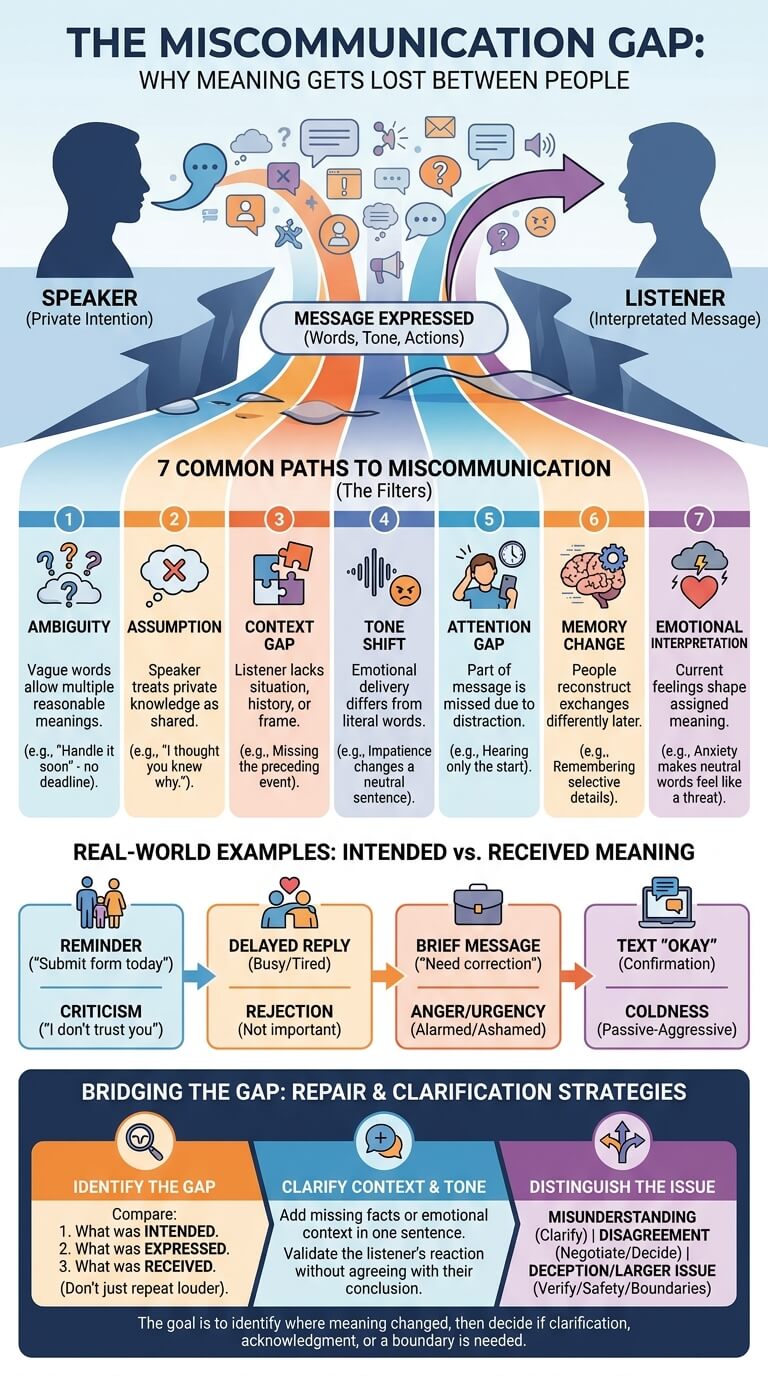
Miscommunication happens because words do not travel alone. Listeners interpret them through context, tone, attention, emotion, memory, expectations, and relationship history. The speaker knows the private intention behind the message, but the listener only has the message that was actually expressed.
That gap does not automatically mean someone communicated badly or listened carelessly. It also does not mean every conflict is an innocent misunderstanding. The practical task is to identify exactly where meaning changed, then decide whether clarification, emotional acknowledgment, a factual correction, or a firmer boundary is needed.
Quick Answer
The central issue is a mismatch in meaning, not merely a failure to speak clearly or listen carefully.
Miscommunication occurs when intended meaning and received meaning do not match
Miscommunication happens when a person’s intended message is interpreted differently by someone else. The gap may come from vague wording, unspoken assumptions, missing context, tone, divided attention, memory differences, or strong emotion. The fastest way to clarify it is to compare what was intended, what was actually said, and what the listener believed it meant.
The Communication Gap Between Saying and Hearing
The National Communication Association describes communication as using messages to generate meaning across contexts. This is different from imagining that a complete thought is simply transferred from one mind to another. A message becomes meaningful through expression and interpretation.
This message-to-meaning gap is a central part of communication psychology, which examines how people form, interpret, and respond to messages.
Intention is private but expression is observable
You may know that “We need to talk about the budget” means “I want us to make a plan before the bill is due.” The other person cannot see that intention. They hear a serious sentence, notice your facial expression, remember the last money argument, and predict what is coming next.
Listeners fill missing information with assumptions
Most conversations contain gaps. Speakers leave out facts they believe are already known. They use words such as “that,” “soon,” “fine,” or “the usual way” without checking whether both people attach the same meaning to them. Listeners rarely leave those spaces empty. They fill them with the most available explanation.
Meaning depends on context, relationship history, and current state
“You are early” can sound appreciative, surprised, sarcastic, or accusatory. Its meaning depends on what happened before, how it is delivered, and what both people believe about punctuality. The same words can function differently in a friendly joke, a formal review, or an argument.
Seven Common Paths to Miscommunication

The following pathways make up a practical Message-to-Meaning Gap check. More than one can occur in the same exchange, but naming the main gap keeps the conversation from turning into a broad argument about who is “bad at communicating.”
| Pathway | What changes | Useful clarification |
|---|---|---|
| Ambiguity | The words allow more than one reasonable meaning. | “What does ‘later’ mean here?” |
| Assumption | The speaker treats private knowledge as shared knowledge. | “What did you expect me to already know?” |
| Context gap | The listener lacks the situation, history, or cultural frame. | “What happened before this message?” |
| Tone shift | The emotional message differs from the literal wording. | “Were you frustrated, rushed, or simply being brief?” |
| Attention gap | Part of the message is not received or processed. | “Which part did you hear me asking for?” |
| Memory change | People later reconstruct the exchange differently. | “What detail are each of us most certain about?” |
| Emotional interpretation | Threat, shame, anger, or anxiety shapes the meaning assigned. | “What did this seem to say about you or us?” |
Ambiguous words and vague references
Ambiguity appears when a word or sentence supports several interpretations. “Handle it soon” does not define the task, deadline, or expected result. “I need more support” may refer to listening, practical help, reassurance, money, time, or shared responsibility.
Research on verbal communication shows that listeners regularly encounter temporary ambiguity and rely on context to settle on a speaker’s meaning. An open-access study on predictions of miscommunication in verbal communication also illustrates that speakers may not accurately judge when their wording will be clear to another person. The cure is not to remove every possible ambiguity. It is to make the decision-relevant part specific.
Unspoken assumptions about what the other person knows
A speaker may assume the listener knows why the plan changed, which version of a document matters, or what “being supportive” should look like. The listener acts from a different information set and appears careless, resistant, or inconsiderate.
Before assigning motive, ask what information was never stated. “I thought you knew the appointment had moved” identifies an assumption. “You never pay attention” turns one missing fact into a character judgment.
Missing situational or cultural context
Context explains what a message is doing. A direct question can be ordinary in one workplace and unusually challenging in another. Silence can mean thoughtfulness, disagreement, deference, discomfort, or a wish not to interrupt. Humor may depend on shared history that an outsider does not have.
Tone that changes the emotional message
Literal wording answers “what was said.” Tone often answers “how am I expected to take this?” Pace, volume, emphasis, pauses, and vocal warmth may make a neutral sentence feel impatient, doubtful, caring, or contemptuous.
Tone is one pathway, not the whole explanation. People sometimes focus on delivery because the content is uncomfortable, while others focus only on content and ignore a delivery that made the exchange hard to tolerate. A balanced clarification addresses both: “I understand the request. I also had trouble hearing it once the volume rose.”
Divided attention and incomplete listening
A person may hear the opening sentence, assume the rest, and prepare a response while important details are still being spoken. Phones, work pressure, children, fatigue, and emotional arousal all compete for attention. The listener may honestly believe they received the message because they recognized the topic.
Memory compression and selective recall
People do not store a perfect recording of a conversation. They remember selected words, emotional peaks, conclusions, and details that fit the meaning they formed. The APA Dictionary of Psychology describes reconstructive memory as recreating an experience that was only partly stored.
This helps explain why two sincere people may later remember different versions. One recalls the harsh phrase. The other recalls the explanation immediately after it. Rather than demanding total agreement about every sentence, identify the shared facts and the practical issue that still needs resolution.
Stress, shame, anger, anxiety, or unclear needs
Strong emotion changes which part of a message feels most urgent. A person afraid of rejection may focus on “I need space” and miss “I will call tomorrow.” Someone feeling accused may listen for factual errors instead of the concern underneath them. Anger may turn an uncertain interpretation into a confident conclusion.
When words are ambiguous, tone of voice can strongly influence the meaning a listener constructs.
Why Emotion Changes Interpretation
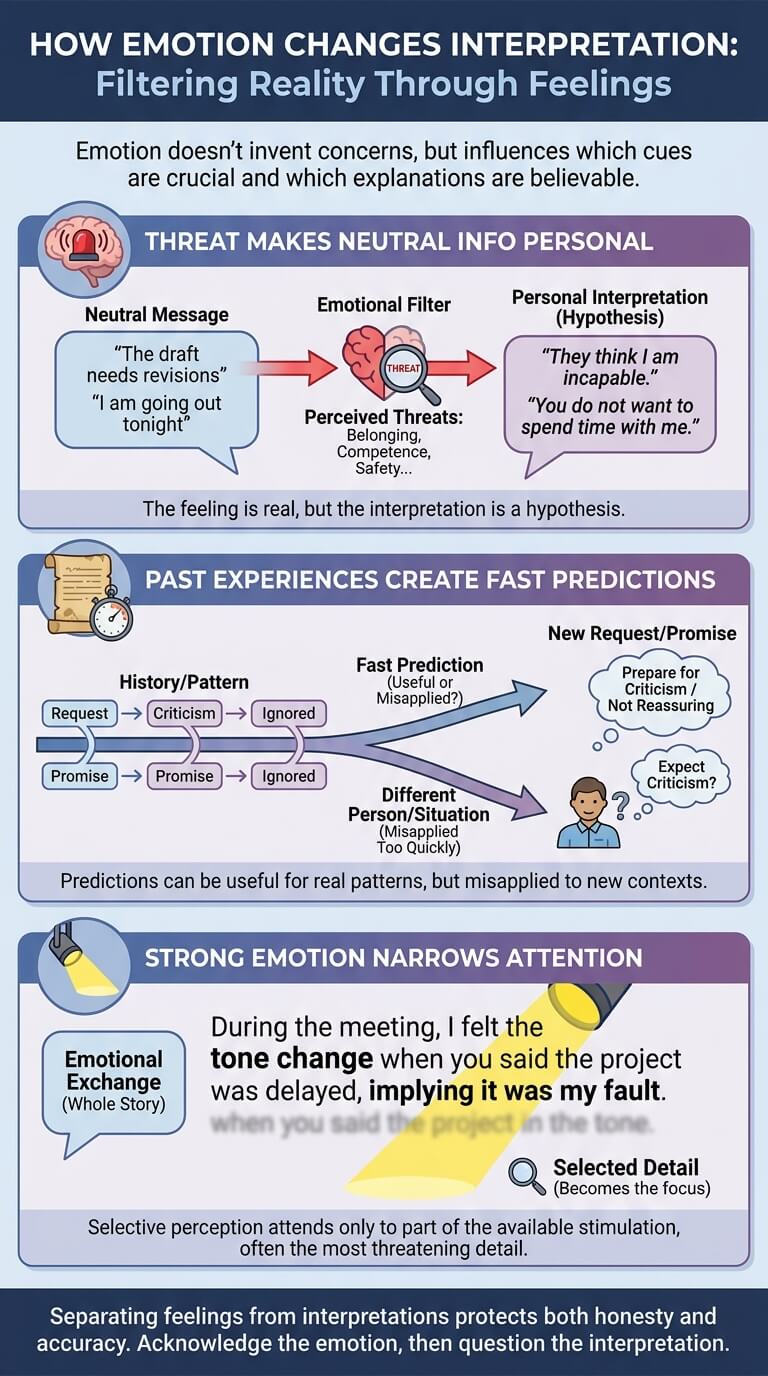
Emotion does not invent every concern, but it influences which cues feel important and which explanation seems most believable.
When emotion is part of the gap, acknowledging feelings without automatically agreeing can make clarification easier.
Threat makes neutral information feel more personal
People continuously judge what a message means for belonging, competence, fairness, freedom, and safety. When one of these feels threatened, neutral information may acquire a personal meaning. “The draft needs revisions” can become “They think I am incapable.” “I am going out tonight” can become “You do not want to spend time with me.”
The feeling is real, but the interpretation is still a hypothesis. Separating them protects both honesty and accuracy: “I felt embarrassed when the correction happened in front of the team. I am telling myself you wanted to expose my mistake. Was that your intention?”
Past experiences create fast predictions
History teaches people what to expect. If previous requests led to criticism, a new request may trigger preparation for criticism. If promises were repeatedly ignored, “I will do it later” may no longer sound reassuring. Predictions can be useful, especially when a pattern is real, but they can also be applied too quickly to a different person or situation.
Strong emotion narrows attention to selected details
During emotional exchanges, people often focus on the most threatening word, tone change, or implication. The rest of the sentence receives less attention. The APA definition of selective perception describes attending to only part of the available stimulation. In conversation, the selected detail may become the whole story.
Everyday Miscommunication Examples
The same gap can appear differently depending on the relationship, channel, expectations, and practical consequences.
Family: a reminder received as criticism
Situation: A parent says, “Remember to submit the form today.” The adult child hears, “I do not trust you to manage your own life.”
What the listener may feel: Controlled, underestimated, or embarrassed. What it may mean: The reminder may reflect care, habit, anxiety, or a real pattern of missed deadlines. What to do next: Name both the impact and the needed boundary: “I know you want the form handled. Repeated reminders make me feel monitored, so please let me manage it unless I ask.”
Friendship: delayed replies interpreted as rejection
Situation: A friend reads a message but replies the next day. The sender concludes that the friendship is becoming unimportant.
What the sender may feel: Rejected, uncertain, or foolish for reaching out. What it may mean: The delay could reflect workload, low energy, distraction, avoidance, or a change in closeness. What to do next: Ask about the communication expectation rather than prosecuting one delay: “When replies take a day or two, should I assume you are busy, or would another way of reaching you work better?”
Work: a brief message interpreted as anger or urgency
Situation: A manager writes, “Need this corrected today.” The employee reads anger, while the manager intended efficiency.
What the employee may feel: Alarmed or ashamed. What it may mean: There is a real deadline, but the emotional tone remains uncertain. What to do next: Clarify the task and priority first: “I can correct it by three. Is there a specific error you want me to address first?” If the delivery is repeatedly demeaning, that is a separate workplace concern.
Online conversation: missing vocal and situational cues
Situation: Someone replies “Okay.” The recipient hears coldness or passive aggression, but the sender meant simple confirmation.
What the recipient may feel: Uneasy or dismissed. What it may mean: Text removes many cues people use to infer social and emotional meaning. Research on how written pauses change the meaning of text messages shows that small formatting choices can influence how a message is perceived. What to do next: Ask before escalating: “I cannot tell the tone from text. Are we okay?”
Misunderstanding, Disagreement, and Deception Are Not the Same

| Issue | What happened to meaning | What helps |
|---|---|---|
| Misunderstanding | The listener received a different meaning from the one intended. | Clarify words, context, assumptions, and impact. |
| Disagreement | Both people understand the position but reach different judgments or choices. | Negotiate, decide, set limits, or accept difference. |
| Deception | Someone intentionally tries to shape another person’s belief through false or withheld information. | Verify facts, protect decision-making, and consider trust or safety. |
Misunderstanding changes perceived meaning
A misunderstanding can often be restated as two different sentences: “I intended to ask for help,” and “I heard a judgment that I was failing.” Once the difference is visible, both people can decide whether clearer wording and acknowledgment are enough.
Impact still matters when the harm was unintended. Clarification should not become a demand that the listener erase their reaction. A useful response is: “I did not intend criticism, but I see that my wording sounded like a judgment. What I meant was that I need help with this specific task.”
Disagreement preserves meaning but rejects the conclusion
Repeating the same point is frustrating when the other person already understands it. Ask them to summarize your position. If they can do so accurately, the problem may be disagreement rather than failed communication.
At that point, the next question is practical: Who decides? Is compromise possible? Does one person need a boundary? Can both positions coexist? Clear communication does not guarantee the same values, priorities, or answer.
Deception intentionally manages another person’s belief
Not every inaccurate statement is deliberate. A person can be mistaken, forgetful, unclear, or overconfident. Deception involves an intention to create or maintain a belief the speaker considers false or materially incomplete.
Do not use “miscommunication” to minimize repeated lying, strategic omission, denial of documented events, or deliberate confusion. When facts are repeatedly manipulated, the issue is no longer solved by finding better wording. Verification, accountability, trust decisions, and personal safety may matter more.
A Message-to-Meaning Self-Check

Use this five-part check before restarting the argument. It works best when each answer is concrete and limited to the current exchange.
Active listening helps by slowing interpretation long enough to check what the speaker actually meant.
What did I intend
State your purpose without describing what the other person should feel. “I wanted to confirm the deadline” is clearer than “I wanted you to stop being so defensive.” Your intention may have included several goals, some constructive and some reactive. Be honest about both.
What exact words and examples did I use
Recall the observable message. Did you make a request, imply one, use sarcasm, raise your voice, send a one-line text, or introduce five complaints at once? Exact wording reveals why a listener may have formed a particular interpretation.
What context did I assume
List what you believed the other person already knew: the previous agreement, the reason for urgency, your emotional state, the definition of “done,” or the importance of the event. Then ask whether that information was ever stated.
What might the other person have heard
Try to form the strongest reasonable version of their interpretation, not a mocking version. “They may have heard that I doubt their competence” creates room for clarification. “They decided to be offended by nothing” closes it.
What information would resolve the gap
Choose the smallest missing fact, example, feeling, or request that would change the meaning. Avoid retelling the entire history unless the history is the actual issue. One sentence may be enough: “The deadline changed this morning, which is why I sounded urgent.”
How to Repair a Misunderstanding Without Restarting the Fight

A useful repair first identifies the meaning that landed, then adds only the context needed to correct it.
If the misunderstanding has already damaged the exchange, repair attempts in communication can address both meaning and impact.
Pause before defending the original wording
Immediate self-defense often answers intention while the other person is describing impact. Take one breath and identify the meaning they received. You can correct it after demonstrating that you understand what needs correcting.
Reflect the meaning the other person received
Use a sentence such as, “You heard my question as doubt about whether you could handle it.” Reflection is not confession. It confirms the interpretation currently shaping the conversation.
Clarify the missing context in one sentence
Add what was absent without producing a long courtroom argument: “I asked because the client moved the deadline, not because I thought you had forgotten.” Short context is easier to process than ten reasons why the listener should not have reacted.
Ask the other person to restate the updated meaning
Try, “How does the message sound with that information?” or “What do you think I am asking now?” This confirms whether the clarification arrived. It also exposes any genuine disagreement that remains.
Agree on any practical next step
A repaired meaning may still require action: correct a message sent to others, confirm a deadline, apologize for wording, provide space, or decide when to revisit the topic. Repair becomes credible when the next behavior matches the clarified message.
When Repeating Yourself Makes Miscommunication Worse
Repetition helps only when the listener missed the words. It fails when the real gap involves context, interpretation, or disagreement.
Repeated correction may fail when defensive communication turns clarification into a contest over blame.
More volume does not add missing context
Saying “I only asked a simple question” louder does not explain why the question mattered or how the delivery affected the listener. Volume may make a confused person feel pressured to accept your interpretation rather than understand it.
Repetition can feel like pressure when the listener needs clarification
If someone says, “I heard the words, but I do not know what you want me to do,” repeating the conclusion is not useful. Define the decision, request, or example. If they understand and still refuse, call it disagreement instead of continuing to explain.
Switching examples can be more useful than repeating conclusions
An abstract statement such as “I need more consideration” may remain unclear. A concrete example provides a testable meaning: “When plans change, please tell me before inviting other people, because I arrange childcare around our agreement.”
Choosing the Right Response for the Type of Gap
Once the main gap is visible, choose the response that addresses that failure rather than applying every communication technique at once.
Use active listening when reception is incomplete
When the listener interrupted, missed details, or answered a different concern, first restore reception. Ask them to summarize the main point and request before debating the content. This is especially useful when several issues were bundled together.
Examine tone when emotional meaning changed
If both people agree on the literal words but disagree about whether they sounded warm, hostile, doubtful, or dismissive, examine delivery. Avoid claiming that tone has one universally obvious meaning. Ask what specific vocal cue changed the interpretation.
Use validation when the emotional impact blocks clarification
Acknowledging emotion can make factual clarification possible: “I understand why that sounded embarrassing in front of everyone.” Validation does not require agreeing with every conclusion. It shows that the emotional effect has been received.
Use repair attempts when trust or cooperation has already dropped
Once people are mocking, shouting, withdrawing, or collecting evidence against each other, more explanation may not land. A repair attempt may involve slowing down, taking responsibility for one part, proposing a timed pause, or returning with a clearer statement and concrete correction.
When the Problem Is Larger Than a Simple Misunderstanding
Clarification requires enough honesty and safety for both people to compare meanings. Some situations do not provide those conditions.
Repeated distortion, contempt, retaliation, or refusal to clarify
A simple misunderstanding usually allows some movement once missing information becomes clear. A larger concern may be present when one person repeatedly changes what was said, mocks requests for clarity, punishes questions, denies documented agreements, or insists that only their interpretation is allowed.
Do not force a “both sides misunderstood” explanation when the behavior is one-sided and repeated. Shared responsibility is useful only when it matches the facts. Deliberate confusion, contempt, and retaliation require boundaries and accountability, not endless rephrasing.
Fear or coercion that makes open clarification unsafe
Communication advice is not enough when someone fears threats, humiliation, stalking, financial control, violence, or retaliation for speaking honestly. In those situations, confronting the person or disclosing more information may increase risk. The National Domestic Violence Hotline offers information about identifying abuse and considering safer support options.
This article is educational and cannot assess a specific relationship or workplace. A qualified mental health professional, trusted advocate, employee support resource, or legal professional may help when distress, power, or safety makes direct clarification difficult.
FAQ About Miscommunication
These questions address the most common uncertainties that remain after the main gap has been identified.
Why do people misunderstand simple statements?
A statement may look simple to the speaker because they know the intention, background, and desired outcome. The listener receives only the expressed words and available cues. Vague references, missing context, relationship history, and current emotion can give the same sentence several plausible meanings.
Can two people both remember the same conversation differently?
Yes. Memory is reconstructive rather than a complete recording. People may remember different phrases, emotional moments, or conclusions, especially if their attention was divided or they formed different meanings during the exchange. Different memories do not automatically prove lying, although documented facts still matter when accuracy affects trust or decisions.
Is miscommunication usually caused by poor wording or poor listening?
Either can contribute, and many misunderstandings involve both expression and reception. The speaker may assume context or use vague wording, while the listener may interrupt or fill gaps too quickly. Instead of assigning one general fault, compare the intended message, the exact expression, and the received meaning.
Why are text messages easier to misread?
Text often removes vocal tone, facial expression, immediate timing, and quick correction. Readers therefore rely more heavily on punctuation, message length, response delay, prior expectations, and their current mood. For emotionally loaded topics, a call or face-to-face conversation may provide more context, provided the interaction feels safe.
How can someone tell whether the issue is misunderstanding or disagreement?
Ask each person to summarize the other person’s position. If the summaries are inaccurate, clarification is still needed. If both people can state the positions fairly but choose different conclusions, priorities, or actions, the issue is disagreement. The next step is negotiation, a decision, a boundary, or acceptance of difference.
Key Takeaways
- Miscommunication is a mismatch between intended meaning and received meaning, not simply a sign that one person is careless.
- The main gaps involve ambiguity, assumptions, context, tone, attention, memory, and emotional interpretation.
- Understanding the words does not guarantee understanding the request, emotional meaning, or practical consequence.
- Misunderstanding needs clarification, disagreement needs a decision or negotiation, and deception requires verification and accountability.
- A useful repair compares intention, exact wording, assumed context, received meaning, and the information needed to close the gap.
- When fear, coercion, retaliation, or deliberate distortion is present, safety and outside support may matter more than another conversation.

Michael Reed is the Founder and Lead Writer at Psychology Exposed. He writes about human behavior, relationships, emotional patterns, self-awareness, and practical psychology topics using research-informed, easy-to-understand content.
Read More About Michael Reed: https://psychologyexposed.com/michael-reed/