
Someone tells you they are hurt, angry, anxious, or disappointed. You may want to help, yet the first response that comes to mind is a correction: “That is not what happened,” “You are worrying too much,” or “I did not mean it that way.” The facts may matter, but when correction arrives before emotional acknowledgment, the person may feel that their inner experience has been rejected.
Emotional validation means recognizing that a feeling is real for the person having it and understandable within their perspective or context. It does not require agreeing with every conclusion, accepting false claims, excusing harmful behavior, or giving up your boundaries. You can say, “I understand why that felt excluding,” while also saying, “I do not agree that I planned it to hurt you.”
The practical challenge is learning to hold two layers at once: the emotional experience and the factual or behavioral issue. When those layers are separated, people have less need to argue about whether they are allowed to feel what they feel, and more room to clarify what happened next.
Quick Answer

Emotional validation is the communication of accurate attention, understanding, and respect toward another person’s emotional experience. You recognize that the feeling exists and may make sense from their point of view without confirming every belief, interpretation, accusation, or action connected to it. Validation is most useful when it creates room for facts, boundaries, problem-solving, and choice rather than replacing them.
What Emotional Validation Means
An emotion is not simply an opinion that can be voted true or false. The APA Dictionary of Psychology definition of emotion describes a complex reaction pattern involving experience, behavior, and physiology. Validation responds to that lived reaction while leaving room to examine the story built around it.
Notice the emotion and the context around it
Validation begins with attention. You notice the feeling, the event that preceded it, and the meaning the person appears to have made. A missed invitation may bring sadness because it represented exclusion. A delayed reply may bring anxiety because uncertainty feels threatening. The context explains why the emotion is understandable without proving that every assumption is accurate.
Emotional validation is one part of the broader communication process, because acknowledgment changes how a message is received.
Good validation uses tentative language when the emotion is not explicit. “It sounds like you felt dismissed” is safer than “You are angry because you need control.” The first offers a hypothesis the person can correct. The second claims access to motives you cannot directly know.
Communicate that the experience has been received
Silent attention may help, but people often need evidence that the message reached you. A brief reflection such as “That was disappointing after how much preparation you did” shows that you noticed both the emotion and its reason.
Keep room for facts, boundaries, and different interpretations
Validation does not close the discussion. It creates a better starting place for it. After acknowledging the experience, you may clarify a timeline, explain your intention, reject an unfair conclusion, or set a limit on behavior.
For example: “I understand why the sudden change felt disrespectful. I should have told you earlier. I do not agree that I changed the plan to embarrass you.” The speaker recognizes impact, owns a specific part, and preserves factual disagreement.
Why Validation Can Calm a Conversation
Validation does not reliably make every emotion disappear, nor should that be its only purpose. Its value is that it reduces one unnecessary struggle: the fight over whether the person’s inner experience deserves recognition.
Accurate acknowledgment may reduce the need for defensive communication by showing that the concern has been received.
It reduces the need to prove that the feeling exists
When a feeling is denied, the person may intensify the description, repeat examples, raise their voice, or move from “I felt ignored” to “You never care about anything I say.” Part of the escalation may be an attempt to make the experience impossible to dismiss.
An experimental examination of emotional validation and invalidation found that invalidating responses tended to escalate emotion, while validation sometimes reduced emotion and sometimes left it unchanged. That nuance matters. Validation can lower the struggle around the emotion even when the emotion itself remains appropriate.
It lowers social threat and defensiveness
Feeling misunderstood can signal that your perspective, dignity, or belonging is at risk. Once the interaction feels like a social threat, attention narrows and both people prepare to defend their position.
Acknowledgment tells the person that they do not need to win a case before their experience will be considered. That can free attention for questions such as what actually happened, what responsibility belongs to each person, and what would help now.
It increases perceived responsiveness and cooperation
People are more likely to feel supported when another person seems to understand, appreciate, and care about their concerns. Research on perceived partner responsiveness and well-being describes responsiveness in terms of feeling cared for, appreciated, and understood.
Validation is one way of communicating that responsiveness. It does not guarantee cooperation, but it reduces the risk that practical problem-solving will be heard as indifference.
The Validation Ladder

The Validation Ladder is a six-step sequence: Attention, Reflection, Naming, Context, Checking, and Response. You do not need every step in every conversation. The ladder helps you move from basic presence toward a useful next action without rushing straight to advice.
Attention: stop competing with the person’s emotion
Pause the competing activity when possible. Put down the phone, stop composing your defense, and let the person finish a complete thought. Attention is not agreement. It is the decision to gather the message before changing it.
When time is limited, be honest rather than pretending to listen: “I want to give this proper attention. I have five minutes now, or we can talk after dinner when I am not rushing.”
Reflection: restate the emotional meaning
Reflect the meaning in your own words. “You expected support, and when I changed the subject it felt like I did not care.” A useful reflection is short enough to check and neutral enough that the person does not have to defend themselves against your summary.
Avoid exaggeration such as “So you think I am the worst person in the world.” That is not reflection. It converts the message into a more extreme accusation.
Naming: tentatively identify the feeling
Naming can help when the person uses events rather than emotion words. Try, “That sounds frustrating,” “Were you embarrassed?” or “I wonder if the uncertainty is making you anxious.”
Context: connect the feeling to what happened
Context makes the response believable. “It makes sense that you felt disappointed after preparing for weeks” is stronger than a generic “Your feelings are valid.” The second phrase may be kind, but it can sound automatic because it does not show what you understood.
Checking: ask whether the understanding is accurate
Validation is a collaborative process, not mind-reading. Ask, “Am I understanding that correctly?” or “Is the main issue that I changed the plan without asking?” The person may refine the message, and that refinement can prevent a long argument about the wrong concern.
Response: clarify whether listening, comfort, action, or space is needed
Once the experience is understood, ask what response would be useful. The person may want listening, reassurance, information, an apology, a changed behavior, practical help, or time alone.
Research on interpersonal emotion regulation in daily life found that people often seek others for emotion-oriented goals such as empathy, not only problem-oriented advice. Asking what is needed prevents you from solving a different problem from the one they brought.
Validation Is Not Agreement, Reassurance, or Permission

Confusion about these concepts makes people hesitate to validate. The distinctions are easier to see when each response is tied to a different question.
| Response | Question it answers | Example |
|---|---|---|
| Validation | Do I recognize your emotional experience? | “I understand why that felt unfair from where you were standing.” |
| Agreement | Do I support your conclusion or interpretation? | “Yes, the policy is unfair.” |
| Reassurance | Can I reduce uncertainty or predict safety? | “I believe the appointment will go well.” |
| Permission | Is the behavior or choice acceptable? | “It is okay to cancel the plan.” |
Agreement supports a conclusion or belief
If someone says, “The manager ignored me because she dislikes me,” agreement would confirm that interpretation. Validation can stay closer to the experience: “Being passed over without an explanation felt personal and upsetting.”
You can then explore other explanations without denying the hurt.
Reassurance predicts that things will be okay
Reassurance may be welcome when it is honest and requested. It becomes invalidating when it skips uncertainty: “There is nothing to worry about” tells the anxious person that the emotion is unnecessary rather than helping them feel understood.
A more grounded response is, “The uncertainty is frightening. We do not know the result yet, but I can stay with you while we plan the next step.”
Permission concerns behavior or choice
Feelings and actions are not the same. Anger can be understandable while shouting insults remains unacceptable. Fear can be real while repeated monitoring of another person’s phone remains controlling.
Validation recognizes the emotional state. Permission concerns what someone may do with it.
Validation recognizes emotional experience
Validation says, in effect, “I can see how this experience arose for you.” It does not make you the judge who certifies every thought as correct. It communicates respect for the person’s inner life while preserving reality-testing and responsibility.
What Validation Sounds Like in Real Conversations
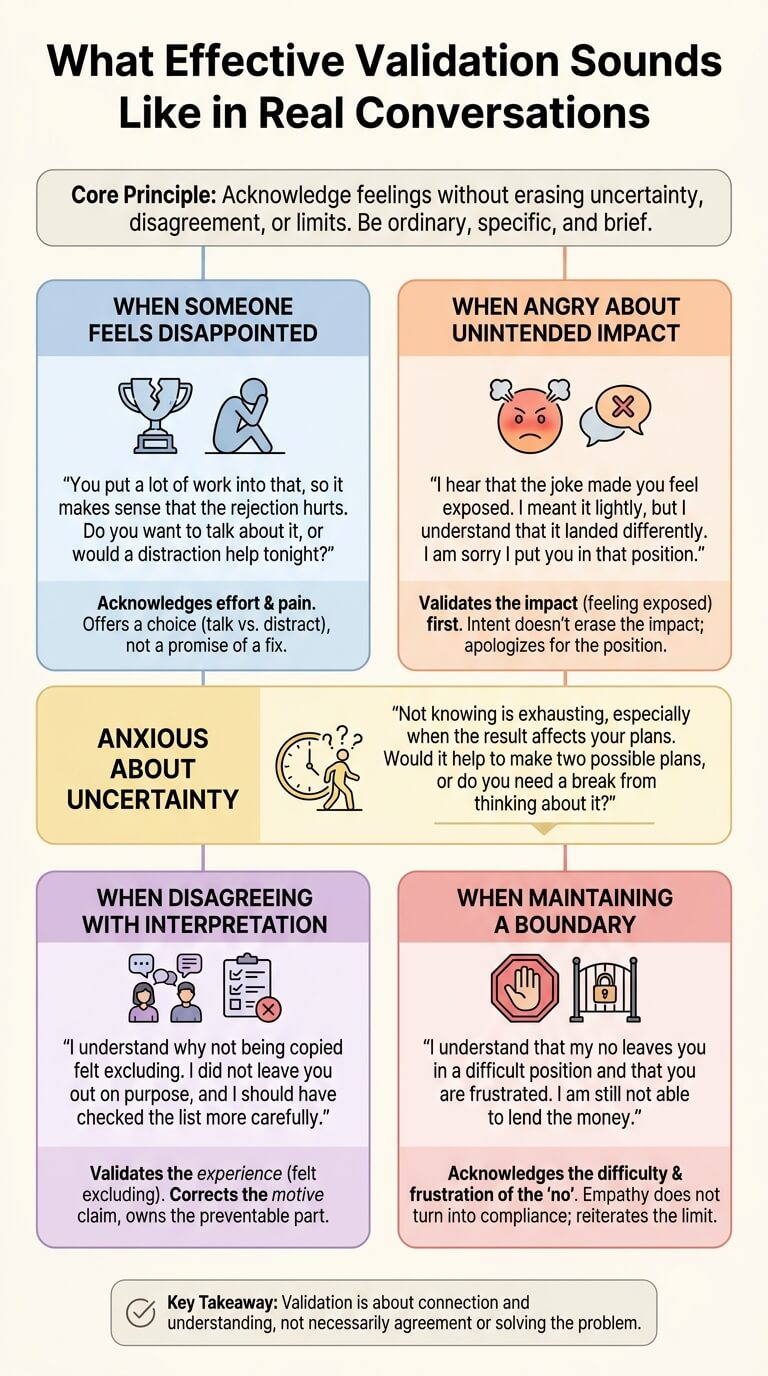
Useful validation sounds ordinary, specific, and brief. The examples below show how acknowledgment can coexist with uncertainty, disagreement, and limits.
When someone feels disappointed
Situation: A friend was not selected for an opportunity they prepared for.
Response: “You put a lot of work into that, so it makes sense that the rejection hurts. Do you want to talk about it, or would a distraction help tonight?”
The response does not promise that another opportunity will appear. It acknowledges effort, disappointment, and choice.
When someone is angry about impact you did not intend
Situation: A joke embarrassed someone in front of a group.
Response: “I hear that the joke made you feel exposed. I meant it lightly, but I understand that it landed differently. I am sorry I put you in that position.”
Intent remains part of the explanation, but it does not erase impact.
When someone is anxious about an uncertain outcome
Situation: A family member is waiting for an important decision.
Response: “Not knowing is exhausting, especially when the result affects your plans. Would it help to make two possible plans, or do you need a break from thinking about it?”
The response recognizes uncertainty before moving toward action.
When you disagree with the person’s interpretation
Situation: A coworker believes you excluded them intentionally.
Response: “I understand why not being copied felt excluding. I did not leave you out on purpose, and I should have checked the list more carefully.”
The speaker validates the experience, corrects the motive claim, and owns the preventable part.
When a boundary still needs to be maintained
Situation: Someone is angry that you will not lend them money.
Response: “I understand that my no leaves you in a difficult position and that you are frustrated. I am still not able to lend the money.”
The feeling is acknowledged without turning empathy into compliance.
Common Forms of Emotional Invalidation

Invalidation is not always deliberate cruelty. It can come from discomfort, urgency, a wish to help, or a habit of treating emotion as a problem to remove. The effect still matters.
Minimizing and comparison
“It is not a big deal,” “Other people have it worse,” and “At least you still have a job” reduce the significance of the current experience. Perspective can become useful later, but comparison rarely helps when it is used to disqualify emotion.
Mocking or pathologizing emotion
Comments such as “You are crazy,” “You are being dramatic,” or “Here comes the meltdown” turn emotional expression into evidence of defect. They also shift the conversation from what happened to whether the person is acceptable.
Do not use a diagnostic label as a shortcut for understanding ordinary distress or conflict.
Fixing before understanding
Advice can communicate care, but timing changes how it lands. The Gottman Institute’s guidance on listening before trying to fix feelings emphasizes empathy, curiosity, summarizing, and validation before moving toward solutions.
A simple question helps: “Do you want ideas, or do you want me to listen first?”
Demanding immediate calm
“Calm down” often asks the person to stop showing emotion so the listener can feel more comfortable. A limit on behavior may be necessary, but the limit should be specific: “I want to continue, and I need us to stop shouting.”
That statement addresses volume rather than declaring the emotion illegitimate.
Denying that the event could have affected the person
“You should not care about that” or “Nobody would be upset by this” treats one person’s reaction as the universal standard. A more curious response is, “I did not expect it to affect you this strongly. Help me understand what it meant to you.”
Why Well-Meant Responses Can Feel Invalidating
Many invalidating moments begin with a genuine wish to help. The difficulty is that the response solves, reframes, or redirects before the emotional message has been received.
Advice answers a problem the person has not yet defined
You may assume the person wants a solution when they are still trying to organize what happened. Advice then feels like pressure to move on before the experience has been understood.
Optimism can skip over present pain
“Everything happens for a reason” may reflect hope, but it can erase uncertainty, grief, or disappointment. Hope is more useful when it joins the present rather than replacing it: “This hurts now, and I believe you will have options when you are ready to consider them.”
Fact correction can arrive before emotional reception
If someone says, “You ignored me all evening,” you may immediately list the three times you spoke. The factual correction may be accurate, yet the emotional message could be that they felt alone during the gathering.
Receive that message first, then clarify the wording: “I hear that you felt alone. I do remember speaking several times, so I want to understand which moments felt most isolating.”
Sharing a similar story can shift attention away
A brief personal example can show solidarity, but return the focus quickly: “I remember that kind of uncertainty. What has been hardest for you?”
How to Validate When the Interpretation Seems Wrong

You do not have to choose between compassion and accuracy. Separate the emotional experience from claims about motives, facts, or future outcomes, then respond to each layer honestly.
Validate the feeling and the perceived meaning
Focus on what the person experienced: “You thought the decision had already been made without you, and that felt dismissive.” This recognizes the meaning they perceived without confirming that exclusion was intentional.
Clarify facts after the person feels received
Use sequencing rather than choosing between empathy and truth. First reflect the emotional point. Then say, “There is one factual detail I remember differently. Can we compare what each of us understood?”
Avoid confirming claims you cannot verify
Do not validate by pretending certainty. “You are right, everyone is judging you” may intensify anxiety and make an unsupported claim. Say, “It sounds frightening to feel watched. I cannot know what everyone is thinking, but I can help you look at what actually happened.”
Hold boundaries around harmful behavior
Validation does not require accepting threats, insults, intimidation, property damage, stalking, or coercion. You can say, “I understand that you are furious. I will not stay while you threaten me.”
The emotional state can be real and understandable while the behavior remains unacceptable.
Validation During Conflict
Conflict makes acknowledgment harder because each person may fear that understanding the other side will weaken their own. Sequencing helps preserve both perspectives.
Validation becomes especially useful in difficult conversations, where empathy and factual disagreement must coexist.
Acknowledge impact before explaining intent
When your action contributed to hurt, begin with impact: “I understand that my silence left you uncertain.” Intent can follow: “I was overwhelmed, not trying to punish you.” This order makes explanation less likely to sound like erasure.
Validate one part without accepting the entire accusation
Many conflict statements contain a valid emotional point and an exaggerated conclusion. “You never respect me” may include a real experience of being interrupted. Respond to the usable part: “Interrupting you twice was disrespectful. I do not agree that I never respect you, and I want to change what happened today.”
Use pauses when both people are too activated to receive acknowledgment
Validation requires enough attention to listen and enough regulation to avoid sarcasm or forced compliance. If either person cannot process the exchange, pause with a return plan: “I want to understand this, and I am too activated right now. I will come back at 8:00.”
A pause helps only when it protects the conversation rather than disappearing from it.
When Validation Does Not Resolve the Problem
Recognition can improve the quality of a conversation, but it cannot replace action, settle every value difference, or make an unsafe demand reasonable.
The person needs action or follow-through, not only words
Repeated acknowledgment without behavioral change can feel hollow. If someone has raised the same missed commitment several times, “I understand why you are upset” is not enough. The next step may be a changed system, a clear deadline, restitution, or a decision about what will happen if the pattern continues.
Core values or facts remain disputed
Two people may understand each other and still disagree about money, parenting, privacy, work, religion, or responsibility. Validation cannot manufacture agreement. Its role is to make the disagreement clearer and less dehumanizing.
Validation is demanded as forced agreement or compliance
“If you really validated me, you would admit I am right” changes validation into a loyalty test. You are allowed to acknowledge emotion while rejecting the demanded conclusion: “I understand that my answer disappoints you. I am not going to say I agree when I do not.”
A Validation Self-Check
Use these questions before offering advice, correcting facts, or explaining your intent. They help you check whether acknowledgment has actually occurred.
Did I name the emotional meaning rather than debate it?
Check whether your first response addressed the experience or immediately argued with the wording. Try to summarize what the event represented to the person.
Did I check instead of assume?
Use questions such as “Is that close?” or “Was the main feeling disappointment or embarrassment?” Validation becomes more accurate when the person can revise your understanding.
Did I preserve facts and boundaries?
Compassion should not require false confession, unsafe access, or approval of harmful conduct. Identify what you can acknowledge honestly and what you still need to clarify or refuse.
Did I ask what response is wanted next?
Listening, comfort, advice, action, and space are different needs. Ask before choosing for the person.
How Validation Works With Listening, Feeling Heard, and Repair
Validation overlaps with several other communication skills, but each solves a different part of the exchange. Knowing the difference prevents one supportive response from being expected to do everything.
Validation works best alongside active listening, which receives the facts, meaning, emotion, and request as a whole.
Active listening receives the whole message
Listening includes attention to facts, meaning, requests, and emotion. Validation focuses specifically on communicating that the emotional experience has been recognized. You can listen accurately yet still leave the person emotionally unseen if you summarize only the timeline.
Validation is only one layer of why people feel unheard, because response and follow-through may still be missing.
People can feel unheard when acknowledgment or follow-through is missing
Being heard involves more than sound entering another person’s ears. Someone may want their concern understood, their emotion acknowledged, or their request acted on. Validation addresses the acknowledgment layer, but it cannot replace follow-through.
If earlier minimization created a rupture, repair attempts may be needed in addition to acknowledgment.
Repair may be needed when earlier invalidation created a rupture
If you minimized, mocked, interrupted, or corrected too quickly, name that part: “I tried to solve the problem before I understood how hurt you were. I can see why that made you feel alone.” Then ask what repair would be meaningful now.
When Safety Matters More Than Validation Technique
Emotional acknowledgment is appropriate only when it can be offered honestly and safely. Fear, coercion, and retaliation change the task from improving communication to protecting agency and wellbeing.
Fear, coercion, threats, humiliation, stalking, or retaliation
In an unsafe dynamic, demands for validation can be used to force agreement, confession, access, or compliance. The National Domestic Violence Hotline’s information on power and control describes patterns involving intimidation, isolation, threats, and coercion.
If direct disagreement may lead to violence, stalking, financial punishment, humiliation, or retaliation, prioritize safety planning and confidential support. Communication technique is not a substitute for protection.
Why validating emotion does not require staying in an unsafe exchange
You may understand that someone feels abandoned, jealous, or enraged and still leave when they threaten you. You may acknowledge fear without surrendering your privacy. You may care about their pain without taking responsibility for preventing every reaction.
Validation is voluntary, honest recognition. It is not an obligation to remain available to a person who is harming or controlling you.
FAQ About Emotional Validation
These answers address the gray areas that most often make validation feel confusing or artificial.
Can you validate a feeling you do not understand?
Yes, but avoid pretending. You can say, “I can see this affected you strongly, and I do not fully understand why yet. Can you tell me what it meant to you?” Validation can begin with recognition and curiosity rather than complete understanding.
Does validation mean admitting you caused the emotion?
No. Many factors shape emotion, including expectations, context, past experiences, uncertainty, and the current event. You can acknowledge the feeling while discussing your actual responsibility separately. If your action contributed, precise ownership is more useful than accepting total blame.
Can you validate anger while rejecting aggressive behavior?
Yes. Say, “I understand that you are angry about the decision. I will discuss it when we can do so without insults or threats.” This recognizes the emotion and sets a limit on behavior.
Why does reassurance sometimes feel invalidating?
Reassurance can arrive as a correction of emotion: “You are fine,” “Nothing bad will happen,” or “Do not worry.” When uncertainty is real, those statements may feel dismissive. Acknowledge the fear first, then offer only reassurance you can honestly support.
What if validation sounds scripted or fake?
Use fewer words and greater specificity. Replace “Your feelings are valid” with “You expected me to remember, and when I forgot, it felt like the event did not matter to me.” Natural validation sounds like accurate understanding, not a memorized formula.
Key Takeaways
- Emotional validation recognizes a feeling and its context without automatically endorsing every belief, accusation, or behavior.
- The Validation Ladder moves from attention and reflection toward checking understanding and choosing the needed response.
- Agreement, reassurance, permission, and validation answer different questions and should not be treated as interchangeable.
- Advice, optimism, correction, and personal stories may feel invalidating when they arrive before emotional reception.
- Validation can coexist with factual disagreement, accountability, firm boundaries, and refusal of harmful behavior.
- Words alone are not enough when the problem requires changed behavior, follow-through, or safety-focused support.
Choose one conversation in which you usually fix, reassure, or defend. Before doing any of those things, reflect the emotional meaning in one sentence and ask whether you understood it correctly. That small sequence does not solve every disagreement, but it gives both people a clearer place from which to decide what comes next.
Author note: Michael Reed is the Founder and Lead Writer at Psychology Exposed. He explains human behavior, relationships, emotional patterns, self-awareness, and everyday decisions in clear, research-aware language. This material is educational and is not a substitute for individualized mental health, legal, workplace, or safety advice.

Michael Reed is the Founder and Lead Writer at Psychology Exposed. He writes about human behavior, relationships, emotional patterns, self-awareness, and practical psychology topics using research-informed, easy-to-understand content.
Read More About Michael Reed: https://psychologyexposed.com/michael-reed/