
A goal can turn a vague wish into a clear direction. It can also create pressure, tunnel vision, or a standard so unrealistic that action feels pointless before it begins. The difference is not simply whether the goal is written down or measurable.
Goals shape motivation by telling the mind what deserves attention, what success should look like, and how current performance compares with a desired future. A useful goal makes effort easier to organize. A poorly designed goal can lower confidence, reward the wrong behavior, or make every imperfect result feel like failure.
This is why setting a more ambitious target does not always create stronger motivation. The goal must be clear enough to guide action, difficult enough to matter, believable enough to invite effort, and personally meaningful enough to deserve commitment. It also needs feedback and room for revision when new information changes what is realistic.
Quick Answer
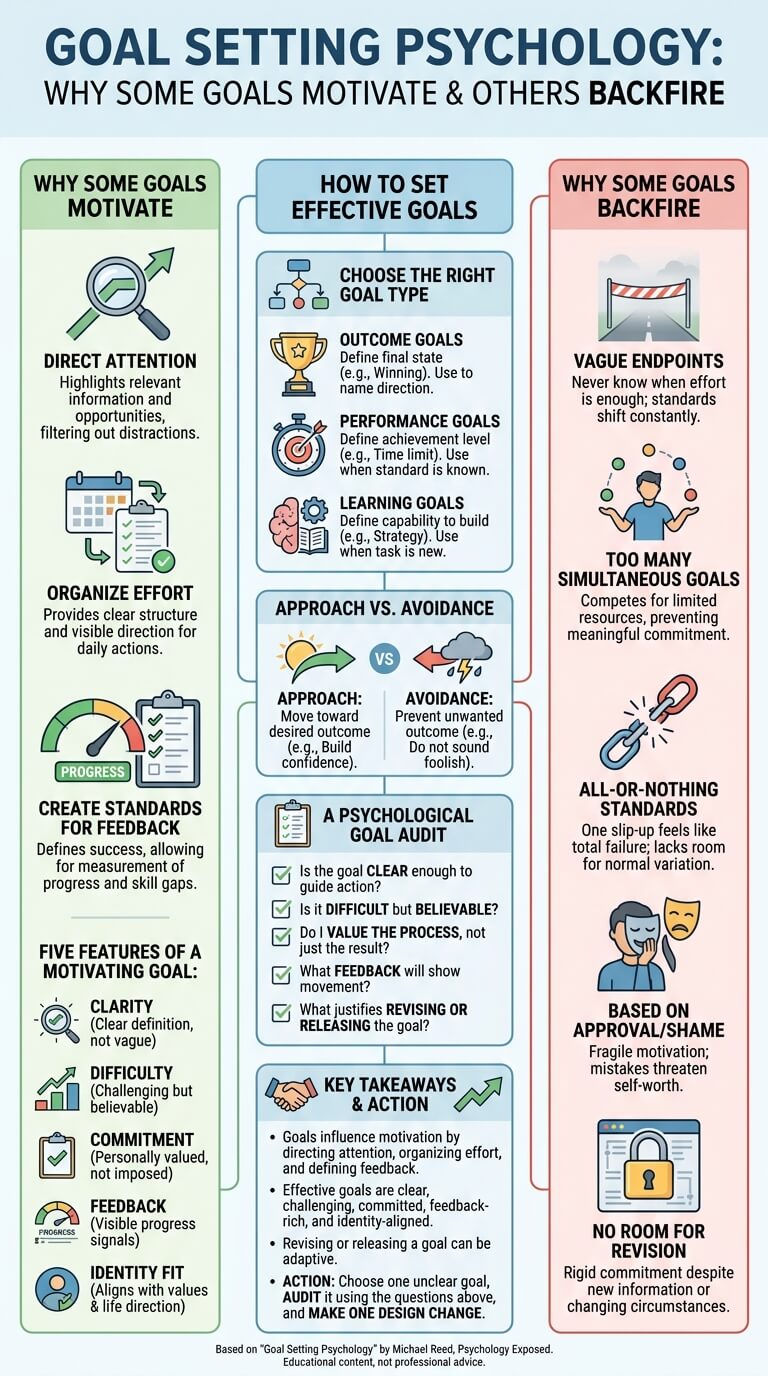
Goal setting affects motivation by directing attention, organizing effort, and creating a standard for feedback. Goals tend to help when they are clear, challenging but believable, personally endorsed, and connected to useful progress signals. They can backfire when they are vague, impossibly difficult, based mainly on approval, too narrow, or treated as permanent commitments that cannot adapt to changing capacity and circumstances.
What Goals Do to Motivation
Direct attention
A goal makes some information more relevant than other information. Once you decide to learn conversational Spanish, you notice useful phrases, practice opportunities, and gaps in understanding that previously blended into the background.
This direction is valuable because attention is limited. It is also risky. A narrow target can cause a person to ignore information that does not appear connected to the goal, even when that information concerns health, quality, relationships, or ethics.
Organize effort
A goal helps answer where effort should go. “Become healthier” is too broad to organize Tuesday afternoon. “Walk for twenty minutes after lunch on three weekdays” gives behavior a more visible direction.
A review of goals and behavior change describes a goal as a desired future state connected with actions that promote reaching it. This distinction between the desired end and the means matters because wanting an outcome does not automatically create a workable path.
Create standards for feedback
Without a goal, feedback has no reference point. A person cannot know whether five pages represent useful progress until they define what they are trying to produce, learn, or change.
The goal creates the comparison. Feedback then shows the distance between the current state and the desired state. That information may strengthen motivation, reveal a skill gap, or indicate that the method needs revision.
Change the meaning of success and failure
A goal defines what counts as success. If the standard is “never miss a day,” one interruption becomes failure. If the standard is “return within forty-eight hours,” the same interruption becomes part of the plan.
Goals therefore shape emotion as well as behavior. They influence whether a result feels encouraging, disappointing, informative, or threatening.
The Five Psychological Features of a Motivating Goal

| Feature | Helpful form | Common problem |
|---|---|---|
| Clarity | The person knows what the desired change means. | The target is vague or depends on an undefined standard. |
| Difficulty | The goal requires effort but still appears possible. | The goal is trivial, overwhelming, or detached from current ability. |
| Commitment | The person accepts the goal as worth pursuing. | The goal is imposed, guilt-driven, or weakly valued. |
| Feedback | The person can see whether action is producing movement. | The final result is too distant or the available metric is misleading. |
| Identity fit | The goal fits current values, roles, capacity, and life direction. | The goal protects an outdated identity or mainly seeks approval. |
Clarity: knowing what counts
Clarity reduces interpretation. It defines the change without requiring the person to decide from the beginning each time. “Read more” leaves many unanswered questions. “Read twenty pages of the selected book before checking social media on Saturday and Sunday” is more actionable.
Clarity does not require reducing every meaningful goal to a number. “Have a more honest conversation with my sister about shared caregiving” may need behavioral signs such as naming limits, asking for specific help, and agreeing on one next decision.
Difficulty: enough challenge without perceived impossibility
A goal that is too easy may provide little focus or satisfaction. A goal that feels impossible may reduce effort because the person expects action to make little difference.
Research overviews of goal-setting theory commonly emphasize that specific and challenging goals can improve performance under suitable conditions. A broader analysis of specific goals and broad long-term goals also shows why concrete targets and higher-level purpose can serve different functions.
Commitment: accepting the goal as worth pursuing
Difficulty only motivates when the person is sufficiently committed. A challenging target imposed by someone else may create resistance, minimum compliance, or anxiety rather than focused effort.
Commitment becomes more believable when the person understands the reason, has meaningful input, and sees the outcome as compatible with personal values.
Feedback: seeing how current performance compares with the target
Feedback answers whether the method is working. It may come from completed stages, improved accuracy, reduced confusion, a teacher’s response, or another credible sign.
The best feedback is timely enough to guide the next attempt and honest enough to reveal both progress and needed change. A comforting number that does not represent the desired outcome can mislead motivation.
Identity fit: the goal belongs in the person’s life and values
A goal can be clear, difficult, and measurable while still feeling wrong. It may belong to a former version of the person, reflect someone else’s expectations, or demand resources needed for more important responsibilities.
Identity fit does not mean the process always feels natural. It means the goal can be defended as part of the life the person currently chooses to build.
When Clear Goals Help
Reducing ambiguity
Ambiguity creates decision cost. Each session begins with questions about what to do, how much is enough, and where to stop. A clear goal removes some of those choices.
This is especially helpful when the task is emotionally difficult. A defined next action can prevent anxiety from expanding a manageable task into an undefined threat.
Turning intention into a direction
Intentions describe what a person wants. Plans connect those intentions with situations and actions. Implementation intentions use an if-then form, such as, “If I finish dinner on Monday, then I will review the first ten practice questions.”
A peer-reviewed review explains that implementation intentions link a critical situation with a goal-directed response. They can reduce the gap between wanting to act and recognizing the moment to begin.
Making progress measurable
A goal creates a reference point that allows progress to become visible. The measure should answer a useful question. Counting study hours may show effort, while test errors may show learning needs.
Measurability is helpful when it reduces uncertainty. It is harmful when the easiest number replaces the meaningful change.
Coordinating effort across time
Long goals compete with daily demands. A clear target helps decide what deserves attention this week and what can wait.
Coordination also requires hierarchy. A broad purpose may guide several shorter targets, while shorter targets provide actions that can be completed now.
When Goals Become Too Narrow
Chasing the metric instead of the purpose
Once a metric becomes the target, people may optimize the number rather than the outcome it was meant to represent. A reading goal can produce rushed pages without understanding. A posting goal can produce frequent content without useful ideas.
Ask what the metric stands for. If the number improves while the underlying purpose does not, the goal needs redesign.
Ignoring learning, health, relationships, or quality
A narrow performance target can absorb attention. The person may sacrifice sleep, hide uncertainty, or neglect relationships because those costs are not included in the score.
A good goal includes boundaries. It defines what should not be sacrificed, especially when success is socially rewarded.
Why measurable does not always mean meaningful
Numbers are attractive because they appear objective. Yet many valuable changes involve judgment, quality, trust, understanding, or flexibility.
Use measures when they clarify reality, not when they create false precision. A mixed approach may include one number and one qualitative review.
Goal Difficulty and Expected Success
Easy goals that create little engagement
An easy goal may be useful for restarting, learning the process, or reducing fear. It becomes limiting when it provides no challenge, skill growth, or meaningful result.
The issue is not that easy goals are bad. The issue is whether the difficulty matches the current purpose.
Stretch goals that increase focus
A stretch goal can concentrate attention and encourage better strategy. It may reveal what preparation, collaboration, or skill development is required.
Stretch goals work poorly when they are motivational theater, meaning they look ambitious but have no credible path, resources, or feedback.
Impossible-feeling goals that reduce expectancy
When success feels impossible, effort appears wasteful. The person may avoid starting, delay evaluation, or protect self-worth by claiming they never truly tried.
Goal design is one part of the wider system described by motivation psychology.
Lowering the next test does not require abandoning the larger aim. It can create evidence that capability is growing.
Matching difficulty to current competence
Competence is specific. A capable writer may be a beginner at public speaking. A person with strong general fitness may still need instruction for a new movement.
Match the challenge to current skill, available support, time, and consequences. The same target can motivate one person and overwhelm another.
Approach Goals vs Avoidance Goals

Moving toward a desired outcome
Approach goals describe what the person wants to create, gain, learn, or experience. Examples include building conversational confidence, completing a portfolio, or increasing strength safely.
These goals direct attention toward desired behavior and can make progress easier to define.
Trying not to fail, lose, embarrass yourself, or feel guilty
Avoidance goals focus on preventing an unwanted outcome. “Do not sound foolish,” “Do not regain weight,” or “Do not disappoint anyone” may create effort, but they also keep attention close to threat.
Avoidance is sometimes realistic. Preventing injury, debt, or a repeated harmful behavior can be important. The problem appears when the goal defines only what must not happen and offers no clear desired direction.
Why avoidance goals can create vigilance and pressure
Avoidance goals encourage monitoring for error. This can be useful in safety-critical situations, but exhausting when every small deviation feels dangerous.
Avoidance goals can become especially powerful when fear of failure makes the result feel personally threatening.
Where possible, pair prevention with an approach target. “Do not avoid difficult conversations” becomes clearer when paired with “Name one concern directly and ask one honest question.”
When fear becomes the real goal manager
If the main purpose is preventing shame, rejection, or proof of inadequacy, the goal may create high effort and low willingness. Progress provides only temporary relief because the threat remains.
This is a sign to examine fear and self-worth, not simply make the goal more specific.
Outcome Goals, Performance Goals, and Learning Goals

Outcome goals define the result
Outcome goals describe the final state, such as getting accepted, winning a competition, reaching a financial target, or publishing a book.
They provide direction but often depend partly on other people, timing, competition, or circumstances outside the person’s control.
Performance goals define a standard
Performance goals define a level of achievement, such as completing a distance within a time or reaching a particular accuracy rate.
They can provide a clearer reference point than broad outcomes, but they may still create pressure when the standard is used as a verdict about identity.
Learning goals define what capability to build
Learning goals focus on strategy, knowledge, or skill. Examples include learning to structure an argument, improving interview responses, or identifying errors in a technique.
They are especially useful when the task is new and the correct method is not yet known.
Choosing the right goal type for uncertainty
Use outcome goals to name direction, performance goals when the relevant standard is known, and learning goals when the main challenge is building capability.
A workable goal still needs follow-through, which is where motivation and discipline play different roles.
| Situation | Most useful emphasis | Example |
|---|---|---|
| The destination matters, but external factors influence it. | Outcome plus controllable supporting goals. | Apply for five suitable programs while improving the portfolio. |
| The task and standard are familiar. | Performance goal. | Complete the presentation within twelve minutes while covering all required points. |
| The task is new or complex. | Learning goal. | Learn three ways to test whether the analysis is reliable. |
| Fear is blocking experimentation. | Learning goal with a small evaluation. | Produce one draft to identify what needs practice. |
Goal Commitment and Personal Ownership
Chosen goals versus imposed goals
An imposed goal can produce action through reward, fear, guilt, or obligation. That does not mean it will create personal commitment.
Sometimes the circumstance is not optional, but the person can still understand the reason, choose part of the method, and decide how the action relates to personal values.
Values, identity, and internalization
Goals become more self-directed when the person accepts their importance. They may not enjoy every action, but the outcome fits something they value.
Self-Determination Theory includes Goal Contents Theory, which examines differences in the kinds of goals people pursue and how those goals relate to psychological needs and well-being. This helps explain why two equally clear goals can have different motivational effects.
When ownership is present but enthusiasm is low
A personally chosen goal does not guarantee excitement. Caregiving, rehabilitation, study, and financial planning may remain tiring or repetitive.
Personal ownership is easier to understand through Self-Determination Theory and its focus on autonomy, competence, and relatedness.
Ownership means the person can endorse the reason. Structure and recovery may still be required for follow-through.
Feedback and Progress Inside Goal Pursuit
Goals create the reference point
A progress signal has meaning only in relation to a target. Ten practice sessions may be encouraging if they improve accuracy, or irrelevant if the method is wrong.
Progress signals show whether movement is happening
Useful signals indicate whether effort is producing change. They can increase confidence, reveal a plateau, or show that the goal needs a new method.
After the standard is defined, progress psychology explains how movement toward it changes motivation.
Goal design comes before progress interpretation
Goal setting defines the destination and standard. Progress psychology examines how movement, small wins, feedback, and perceived distance affect motivation after that reference point exists.
Keeping these questions separate prevents a person from tracking a goal that was poorly designed from the beginning.
Why Goal Setting Can Reduce Motivation
Vague endpoints
“Do better,” “be successful,” and “get organized” create standards that can move without warning. The person never knows when effort is enough.
Too many simultaneous goals
Every goal competes for time, attention, money, and emotional energy. A long list can create the appearance of direction while preventing meaningful commitment to any one target.
All-or-nothing standards
A standard such as perfect daily consistency makes normal interruption look like total failure. Better goals include a return condition and acceptable variation.
Goals based mainly on approval or shame
Approval-based goals can create intense launches because success promises relief or recognition. They become fragile when feedback is absent or mistakes threaten self-worth.
No room for adjustment after new information
A goal is a decision based on current knowledge. New information about health, cost, skill, opportunity, or values may justify change.
Research on goal disengagement and reengagement treats reducing effort and releasing commitment as meaningful self-regulatory processes. Revising or leaving a goal can be adaptive when the target is blocked, too costly, or no longer valuable.
A Psychological Goal Audit

| Audit question | Useful evidence | Reason to revise |
|---|---|---|
| Is the goal clear enough to guide action? | You can describe the desired change and the next relevant behavior. | The standard changes depending on mood or comparison. |
| Is it difficult but believable? | The goal requires growth and has a credible path. | Success appears unrelated to effort or current capacity. |
| Do I value the process or only the result? | The effort builds a skill, value, contribution, or useful experience. | Only status, approval, or fantasy makes the goal attractive. |
| What feedback will show movement? | The signal reflects meaningful change and arrives soon enough to guide action. | The metric rewards activity, appearance, or shortcuts. |
| What would justify revising or releasing the goal? | Clear review criteria exist before a crisis occurs. | Any change is automatically treated as failure. |
Is the goal clear enough to guide action?
State the desired change in plain language. Then name one behavior that would be relevant this week. If those answers remain vague, clarity is the first problem.
Is it difficult but believable?
Estimate what skills, time, support, and resources the goal requires. Believability should come from evidence and planning, not forced optimism.
Do I value the process or only the result?
Most goals involve a large amount of process and a brief final result. If the process offers no value, consider whether another path can produce the desired outcome.
What feedback will show movement?
Choose one measure of action and one measure of change. This prevents effort counts from being mistaken for results.
What would justify revising or releasing the goal?
Define review conditions in advance. Examples include health cost, new responsibilities, repeated evidence that the method fails, or discovery that the outcome no longer fits personal values.
What to Do When a Goal Is Not Motivating
Clarify the desired change
Replace a label with an observable difference. Instead of “be confident,” define where confidence should appear and what behavior would show it.
Reduce ambiguity before reducing ambition
A large goal may feel impossible because the path is unclear rather than because the ambition is wrong. Clarify the next stage, decision, or skill before shrinking the final outcome.
Shift from outcome to learning when skill is uncertain
When you do not yet know how to succeed, use a learning target. A meta-analysis of mental contrasting with implementation intentions notes that wishes and goals benefit from planning that identifies obstacles and connects them with specific responses.
A learning goal makes early difficulty informative instead of treating it as proof that the outcome is unreachable.
Separate personal value from social approval
Imagine pursuing the goal without public recognition. What skill, contribution, experience, or option would remain valuable? If nothing remains, the goal may be serving status more than personal direction.
Create a review point instead of demanding permanent commitment
Commit for a defined period or stage, then evaluate evidence. A review point reduces the fear that beginning means being trapped forever.
Goal Setting vs Discipline and Success Mindset
Goal design sets direction
Goal design defines what the person is trying to change and what standard will guide effort. A poorly designed direction cannot be repaired by stronger consistency alone.
Discipline supports follow-through
Discipline helps carry out a chosen plan when preference fluctuates. It does not determine whether the destination is meaningful, ethical, or realistic.
Mindset affects interpretation but does not replace a workable goal
Beliefs influence how setbacks are interpreted. A constructive mindset may help a person treat difficulty as information. It cannot make a vague goal clear or make an impossible demand feasible.
Frequently Asked Questions About Goal Setting Psychology
Do specific goals always work better than general goals?
No. Specific goals are useful when the task and desired behavior are understood. Broad goals can preserve meaning and flexibility in complex or long-term pursuits. Many people benefit from a hierarchy that combines a broad purpose with specific near-term targets.
Can a goal be too difficult to motivate?
Yes. Challenge can increase focus when the person is committed and believes effort can work. A goal that feels impossible may reduce expectancy, encourage avoidance, or turn performance into a threat to self-worth.
Why do goals feel exciting before I begin?
Before action, the desired future is vivid while the cost remains partly imagined. Planning also provides an immediate sense of direction and identity. Motivation may change when repetition, skill gaps, and real constraints become visible.
Should I change a goal after losing motivation?
Investigate first. Motivation may fall because the goal is vague, feedback is missing, the pace is unrealistic, or capacity has changed. Revise or release the goal when evidence shows that it no longer fits, not simply because one difficult week occurred.
Are learning goals better than performance goals?
They serve different purposes. Learning goals are especially useful when the task is new or strategy is uncertain. Performance goals are useful when the relevant capability and standard are already understood. Complex pursuits often need both at different stages.
Key Takeaways
- Goals influence motivation by directing attention, organizing effort, and defining the standard used to interpret feedback.
- A motivating goal is usually clear, challenging but believable, personally endorsed, supported by feedback, and compatible with current values and capacity.
- Specific metrics help only when they represent the real purpose rather than becoming a substitute for it.
- Approach goals define a desired direction, while avoidance goals can keep attention focused on threat, error, or shame.
- Outcome, performance, and learning goals serve different functions and should match the level of uncertainty and control.
- Revising or releasing a goal can be adaptive when new information changes its value, feasibility, or cost.
Choose one goal that currently feels unclear or heavy. Audit its direction, difficulty, ownership, feedback, and fit. Then make one design change before demanding more effort. A goal should not merely sound ambitious. It should help you understand what matters, what action is relevant, and what evidence would justify continuing, revising, or choosing a different direction.
Author note: Michael Reed is the Founder and Lead Writer at Psychology Exposed. He explains human behavior, emotional patterns, self-awareness, and everyday decisions in clear, research-aware language. This content is educational and is not a substitute for diagnosis, therapy, medical care, or professional advice.

Michael Reed is the Founder and Lead Writer at Psychology Exposed. He writes about human behavior, relationships, emotional patterns, self-awareness, and practical psychology topics using research-informed, easy-to-understand content.
Read More About Michael Reed: https://psychologyexposed.com/michael-reed/