
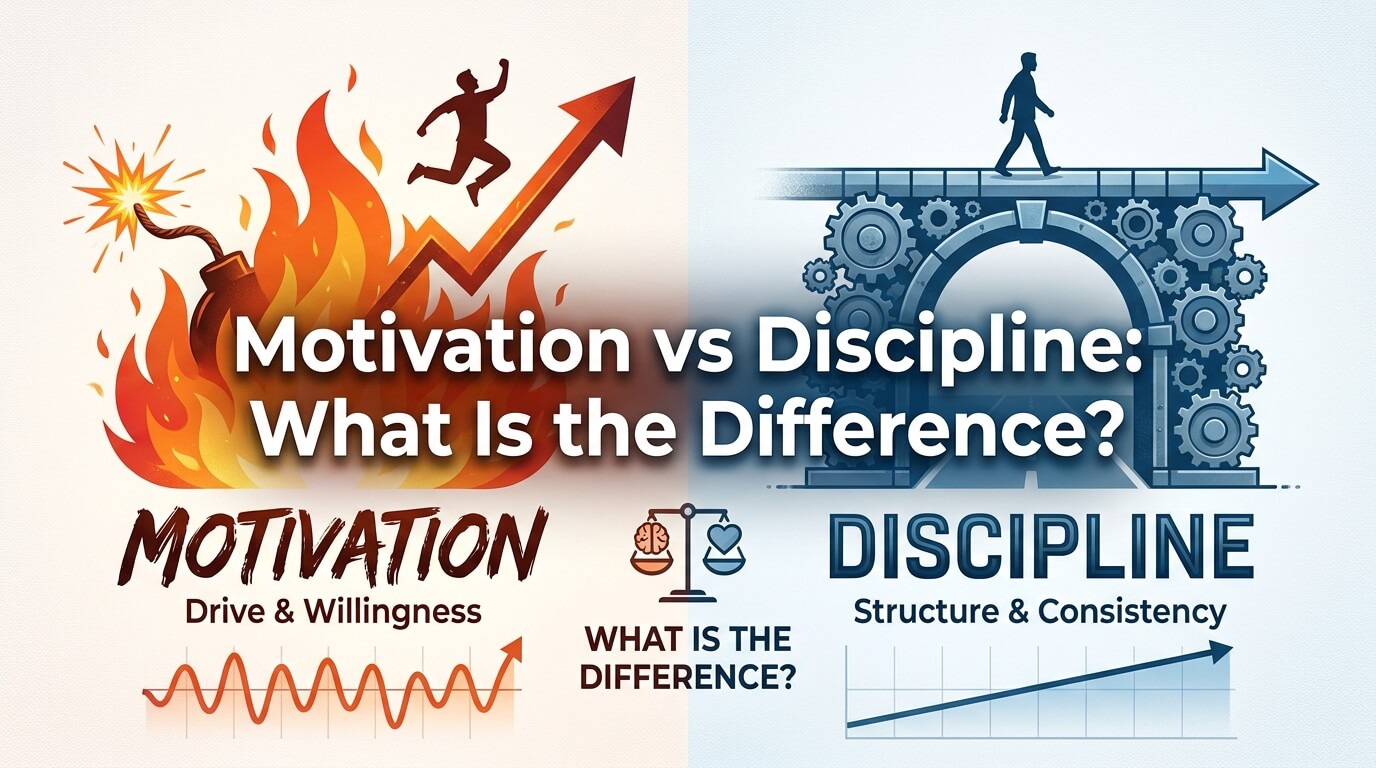
You may hear that motivation is unreliable and discipline is the answer. The advice sounds decisive, but it leaves out an important question: what problem are you actually trying to solve?
Motivation and discipline are not rival personality traits. Motivation helps explain why an action feels worth doing, which goal receives attention, and how much energy or willingness is available. Discipline helps protect behavior when preference changes, discomfort appears, or a decision must be carried out more than once.
A person can have strong motivation without enough structure to continue. Another person can be highly disciplined while pursuing a goal that no longer fits their values, health, or circumstances. Understanding the difference helps you avoid two common mistakes: waiting for inspiration before every action, or forcing yourself through every difficulty without checking whether the goal still deserves the effort.
Quick Answer

Motivation is the drive, value, and willingness that direct action. Discipline is the ability to follow a chosen course when feelings, comfort, or immediate rewards change. Motivation answers, “Why does this matter?” Discipline answers, “What will I do when the feeling is weaker?” The two work best together, and neither should be used to ignore exhaustion, fear, changing values, or unrealistic demands.
Motivation and Discipline Solve Different Problems
Motivation answers why this action feels worth doing
The APA Dictionary of Psychology defines motivation as an impetus that gives purpose or direction to behavior. Motivation helps a person select among competing actions and decide whether an expected outcome is worth the effort.
It can come from enjoyment, curiosity, meaning, reward, approval, fear, duty, identity, or a combination of these. Motivation also changes when value, expected success, effort, or feedback changes.
Discipline answers what happens when the feeling changes
The APA definition of self-discipline emphasizes controlling impulses and regulating behavior in service of improvement or a chosen standard. Discipline helps a person act when the immediate preference is to delay, stop, or choose an easier option.
This does not mean discipline removes emotion. It means the person does not let every temporary feeling rewrite the plan. They may acknowledge boredom, reluctance, or frustration and still complete the next reasonable action.
Neither concept explains every failure to act
A person may fail to act because the goal is unclear, the task is impossible under current conditions, needed skills are missing, fear is high, or energy is severely depleted. Calling every difficulty a motivation problem or a discipline problem hides those differences.
Before choosing a solution, ask whether the barrier is about value, belief, capacity, structure, or safety. The correct response may be more meaning, a smaller plan, better instruction, recovery, or permission to change direction.
Motivation vs Discipline at a Glance
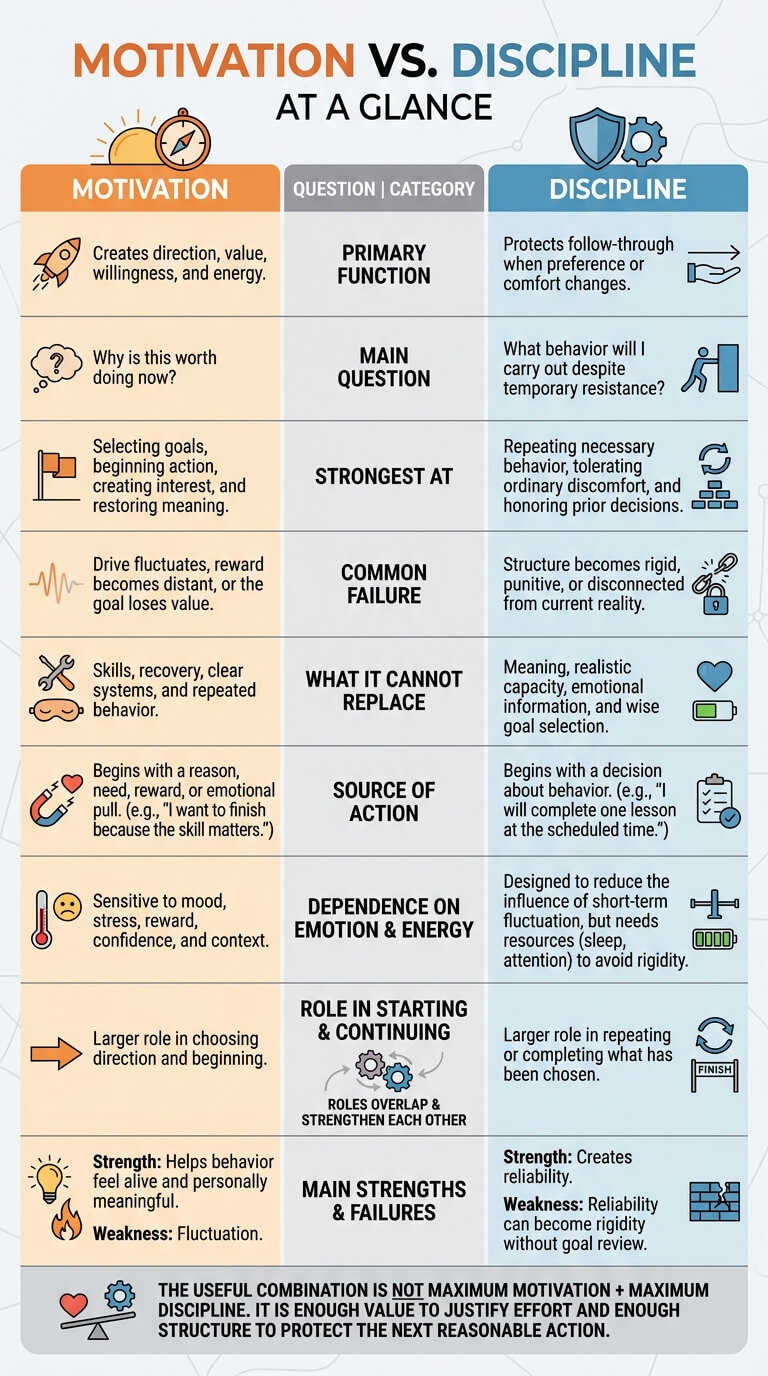
| Question | Motivation | Discipline |
|---|---|---|
| Primary function | Creates direction, value, willingness, and energy. | Protects follow-through when preference or comfort changes. |
| Main question | Why is this worth doing now? | What behavior will I carry out despite temporary resistance? |
| Strongest at | Selecting goals, beginning action, creating interest, and restoring meaning. | Repeating necessary behavior, tolerating ordinary discomfort, and honoring prior decisions. |
| Common failure | Drive fluctuates, reward becomes distant, or the goal loses value. | Structure becomes rigid, punitive, or disconnected from current reality. |
| What it cannot replace | Skills, recovery, clear systems, and repeated behavior. | Meaning, realistic capacity, emotional information, and wise goal selection. |
Source of action
Motivation begins with a reason, need, reward, or emotional pull. Discipline begins with a decision about behavior. Motivation may say, “I want to finish this course because the skill matters.” Discipline may say, “I will complete one lesson at the scheduled time even when another option feels easier.”
Dependence on emotion and energy
Motivation is sensitive to mood, stress, reward, confidence, and context. Discipline is designed to reduce the influence of short-term fluctuation, but it is not independent of energy or health.
A disciplined plan still needs sleep, attention, time, and realistic capacity. When those resources are repeatedly absent, greater force may produce worse decisions rather than better consistency.
Role in starting, choosing, and continuing
Motivation has a larger role in choosing direction and beginning. Discipline has a larger role in repeating or completing what has already been chosen.
The roles overlap. Starting one small action may increase motivation through progress. Reconnecting with meaning may strengthen discipline by making discomfort feel worthwhile.
Main strengths and failure points
Motivation helps behavior feel alive and personally meaningful. Its weakness is fluctuation. Discipline creates reliability. Its weakness is that reliability can become rigidity when the person stops reviewing the goal.
The useful combination is not maximum motivation plus maximum discipline. It is enough value to justify effort and enough structure to protect the next reasonable action.
What Motivation Contributes
Direction and goal selection
Motivation helps decide which goal deserves attention. Without this function, discipline can become efficient movement in the wrong direction.
A person may follow a routine perfectly while pursuing a standard chosen mainly for approval. The behavior is consistent, but the reason remains externally controlled or emotionally costly.
Both concepts belong within the broader study of motivation psychology.
Energy and willingness
Motivation changes how effort feels. A meaningful action may still be difficult, but the person is more willing to pay the cost. When value is low or success feels impossible, the same action feels heavier.
Willingness is especially important during change. Before a behavior becomes familiar, the person must repeatedly choose it over more immediate alternatives.
Meaning, reward, and expected success
Motivation grows when the outcome matters, the reward is credible, and effort seems capable of producing change. A goal can be highly valuable and still produce little action when expected success is near zero.
Useful feedback strengthens motivation because it shows that action has an effect. Vague praise or distant outcomes may not provide enough evidence to continue.
Why motivation can be present but unstable
A person may care deeply but depend on emotional intensity to act. They work only when inspired, afraid, or close to a deadline. The motive is real, but the action has no stable support.
This is where discipline becomes useful. It converts a valued intention into a decision that does not need to be renegotiated every time.
What Discipline Contributes
Structure and pre-decided behavior
Discipline reduces repeated decision making. A person decides in advance when, where, or how a behavior will occur. This protects action from the changing appeal of immediate alternatives.
Structure can be as simple as opening the same document after breakfast, reviewing notes for twenty minutes, or preparing tomorrow’s materials before stopping.
Following through when preference changes
Immediate preference often favors comfort, novelty, or relief. Discipline allows the person to honor a previous decision made under clearer conditions.
This does not require ignoring every new feeling. It requires distinguishing temporary reluctance from information that genuinely changes the decision.
Tolerating short-term discomfort
Many meaningful activities involve boredom, uncertainty, frustration, or delayed reward. Discipline supports the ability to remain in contact with these experiences without immediately escaping.
The APA Dictionary of Psychology describes self-control as the ability to regulate behavior and inhibit impulses in pursuit of longer-term goals. Discipline uses this capacity, but it also includes planning and repeated follow-through.
Why discipline still depends on limits and context
No amount of discipline makes every demand reasonable. Time, health, caregiving, financial pressure, emotional strain, and access to resources all shape what is possible.
Discipline is easier to maintain when progress signals show that repeated effort is working.
A disciplined response may involve reducing the goal, asking for help, renegotiating an agreement, or stopping. Discipline is not identical to endless persistence.
When Motivation Works Better Than Discipline

Choosing goals that fit your values
Before building a strict plan, determine whether the outcome is personally meaningful. Discipline cannot solve a goal selected only to impress someone or avoid shame.
If the goal is weakly valued, return to motivation. Clarify the reason, revise the target, or decide that another priority deserves the effort.
Creative exploration and curiosity
Creative work often needs freedom to experiment, notice unexpected directions, and tolerate imperfect ideas. Excessive discipline can force output while narrowing curiosity.
Structure is still useful, but it should protect time for exploration rather than dictate every result.
Reconsidering a goal that no longer makes sense
New information may reveal that a goal is too costly, outdated, harmful, or incompatible with current circumstances. Motivation helps reassess value instead of treating prior commitment as permanent.
Leaving the wrong goal can free attention for a better one. Persistence is valuable only when the direction remains defensible.
When Discipline Works Better Than Motivation

Repetitive necessary actions
Some tasks never become exciting. Paying bills, cleaning equipment, completing forms, and reviewing basic material may remain ordinary.
Waiting for motivation gives the task too much emotional power. A simple schedule or pre-decided sequence can reduce the need for inspiration.
Delayed rewards
Long-term benefits often provide little immediate reinforcement. Discipline bridges the gap between today’s effort and a future result.
It works best when the person still values the outcome and receives enough feedback to believe the path is working.
Continuing through ordinary low-energy periods
Not every low-energy day requires stopping. Discipline supports a reduced but meaningful version of the behavior when capacity is lower than usual.
The key word is ordinary. Severe exhaustion, illness, pain, or major distress may require recovery or professional assessment rather than more force.
How Motivation and Discipline Fail
Motivation without structure
Motivation without structure produces repeated negotiation. The person asks every day whether they feel ready, whether the timing is perfect, and whether another option would be easier.
Strong emotion may create impressive bursts, but ordinary days receive no protection. The goal depends on a state that cannot be guaranteed.
Motivation without structure often produces the pattern of starting strong and then losing motivation.
Discipline without value or recovery
Discipline without value becomes mechanical compliance. The person may continue because stopping feels shameful, even when the goal no longer fits.
Discipline without recovery also raises cost over time. A plan that treats rest as weakness can turn temporary progress into chronic resistance.
Before demanding more discipline, check whether the goal itself is clear, believable, and personally meaningful.
Rigid persistence in the wrong direction
Consistency is not automatically intelligent. A person can keep using a method that repeatedly fails because changing it feels like admitting weakness.
Useful discipline includes review points. It asks whether the behavior is producing the intended result and whether the cost remains reasonable.
Waiting for inspiration before every action
Inspiration is valuable but unpredictable. When every session requires a strong feeling, the person may spend more time trying to create motivation than engaging with the task.
A modest starting action can sometimes generate motivation through progress, clarity, or reduced uncertainty.
Motivation, Discipline, and Habit Are Not the Same
Motivation creates reasons and energy
Motivation says the behavior matters. It may be strong at the beginning, after meaningful feedback, or when a reward becomes emotionally close.
Discipline supports intentional follow-through
Discipline keeps behavior connected to a chosen decision. It is active and conscious, especially when another option feels more attractive.
Habit reduces the need for repeated decisions
Habit develops when behavior becomes linked to a stable context and is repeated often enough to require less deliberation. It lowers decision cost.
A habit can continue with little motivation, but it may also continue after the original goal has changed. Periodic reflection is still necessary.
Why the distinction matters
If the problem is low value, habit cues will not create meaning. If the problem is repeated renegotiation, motivation alone may not create reliability. If the behavior is already automatic but no longer useful, discipline may be needed to interrupt it.
What looks like weak discipline may instead reflect low motivation caused by depletion, low value, fear, or excessive cost.
A Decision Guide for What Is Missing

| What you notice | What may be missing | A more fitting first response |
|---|---|---|
| I do not care enough about the goal. | Value or personal ownership. | Clarify why it matters, revise it, or release it. |
| I care, but I do not believe I can succeed. | Expectancy, competence, or useful feedback. | Build skill, reduce difficulty, or create a smaller test. |
| I know what to do but keep renegotiating. | Structure and a pre-decided commitment. | Choose a clear time, place, and minimum action. |
| The plan is too costly for my current capacity. | Recovery, resources, or a realistic scale. | Reduce the demand, change the method, or seek support. |
| Fear makes the action feel threatening. | Safety, emotional tolerance, or a smaller evaluation. | Name the feared meaning and reduce unnecessary exposure. |
| I continue even though the goal no longer fits. | Review and permission to change direction. | Reassess value and decide whether persistence is still wise. |
A Balanced Way to Use Both
Clarify the reason before building structure
Write one sentence explaining what the action serves. Use a reason that remains true when excitement is low. “I want to understand this skill well enough to make an informed decision” is more useful than “I should be productive.”
Use minimum reliable commitments instead of maximum pressure
A minimum reliable commitment is the smallest version that preserves meaningful contact with the goal. It should be realistic during an ordinary week, not merely possible on the best day.
This is not the maximum you may do. It is the level that prevents every low-energy day from becoming total disengagement.
Review whether the goal still deserves persistence
Set review points before difficulty becomes a crisis. Ask whether the goal still matters, whether the method works, and whether the cost remains proportionate.
Self-Determination Theory emphasizes the difference between self-endorsed motivation and behavior driven mainly by pressure or control. A review helps you notice when a chosen goal has become a test of worth or compliance.
Create a return plan rather than demanding perfection
Consistency is not the absence of interruption. It includes the ability to return. A peer-reviewed model of everyday goal persistence describes persistence as resisting disengagement, recognizing opportunities to act, and returning after interruptions.
Define the first action after a missed session. Make it smaller than the normal plan and specific enough to complete without rebuilding everything.
Motivation vs Discipline in Everyday Scenarios
Studying for a long-term goal
Situation: A learner values the qualification but studies only when a deadline creates panic. What may be happening: Motivation exists, but the action depends on urgency. What helps: Keep the valued reason visible and use a pre-decided study window with one clear task.
Exercise when enthusiasm changes
Situation: Exercise feels exciting for two weeks and burdensome afterward. What may be happening: Novelty supplied energy, but the plan has no ordinary-day version. What helps: Choose a repeatable minimum and review whether the chosen form of movement fits current capacity and preference.
Creative work with delayed feedback
Situation: A writer cares about the project but avoids sessions when no praise or visible result is available. What may be happening: Motivation depends on distant or external reward. What helps: Protect a regular work period and track evidence such as clearer scenes, solved problems, or completed revisions.
Necessary tasks that do not become enjoyable
Situation: An adult keeps postponing administrative tasks they will never enjoy. What may be happening: They are waiting for a type of motivation the task is unlikely to provide. What helps: Use a fixed sequence, reduce setup, and pair completion with a reasonable transition or reward.
A goal that no longer fits
Situation: Someone maintains a demanding plan because stopping would feel like failure. What may be happening: Discipline is protecting identity rather than serving current value. What helps: Review the original reason, current cost, and what resources the goal prevents from reaching other priorities.
Common Myths
Successful people never need motivation
People who act consistently still rely on value, reward, identity, feedback, and belief that effort matters. Structure reduces daily fluctuation, but it does not remove motivation from human behavior.
Discipline means ignoring emotions
Discipline can acknowledge emotion without obeying every impulse. It should also treat persistent fear, exhaustion, resentment, and loss of meaning as information worth examining.
Motivation is unreliable and therefore useless
Motivation fluctuates, but it performs essential functions. It helps select goals, detect changing value, restore effort, and decide when persistence is no longer wise.
More force always creates more consistency
Pressure may create short-term compliance while increasing avoidance, resentment, or exhaustion. Reliable action usually depends on workable scale, clear feedback, personal ownership, and enough recovery.
When Discipline Should Not Mean Pushing Through
Do not use discipline as a reason to ignore severe fatigue, illness, pain, unsafe conditions, coercion, or major emotional distress. A responsible plan distinguishes ordinary reluctance from signals that require rest, medical care, boundaries, or professional support.
Persistent loss of interest, hopelessness, major changes in energy or concentration, and difficulty managing daily life deserve attention beyond productivity advice. Seek urgent local help when there are thoughts of self-harm, suicide, or immediate danger.
Frequently Asked Questions About Motivation and Discipline
Should I act even when I have no motivation?
Sometimes. If the goal still matters, the task is safe, and the resistance is ordinary reluctance, a small pre-decided action may help. If low motivation reflects severe depletion, fear, illness, or a goal that no longer fits, pushing through may be the wrong response.
Can discipline create motivation after starting?
Yes. Beginning can reduce uncertainty, create progress, and restore a sense of competence. However, action does not always create motivation. If the task remains meaningless, unsafe, or impossible under current conditions, structure alone will not solve it.
Is discipline a personality trait or a learned pattern?
People differ in temperament, self-control, environment, and experience, but disciplined behavior can also be supported through clear decisions, realistic commitments, reduced friction, and repeated practice. It should not be treated as a fixed identity that some people simply have and others lack.
Why does strict discipline sometimes backfire?
Rigid plans can ignore capacity, remove choice, and make one mistake feel like total failure. They may also protect a goal that no longer deserves effort. Discipline works better when it includes review, recovery, and a defined return after interruption.
What if the goal is no longer worth pursuing?
Reconsidering the goal is not a failure of discipline. It may be a disciplined use of attention and resources. Review what changed, what the goal currently costs, and whether another direction better serves your values and responsibilities.
Key Takeaways
- Motivation gives behavior value, direction, and willingness, while discipline protects chosen behavior when short-term preference changes.
- Motivation without structure often creates bursts of effort, while discipline without meaning can create rigid compliance.
- Not acting may reflect low value, low expectancy, high cost, fear, missing skill, or depleted capacity, not simply weak discipline.
- Habit is different from both motivation and discipline because it reduces the need for repeated conscious decisions.
- A balanced approach uses a personally meaningful reason, a minimum reliable commitment, periodic review, and a clear return plan.
- Discipline should never be used to dismiss severe exhaustion, unsafe conditions, major distress, or a goal that no longer fits.
Choose one behavior you keep postponing or forcing. Ask two separate questions: “Why does this deserve effort?” and “What reasonable action will I carry out when I do not feel like it?” If the first answer is weak, revisit the goal. If the first answer is strong but the second is vague, create a small structure. That distinction prevents you from demanding discipline when you need meaning, or waiting for motivation when you need a decision.
Author note: Michael Reed is the Founder and Lead Writer at Psychology Exposed. He explains human behavior, emotional patterns, self-awareness, and everyday decisions in clear, research-aware language. This content is educational and is not a substitute for diagnosis, therapy, medical care, or crisis support.

Michael Reed is the Founder and Lead Writer at Psychology Exposed. He writes about human behavior, relationships, emotional patterns, self-awareness, and practical psychology topics using research-informed, easy-to-understand content.
Read More About Michael Reed: https://psychologyexposed.com/michael-reed/