
The first week feels easy. You buy what you need, build an ambitious plan, tell yourself this time will be different, and move with more energy than usual. Then the excitement weakens. A missed day becomes two. The project starts feeling heavier, and soon you are wondering why you cannot maintain anything you begin.
This pattern is not simply a lack of seriousness. Starting and continuing are different psychological tasks. At the beginning, novelty, imagined success, urgency, and identity provide immediate rewards. Later, the goal asks for repetition, skill, recovery, and tolerance for progress that is slower than the picture in your mind.
People often respond by searching for another emotional high. They restart on a perfect Monday, choose a stricter plan, and repeat the same cycle. A more useful response is to understand where the original plan stopped matching ordinary life. The goal is not to preserve opening-day intensity. It is to build a version of the effort that can survive familiarity, interruptions, and imperfect weeks.
Quick Answer
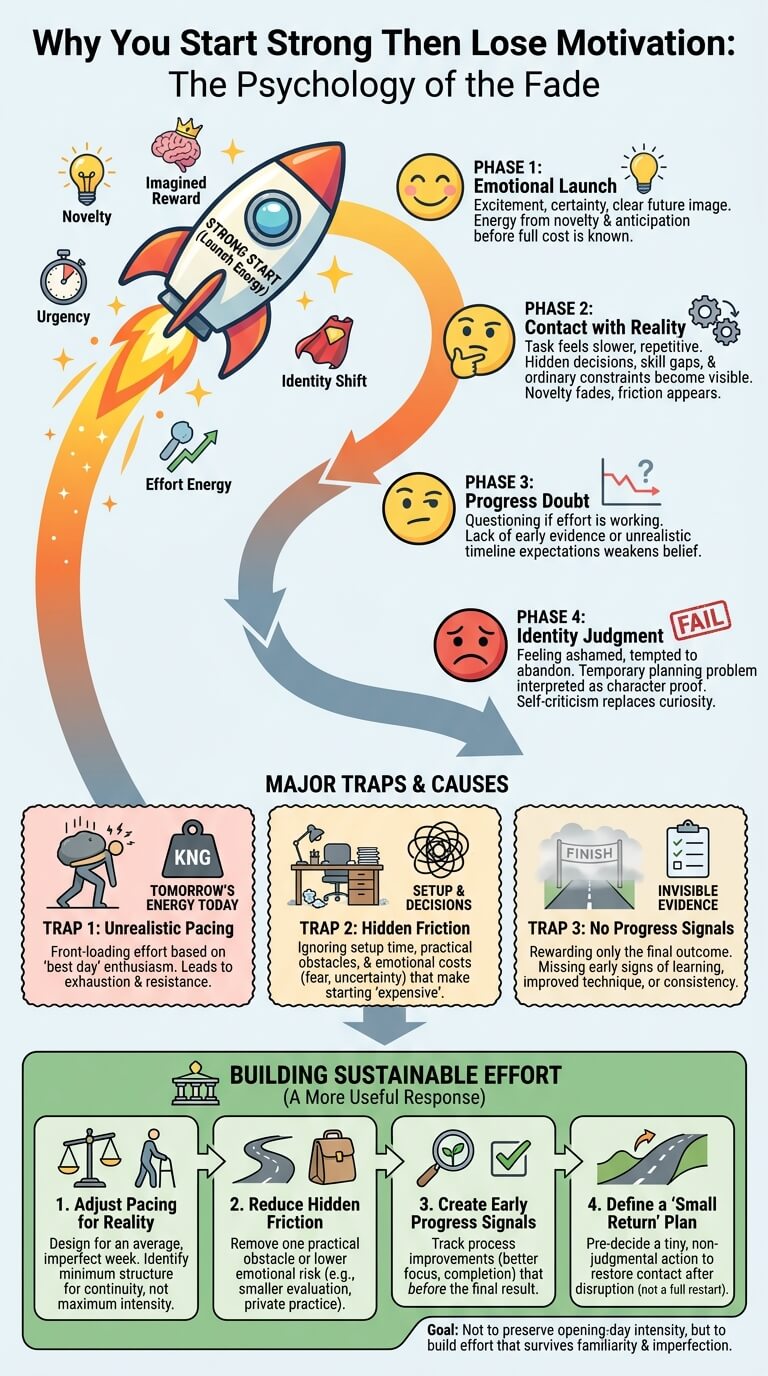
You start strong because a new goal offers novelty, hope, a vivid reward, and an immediate sense of becoming someone different. Motivation drops when the real cost appears, progress is slower than expected, the pace is unsustainable, or the goal does not fit your daily life. Continuing becomes easier when you reduce hidden friction, use realistic pacing, track early evidence, and define how to return after disruption.
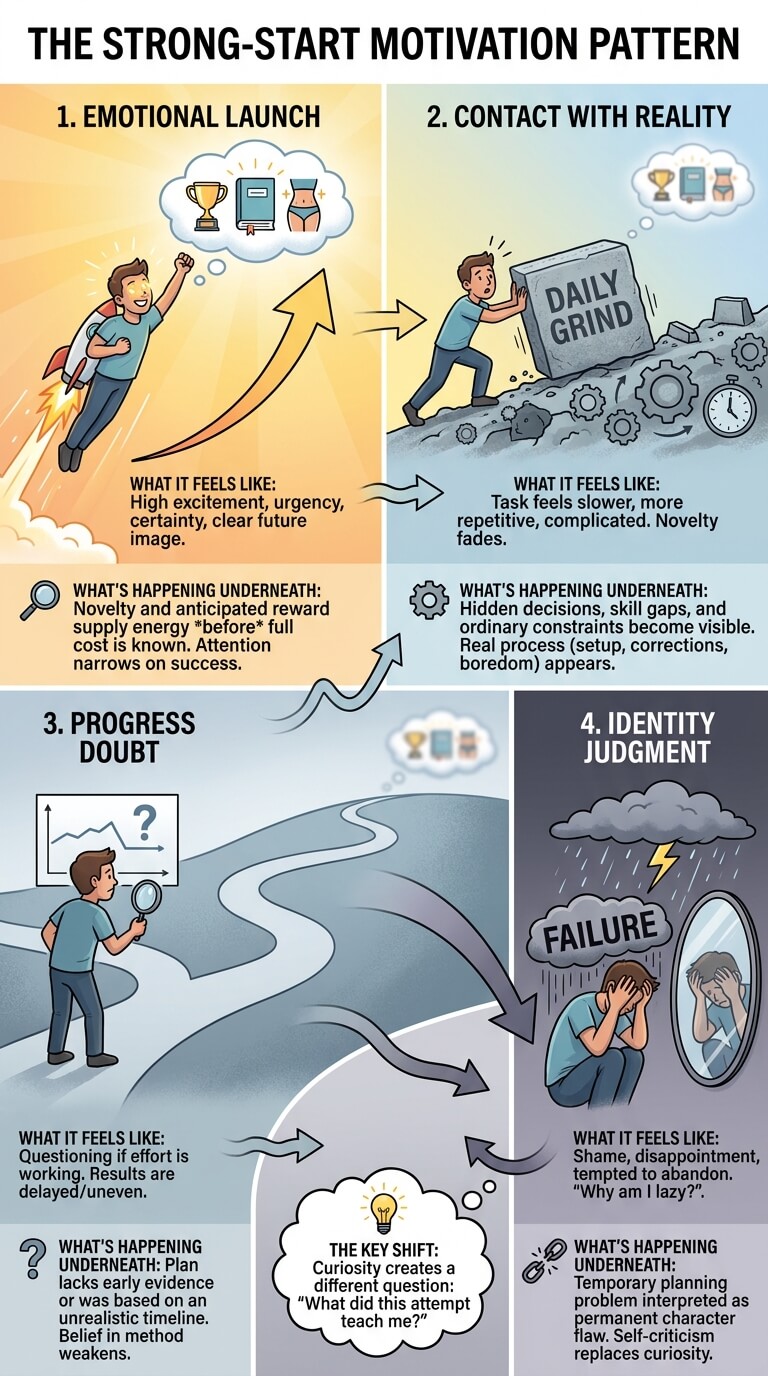
The Strong-Start Motivation Pattern
| Phase | What it feels like | What is happening underneath |
|---|---|---|
| 1. Emotional launch | Excitement, certainty, urgency, and a clear future image. | Novelty and anticipated reward are providing energy before the full cost is known. |
| 2. Contact with reality | The task feels slower, more repetitive, or more complicated. | Hidden decisions, skill gaps, and ordinary constraints become visible. |
| 3. Progress doubt | You question whether the effort is working. | The plan lacks early evidence, or expectations were based on an unrealistic timeline. |
| 4. Identity judgment | You feel ashamed, disappointed, or tempted to abandon the goal. | A temporary planning problem becomes interpreted as proof about your character. |
Phase one: imagined reward and emotional certainty
At the beginning, the future is emotionally close. You can picture the completed course, stronger body, finished manuscript, organized home, or improved skill. Imagination supplies a reward before the difficult work begins.
Newness also narrows attention. The goal temporarily becomes more interesting than competing options. You notice equipment, methods, success stories, and possible outcomes everywhere. This concentration can feel like permanent commitment, but it is often a temporary advantage of novelty.
Phase two: novelty fades and friction appears
After several repetitions, the activity becomes familiar. The real process includes waiting, setup, corrections, fatigue, boredom, and decisions that were absent from the imagined version.
This is the moment when motivation is often misread. The feeling has changed, but the goal may still matter. What disappeared was not necessarily commitment. It may have been the extra stimulation that made the early effort feel unusually cheap.
Phase three: progress feels slower than expected
Many plans assume a smooth relationship between effort and results. Real progress is often delayed, uneven, and difficult to notice. A person can practice consistently while still feeling awkward. A project can require several revisions before it looks complete.
When expected results do not appear quickly, belief in the method weakens. The person may think, “If I were good at this, I would be further ahead,” rather than, “My original timeline did not account for learning.”
Phase four: self-criticism replaces curiosity
Once motivation becomes a test of identity, the person stops investigating the plan. They ask why they are lazy or undisciplined instead of asking which demand was unrealistic.
Shame makes restarting harder because returning now means facing both the task and the story of failure attached to it. Curiosity creates a different question: What did the first attempt teach me about pace, friction, skill, and recovery?
Why Starting Feels Easier Than Continuing
The beginning is clear, exciting, and socially visible
Starting creates obvious actions. Sign up. Buy the materials. Choose the schedule. Create the folder. These steps provide fast completion signals and often receive encouragement from other people.
Continuing is less visible. It may involve repeating the same basic movement, revising a paragraph nobody sees, reviewing difficult material, or practicing without praise. The emotional return becomes smaller while the effort remains real.
The middle contains repetition, ambiguity, and delayed payoff
The beginning answers, “What should I do first?” The middle asks, “What should I do after the easy steps stop working?” This requires interpretation rather than simple action.
A broad review of behavior change maintenance notes that maintaining change involves processes that are not identical to initiating it. Continued behavior may depend on motives, self-regulation, resources, social conditions, and whether the behavior becomes integrated into everyday life.
Starting can support identity before skill has developed
A new goal provides an immediate identity story. You are becoming a runner, writer, learner, creator, or organized person. That story feels rewarding even before the matching skill exists.
Later, mistakes challenge the identity. The person may protect the positive image by avoiding situations that reveal beginner-level ability. The goal that once improved self-image now threatens it.
When drive stays low beyond the early crash, a broader review of low motivation can identify value, expectancy, energy, overload, or fear.
Novelty Creates Energy but Not a Maintenance System
New goals produce attention and anticipation
Novelty makes details stand out. A new exercise plan feels different from an old routine. A new course carries unanswered questions. A new creative tool offers many possibilities.
This attention is useful. It can help you begin before confidence is fully developed. The mistake is designing the entire plan around a level of interest that naturally changes once the activity becomes familiar.
Familiarity lowers emotional intensity
Familiarity is not failure. It is what happens when the brain no longer treats the activity as new information. The emotional high becomes quieter, and the actual value of the process becomes easier to see.
Some goals survive this transition because the person enjoys mastery, values the outcome, or notices progress. Others reveal that the person wanted the fantasy more than the repeated activity. Both discoveries are useful.
A quieter form of motivation can still be real
Sustainable motivation often feels less dramatic than a fresh start. It may show up as willingness to complete twenty useful minutes, return after a poor session, or practice despite mild boredom.
Do not compare ordinary willingness with opening-day excitement. They serve different functions. Excitement helps launch. Quieter commitment makes room for repetition.
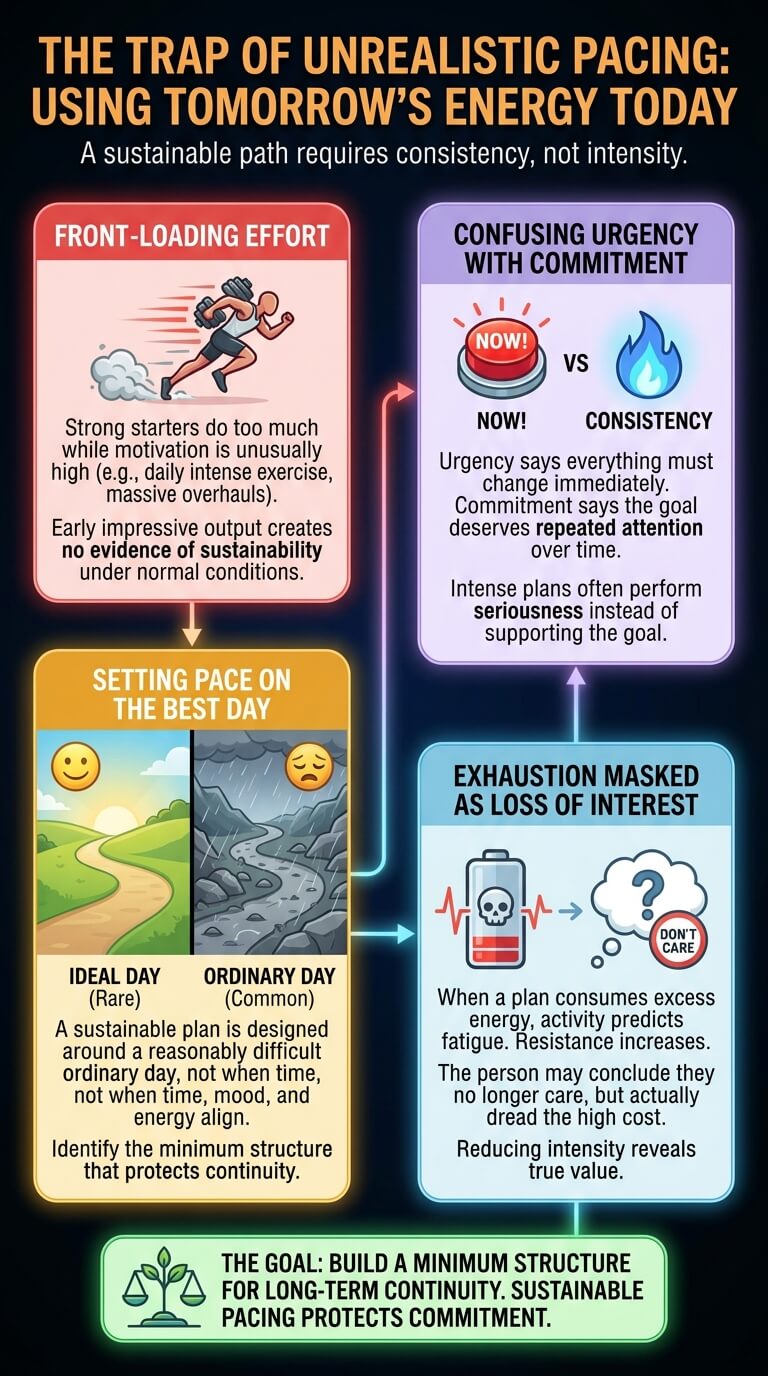
Unrealistic Pacing Uses Tomorrow’s Energy Today
Front-loading effort
Strong starters often do too much while motivation is unusually high. They exercise every day, study for several hours, overhaul every meal, or set a publication pace they have never sustained.
The early output looks impressive, but it creates no evidence that the plan works under normal conditions. It only proves that the person can perform intensely during a short period of elevated interest.
Setting a pace based on the best day
A sustainable plan should be designed around a reasonably difficult ordinary day, not the day when time, mood, energy, and enthusiasm all align.
The crash may begin with the plan itself, which is why goal setting psychology matters before adding more pressure.
Ask what version of the activity remains possible after work, during a busy week, or when progress feels slow. This is not lowering standards permanently. It is identifying the minimum structure that protects continuity.
Confusing urgency with commitment
Urgency says everything must change now. Commitment says the goal deserves repeated attention over time. Urgency can create action, but it often treats pacing as hesitation.
A person may choose an intense plan because a moderate plan does not feel emotionally convincing. The plan becomes a performance of seriousness instead of an arrangement that supports the goal.
Why exhaustion can look like loss of interest
When a plan repeatedly consumes more energy than expected, the activity begins to predict fatigue. Resistance increases before the session even starts.
The person may conclude that they no longer care, when they may actually care but dread the cost created by the current pace. Reducing intensity can reveal whether value remains.
Hidden Friction Appears After the Excitement
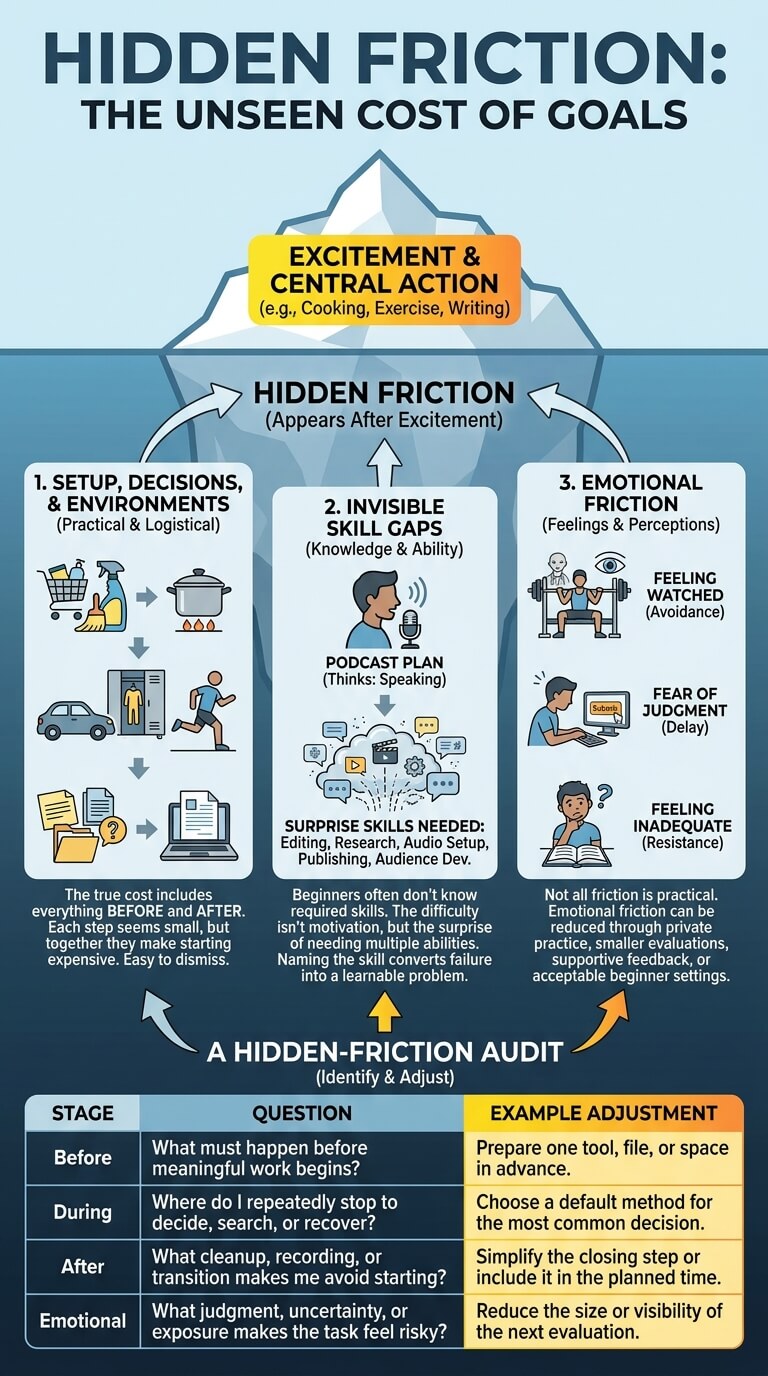
Setup time, decisions, and inconvenient environments
The true cost of a goal includes everything required before and after the central action. Cooking includes shopping and cleaning. Exercise may include travel and changing clothes. Writing may include finding notes, opening files, and deciding where to resume.
Hidden friction is dangerous because it is easy to dismiss. Each step looks small, but together they can make starting feel expensive.
Skill gaps that were invisible at the beginning
A beginner often does not know which skills the goal requires. Someone planning a podcast thinks mainly about speaking, then discovers editing, research, audio setup, publishing, and audience development.
The difficulty may not be motivation. It may be the surprise of needing several abilities instead of one. Naming the missing skill converts a vague sense of failure into a learnable problem.
Emotional friction such as embarrassment or uncertainty
Not all friction is practical. A person may avoid the gym because they feel watched, delay submitting work because it can be judged, or resist studying because confusion makes them feel inadequate.
When excitement can no longer carry the plan, understanding motivation versus discipline clarifies what kind of support is missing.
Emotional friction can be reduced through private practice, clearer criteria, a smaller evaluation, supportive feedback, or a setting where beginner status feels acceptable.
A hidden-friction audit
| Stage | Question | Example adjustment |
|---|---|---|
| Before | What must happen before the meaningful work begins? | Prepare one tool, file, or space in advance. |
| During | Where do I repeatedly stop to decide, search, or recover? | Choose a default method for the most common decision. |
| After | What cleanup, recording, or transition makes me avoid starting? | Simplify the closing step or include it in the planned time. |
| Emotional | What judgment, uncertainty, or exposure makes the task feel risky? | Reduce the size or visibility of the next evaluation. |
No Progress Signal Means No Evidence the Effort Works
Goals that only reward the final outcome
A plan becomes fragile when success is visible only at the end. “Finish the book,” “lose the weight,” or “become fluent” provides no useful information during the early stages.
The person needs evidence that the process is changing something before the final outcome arrives. That evidence might be clearer recall, improved technique, better tolerance, a completed stage, or fewer errors.
Slow improvement that is difficult to notice
Daily differences are often smaller than natural variation. A learner may perform worse today despite improving over a month. A creator may produce several unsatisfying drafts before a stronger method becomes visible.
Compare meaningful intervals rather than judging every session. A baseline and a weekly or monthly review can reveal movement that daily emotion hides.
Progress should answer a useful question
Tracking only effort can create a false sense of movement. Tracking only outcomes can hide learning. Choose a signal that matches the current stage.
Early in a skill, the useful question may be whether you can complete the process with less confusion. Later, it may be whether the quality or result is improving. The measure should evolve with the goal.
Identity Mismatch Can Break the Goal
Wanting the result but not the process
Some goals are attractive mainly because of what they symbolize. A person wants the published book but dislikes writing. They want the status of expertise but dislike study. They want the appearance associated with exercise but dislike every available form of movement.
This does not automatically mean the goal should be abandoned. It means the process deserves honest evaluation. Another method may fit better, or the desired result may need to be reconsidered.
Choosing a goal to impress or repair self-worth
A goal built mainly around approval can feel powerful at first because it promises recognition. As the work becomes private and repetitive, the external audience becomes less available.
Self-Determination Theory distinguishes more autonomous motives from motives driven mainly by reward, approval, guilt, or pressure. Effort tends to be more willing when the reason is personally endorsed rather than experienced only as control.
When the goal conflicts with current values or life conditions
A goal may have fit the person who created it but not the person living with it now. New responsibilities, health changes, financial pressure, or shifting values can alter what is realistic and worthwhile.
Persistence is not automatically wise. Revising or releasing a goal can be an accurate response to new conditions rather than proof that the original effort was meaningless.
The Missing Recovery Plan
Treating one missed day as proof of failure
Many plans explain what to do when everything goes well and say nothing about interruption. A missed session therefore feels outside the plan, not part of it.
All-or-nothing thinking turns a small lapse into a broken identity. “I missed Tuesday” becomes “I never follow through.” The emotional cost of returning grows larger than the missed action itself.
All-or-nothing restarting
Some people believe they must restart perfectly. They wait for Monday, the first of the month, new equipment, or enough time to rebuild the complete schedule.
This early rise and drop is one example of how motivation changes across a goal.
This keeps the goal dependent on another dramatic beginning. A return should be smaller than a launch. Its purpose is to restore contact, not prove total commitment.
Sustainable goals need a return path
Research on everyday persistence proposes that continuing a goal involves more than resisting the urge to stop. It also includes recognizing opportunities and returning to pursuit after interruptions.
A return path defines the first action after disruption. It might be opening the document and reading the last paragraph, completing ten minutes instead of the full session, or reviewing what changed before choosing a new time.
Strong Start vs General Motivation Fade
A timeline-specific early crash
The strong-start pattern usually appears soon after beginning. Novelty, identity excitement, and ambitious pacing create the launch. Hidden friction and slow feedback create the drop.
The key question is whether the plan depended on an emotional state that was never likely to remain constant.
Motivation decline that happens later or for broader reasons
Motivation can also fade after months of effort, a major setback, changing priorities, depletion, weak reward, or fear of evaluation. That broader pattern is not always connected to an intense start.
Separating the two matters because the solution differs. Early crashes often require pacing, friction reduction, and a return plan. Later decline may require reexamining value, capacity, expected success, or whether the goal still belongs in the person’s life.
How to choose the better explanation
Ask when the drop occurred and what changed first. If enthusiasm fell as soon as the activity became ordinary, the strong-start pattern is likely. If motivation changed after long effort, a setback, new demands, or loss of meaning, a broader cause deserves attention.
A Restart Framework That Does Not Depend on a New Emotional High
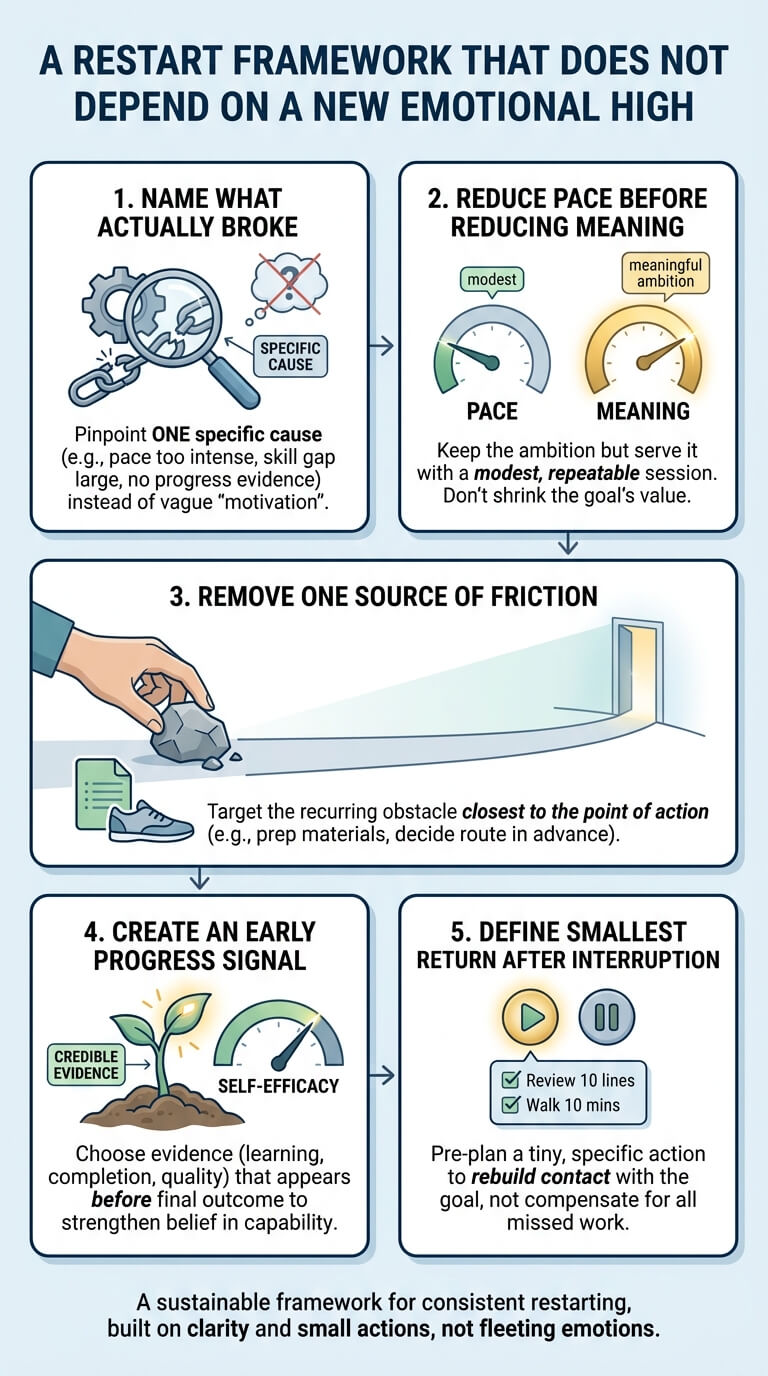
1. Name what actually broke
Choose one cause rather than using “motivation” as the entire explanation. Was the pace too intense? Did setup become difficult? Was the skill gap larger than expected? Did you receive no evidence of progress? Did the goal stop fitting?
A specific cause produces a testable change.
2. Reduce the pace before reducing the meaning
Keep the reason for the goal separate from the size of the next action. A meaningful ambition can be served by a modest session.
Set a pace you could repeat during an ordinary week. Once continuity and capacity are clearer, intensity can be adjusted.
3. Remove one source of friction
Do not build a complex optimization system. Remove the obstacle that repeatedly appears closest to the point of action.
Prepare the file, choose the route, set out the equipment, define the next page, or make one decision in advance.
4. Create an early progress signal
Choose evidence that can appear before the final outcome. It should show learning, completion, quality, or reduced difficulty.
A strong start becomes easier to sustain when visible progress and small wins show that effort is producing change.
The APA definition of self-efficacy emphasizes perceived capability to perform or attain desired results. A credible progress signal can strengthen that belief because it shows that effort is producing an effect.
5. Define the smallest return after interruption
Write the return action before the next disruption occurs. Make it smaller than the normal session and specific enough to perform without planning.
Examples include reviewing the last ten lines, completing one exercise, preparing tomorrow’s materials, or walking for ten minutes. The action should rebuild contact with the goal, not compensate for everything missed.
What Motivation Cannot Do Alone
Structure protects action when feelings change
Motivation supplies willingness and direction, but repeated action often needs a stable cue, time, environment, or agreement. Structure reduces the number of decisions required in the moment.
Structure should support the goal rather than punish fluctuation. A plan that repeatedly fails under normal conditions needs revision, not harsher self-judgment.
Repetition can lower decision cost
When an action occurs in a consistent context, it may become easier to begin without recreating the full reason each time. This is where habit processes become relevant.
Habit does not replace value. It reduces the need to make the same small decision repeatedly.
Goal design can create or remove the problem
A vague or impossible goal makes progress difficult to detect. A goal based only on a final result creates long periods without reward. A goal chosen mainly for approval becomes fragile when recognition is absent.
Sometimes the most useful change is not greater persistence. It is a clearer, more believable goal.
Examples of the Pattern in Everyday Life
Starting an exercise plan
Situation: Someone begins with six demanding sessions per week after months of little exercise. What they may feel: Powerful for several days, then sore, tired, and disappointed. What it may mean: The pace was built around launch energy rather than current capacity. What to do next: Reduce frequency, choose a repeatable minimum, and track one sign of improved capacity.
Beginning an online course
Situation: A learner completes several lessons immediately, then stops when exercises become difficult. What they may feel: Less intelligent than expected. What it may mean: Watching lessons provided quick completion, while active practice exposed a skill gap. What to do next: Slow the pace, define one question per session, and use mistakes as feedback about what to review.
Launching a creative project
Situation: A creator spends days planning the concept but avoids producing the first imperfect version. What they may feel: Inspired during planning and ashamed during execution. What it may mean: The identity reward arrived before the evaluation risk. What to do next: Make a private rough version with criteria focused on completion and learning.
Trying to change a personal routine
Situation: Someone redesigns mornings, evenings, food, exercise, and study at once. What they may feel: Organized at first, then constantly behind. What it may mean: Too many simultaneous decisions and standards created overload. What to do next: Keep the change with the clearest value and pause the rest until the first one fits ordinary life.
Returning after an interruption
Situation: Travel, illness, family demands, or a busy week interrupts a plan. What they may feel: As if all earlier progress has been erased. What it may mean: The plan defined consistency as never being interrupted. What to do next: Use the prewritten return action and review capacity before restoring the full schedule.
When the Pattern May Need More Support
Repeated strong starts are not a diagnosis. They can result from pacing, unclear goals, unrealistic expectations, changing capacity, fear, or environments with too much friction.
However, seek professional support when low motivation is persistent across many areas, accompanied by a broad loss of interest, severe fatigue, hopelessness, major concentration changes, or difficulty managing daily life. The National Institute of Mental Health explains that these can be depression-related symptoms, although only a qualified professional can assess the full picture.
Seek urgent local help if you are having thoughts of self-harm, suicide, or immediate danger. A motivation strategy is not an appropriate response to a safety crisis.
Frequently Asked Questions About Starting Strong and Losing Motivation
Why am I motivated for only a few days?
The first days contain novelty, visible setup tasks, anticipated reward, and few interruptions. Motivation may drop when the activity becomes familiar and the real cost appears. This does not prove that the goal is false, but it does mean the plan needs support beyond excitement.
Does losing excitement mean the goal is wrong?
No. Excitement naturally changes as an activity becomes familiar. The goal may still fit if the outcome remains meaningful and interest improves with better pacing, skill, or feedback. A mismatch is more likely when neither the process nor the outcome feels personally valuable under realistic conditions.
Should I restart from day one after a break?
Usually not. Restart from your current knowledge, capacity, and circumstances. Review what interrupted the plan, choose a small return action, and rebuild the schedule gradually. Treating every break as total erasure makes returning unnecessarily expensive.
Why do I keep choosing plans that are too intense?
An intense plan can feel like evidence of commitment. It also matches the emotional energy of a fresh start. A moderate plan may seem unimpressive even when it is more effective. Judge the plan by whether it survives ordinary weeks, not by how serious it looks on the first day.
Can I continue without feeling inspired?
Yes. Continued effort often depends on personally endorsed value, manageable cost, useful feedback, and enough structure to make the next action clear. Inspiration can help, but it does not need to appear before every meaningful session.
Key Takeaways
- Starting and maintaining a goal require different psychological conditions.
- Novelty and imagined success create useful launch energy, but they do not provide a long-term maintenance system.
- Ambitious pacing often uses exceptional early energy and fails to represent ordinary capacity.
- Hidden practical and emotional friction can make a valued goal feel much more expensive than expected.
- A return plan prevents one interruption from becoming an identity judgment or total restart.
- The most useful restart identifies what broke, lowers one cost, creates early evidence, and defines a small way back.
Choose one goal you started strongly and then stopped. Do not rebuild the original plan. Identify the first point where reality differed from expectation, then make one correction: reduce the pace, remove one hidden obstacle, choose a better progress signal, or define a smaller return action. The aim is not to feel like the person you were on day one. It is to create a version of the goal that the person living your ordinary week can actually continue.
Author note: Michael Reed is the Founder and Lead Writer at Psychology Exposed. He explains human behavior, emotional patterns, self-awareness, and everyday decisions in clear, research-aware language. This content is educational and is not a substitute for diagnosis, therapy, medical care, or crisis support.

Michael Reed is the Founder and Lead Writer at Psychology Exposed. He writes about human behavior, relationships, emotional patterns, self-awareness, and practical psychology topics using research-informed, easy-to-understand content.
Read More About Michael Reed: https://psychologyexposed.com/michael-reed/