
You may know exactly what bothers you and still struggle to say it. Perhaps you soften a request until it disappears, explain a simple no for ten minutes, or wait until frustration turns a small concern into a sharp confrontation. The difficulty is not always a lack of words. Often, it is the fear of what directness might cost: approval, harmony, status, closeness, or safety.
Assertive communication offers a middle path between hiding your message and forcing it. It means expressing what you observed, how it affects you, what matters to you, and what you are asking for in language the other person can understand. It also means leaving room for an answer you may not like. That last part matters because assertiveness protects your voice without taking away someone else’s agency.
This skill is useful with partners, relatives, friends, coworkers, service providers, and anyone else with whom expectations need to be made visible. It does not guarantee agreement, kindness, or change. It simply helps you communicate without abandoning yourself or trying to control the response.
Quick Answer
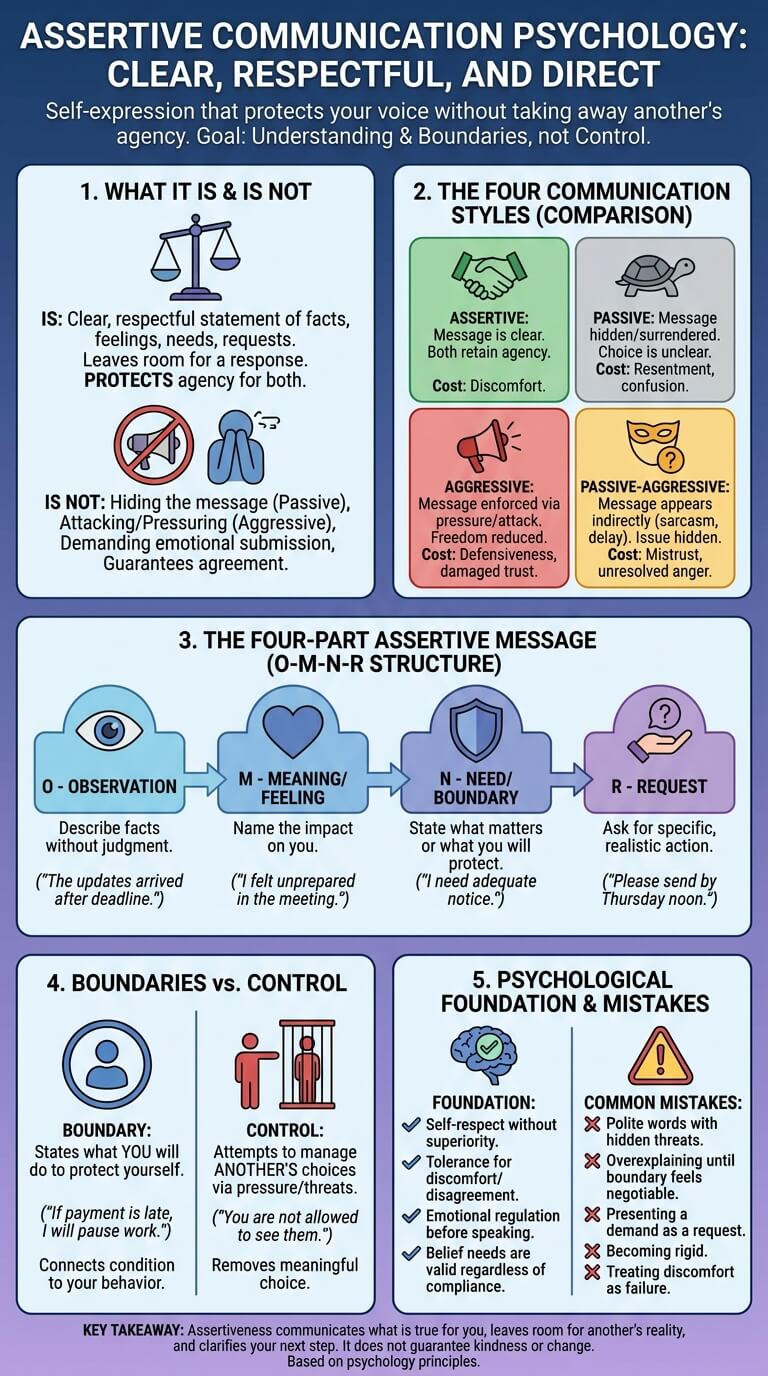
Assertive communication is clear, respectful self-expression. You state facts, feelings, needs, limits, or requests without hiding the message, attacking the other person, or demanding emotional submission. The goal is not to get your way every time. It is to make your position understandable, protect appropriate boundaries, and respond to disagreement without becoming passive, aggressive, or manipulative.
What Assertive Communication Means
The APA Dictionary of Psychology definition of assertiveness centers on confident, direct expression that does not deny the rights of others. In ordinary life, this means speaking plainly enough to be understood while remaining responsible for your own behavior.
Assertiveness is one practical area within communication psychology, especially where clarity, agency, and response meet.
Direct enough to be understood
An assertive message does not make the listener solve a puzzle. It replaces hints, strategic silence, vague disappointment, and indirect testing with a recognizable point. Instead of saying, “It would be nice if somebody helped around here,” you might say, “Could you wash the dishes tonight while I finish the laundry?”
Respectful enough to allow a real response
Respect includes how you speak, but it also includes what freedom you leave the other person. A genuine request permits a yes, a no, a question, or a proposed alternative. If refusal is punished with insults, guilt, threats, or withdrawal of basic care, the message was not truly a request.
Responsible enough to own feelings, choices, and follow-through
Owning your experience means describing it without claiming complete knowledge of someone else’s motives. “I felt left out when the plan changed and nobody told me” is more grounded than “You changed it because you do not respect me.” The first statement names an event and impact. The second presents an interpretation as proven fact.
Assertive vs Passive, Aggressive, and Passive-Aggressive Communication
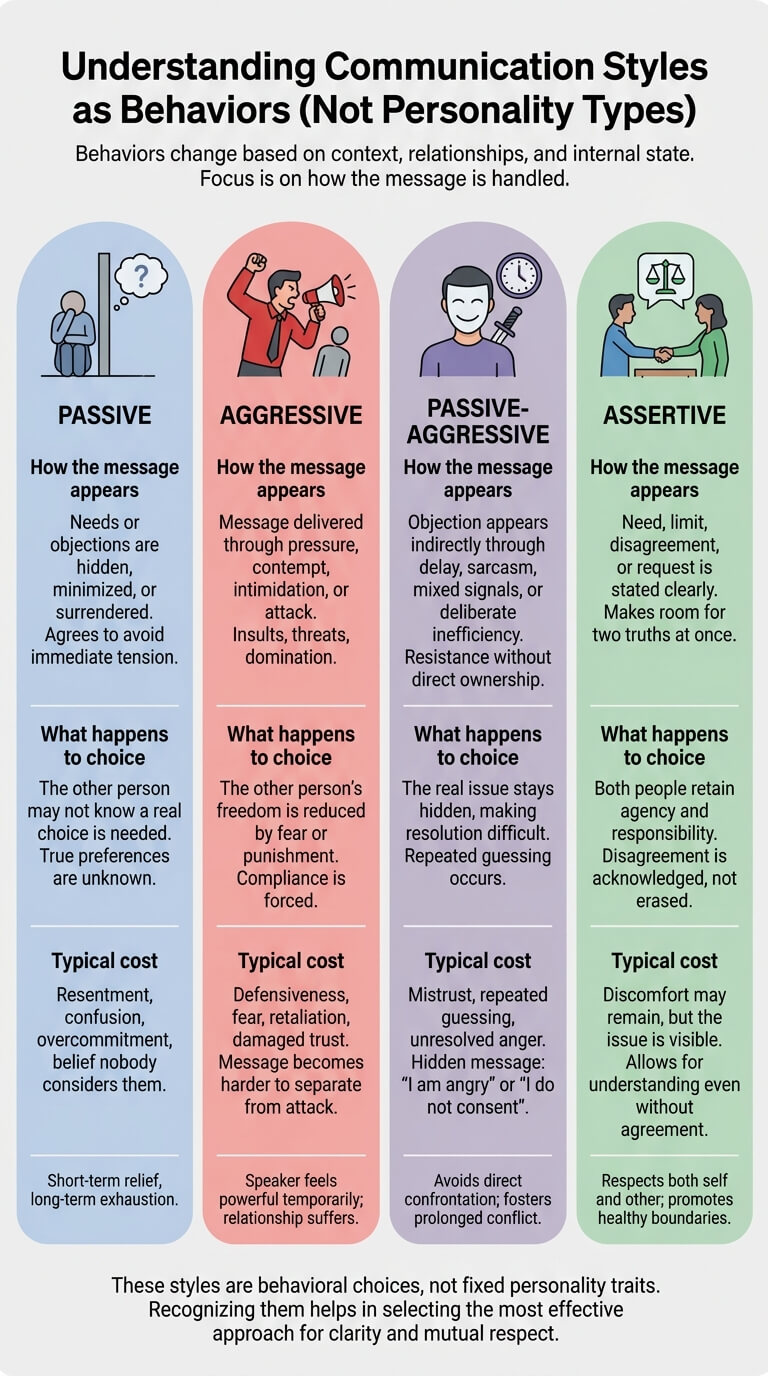
These styles are best understood as behaviors, not permanent personality types. A person may be direct with friends, passive with a manager, aggressive when exhausted, and indirect in a family where disagreement was discouraged. The comparison below focuses on how the message is handled.
Assertiveness makes more sense when compared with the other communication styles people use under pressure.
| Style | How the message appears | What happens to choice | Typical cost |
|---|---|---|---|
| Passive | Needs or objections are hidden, minimized, or surrendered | The other person may not know a real choice is needed | Resentment, confusion, overcommitment |
| Aggressive | The message is delivered through pressure, contempt, intimidation, or attack | The other person’s freedom is reduced by fear or punishment | Defensiveness, fear, retaliation, damaged trust |
| Passive-aggressive | The objection appears indirectly through delay, sarcasm, mixed signals, or deliberate inefficiency | The real issue stays hidden, so resolution is difficult | Mistrust, repeated guessing, unresolved anger |
| Assertive | The need, limit, disagreement, or request is stated clearly | Both people retain agency and responsibility | Discomfort may remain, but the issue is visible |
Passive: the message is hidden or surrendered
Passive communication often protects against immediate tension. You agree when you want to decline, say “whatever is fine” when you have a preference, or apologize before stating a reasonable need. The short-term reward is relief from confrontation. The longer-term cost may be exhaustion, resentment, or the belief that nobody considers you.
Aggressive: the message is enforced through pressure or disrespect
Aggressive communication makes the issue visible but treats domination as the solution. It may include insults, raised volume, humiliation, threats, relentless interruption, or statements that define the other person’s character. The speaker may feel powerful for a moment, especially after feeling ignored, but the message becomes harder to separate from the attack.
Passive-aggressive: the message appears indirectly
Passive-aggressive behavior communicates resistance while avoiding direct ownership of it. Someone may agree to a task and repeatedly “forget,” make a cutting joke, give minimal answers, or delay until the other person gives up. The hidden message might be “I am angry,” “I do not consent,” or “I want you to notice what I will not say.”
Assertive: the message is clear without demanding emotional submission
Assertiveness makes room for two truths at once. You can care about another person and disagree with them. You can understand their disappointment and keep your answer. You can regret that a boundary is painful without treating the pain as proof that the boundary is wrong.
The Psychology Behind Assertiveness
Assertiveness is not simply a sentence formula. It asks you to tolerate several forms of discomfort that indirect or forceful communication tries to escape.
Self-respect without superiority
Self-respect says your time, body, attention, values, and preferences matter. Superiority says they matter more because you are more deserving than the other person. Assertiveness depends on the first position and rejects the second.
Tolerance for disagreement and disappointment
Many indirect messages are attempts to prevent a negative reaction. You hint because a direct request might be refused. You overexplain because someone might think badly of you. You become forceful because their disappointment feels unbearable.
Emotional regulation before expression
Clear speech becomes harder when your body is preparing to fight, flee, freeze, or appease. You may speak faster, pile up accusations, agree too quickly, or lose track of your actual request. A short pause can help you recover enough attention to choose language rather than discharge emotion.
Belief that needs can be named without guaranteeing compliance
A need can be valid even when another person cannot meet it. A request can be reasonable even when the answer is no. This distinction reduces the urge to prove your need through exaggeration or to treat refusal as moral failure.
Research on communication training often treats assertiveness as a learnable behavior rather than an inborn trait. A recent systematic review of assertiveness communication training also highlights practice, modeling, and structured learning as common features of skill development.
The Four-Part Assertive Message

A useful structure is O-M-N-R: Observation, Meaning, Need, Request. It is not a script you must recite word for word. It is a checklist that helps you include the information most likely to get lost when you are nervous or frustrated.
Observation: describe what happened without a character judgment
Begin with something specific enough that both people can recognize it. “The last two project updates arrived after the deadline” is observable. “You are irresponsible” is a character conclusion. Specificity gives the conversation a point that can be checked, clarified, or corrected.
Meaning or feeling: name the impact you are responsible for communicating
State what the event meant for you without presenting your interpretation as the only possible explanation. You might say, “I felt unprepared in the meeting,” “I became worried when I did not hear back,” or “I took the joke as criticism.”
Need or boundary: state what matters and what you will protect
A need identifies the condition that matters, such as adequate notice, privacy, reliable follow-through, or respectful speech. A boundary identifies what you will do to protect that condition. “I need notice before plans involving my time are confirmed” names the need. “If I am not asked first, I may not be able to attend” states the practical limit.
Request or next step: ask for a specific, realistic action
Finish with something the other person can understand and answer. “Please send the update by Thursday at noon” is clearer than “Communicate better.” “Can you listen for five minutes before offering solutions?” is clearer than “Be more supportive.”
Example: “When the plan changed after I had already arranged transportation, I felt frustrated and left out of the decision. I need changes involving my time to be discussed with me first. Next time, can you check with me before confirming?”
Assertive Communication Examples
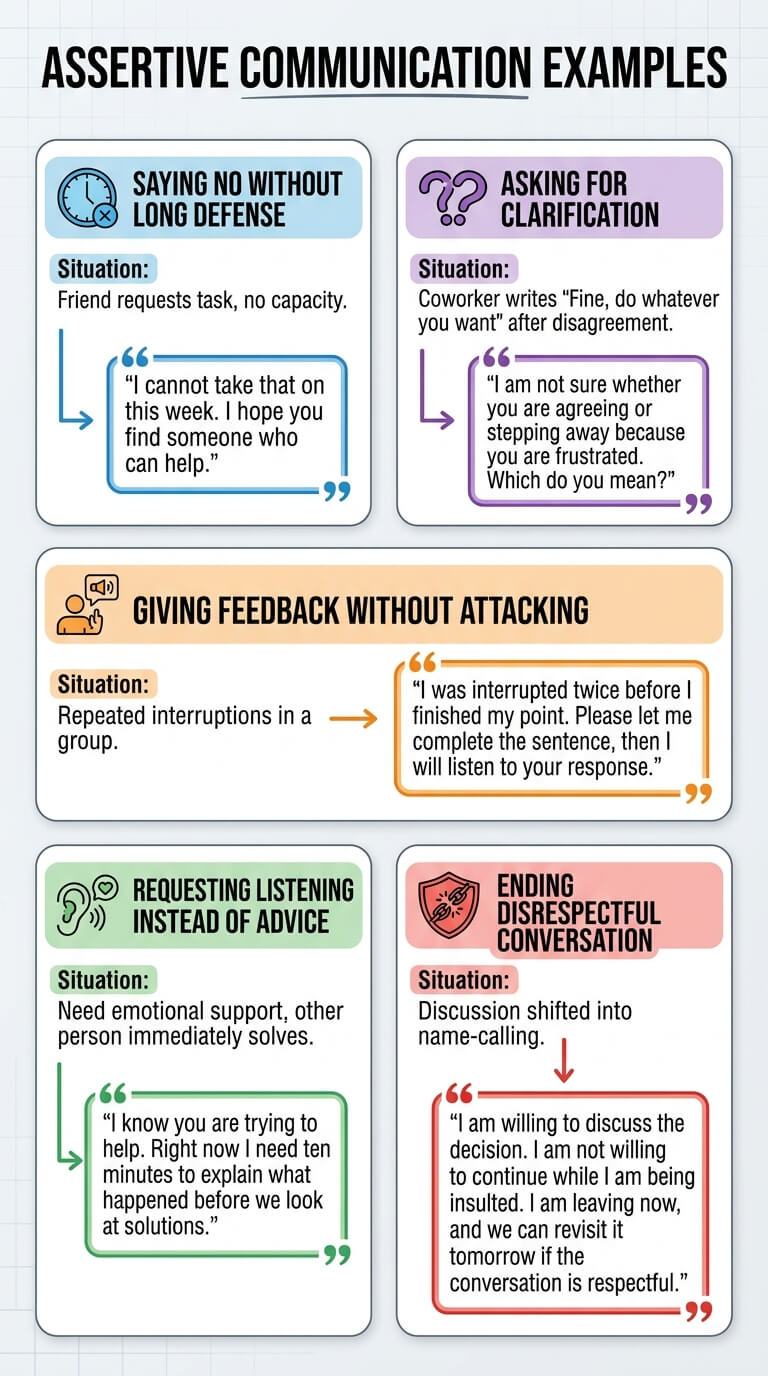
The examples below are intentionally brief. Natural speech usually works better than a polished monologue.
Saying no without a long defense
Situation: A friend asks you to take on a task you do not have capacity for.
Possible response: “I cannot take that on this week. I hope you find someone who can help.”
Asking for clarification after a confusing message
Situation: A coworker writes, “Fine, do whatever you want,” after a disagreement.
Possible response: “I am not sure whether you are agreeing or stepping away because you are frustrated. Which do you mean?”
Giving feedback without attacking identity
Situation: Someone repeatedly interrupts you in a group.
Possible response: “I was interrupted twice before I finished my point. Please let me complete the sentence, then I will listen to your response.”
Requesting listening instead of advice
Situation: You want emotional support, but the other person immediately starts solving the problem.
Possible response: “I know you are trying to help. Right now I need ten minutes to explain what happened before we look at solutions.”
Ending a conversation that has become disrespectful
Situation: The discussion has shifted into name-calling.
Possible response: “I am willing to discuss the decision. I am not willing to continue while I am being insulted. I am leaving now, and we can revisit it tomorrow if the conversation is respectful.”
Boundaries Are Not the Same as Control

The difference becomes clearer when you ask who must act and whether the other person retains meaningful choice.
A boundary states what you will do
A boundary connects a condition to your own behavior. “If people smoke in the car, I will arrange separate transportation.” “I will not share my password.” “If the payment is late again, I will pause further work until the balance is settled.”
Control removes the other person’s meaningful choice
Control attempts to manage another person through surveillance, threats, intimidation, isolation, humiliation, or punishment. “You are not allowed to speak to that friend, and I will check your phone” is not a personal boundary. It is an attempt to govern another person’s relationships and privacy.
The National Domestic Violence Hotline’s explanation of power and control emphasizes that abusive dynamics involve patterns used to gain or maintain control. A calm tone does not make controlling behavior assertive.
Consequences should be realistic, proportionate, and enforceable
A consequence is credible when it is connected to the issue and within your control. If a client repeatedly misses appointments, requiring prepayment may be proportionate. Threatening to damage their reputation is retaliatory and unrelated to protecting your time.
Common Assertiveness Mistakes
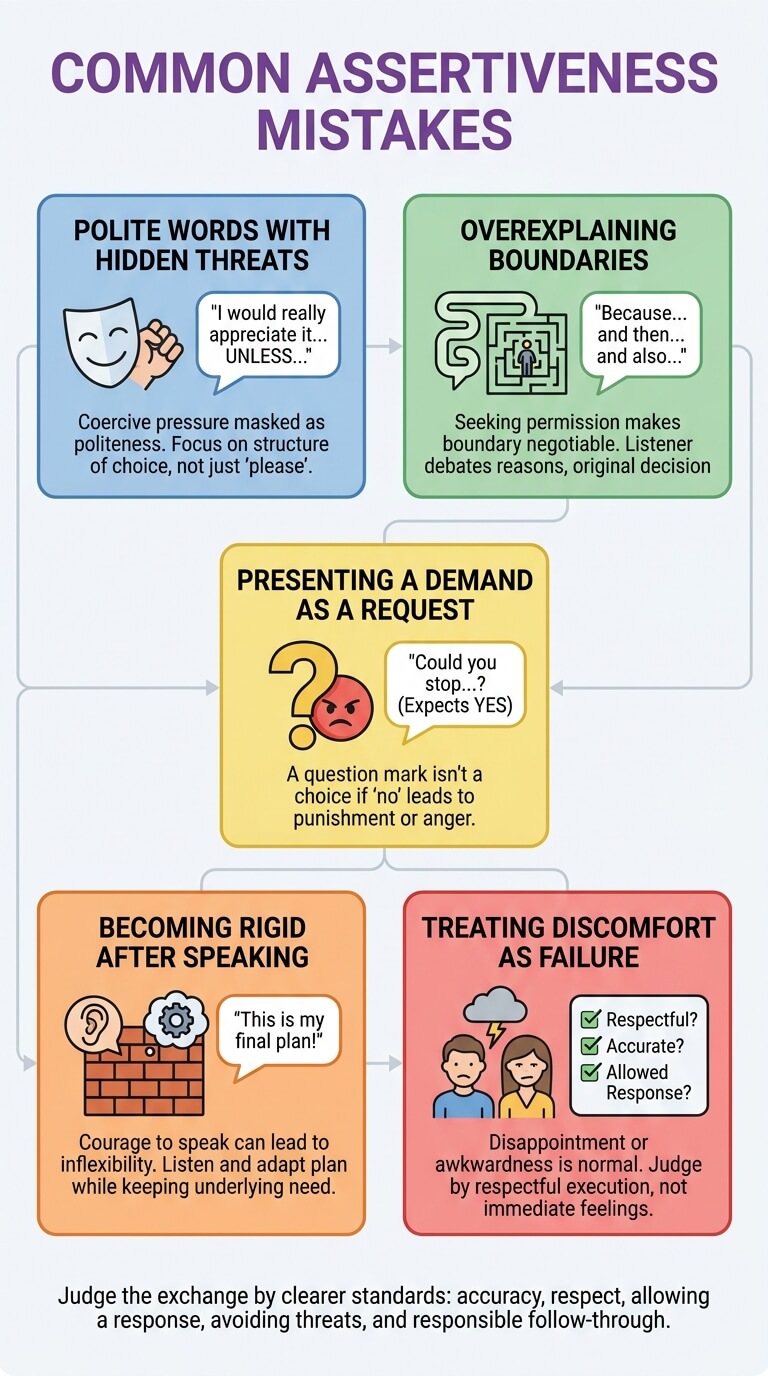
Direct speech can still become confusing or coercive when the structure underneath it is unclear. The following mistakes are common because each one temporarily reduces anxiety.
Using polite words with a hidden threat
“I would really appreciate it if you did this, unless you want everyone to know what happened” contains polite wording but coercive pressure. Assertiveness is not defined by “please” or a calm voice. The structure of the choice matters.
Overexplaining until the boundary sounds negotiable
Long explanations often begin as an attempt to be considerate. They can become a search for permission. The listener starts debating each reason, and the original decision disappears.
Presenting a demand as a request
A question mark does not create choice. “Could you stop seeing your friends?” may sound like a request, but anger or punishment after a no can reveal that compliance was expected.
Becoming rigid because the message was difficult to say
It may take courage to speak, and that effort can make your first proposal feel untouchable. Yet assertiveness includes listening to new information. You can keep the underlying need while changing the plan.
Treating discomfort as proof the conversation went badly
A clear no may disappoint someone. Feedback may create embarrassment. Naming a long-avoided problem may feel awkward for both people. These reactions do not automatically mean you were unkind.
Judge the exchange by clearer standards: Was the message accurate? Was the language respectful? Did you allow a response? Did you avoid threats or humiliation? Did you follow through responsibly?
How to Stay Assertive When the Other Person Pushes Back
Pushback may be reasonable disagreement, emotional surprise, confusion, or an attempt to wear you down. Your next response should depend on which one you are facing.
Pushback is easier to navigate when you recognize how defensive communication can make a request feel like an attack.
Repeat the central point without adding new accusations
When you become anxious, you may add ten more reasons to make the message stronger. This often creates ten new arguments. A calmer option is to repeat the core point: “I understand the deadline is difficult. I still need the final files by Friday if the launch is staying on Monday.”
Acknowledge their view without abandoning your own
Perspective-taking can lower the sense that only one person is allowed to exist in the conversation. Research examining messages that communicate both one’s own and another person’s perspective found benefits to combining self-expression with acknowledgment rather than choosing only one side. You can explore the open-access study on communicating both perspectives for the research context.
Ask for time when arousal makes clarity impossible
If you cannot track what is being said, your voice is rising, or you are close to saying something harmful, pause with a return plan. “I need thirty minutes to settle down. I will come back at 7:30 so we can finish discussing the budget.”
End or postpone the exchange when respect collapses
You do not have to remain in a conversation that includes threats, intimidation, degrading language, or relentless harassment. State the limit once if doing so is safe, then leave or seek support. Repeating a perfect sentence is not a solution when the other person is committed to overriding your agency.
A Pre-Conversation Assertiveness Self-Check
Before a meaningful exchange, take a few minutes to separate what you want from what you can control. The questions below make hidden expectations easier to spot.
What outcome do I control?
You control whether you speak, the language you choose, the limit you set, and the action you take afterward. You do not control whether the other person agrees, apologizes, understands immediately, or changes.
What exact request am I making?
Reduce the request to one observable action. If you cannot state it simply, you may still be sorting out whether you want information, listening, an apology, a changed behavior, or a decision.
What answer am I willing to hear?
If “no” is possible, decide how you will respond. You might negotiate, accept it, make a different plan, or reconsider the relationship or agreement. If “no” is not possible because the issue concerns your own participation, present a boundary rather than disguising it as a request.
What boundary will I follow if nothing changes?
Choose an action that protects you without attempting revenge. This could mean declining future requests, leaving disrespectful discussions, changing a work process, limiting access to private information, or seeking formal support.
Is direct communication safe in this context?
Directness is not always the safest first step. If you fear violence, stalking, retaliation, financial punishment, forced isolation, or monitoring, private confrontation may increase risk. A personalized safety plan from the National Domestic Violence Hotline may be more appropriate than another communication attempt.
First Steps for Building Assertiveness
Skill grows through repetition, especially when practice begins before the most emotionally loaded situation. Choose actions small enough that you can notice what you are doing.
Practice low-stakes preferences
Start where the emotional cost is small. Choose a restaurant, correct a minor order, ask for a quieter table, or say which meeting time works better. Small repetitions teach your nervous system that expressing a preference does not always create catastrophe.
Shorten apologies that are not needed
An apology is useful when you caused harm or failed a responsibility. It is less useful as an entry fee for having a need. Replace “I am so sorry to bother you, and this may be stupid” with “I have a question about the deadline.”
Use one clear request instead of several hints
Notice when you are hoping someone will infer the desired action from mood, silence, or indirect comments. Convert the hidden request into one sentence. “Could you text me if you will be more than twenty minutes late?” gives the other person something concrete to answer.
Review the outcome without judging your worth
Practice-based approaches are common in assertiveness training. One open-access evaluation of assertiveness communication training used structured learning to examine changes in speaking-up intentions, illustrating why rehearsal can matter when a skill must be used under pressure.
How Assertiveness Works With Listening and Hard Conversations
Clear expression is only one part of a complete exchange. What happens after the message matters just as much as how the message begins.
Preparation and timing become more important when assertiveness is used in difficult conversations.
Understanding the alternatives
Recognizing passive, aggressive, and indirect habits helps you identify what happens when clarity feels risky. The purpose is not to label yourself. It is to notice the moment when you begin hiding the point, forcing an answer, or communicating resistance indirectly.
Listening after expressing an assertive message
Assertiveness covers your side of the exchange, not the whole exchange. After making a request, listen for the answer rather than preparing to repeat your case. Clarify what you heard, ask questions about constraints, and decide what the response means for your next step.
Clear expression works best when it is paired with active listening after the request has been made.
Planning when stakes, power, or history are high
A four-part message may be enough for a routine scheduling issue. It may not be enough when the conversation affects employment, housing, finances, caregiving, or a relationship with a long history of escalation. In those situations, consider timing, documentation, support people, formal procedures, and whether a private conversation is appropriate.
When Assertiveness Is Not Enough
Some problems persist because a person lacks clarity. Others persist because the other person benefits from ignoring, punishing, or overriding the message. Those situations require a different response.
Repeated disregard, manipulation, coercion, or retaliation
Communication skills cannot create mutual respect by themselves. If a person repeatedly ignores a stated limit, punishes you for saying no, distorts events to make you doubt yourself, threatens consequences for seeking help, or monitors your movements and contacts, the issue is not merely that you need a better sentence.
Do not interpret another person’s continued coercion as evidence that you failed to communicate correctly. Your priority may need to shift from being understood to protecting access to money, transportation, documents, support, or a safe place.
When other forms of support may be more appropriate
Professional counseling may help when fear of ordinary disagreement is affecting many parts of life, or when you want structured practice with self-advocacy. Workplace concerns may require a manager, union representative, human resources process, or legal advice. Harassment, threats, stalking, and violence call for safety-focused support rather than joint communication exercises.
FAQ About Assertive Communication
These questions address common points of confusion that can make direct communication feel harsher or more absolute than it is.
Is assertiveness the same as confidence?
No. Confidence is a feeling or belief about your ability, while assertiveness is observable behavior. You can speak assertively while nervous, uncertain, or afraid of disappointing someone. Confidence may grow through practice, but it is not a requirement for making a clear request or stating a limit.
Can an assertive statement still upset someone?
Yes. A person may feel disappointed by your no, embarrassed by feedback, or frustrated that your needs differ from theirs. Emotional discomfort does not automatically mean the statement was disrespectful. Check the accuracy, tone, freedom of response, and proportionality of any consequence rather than judging only by whether the listener was pleased.
How is a boundary different from an ultimatum?
A boundary describes what you will do to protect your wellbeing, time, values, or participation. An ultimatum presents a forced choice and is often intended to pressure compliance. Context matters because some serious decisions legitimately have firm conditions. The key questions are whether the condition concerns your own participation, whether it is proportionate, and whether it is stated honestly rather than used as a recurring threat.
What if the other person calls directness rude?
Review the message rather than accepting or dismissing the accusation automatically. You may have used contempt, interrupted, chosen a public setting, or spoken more harshly than intended. You may also have been respectful while saying something they did not want to hear. Ask what specifically felt rude, consider useful feedback, and keep the central point if it remains valid.
Can assertiveness work with a power imbalance?
It may help, but power changes the risks and available choices. An employee, dependent family member, tenant, student, or person facing financial control may have fewer safe ways to refuse. Consider documentation, formal channels, allies, advocacy, and safety before treating a direct conversation as the only responsible option.
Key Takeaways
- Assertive communication makes your message clear while preserving the other person’s right to respond.
- Directness is different from aggression because it does not rely on intimidation, humiliation, or forced compliance.
- The O-M-N-R structure helps organize an observation, personal impact, need or boundary, and specific request.
- A boundary states what you will do; control tries to remove another person’s meaningful choice.
- Discomfort, disagreement, or refusal does not automatically mean an assertive conversation failed.
- When directness may trigger threats, stalking, coercion, or retaliation, safety planning matters more than finding better wording.
Final Thoughts
Choose one low-stakes situation this week and make the hidden message visible. State one preference, ask one direct question, or give one concise no without apologizing for existing. Then evaluate the exchange by clarity, respect, and follow-through, not by whether everyone felt comfortable.
Assertiveness becomes more reliable when you stop treating it as a performance that must produce agreement. Its real value is simpler: you communicate what is true for you, leave room for another person’s reality, and make your next decision from clearer information.
Author note: Michael Reed is the Founder and Lead Writer at Psychology Exposed. He writes about human behavior, relationships, emotional patterns, self-awareness, and everyday decisions in clear, research-aware language. This content is educational and is not a substitute for individualized mental health, legal, workplace, or safety advice.

Michael Reed is the Founder and Lead Writer at Psychology Exposed. He writes about human behavior, relationships, emotional patterns, self-awareness, and practical psychology topics using research-informed, easy-to-understand content.
Read More About Michael Reed: https://psychologyexposed.com/michael-reed/