
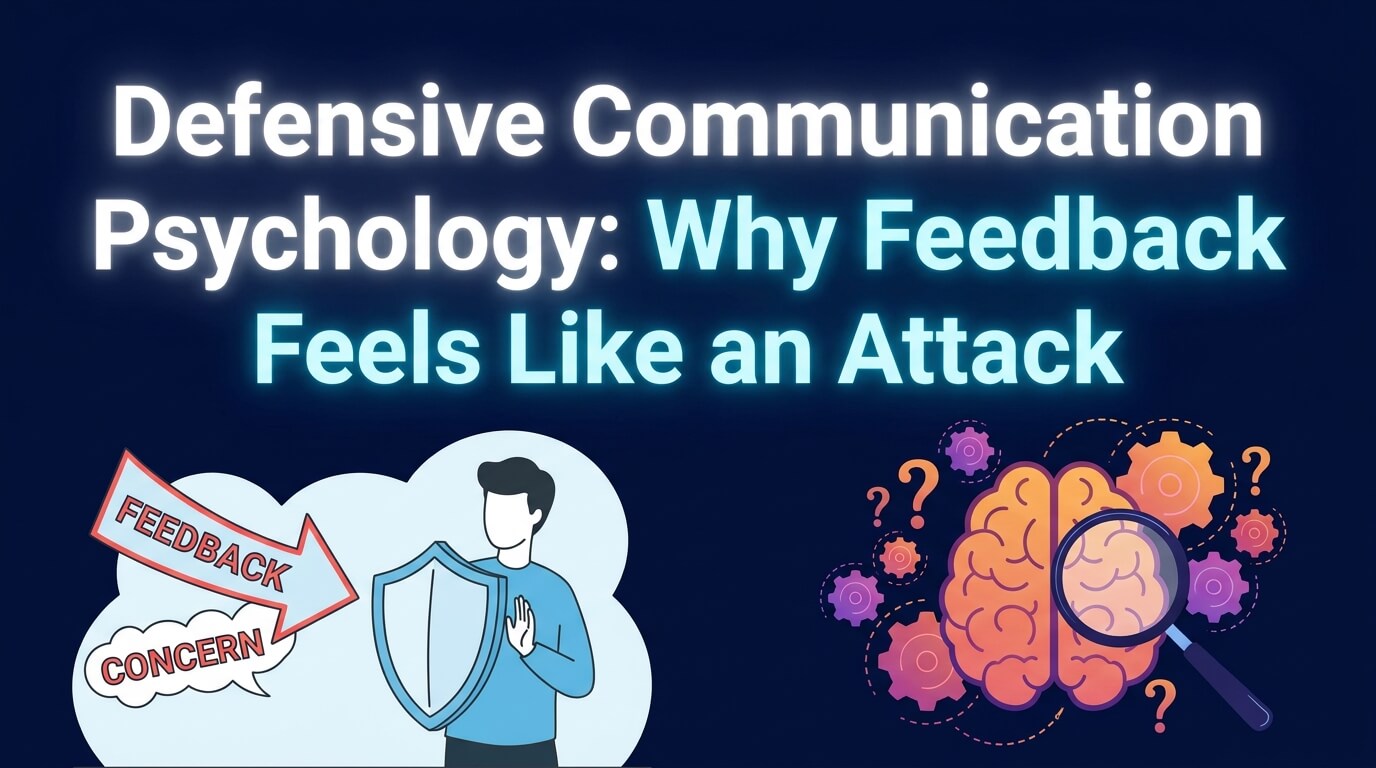
A simple question can land like an accusation. “Did you send the file?” becomes “You think I am incompetent.” Before the concern is understood, the conversation shifts into denial, justification, counterattack, or shutdown.
Defensive communication is not proof of bad character. It often protects identity, fairness, status, belonging, or emotional safety. Yet that protection can block the information needed to resolve the issue. One person intensifies to feel heard, while the other works harder to escape blame.
Reducing defensiveness does not mean accepting every accusation or becoming vulnerable in an unsafe exchange. It means receiving a specific concern before deciding what you own, dispute, or need to limit.
Quick Answer

Defensive communication is a self-protective reaction to perceived criticism, blame, or threat. It may appear as denial, excuses, counterattack, blame-shifting, joking, overexplaining, or withdrawal. Defensiveness becomes a problem when protection replaces accurate listening and accountability. A person can acknowledge impact, correct inaccurate facts, and reject unfair treatment without accepting the entire story being told about them.
What Defensive Communication Looks Like

The APA Dictionary of Psychology describes defensiveness as sensitivity to criticism or comments about deficiencies, followed by efforts to counter or deny them. In conversation, the defining feature is not merely disagreeing. It is that protecting the self becomes more urgent than understanding the concern.
| Defensive response | What it may be trying to protect | What the other person often experiences |
|---|---|---|
| Immediate denial | Innocence, competence, or moral identity | “My concern was dismissed before it was heard.” |
| Counterattack | Fairness or equal status | “Now I am on trial for raising the issue.” |
| Intent-first explanation | The wish not to be seen as harmful | “My experience matters less than your intention.” |
| Joking or minimizing | Distance from shame or discomfort | “The issue is being treated as too small to discuss.” |
| Detail overload | Control over the narrative | “The central point has disappeared.” |
| Shutdown | Escape from overwhelm, conflict, or exposure | “There is no way to finish the conversation.” |
Denial before the concern is understood
Immediate denial sounds like “That never happened” or “I did nothing wrong” before the concern is clear. The accusation may be inaccurate. The defensive part is how quickly certainty replaces inquiry.
A less reactive response would be, “I remember it differently. Tell me which part felt dismissive so I understand what you are referring to.” This preserves disagreement while gathering enough information to respond fairly.
Counterattack and what-about responses
Counterattack moves attention from the concern to the speaker’s flaws. “You missed the deadline” becomes “You were late last month.” The second issue may be real, but using it as a shield prevents resolution.
A what-about response often reflects a fairness concern. Raise that concern after the first topic receives a clear response. Otherwise, both people accumulate charges and neither receives resolution.
Explaining intent before acknowledging impact
Intent helps distinguish an accident from deliberate harm. Yet an immediate defense such as “I was only joking” can sound like a refusal to recognize impact.
A more balanced order is, “I can see that the joke embarrassed you. I meant it playfully, but it did not land that way.” The speaker does not confess to an intention they did not have. They acknowledge the observable effect before providing context.
Minimizing, joking, or changing the subject
Humor can regulate tension, but it can also distance a person from discomfort. “Relax, it is not that serious” may protect the speaker while making the listener feel foolish for caring. Changing the subject can do the same.
The useful question is whether the move helps both people return to the issue or quietly removes the issue from discussion. A brief joke followed by genuine engagement is different from repeated humor that prevents accountability.
Blame-shifting, overloading details, or shutting down
Blame-shifting makes another person responsible for the reaction: “I only shouted because you kept pushing.” Detail overload buries the point, while shutdown ends participation through silence or leaving.
These reactions are not identical. One pushes responsibility outward, one makes the issue impossible to track, and one exits the exchange. All can prevent the original concern from receiving a usable answer.
Why People Become Defensive

Defensiveness often begins with a rapid meaning-making process. The person does not hear only “This action had a problem.” They may hear “You are incompetent,” “You are selfish,” “You do not belong,” or “You are about to lose control of the situation.”
Defensiveness is easier to understand within the psychology of how messages are interpreted, where perceived meaning can matter as much as the original wording.
Threat to identity or self-image
Feedback is harder to receive when it conflicts with an important identity. A person who sees themselves as dependable may react strongly to a missed commitment. Someone who values being kind may struggle to hear that their words caused hurt.
Psychological threat can involve the sense that freedom, inclusion, competence, or a valued belief is in danger. Research on psychological safety and threat in interpersonal contexts describes this broader process. The perceived threat may be larger than the feedback itself.
Shame and fear of being seen as bad
Guilt focuses more narrowly on a behavior: “I did something wrong.” Shame tends to involve a negative judgment of the whole self: “I am wrong.” When feedback is processed as a verdict on personal worth, denial, hiding, anger, or blame may feel like urgent protection.
An open-access review of guilt and related shame responses notes links between shame and withdrawal, denial, or lashing out, while guilt is more closely tied to repair. Not every defensive response comes from shame, but the distinction helps separate identity from behavior.
Fairness concerns and fear of false blame
People are not always defending against accurate feedback. A complaint may exaggerate, omit context, assign motives, or place shared responsibility on one person. Listening may feel risky when it could be treated as agreement.
This is why “just accept responsibility” can be too simplistic. A fair response may include partial ownership and factual correction: “I should have updated you earlier. I do not agree that I hid the information on purpose.”
Status, authority, or competence threat
Feedback carries extra weight when it comes from a manager, parent, teacher, or respected peer. It may affect reputation, opportunity, belonging, or authority. Both leaders and subordinates may protect themselves when status feels uncertain.
Power can therefore increase defensiveness on both sides. The person with less power may protect themselves from punishment, while the person with more power may protect their authority from challenge.
Emotional overload, fatigue, or prior criticism
A concern that would be manageable at noon may feel unbearable late at night after several stressful events. Fatigue reduces patience and makes nuance harder to hold. A long history of criticism can also prime someone to expect a global attack even when the current message is relatively specific.
Context explains sensitivity, but it does not erase impact. Timing may need to change, and the issue may still need a return plan.
Learned protection from punitive or unsafe environments
Some people learned that admitting a mistake led to humiliation, punishment, or loss of affection. Quick denial or strategic agreement may have protected them then, and those habits can continue in safer settings.
Understanding the origin can reduce shame and increase choice. It should not be used to excuse repeated harm or demand that others tolerate endless denial.
The Defensive Communication Loop

Defensiveness can become a shared interaction problem because each reaction becomes evidence for the next.
Feedback is interpreted as attack
A specific concern is heard as a global judgment. “The report needs corrections” becomes “You think I am incompetent.” The receiver prepares to protect worth, innocence, or status rather than examine the report.
Protection replaces curiosity
The person denies, explains, counterattacks, or shuts down. Questions are used to challenge the speaker rather than understand the claim. Attention moves toward proving safety or innocence.
The speaker intensifies to feel heard
When the concern does not register, the speaker repeats it with more examples, stronger language, or a louder voice. They may shift from behavior to character: “You never listen,” or “You cannot take responsibility for anything.”
Both people gather evidence that the other is unsafe or unreasonable
The receiver sees the intensified language as proof that the original feedback was an attack. The speaker sees the defensive response as proof that gentleness does not work. The topic disappears beneath a second conflict about blame, tone, and who started it.
The exit point: Slow the sequence before deciding who is completely right. The receiver identifies the specific claim and reflects it. The speaker returns from character judgment to behavior, impact, and the desired change.
Defensiveness vs Explaining Your Side

Not every explanation is an excuse, and not every disagreement is defensive. Timing, accuracy, ownership, and continued attention to the concern make the difference.
| Response | What it does | What keeps it constructive |
|---|---|---|
| Explanation | Adds context, intention, or constraints | It follows accurate reception rather than replacing it |
| Correction | Challenges a factual error | It stays specific and does not dismiss valid impact |
| Disagreement | Rejects an interpretation, conclusion, or request | It represents the other view fairly before responding |
| Boundary | Refuses humiliating, coercive, or unsafe treatment | It addresses the process without using safety as a way to avoid every concern |
| Defensiveness | Protects identity, innocence, status, or control | It becomes less blocking when curiosity and partial ownership return |
Explanation follows understanding rather than replacing it
Constructive explanation begins after the speaker can tell their concern was received. “I understand that waiting without an update caused problems. The delay happened because the system failed, and I should still have contacted you.” Context and responsibility can coexist.
Correction addresses facts without dismissing impact
You may need to correct an inaccurate timeline, quotation, or motive claim. Do it narrowly: “I did not approve the change, but I understand why the email made it look that way.” Avoid using one incorrect detail to dismiss everything else.
A boundary rejects unfair treatment without avoiding the original issue
“I will discuss the missed deadline, but I will not continue while I am being insulted” protects the process. The boundary does not declare the underlying topic off limits. It creates a condition for discussing it safely and respectfully.
Defensiveness primarily protects identity or control in the moment
When your main goal is to avoid feeling wrong, weak, exposed, or subordinate, every sentence may become a defense brief. The important shift is not forced agreement. It is becoming able to examine one claim without treating it as a complete definition of who you are.
What Happens in the Body and Attention
A defensive reaction is not only verbal. It changes what receives attention, what can be remembered in the moment, and which action feels most urgent.
Threat narrows attention toward accusation and danger
Once the exchange feels threatening, attention selects words that support the danger story. Neutral phrases sound loaded, and information that could soften the interpretation may receive less attention.
Working memory becomes crowded by rebuttal preparation
While the other person speaks, you may build your case, retrieve old examples, and predict punishment. That load leaves less capacity to hold the full message, so you answer the most painful phrase instead of the central concern.
The body prepares for escape, attack, appeasement, or shutdown
Defensiveness may include a faster pulse, tightness, heat, shallow breathing, restless movement, or a strong urge to leave. Some people become louder and more forceful. Others agree quickly, go blank, or stop speaking. A short pause is useful when it restores enough attention to return, not when it becomes indefinite avoidance.
How to Respond Before You Counterargue
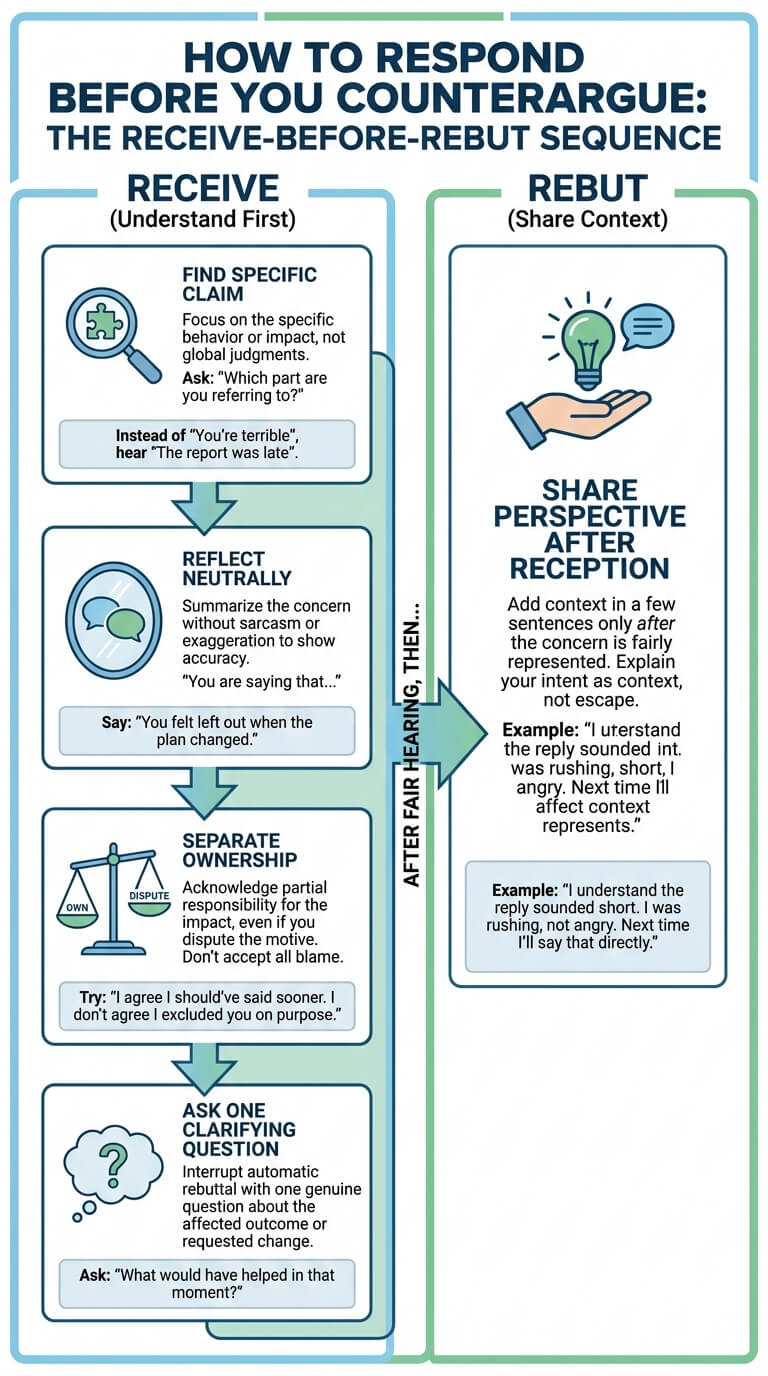
The Receive-Before-Rebut sequence separates understanding from agreement. It gives the concern a fair hearing before you decide what to own, correct, reject, or clarify.
One way to interrupt automatic rebuttal is to use active listening before explaining your own position.
Find the specific claim instead of hearing a global judgment
Ask yourself, “What behavior, decision, or impact is actually being named?” If the message is vague, request specificity: “When you say I was dismissive, which part of the conversation are you referring to?”
This turns “You think I am terrible” into a claim that can be examined.
Reflect the concern in neutral language
Summarize without sarcasm or exaggeration: “You are saying that I changed the plan after you had arranged your day, and you felt left out of the decision.” Reflection does not certify every interpretation as fact. It shows that you can represent the concern accurately.
Separate the part you can own from the part you dispute
Look for partial responsibility. Perhaps the impact was real but the motive claim is wrong. Perhaps the decision was reasonable but the communication was late. Try: “I agree I should have told you sooner. I do not agree that I changed it to exclude you.”
The Gottman Institute’s discussion of defensiveness and partial responsibility focuses on couple conflict, but the underlying distinction is useful in many settings: ownership does not have to mean accepting all blame.
Ask one clarifying question
One genuine question can interrupt automatic rebuttal. Ask what outcome was affected, which example matters most, or what change is being requested. Avoid cross-examination designed to expose a flaw in every sentence.
Useful questions include: “What would have helped in that moment?” “Are you asking for acknowledgment, a correction, or a change next time?” “Which part feels unresolved?”
Share your perspective after showing accurate reception
Once the concern is represented fairly, add context in a few sentences. “I understand why the short reply sounded annoyed. I was rushing between appointments, not angry with you. Next time I can say that directly.”
This order increases the chance that explanation will be heard as context rather than escape.
How to Give Feedback That Reduces Unnecessary Defensiveness
You cannot guarantee receptivity, but you can reduce avoidable threat and make the concern easier to process.
Describe behavior and impact instead of identity
“You interrupted me three times in the meeting, and I could not finish the recommendation” is more usable than “You are disrespectful.” Behavior can be discussed and changed. Character labels invite a debate about the person’s entire identity.
Use one issue at a time
A list of past failures makes full defense seem necessary. Choose the issue that needs action now. If history matters, describe the recurring behavior without reviewing every disappointment.
State the desired change clearly
Feedback without a next step can feel like punishment. Explain what would help: “Please review the figures before the Monday meeting,” or “When I say I need a pause, I need us to agree on a time to return.”
Feedback becomes more manageable when it is approached with the preparation used for difficult conversations.
Leave room for context without surrendering the concern
You can say, “I want to understand what was happening for you, and the impact still needs attention.” This prevents the false choice between hearing context and maintaining the concern.
Choose timing that supports regulation and attention
Public embarrassment, surprise confrontation, and late-night exhaustion can increase self-protection. When possible, choose privacy, adequate time, and a moment when neither person must immediately perform for an audience.
When Defensiveness Is Protecting Something Legitimate
Sometimes resistance is a response to an unfair process rather than avoidance of responsibility. The task is to protect fairness and safety without automatically dismissing every concern.
The feedback is vague, humiliating, manipulative, or factually wrong
Feedback is not automatically fair because someone calls it honest. “Everyone knows you are impossible” gives no behavior to examine. Public ridicule, motive claims, and moving standards can make openness unsafe.
You can request facts and respectful delivery: “I am willing to discuss a specific example privately. I will not respond to insults or claims about what everyone thinks.”
The conversation contains coercion, threats, or retaliation
In a controlling dynamic, demands for “accountability” may be used to force confession, access, compliance, or submission. The National Domestic Violence Hotline’s information on power and control describes patterns such as intimidation, isolation, threats, and coercion. These are not ordinary feedback problems.
If disagreement could lead to violence, stalking, financial punishment, humiliation, or retaliation, prioritize safety and outside support. Better listening is not a substitute for protection.
The person needs a boundary or safer process rather than more openness
A workplace complaint may need documentation, while a family conversation may require a third person. Protecting a fair process is different from refusing all examination.
Defensiveness Across Contexts
The protected concern changes with the setting. Family history, friendship expectations, workplace power, and public online audiences can each make feedback carry a different emotional cost.
Family criticism and old roles
An adult may hear a parent’s question through years of being treated as careless. Naming the present event can help: “I want to discuss today’s plan without turning this into who I was at sixteen.”
Friendship misunderstandings
A friend says, “I felt forgotten when you did not reply,” and the receiver lists every past act of support. A better first response is, “I can see why the silence felt personal. I was overwhelmed, and I should have let you know.”
Workplace feedback and status
An employee may fear that admitting one error will damage advancement. A manager may interpret questions as disrespect. Useful workplace feedback separates performance facts, impact, expectations, and available support. Where consequences are serious, written clarification can reduce ambiguity.
Online debate and identity threat
Online exchanges are public, compressed, and easy to misread. A correction may feel like a challenge before an audience, so people defend identity and belonging as well as facts. Sometimes one clarifying question, or leaving the exchange, is the wiser response.
A Defensiveness Self-Check
Use these questions before replying or during a planned pause. They help distinguish what needs ownership, what needs clarification, and what may require a boundary.
What am I afraid this feedback says about me?
Complete the sentence privately: “If this criticism is true, it means I am…” The answer may reveal the identity threat beneath the rebuttal. Then narrow it: one poor decision does not prove a global identity.
What part have I not yet understood?
Before responding, identify what remains unclear. Is the concern about intention, impact, frequency, timing, reliability, or respect? Ask for the missing information instead of arguing with an incomplete version.
What can I own without accepting the whole story?
Look for the smallest honest unit of responsibility. You may own a delay, unclear wording, a harsh tone, or failure to follow through while disputing a larger accusation. Partial ownership is not weakness. It is precision.
What fact or boundary needs calm clarification?
Write the correction in one or two sentences. If it requires ten minutes of background, decide which details change the conclusion and which are attempts to reduce discomfort.
Is this conversation safe enough for vulnerability?
Consider the other person’s past behavior. Do they use admissions against you, punish disagreement, threaten consequences, monitor you, or humiliate you publicly? Openness belongs in a context with enough safety and fairness to use it responsibly.
Some research suggests that affirming valued parts of the self can make threatening information easier to process. An open-access study on self-affirmation and negative information provides one example. The practical point is to remember that one piece of feedback does not decide your entire worth.
Listening, Validation, and Repair After a Defensive Moment
Once protection softens, the conversation still needs a path forward. Accurate listening, emotional acknowledgment, and a concrete correction each solve a different part of the rupture.
After denial, counterattack, or shutdown, repair attempts in communication can help restore a workable exchange.
Listening before rebuttal
Listening gives you a more accurate target. Reflect the specific concern, then check whether you understood it. This prevents you from defending against an accusation the speaker did not actually make.
Validation of impact without automatic agreement
You can recognize an emotional experience without accepting every conclusion: “I understand why the silence felt dismissive.” Validation addresses the person’s experience. It does not require saying that every motive they assigned is correct.
Repair after denial, counterattack, or shutdown
If you already reacted defensively, name it directly: “I started arguing before I understood you. Let me try again.” Then summarize the concern, own a specific part, and state what you will do differently. Repair becomes credible through changed behavior, not only a smoother explanation.
When Professional or Safety Support May Help
Self-practice is useful for ordinary feedback difficulty. Repeated severe distress, major impairment, or unsafe power dynamics may require support beyond a private conversation.
Defensiveness repeatedly damages work or relationships
Support may help when feedback reliably produces panic, rage, shutdown, prolonged rumination, or serious impairment. A qualified professional can help explore triggers and practice responses without assigning a diagnosis from one behavior.
Fear, coercion, humiliation, threats, stalking, or retaliation
When the concern includes safety, direct communication may not be the best first step. Consider confidential advocacy, organizational procedures, trusted support, or emergency services appropriate to your location. Joint conversation is not recommended as a universal solution when one person may retaliate for honesty.
FAQ About Defensive Communication
These questions clarify common gray areas, especially the difference between self-advocacy and avoidance.
Is every explanation defensive?
No. An explanation becomes defensive when it replaces understanding, denies clear impact, or overwhelms the issue to protect identity or innocence. A constructive explanation accurately represents the concern first, adds relevant context, and includes any responsibility that remains.
Why do people get defensive even when feedback is gentle?
The current wording is only one part of the reaction. Past criticism, shame, fatigue, power differences, identity threat, or fear of consequences may shape what the message means. Gentle delivery can reduce avoidable threat, but it cannot guarantee receptivity.
Can someone acknowledge impact without agreeing with intent claims?
Yes. “I see that my comment embarrassed you” acknowledges impact. “I intended to embarrass you” is a different claim. A fair conversation can hold both the experienced effect and the speaker’s account of intention while focusing on what should change next.
What should you do when the other person becomes defensive?
Return to one specific behavior and impact. Avoid piling on examples or attacking character. Ask them to summarize the concern before responding, and allow relevant context. If the exchange becomes insulting, coercive, or unsafe, end it and use a safer process.
Can defensiveness be reduced over time?
Yes, many defensive habits can change through repeated practice. Useful skills include noticing bodily activation, separating behavior from identity, reflecting the concern, owning a precise part, asking clarifying questions, and repairing quickly after a reactive response. Change also depends on whether the surrounding environment permits honest mistakes and fair disagreement.
Key Takeaways
- Defensiveness is self-protection in response to perceived criticism, blame, or threat, not simply any disagreement.
- Denial, counterattack, intent-first explanations, minimizing, detail overload, and shutdown can all block accurate reception.
- Feedback becomes easier to process when it stays specific to behavior, impact, and the requested change.
- The Receive-Before-Rebut sequence makes room for understanding, partial ownership, factual correction, and legitimate boundaries.
- Acknowledging impact does not require accepting an inaccurate motive claim or taking all responsibility.
- Coercion, humiliation, threats, stalking, and retaliation require safety-focused support rather than greater openness.
A useful next step is to notice the first protective sentence that appears in your mind during feedback. Do not force yourself to agree. Translate that sentence into one question that helps you understand the specific claim. That small delay can keep your perspective intact while giving accountability a genuine chance.
Author note: Michael Reed is the Founder and Lead Writer at Psychology Exposed. He explains human behavior, relationships, emotional patterns, self-awareness, and everyday decisions in clear, research-aware language. This material is educational and is not a substitute for individualized mental health, workplace, legal, or safety advice.

Michael Reed is the Founder and Lead Writer at Psychology Exposed. He writes about human behavior, relationships, emotional patterns, self-awareness, and practical psychology topics using research-informed, easy-to-understand content.
Read More About Michael Reed: https://psychologyexposed.com/michael-reed/