

A goal may still matter, yet effort becomes difficult when you cannot tell whether anything is changing. You study but still make mistakes. You write for weeks but the project does not look finished. You follow a long-term health plan while daily results rise, fall, or remain too small to notice.
Progress changes motivation because it provides evidence. It tells you that action can influence the result, that a skill is developing, or that the desired outcome may be closer than it was before. When that evidence disappears, effort can begin to feel like a cost without a consequence.
This does not mean every action should become a score. Some metrics reward the wrong behavior, and frequent checking can increase anxiety or shame. The useful aim is to identify honest signals that show meaningful movement while leaving room for slow, nonlinear, and partly invisible change.
Quick Answer
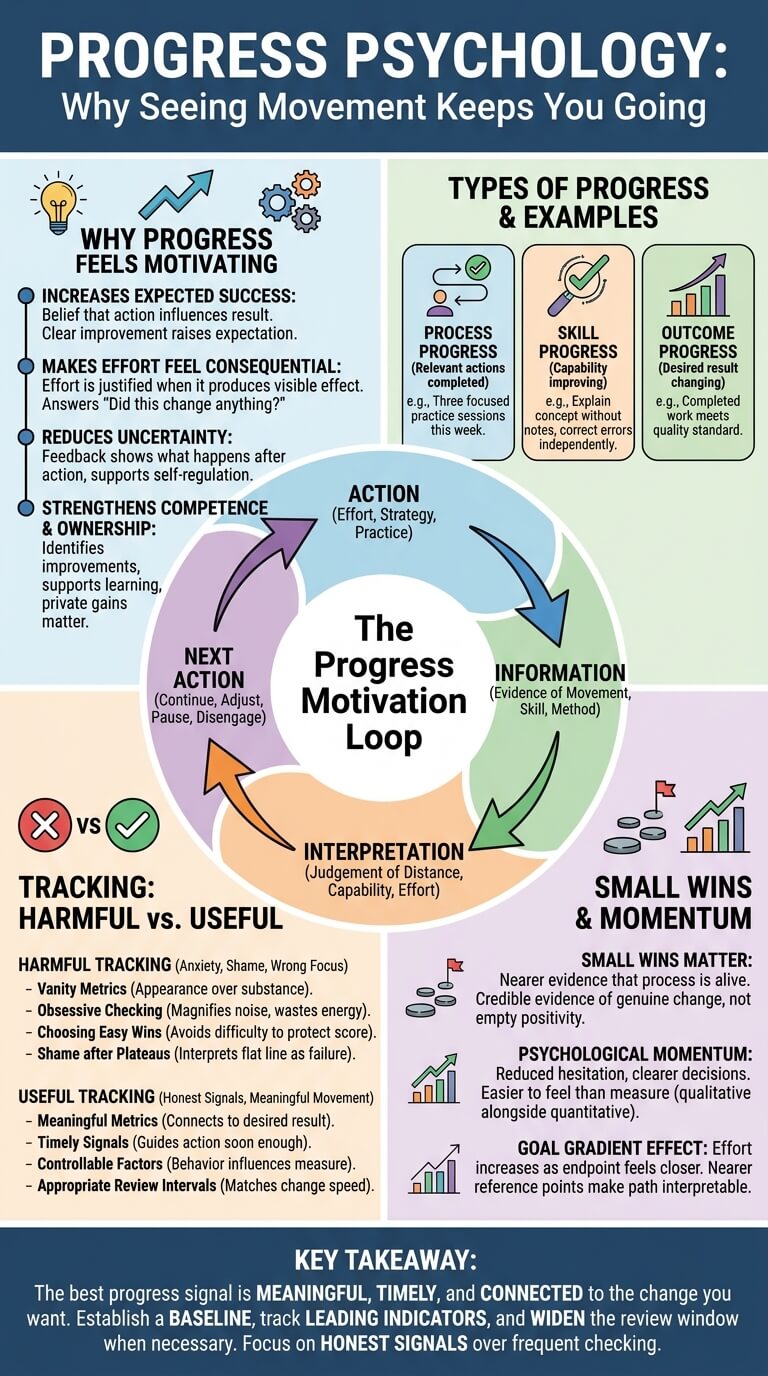
Progress feels motivating because it increases confidence that effort can work, reduces uncertainty, and makes a distant outcome feel more reachable. Small wins help when they provide credible evidence of learning, capability, or movement. Tracking becomes harmful when it rewards vanity metrics, encourages constant checking, or turns normal plateaus into personal failure. The best progress signal is meaningful, timely, and connected to the change you actually want.
Why Progress Feels Motivating
Progress increases expected success
People are more willing to invest effort when they believe action can influence the result. A clear improvement, even a small one, raises the expectation that another useful action may also matter.
This is different from forced optimism. Evidence can be modest: fewer errors, clearer recall, a completed section, greater tolerance for a difficult task, or more confidence using a new skill.
Progress makes effort feel consequential
Effort becomes easier to justify when it produces a visible effect. Without that connection, the person may feel they are repeatedly paying a cost without receiving information or movement.
A progress signal answers, “Did this action change anything?” The answer may concern the final result, the quality of the method, or the person’s growing capability.
Progress reduces uncertainty
Long goals contain uncertainty about the method, timeline, and likelihood of success. Feedback reduces some of that uncertainty by showing what happened after a particular action.
Research on monitoring goal-directed behavior notes that seeking information about progress can support metacognition and self-regulation. The person can compare performance with the goal and decide whether to continue, adjust, or seek another strategy.
Progress can strengthen competence and ownership
Useful feedback can help a person feel capable of learning rather than dependent on praise. It identifies what improved and how the person’s choices contributed.
Progress also supports ownership when the signal reflects a personally meaningful change. A private improvement can remain motivating even when nobody else notices it.
The Progress Motivation Loop

| Stage | What happens | Motivational effect |
|---|---|---|
| Action | The person applies effort, strategy, or practice. | The goal creates a reason to test what may work. |
| Information | The result provides evidence about movement, skill, or method. | Uncertainty becomes more manageable. |
| Interpretation | The person judges distance, capability, and whether effort matters. | Expected success rises, falls, or becomes more precise. |
| Next action | The person continues, adjusts, pauses, or disengages. | The loop creates momentum or weakening effort. |
Action creates information
Before action, many beliefs about difficulty and capability are guesses. A first attempt produces information. It shows what is easy, what is missing, and which obstacles were invisible during planning.
The action does not need to succeed fully to be informative. A rough draft can reveal a structural problem. A practice test can show which concepts need review.
Information changes perceived distance and expectancy
Progress can make the endpoint feel closer. It can also reveal that the goal is farther away than expected. Both forms of information matter.
Motivation is better supported by accurate evidence than by an artificially positive estimate. Discovering a larger distance may be disappointing, but it allows the method, timeline, or standard to be revised.
Updated expectancy changes the next action
If effort appears effective, the person is more likely to continue. If effort appears ineffective, they may reduce investment or search for another strategy.
The key question is whether the result reflects the method, the time window, the measurement, or a temporary fluctuation. One data point should not automatically become a permanent conclusion.
Repeated feedback creates momentum or disengagement
Momentum is the experience that actions are connected and movement is accumulating. Each completed step lowers uncertainty about the next one.
Repeated evidence of no effect can create disengagement, especially when the person receives no explanation. Better feedback may reveal hidden learning or show honestly that a change is needed.
Small Wins and Psychological Momentum

Why small changes can matter before the final result
A distant outcome may provide no reward for weeks or months. Small wins create nearer evidence that the process is alive.
For a language learner, the win may be understanding a short conversation. For a writer, it may be solving one structural problem. For someone rebuilding strength after professional guidance, it may be completing a movement with better control rather than reaching the final physical outcome.
Small wins as evidence, not empty positivity
A small win is useful when it represents genuine change. Calling every action a victory can make feedback meaningless.
Completing a session may be worth noticing when consistency is the current barrier. Later, the relevant win may need to shift toward quality, skill, or outcome. The signal should mature with the goal.
When a small win restores competence
After repeated confusion or failure, one believable improvement can change the interpretation of effort. The person sees that they are not completely ineffective and that a strategy can produce movement.
Informational feedback matters here. Research associated with Self-Determination Theory has long distinguished feedback that supports perceived competence from feedback experienced mainly as control. A meta-analysis of negative feedback and intrinsic motivation highlights how feedback effects depend on context and the meaning communicated to the recipient.
Why momentum is easier to feel than to measure
Momentum may include reduced hesitation, clearer decisions, and faster recovery after mistakes. These changes are real but not always captured by a single number.
A person may feel more capable before the final performance improves. This suggests using qualitative evidence alongside quantitative tracking.
The Goal Gradient Effect
Effort often increases as the endpoint feels closer
The goal gradient effect describes a tendency for motivation or effort to increase as a person perceives greater proximity to a goal. Recent experimental work continues to examine how positive affect and effort change near completion. A study using Wordle-style tasks found that motivation and affect can rise as goals feel closer.
Closeness makes the remaining effort easier to imagine. The final result also becomes more emotionally available than it was at the beginning.
Progress is one of the feedback processes that sustain motivation across a goal.
Artificial closeness and milestone design
A large project can be divided into meaningful milestones that create nearer reference points. The milestone should represent a completed capability, stage, or decision rather than an arbitrary line designed only to create excitement.
Artificial progress can help someone begin, but misleading progress damages trust. A milestone is strongest when it corresponds to real work already completed or a useful stage now reached.
Why distant goals need nearer reference points
A final outcome such as fluency, publication, financial security, or long-term recovery may be too distant to guide today’s effort. Nearer reference points make the path interpretable.
These points can answer different questions: Did I practice the right process? Did skill change? Did I finish a meaningful stage? Is the method producing the intended outcome?
Visible Progress vs Real Progress

Metrics that represent meaningful change
A meaningful metric has a defensible connection with the desired result. If the goal is clearer writing, useful evidence might include fewer revisions needed for structure, stronger reader comprehension, or improved ability to identify weak passages.
The measure does not need to capture everything. It needs to illuminate an important part of the change without pretending to be the whole result.
Vanity metrics and misleading movement
Vanity metrics create the appearance of progress while offering little information about the purpose. Examples include counting resources collected instead of material understood, tracking hours without examining skill, or prioritizing visible engagement over useful contribution.
Misleading metrics can increase activity while moving the person away from what matters. They are especially powerful because they produce frequent positive signals.
Process progress, skill progress, and outcome progress
| Type of progress | What it shows | Example |
|---|---|---|
| Process progress | Whether relevant actions are being completed. | Three focused practice sessions were completed this week. |
| Skill progress | Whether capability is improving. | The person can explain the concept without notes and correct errors independently. |
| Outcome progress | Whether the desired real-world result is changing. | The completed work meets the intended quality standard. |
A strong review often uses more than one type. Process evidence is useful early, skill evidence shows learning, and outcome evidence tests whether the learning transfers to the desired result.
Missing early feedback is one reason people can start strong and then lose motivation.
When no visible result still includes learning
An unchanged outcome does not always mean nothing happened. The person may have ruled out an ineffective method, identified a hidden obstacle, or developed skill that has not yet transferred to performance.
Hidden progress should not become an excuse for endless ineffective effort. It needs evidence, such as clearer understanding, fewer mistakes, or a better ability to choose the next strategy.
Why Progress Becomes Hard to See
Delayed outcomes
Some changes appear only after repeated effort. The delay makes it difficult to connect today’s action with the eventual result.
Leading indicators can help, but they should be chosen carefully. A leading indicator is evidence that occurs earlier and plausibly contributes to the later outcome.
Nonlinear improvement
Learning and behavior change rarely move in a smooth line. Improvement may appear in bursts, followed by flat periods or temporary declines.
A plateau can occur because the next level requires a new strategy, because the person is consolidating a skill, or because the available measure is not sensitive to smaller changes.
Comparing daily noise instead of long-term change
Daily performance varies with sleep, stress, environment, task difficulty, and normal randomness. Comparing today only with yesterday can exaggerate these fluctuations.
A wider time window can reveal a trend. Weekly or monthly comparisons may be more informative for slow goals than constant checking.
Goals with no baseline or feedback method
Without a starting point, the person relies on memory and mood. Current frustration can make earlier ability look better than it was.
Research on how people monitor personal goals shows that progress may be judged against past performance, a desired target, or both. Studies of goal progress monitoring also show that the chosen comparison can vary with goal characteristics and individual differences.
Progress Signals That Support Motivation
Clear before-and-after evidence
A baseline creates a fair comparison. Save an early sample, record a starting score, describe current capability, or note how long a task takes before changing the method.
The comparison should occur under reasonably similar conditions. Otherwise, an easier task may look like skill improvement.
Milestones tied to meaningful capability
A useful milestone represents something the person can now do, understand, or complete. It is stronger than a milestone based only on elapsed time.
Examples include holding a short conversation, completing a full first draft, explaining the method to another person, or performing a task without a previous source of assistance.
Feedback from a trusted person or system
External feedback can reveal blind spots. The source should understand the standard and explain what changed rather than offering only praise or criticism.
Trust also matters. Feedback is easier to use when it is consistent, specific, and not tied to humiliation or conditional approval.
Process evidence when outcomes are delayed
When the result cannot appear yet, track whether the necessary process is occurring with sufficient quality. This keeps the person connected to controllable action.
Process evidence should eventually be tested against skill and outcome. Otherwise, the person may become efficient at repeating an ineffective method.
When Progress Tracking Backfires
Obsessive checking
Frequent checking can magnify normal variation and make attention revolve around the number. The person may spend more energy evaluating progress than producing it.
Set a review interval that matches how quickly meaningful change can occur. A slow process does not need an hourly verdict.
Turning every activity into a score
Measurement can narrow an experience. Reading becomes pages, friendship becomes messages, exercise becomes numbers, and creativity becomes output volume.
Not every benefit needs to be quantified. Qualitative reflection can preserve meaning that a score would flatten.
Choosing easy wins to protect the metric
Once the score becomes important, people may select tasks that improve it rather than tasks that produce growth. They avoid difficult practice because errors would make performance look worse.
A useful system allows temporary difficulty when the difficulty serves learning.
Shame after a flat or backward period
Tracking can turn a plateau into a moral judgment. The person interprets a flat line as evidence that they are failing rather than information about the task, method, time window, or capacity.
Use neutral review language: What changed, what remained stable, and what evidence would justify a new strategy?
Setbacks, Plateaus, and Motivation
A setback is information, not the whole trend
One poor result may reflect a harder task, temporary stress, a changed environment, or a real weakness that needs attention. It does not automatically erase earlier improvement.
Compare the setback with the baseline and the wider pattern. Then decide whether the method needs adjustment.
Plateaus during skill development
A plateau can indicate that the current strategy has produced most of the improvement it can provide. The next stage may require more precise feedback, deliberate practice, or a different challenge.
It can also reflect a measure that is too crude to detect smaller gains.
Distinguishing no progress from hidden progress
Hidden progress should have observable traces. The person may recover from errors faster, need less support, notice problems earlier, or make better decisions even when the final score is unchanged.
If neither the outcome nor any credible leading evidence changes over a reasonable period, reconsider the method or goal rather than insisting that invisible progress must be occurring.
Progress feedback is not identical to an incentive; reward psychology explains how external outcomes and reinforcement work differently.
When stalled progress weakens motivation
Motivation often fades when effort repeatedly produces no meaningful signal. The person loses confidence that the action matters.
A plateau may require better feedback, a wider review window, recovery, skill support, or an honest decision about whether the current path remains worthwhile.
Feedback is most helpful when it strengthens competence without control, a distinction explained by Self-Determination Theory.
Goal Setting vs Progress Psychology
Goals define the direction and standard
A goal names the desired future and provides the reference point. It answers what the person is trying to change.
Progress indicates movement relative to that standard
Progress answers whether the current state is moving toward the goal, how quickly, and through which process.
Without a clear goal, progress signals become arbitrary. Without progress information, a well-designed goal can still feel distant and uncertain.
Progress can only be interpreted against a standard, so it depends on how the goal was designed.
Why a good goal still needs usable feedback
A meaningful, realistic goal does not automatically show the person what is working. Feedback closes that gap.
Goal design comes first, then progress monitoring helps the person learn how pursuit is unfolding.
A Progress Signal Audit

What kind of change am I actually trying to produce?
Name the result in plain language. Then separate the process, skill, and outcome involved.
What evidence would appear before the final outcome?
Identify a leading sign that should change earlier. It may be improved technique, fewer errors, stronger understanding, or completion of a meaningful stage.
Is the signal timely, meaningful, and controllable?
Timely means it appears soon enough to guide action. Meaningful means it represents the desired change. Controllable means your behavior can influence it, even if other factors also matter.
Could the metric encourage the wrong behavior?
Imagine trying to improve the score without improving the real outcome. If that is easy, the metric needs a safeguard or a companion measure.
How often should I review without overchecking?
Match review frequency to the speed of meaningful change. Daily process checks may suit one goal, while skill or outcome reviews may need a weekly or monthly interval.
What to Do When Progress Feels Invisible
Establish a baseline
Record where you are now using a sample, description, score, or specific capability. The baseline should be simple enough to repeat.
Track a leading indicator
Choose evidence that appears before the final result and has a plausible connection to it. Avoid selecting a signal only because it is convenient.
Widen the time window
Compare longer intervals when daily noise hides the trend. A month may show what three days cannot.
Ask for competence-building feedback
Seek feedback that explains what improved, what remains weak, and what action could change the next attempt. General encouragement is not a substitute for information.
Reconsider the goal or method when evidence stays absent
Monitoring is useful only when it can lead to a decision. If meaningful evidence remains absent after a fair period, test another method, revise the goal, seek qualified guidance when appropriate, or release the pursuit.
Frequently Asked Questions About Progress and Motivation
Why do small wins increase motivation?
Small wins provide evidence that effort can produce change. They reduce uncertainty, strengthen competence, and make a distant outcome feel less abstract. They help most when they represent real learning or movement rather than empty celebration.
Can tracking progress make motivation worse?
Yes. Tracking can increase anxiety, shame, comparison, and metric chasing when it is too frequent or disconnected from the real goal. A useful system limits review frequency and includes qualitative context.
What if improvement is too slow to notice?
Establish a baseline, widen the comparison window, and identify an earlier sign of learning or capability. If no credible signal changes over a reasonable period, reconsider the method instead of assuming progress is merely hidden.
Does a setback erase momentum?
No. A setback is one piece of information within a wider trend. It may reveal a new challenge, weak strategy, temporary condition, or genuine loss. Review it against the baseline and previous pattern before deciding what it means.
Should I track effort or results?
Often both, along with skill. Effort shows whether the process occurred, skill shows whether capability changed, and results show whether that capability produced the desired outcome. The useful balance depends on the stage of the goal.
Key Takeaways
- Progress supports motivation by increasing expected success, reducing uncertainty, and showing that effort has consequences.
- Small wins matter when they provide credible evidence of learning, capability, or meaningful movement.
- The goal gradient effect helps explain why motivation may increase as completion feels closer.
- Process, skill, and outcome progress answer different questions and should not be treated as interchangeable.
- Tracking can backfire through obsessive checking, vanity metrics, easy-win selection, and shame during plateaus.
- A good progress signal is timely, meaningful, reasonably controllable, and unlikely to reward the wrong behavior.
Choose one slow goal and define three forms of evidence: one process action, one skill change, and one outcome signal. Set review intervals that match how quickly each can realistically change. This gives motivation something stronger than hype. It provides an honest record of whether effort is producing movement and when the method or goal deserves revision.
Author note: Michael Reed is the Founder and Lead Writer at Psychology Exposed. He explains human behavior, emotional patterns, self-awareness, and everyday decisions in clear, research-aware language. This content is educational and is not a substitute for diagnosis, therapy, medical care, rehabilitation guidance, or professional advice.

Michael Reed is the Founder and Lead Writer at Psychology Exposed. He writes about human behavior, relationships, emotional patterns, self-awareness, and practical psychology topics using research-informed, easy-to-understand content.
Read More About Michael Reed: https://psychologyexposed.com/michael-reed/