
You can know exactly what you want to say and still express it in a way that hides the request, pressures the listener, or leaves both people unsure about what happens next. One person says, “It is fine,” while quietly building resentment. Another pushes until the answer becomes yes. Someone else makes a clear request, hears no, and stays respectful even while disappointed.
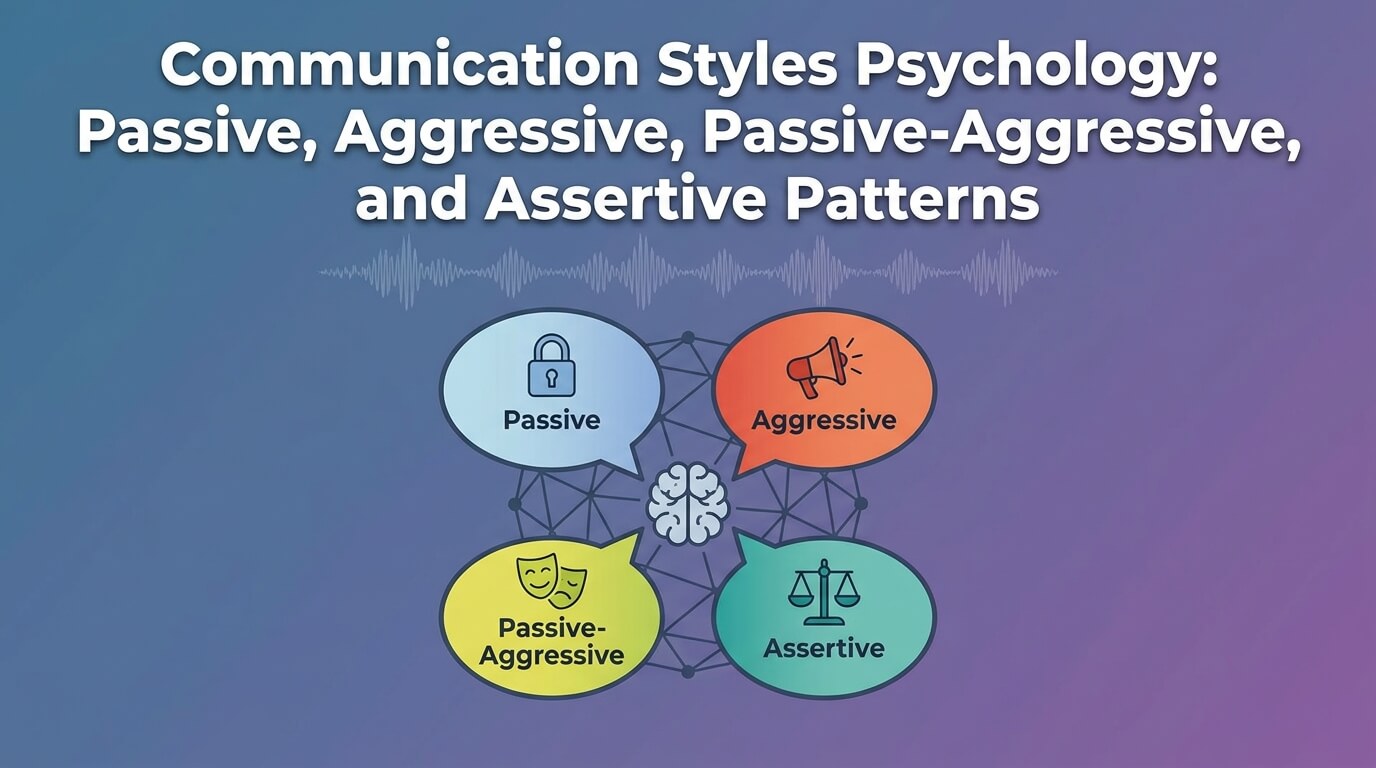
These differences are often described as communication styles. The four familiar categories are passive, aggressive, passive-aggressive, and assertive communication. They help only when they clarify behavior rather than become permanent labels. Most people shift across styles depending on the relationship, stakes, stress, and perceived safety.
The practical question is not simply, “Which style am I?” A better question is, “How do I express needs, handle disagreement, protect boundaries, and respond when the other person does not give me what I want?” That question reveals both the protective purpose of a style and the cost it may create.
Quick Answer
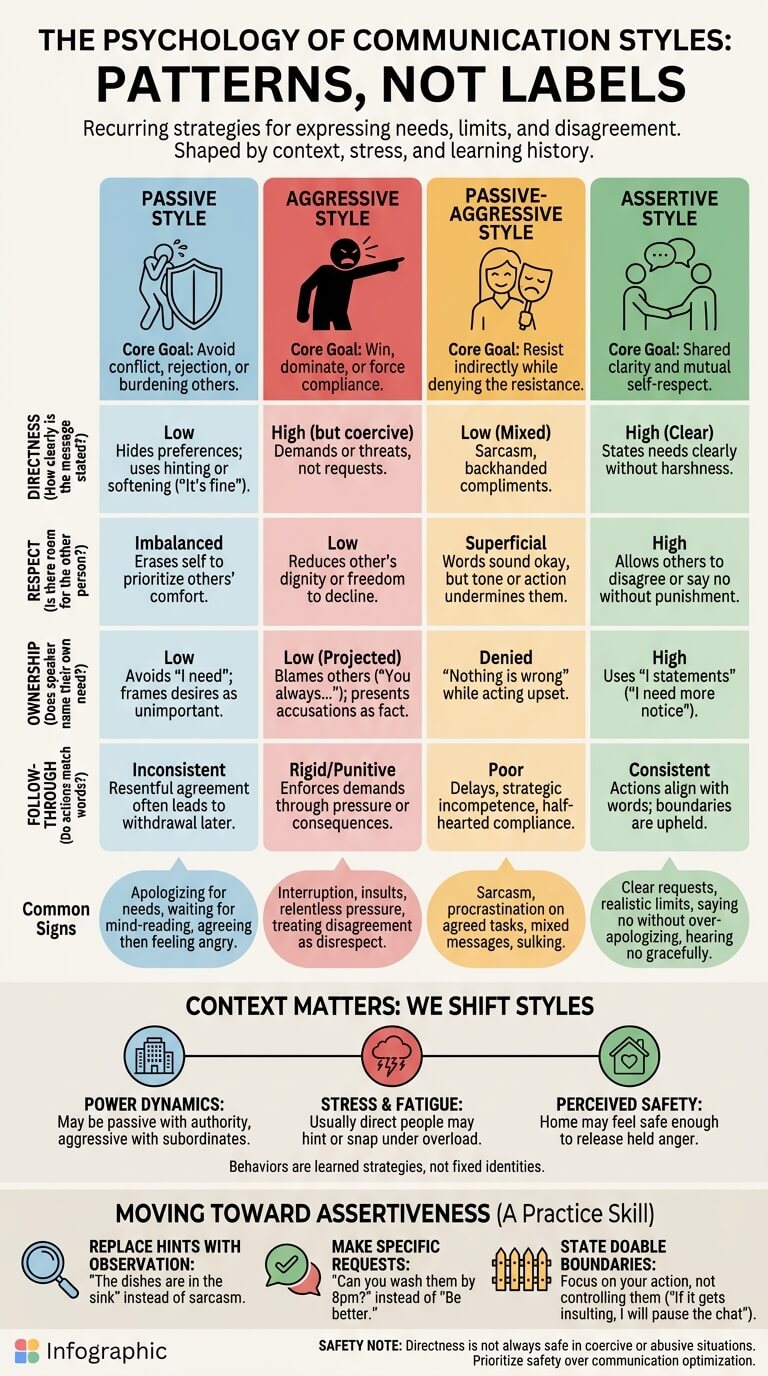
Communication styles are recurring ways of expressing needs, limits, disagreement, and emotion. Passive communication hides or gives up a need. Aggressive communication pushes a need while reducing the other person’s freedom or dignity. Passive-aggressive communication resists indirectly. Assertive communication states a need clearly while leaving room for a real response. These are learned behaviors, not fixed identities.
A Style Is a Pattern, Not a Permanent Identity
A communication style is best understood as a repeated strategy for expressing yourself, avoiding a feared outcome, or managing uncertainty. The same person may communicate differently with a manager, parent, partner, stranger, or child.
These recurring patterns are one part of the psychology of communication, which examines how messages create meaning across contexts.
The National Communication Association describes communication as messages generating meaning across contexts. Power, history, timing, expectations, and perceived risk influence how directly someone speaks and how freely another person can answer.
People shift styles across relationships and stress levels
Someone may speak assertively with friends but become passive around authority. Another person may remain controlled at work, then become demanding at home because home feels like the only place where anger can be released. A usually direct person may start hinting when tired, ashamed, or afraid of rejection.
A protective reason can explain behavior without making its impact harmless. Understanding it creates more room for accountability and change than a permanent label does.
Culture, role, power, safety, and learning history influence directness
Directness is not interpreted the same way in every family, workplace, language community, or culture. Some settings reward blunt expression, while others show respect through restraint, indirect wording, or attention to hierarchy. Past punishment or ridicule can also make disagreement feel risky.
Indirect speech is not automatically unhealthy, and direct speech is not automatically mature. Ask whether the message is understandable, consent remains real, both people retain dignity, and the speaker owns the request.
Labels help only when they lead to more accurate choices
A useful label names observable behavior: “I agreed even though I meant no,” or “I interrupted until the other person stopped objecting.” Turning a moment into identity may feel certain, but it reduces curiosity and makes change harder to imagine.
Look for repetition, context, and consequences. One sharp sentence does not define a style. Repeated pressure, contempt, threats, or punishment for disagreement deserves more concern.
The Four-Style Communication Map

The four styles become easier to distinguish when you assess them through four practical dimensions: directness, respect, ownership, and follow-through. This framework focuses on what the communication does, not on whether the speaker sounds confident.
Directness: how clearly the message is stated
Directness asks whether another person can identify the request, concern, limit, or disagreement. “Whatever you want” hides a preference, while “I would rather stay home tonight” makes it visible.
Directness does not require harshness. You can be clear with a calm voice, soft wording, and consideration for the other person.
Respect: how much room remains for both people
Respect means the other person can disagree, ask questions, or say no without humiliation, threats, or punishment. A clear message can still be aggressive if it removes meaningful choice.
Respect also applies to the speaker. Constant self-erasure is not respectful simply because it avoids visible conflict.
Ownership: whether the speaker names their own need or feeling
Ownership sounds like, “I need more notice before plans change,” rather than, “You never care about anyone but yourself.” It means naming your experience, request, or boundary without presenting an accusation as fact.
Ownership makes disagreement easier to examine because the listener can respond to a specific concern rather than defend their entire character.
Follow-through: whether words and actions align
Communication includes what happens after the sentence. Repeated delay may reveal resistance, an unenforced boundary may look negotiable, and an apology without changed behavior may not restore trust.
Follow-through is where style becomes visible over time. It shows whether the message was a clear commitment, a pressured concession, an indirect protest, or a realistic limit.
Passive Communication
Passive communication places the speaker’s preference, need, or limit out of view. The person may agree, stay silent, over-apologize, or soften the message until it is difficult to recognize. The immediate goal is often to prevent conflict, rejection, criticism, or the feeling of burdening someone.
Common signs: softening, apologizing, hinting, and resentful agreement
- Saying “I do not mind” when you do mind.
- Giving long explanations before making a small request.
- Apologizing for having a preference.
- Waiting for others to guess what you need.
- Agreeing in the moment, then feeling angry afterward.
- Letting a limit be crossed because saying no feels selfish or dangerous.
Passivity can look peaceful while leaving the speaker anxious, resentful, confused, or convinced that other people’s comfort matters more.
Possible drivers: fear of conflict, rejection, punishment, or burdening others
Passive communication may develop where speaking up brought negative consequences. It can also reflect uncertainty, a strong wish to be liked, or a genuine power imbalance.
The distinction matters. Practicing clearer language may help when the main barrier is habit or fear of disappointing someone. It may not be safe to speak more directly when another person retaliates, monitors, threatens, or controls access to money, housing, work, or children.
Short-term protection and long-term cost
Saying yes can end tension quickly, but hidden preferences create unreliable agreements. The listener trusts the answer while the speaker grows resentful, withdraws, or later refuses to cooperate.
A small shift is to replace automatic agreement with time: “Let me think about that and get back to you this afternoon.” This protects space for an honest answer without requiring an immediate confrontation.
Aggressive Communication
Aggressive communication advances the speaker’s goal by reducing the other person’s room to respond freely. It may involve interruption, contempt, intimidation, ridicule, threats, relentless pressure, or certainty that dismisses every other perspective.
Common signs: pressure, interruption, contempt, threats, and one-sided certainty
- Talking over someone until they give up.
- Using insults or humiliation to establish superiority.
- Turning a request into a demand backed by consequences.
- Treating disagreement as disrespect or disloyalty.
- Raising intensity whenever the answer is not immediately favorable.
- Claiming to know the other person’s motives better than they do.
Aggression is not the same as anger. The APA Dictionary distinguishes anger from aggression: anger is an emotion, while aggression involves harmful behavior. Intense anger does not require threats, degradation, or control.
Possible drivers: urgency, learned control, status threat, or poor regulation
Aggressive responses may reflect fear of losing control, learned beliefs that force is necessary, or low tolerance for disagreement. Escalation may also grow from being ignored or from learning that intensity produces compliance.
Explanation does not remove accountability. Compliance produced by pressure is not evidence of mutual understanding.
Why clarity without respect becomes coercive or damaging
“I need an answer by Friday” can be assertive when there is a legitimate deadline and the listener can decline. “Agree by Friday or I will make you regret it” uses threat. Both are direct, but only one preserves choice and dignity.
Firm boundaries can include consequences you control, such as leaving a conversation that becomes insulting. Aggression tries to control the other person through fear, degradation, or punishment. The difference is not softness. It is whether the message protects a limit or dominates another person.
Passive-Aggressive Communication
Passive-aggressive communication expresses opposition indirectly through delay, sarcasm, selective forgetting, mixed messages, or low-effort compliance. The concern may be real, but the delivery lets the speaker deny the resistance.
Common signs: indirect resistance, sarcasm, delay, mixed messages, and strategic compliance
- Saying “Sure, no problem,” then repeatedly failing to do the task.
- Using jokes to deliver criticism while denying any serious meaning.
- Giving minimal cooperation to show resentment.
- Withholding useful information rather than stating an objection.
- Agreeing publicly and undermining the decision privately.
- Responding “Nothing is wrong” while using silence or behavior to communicate displeasure.
Not every delay is passive-aggressive. Fatigue, competing priorities, unclear instructions, or mistakes can look similar. Look for a repeated link between unspoken opposition and indirect resistance.
Possible drivers: blocked direct expression and fear of open conflict
Indirect resistance can feel safer when saying no seems forbidden. It may reflect resentment about power, limited language for disagreement, or a history of being dismissed when speaking plainly.
The APA Dictionary’s description of displaced aggression illustrates a related protective logic: hostility may be redirected when the original source feels too powerful to confront. This does not make every passive-aggressive act displaced aggression, but it helps explain why resentment sometimes appears sideways or toward safer people.
Why plausible deniability makes repair difficult
Repair needs a shared description of what happened. Passive-aggressive behavior makes that difficult because the conversation can shift from the repeated mismatch between words and behavior to an argument about intention.
A more useful response is specific and non-mind-reading: “You said yes three times, and the task was not completed. I need an honest no or a realistic time, not an agreement that will not happen.”
Assertive Communication
Assertive communication states a need, opinion, limit, or disagreement while respecting the other person’s right to respond. It protects self-respect without requiring submission.
Common signs: direct needs, clear limits, respectful disagreement, and realistic requests
- Naming the issue without attacking character.
- Making a request that can genuinely be accepted, declined, or discussed.
- Saying no without an unnecessary apology or invented excuse.
- Describing impact while remaining open to additional context.
- Setting a consequence that depends on your own action.
- Following through consistently enough that words remain credible.
Assertiveness appears among the social abilities listed by the APA Dictionary of Psychology. It is better treated as learnable behavior than as a narrow personality quality.
Why assertiveness protects self-respect and shared clarity
Clear expression gives others usable information. “I cannot take another project this week” is more workable than reluctant agreement followed by missed work.
Assertiveness also reduces false agreement. When people can say no, their yes becomes more trustworthy. When disagreement does not automatically trigger punishment, more accurate information can enter the conversation.
Why assertiveness is a skill rather than a guarantee of agreement
An assertive request may still be refused, and a boundary may disappoint someone. Assertiveness is not measured by comfort or approval.
One open-access discussion of assertiveness as an interpersonal communication skill emphasizes expressing one’s position while respecting the other person’s knowledge, ideas, and autonomy. That balance is central: your view remains visible, and the other person does not have to disappear for it to matter.
Communication Style Comparison

| Style | How needs are expressed | How disagreement is handled | Likely effect on the listener | Typical follow-through problem |
|---|---|---|---|---|
| Passive | Hidden, softened, or surrendered | Avoided or delayed | May feel unsure, falsely reassured, or unexpectedly blamed later | Agreement may exceed real willingness |
| Aggressive | Demanded or imposed | Treated as defiance, weakness, or obstruction | May feel pressured, diminished, angry, or afraid | Compliance may replace genuine commitment |
| Passive-aggressive | Implied through resistance or mixed messages | Expressed indirectly with deniability | May feel confused, mistrustful, or forced to guess | Words and behavior repeatedly conflict |
| Assertive | Stated clearly and specifically | Allowed without humiliation or surrender | May feel informed and respected, even when disappointed | Requests and limits are more realistic and visible |
How each style handles needs
Passive communication acts as though the need should not take up space. Aggressive communication acts as though only one person’s need matters. Passive-aggressive communication hides the need inside resistance. Assertive communication makes the need discussable without claiming automatic priority.
How each style handles disagreement
Passivity tries to prevent disagreement. Aggression tries to defeat it. Passive-aggression expresses it indirectly. Assertiveness permits it and works with the information it provides.
How each style affects the listener
The listener’s experience matters. Confusion may signal hidden information, fear may signal pressure, and persistent guessing may signal indirect resistance. Disappointment without punishment is more compatible with assertiveness.
How each style handles responsibility and follow-through
Responsibility becomes clearer when people state what they will do, what they will not do, and what they request. Style also appears in whether they accept the answer and act consistently.
Mixed and Context-Dependent Styles
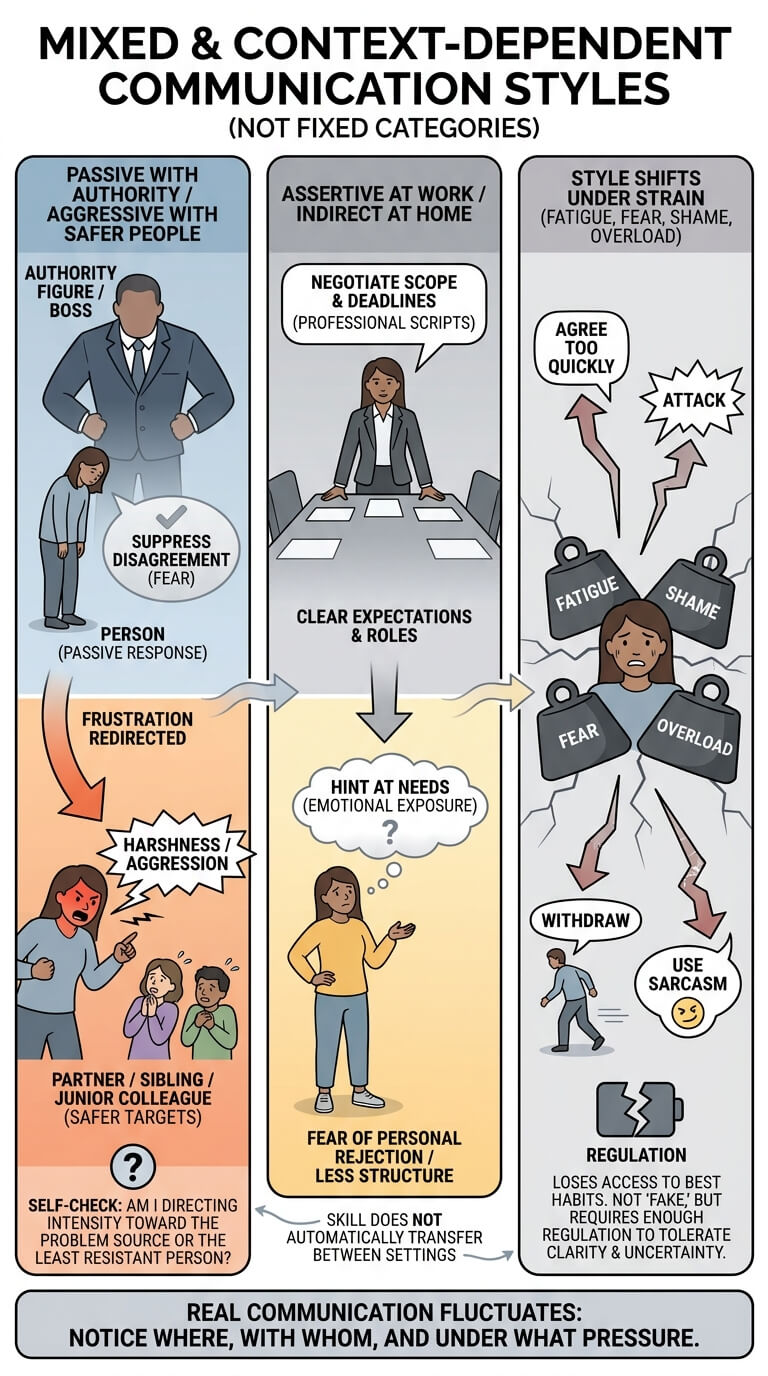
Real communication rarely stays inside one category. Notice where, with whom, and under what pressure each response appears.
Passive with authority but aggressive with safer people
A person may suppress disagreement with a boss, then release the frustration through harshness toward a partner, sibling, child, or junior colleague. The shift may reflect power and fear, but the safer person still receives the harm. A useful self-check is: “Am I directing this intensity toward the person who caused the problem, or toward the person least likely to resist me?”
Assertive at work but indirect at home
Professional roles often provide scripts, deadlines, and clearer expectations. Home can feel more emotionally exposed. A person who can negotiate scope at work may hint at needs in a close relationship because rejection feels more personal. Skill in one setting does not automatically transfer to another.
Style shifts during fatigue, shame, fear, or overload
Under strain, people often lose access to their best communication habits. They may agree too quickly, attack, withdraw, or use sarcasm. This is not proof that the calmer version was fake. It shows that reliable communication requires enough regulation to tolerate clarity, disagreement, and uncertainty.
A Communication Style Self-Check
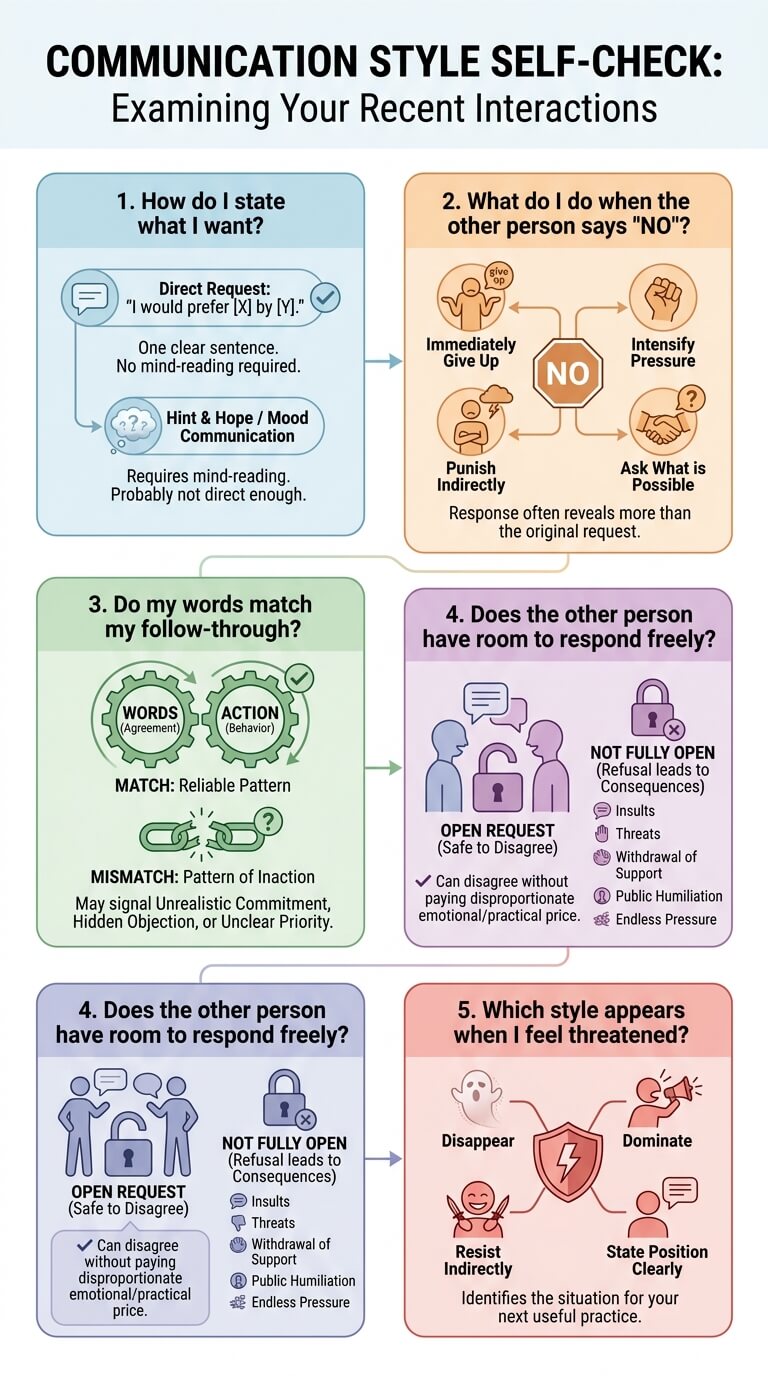
Use these questions to examine a recent interaction without assigning yourself a fixed type.
How do I state what I want?
Do you name the preference directly, hint and hope, demand, or communicate it through mood? Write the request in one sentence. If the sentence requires the other person to read your mind, it is probably not direct enough.
What do I do when the other person says no?
Notice the first impulse. Do you immediately give up your position, intensify pressure, punish indirectly, or ask what is possible? Your response to no often reveals more about style than the original request.
Do my words match my follow-through?
Compare recent agreements with actual behavior. A pattern of saying yes and not acting may point to an unrealistic commitment, hidden objection, or unclear priority. The honest correction might be a no, a new deadline, or a request for help.
Does the other person have room to respond freely?
A request is not fully open when refusal leads to insults, threats, withdrawal of basic support, public humiliation, or endless pressure. Ask whether the other person can disagree without paying a disproportionate emotional or practical price.
Which style appears when I feel threatened?
Think of a moment involving criticism, authority, rejection, or loss of control. Did you disappear, dominate, resist indirectly, or state your position clearly? The answer identifies the situation where your next practice is most useful.
How to Move One Step Toward Assertiveness

Trying to sound perfectly confident can make practice harder. Aim for one step toward greater clarity, respect, ownership, or follow-through.
Replace hints with one clear observation
Instead of “I guess the dishes will clean themselves,” say, “The dishes from last night are still in the sink.” An observation gives the conversation a shared starting point without hiding criticism inside sarcasm.
Name one need without blaming
Try, “I need a clearer division of chores this week,” rather than, “You are lazy and never help.” The first sentence may still be uncomfortable, but it identifies the problem that can be discussed.
Make one specific request
“Can you wash the dishes before 8 tonight?” is more usable than “Be more considerate.” Specific requests clarify the action, timing, and decision. They also reveal whether the issue is willingness, capacity, disagreement, or unclear expectations.
State one boundary you can actually follow
A boundary describes what you will do to protect a limit. “If the conversation becomes insulting, I will pause and return tomorrow” is different from “You are not allowed to get angry.” The first names your action. The second attempts to control an internal state.
Listen to the answer without escalating
Assertiveness includes receiving information you do not like. You can ask a follow-up question, negotiate, or maintain your boundary. You do not have to surrender, but you do need to hear the actual answer rather than convert every no into a battle.
Communication Styles vs Nearby Concepts
Several related ideas can change communication, but they describe different parts of the interaction.
Style versus tone of voice
Tone is vocal delivery, including pace, pitch, volume, emphasis, and pauses. Style is broader. A person can make an assertive request in a shaky voice, or deliver an aggressive demand in a calm voice. Sound matters, but it does not define the whole interaction.
Style versus defensiveness
Defensiveness is a response to feeling accused, exposed, or blamed. It can appear through any style. One person may become passive and agree too quickly. Another may counterattack. A third may use sarcasm. The core issue is how feedback is processed, not only how needs are usually expressed.
Style versus attachment tendency
Attachment ideas describe expectations and strategies related to closeness, availability, and security. Communication styles describe observable ways of expressing needs and handling conflict. They may influence each other, but one does not diagnose or prove the other.
Style versus one-time conflict behavior
A style requires repetition across relevant situations. Anyone can become indirect, sharp, or overly accommodating once. Look for frequency, context, repair, and whether the person can change course after the impact is named.
What to Examine Next When the Pattern Persists
The four-style map may reveal a more specific skill or obstacle that needs attention.
When the stakes or power difference are high, the pattern may need to be addressed through a more deliberate approach to difficult conversations.
Build deeper assertiveness when clarity and boundaries are the goal
If you understand the four styles but still struggle to make requests, say no, or hold limits, the next task is practicing assertive communication in small, specific situations. Skill grows through usable sentences and realistic follow-through, not through adopting a confident identity.
Examine defensiveness when feedback triggers denial or counterattack
If conversations become battles the moment impact is mentioned, the main obstacle may be threat response rather than a general style. Slowing the move from “I did not mean that” to “I can see what happened” can create room for accountability without forced self-condemnation.
Use repair when a repeated style has damaged trust
Changing one sentence is useful, but trust usually depends on what follows. Repair may include naming the old behavior, acknowledging impact, making a different agreement, and showing through repeated action that the new message is reliable.
When Direct Communication May Be Unsafe
Clarity is valuable only when it does not expose someone to greater danger or retaliation.
Power, retaliation, threats, stalking, or coercion
More direct communication is not always the right first step. If someone monitors you, threatens consequences, controls resources, humiliates you, stalks you, blocks you from leaving, or retaliates when you disagree, the problem is not simply a difference in communication style. The National Domestic Violence Hotline’s explanation of emotional abuse includes patterns such as threats, intimidation, humiliation, and control.
Why safety planning can matter more than communication optimization
In an unsafe dynamic, direct confrontation may increase risk. Consider confidential support, practical safety planning, and trusted local resources rather than assuming that a better script will make the other person respect a boundary. You are not responsible for communicating perfectly enough to stop someone else’s coercive behavior.
FAQ About Communication Styles
These distinctions answer common questions that a simple four-label chart often misses.
Can someone have more than one communication style?
Yes. Style can change by relationship, role, topic, and stress level. Someone who is passive with authority but aggressive at home may need different skills and accountability in each setting.
Is passive-aggressive communication always intentional?
No. Resistance may be deliberate, partly conscious, or linked to automatic overcommitment. Focus first on the observable mismatch between words and behavior. Intention can be explored, but repeated impact still matters.
Is direct communication automatically assertive?
No. Directness is only one dimension. A threat can be direct. An insult can be direct. Assertiveness combines clarity with respect, ownership, realistic requests, and room for the other person to respond without coercion.
Can an aggressive communicator learn assertiveness?
Yes, when the person is willing to notice impact, tolerate disagreement, and replace pressure with clear requests and boundaries. It also requires accepting that a respectful request does not guarantee compliance.
How are communication styles different from personality types?
Communication styles describe interaction behavior. Personality refers to broader tendencies across thought, emotion, and behavior. Style is also shaped by learning, power, culture, stress, and relationship history.
Key Takeaways
- Passive communication hides or surrenders a need, often to avoid conflict or rejection.
- Aggressive communication advances a goal by reducing the other person’s dignity or freedom to respond.
- Passive-aggressive communication expresses opposition through indirect resistance and mixed follow-through.
- Assertive communication combines clarity, respect, ownership, and realistic action.
- People shift styles across settings, so repeated behavior matters more than a fixed label.
- The next useful step is one clearer observation, need, request, or boundary, provided directness is safe.
Review one recent conversation through the four dimensions: directness, respect, ownership, and follow-through. The first weak point gives you a practical place to improve without assigning yourself a permanent type.
Educational note: Michael Reed is the Founder and Lead Writer at Psychology Exposed. This material explains everyday communication behavior for general education and is not a diagnosis, therapy, crisis service, or substitute for professional support.

Michael Reed is the Founder and Lead Writer at Psychology Exposed. He writes about human behavior, relationships, emotional patterns, self-awareness, and practical psychology topics using research-informed, easy-to-understand content.
Read More About Michael Reed: https://psychologyexposed.com/michael-reed/