

A reward can make a difficult task easier to begin. It can also make an enjoyable activity feel like an obligation. Praise may strengthen confidence in one moment and create approval-seeking in another. A streak can make progress visible, then become a source of anxiety when one missed day threatens the entire score.
These differences exist because rewards do more than create pleasure. They direct attention, shape expectations, influence what people repeat, and communicate meaning. The same payment, prize, grade, compliment, or self-reward can feel supportive, controlling, informative, or irrelevant depending on the timing and context.
Reward psychology is therefore not a simple rule that says incentives are good or bad. The useful questions are more precise: What behavior is the reward teaching? How quickly does it arrive? Does it make progress visible or replace the original reason? Does the person feel capable and free to choose, or watched and controlled?
Quick Answer
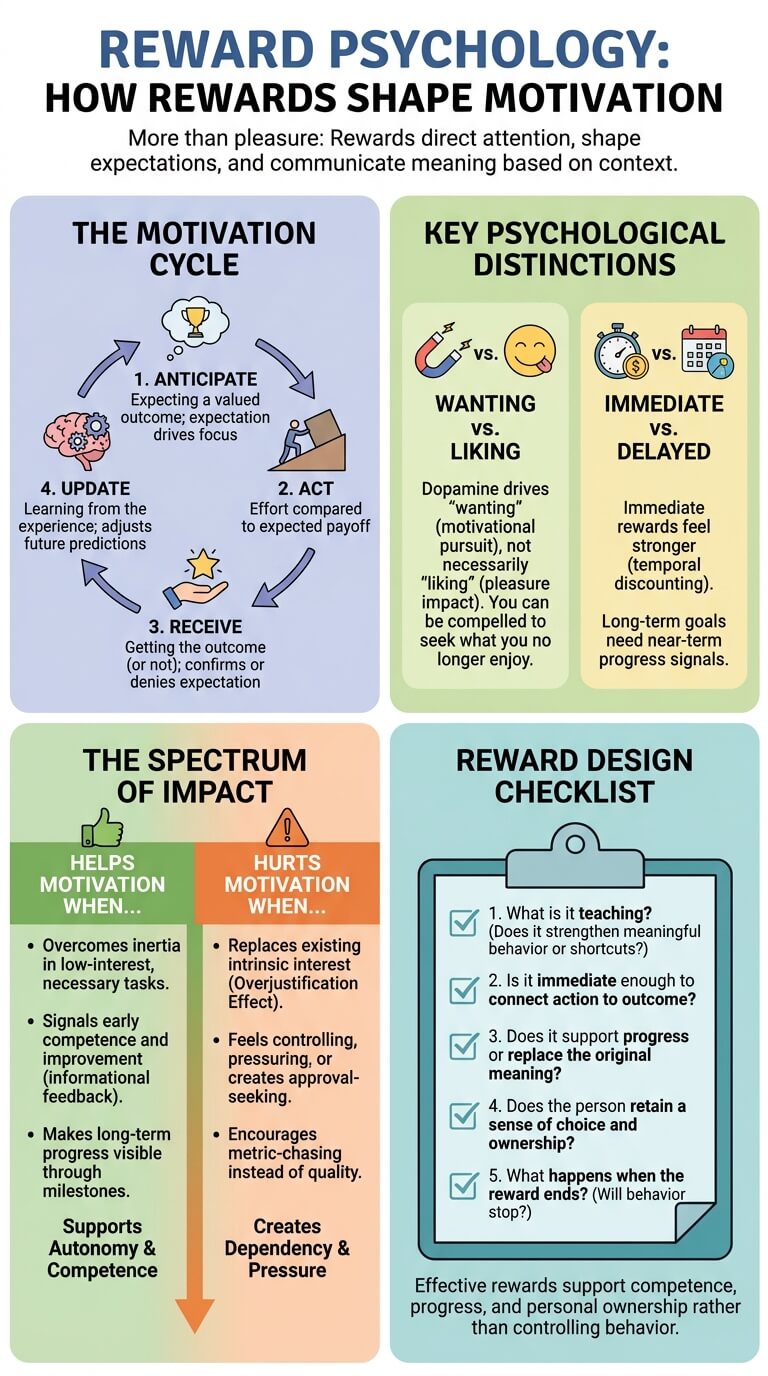
Rewards shape motivation by making outcomes feel valuable, guiding attention, and teaching expectations about what follows an action. Immediate and meaningful rewards can help start difficult behavior, while delayed or controlling rewards may have weaker or harmful effects. Rewards work best when they support competence, progress, and personal ownership. They can backfire when they replace meaning, create dependency, or turn approval into the main reason for acting.
What a Reward Does Psychologically
Signals that an outcome is worth pursuing
A reward gives an action a reason to compete for attention. The reward may be tangible, such as money or a treat, or social, such as praise, recognition, access, or inclusion. It may also be naturally built into the activity, such as satisfaction from solving a problem.
The signal does not need to be intense. A small but reliable benefit can guide action when it arrives soon enough and matters to the person. A large reward may have little effect when it feels unreachable, unrelated to the task, or unlikely to occur.
Strengthens expectations about what follows an action
People learn from patterns. If preparing the night before repeatedly makes the morning calmer, preparation begins predicting relief. If sharing an idea reliably brings ridicule, speaking up begins predicting social cost.
Reward expectations influence motivation before the outcome appears. The person acts partly because they have learned what is likely to follow. When that expectation changes, motivation often changes with it.
Changes attention, effort, and choice
A reward highlights the behavior connected to it. Students may focus on what earns points. Creators may prioritize what receives visible engagement. A person using a streak may pay more attention to daily completion than to quality.
This focus can be useful when the reward points toward the desired behavior. It becomes misleading when the measurable target is only a rough substitute for what truly matters.
Can support or control motivation depending on context
A reward can communicate useful information: “Your method improved,” “Your contribution mattered,” or “You completed a meaningful stage.” It can also communicate pressure: “You are acceptable only if you produce,” or “Your choice matters only when it matches mine.”
The object itself does not determine the effect. Timing, language, autonomy, relationship quality, and the meaning assigned to the reward all shape how it is experienced.
The Reward Motivation Cycle
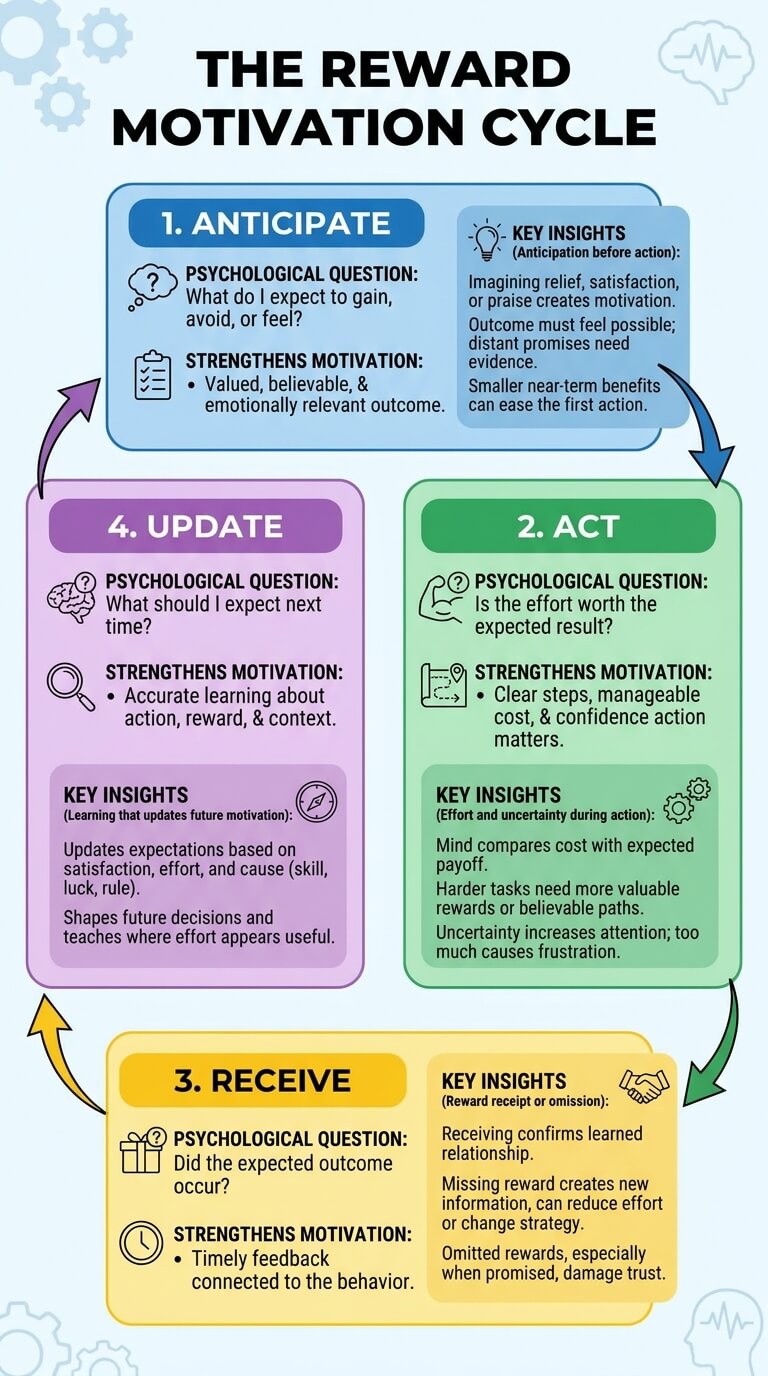
| Stage | Psychological question | What can strengthen motivation |
|---|---|---|
| Anticipate | What do I expect to gain, avoid, or feel? | A valued, believable, and emotionally relevant outcome. |
| Act | Is the effort worth the expected result? | Clear steps, manageable cost, and confidence that action matters. |
| Receive | Did the expected outcome occur? | Timely feedback that is connected to the behavior. |
| Update | What should I expect next time? | Accurate learning about the action, reward, and context. |
Anticipation before action
Anticipation can create motivation before a reward is received. You imagine relief after finishing a form, satisfaction after a workout, praise after sharing work, or comfort after completing an unpleasant chore.
The anticipated outcome needs to feel possible. A distant promise with no evidence may not compete effectively with immediate comfort. A smaller near-term benefit can sometimes make the first action easier without replacing the long-term reason.
Effort and uncertainty during action
During effort, the mind continues comparing cost with expected payoff. If the task becomes harder, the reward may need to feel more valuable or the path more believable.
Uncertainty can increase attention because the person wants to know what will happen. Too much uncertainty can produce frustration, especially when effort seems unrelated to the result.
Reward receipt or omission
Receiving the expected outcome confirms the learned relationship between action and result. Missing it creates new information. The person may reduce effort, change strategy, or search for another explanation.
An omitted reward is especially discouraging when the rule was presented as reliable. If someone is promised recognition for a clear contribution and repeatedly receives none, the issue is not simply weak motivation. Trust in the reward system has changed.
Learning that updates future motivation
After the result, the person updates expectations. Was the reward as satisfying as imagined? Was the effort larger than expected? Did the outcome depend on skill, luck, another person, or an unclear rule?
This learning shapes the next decision. Reward systems influence motivation over time because they teach people where effort appears useful and where it does not.
Reward Is Not the Same as Pleasure
Wanting, liking, and learning are related but different
People often assume that a reward is motivating because it feels pleasurable. Research on reward distinguishes at least three related processes: “wanting,” which concerns motivational attraction; “liking,” which concerns pleasurable impact; and learning, which concerns expectations and associations.
A widely cited review of wanting, liking, and reward learning explains that these processes can come apart. A person may strongly pursue something that delivers less pleasure than expected, or enjoy something without feeling compelled to obtain it repeatedly.
Why dopamine is not a simple pleasure chemical
Dopamine is often described online as the chemical of pleasure. That phrase is too simple. Dopamine systems are involved in learning, motivational salience, prediction, movement, and the willingness to pursue outcomes. Dopamine activity does not prove that an experience is pleasurable.
Stressful or attention-grabbing events can also involve dopamine-related signaling. A responsible explanation therefore avoids treating every desire, notification, or productive action as a “dopamine hit.”
Reward prediction and motivational salience
Cues connected to reward can become attention-grabbing. A notification sound, progress bar, familiar location, or packaging may create expectation before the outcome occurs.
Rewards are one part of the broader system explained by motivation psychology.
These cues can make an option feel urgent or attractive without changing its actual value. This is one reason people sometimes want an outcome more strongly than they enjoy it after receiving it.
Reinforcement and Motivation
Positive reinforcement
Positive reinforcement means that a behavior becomes more likely because it is followed by the presentation of a stimulus or circumstance. “Positive” means something was added, not that the method was morally good or emotionally pleasant in every case.
If completing a practice session is followed by useful feedback, social appreciation, or access to a valued activity, the practice behavior may become more likely. Whether this strengthens deep personal motivation is a separate question.
Negative reinforcement is not punishment
Negative reinforcement means a behavior becomes more likely because it removes, prevents, or postpones something aversive. “Negative” means subtraction, not punishment.
For example, responding to a message may become more frequent because it stops repeated reminders. Avoidance may become stronger because it immediately reduces anxiety. The behavior is reinforced by relief, even when the long-term result is unhelpful.
Why reinforced behavior can continue without deep personal value
Reinforcement explains why a behavior becomes more likely under certain consequences. It does not prove that the person identifies with the behavior or finds it meaningful.
A student can repeatedly complete work for grades without caring about the subject. An employee can respond quickly to avoid criticism without feeling engaged. Behavior may be reliable while the quality of motivation remains controlled or fragile.
Reinforcement is only one part of human motivation
Learning from consequences matters, but people also interpret fairness, identity, autonomy, trust, and purpose. A consequence that appears effective in the short term may create resentment, concealment, or minimum compliance later.
This is why broad explanations of behavior require more than a list of rewards and punishments. Reward psychology becomes most useful when consequence learning is combined with meaning and context.
Immediate vs Delayed Rewards
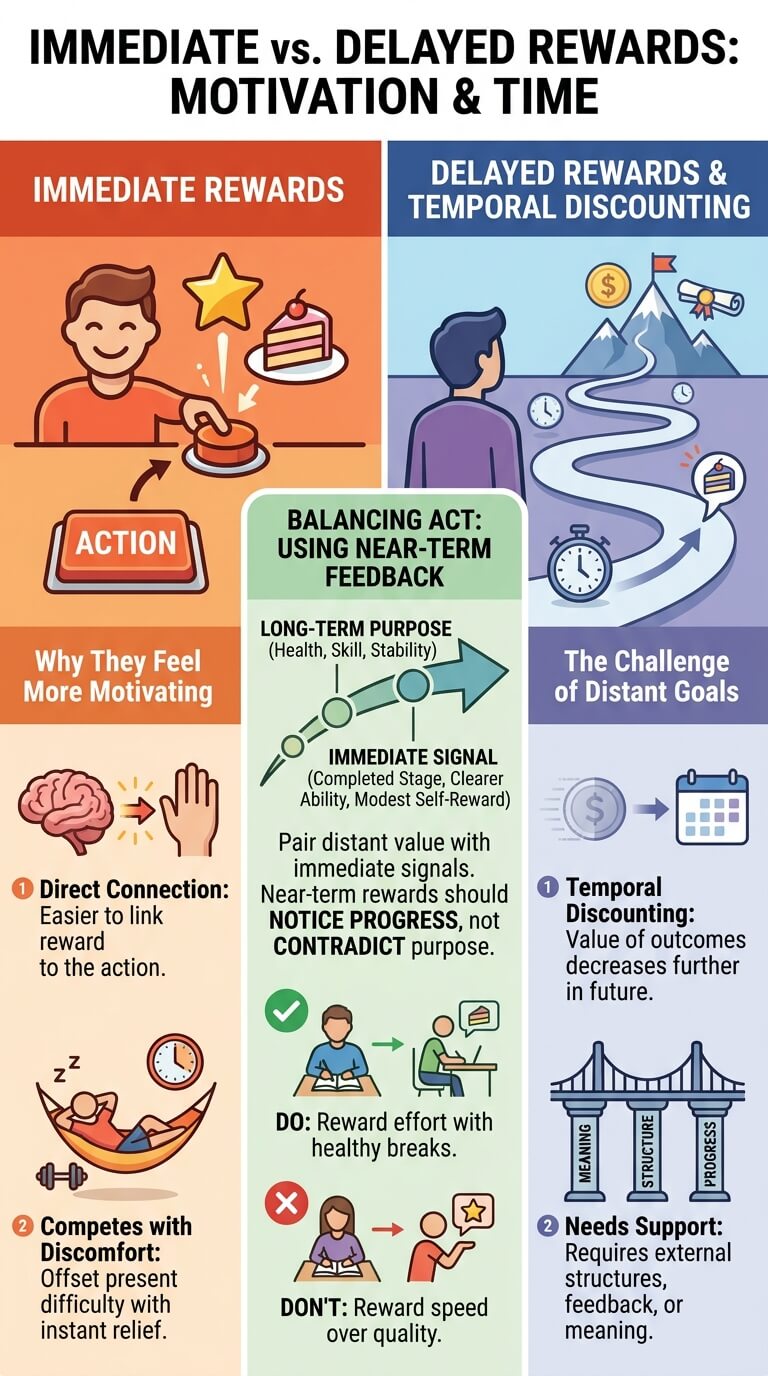
Why immediate outcomes often feel more motivating
An immediate reward is easier to connect with the action that produced it. The person does not need to hold a distant future in mind or trust that the payoff will eventually arrive.
Immediate outcomes also compete effectively with present discomfort. A pleasant break after a difficult session may feel more motivating than a benefit expected six months later.
Temporal discounting and distant goals
People tend to value delayed outcomes less than comparable immediate ones. This tendency is called temporal or delay discounting. An open-access study describes temporal discounting as the natural tendency to devalue rewards available further in the future.
This does not mean people are incapable of long-term action. It means distant outcomes often need support from meaning, structure, progress feedback, or smaller benefits that appear sooner.
Using near-term feedback without replacing the long-term reason
A near-term reward should help the person notice progress or tolerate delay. It should not contradict the purpose. Rewarding careful learning with permission to skip understanding would teach the wrong behavior.
A useful approach pairs a distant value with an immediate signal. The long-term reason may be health, skill, or financial stability. The near-term signal may be a completed stage, clearer ability, or a modest self-reward after the planned effort.
Expected, Unexpected, and Missing Rewards
Reward prediction errors in simple terms
A reward prediction error is the difference between the reward expected and the reward received. An outcome better than expected creates a positive prediction error. An outcome worse than expected creates a negative prediction error.
A major review of dopamine reward prediction error coding explains that these differences are central to learning about rewards. The brain updates expectations so future behavior can respond to what actually happened.
Why inconsistent payoff can intensify attention
When a reward is uncertain, people may monitor cues more closely. They want to know whether this attempt will produce the valued outcome. The uncertainty can make the cue feel especially important.
This does not mean uncertain rewards are always more motivating or appropriate. Uncertainty can create persistent checking, frustration, and poor judgment, especially when systems are deliberately designed to keep the person engaged.
When uncertainty becomes frustrating rather than motivating
Uncertainty is more tolerable when the person understands the process and believes effort improves the chance of success. It becomes discouraging when rules are hidden, outcomes feel arbitrary, or rewards are repeatedly promised without reliable delivery.
A trustworthy system makes the relationship between action and outcome as clear as possible. It does not use confusion as the main source of engagement.
When Rewards Help Motivation
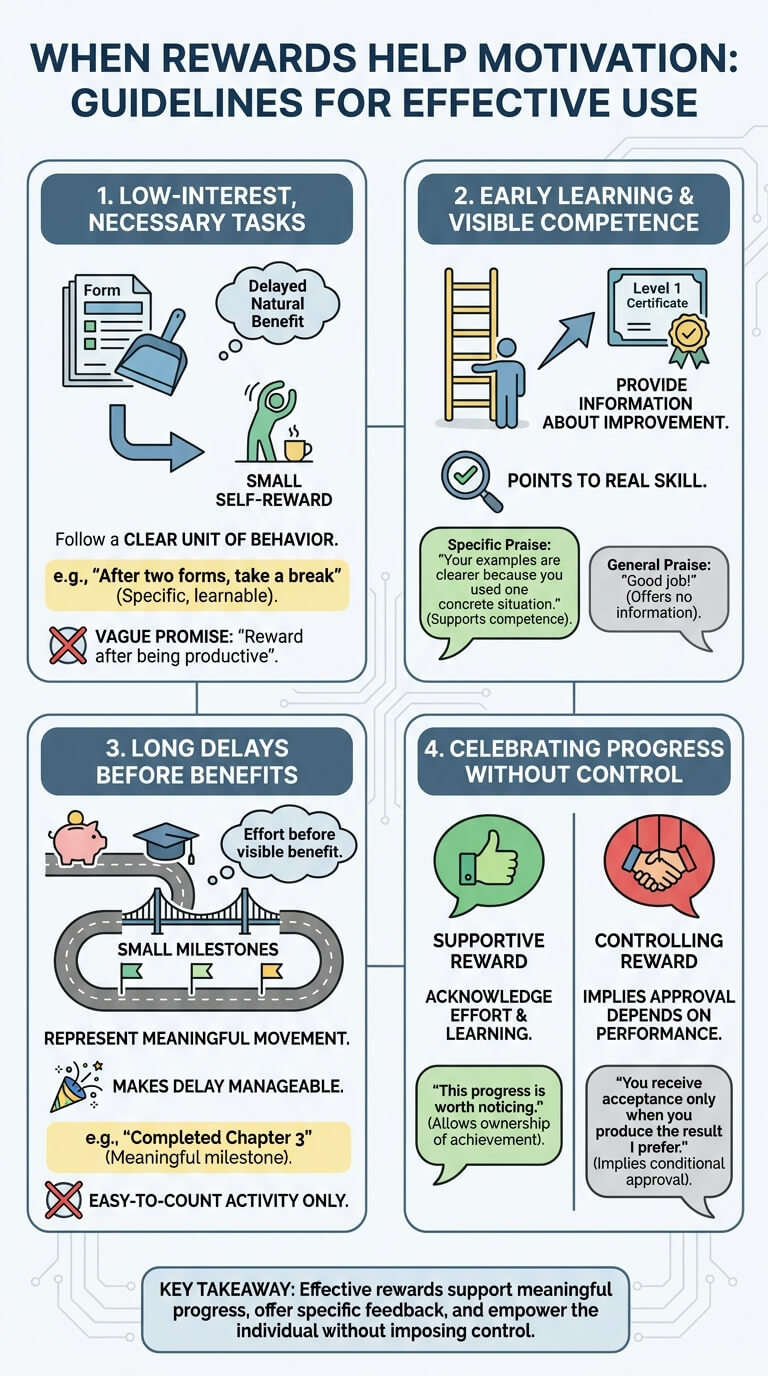
Low-interest but necessary tasks
Not every necessary task will become enjoyable. A small self-reward can help with paperwork, cleaning, routine maintenance, or another activity whose natural benefit is delayed.
The reward should follow a clear unit of behavior. “After I complete these two forms, I will take a quiet break” is easier to learn from than a vague promise to reward yourself after being productive.
Early learning and visible competence
Rewards can support motivation when they provide information about improvement. A certificate, level, badge, or encouraging comment may help a beginner notice that effort is producing skill.
The reward is most useful when it points to something real. “Your examples are clearer because you used one concrete situation” supports competence better than praise that offers no information.
Long delays before natural benefits appear
Saving, studying, rehabilitation, and long creative projects may require effort before their natural benefits become visible. Smaller milestones can make the delay psychologically manageable.
These milestones should represent meaningful movement, not activity chosen only because it is easy to count.
Celebrating progress without controlling the person
Celebration can acknowledge effort, learning, and completion without implying that approval depends on performance. It allows the person to own the meaning of the achievement.
A supportive reward says, “This progress is worth noticing.” A controlling reward says, “You receive acceptance only when you produce the result I prefer.”
When Rewards Hurt Motivation
The overjustification effect
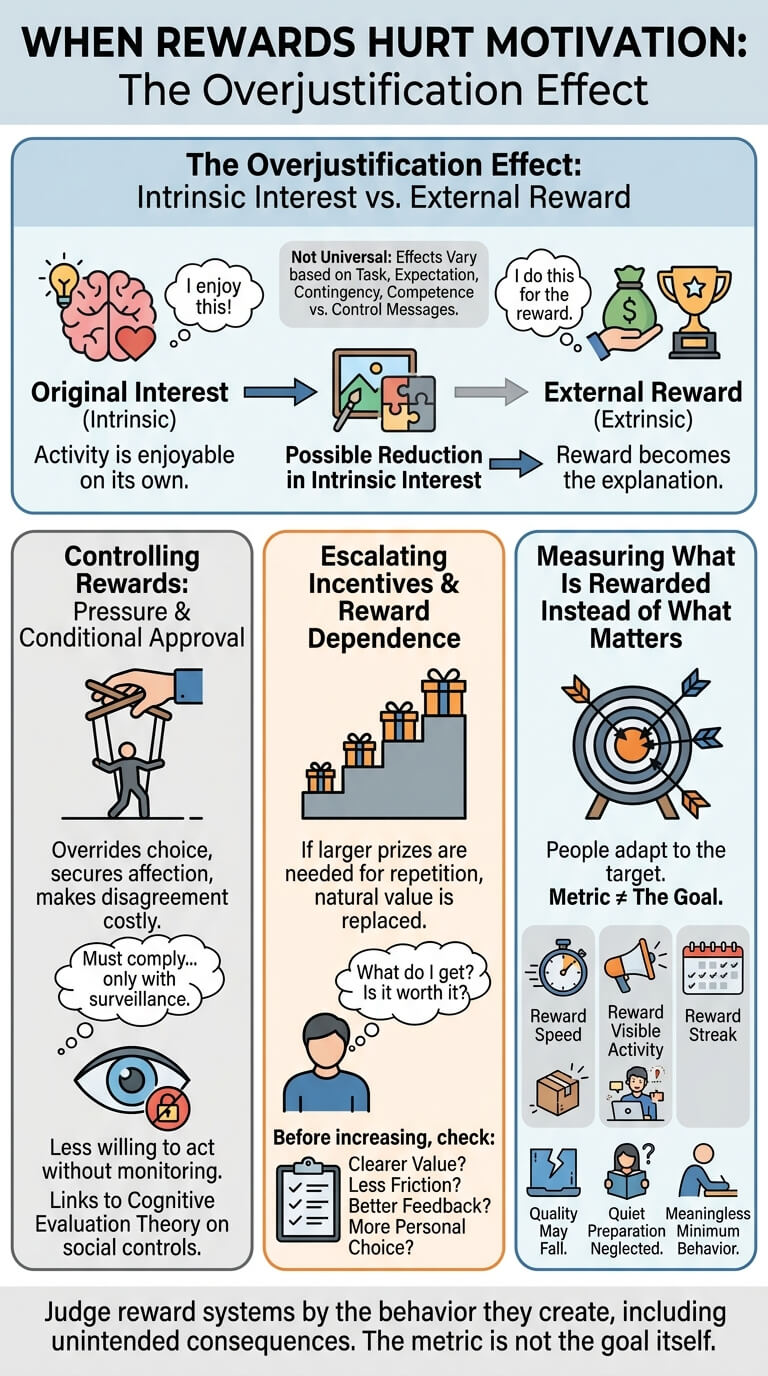
The overjustification effect refers to a possible reduction in intrinsic interest when an external reward becomes the obvious explanation for an activity that was already enjoyable. The person may begin thinking, “I do this for the reward,” rather than noticing the original interest.
Their effect becomes clearer when viewed through intrinsic and extrinsic motivation.
This is not a universal outcome. Effects vary with the task, whether the reward was expected, what it was contingent upon, and whether it communicated competence or control.
Rewards that communicate pressure or conditional approval
A reward becomes controlling when it is used to override choice, secure affection, or make disagreement costly. The person may comply while becoming less willing to act without surveillance.
Self-Determination Theory helps explain why the same reward can feel informative in one context and controlling in another.
The official overview of Cognitive Evaluation Theory focuses specifically on how rewards, feedback, interpersonal controls, and other social events can affect intrinsic motivation.
Escalating incentives and reward dependence
If every repetition requires a larger prize, the incentive may be replacing the natural value of the action. The person learns to ask, “What do I get?” before deciding whether the behavior is worthwhile.
Escalation can also make ordinary rewards feel insufficient. Before increasing the incentive, check whether the task needs clearer value, less friction, better feedback, or more personal choice.
Some of the best rewards work as credible progress signals rather than prizes detached from the task.
Measuring what is rewarded instead of what truly matters
People adapt to the target. If speed is rewarded, quality may fall. If visible activity is rewarded, quiet preparation may be neglected. If a streak is rewarded, the person may protect the streak with meaningless minimum behavior.
A reward system should be judged by the behavior it creates, including unintended behavior. The metric is not the goal itself.
A reward system also depends on how the goal defines success and what behavior the metric encourages.
Praise as a Psychological Reward
Informational praise that supports competence
Informational praise identifies what improved and why. It helps the person understand which strategy produced a better result.
Examples include: “Your explanation became clearer when you defined the term first,” or “You stayed with the difficult section and found the error.” The focus is on learning and repeatable behavior.
Controlling praise that creates approval-seeking
Controlling praise makes the evaluator’s approval the central outcome. It may compare the person with others, tie affection to success, or imply disappointment if performance changes.
Examples include: “You are the only one who never lets me down,” or “I knew you were too smart to fail.” These statements may feel positive while making future mistakes more threatening.
Process, strategy, and honest feedback
Good feedback does not praise effort regardless of outcome. It connects effort, strategy, judgment, and result honestly.
When a method did not work, feedback can still protect competence by identifying what was learned and what should change next. Empty praise reduces trust when the person knows the result was weak.
Rewards, Intrinsic Motivation, and Self-Determination
The reward itself is not the only variable
Money, praise, grades, or badges do not have one fixed psychological effect. The same reward may feel fair and informative in one context, then controlling in another.
The relationship, wording, timing, choice, and meaning all influence the result.
Autonomy, competence, and meaning change the effect
A reward that acknowledges competence may support motivation. A reward that restricts choice may weaken ownership. A practical incentive can coexist with personal meaning when the person accepts the reason for acting.
People often have mixed motives. They may enjoy the task, value its outcome, want payment, and appreciate recognition at the same time.
How reward questions connect to broader motivation questions
When a reward stops working, the problem may not be the amount. The person may have lost confidence, stopped valuing the goal, become overloaded, or received no meaningful progress signal.
Reward analysis is therefore one part of understanding motivation. Incentives cannot replace a believable path, sufficient capacity, personal ownership, or a goal worth pursuing.
A Reward Design Check
| Question | Helpful sign | Warning sign |
|---|---|---|
| What behavior is the reward teaching? | It strengthens the meaningful action or skill. | It rewards appearances, shortcuts, or the easiest metric. |
| Is it immediate enough to be noticed? | The connection between action and outcome is clear. | The reward is so delayed or uncertain that it provides little guidance. |
| Does it support progress or replace meaning? | It highlights learning, competence, or completion. | The activity seems pointless without the reward. |
| Does it create pressure or dependency? | The person retains meaningful choice and ownership. | Approval, affection, or safety feels conditional on performance. |
| What happens when the reward ends? | The person still sees value, skill, or natural benefit. | Behavior stops because no other reason developed. |
What behavior is the reward teaching?
Define the behavior precisely. “Study more” is vague. “Complete one active-recall session and check errors” identifies the action that should become more likely.
Is the reward immediate enough to be noticed?
The reward does not need to arrive instantly, but the person should be able to connect it with the behavior. A clear milestone can help when a final outcome is far away.
Does it support progress or replace meaning?
Ask whether the reward helps the person notice useful change. If the reward becomes the only visible reason, reconnect the action to skill, value, contribution, or natural benefit.
Does it create pressure, comparison, or dependency?
Watch for anxiety about losing approval, escalating demands, concealment of mistakes, or behavior performed only while someone is monitoring.
What happens when the reward ends?
Plan the transition. The reward may become less necessary as competence grows, natural benefits appear, or the action becomes integrated into ordinary life.
Ethical and Practical Boundaries
Rewarding yourself versus controlling another person
Self-reward gives you authority over your own behavior and outcome. Rewarding another person involves power, expectations, and consent. A reward can become coercive when the person cannot safely refuse or when basic care and affection are made conditional.
Consent, transparency, and avoiding manipulation
People should understand the rule connecting behavior and outcome. Hidden conditions and changing standards damage trust. In close relationships, rewards should not be used to purchase agreement, affection, sexual access, or silence.
Why variable rewards deserve caution
Uncertain rewards can intensify attention and repeated checking. Digital platforms, games, and gambling-like systems may use this uncertainty deliberately.
The practical boundary is not that every surprise is harmful. The concern appears when the system is designed to exploit repeated pursuit, obscure the odds, or make stopping unusually difficult.
Frequently Asked Questions About Reward Psychology
Do rewards always reduce intrinsic motivation?
No. Effects depend on the task, reward type, timing, expectation, perceived control, and whether the reward communicates competence. Rewards are more likely to undermine interest when they are expected, controlling, and attached to an activity the person already enjoyed.
Why do small rewards sometimes work better than large ones?
A small reward may be enough to make progress visible without becoming the main reason for acting. A large reward can increase pressure, distract attention from the task, or make the person question whether the activity is worth doing without it.
Is praise an intrinsic or extrinsic reward?
Praise is an external social reward. Its effect varies. Specific feedback may support competence, while comparison-based or conditional praise may create approval-seeking and controlled motivation.
Why does a reward stop feeling motivating?
The reward may become familiar, lose value, arrive too late, feel disconnected from effort, or require escalation. The person may also discover that the cost of the task is larger than the reward can justify.
Can rewards help build long-term motivation?
Yes, when they help a person begin, develop skill, notice progress, or remain engaged until natural benefits appear. Long-term motivation is more likely when the reward supports personal ownership instead of replacing it.
Key Takeaways
- Rewards influence motivation by shaping anticipation, attention, effort, and learning about what follows an action.
- Wanting, liking, and learning are related reward processes, but they are not the same psychological experience.
- Positive reinforcement adds a consequence that increases behavior, while negative reinforcement strengthens behavior by removing or preventing something aversive.
- Immediate rewards often feel stronger than delayed rewards, so long-term goals may need nearer progress signals.
- Rewards help most when they support competence, meaningful progress, and personal ownership.
- Rewards can backfire when they create pressure, dependency, metric chasing, conditional approval, or loss of the original reason.
Choose one reward you currently use and ask what it is actually teaching. Does it strengthen the meaningful behavior, make progress visible, and leave you with a reason to continue when the reward ends? If not, change the reward before increasing it. A smaller, clearer, and less controlling outcome often supports motivation better than a larger incentive attached to the wrong target.
Author note: Michael Reed is the Founder and Lead Writer at Psychology Exposed. He explains human behavior, emotional patterns, self-awareness, and everyday decisions in clear, research-aware language. This content is educational and is not a substitute for diagnosis, therapy, financial advice, or treatment for gambling or compulsive behavior.

Michael Reed is the Founder and Lead Writer at Psychology Exposed. He writes about human behavior, relationships, emotional patterns, self-awareness, and practical psychology topics using research-informed, easy-to-understand content.
Read More About Michael Reed: https://psychologyexposed.com/michael-reed/