

You may read a book because the subject fascinates you, because a class requires it, because you want praise, or because finishing it supports a future you value. The behavior looks the same from the outside, but the reason behind it can change how the effort feels and what happens when difficulty appears.
This is the central difference between intrinsic and extrinsic motivation. Intrinsic motivation comes from interest or satisfaction within the activity. Extrinsic motivation comes from an outcome that is separate from the activity, such as money, a grade, recognition, access, or avoiding a consequence. Real motivation is rarely divided into two perfectly separate boxes. People often act from several motives at once, and external reasons can become personally meaningful over time.
Understanding the difference helps you ask a better question than “Am I motivated enough?” You can examine whether your reason supports curiosity, personal ownership, competence, and persistence, or whether it creates pressure that works only while a reward or threat remains present.
Quick Answer
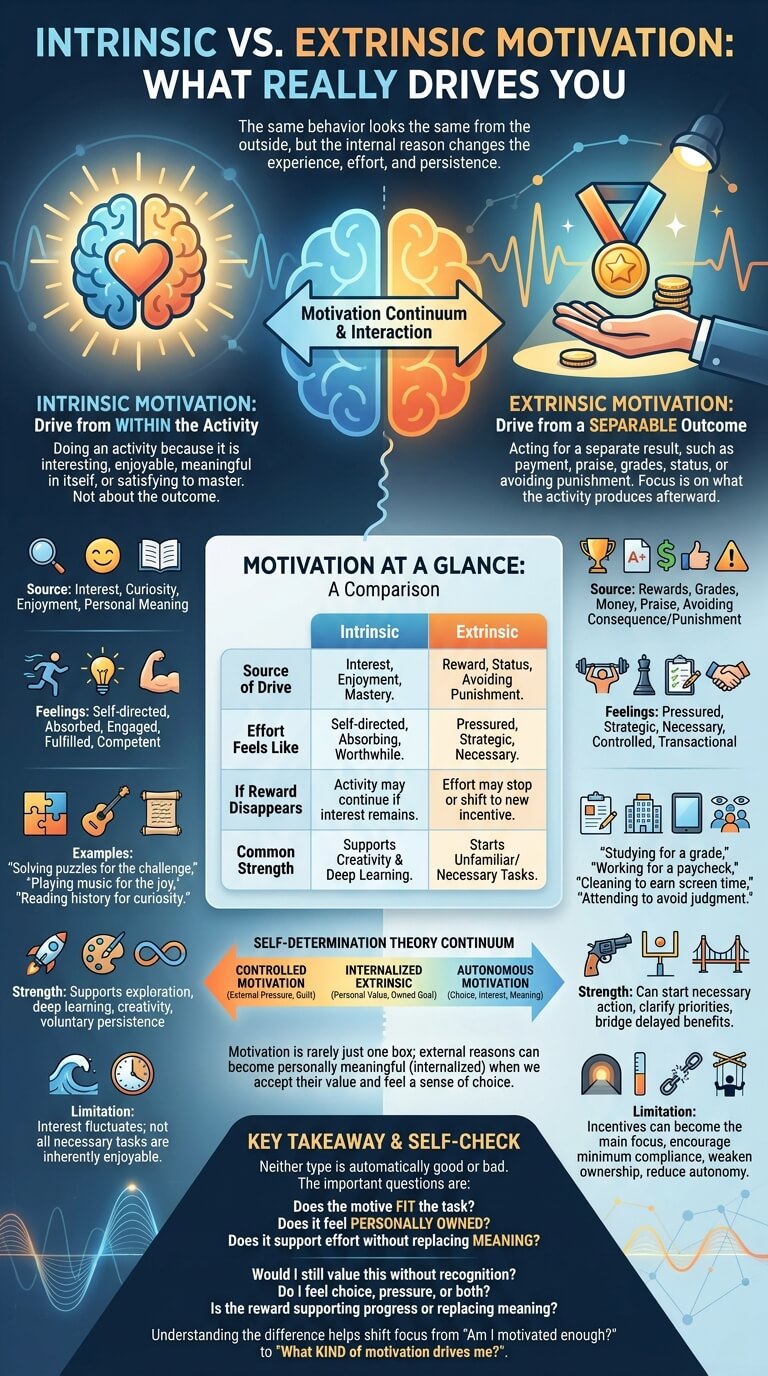
Intrinsic motivation means doing an activity because it is interesting, enjoyable, meaningful in itself, or satisfying to master. Extrinsic motivation means acting for a separate result, such as payment, praise, grades, status, or avoiding punishment. Neither type is automatically good or bad. The important questions are whether the motive fits the task, feels personally owned, and continues to support effort without replacing meaning.
The Core Difference Between Intrinsic and Extrinsic Motivation
Intrinsic motivation: doing something because the activity itself matters
The APA Dictionary of Psychology describes intrinsic motivation as an incentive that comes from pleasure or genuine interest in the activity itself rather than from an external benefit. A person may solve puzzles because the challenge is absorbing, practice guitar because making music feels rewarding, or read about history simply because the questions hold their attention.
Intrinsic motivation does not require constant fun. A person can care about learning a language and still find grammar drills tedious. The deeper source of motivation may be curiosity, mastery, or satisfaction in becoming more capable, even when individual moments require effort.
Extrinsic motivation: doing something for a separable outcome
The APA definition of extrinsic motivation focuses on incentives outside the activity, especially expected rewards or punishments. A student may complete an assignment for a grade. A child may clean a room to earn screen time. An adult may attend an event mainly to avoid disappointing someone.
External motivation includes more than money and prizes. Approval, status, guilt, deadlines, public recognition, rules, and fear of criticism can all influence action. Some external reasons feel practical and freely accepted. Others feel controlling, even when the pressure comes from inside the person as self-criticism.
Why the same behavior can come from different motives
Imagine three people taking the same cooking class. One enjoys experimenting with flavors. Another wants a certificate for a future application. The third feels embarrassed about not knowing how to cook and wants to avoid judgment. All three attend the same lessons, yet their attention, emotional experience, and response to mistakes may differ.
Behavior alone does not reveal motivation. Asking what outcome the person seeks, what would happen if recognition disappeared, and how much choice they feel provides a clearer picture.
Intrinsic and Extrinsic Motivation at a Glance
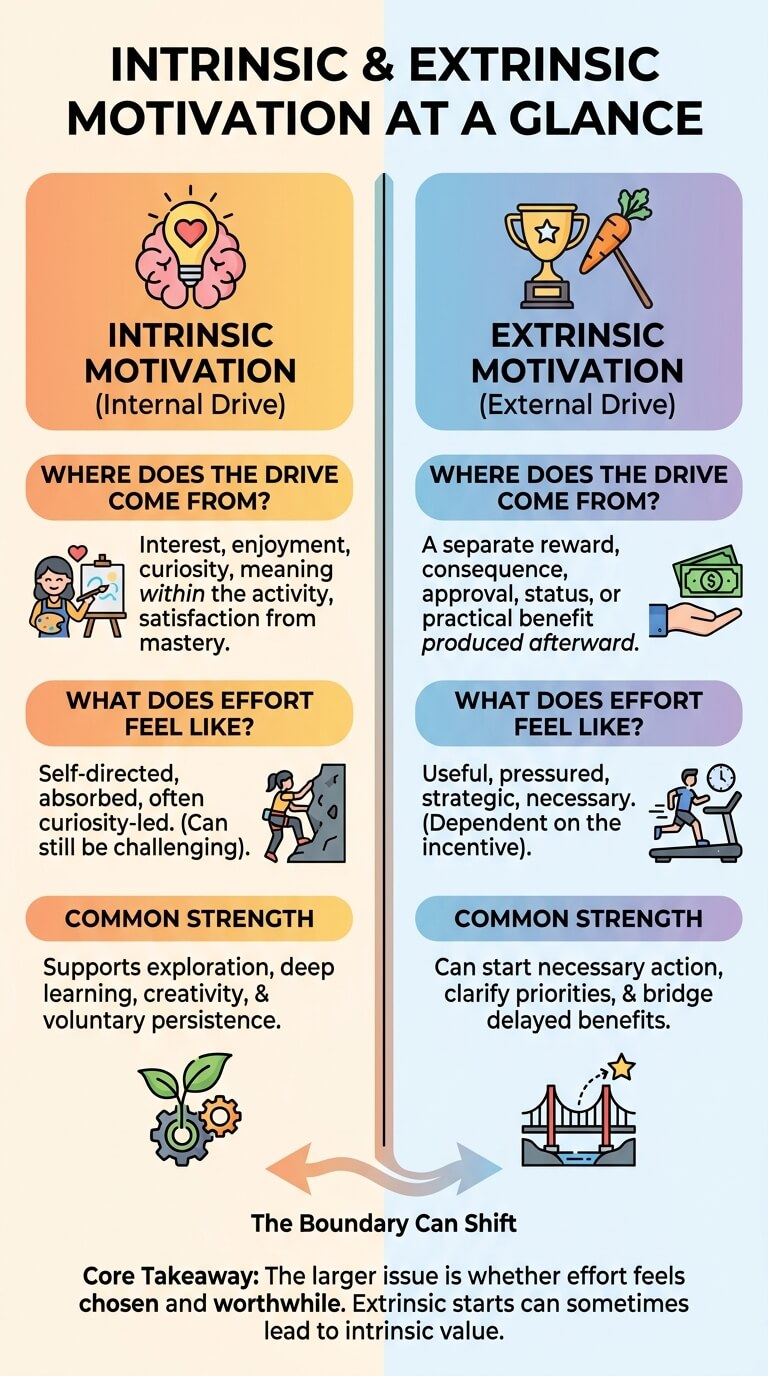
| Question | Intrinsic motivation | Extrinsic motivation |
|---|---|---|
| Where does the drive come from? | Interest, enjoyment, curiosity, meaning within the activity, or satisfaction from mastery. | A separate reward, consequence, approval, status, deadline, rule, or practical benefit. |
| What does effort often feel like? | More self-directed, although it can still be difficult or frustrating. | Useful, pressured, strategic, necessary, or dependent on the kind of incentive. |
| What happens if the reward disappears? | The activity may continue if interest and value remain. | Effort may fall, continue for internalized reasons, or shift toward another incentive. |
| What is a common strength? | Supports exploration, learning, creativity, and voluntary persistence. | Can start necessary action, clarify priorities, and bridge delayed benefits. |
| What is a common limitation? | Interest can fluctuate, and not every necessary task becomes enjoyable. | Pressure or reward dependence can weaken ownership and narrow attention. |
Source of drive
Intrinsic motivation is tied to what happens during the activity. Extrinsic motivation is tied to what the activity produces afterward. This distinction is useful, but the boundary can move. A person may start exercising for a prize, notice improved energy, and eventually value the activity for its own rhythm and challenge.
Emotional experience during effort
Intrinsic motivation often includes interest, curiosity, absorption, or satisfaction. Extrinsic motivation can feel energizing when the reward is valued and the choice is accepted. It can also feel tense when the person acts mainly to avoid guilt, rejection, or punishment.
The emotional difference is not simply happiness versus unhappiness. A difficult intrinsically motivated project may involve frustration, while an externally motivated task may feel calm and sensible. The larger issue is whether effort feels chosen and worthwhile.
What happens when the reward disappears
If an external incentive is the only reason for acting, behavior may stop when that incentive ends. However, a reward can also help a person discover interest, build competence, or connect the activity to a personal value. In that case, the reason for continuing has changed rather than vanished.
This is why it is risky to predict long-term motivation from the reward alone. You also need to know whether the person developed skill, ownership, or a reason they personally endorse.
Typical strengths and limitations
Intrinsic motivation is especially useful for open-ended learning, exploration, and creative work because it supports engagement with the process. Its limitation is that interest cannot be commanded, and important activities often contain dull parts.
Extrinsic motivation is useful when action is necessary before natural benefits become noticeable. Its limitation is that incentives can become the main focus, encourage minimum compliance, or make people feel controlled.
Intrinsic Motivation in Real Life

Curiosity and learning
Curiosity creates a question that the person wants to resolve. A child repeatedly asks how an animal survives in winter. An adult watches tutorials because a technical problem is genuinely interesting. Learning becomes rewarding because each answer opens another useful question.
Intrinsic curiosity often supports deeper exploration, but it still benefits from structure. Too little guidance can create confusion, while excessive control can replace discovery with compliance. A good learning environment protects room for questions while providing enough support to build competence.
Enjoyment and mastery
Some activities are rewarding because they feel pleasant now. Others become rewarding as skill grows. A beginner may not enjoy drawing unfamiliar shapes, but noticing better proportion and control can make practice increasingly satisfying.
Mastery-based motivation depends on challenge being neither trivial nor impossible. When difficulty stays far above current skill, the activity may stop producing evidence of competence. Better instruction or a smaller challenge can restore the satisfaction that originally supported practice.
Meaning and personal identity
People sometimes use “intrinsic” to describe any deeply personal reason, but meaning and intrinsic enjoyment are not identical. Caring for an elderly parent may be tiring and not inherently pleasurable, yet it may strongly express love, duty, or identity.
Self-Determination Theory distinguishes between doing something because the activity itself is enjoyable and doing it because the person has accepted its value. Both can feel self-directed. This distinction prevents meaningful but difficult responsibilities from being mislabeled as fake motivation.
When an enjoyable activity still feels difficult
Enjoyment does not remove fatigue, uncertainty, or fear of evaluation. A writer can love storytelling and still avoid revising a weak chapter. A runner can value the experience and still resist going outside on a cold morning.
When an enjoyable activity becomes hard, examine the obstacle before assuming interest has disappeared. The difficulty may come from perfectionism, overload, skill gaps, social comparison, or an unrealistic pace.
Extrinsic Motivation in Real Life
Money, grades, prizes, and privileges
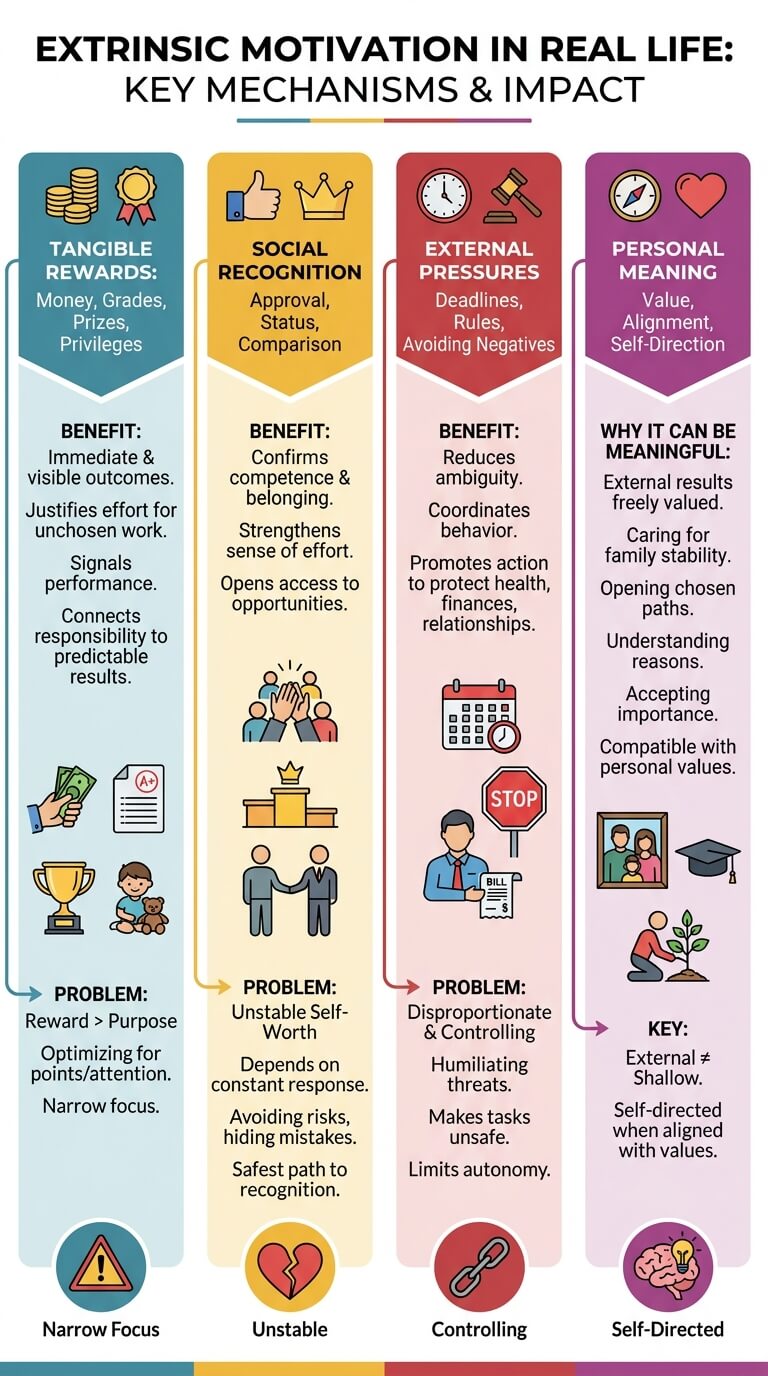
Tangible rewards make the outcome of action immediate and visible. A payment can justify effort for work that would not otherwise be chosen. A grade can signal performance in a course. A small privilege may help a child connect completing a responsibility with a predictable result.
Problems arise when the reward becomes more important than the purpose. A student may optimize for points instead of understanding. A creator may choose only work that receives quick attention. The incentive directs behavior, but it may direct it narrowly.
Approval, status, and social comparison
Recognition can confirm competence and belonging. Genuine appreciation may strengthen a person’s sense that their effort matters. Status can also open access to opportunities and resources.
Approval becomes unstable when self-worth depends on constant response from other people. The person may avoid unfamiliar work, hide mistakes, or choose visible tasks over meaningful ones. Motivation then follows the safest path to recognition rather than the activity that matters most.
Deadlines, rules, and avoiding negative consequences
Deadlines reduce ambiguity by defining when action must occur. Rules coordinate behavior when several people depend on one another. Avoiding a consequence can also prompt action that protects health, finances, or relationships.
These pressures are not automatically harmful. The question is whether the structure is proportionate and understandable. A reasonable deadline can focus attention, while a humiliating threat can make the same task feel unsafe and controlling.
Why external motivation can still be personally meaningful
An action can have an external result and still be freely valued. Someone may work for money while also caring about providing stability for family. A student may seek a qualification because it opens a path they genuinely chose.
The motive becomes more self-directed when the person understands the reason, accepts its importance, and sees the action as compatible with personal values. External does not necessarily mean shallow, dishonest, or imposed.
Motivation Is Often Mixed, Not Either-Or
Multiple motives behind one action
Consider someone publishing educational videos. They may enjoy explaining ideas, value helping viewers, want income, appreciate recognition, and fear becoming irrelevant. These motives can operate together and may pull behavior in different directions.
When neither internal interest nor external incentives produce action, the causes of low motivation may include low expectancy, overload, depletion, or fear.
| Situation | Possible intrinsic element | Possible extrinsic element | Useful question |
|---|---|---|---|
| Studying a new subject | Curiosity and satisfaction from understanding. | Grades, qualifications, or parental approval. | Would I still want some part of this knowledge without the grade? |
| Exercising | Enjoyment of movement or skill improvement. | Appearance, praise, competition, or a reward program. | Which reason helps me continue without turning my body into a score? |
| Creative work | Pleasure in making, experimenting, or expressing an idea. | Income, audience reaction, awards, or professional status. | What kind of work would still feel worth making before anyone responds? |
| Caregiving | Connection, love, and personal meaning. | Duty, family expectations, or avoiding criticism. | Where do care and pressure overlap, and what support is missing? |
When external reasons become internalized
Internalization occurs when a person gradually accepts the value of an action that first came from outside. A teenager may practice budgeting because a parent requires it, then continue because financial independence matters personally. The action remains connected to an outcome, but the reason feels more owned.
A major review of intrinsic and extrinsic motivation explains that motivation is better understood as a continuum than as two isolated categories. Some forms of extrinsic motivation are highly controlled, while others are willingly endorsed and integrated with personal values.
How motives change over time
Motives can become more personal as competence grows, or more controlled as pressure increases. A hobby may become a job and acquire deadlines. A required class may reveal a lasting interest. An admired goal may lose value once the person experiences its daily demands.
Regularly reviewing motives is not indecisive. It helps distinguish a temporary drop in excitement from a deeper change in ownership or value.
When External Rewards Help
Starting an unfamiliar or low-interest task
A modest reward can lower the barrier to trying something unfamiliar. The person gains an immediate reason to begin before natural enjoyment or competence has had time to develop.
The reward works best when it supports exposure and learning rather than becoming permanent payment for every repetition. After the person has enough experience, the activity can be reevaluated on its own merits.
These motives sit within the broader field of motivation psychology, which also considers value, expectancy, effort cost, feedback, and persistence.
Making delayed benefits more visible
Many useful actions have distant rewards. Saving money, practicing a skill, and completing preventive tasks may produce little immediate satisfaction. A near-term marker or small reward can connect today’s effort with a future benefit that otherwise feels abstract.
The incentive should not contradict the goal. Rewarding careful study with permission to stop before understanding may weaken the intended behavior. Rewarding a completed practice session with a pleasant break may support it.
Supporting competence without controlling the person
Feedback, certificates, and praise can function as rewards while also communicating useful information. “Your examples became clearer because you organized them around one question” supports competence more effectively than “You are the smartest person here.”
Informational feedback points to a repeatable action. Controlling feedback makes approval feel conditional and can shift attention from learning to protecting status.
When External Rewards Undermine Motivation
The overjustification effect
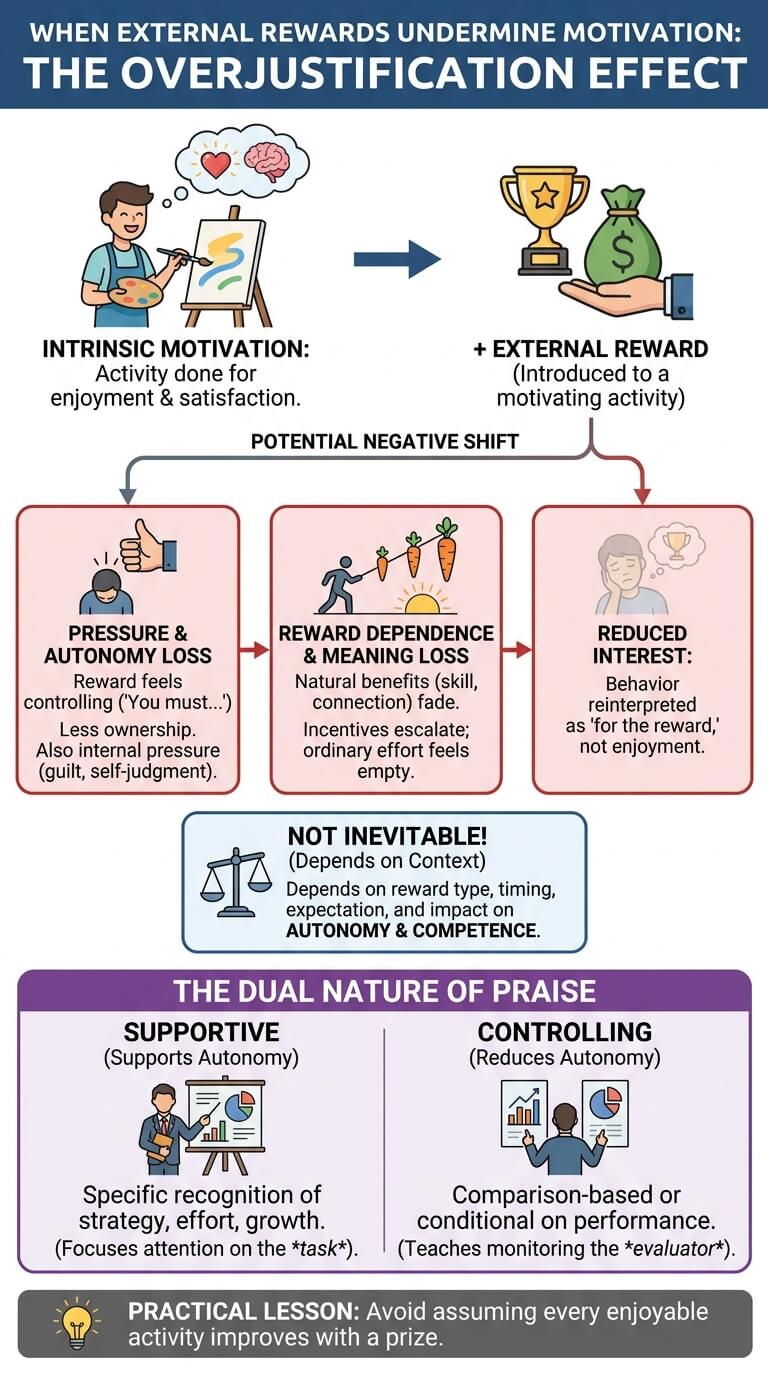
The overjustification effect describes a possible reduction in interest when an external reward is introduced for an activity that was already strongly intrinsically motivating. The person may begin interpreting the behavior as something done for the reward rather than for enjoyment.
This effect should not be presented as inevitable. Research findings depend on the reward type, timing, expectation, task, and how the reward affects autonomy and competence. The practical lesson is to avoid assuming that every enjoyable activity improves when a prize is attached.
Pressure that reduces autonomy
A reward can feel controlling when it communicates, “You must do this to earn approval,” or “Your choice is acceptable only if it produces the result I want.” The person may comply while feeling less ownership.
Pressure can also be internal. Someone may exercise mainly to silence guilt or study mainly to avoid feeling worthless. The behavior looks self-directed, but the emotional experience is controlled by threat and self-judgment.
Reward dependence and loss of meaning
When every action requires a prize, the person may stop noticing natural benefits such as skill, connection, relief, or competence. The reward becomes the only visible reason to continue.
Dependence is especially likely when incentives escalate. A small reward stops feeling sufficient, so a larger one is needed to produce the same willingness. This pattern can make ordinary effort feel empty without an added payoff.
Why praise can feel supportive or controlling
Praise is not one psychological experience. Specific recognition can help someone understand what improved. Comparison-based praise can make status the central goal. Conditional praise can communicate that affection or acceptance depends on performance.
Before offering praise, ask what attention it directs. Does it help the person notice strategy, effort, judgment, or growth? Or does it teach them to monitor the evaluator’s mood?
Intrinsic vs Extrinsic Motivation Through Self-Determination Theory
Autonomous motivation versus controlled motivation
Self-Determination Theory separates autonomous motivation from controlled motivation. Autonomous action feels chosen or personally endorsed. Controlled action is driven mainly by external demands or internal pressure such as guilt, shame, or ego protection.
This distinction is more precise than saying intrinsic is always good and extrinsic is always bad. A person may freely endorse an external goal, such as earning a qualification, while another person may pursue an enjoyable activity under intense pressure to prove talent.
Why autonomy matters more than the simple presence of a reward
The same reward can have different effects depending on its meaning. Payment agreed upon for useful work may respect choice. A surprise acknowledgment may communicate competence. A promised reward used to control every detail may reduce ownership.
Autonomy does not require removing all expectations. People can accept structure when they understand the reason, have meaningful input, and are not humiliated or manipulated.
Autonomy, competence, and relatedness
Motivation is supported when people experience meaningful choice, feel capable of improving, and feel respected and connected. Competence helps effort feel effective. Relatedness can make a difficult responsibility feel worthwhile because it serves a valued relationship or community.
This is a brief lens rather than a complete account of the theory. Its main contribution here is showing why a reward cannot be evaluated separately from the environment in which it is offered.
The deeper continuum is explained by Self-Determination Theory, especially its focus on autonomy, competence, and relatedness.
A Self-Check for Understanding Your Current Motive
Use the following four lenses to examine one action. The aim is not to label your motive as pure or impure. It is to see which reason is helping and which one may be creating pressure.
Would I still value this without recognition?
Imagine that nobody could see the result. Would the knowledge, skill, contribution, experience, or practical outcome still matter? A “no” does not make the goal invalid, but it reveals how strongly recognition is carrying the effort.
If recognition is essential, identify whether it provides useful opportunity or mainly protects self-worth. Those are different needs.
Do I feel choice, pressure, or both?
Ask what you believe would happen if you paused, declined, or changed the goal. Choice can exist within responsibility, but fear of rejection, punishment, or humiliation suggests a more controlled motive.
Mixed answers are common. You may choose the broader goal while feeling pressured by one part of the method or timeline.
Is the reward supporting progress or replacing meaning?
A useful reward highlights movement, competence, or completion. A replacement reward makes the activity seem pointless without the prize. Notice whether the incentive helps you engage with the task or merely tolerate it until payment arrives.
If the reward has replaced meaning, reconnect the action to a value, skill, person, or future option that matters. When no such connection exists, reconsider whether the task deserves continued effort.
What would make this goal feel more personally owned?
Ownership may increase through choosing the method, understanding the reason, adjusting the pace, building missing skill, or deciding how success will be evaluated. Sometimes the most autonomy-supportive choice is to stop pursuing a goal selected mainly for approval.
Choose one change rather than redesigning everything. A small increase in meaningful control can reveal whether the motive becomes more sustainable.
Choosing the Right Kind of Motivation for the Situation
Tasks that need curiosity and creativity
Creative exploration benefits from room to experiment, make mistakes, and follow interesting questions. Highly controlling rewards may narrow attention toward the safest acceptable result.
Use external structure to protect time and clarify constraints, not to dictate every choice. Feedback should help the person improve the work rather than perform only for approval.
Tasks with delayed or invisible rewards
Long-term goals often need nearer feedback. Milestones, visible skill gains, and small celebrations can make progress easier to recognize. These supports are external, but they do not have to replace the deeper reason.
For a closer look at incentives, timing, praise, and overjustification, see how rewards shape motivation.
Keep the final value visible while creating shorter loops of evidence. The purpose is to make effort believable, not to bribe yourself indefinitely.
Necessary tasks that may never become enjoyable
Some chores, forms, appointments, and maintenance tasks remain uninteresting. Expecting intrinsic passion for them creates unnecessary frustration.
Practical external motivation is appropriate here. A deadline, checklist, paired reward, or social commitment may help. The goal is reliable completion with reasonable cost, not emotional transformation.
Goals that involve other people’s expectations
Separate the relationship from the request. You may value helping someone while disagreeing with the method, timing, or level of pressure. Clarifying what you freely accept can preserve care without turning compliance into proof of love.
If refusal brings threats, humiliation, retaliation, or fear, the issue is not simply motivation. Prioritize safety and seek appropriate support rather than trying to become more compliant.
Common Misunderstandings
Intrinsic motivation does not mean constant enjoyment
Interest can coexist with boredom, frustration, and effort. Intrinsic motivation describes where the incentive comes from, not a promise that every moment feels pleasant.
Extrinsic motivation is not automatically fake
Money, grades, and recognition are real outcomes with practical value. An externally rewarded action can also express responsibility, care, and personally chosen goals.
Rewards do not always destroy interest
Effects differ according to expectation, timing, task, autonomy, and the information conveyed by the reward. Acknowledgment that supports competence is not psychologically identical to a controlling prize.
Personal values can coexist with practical incentives
A person may love teaching and still expect fair pay. They may enjoy competing and still value a trophy. Mixed motivation is normal. The more revealing question is which motive dominates when choices become difficult.
Frequently Asked Questions About Intrinsic and Extrinsic Motivation
Can extrinsic motivation become intrinsic?
Sometimes an externally prompted activity becomes genuinely enjoyable as skill and familiarity grow. More often, extrinsic motivation becomes internalized rather than fully intrinsic. The person continues because they personally value the result, even if the activity itself is not enjoyable.
Is money always an extrinsic motivator?
Money is an external outcome, so motivation directed toward receiving it is extrinsic. However, earning money may serve personally endorsed values such as independence, security, generosity, or caring for family. The external incentive and the internal meaning can coexist.
Why do rewards sometimes make a hobby feel like work?
A promised reward can shift attention from enjoyment to evaluation, output, or obligation. The hobby may also acquire deadlines and audience expectations. This does not happen in every case, but it is more likely when the reward feels controlling or becomes the main reason for participation.
Can a person have both intrinsic and extrinsic motivation?
Yes. A musician may enjoy performing, want to master difficult material, earn income, and appreciate applause. The motives can support one another or conflict. Problems often appear when approval or payment begins crowding out experimentation and personal meaning.
Which type of motivation lasts longer?
There is no universal winner. Intrinsic motivation and well-internalized extrinsic motivation often support willing persistence, but context matters. Necessary tasks may rely on external structure, while interesting tasks may continue without reward. Motivation lasts longer when the reason feels valuable, ownership is respected, competence can grow, and effort receives meaningful feedback.
Key Takeaways
- Intrinsic motivation comes from interest or satisfaction within an activity, while extrinsic motivation is directed toward a separate outcome.
- The same behavior can reflect curiosity, personal values, money, approval, pressure, fear, or several motives at once.
- External motivation can become more self-directed when a person accepts the reason and connects it to personally meaningful values.
- Rewards are more likely to help when they support early action, visible progress, or competence without controlling the person.
- Rewards may weaken interest when they replace an existing reason, create pressure, or make approval the main focus.
- A useful motive is not necessarily pure. It is one that fits the task, respects choice, and supports effort without damaging meaning.
Your next step is to choose one activity and name every reason you currently do it, including the reasons you would rather not admit. Then identify which motive gives the action meaning, which one creates pressure, and what small change would increase personal ownership. That distinction is often more useful than trying to force yourself into being either intrinsically or extrinsically motivated.
Author note: Michael Reed is the Founder and Lead Writer at Psychology Exposed. He explains human behavior, emotional patterns, self-awareness, and everyday decisions in clear, research-aware language. This content is educational and is not a substitute for diagnosis, therapy, or medical care.

Michael Reed is the Founder and Lead Writer at Psychology Exposed. He writes about human behavior, relationships, emotional patterns, self-awareness, and practical psychology topics using research-informed, easy-to-understand content.
Read More About Michael Reed: https://psychologyexposed.com/michael-reed/