
Most people do not evaluate themselves as if they were neutral auditors. A good result can feel like evidence of ability, while a poor result may be explained as bad timing, an unusually hard task, or something that does not represent the whole person. A compliment may be easy to absorb, while criticism may be examined closely for reasons it is incomplete. These reactions are not automatically dishonest. They are part of a broader psychological question: how strongly are we motivated to see ourselves in a favorable light?
Self-enhancement psychology examines that pull toward a positive self-view. It can shape what people notice, how they interpret ambiguous feedback, which comparisons feel meaningful, and what a setback comes to mean about the self. The important nuance is that positive self-belief is not the same as distortion. A person can recognize genuine strengths accurately, and a favorable interpretation can sometimes coexist with evidence. Problems arise when the need to feel positive becomes more important than learning from reality.
This distinction also helps separate self-enhancement from trying to impress other people. Self-enhancement can happen privately, with no audience at all. The central question is not simply, “How do I want others to see me?” It is also, “How do I want to understand myself?”
Quick Answer
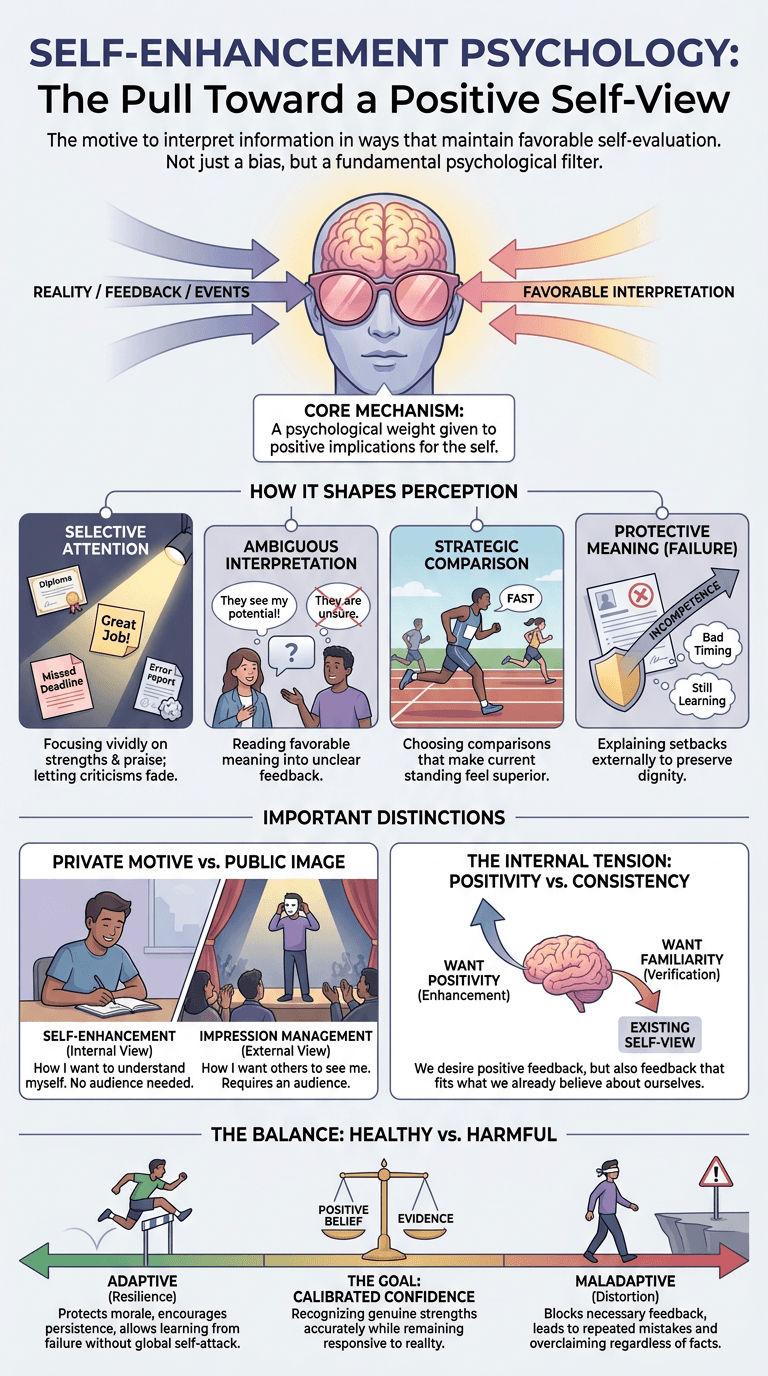
Self-enhancement is the tendency or motive to maintain a relatively favorable view of oneself. It may influence attention, comparison, feedback interpretation, and the meaning assigned to success or failure. It is not automatically a bias, lie, or sign of narcissism. A useful distinction is whether positive self-belief remains responsive to evidence or requires dismissing information that would meaningfully change the picture.
What Self-Enhancement Means
The APA Dictionary of Psychology describes self-enhancement as behavior that can increase self-esteem or the esteem of others, including pursuing success or interpreting events in ways that reflect more positively on the self. In broader social-psychological research, the term is also used for the motive to develop or maintain positive self-views.
Favorable self-evaluation as a motive or tendency
It helps to think of self-enhancement as a direction rather than a single behavior. The direction points toward a more favorable understanding of the self. Two people can move in that direction in very different ways. One may focus on a real strength after a disappointment. Another may reinterpret an ambiguous result as evidence that they did better than it first appears. A third may compare themselves with someone who performed worse.
The key feature is not that every conclusion must be false. It is that positive implications for the self receive psychological weight. Sometimes that weight supports resilience. Sometimes it interferes with accurate correction. The usefulness of the process depends partly on whether the person can still update when evidence becomes clear.
Why an audience is not required
Imagine finishing a difficult exam alone and thinking, “That test was unusually hard, but I handled several parts well.” No audience is present, yet the interpretation protects a reasonably positive view of your competence. That differs from telling classmates, “I barely studied and still did great,” with the goal of appearing naturally talented.
Both situations can involve favorable presentation of the self, but only the second requires an audience. This is why self-enhancement should not be collapsed into impression management. One concerns how positively the self is understood. The other centers the impression a particular audience may form.
Where Self-Enhancement Shows Up
Self-enhancement rarely appears as one obvious thought labeled “I am making myself look better.” It is more often woven into ordinary attention, interpretation, memory, and comparison. The examples below are useful because each shows a different route by which a positive self-view can be maintained.
Attention to strengths and successes
After a mixed performance review, someone might remember the praise about creativity more vividly than the criticism about missed deadlines. That does not prove they are ignoring reality. The praise may be meaningful and accurate. The self-enhancing element appears when favorable information receives greater emotional or explanatory importance because it fits the person’s wish to see themselves positively.
A balanced response would allow both pieces of information to remain in view: “My ideas are a genuine strength, and my follow-through needs work.” Self-enhancement becomes less calibrated when the positive part is used to erase the corrective part.
Favorable interpretation of ambiguous feedback
Ambiguity gives motivation room to influence meaning. If a manager says, “You bring a lot of energy to meetings,” the comment could mean enthusiasm, intensity, or both. A favorable interpretation might be, “They see me as engaged and motivating.” That reading may be correct, but the wording itself does not settle the issue.
This is one reason self-enhancement is easiest to notice when evidence is incomplete. The mind often has several plausible stories available. A self-favoring motive can make the more positive story feel especially compelling before all alternatives have been considered.
Comparative self-evaluation
People often understand qualities by comparison. A runner may feel fast after training with beginners and average after joining an elite group. A student may feel highly prepared in one class and ordinary in another. The comparison target changes the meaning of the same ability.
Self-enhancement can shape which comparison feels psychologically attractive. Looking downward may make current performance feel more favorable, while comparing with a stronger performer may highlight room to improve. Neither direction is inherently good or bad. The useful question is whether the comparison helps you understand your actual position or mainly protects a conclusion you do not want challenged.
Self-protective meaning after failure
A setback often carries two separate questions: “What happened?” and “What does this say about me?” Self-enhancement matters especially in the second question. Someone rejected for a role may conclude, “I am still capable; this position may have required experience I have not built yet.” That interpretation protects self-respect while leaving room for learning.
A less reality-sensitive version would be, “The decision was obviously unfair, and there is nothing I could improve,” despite clear evidence of missing skills. The difference is not positivity versus negativity. It is whether the explanation can hold both dignity and useful information at the same time.
A Favorable-Interpretation Pathway
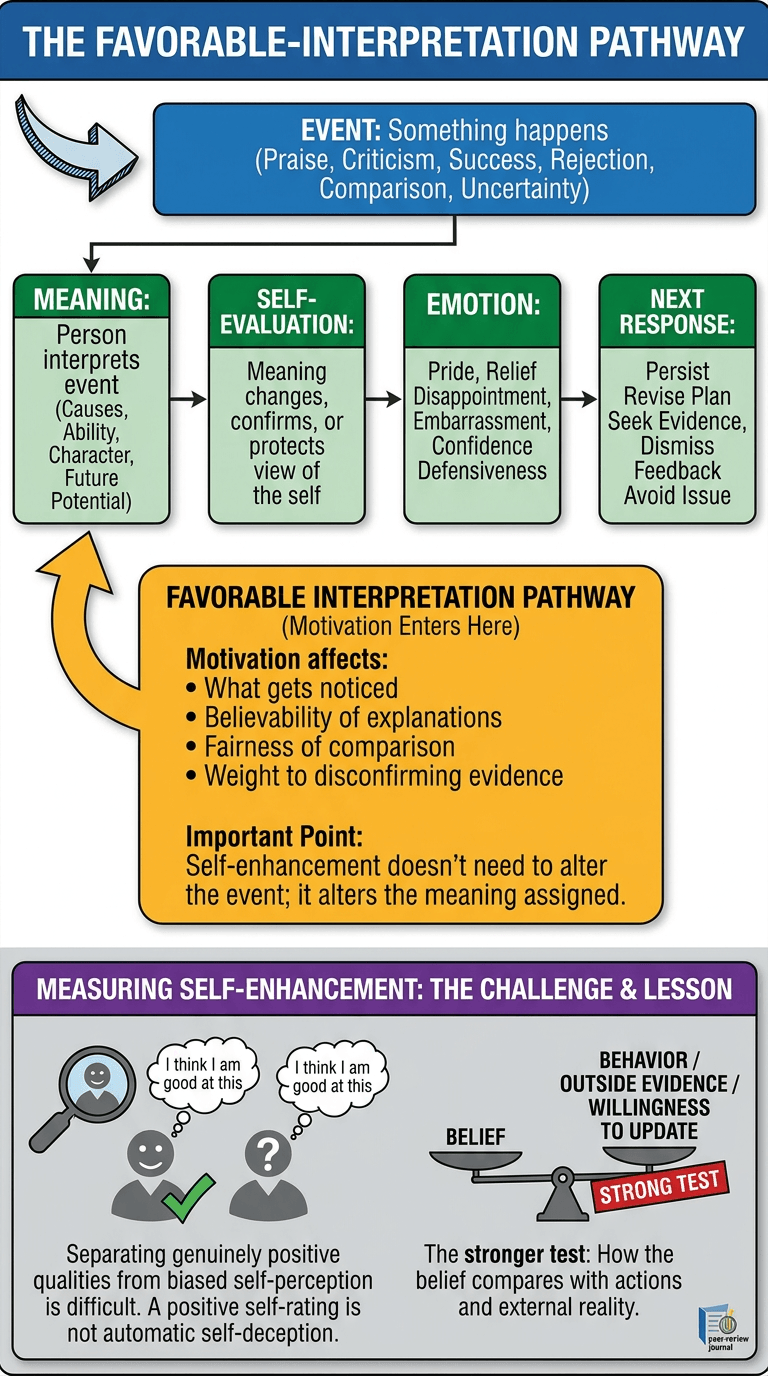
Self-enhancement becomes easier to understand when it is broken into stages. The same event can produce very different outcomes depending on what meaning is assigned to it.
Event → meaning → self-evaluation → emotion → next response
- Event: Something happens, such as praise, criticism, success, rejection, comparison, or uncertainty.
- Meaning: The person interprets what the event says about causes, ability, character, or future potential.
- Self-evaluation: That meaning changes, confirms, or protects a view of the self.
- Emotion: Pride, relief, disappointment, embarrassment, confidence, or defensiveness may follow.
- Next response: The person may persist, revise a plan, seek more evidence, dismiss feedback, or avoid the issue.
The important point is that self-enhancement does not need to alter the event itself. It can enter through the meaning assigned to the event. Two people can receive the same feedback and leave with different conclusions because they interpreted its implications for the self differently.
Where motivation can enter the interpretation process
Motivation may affect what gets noticed first, which explanation feels most believable, what comparison seems fair, or how much weight is given to disconfirming evidence. Research on measuring self-enhancement also shows why the concept requires care: a person rating themselves positively is not enough to prove bias, because accurate ability and favorable self-evaluation can look similar on the surface. A peer-reviewed analysis of self-enhancement measurement highlights the challenge of separating genuinely positive qualities from biased self-perception.
That measurement problem has a practical lesson. “I think I am good at this” is not automatically self-deception. The stronger test is how the belief compares with behavior, outside evidence, and the person’s willingness to update.
Self-Enhancement vs Impression Management
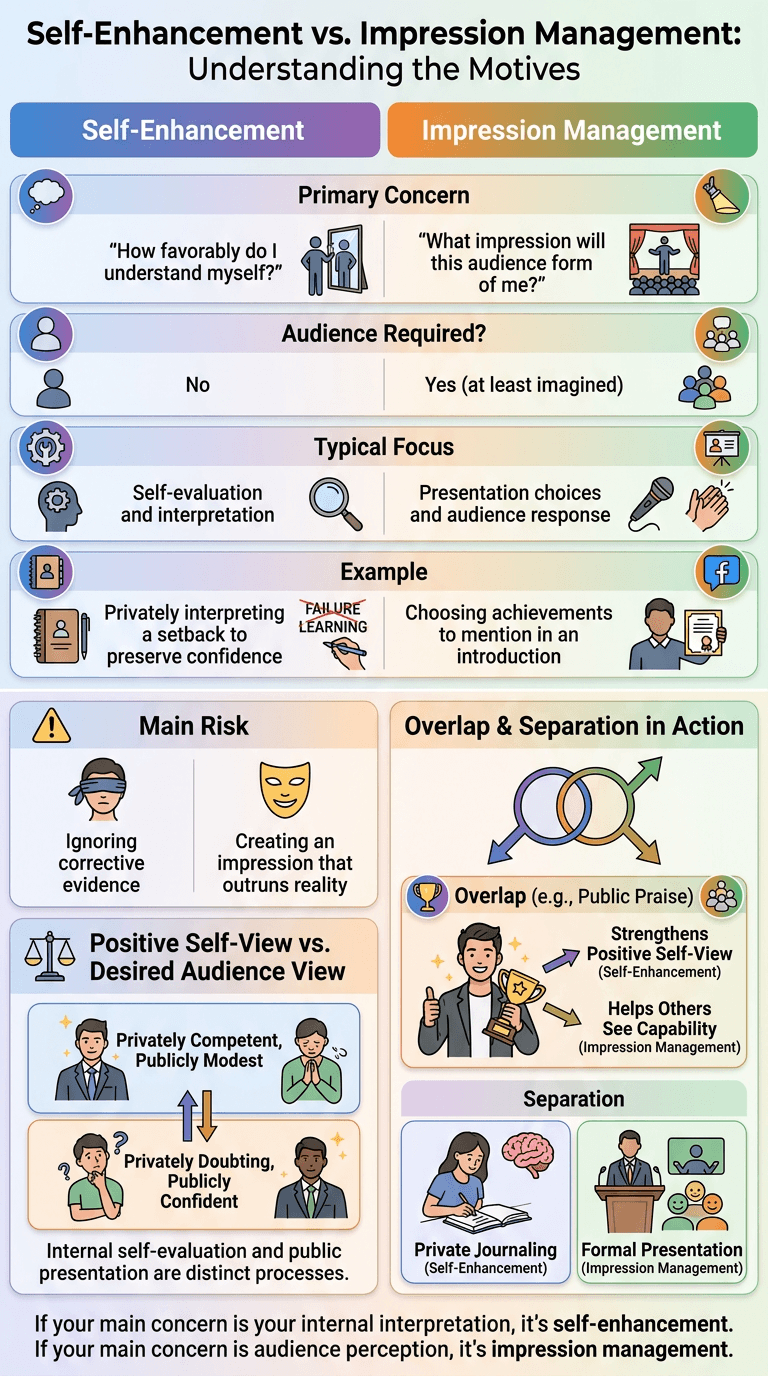
These ideas overlap because a person who wants to feel positive about themselves may also want others to see them positively. Still, the motives are not identical.
| Question | Self-enhancement | Impression management |
|---|---|---|
| Primary concern | “How favorably do I understand myself?” | “What impression will this audience form of me?” |
| Audience required? | No | Yes, at least an imagined or relevant audience |
| Typical focus | Self-evaluation and interpretation | Presentation choices and audience response |
| Example | Privately interpreting a setback in a way that preserves confidence | Choosing which achievements to mention in an introduction |
| Main risk | Ignoring corrective evidence | Creating an impression that outruns reality |
Positive self-view versus desired audience view
A person may privately believe they are competent yet choose not to highlight that competence socially. Another person may privately doubt themselves while presenting confidence because the situation seems to demand it. Those combinations show why internal self-evaluation and public presentation cannot be treated as the same process.
If your main concern is whether you are interpreting yourself favorably, self-enhancement is the more relevant lens. If your main concern is why you changed what you showed because someone was watching, impression management is usually the closer fit.
When the two motives overlap in public situations
Suppose a designer receives praise for a project and later describes the success at a professional event. The praise may strengthen a positive self-view, and sharing the achievement may also help others see the designer as capable. One event can therefore serve both an internal and an audience-facing function.
Overlap does not make the concepts redundant. The distinction becomes visible when one motive is removed. If the designer still feels proud at home with no audience, self-enhancement can remain active. If the designer carefully chooses what to mention at an event, audience concerns have entered the picture.
When they occur separately
Private journaling after failure can involve self-enhancement without impression management. A formal presentation can involve impression management without strong self-enhancement if the speaker simply adapts information to the audience while holding a realistic private view of their abilities.
This separation matters because otherwise every polished public behavior starts to look like ego protection, and every positive self-belief starts to look performative. Human motives are usually more specific than that.
Self-Enhancement vs Self-Esteem
Self-enhancement and self-esteem are related, but one is not simply another name for the other. The distinction is easier to see by separating a process from a broader evaluation.
Process or motive versus broader self-evaluation
The APA definition of self-esteem describes the degree to which qualities and characteristics in a person’s self-concept are perceived positively. Self-enhancement, by contrast, concerns the movement toward or maintenance of favorable self-evaluation.
Someone can therefore have relatively high self-esteem and still encounter moments when self-enhancement is strong, weak, or unnecessary. Another person can have lower self-esteem yet still prefer positive feedback in some domains. A baseline evaluation of the self and the motive to make a particular interpretation more favorable are related but separable.
Why this is not a self-esteem improvement guide
Trying to “boost” every self-evaluation would miss the point. A more useful goal is accurate, flexible confidence: knowing where you are capable, admitting where the evidence is mixed, and allowing specific weaknesses without turning them into a global verdict about your worth.
For example, “I handled that conversation poorly” contains information about one behavior. “I am terrible with people” is a much broader identity claim. Self-enhancement is not required to replace the first statement with praise. Sometimes the healthier correction is simply to keep the conclusion proportional to the evidence.
Self-Enhancement vs Self-Serving Bias
The two ideas are often discussed together because both can produce self-favorable conclusions. Their scope is different, however.
Broad favorable motive versus a specific explanatory tendency
Self-enhancement is a broad motive or tendency toward favorable self-evaluation. Self-serving bias usually refers more specifically to patterns in how people explain outcomes, such as giving internal credit for success while assigning more responsibility for failure to external circumstances.
A person can self-enhance without making that exact attribution. They might focus on a genuine strength, choose a favorable comparison, remember encouraging feedback, or interpret an ambiguous comment positively. Likewise, not every external explanation for failure is biased. Sometimes the task really was unfair, the instructions really were unclear, or bad luck genuinely mattered.
Why broad cognitive bias belongs elsewhere
Self-serving explanations are only one way favorable self-views can be protected. Treating them as the whole topic would make self-enhancement seem narrower than it is. It would also encourage a common mistake: labeling any positive interpretation as a cognitive error before checking whether the interpretation is actually inaccurate.
A better sequence is evidence first, label second. Ask what happened, what alternative explanations exist, and which conclusion best fits the available information. Then consider whether a preference for a positive self-view may be tilting the judgment.
Accurate Confidence, Calibrated Positivity, and Inflated Self-View
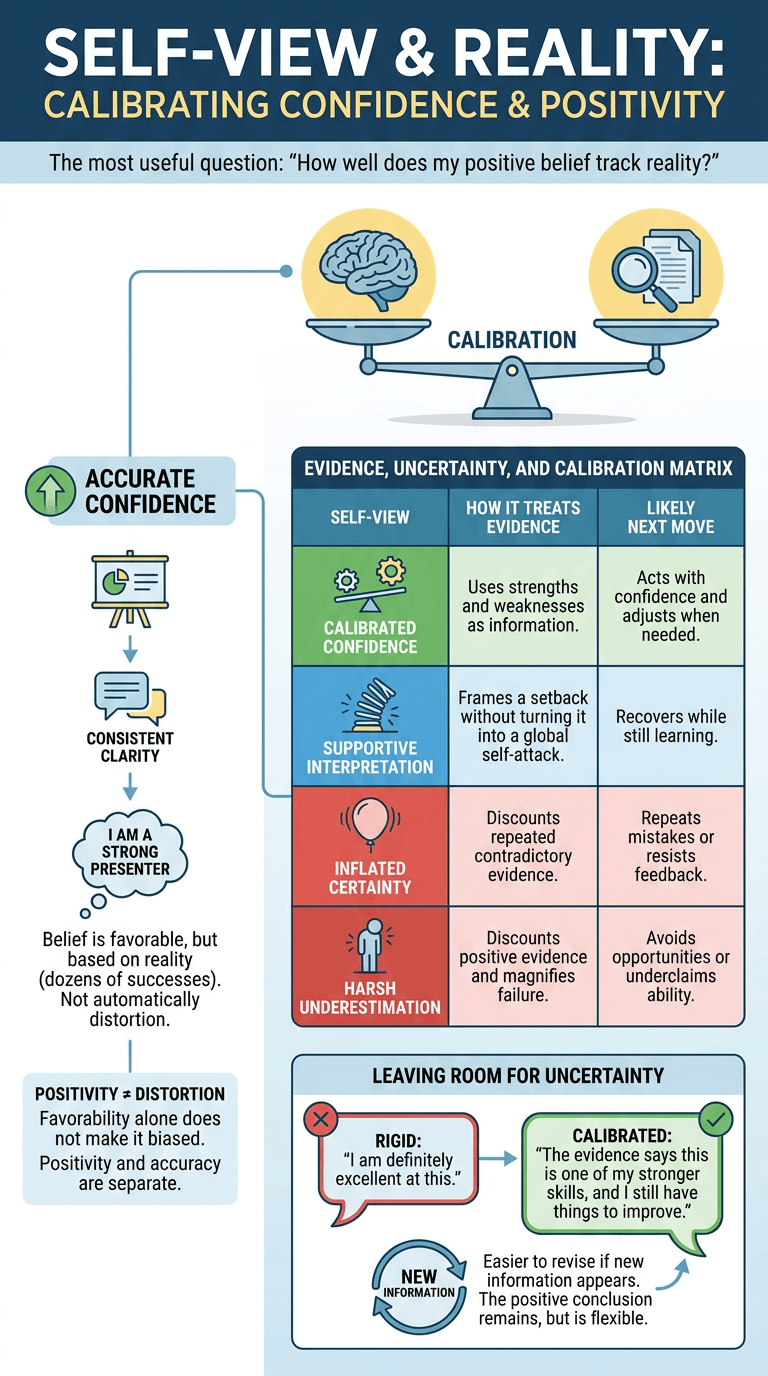
The most useful question is not, “Am I thinking positively?” It is, “How well does my positive belief track reality?” Confidence becomes more reliable when it can survive contact with evidence rather than needing evidence to be filtered out.
Why positive self-belief is not automatically distortion
If you have completed dozens of successful presentations, received consistent feedback about clarity, and can identify what you do well, believing “I am a strong presenter” may simply be accurate. The belief is favorable, but favorability alone does not make it biased.
Research on “positive illusions” has produced longstanding debate about where helpful positivity ends and distortion begins. The original Taylor and Brown review on positive illusions argued that some positively biased perceptions may accompany well-being, while later critiques challenged broad claims that inaccurate positive views are necessarily beneficial. The practical takeaway is modest: positivity and accuracy should be evaluated separately.
Evidence, uncertainty, and calibration
| Self-view | How it treats evidence | Likely next move |
|---|---|---|
| Calibrated confidence | Uses strengths and weaknesses as information | Acts with confidence and adjusts when needed |
| Supportive interpretation | Frames a setback without turning it into a global self-attack | Recovers while still learning |
| Inflated certainty | Discounts repeated contradictory evidence | Repeats mistakes or resists feedback |
| Harsh underestimation | Discounts positive evidence and magnifies failure | Avoids opportunities or underclaims ability |
Calibration means leaving room for uncertainty. Instead of “I am definitely excellent at this,” a person might think, “The evidence says this is one of my stronger skills, and I still have things to improve.” The positive conclusion remains, but it is easier to revise if new information appears.
When Self-Enhancement Can Help
Positive self-interpretation can be useful when it keeps a setback from becoming an unnecessarily global judgment. After one failed application, “I still have useful skills, and I need a better fit or stronger application” can preserve motivation without denying the rejection.
Persistence, morale, and coping when beliefs remain evidence-sensitive
A modestly favorable interpretation can protect effort. People often need enough confidence to keep practicing before the outcome is guaranteed. Seeing a difficult event as temporary, specific, or learnable can make another attempt psychologically possible.
The qualifier is evidence-sensitive. Self-enhancement is more likely to help when it protects the person from needless self-condemnation while still allowing precise correction. “This result does not define me” can coexist with “I need to prepare differently next time.” Those two thoughts do different jobs, and they do not have to compete.
When Self-Enhancement Creates Costs
The same motive that protects confidence can become costly when it blocks information. The warning sign is not feeling good about yourself. It is needing a favorable conclusion so strongly that contradictory evidence cannot be used.
Missing corrective feedback
Consider someone who regularly receives the same feedback about interrupting colleagues. If every comment is dismissed as jealousy, oversensitivity, or misunderstanding, the person loses access to a potentially useful pattern. A self-protective explanation has become expensive because it prevents behavioral learning.
A more flexible response would be, “I do not think I am intentionally disrespectful, but several people have noticed the same behavior. I should watch when it happens.” The self-view remains nuanced without making the feedback disappear.
Repeated overclaiming and social consequences
Internal self-enhancement can become socially relevant when favorable beliefs are stated as claims other people are expected to accept. If someone repeatedly overstates skill, minimizes errors, or insists on credit that others cannot verify, the problem is no longer only private self-evaluation. It can affect credibility, cooperation, and reputation.
This is another reason accuracy matters. Positive self-belief does not need to be modest in the sense of denying real ability. It does need enough evidence that other people are not continually asked to ignore what they can observe.
Cultural and contextual variation where evidence supports it
Researchers have long debated whether self-enhancement appears similarly across cultures. Some studies find differences in how strongly people explicitly describe themselves positively, while other work suggests that the underlying motive may appear in different forms depending on cultural norms and self-construal. An open-access cross-cultural study of self-enhancement illustrates both the differences and the continuing debate.
That means broad statements such as “people from culture X do not self-enhance” are too strong. What counts as desirable, appropriate, modest, admirable, or socially acceptable can change the way favorable self-evaluation is expressed and measured.
The Tension With Self-Verification
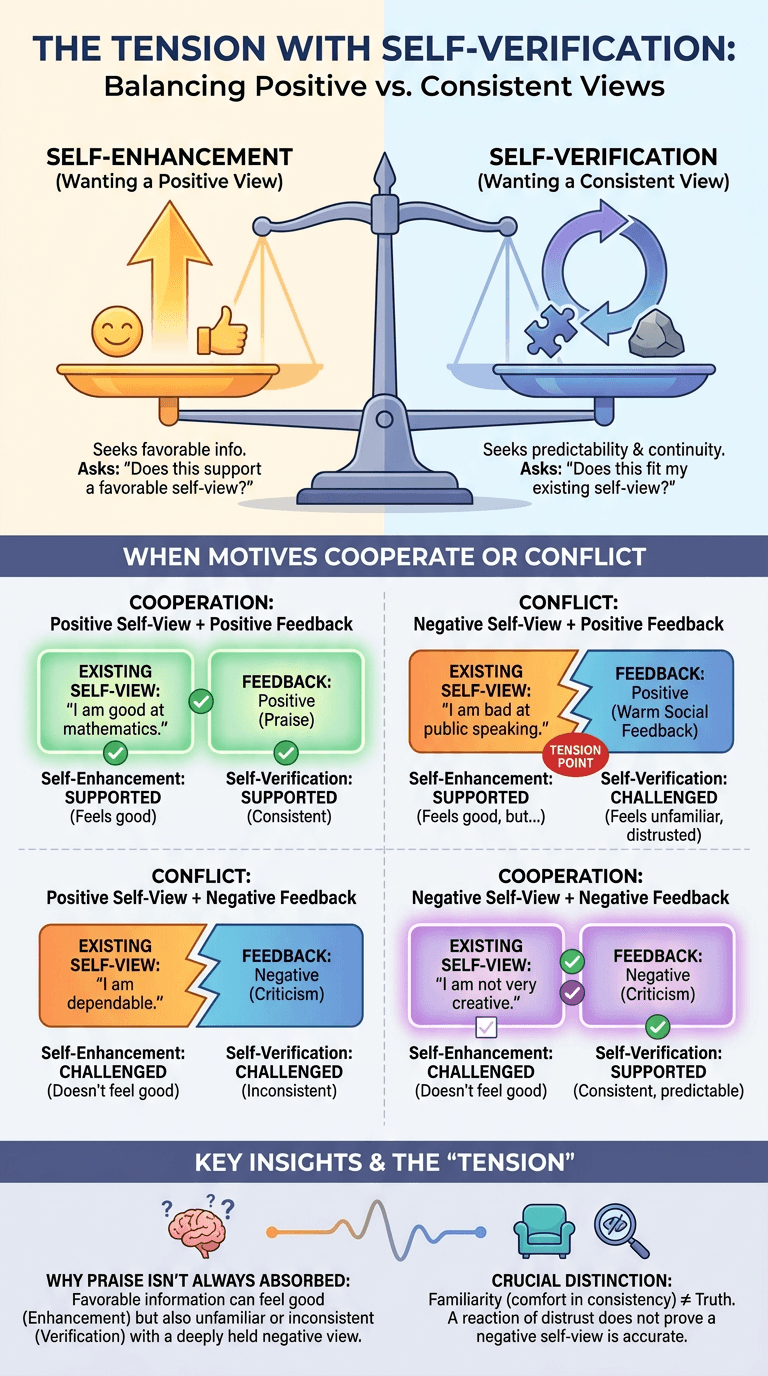
Wanting a positive view of yourself is not the only self-related motive. People also tend to value continuity and predictability in how they understand who they are. This creates one of the most interesting tensions in self psychology.
Wanting to feel positive versus wanting feedback that fits an existing self-view
Self-enhancement asks whether information supports a favorable self-view. Self-verification asks whether information fits the self-view a person already holds. If someone already believes “I am a strong writer,” praise for writing may satisfy both motives. It is positive and consistent.
The conflict appears when the existing self-view is negative. A person who strongly believes “I am awkward in groups” may distrust warm social feedback even though positive feedback would be more self-enhancing. Research comparing these motives has found that people can sometimes prefer information consistent with established self-views rather than simply choosing the most flattering option. One peer-reviewed study of feedback seeking clearly illustrates the different predictions made by self-enhancement and self-verification.
Cases where the motives cooperate or conflict
| Existing self-view | Feedback | Self-enhancement | Self-verification |
|---|---|---|---|
| “I am good at mathematics.” | Positive | Supported | Supported |
| “I am bad at public speaking.” | Positive | Supported | Challenged |
| “I am dependable.” | Negative | Challenged | Challenged |
| “I am not very creative.” | Negative | Challenged | Supported |
This tension explains why praise is not always absorbed automatically. Favorable information can feel good while also feeling unfamiliar, exaggerated, or inconsistent with a deeply held self-view. That reaction does not prove the negative self-view is accurate. Familiarity and truth are different questions.
What to Do Next: A Reality-Calibrated Self-Check
You do not need to eliminate every self-favoring interpretation. A better aim is to notice when positivity is helping you stay proportionate and when it is preventing useful updating.
Separate supportive interpretation from unsupported certainty
Use these questions after praise, criticism, success, or failure:
- What happened before I interpreted it? Describe the observable event in one or two sentences.
- What conclusion am I drawing about myself? Keep the conclusion specific rather than global.
- What evidence supports that conclusion? Include behavior, outcomes, and repeated feedback.
- What evidence complicates it? Look for information you would rather not include.
- Can I preserve self-respect without deleting the corrective information? This is the core calibration question.
For example, after a rejected proposal, “My work has no value” is broader than the evidence. “The reviewers missed the point, so I should change nothing” may be too protective. “The idea still has strengths, and the feedback shows where the explanation failed” protects both dignity and learning.
Ask what evidence would change the conclusion
A belief becomes difficult to calibrate when no imaginable evidence could revise it. If success always proves ability but failure is always dismissed as irrelevant, the conclusion is protected from reality. The same problem exists in reverse when every success is dismissed and every failure is treated as proof of inadequacy.
Try completing one sentence: “I would update my view if I repeatedly saw…” Then name observable evidence. This creates a standard before emotion chooses the answer. It also lets confidence remain confidence rather than turning into certainty that cannot be tested.
FAQ About Self-Enhancement Psychology
These questions address common confusions that arise when a normal preference for positive self-evaluation is treated as either automatically healthy or automatically biased.
Is self-enhancement the same as narcissism?
No. Self-enhancement is a broad psychological motive or tendency and can appear in ordinary self-evaluation. It is not enough to diagnose narcissism or any personality disorder. A person can interpret an event favorably, highlight a real strength, or protect confidence after a setback without showing the broader and persistent pattern required for a clinical diagnosis.
Can self-enhancement happen in private?
Yes. A person can privately focus on strengths, interpret ambiguous feedback positively, or explain a setback in a self-protective way with no audience present. This is one of the clearest differences between self-enhancement and impression management, which is organized around how an audience may see the person.
Is every positive self-view biased?
No. A favorable view can be accurate. If repeated performance, observable results, and credible feedback support a strength, recognizing that strength is not automatically self-deception. Bias becomes a stronger possibility when positive conclusions persist despite substantial contradictory evidence or depend on selectively excluding information that matters.
How is self-enhancement different from self-esteem?
Self-esteem is a broader evaluation of oneself, while self-enhancement refers to processes or motives that move self-evaluation in a favorable direction or help maintain a positive view. They can influence one another, but they are not interchangeable. A person’s general level of self-esteem does not tell you exactly how they will interpret every success or setback.
Why can self-enhancement conflict with self-verification?
Self-enhancement favors positive information, while self-verification favors information that fits an existing self-view. If the existing self-view is already positive, both motives may prefer the same feedback. If the existing self-view is negative, praise may be self-enhancing but feel inconsistent, creating tension between positivity and familiarity.
Key Takeaways
- Self-enhancement is a preference or motive toward favorable self-evaluation, not proof that someone is lying, biased, or narcissistic.
- It can happen privately, which separates it from impression management and its focus on an audience’s view.
- Positive self-belief may be accurate. The better test is whether the belief remains responsive to repeated evidence and meaningful feedback.
- Self-enhancement is broader than self-serving bias and different from self-esteem, which describes a more general evaluation of the self.
- Self-enhancement and self-verification can cooperate when existing self-views are positive and conflict when familiar self-views are negative.
- A useful next step is to protect self-respect while asking what evidence would genuinely change your conclusion.
Author note: Michael Reed, Founder & Lead Writer at Psychology Exposed, focuses on making research about everyday thought and behavior understandable without turning normal psychological tendencies into diagnoses.

Michael Reed is the Founder and Lead Writer at Psychology Exposed. He writes about human behavior, relationships, emotional patterns, self-awareness, and practical psychology topics using research-informed, easy-to-understand content.
Read More About Michael Reed: https://psychologyexposed.com/michael-reed/