
A conversation can go wrong in less than a minute. A joke lands as contempt, a question sounds like blame, an interruption becomes proof that nobody is listening, or a hurried text creates a meaning the sender never intended. Once tension rises, both people may keep arguing about the original topic while also reacting to the damage caused by the conversation itself.
A repair attempt is a word or action that addresses that second problem. It signals that the interaction has gone off course and tries to restore enough clarity, cooperation, or connection for the people involved to continue. Repair may include softening a harsh statement, correcting a misunderstanding, acknowledging emotional impact, accepting a specific responsibility, taking a pause with a return time, or changing what happens next.
Repair is not pretending nothing happened. It is not a demand for instant forgiveness, and it cannot make repeated coercion or harm safe. Its value comes from matching the response to the rupture and following words with observable action.
Quick Answer

A repair attempt is a verbal or nonverbal effort to reduce threat and restore workable communication after tension, misunderstanding, defensiveness, interruption, or hurtful impact. Effective repair identifies what went wrong, acknowledges the relevant impact, clarifies meaning without erasing that impact, takes proportionate responsibility, and creates a practical next step. The other person remains free to accept, delay, question, or decline the attempt.
What a Communication Rupture Is

A communication rupture is a break in shared understanding, cooperation, trust, or emotional connection during an interaction. The rupture may be obvious, such as shouting or walking out, or subtle, such as a small shift into guarded answers and reduced engagement.
Repair shows how the psychology of communication continues after impact becomes visible and the original exchange needs correction.
Misunderstanding, interruption, harsh tone, and defensiveness
Some ruptures begin because the message received differs from the message intended. “I need more detail” may sound like “Your work is poor.” Other ruptures arise from how the exchange unfolds. Repeated interruption can communicate that one voice matters less. A sharp tone can make a reasonable question feel threatening. Defensiveness can move attention from impact to self-protection before the concern is understood.
Conversation research uses the word repair in a narrower sense for how people fix problems in speaking, hearing, or understanding. A cross-linguistic study of universal principles in communication repair shows how people routinely signal and correct trouble in ordinary conversation. Interpersonal repair is broader, but it begins with the same recognition: something in the exchange no longer works as intended.
Invalidation, withdrawal, and broken follow-through
A rupture may occur when an emotional experience is minimized, mocked, or corrected before it is received. It may also occur when someone stops participating without explaining whether or when they will return. In other cases, the words appear resolved but a promised action never happens, reopening the original injury.
The rupture is therefore not always a dramatic argument. It can be the moment someone realizes that acknowledgment, reliability, or mutual attention has disappeared.
Why small ruptures matter when they are ignored
Small mistakes are common. Their significance often depends on what follows. A missed cue can remain minor when it is noticed and corrected. The same cue can become evidence of disregard when it is repeatedly denied or left unaddressed.
Ignored ruptures also change later conversations. People may arrive guarded, expect dismissal, or interpret neutral ambiguity through the memory of what was never repaired.
Why rupture is not the same as relationship failure
A rupture describes a moment or process, not the final meaning of a relationship, friendship, family tie, or working partnership. People can care about each other and still misread, interrupt, disappoint, or react poorly.
Many ruptures begin with miscommunication, when the meaning received differs from the message intended.
The more useful question is not whether a rupture occurred. It is whether the people involved can recognize it, respond proportionately, learn from it, and change behavior when needed.
Why Repair Attempts Work
Repair changes the immediate task. Instead of continuing to prove a position while the interaction deteriorates, someone communicates that the way the conversation is happening now requires attention.
They signal that the relationship or shared task still matters
A repair attempt tells the other person, “I do not want this moment to define the entire exchange.” That message may preserve cooperation even when disagreement remains.
Experimental research suggests that apologies can support forgiveness partly by communicating relationship value. One study on apologies and perceived relationship value found that an apology can carry information about how much the relationship matters to the person offering it. A repair attempt does not always require an apology, but it often contains a similar signal of continued investment.
They lower intensity and interrupt escalation
Repair can create a pause between feeling threatened and taking the next reactive step. A softer restatement, a request to slow down, or a specific acknowledgment may reduce the need to repeat the concern more forcefully.
The Gottman Institute describes repair attempts as ways to de-escalate conflict and bring an interaction back on track. Although much of that work concerns couples, the basic principle applies more broadly to family, friendship, workplace, and everyday conversations.
They update meaning after harmful impact
People react not only to words but to what those words appear to mean. An interruption may mean “My point does not matter.” Silence may mean “I am being punished.” Repair supplies updated information: “I interrupted because I became anxious, not because your point was unimportant, and I want to hear the rest.”
Updated meaning does not erase impact. It helps the people involved distinguish intention, interpretation, responsibility, and the change required next.
They create a test of accountability and responsiveness
A repair attempt makes intentions observable. Does the speaker listen to impact, accept a specific part, make a realistic correction, and follow through? Does the receiver have space to ask questions or need time?
The answer matters because trust is influenced by what happens after harm. Research on apology and trust repair found that perceived trustworthiness and emotional state affected whether an apology helped restore trust. Words can open a door, but credibility depends on how the whole response is received.
The Six Types of Repair Attempt

Different ruptures require different responses. A useful repair matches the problem instead of relying on one preferred sentence for every situation.
Softening: reduce intensity without erasing the issue
Softening changes how the point is delivered. “Let me say that again without the accusation” or “I am getting too sharp, but the issue still matters to me” reduces threat while keeping the topic visible.
Softening is especially useful when tone, volume, sarcasm, or absolute language has become the new conflict. It is not useful when it becomes a way to make the other person drop a legitimate concern.
Clarification: correct the meaning that was received
Clarification is appropriate when your message was ambiguous or misinterpreted. A useful version begins by naming the received meaning: “That sounded like I was blaming you for the whole delay. I meant that we both missed a step, and I should have explained that more clearly.”
A clarification that only says “You misunderstood me” places the entire problem on the listener. Repair requires examining what in the wording, timing, context, or delivery made the unintended meaning plausible.
Validation: acknowledge emotional impact
Validation recognizes the experience created by the interaction. “I see why changing the plan without asking made you feel excluded” communicates that the impact has been received.
Validation does not require accepting every motive claim. You may recognize that someone felt dismissed while disagreeing that dismissal was intentional.
Responsibility: own a specific part without vague self-condemnation
Responsibility identifies the action that belongs to you. “I interrupted twice and then argued about your tone instead of answering the concern” is more useful than “I am terrible at communication.”
Global self-condemnation can shift the conversation toward comforting the person who caused the rupture. Specific ownership keeps attention on what can be corrected.
Pause and return: protect regulation while preserving engagement
A pause can be a repair when it includes a return plan. “I am too activated to listen well. I need forty minutes, and I will come back at 7:30” protects the conversation from further damage without abandoning it.
Leaving without a return time may deepen uncertainty. If the proposed time later becomes impossible, communicate the change rather than disappearing.
Concrete correction: change behavior, information, or follow-through
Some ruptures require action rather than additional explanation. Send the missing information, correct the public record, restore access, replace what was damaged, change the workflow, or complete the promise.
Concrete correction is what turns “I understand” into evidence. When the same harm repeats, the quality of the action matters more than the creativity of the wording.
What Repair Can Sound Like

Natural repair language is brief, specific, and connected to the actual rupture. These examples are starting points, not speeches that guarantee a particular response.
“I said that too sharply and want to try again.”
This works when delivery became more damaging than the point itself. The speaker does not withdraw the concern. They take responsibility for how it was expressed and offer a clearer version.
“I can see why that sounded dismissive.”
This statement acknowledges received meaning. It can be followed by clarification: “I was trying to move quickly, but I skipped over the part that mattered most to you.”
“I agree that I interrupted before understanding your point.”
This identifies observable behavior and avoids debating whether the interruption was intentional. A meaningful next step is to invite the unfinished point and listen without preparing an immediate rebuttal.
“I need a pause and will return at a specific time.”
This phrase works only when the return is credible. The speaker should choose a realistic time and come back prepared to continue, clarify, or renegotiate the timing honestly.
“Here is the action I will take next.”
This moves repair from emotion into follow-through. The action should be specific enough to verify: resend the correct document, speak to the affected person, change the schedule, or establish a reminder system.
Repair Is Not the Same as Avoidance or Resetting to Zero
Some gestures create temporary relief while leaving the rupture untouched. The distinction becomes clearer when asking whether the impact, responsibility, and needed change remain visible.
Moving on without naming impact
Changing the subject, offering food, acting cheerful, or returning to normal routines may reduce tension. These gestures can be caring, but they are not complete repair when the other person still lacks acknowledgment or clarity.
Using humor to escape accountability
Humor can interrupt escalation when both people experience it as warm and safe. It becomes avoidance when it mocks the concern, turns the injured person into the joke, or prevents a direct response.
Apologizing only to stop the other person’s emotion
“Fine, I am sorry, are you happy now?” asks the other person to stop reacting rather than addressing what happened. A reluctant apology may be honest, but contempt for the receiver’s emotion undermines its repair value.
Demanding instant forgiveness or closeness
Offering repair does not create a right to immediate relief. The receiver may need time, information, distance, or evidence of change. Pressure to forgive can repeat the original problem by overriding their agency.
Timing, Sincerity, and Fit
A repair attempt can contain reasonable words and still miss because it arrives at the wrong time, addresses the wrong layer, or asks for more than the other person can give.
Timing and return plans matter most when repair happens inside difficult conversations.
Repair too early can feel like interruption
If acknowledgment comes before the person has explained the impact, it may sound like an attempt to close the subject quickly. Let them finish enough of the message to know what you are repairing.
Repair too late can allow resentment to harden
Waiting may be necessary for regulation or reflection. Indefinite delay leaves the other person to decide whether the rupture matters to you. When you need time, communicate that intention: “I want to respond carefully. Can we revisit this tomorrow morning?”
The repair must match the rupture
A tone rupture may need a softer restatement. A factual error may need correction. Public embarrassment may require public clarification. Broken follow-through may require completed action. A generic apology does not automatically solve each problem.
Repeated harm requires behavior change, not better wording alone
Repeated repair language without changed behavior can become part of the harmful cycle. Sincerity is judged partly by whether the person learns, prepares differently, and reduces recurrence.
Research on apology and restitution as accountable repair responses highlights the distinction between words and tangible efforts to repair harm. The exact action will vary, but accountability becomes more credible when it costs attention, effort, or changed behavior.
A Step-by-Step Repair Map
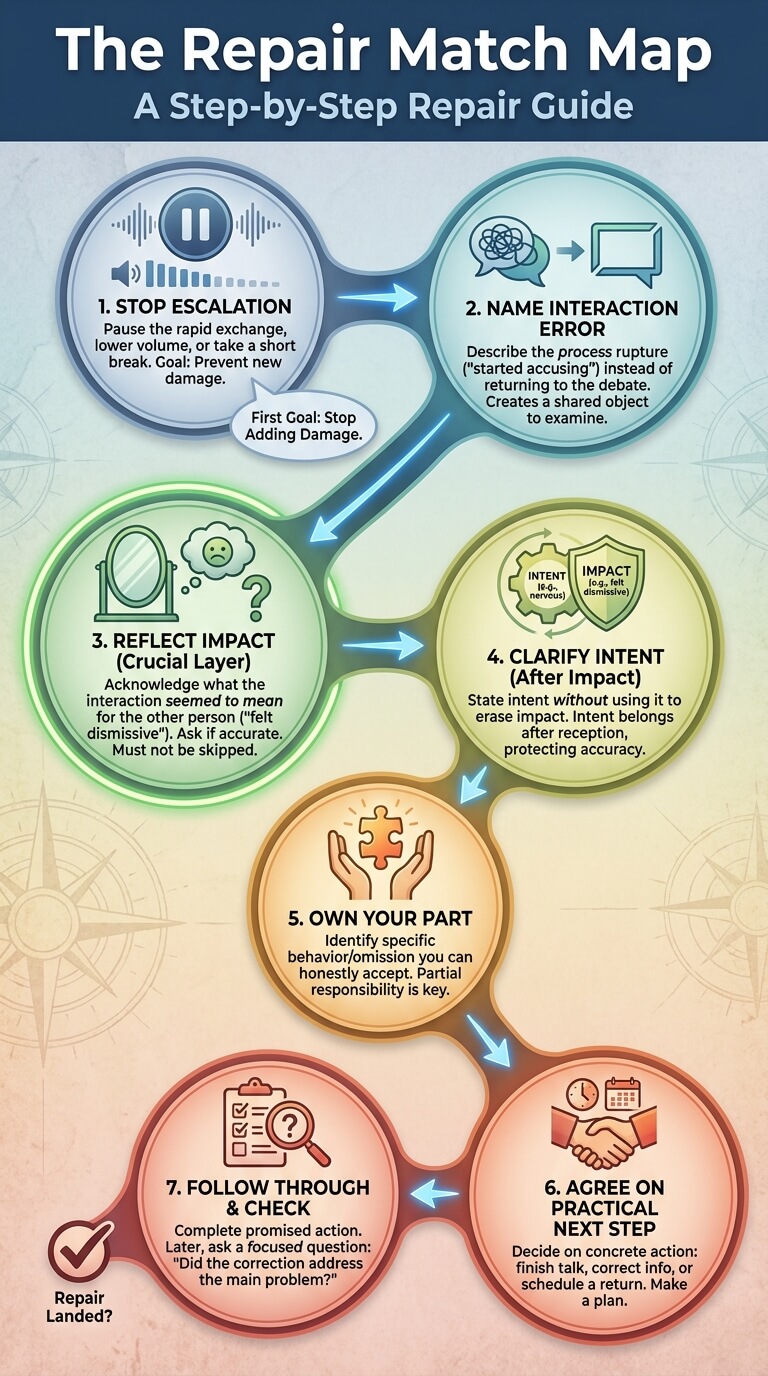
The Repair Match Map organizes repair into seven decisions. Use only the steps relevant to the rupture, but do not skip the layer that the other person is still trying to have recognized.
1. Stop the escalation
Lower volume, stop interrupting, put down the phone, or pause the rapid exchange. If you cannot stay respectful, propose a short break with a return time. The first goal is to stop adding new damage.
2. Name what went wrong in the interaction
Describe the rupture rather than returning immediately to the original debate: “We stopped discussing the schedule and started accusing each other of not caring.” This creates a shared object to examine.
3. Reflect the impact that needs acknowledgment
State what the interaction appears to have meant for the other person: “When I laughed, it seemed as though I was treating the concern as unimportant.” Ask whether your understanding is accurate.
Effective repair usually requires active listening before clarification or responsibility can be credible.
4. Clarify intent without using it to erase impact
Intent belongs after reception. “I laughed because I was nervous, not because the issue was funny. I understand that it still felt dismissive.” This protects accuracy without making intention the only fact that matters.
5. Own the part that is yours
Identify the behavior, decision, delay, wording, or omission you can honestly accept. Partial responsibility is often more useful than total blame or total innocence.
6. Agree on a practical next step or return plan
Decide what happens now. The next step may be completing the conversation, correcting information, making amends, changing a process, or scheduling a return when both people can participate.
7. Follow through and check whether repair landed
Complete the promised action. Later, ask a focused question: “Did the correction address the main problem, or is something still unresolved?” The check should invite information, not pressure the person to reassure you.
When a Repair Attempt Is Rejected
A rejected repair does not always mean the attempt was worthless. It may indicate a timing problem, a mismatch, repeated history, or the receiver’s legitimate choice not to re-enter the exchange.
The other person may need time or more specific accountability
“I am sorry you were upset” may not address the action that caused the rupture. The person may need a clearer acknowledgment or time to decide what they want.
The repair may not match the harm
A private apology may not correct public misinformation. A joke may not fit humiliation. Reassurance may not solve missing follow-through. Ask what remains unaddressed without promising to accept every requested remedy.
The pattern may be too repeated for words to restore trust
If the same rupture has happened many times, the receiver may wait for behavior rather than respond warmly to another promise. Trust can require a consistent record, not one persuasive conversation.
Respect refusal without retaliating or pressuring
The other person may decline closeness, further discussion, forgiveness, or reconciliation. You may communicate what you are willing to do and leave the option open, but repair does not entitle you to access.
Repair After Digital Miscommunication
Text and messaging remove many cues that help people interpret tone, timing, and emotional intention. Repair should reduce ambiguity rather than create a larger stream of messages to decode.
When to move from text to voice or an in-person conversation
Move channels when messages are becoming longer, interpretations are multiplying, or both people are replying to isolated phrases. Ask first: “This is getting harder to clarify by text. Are you available for a ten-minute call?”
Correcting tone and context without sending a message flood
Send one organized clarification. Name the phrase that landed badly, acknowledge how it could be read, state the intended meaning, and propose a next step. Ten rapid messages can create pressure and bury the central repair.
Summarizing the updated meaning and next step
End with a concise shared understanding: “We agree that the deadline remains Friday, and I will send the missing section by noon tomorrow.” A written summary is especially useful when the rupture involved plans, responsibilities, or factual confusion.
Repair vs Apology, Forgiveness, and Reconciliation
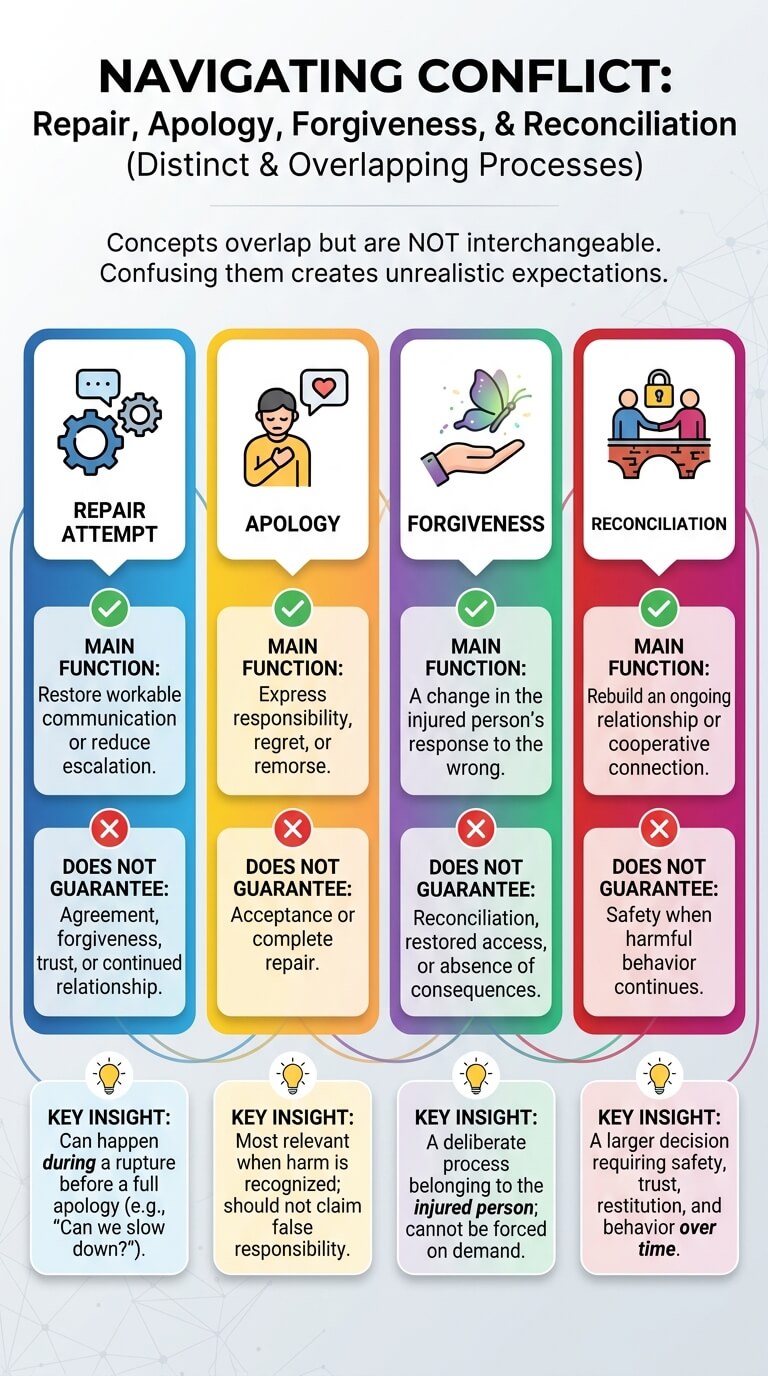
These concepts overlap, but they are not interchangeable. Confusing them can create pressure and unrealistic expectations.
| Concept | Main function | What it does not guarantee |
|---|---|---|
| Repair attempt | Restore workable communication or reduce escalation | Agreement, forgiveness, trust, or continued relationship |
| Apology | Express responsibility, regret, or remorse | Acceptance or complete repair |
| Forgiveness | A change in the injured person’s response to the wrong | Reconciliation, restored access, or absence of consequences |
| Reconciliation | Rebuild an ongoing relationship or cooperative connection | Safety when harmful behavior continues |
Repair is an attempt to restore communication
Repair may happen during the rupture before a full apology is possible. “We are misreading each other. Can we slow down?” can restore enough cooperation to understand what requires responsibility.
Apology addresses responsibility and remorse
An apology is most relevant when someone recognizes that their action caused harm or violated an expectation. It should not be used to claim responsibility for events or motives that are not yours.
Forgiveness is not owed on demand
Forgiveness is generally understood as a deliberate process involving changes in feelings, thoughts, or behavior toward an offender. It belongs to the injured person and cannot be forced by the person seeking relief.
Reconciliation requires safety, trust, and behavior over time
Reconciliation is a larger decision about continued relationship. It may require restitution, transparency, changed patterns, and enough safety for renewed contact. Repairing one conversation does not decide that outcome.
A Repair Readiness Self-Check
Before offering repair, check whether you are ready to address the rupture or mainly trying to make discomfort disappear.
Can I name the specific rupture?
Identify the exact moment or behavior: interruption, harsh wording, withdrawal, factual error, missed follow-through, or emotional dismissal. A specific target makes a specific response possible.
Am I willing to hear impact without immediate rebuttal?
You do not have to agree with every interpretation. You do need enough openness to understand what the other person experienced before deciding what requires clarification.
Is there a concrete correction I can make?
Consider what action would show learning. If no action is possible, be honest about what acknowledgment, information, or boundary you can provide.
Is the other person free to accept, delay, or decline the repair?
A repair attempt becomes coercive when refusal triggers punishment, repeated pressure, threats, or forced contact. Respect for agency is part of repair, not an obstacle to it.
Defensiveness, Validation, and Feeling Unheard
Repair draws on other communication skills, but each addresses a different obstacle.
Repair becomes harder when defensive communication blocks the first acknowledgment.
Defensiveness blocks the first acknowledgment
When self-protection dominates, the person may explain intention, counterattack, or dispute details before recognizing the rupture. Repair becomes possible when they can identify one part without treating it as a total verdict on character.
Even a sincere apology may fail when the deeper reason people feel unheard is missing follow-through.
Validation helps the impact feel received
Validation communicates that the emotional result makes sense within the other person’s experience. It does not require confirming every conclusion, but it prevents clarification from becoming emotional erasure.
Feeling unheard may persist when repair lacks follow-through
A person may understand the apology and still feel unheard because the promised change never occurs. Repair is complete only to the extent that the relevant acknowledgment, action, or return actually happens.
Emotional validation helps the impact feel received without automatically confirming every conclusion.
When Repair Is Not Enough
Repair language is designed for interactions in which people have meaningful agency and some possibility of mutual accountability. It is not a solution for every harmful dynamic.
Ongoing coercion, threats, humiliation, stalking, or retaliation
If communication includes fear, surveillance, forced isolation, threats, stalking, humiliation, or retaliation, attempting a more skillful repair may increase risk. A person using coercion may treat repair as a way to regain access without changing the controlling behavior.
The National Domestic Violence Hotline’s information on power and control can help distinguish ordinary conflict from patterns involving coercion and intimidation. Safety planning and confidential support take priority over reconciliation.
When professional, organizational, legal, or safety support is more appropriate
Workplace misconduct may require documentation and formal reporting. Serious family conflict may require professional or legal guidance. Threats, stalking, violence, or severe retaliation require safety-focused resources appropriate to your location.
Seeking outside support does not mean communication failed. It means the problem exceeds what a private exchange can safely or fairly resolve.
FAQ About Repair Attempts
These questions address common misunderstandings about what repair can and cannot accomplish.
Does a repair attempt have to include an apology?
No. A repair attempt may be clarification, validation, a pause with a return plan, a softer restatement, or a practical correction. An apology is appropriate when you recognize responsibility for harm. Do not offer a false apology merely to end tension.
Can humor be a healthy repair attempt?
Yes, when both people experience it as warm, inclusive, and relieving. Humor is not healthy repair when it mocks the concern, targets the injured person, or replaces accountability. If the joke does not lower threat for both people, choose a more direct form.
What if the other person refuses to repair?
You can state what you understand, what responsibility you accept, and what action you will take. You cannot force participation, forgiveness, or renewed contact. Decide what boundaries or formal steps are appropriate if the unresolved issue affects safety, work, money, or ongoing commitments.
How many times should someone try to repair the same rupture?
There is no universal number. Pay attention to whether each attempt brings new understanding or behavior. Repeated promises without change are not stronger repair. At some point, the relevant next step may be a boundary, changed agreement, outside support, or ending participation.
How can you tell whether repair is sincere?
Sincerity cannot be proven by tone alone. Look for accurate acknowledgment, willingness to hear impact, proportionate responsibility, respect for the other person’s choice, a correction that matches the rupture, and follow-through over time.
Key Takeaways
- A repair attempt addresses damage in the interaction so communication can become workable again.
- Softening, clarification, validation, responsibility, pause and return, and concrete correction solve different kinds of rupture.
- Intent can clarify meaning, but it should not be used to erase emotional or practical impact.
- Repair is not the same as avoidance, apology, forgiveness, or reconciliation.
- The repair must match the rupture, and repeated harm requires observable behavior change.
- The receiver remains free to accept, delay, question, or decline the attempt.
- Coercion, threats, stalking, humiliation, and retaliation require safety-focused support rather than better repair language.
A practical first step is to name the smallest accurate rupture before trying to solve the entire disagreement. Say what went wrong in the interaction, identify the impact you can recognize, and choose one correction you can complete. Repair becomes trustworthy when the next action confirms the meaning of the words.
Michael Reed, Founder and Lead Writer at Psychology Exposed, writes about human behavior, emotional patterns, relationships, and everyday decisions in accessible, research-aware language. This article offers general education and cannot assess individual mental health, legal, organizational, or safety circumstances.

Michael Reed is the Founder and Lead Writer at Psychology Exposed. He writes about human behavior, relationships, emotional patterns, self-awareness, and practical psychology topics using research-informed, easy-to-understand content.
Read More About Michael Reed: https://psychologyexposed.com/michael-reed/