

You remember a careless comment hours after the conversation ended and feel pulled to apologize. You watch someone being treated unfairly and feel anger rise before you have decided what to do. You hear about a generous act and suddenly want to be more helpful yourself. These reactions are not identical, even though each one carries a sense that something socially or morally important has happened.
Moral emotions are feelings connected to judgments about harm, responsibility, character, fairness, care, and shared standards. They help draw attention to what may need repair, protection, rejection, gratitude, or imitation. Yet emotional intensity is not proof that a judgment is accurate. Guilt can be misplaced, shame can make responsibility harder, empathy can favor familiar people, and outrage can become disproportionate.
Understanding these differences gives you a more useful question than “Is this feeling good or bad?” The better question is: “What is this emotion directing me toward, and does that direction fit the facts?”
Quick Answer
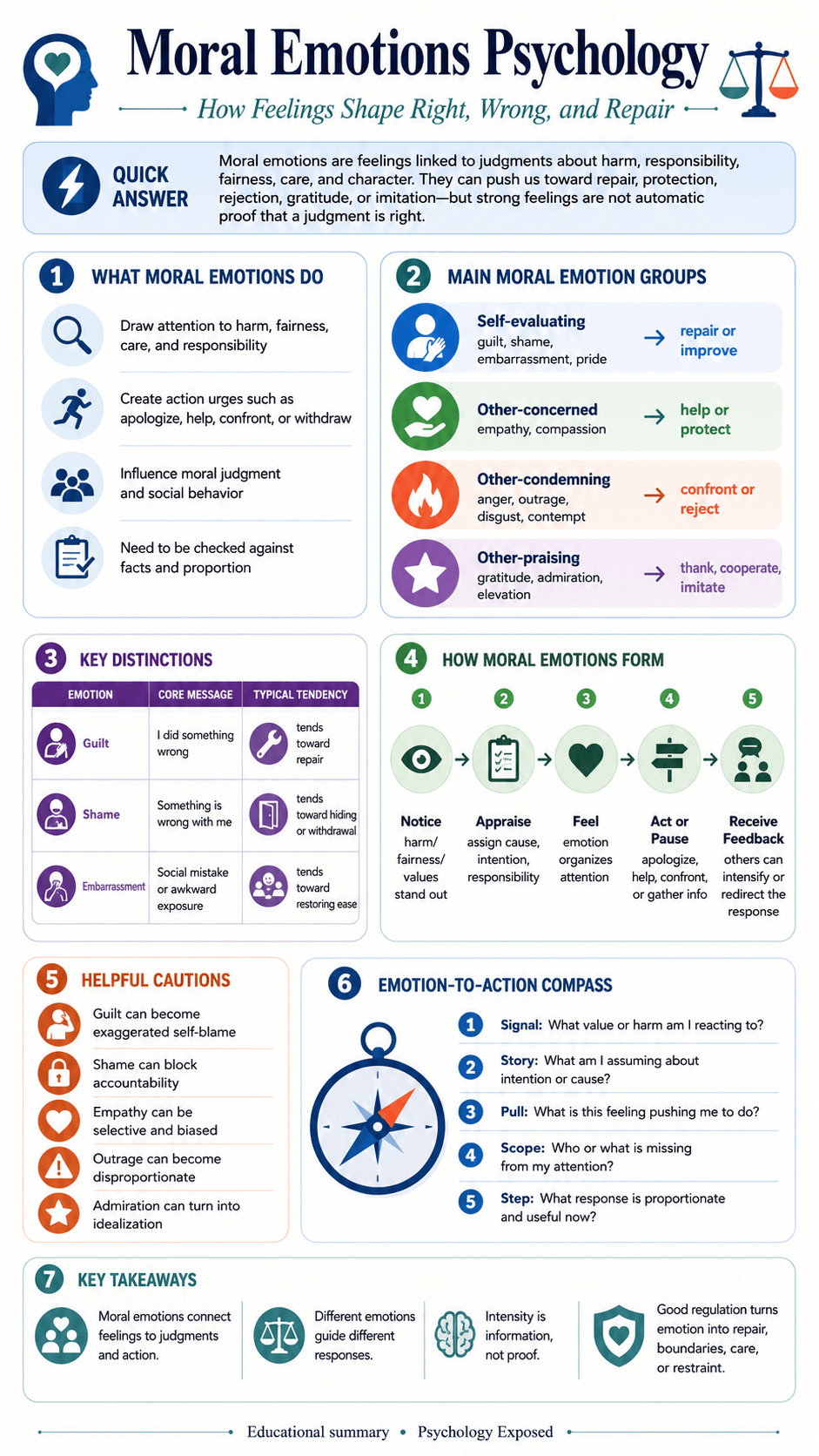
Moral emotions are feelings that arise when people evaluate their own conduct, another person’s welfare, a perceived violation, or an example of admirable behavior. Guilt often encourages repair, shame may encourage hiding, empathy can motivate care, anger can support protection, disgust can create distance, and gratitude or elevation can inspire cooperation. Each emotion offers information, but none should be treated as automatic proof of what is right.
What Counts as a Moral Emotion?
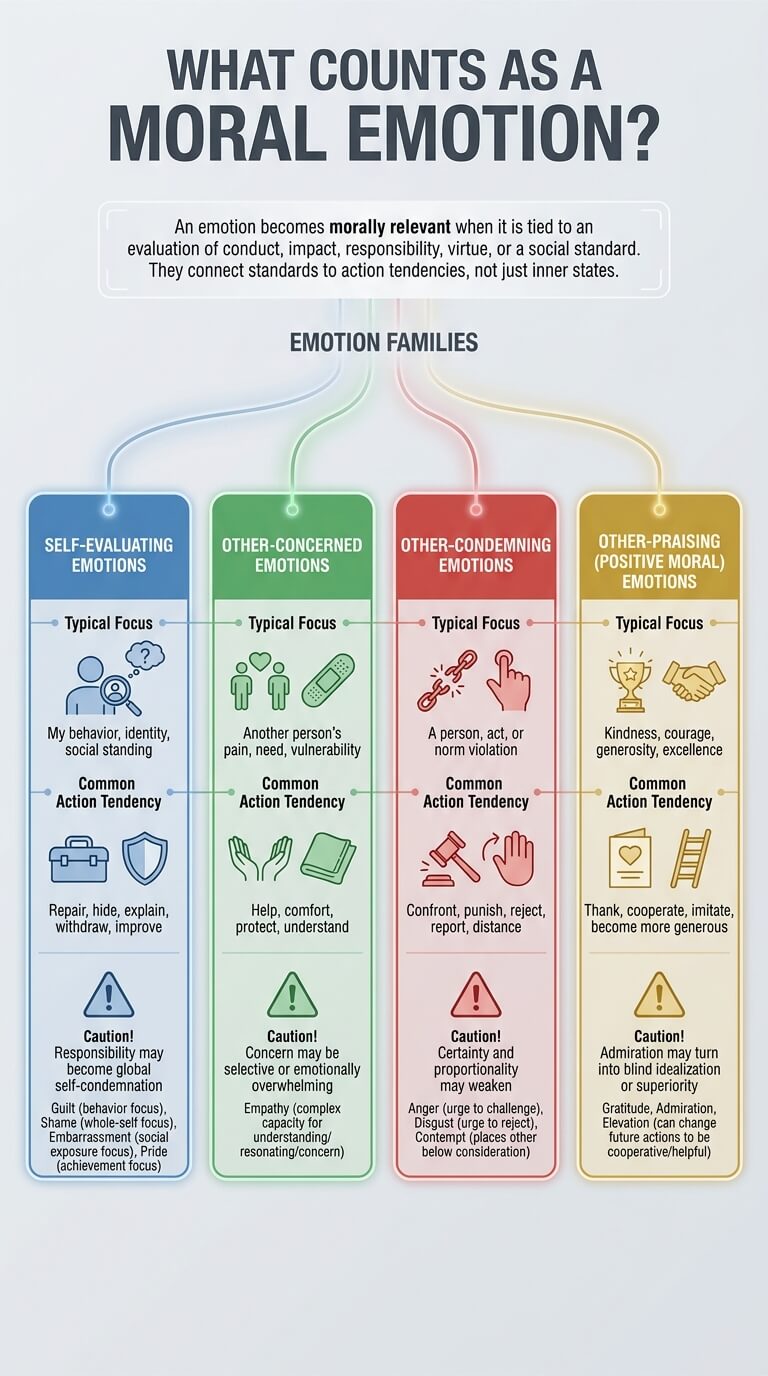
An emotion becomes morally relevant when it is tied to an evaluation of conduct, impact, responsibility, virtue, or a social standard. The same basic feeling may appear in a nonmoral situation, but its meaning changes when right and wrong enter the picture. Anger about a delayed train is frustrating. Anger because someone deliberately humiliated a vulnerable person includes a judgment about how people should be treated.
A widely cited review of moral emotions and moral behavior describes these feelings as part of the connection between standards and action. They do not merely report an inner state. They can prepare a person to approach, avoid, repair, punish, protect, thank, or imitate.
| Emotion family | Typical focus | Common action tendency | Important caution |
|---|---|---|---|
| Self-evaluating emotions | My behavior, identity, or social standing | Repair, hide, explain, withdraw, or improve | Responsibility may become global self-condemnation |
| Other-concerned emotions | Another person’s pain, need, or vulnerability | Help, comfort, protect, or understand | Concern may be selective or emotionally overwhelming |
| Other-condemning emotions | A person, act, or norm violation | Confront, punish, reject, report, or distance | Certainty and proportionality may weaken |
| Other-praising emotions | Kindness, courage, generosity, or excellence | Thank, cooperate, imitate, or become more generous | Admiration may turn into idealization or superiority |
Emotions tied to self-evaluation
Guilt, shame, embarrassment, and pride all involve some form of attention to the self, but they do not focus on the same target. Guilt often centers on a behavior or consequence: “I did something that hurt someone.” Shame is more likely to spread the evaluation across the whole self: “There is something wrong with me.” Embarrassment usually centers on social exposure, awkwardness, or a failure that others can see.
Emotions focused on another person’s welfare
Empathy is not a single process. It may involve understanding another perspective, resonating with an emotion, or feeling concern that motivates help. A review of the science of empathy describes it as a complex capacity involving both understanding and emotional response. That complexity matters because understanding someone does not always mean sharing the feeling, and sharing the feeling does not guarantee a fair decision.
Emotions directed at violations and violators
Anger, outrage, disgust, and contempt tend to focus outward. They tell the person that a boundary, expectation, or standard may have been violated. Anger often creates an urge to approach, challenge, or correct. Disgust more often creates an urge to reject, distance, or remove. Contempt can place the other person below consideration, which is one reason it deserves caution.
Positive moral emotions such as pride, gratitude, admiration, and elevation
Research on gratitude, admiration, and elevation suggests that these positive reactions are distinct from ordinary amusement or pleasure. They can change what a person wants to do next, including becoming more cooperative, appreciative, or helpful. Still, inspiration should not become blind idealization. A good act does not make every later act good.
The Moral Emotion Sequence
A moral emotion usually does not appear from the event alone. It emerges from a rapid sequence of interpretation. Understanding that sequence creates room to correct an error without dismissing the feeling itself.
- Notice: Something stands out as relevant to harm, care, fairness, loyalty, honesty, responsibility, or character.
- Appraise: The mind interprets what happened, who caused it, whether it was intentional, and which standard applies.
- Feel: An emotional response organizes attention and creates an action urge.
- Act or pause: The person apologizes, hides, helps, confronts, rejects, praises, shares, or chooses to gather more information.
- Receive feedback: Other people’s reactions can soften, intensify, reward, or redirect the emotion.
A situation is interpreted as relevant to a value or norm
Imagine that a friend cancels an important plan at the last minute. One person interprets it as a practical problem. Another reads it as disrespect. A third sees it as evidence that the friend is struggling and needs compassion. The event is the same, but the moral meaning depends on what the person believes is threatened.
Responsibility and intention are assigned
Moral emotions become stronger when responsibility seems clear. Guilt grows when you believe your choice caused avoidable harm. Anger rises when another person appears to have acted knowingly. Compassion may increase when the harm seems accidental or constrained by circumstances.
The emotion narrows attention and prepares an action
Every strong emotion highlights some information and pushes other information into the background. Guilt highlights responsibility. Shame highlights exposure and identity. Anger highlights violation and blame. Empathy highlights another person’s experience. Gratitude highlights a benefit and the person who provided it.
Social feedback can intensify, redirect, or regulate the response
Emotions are shaped by audiences. A calm private conversation may turn guilt into repair. Public humiliation may turn the same event into shame and defensiveness. Group approval may reward outrage, while a thoughtful question may slow certainty. Praise can reinforce generosity, but excessive praise can also encourage someone to protect a moral image rather than examine later behavior honestly.
Guilt, Shame, and Embarrassment Are Not the Same
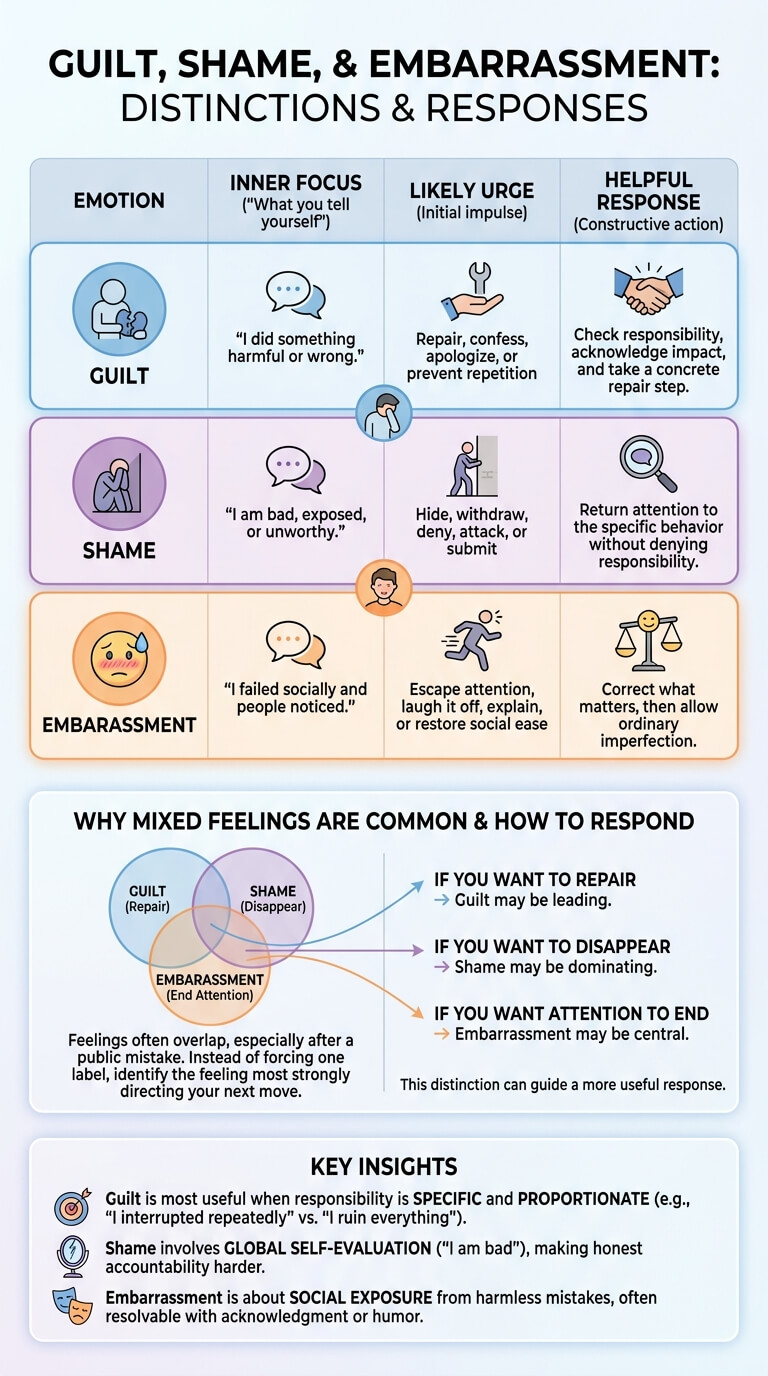
These feelings often overlap in real life, especially after a public mistake. A person might feel guilty about the harm, ashamed of being seen as careless, and embarrassed by the social attention. The useful distinction is not that each experience fits into a perfect box. It is that each focus tends to pull behavior in a different direction.
| Emotion | Inner focus | Likely urge | Helpful response |
|---|---|---|---|
| Guilt | “I did something harmful or wrong.” | Repair, confess, apologize, or prevent repetition | Check responsibility, acknowledge impact, and take a concrete repair step |
| Shame | “I am bad, exposed, or unworthy.” | Hide, withdraw, deny, attack, or submit | Return attention to the specific behavior without denying responsibility |
| Embarrassment | “I failed socially and people noticed.” | Escape attention, laugh it off, explain, or restore social ease | Correct what matters, then allow ordinary imperfection |
Guilt and behavior-focused responsibility
Guilt is often most useful when responsibility is specific and proportionate. “I interrupted her repeatedly” is actionable. “I ruin every conversation” is not. The first statement can lead to an apology and a changed behavior. The second makes the entire self the problem and leaves no clear next step.
Shame and global self-evaluation
Shame can make a person intensely aware of how they appear to others. That awareness may encourage humility in some situations, but global self-condemnation often makes honest accountability harder. If admitting one mistake feels equivalent to proving that the whole self is worthless, denial and counterattack become tempting forms of protection.
A 2023 meta-analysis of shame, embarrassment, and guilt found both shared and distinct patterns across these self-conscious experiences. The practical lesson is not that a brain scan can tell you what you feel. It is that these emotions overlap while still involving different forms of social and self-evaluation.
Embarrassment and social exposure
Embarrassment can arise from a harmless mistake, such as forgetting a name, sending a message to the wrong person, or stumbling during a presentation. The event may violate a social expectation without causing meaningful moral harm. This is why embarrassment sometimes resolves with acknowledgment and humor rather than apology or restitution.
Why mixed feelings are common
Instead of forcing one label, identify which feeling is most strongly directing your next move. If you want to repair, guilt may be leading. If you want to disappear, shame may be dominating. If you mainly want the awkward attention to end, embarrassment may be central. This distinction can guide a more useful response.
Empathy, Compassion, and Concern for Harm
Empathy can make moral concern immediate. A statistic may feel distant, while one person’s voice, face, or story evokes a strong desire to help. This is one reason empathy matters: it turns another person from an abstract category into someone whose experience feels real.
Feeling with someone versus understanding their perspective
Affective empathy involves emotional resonance. Cognitive empathy involves understanding how a situation may look from another person’s position. Compassion adds a caring motivation that may lead to help. These experiences can occur together, but not always.
When empathy supports helping and repair
Empathy becomes especially useful when it expands the information included in a decision. Someone who initially focuses on intention may pause to consider impact. A person who wants to defend a rule may notice that the rule burdens one individual more heavily. A person who caused harm may become more willing to listen rather than rush into self-explanation.
Why empathy can be selective or overwhelming
People tend to respond more strongly to those who feel familiar, similar, nearby, vivid, or personally known. That selectivity does not erase sincere concern, but it means emotional closeness can produce unequal attention. A compelling individual story may outweigh a quieter problem affecting many people.
Moral Anger, Outrage, and Disgust
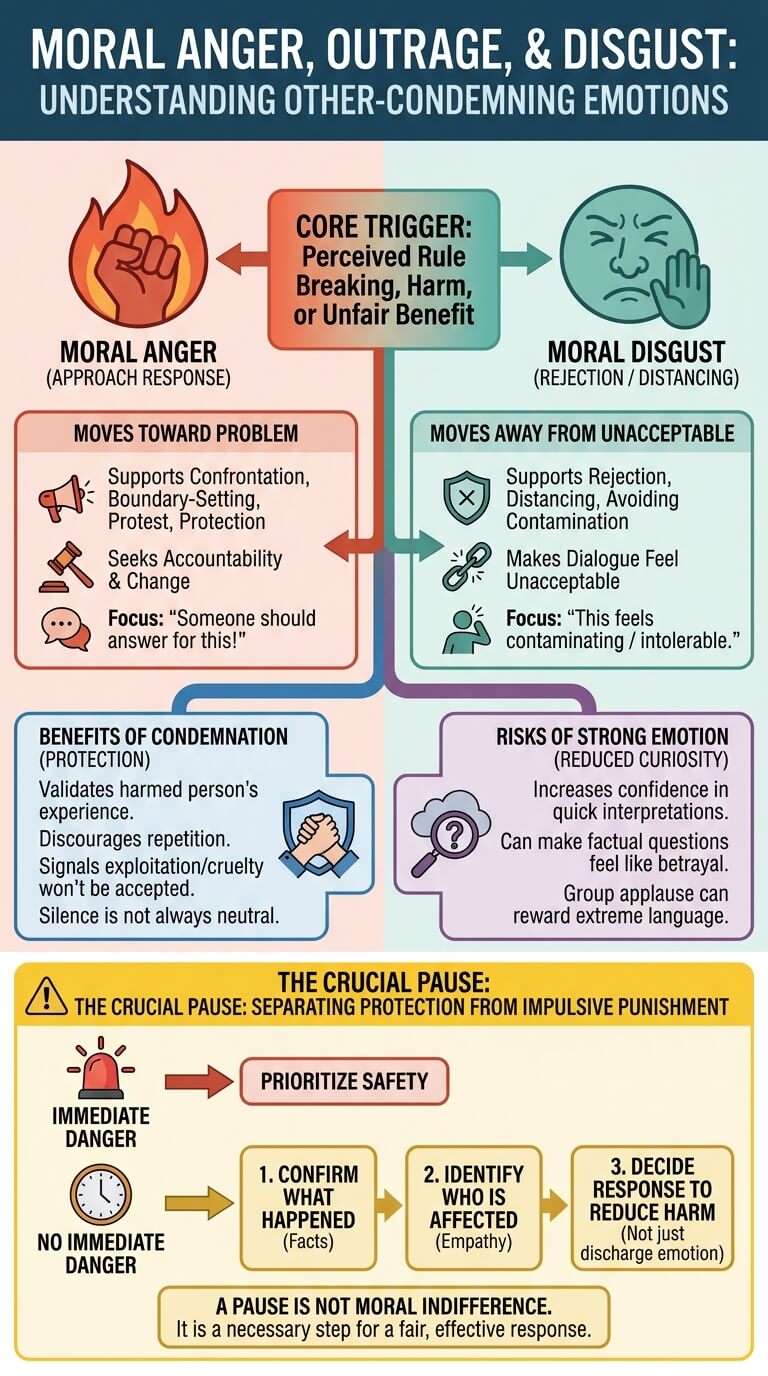
Other-condemning emotions often appear when people believe a rule has been broken, a person has been harmed, or someone has benefited unfairly. These feelings can motivate protection and accountability. They can also make a single interpretation feel complete before the evidence is complete.
Anger as an approach response to perceived violation
Anger often moves people toward the problem. It may support confrontation, boundary-setting, reporting, protest, or protection. The person feels not only that something is unpleasant, but that someone should answer for it or that the situation should change.
Disgust as rejection, distancing, or contamination language
Research comparing anger and disgust after moral violations indicates that the two emotions are associated with different aggressive responses. This does not give either emotion a fixed meaning in every situation. It does support the practical distinction between approaching a wrong to correct it and distancing from what feels unacceptable.
When condemnation protects a norm
Condemnation can tell a group that exploitation, cruelty, betrayal, or humiliation will not be quietly accepted. It can validate a harmed person’s experience and discourage repetition. Silence is not always neutral, especially when a person with less power is being targeted.
When strong emotion reduces curiosity and proportionality
Moral anger can increase confidence in a quick interpretation. Disgust can make contact or dialogue feel unacceptable. Group applause can reward stronger language. Under these conditions, asking a factual question may feel like betrayal even when the question is necessary for a fair response.
A pause is not moral indifference. It may be the step that separates protection from impulsive punishment. When immediate danger is present, prioritize safety. When danger is not immediate, confirm what happened, identify who is affected, and decide what response is likely to reduce harm rather than merely discharge emotion.
Pride, Gratitude, Admiration, and Moral Elevation
How positive emotions reinforce identity and cooperation
Positive moral emotions show people what they want to continue, not only what they want to stop. Gratitude recognizes a benefit and often encourages reciprocity. Admiration directs attention toward an ability or quality worth developing. Elevation can make kindness, courage, or generosity feel possible and worth imitating.
Authentic pride versus superiority
Authentic pride is tied to effort, conduct, or growth: “I kept my promise even though it was difficult.” Superiority turns the comparison outward: “People like me are better than people like them.” The first can support persistence. The second can weaken curiosity and make exceptions for one’s own behavior easier to justify.
Why witnessing goodness can motivate imitation
Seeing someone act generously can interrupt cynicism. It provides a model, makes a behavior easier to imagine, and may create a desire to participate. A small example can matter: a stranger returning a lost wallet, a colleague giving credit, or a family member defending someone who is absent.
When Moral Emotions Help
Noticing impact
Moral emotions can interrupt self-focus. Guilt draws attention to a consequence you may prefer to avoid. Empathy makes another person’s experience more visible. Anger signals that a boundary or standard may have been crossed. Gratitude highlights a benefit that could otherwise be taken for granted.
Motivating apology, repair, protection, or cooperation
A feeling becomes useful when it supports behavior matched to the situation. Guilt can lead to replacing what was damaged. Concern can lead to checking on someone privately. Anger can lead to documenting a repeated violation. Gratitude can lead to acknowledgment and future reciprocity.
Signaling values and group expectations
The signal becomes less reliable when expression is rewarded more than follow-through. A person may display outrage publicly but avoid practical support. Another may speak movingly about compassion while applying it only to familiar people. Look at behavior over time rather than emotional intensity alone.
When Moral Emotions Mislead or Backfire
False responsibility and excessive guilt
Guilt is not proof that you caused harm. People may feel responsible for another adult’s emotions, for outcomes they could not control, or for setting a reasonable limit. Check what you chose, what you knew, what power you had, and what repair is realistically yours to make.
Shame-driven hiding, denial, or defensiveness
When feedback threatens the entire self, a person may minimize the impact, blame the other person, or avoid the conversation. The way forward is not humiliation. It is a narrower statement: “This specific behavior caused this specific impact, and this is what I will do differently.”
Empathy bias and favoritism
Empathy can pull strongly toward the person whose story is vivid while leaving unseen people outside attention. Before acting, ask who is absent, whether the same standard applies across groups, and whether immediate emotion is hiding a larger consequence.
Outrage escalation and public punishment
Outrage spreads easily when expression receives approval. The goal can shift from stopping harm to proving loyalty, displaying certainty, or punishing someone publicly. A proportionate response stays tied to evidence, safety, repair, and prevention.
Moral pride becoming permission or superiority
A past good act may create a sense that the current choice deserves less scrutiny. Someone may think, “I have already proved what kind of person I am.” Evaluate the present behavior on its own. Previous generosity does not erase current impact.
An Emotion-to-Action Compass
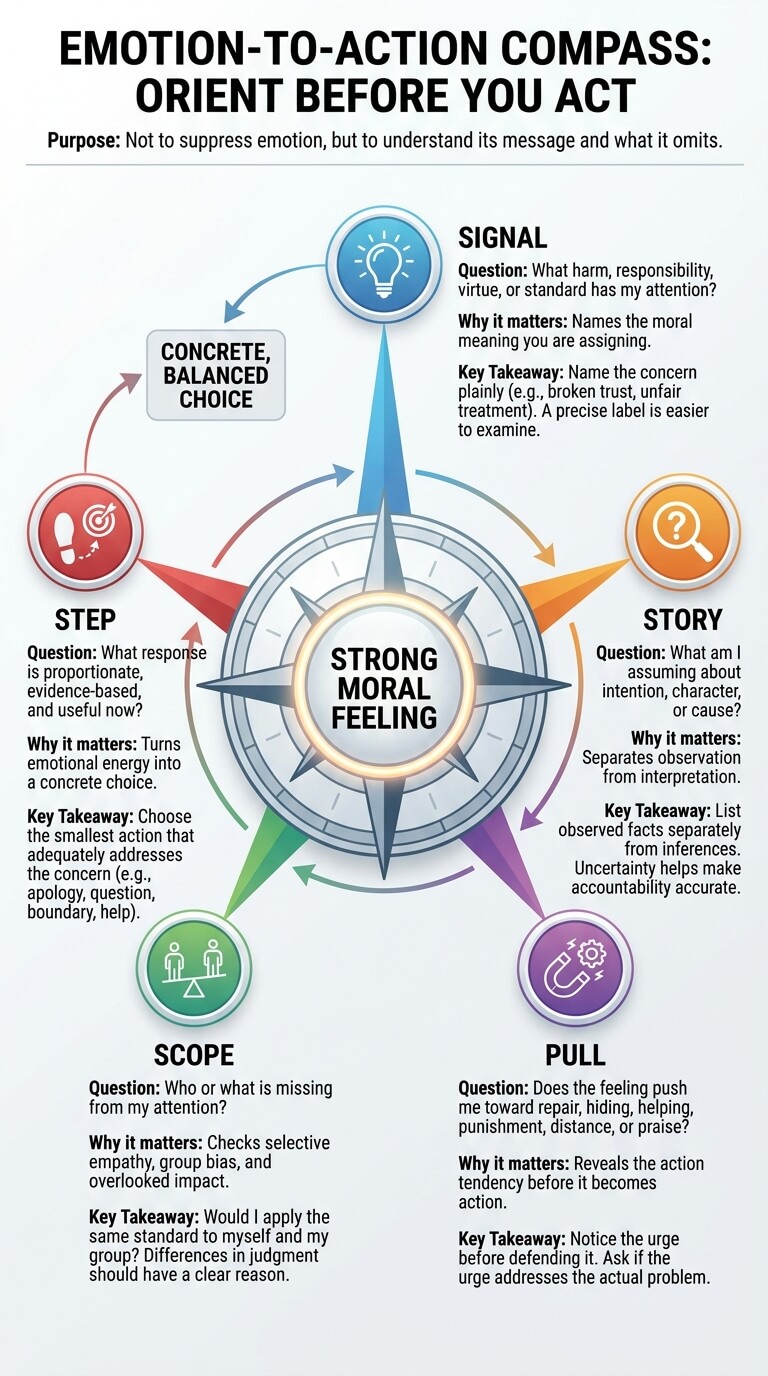
Before acting on a strong moral feeling, use five points to orient yourself. The aim is not to suppress emotion. It is to understand what the feeling is highlighting and what it may be leaving out.
When several moral concerns point in different directions, a structured ethical decision-making process can help compare harm, duties, fairness, and uncertainty before acting.
| Compass point | Question | Why it matters |
|---|---|---|
| Signal | What harm, responsibility, virtue, or standard has my attention? | Names the moral meaning you are assigning |
| Story | What am I assuming about intention, character, or cause? | Separates observation from interpretation |
| Pull | Does the feeling push me toward repair, hiding, helping, punishment, distance, or praise? | Reveals the action tendency before it becomes action |
| Scope | Who or what is missing from my attention? | Checks selective empathy, group bias, and overlooked impact |
| Step | What response is proportionate, evidence-based, and useful now? | Turns emotional energy into a concrete choice |
What value or harm am I reacting to?
Name the concern plainly: broken trust, unfair treatment, preventable harm, disloyalty, dishonesty, courage, or generosity. A precise label is easier to examine than a global statement such as “Everything about this is wrong.”
What facts, intentions, or perspectives are uncertain?
List what you observed separately from what you inferred. You may know that a promise was broken but not why. You may know that someone was hurt but not whether the harm was intentional. Uncertainty does not remove accountability. It helps make accountability accurate.
Does the emotion point toward repair, protection, punishment, or avoidance?
Notice the urge before defending it. Guilt may pull you toward an apology. Shame may pull you toward hiding. Anger may pull you toward confrontation. Disgust may pull you toward total rejection. Empathy may pull you toward immediate rescue. Ask whether that urge addresses the actual problem.
Would I apply the same standard to myself and my group?
Reverse the roles. Would you judge the same words differently if a friend said them instead of a rival? Would you explain your own mistake through intention but judge another person only by impact? Consistency does not require ignoring context, but differences should have a clear reason.
What response is proportionate to the actual situation?
Choose the smallest action that adequately addresses the concern. That might be an apology, a question, a boundary, a correction, a report, a private conversation, a pause, or practical help. Severe or immediate danger requires a safety response, not a communication exercise.
Moral Emotion Versus Moral Judgment
A feeling can inform judgment without settling it
Emotions often notice something before deliberate reasoning catches up. Unease may alert you to an inconsistency. Anger may reveal a violated boundary. Guilt may reveal impact you had minimized. These signals deserve attention, but they still need interpretation.
Reasoning can regulate emotion without erasing concern
Regulation does not require becoming indifferent. It may mean broadening attention, checking intention, naming uncertainty, or choosing a proportionate response. A review of emotion regulation in moral judgment argues against treating emotion and reason as simple opponents. People use cognitive strategies to shape which emotional information influences a judgment and how strongly.
Suppression says, “I should not feel this.” Regulation says, “I feel this strongly, so I will understand the signal before I choose the action.”
How different questions call for different kinds of attention
If guilt or shame is central, focus on responsibility, identity, and repair. If anger dominates, examine the alleged violation, the evidence, and proportionality. If empathy is driving the choice, include people whose stories are less visible. If pride or admiration is present, separate inspiration from the belief that a good person cannot make a harmful choice.
What to Do Next When a Moral Emotion Feels Intense
Name the emotion more precisely
Replace “I feel bad” with a closer label: guilty, ashamed, embarrassed, angry, disgusted, concerned, grateful, or admiring. If several feelings are present, name the strongest two. Precision helps reveal whether you are moving toward responsibility, protection, avoidance, or approval.
Separate event, interpretation, identity, and action urge
- Event: What happened in observable terms?
- Interpretation: What do you believe it means about harm, intention, fairness, or responsibility?
- Identity: What does it seem to say about you, the other person, or the group?
- Action urge: What do you want to do immediately?
This separation is especially useful after criticism. “I missed an important deadline” is an event. “Everyone thinks I am unreliable” is an interpretation. “I am a failure” is an identity judgment. “I want to avoid the team” is an action urge. Each part requires a different response.
Choose a repair, boundary, information, or pause step
Use the emotion to select one next move. For guilt, acknowledge impact and ask what repair is useful. For empathy, verify what support is wanted rather than assuming. For anger, state the concern without exaggerating motives. For disgust, describe the behavior instead of reducing the person to a label. For gratitude, name the specific act and why it mattered.
Useful language may be simple: “I see the impact now, and I want to correct it.” “I am angry about what happened, but I need to confirm the details before I respond.” “I care about what you are experiencing. What would be helpful rather than intrusive?”
Seek support when guilt, shame, anger, or fear becomes persistent or unsafe
Professional support may be worth considering when guilt remains intense despite little or no responsibility, shame becomes persistent worthlessness, anger feels difficult to control, or moral conflict disrupts sleep, work, eating, relationships, or daily functioning. Immediate help is more urgent when there are thoughts of self-harm, credible threats, stalking, coercion, humiliation, violence, or fear of retaliation.
Communication advice is not the priority in an unsafe situation. Safety planning and qualified support come first.
Frequently Asked Questions About Moral Emotions
Is guilt always useful for moral behavior?
No. Guilt may support accountability when it is accurate, specific, and connected to repair. It becomes less useful when responsibility is exaggerated, the person cannot identify a realistic repair, or self-punishment replaces changed behavior. The question is not simply whether guilt is present, but whether it points toward proportionate responsibility.
Can shame ever motivate positive change?
Shame can make social standards and consequences highly visible, and some people respond by changing behavior. However, global self-condemnation also creates strong urges to hide, deny, withdraw, or attack. Change is more sustainable when attention returns to the specific behavior, its impact, and what accountability requires.
Is disgust a reliable sign that something is wrong?
Disgust signals rejection, but it is not a perfect moral detector. It may reflect a serious concern, a learned social rule, unfamiliarity, group prejudice, or an association that has little to do with harm. Examine the conduct, evidence, impact, and standard rather than using the strength of disgust as the whole argument.
Why can empathy lead to unfair choices?
Empathy is often stronger for people who are familiar, similar, nearby, or represented through a vivid story. This can make one person’s needs emotionally dominant while less visible people receive little attention. Fair choices often require empathy plus consistent standards, broader information, and attention to scale.
Are moral emotions learned or universal?
Human beings appear broadly capable of self-evaluation, concern, anger, gratitude, and social approval, but the situations that trigger these emotions and the ways people express them are shaped by development, relationships, culture, roles, and group norms. Shared emotional capacities do not guarantee identical moral judgments.
Key Takeaways
- Moral emotions connect judgments about harm, responsibility, fairness, virtue, and social standards to action.
- Guilt, shame, embarrassment, empathy, anger, disgust, pride, gratitude, admiration, and elevation have different focuses and action tendencies.
- An intense feeling can reveal what you currently believe is important, but it does not prove that every fact or interpretation is correct.
- The Emotion-to-Action Compass checks the signal, story, behavioral pull, missing scope, and proportionate next step.
- Useful regulation does not erase moral concern. It helps turn concern into accurate repair, protection, boundaries, cooperation, or informed restraint.
A practical next step is to identify one recent moral emotion and write down its action urge. Then ask what specific response would address the real impact without turning the feeling into self-punishment, impulsive punishment of others, or unquestioned certainty.
Author note: Michael Reed is the Founder and Lead Writer at Psychology Exposed. He explains human behavior, emotional patterns, self-awareness, relationships, and everyday decisions in clear, research-aware language. This material is educational and is not a substitute for mental health, medical, legal, or crisis support.

Michael Reed is the Founder and Lead Writer at Psychology Exposed. He writes about human behavior, relationships, emotional patterns, self-awareness, and practical psychology topics using research-informed, easy-to-understand content.
Read More About Michael Reed: https://psychologyexposed.com/michael-reed/